|
시장보고서
상품코드
1850068
자동차용 레인 센서 시장 : 점유율 분석, 산업 동향, 통계, 성장 예측(2025-2030년)Automotive Rain Sensor - Market Share Analysis, Industry Trends & Statistics, Growth Forecasts (2025 - 2030) |
||||||
 Mordor Intelligence
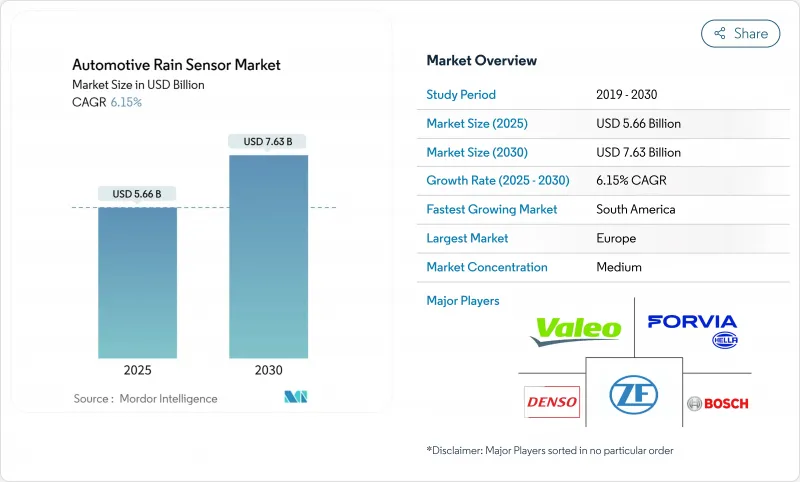
세계의 자동차용 레인 센서 시장은 2025년 56억 6,000만 달러에 이르고, CAGR 6.15%를 반영하여 2030년까지 약 76억 3,000만 달러에 이를 것으로 예측되고 있습니다.
꾸준한 전동화, 레벨 2 운전자 어시스턴스 채용 증가, 규제의 기세에 의해 레인 센서는 쾌적한 부가물로부터 안전상 중요한 지각 입력으로 계속 쉬프트하고 있습니다. ADAS 기능의 번들화, 반도체의 소형화, 구독 대응의 소프트웨어 스택에 의해 대응 가능한 베이스가 확대되는 한편, 비용 절감을 위한 MEMS 기술 혁신에 의해 볼륨 부문에 대한 액세스가 확대하고 있습니다. 칩 제조업체와 공급업체 간 경쟁의 격화도 하드웨어 마진을 압축하고 있지만, 통합된 광학, 정전 용량, 습도 모듈에 의한 기능 업그레이드를 가속화하고 있습니다. 이러한 힘을 종합하면 OEM이 중앙 집중식 무선 업데이트 가능 영역을 중심으로 차량 전기 아키텍처를 재구성함에 따라 자동차 레인 센서 시장은 수년간의 혁신 궤도를 유지할 것입니다.
세계 자동차용 레인 센서 시장 동향과 통찰
ADAS 보급률 상승으로 다기능 환경 센싱이 필수화
레벨 2 및 레벨 3의 지각 스택은 카메라 렌즈와 LiDAR 윈도우를 깨끗하게 유지하기 위해 정확한 빗방울, 빛, 안개 데이터가 필요하며 센서를 편안함을 위한 여분에서 핵심적인 안전 인에이블러로 바꾸고 있습니다. 유럽의 OEM 프로그램은 광학 레인 센서와 습도 및 광 채널을 하나의 PCB로 결합하여 하네스의 경량화와 통합 진단을 실현하고 있습니다. 또한 북미 트럭 제조업체는 자동 비상 브레이크 가동 시간을 연장하기 위해 전방 시야 클러스터에 비 감지를 통합합니다. 고해상도 CCD 어레이는 액적 분류를 개선하여 와이퍼 속도, 적응형 헤드라이트 및 디포거 로직을 하나의 제어 루프로 조정하는 퓨전 소프트웨어에 공급합니다. 그 결과 조달팀은 현재 와이퍼 대기 시간뿐만 아니라 레이더와 카메라 시너지 지표를 벤치마킹으로 성능을 평가하게 되었고, 멀티센서의 승리는 Tier 1의 수익 파이프라인에 있어서 매우 중요합니다.
가전 및 고전압 아키텍처 채택을 가속화
400V 및 800V에서 작동하는 E 플랫폼은 신호 처리 ASIC 및 레이저 트리밍된 VCSEL 이미터에 안정적인 전력 헤드룸을 제공하며, 고습도의 과도 현상 하에서는 12V의 동등품보다 우수합니다. 중앙 연산 도메인은 안전한 CAN-FD 링크를 통해 원시 액적 벡터를 영역 컨트롤러로 가져와 머신러닝 모델이 닦는 타이밍을 개선하고 블레이드의 수명을 연장하며 에어컨 부하를 줄입니다. 무선 펌웨어의 출시로 OEM은 감지 임계값을 반복적으로 날카롭게 할 수 있으며, 예지 보전 경보와 연동된 종량 과금의 수익 계층이 열립니다. 따라서 배터리 브랜드는 레인 센서를 패시브 유리 액세서리가 아닌 창문의 흐림 방지 사이클을 최대 6%까지 줄이는 에너지 관리 자산으로 판매하고 있습니다.
엔트리 레벨 A/B 부문 자동차의 높은 가격 민감도
인도, ASEAN의 일부 및 라틴아메리카의 비용 중심 플랫폼은 계기판의 전자 스택 전체에 75달러 이하를 할당하고 있으며 25-30달러의 레인 센서 모듈에 대한 여유가 적습니다. 인도의 국산부품규제는 현지화되지 않은 PCBA의 수입관세를 증폭시켜 Tier 1의 수익성을 압박하고 취득률을 둔화시킵니다. OEM은 통합 MEMS의 가격이 15달러 미만으로 떨어질 때까지 4m차 이하의 차종에서는 수동 가변 간헐 와이퍼에 의존합니다. 현지에서 유리 접합 파트너십을 확보하는 공급업체는 운임 요금을 줄일 수 있지만 현재는 소량의 주문이 그러한 CAPEX의 지출을 방해하고 있습니다.
부문 분석
승용차용 자동차용 레인 센서 시장 규모는 2024년에 71.23%의 점유율을 획득했으며, 2030년까지 CAGR은 6.55%로 견조하게 추이할 것으로 예측됩니다. 세단 프로그램은 트림 라인 전체에서 일관된 장착율을 유지하고 있지만 해치백은 여전히 상위 차종에 대한 가격 경사가 계속되고 있습니다. 소형 상업용 밴의 플릿은 운전자의 주의 산만과 보험금 청구를 최소화하기 위해 자동 와이핑을 지정하게 되었지만, 중형 트럭은 개입이 복잡하기 때문에 지연됩니다. 수요조정에서는 SUV의 구성비가 10포인트 상승할 때마다 시스템 평균의 BOM 상한이 4달러 상승하여 Tier 1의 마진 유지를 지지하고 있습니다. 예측 기간 동안 SUV는 앞유리의 면적이 크기 때문에 정전용량 어레이의 액적 노이즈가 커져 호우에서도 감도 정밀도를 +-2ml로 유지할 수 있는 광학 아키텍처를 OEM이 선호하는 경향이 계속됩니다.
승용차의 리프레시 사이클은 고회전 소형 상용차 플릿에 비해 느리지만 안정적인 대수 증가를 가져옵니다. 텔레매틱스를 조사하는 플릿 운영자는 예측 와이핑 분석이 활성화되면 전면 유리 수리 청구가 7% 감소하고 비즈니스 사례가 강화된다고 보고합니다. 전반적으로 SUV의 보급으로 자동차용 레인 센서 시장은 기능이 풍부한 패키지로 치우쳐 대량 생산되는 해치백 차량의 저 마진과 균형을 유지하고 있습니다.
광학 CCD 및 CMOS 디바이스는 신호 대 잡음 비율의 정도가 실증되어 2024년 매출의 81.64%를 차지했습니다. 광 컨트롤러 ASIC의 상위 5개 제품은 이미 실리콘 리비전 B 이후이므로 비용 곡선은 평탄화되고 MEMS 진출기업은 가격 대 성능으로 우위를 차지합니다. 커패시턴스 및 MEMS 기반 장치는 유리 결합 공차를 피할 수 있으므로 CAGR이 8.83%에 도달합니다. 적외선 반사 하이브리드는 단가가 높고 -25 ° C 이하의 빙결 방지 성능이 필요한 틈새 프로그램을 통합합니다.
전략 로드맵에 따르면 MEMS 공급업체는 환경 광 센서와 IR 프록시미티를 공유 다이 공간에 번들로 제공하여 PCB 실적를 35% 줄였습니다. 반대로 광학 업계의 기존 기업은 AI의 최첨단 추론 코어를 내장함으로써 자기 교정 가능한 액적 인식을 가능하게 하고 스펙 리더십을 유지함으로써 생산량을 확보하고 있습니다. 광학은 프리미엄과 시비어 듀티의 틈새를 유지하고 MEMS는 민주화를 추진합니다.
지역 분석
유럽 점유율 37.84%는 UNECE의 엄격한 시인성 기준과 우광과 습도의 융합에 2점의 안전 포인트를 주는 2025 NCAP의 채점을 반영하고 있으며, B부문 해치백 이상의 차종에 센서의 장착이 의무화되고 있습니다. 남미 대륙의 확립된 프리미엄 믹스는 이익률이 높은 광학 어레이의 우위성을 확실히 하고 있습니다. 상파울루에 위치한 브라질의 대량 판매 OEM 허브가 견인하는 남미는 CAGR 10.33%에서 가장 빠르게 성장하고 있습니다. 엔트리 SUV에서 컴팩트 SUV로 소비자 업그레이드는 자동 와이핑을 위한 BOM에 여유를 가져오고, 전자 컨텐츠의 현지화를 촉진하는 연방 정부의 인센티브는 마나우스 근처의 센서 하우징 성형 벤처에 박차를 가합니다.
아시아태평양은 미묘한 움직임을 보여줍니다. 중국의 신차 평가 프로그램에서는 2027년부터 자동 시야 관리가 평가되어 이미 연간 2,500만대 규모를 자랑하는 제조 거점 내에서의 안정적인 출하가 전망됩니다. 인도와 아세안의 일부에서는 수입 전자 기기에 대한 과세가 비용을 끌어 올리고 있습니다. 그럼에도 불구하고 EV의 보급으로 인해 레인 센서는 다시 중요성을 늘리고 있습니다. 따라서 아시아태평양은 여전히 가장 큰 성장 지역인 동시에 가장 세분화된 전장이기도 합니다.
북미의 보급은 눈에 띄는 것이 아니라 오히려 꾸준하지만, 평균 거래 가격이 높기 때문에 주류 픽업과 SUV에 복잡한 센서 융합 패키지가 탑재되어 있습니다. 무선 업데이트 문화는 윈드스크린의 예지 보전을 위한 구독 모델을 만들어 하드웨어 상용화를 완화하는 경상 수익을 창출합니다.
기타 혜택:
- 엑셀 형식 시장 예측(ME) 시트
- 3개월의 애널리스트 서포트
목차
제1장 서론
- 조사의 전제조건과 시장의 정의
- 조사 범위
제2장 조사 방법
제3장 주요 요약
제4장 시장 상황
- 시장 개요
- 시장 성장 촉진요인
- ADAS의 보급률 상승에 의해 다기능 환경 센서(비, 빛, 안개)가 필수화
- 전동화와 고전압 온보드 아키텍처에 의해 솔리드 스테이트 광학 우량 센서의 채용이 가속
- 자동 와이퍼 시스템에 대한 규제 추진
- 중형차에서 쾌적성과 편리성의 기능에 대한 소비자 수요 증가
- 전면 유리 헤드업 디스플레이(HUD) 모듈의 통합에는 청정도 센싱이 필요(보고 부족)
- 자동차의 무선 업데이트가 구독 기반의 와이퍼 자동화를 통해 새로운 수익 창출(보고 부족)
- 시장 성장 억제요인
- 엔트리 레벨의 A/B 부문 차에서 높은 가격 감도에 의해 인도와 ASEAN에서 센서 설치율 제한
- 자동차용 포토다이오드 및 VCSEL 부족
- 윈드스크린 설계의 불균일성에 의해 광학적 결합이 복잡해져 검증 비용 상승(보고 부족)
- 카메라 전용 ADAS 스택과의 경쟁에 의해 소프트웨어 정의 빗방울 검출이 유망해질 것(보고 부족)
- 밸류체인/공급망 분석
- 규제 상황
- 기술의 전망
- Porter's Five Forces
- 신규 참가업체의 위협
- 구매자의 협상력/소비자
- 공급기업의 협상력
- 대체품의 위협
- 경쟁 기업간 경쟁 관계
제5장 시장 규모와 성장 예측
- 차량 유형별
- 승용차
- 해치백
- 세단
- SUV 및 크로스오버
- 상용차
- 소형 상용차(LCV)
- 중형 및 대형 상용차
- 승용차
- 기술별
- 광학식(CCD 및 CMOS)
- 적외선 반사
- 정전용량식 및 MEMS 베이스
- 판매 채널별
- OEM 설치
- 애프터마켓 개조
- 용도별
- 자동 와이퍼 제어
- 우량, 광량 및 습도 통합 센서
- ADAS 센서 퓨전 모듈
- 지역별
- 북미
- 미국
- 캐나다
- 기타 북미
- 남미
- 브라질
- 아르헨티나
- 기타 남미
- 유럽
- 독일
- 영국
- 프랑스
- 스페인
- 이탈리아
- 러시아
- 기타 유럽
- 아시아태평양
- 중국
- 일본
- 인도
- 한국
- 기타 아시아태평양
- 중동 및 아프리카
- 튀르키예
- 사우디아라비아
- 아랍에미리트(UAE)
- 남아프리카
- 기타 중동 및 아프리카
- 북미
제6장 경쟁 구도
- 시장 집중도
- 전략적 동향
- 시장 점유율 분석
- 기업 프로파일
- HELLA GmbH & Co. KGaA
- Valeo SA
- DENSO Corporation
- ZF Friedrichshafen AG
- Robert Bosch GmbH
- STMicroelectronics NV
- Analog Devices Inc.
- ams-OSRAM AG
- onsemi
- Hamamatsu Photonics KK
- Sensata Technologies Inc.
- Melexis NV
- Texas Instruments Inc.
- Panasonic Holdings Corp.
제7장 시장 기회와 장래의 전망
JHS 25.11.17The automotive rain sensor market currently stands at USD 5.66 billion in 2025 and is predicted to reach roughly USD 7.63 billion by 2030, reflecting a 6.15% CAGR.
Steady electrification, rising Level 2+ driver-assistance adoption, and regulatory momentum continue to shift rain sensors from comfort add-ons to safety-critical perception inputs. ADAS feature bundling, semiconductor miniaturization, and subscription-ready software stacks are enlarging the addressable base, while cost-down MEMS innovation is broadening access for volume segments. Increased supplier competition from chip makers is also compressing hardware margins but accelerating functional upgrades through integrated optical, capacitive, and humidity modules. Collectively, these forces sustain a multi-year transformation trajectory for the automotive rain sensor market as OEMs reshape vehicle electrical architectures around centralized, over-the-air-update-capable domains.
Global Automotive Rain Sensor Market Trends and Insights
Rising ADAS Penetration Mandates Multi-Function Environmental Sensing
Level 2+ and Level 3 perception stacks require precise raindrop, light, and fog data to keep camera lenses and LiDAR windows clear, recasting the sensor from a comfort extra into a core safety enabler. European OEM programs pair optical rain sensors with humidity and light channels on a single PCB for reduced harness weight and unified diagnostics. Chinese brands replicate the architecture to meet forthcoming NCAP visibility scoring, while North American truck makers embed rain detection in forward-vision clusters to extend automatic emergency braking uptime. High-resolution CCD arrays improve droplet classification, feeding fusion software that modulates wiper speed, adaptive headlights, and defogger logic in one control loop. Consequently, procurement teams now benchmark performance against radar-camera synergy metrics rather than wiper latency alone, making multi-sensor wins pivotal to Tier 1 revenue pipelines.
Electrification & Higher Onboard Voltage Architectures Accelerate Adoption
E-platforms working at 400 V and 800 V offer stable power headroom for signal-processing ASICs and laser-trimmed VCSEL emitters that outperform 12 V counterparts under high-humidity transients. Centralized compute domains pull raw droplet vectors over secure CAN-FD links into zone controllers where machine-learning models refine wipe timing, extending blade life, and trimming HVAC load. Over-the-air firmware releases let OEMs iteratively sharpen detection thresholds, opening pay-per-use revenue tiers tied to predictive maintenance alerts. Battery-electric brands, therefore, market rain sensors as energy-management assets, reducing window-defog cycles by up to 6%, rather than passive glass accessories.
High Price Sensitivity in Entry-Level A/B-Segment Cars
Cost-led platforms in India, parts of ASEAN, and Latin America allocate less than USD 75 for the entire instrument-panel electronics stack, leaving marginal headroom for a USD 25-30 rain-sensing module. Domestic content rules in India amplify import tariffs on unlocalized PCBAs, compressing Tier 1 profitability and slowing take rates. OEMs resort to manual-variable-intermittent wipers in sub-4-m vehicles until integrated MEMS pricing drops below USD 15. Suppliers that secure local glass-bonding partnerships can shave freight surcharges, but low-volume orders currently deter such CAPEX outlays.
Other drivers and restraints analyzed in the detailed report include:
- Regulatory Push for Automatic Wiper Systems
- Rising Consumer Demand for Comfort & Convenience Features
- Shortage of Automotive-Grade Photodiodes & VCSELs
For complete list of drivers and restraints, kindly check the Table Of Contents.
Segment Analysis
The automotive rain sensor market size for passenger cars captured 71.23% share in 2024, and is expected to lead at a robust 6.55% CAGR through 2030. Sedan programs maintain consistent attach rates across trim lines, yet hatchbacks remain price-gated to upper variants. Fleets of light commercial vans now specify automatic wiping to minimize driver distraction and insurance claims, though medium trucks lag because of retrofit complexities. Demand alignment shows that every 10-point uptick in SUV mix raises system-average BOM ceiling by USD 4, supporting margin retention for Tier 1s. Over the forecast period, SUVs' larger windshield area drives higher droplet-noise in capacitive arrays, sustaining OEM preference for optical architectures that maintain +-2 ml sensitivity accuracy in heavy downpours.
Passenger-car refresh cycles grant slower but steadier volume accrual compared with high-churn small commercial fleets. Fleet operators investigating telematics report 7% lower windshield repair claims once predictive wipe analytics are activated, strengthening business cases. Overall, SUV proliferation ensures the automotive rain sensor market remains skewed toward feature-rich packages, balancing the lower margins of high-volume hatchbacks.
Optical CCD/CMOS devices controlled 81.64% of 2024 revenue owing to proven signal-to-noise fidelity. With the top five optical controller ASICs already at silicon-revision B or later, cost curves flatten, giving MEMS entrants a price-to-performance opening. Capacitive / MEMS-based devices will clock an 8.83% CAGR as they sidestep glass-coupling tolerances, ideal for vehicles using advanced UV-blocking laminated windshields. Infrared-reflective hybrids capture niche programs needing anti-icing credibility below -25 °C, albeit at higher per-unit cost.
Strategy roadmaps show MEMS suppliers bundling ambient-light sensors and IR proximity in shared die space, trimming PCB footprint by 35%. Conversely, optical incumbents shield volumes by embedding AI-edge inference cores, enabling self-calibrating droplet recognition that sustains specification leadership. Coexistence rather than displacement defines the horizon: optical retains premium and severe-duty niches; MEMS drives democratization.
The Automotive Rain Sensors Market Report is Segmented by Vehicle Type (Passenger Cars [Hatchback, Sedan, and More] and Commercial Vehicles (Light Commercial Vehicle (LCV) and More), Technology (Optical (CCD/CMOS) and More), Sales Channel (OEM-Installed and Aftermarket Retrofit), Application (ADAS Sensor Fusion Modules, and More), and Geography. The Market Forecasts are Provided in Terms of Value (USD) and Volume (Units).
Geography Analysis
Europe's 37.84% share reflects strict UNECE visibility norms and 2025 NCAP scoring that awards two safety points for rain-light-humidity fusion, cementing sensor fitment as an entitlement across B-segment hatchbacks upward. The continent's established premium mix also ensures high-margin optical arrays dominate. South America, led by Brazil's volume OEM hubs in Sao Paulo, is the fastest climber with a 10.33% CAGR. Consumer upgrades from entry to compact SUVs introduce room in the BOM for automated wiping, while federal incentives to localize electronic content spur sensor-housing molding ventures near Manaus.
Asia-Pacific delivers nuanced dynamics. China's New Car Evaluation Program will credit automated visibility management starting in 2027, anchoring stable shipments within a manufacturing base already scaling 25 million vehicles yearly. Hindrances lie in India and parts of ASEAN, where taxation on imported electronics inflates cost. Nonetheless, EV push grants rain sensors renewed relevance: Chinese-built sub-USD 15,000 micro-EVs that export to Thailand and Indonesia include basic capacitive sensors to ease right-hand-drive adaptation. Hence, Asia-Pacific remains both the largest growth reservoir and the most fragmented battlefield.
North America's uptake is steady rather than spectacular, yet high average transaction prices allow complex sensor-fusion packages on mainstream pickups and SUVs. Over-the-air update culture seeds subscription models for predictive windshield maintenance, producing recurring revenues that temper hardware commoditization.
- HELLA GmbH & Co. KGaA
- Valeo SA
- DENSO Corporation
- ZF Friedrichshafen AG
- Robert Bosch GmbH
- STMicroelectronics N.V.
- Analog Devices Inc.
- ams-OSRAM AG
- onsemi
- Hamamatsu Photonics K.K.
- Sensata Technologies Inc.
- Melexis NV
- Texas Instruments Inc.
- Panasonic Holdings Corp.
Additional Benefits:
- The market estimate (ME) sheet in Excel format
- 3 months of analyst support
TABLE OF CONTENTS
1 Introduction
- 1.1 Study Assumptions & Market Definition
- 1.2 Scope of the Study
2 Research Methodology
3 Executive Summary
4 Market Landscape
- 4.1 Market Overview
- 4.2 Market Drivers
- 4.2.1 Rising ADAS penetration mandates multi-function environmental sensing (rain, light, fog)
- 4.2.2 Electrification & higher onboard voltage architectures accelerate adoption of solid-state optical rain sensors
- 4.2.3 Regulatory push for automatic wiper systems
- 4.2.4 Rising consumer demand for comfort & convenience features across mid-segment vehicles
- 4.2.5 Integration of windshield head-up-display (HUD) modules requires cleanliness sensing (under-reported)
- 4.2.6 Automotive over-the-air updates unlock new revenue via subscription-based wiper automation (under-reported)
- 4.3 Market Restraints
- 4.3.1 High price sensitivity in entry-level A/B-segment cars limits sensor attach-rates in India & ASEAN
- 4.3.2 Shortage of automotive-grade photodiodes & VCSELs
- 4.3.3 Windshield design heterogeneity complicates optical coupling & raises validation cost (under-reported)
- 4.3.4 Competition from camera-only ADAS stacks promising software-defined rain detection (under-reported)
- 4.4 Value/Supply-Chain Analysis
- 4.5 Regulatory Landscape
- 4.6 Technological Outlook
- 4.7 Porter's Five Forces
- 4.7.1 Threat of New Entrants
- 4.7.2 Bargaining Power of Buyers/Consumers
- 4.7.3 Bargaining Power of Suppliers
- 4.7.4 Threat of Substitute Products
- 4.7.5 Intensity of Competitive Rivalry
5 Market Size & Growth Forecasts
- 5.1 By Vehicle Type
- 5.1.1 Passenger Cars
- 5.1.1.1 Hatchback
- 5.1.1.2 Sedan
- 5.1.1.3 SUVs and crossovers
- 5.1.2 Commercial Vehicles
- 5.1.2.1 Light Commercial Vehicle (LCV)
- 5.1.2.2 Medium and Heavy Commercial Vehicle
- 5.1.1 Passenger Cars
- 5.2 By Technology
- 5.2.1 Optical (CCD/CMOS)
- 5.2.2 Infra-red Reflective
- 5.2.3 Capacitive / MEMS-based
- 5.3 By Sales Channel
- 5.3.1 OEM-Installed
- 5.3.2 Aftermarket Retrofit
- 5.4 By Application
- 5.4.1 Automatic Wiper Control
- 5.4.2 Integrated Rain-Light-Humidity Sensing
- 5.4.3 ADAS Sensor Fusion Modules
- 5.5 By Geography
- 5.5.1 North America
- 5.5.1.1 United States
- 5.5.1.2 Canada
- 5.5.1.3 Rest of North America
- 5.5.2 South America
- 5.5.2.1 Brazil
- 5.5.2.2 Argentina
- 5.5.2.3 Rest of South America
- 5.5.3 Europe
- 5.5.3.1 Germany
- 5.5.3.2 United Kingdom
- 5.5.3.3 France
- 5.5.3.4 Spain
- 5.5.3.5 Italy
- 5.5.3.6 Russia
- 5.5.3.7 Rest of Europe
- 5.5.4 Asia-Pacific
- 5.5.4.1 China
- 5.5.4.2 Japan
- 5.5.4.3 India
- 5.5.4.4 South Korea
- 5.5.4.5 Rest of Asia-Pacific
- 5.5.5 Middle East and Africa
- 5.5.5.1 Turkey
- 5.5.5.2 Saudi Arabia
- 5.5.5.3 United Arab Emirates
- 5.5.5.4 South Africa
- 5.5.5.5 Rest of Middle East and Africa
- 5.5.1 North America
6 Competitive Landscape
- 6.1 Market Concentration
- 6.2 Strategic Moves
- 6.3 Market Share Analysis
- 6.4 Company Profiles (includes Global level Overview, Market level overview, Core Segments, Financials as available, Strategic Information, Market Rank/Share for key companies, Products & Services, and Recent Developments)
- 6.4.1 HELLA GmbH & Co. KGaA
- 6.4.2 Valeo SA
- 6.4.3 DENSO Corporation
- 6.4.4 ZF Friedrichshafen AG
- 6.4.5 Robert Bosch GmbH
- 6.4.6 STMicroelectronics N.V.
- 6.4.7 Analog Devices Inc.
- 6.4.8 ams-OSRAM AG
- 6.4.9 onsemi
- 6.4.10 Hamamatsu Photonics K.K.
- 6.4.11 Sensata Technologies Inc.
- 6.4.12 Melexis NV
- 6.4.13 Texas Instruments Inc.
- 6.4.14 Panasonic Holdings Corp.
7 Market Opportunities & Future Outlook
- 7.1 Demand surge for combined rain-fog-light sensor modules to support L3 autonomy
- 7.2 Growth of subscription-based "feature-on-demand" wiper services post-2026
- 7.3 Localisation of sensor assembly in India, Brazil & Indonesia to bypass import duties
- 7.4 Development of hydrophobic nano-coated windshields reducing sensor calibration cycles