
|
시장보고서
상품코드
1851587
상황인식 컴퓨팅(CAC) : 시장 점유율 분석, 산업 동향, 통계, 성장 예측(2025-2030년)Context Aware Computing - Market Share Analysis, Industry Trends & Statistics, Growth Forecasts (2025 - 2030) |
||||||
 Mordor Intelligence
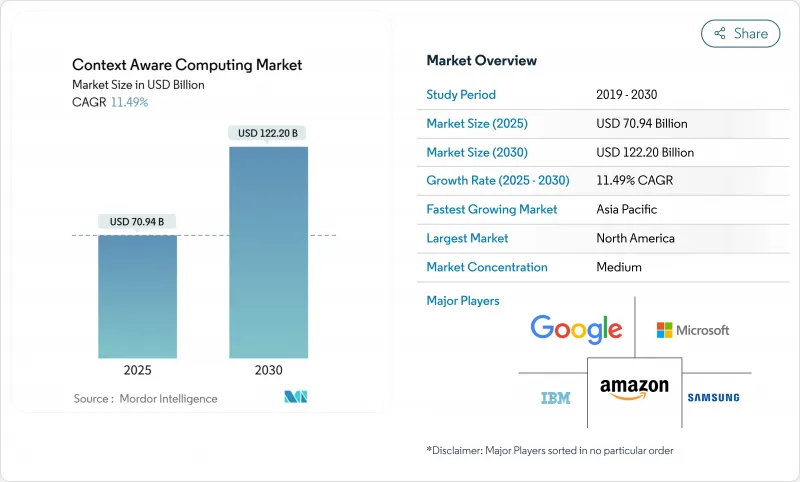
상황인식 컴퓨팅(CAC) 시장 규모는 2025년에 709억 4,000만 달러로 평가되고, 2030년에는 1,222억 달러에 이르며, CAGR 11.49%를 나타낼 것으로 예측됩니다.
이 전망은 리액티브 디지털 경험으로부터 명시적인 입력 전에 사용자의 요구를 예측하는 예측형, 의도 구동형 서비스로의 구조적 변화를 반영합니다. AI 추론 엔진의 광범위한 전개, 에지 하드웨어 비용의 저하, 전국적인 5G의 보급으로, 현재는 수십억의 엔드포인트에서 실시간 컨텍스트 분석이 가능해지고 있습니다. 엔터프라이즈는 슈퍼 개인화된 참여, 비즈니스 효율성 및 기밀 데이터를 로컬로 유지하는 프라이버시 우선 아키텍처를 요구하고 있으며 수요가 점점 증가하고 있습니다. 하드웨어가 수익의 기둥임에 변화는 없지만, 소프트웨어 오케스트레이션 레이어가 상황인식 컴퓨팅(CAC) 시장에서 경쟁력의 주요 원천이 되고 있습니다.
세계의 상황인식 컴퓨팅(CAC) 시장 동향 및 인사이트
AI를 활용한 인텐트 예측이 UX를 높입니다.
스마트폰, 자동차, 소매점 키오스크 단말기에 내장된 대규모 언어 모델과 머신러닝 파이프라인은 사용자의 목표를 예측하고 다음 작업을 제안하고 작업을 자동으로 완료합니다. Apple Intelligence는 기기의 행동, 주변 상황, 메시징 스타일을 분석하고 프롬프트를 만들어 워크플로를 자동화합니다. 유사한 모델을 도입한 기업은 직관적이고 쉽게 경험할 수 있으므로 사용자의 정착률이 높아집니다. 각 상호작용이 모델을 정교하게 만들고 네트워크 효과를 강화하기 때문에 가치는 빠르게 확대됩니다. AI 인프라에 대한 설비 투자는 급증하고 있으며, 고밀도 GPU 클러스터에 초점을 맞춘 Oracle과 OpenAI의 300억 달러 제휴가 이를 증명하고 있습니다. 예측 정확도가 향상됨에 따라 소비자는 상황인식 컴퓨팅(CAC) 시장의 기본 기능으로 프로액티브 서비스를 점점 더 기대하게됩니다.
엣지 컴퓨팅 비용 저하로 채용 확대
최첨단 3nm 및 4nm 프로세스 노드는 테라 OPS당 비용을 절감하고 와트당 성능을 향상시켰습니다. Qualcomm의 최신 Snapdragon 플랫폼에는 배터리 구동 장치에서 멀티모달 컨텍스트 분석을 지원하는 전용 NPU가 내장되어 있어 클라우드에 항상 연결할 필요가 없습니다. 총소유 비용 절감으로 스마트 소매 선반, 공장 자동화, 현장 서비스용 웨어러블 등 중소기업에서의 도입이 가능합니다. 이와 같이 어드레싱 가능한 기반이 넓어지면 센서와 게이트웨이 출하량이 가속화되어 상황인식 컴퓨팅(CAC) 업계 수요가 강화됩니다.
개인정보 보호 제1 규정이 데이터 이용을 제한
GDPR(EU 개인정보보호규정) 스타일의 의무화는 명시적인 동의, 데이터 최소화, 삭제 권한을 요구하며, 한때 모바일 애플리케이션에서 일반적이었던 자유로운 데이터 수집을 억제합니다. 기업은 현재 준수를 위해 연합 학습, 차등 프라이버시 및 On-Premise 추론을 추구하고 있지만, 이러한 기술은 종종 모델의 정확성을 낮추고 롤아웃을 지연시킵니다. 프라이버시 바이 디자인 프레임워크를 제공할 수 있는 공급업체는 신뢰의 이점을 얻지만 더 높은 엔지니어링 비용을 흡수해야 합니다. 규제의 영향으로 일부 기업은 조심스럽고 상황인식 컴퓨팅(CAC) 시장의 단기 성장이 억제됩니다.
부문 분석
추론 워크로드를 지원하는 센서, 엣지 게이트웨이, 스마트 웨어러블이 호조로 2024년 매출 점유율은 하드웨어가 52%를 차지했습니다. 모션, 바이오메트릭스, 환경용 센서가 가장 큰 품목입니다. 게이트웨이는 이 입력을 집계하여 고속 경로 분석을 수행하여 상황인식 컴퓨팅(CAC) 시장의 피드백 루프를 단축합니다. 한편 2030년까지 연평균 복합 성장률(CAGR)은 13.20%로 소프트웨어가 하드웨어 성장을 웃돌 것으로 전망됩니다. 컨텍스트 관리 미들웨어는 다른 스트림을 조화시키고 애널리틱스 엔진은 원시 신호를 예측 가능한 추천으로 변환합니다. 전문 서비스 판매는 기업이 데이터 파이프라인, 보안 및 규정 준수를 조정할 때 직면하는 어려운 학습 곡선을 반영합니다. 매니지드 서비스는 비즈니스 로직에 집중하기 위해 일상 업무를 아웃소싱하는 기업에게 채용이 증가하고 있습니다.
소프트웨어가 최종 사용자의 가치 창조를 좌우하게 되었습니다. 미들웨어 공급업체는 스키마 매핑, ID 확인 및 정책 구현을 번들로 하여 플랫폼 선택을 전략적 결정으로 바꿉니다. AI 추론 라이브러리는 워크로드를 CPU, GPU, NPU 리소스로 분할하여 전력 소비를 최적화합니다. 이러한 기술적 혁신을 통해 개발자는 칩셋별로우코드를 다시 작성하지 않고도 적응형 자동차 인포테인먼트와 같은 세밀한 경험을 만들 수 있습니다. 그 결과 업스트림 센서와 게이트웨이 출하가 강화되고 통합 솔루션의 상황인식 컴퓨팅(CAC) 시장 규모가 확대됩니다.
지역 분석
북미는 견조한 벤처 투자, 5G 조기 전개, 클라우드 도입에 힘입어 2024년 세계 매출의 39%를 차지했습니다. 미국의 기업은 컨텍스트가 풍부한 고객 여정을 개발하여 지속률과 크로스셀 비율을 높이고 있습니다. 캐나다에서는 공공 부문의 디지털 전략으로 프라이버시를 중시한 전개 수요가 높아집니다.
아시아태평양은 2030년까지 연평균 복합 성장률(CAGR)이 14.80%로 가장 높은 성장 궤도를 기록할 전망입니다. 5G 국가별 보급률, 디바이스 제조 거점, 디지털 네이티브 인구 규모가 상황인식 컴퓨팅(CAC) 시장을 확대합니다. 중국의 25억 7,000만 IoT 엔드포인트는 현지 생태계 기업이 사용할 수 있는 컨텍스트 데이터의 깊이를 보여줍니다. 스마트시티, 헬스케어, 산업 업그레이드 프로젝트에 대한 정부의 자극책이 보급을 더욱 가속화시킵니다.
유럽은 혁신과 엄격한 프라이버시 법 준수의 균형을 유지하면서 차별화된 우선순위로 전진하고 있습니다. 동의 관리와 데이터 현지화를 통합한 공급업체가 기업과의 계약을 획득. 중동은 사우디아라비아의 NEOM과 같은 스마트 시티의 거대한 프로젝트를 활용하여 대규모 컨텍스트 플랫폼을 시도하고 있습니다. 아프리카에서는 클라우드 네이티브 모바일 서비스가 레거시 인프라가 까다로운 곳에서도 실용적인 솔루션을 제공하기 때문에 비약적인 잠재력을 보여줍니다. 남미에서는 스마트폰의 보급이 꾸준히 진행되고 있으며, 통신사업자는 저지연의 컨텍스트 앱을 지원하기 위해 엣지 컴퓨팅 노드를 추진하고 있습니다.
기타 혜택 :
- 엑셀 형식 시장 예측(ME) 시트
- 3개월간의 애널리스트 지원
목차
제1장 서론
- 조사 전제조건과 시장 정의
- 조사 범위
제2장 조사 방법
제3장 주요 요약
제4장 시장 상황
- 시장 개요
- 시장 성장 촉진요인
- AI에 의한 의도 예측이 UX 향상
- 엣지 컴퓨팅의 비용 저하가 채용을 확대
- 5G의 전개에 의해 실시간 컨텍스트 데이터 가능
- IoT 엔드포인트의 급증이 데이터 홍수 발생
- 차재 인포테인먼트의 개인화 수요
- 중소기업 앱용 Context-as-a-Service API
- 시장 성장 억제요인
- 프라이버시 우선의 규제가 데이터 이용을 제한
- 레거시 IT와의 높은 통합 복잡성
- 문맥추론에서의 모델 바이어스의 위험
- 웨어러블 단말의 배터리 수명이 한정
- 밸류체인 분석
- Porter's Five Forces 분석
- 공급기업의 협상력
- 구매자의 협상력
- 신규 참가업체의 위협
- 대체품의 위협
- 기업 간 경쟁 관계
제5장 시장 규모와 성장 예측
- 유형별
- 하드웨어
- 센서
- 엣지 게이트웨이
- 스마트 웨어러블
- 소프트웨어
- 컨텍스트 관리 미들웨어
- 분석 및 추론 엔진
- 서비스
- 전문 서비스
- 관리형 서비스
- 하드웨어
- 공급업체별
- 디바이스 제조업체
- 이동통신사
- 온라인 및 소셜 플랫폼
- 독립 소프트웨어 공급업체
- 최종 사용자 업계별
- BFSI
- 소비자 일렉트로닉스
- 미디어 및 엔터테인먼트
- 자동차
- 헬스케어
- 통신
- 물류 및 운송
- 기타 산업
- 지역별
- 북미
- 미국
- 캐나다
- 멕시코
- 유럽
- 영국
- 독일
- 프랑스
- 이탈리아
- 기타 유럽
- 아시아태평양
- 중국
- 일본
- 인도
- 한국
- 기타 아시아태평양
- 중동
- 이스라엘
- 사우디아라비아
- 아랍에미리트(UAE)
- 튀르키예
- 기타 중동
- 아프리카
- 남아프리카
- 이집트
- 기타 아프리카
- 남미
- 브라질
- 아르헨티나
- 기타 남미
- 북미
제6장 경쟁 구도
- 시장 집중도
- 전략적 동향
- 시장 점유율 분석
- 기업 프로파일
- IBM Corporation
- Microsoft Corporation
- Cisco Systems Inc.
- Google LLC(Alphabet)
- Oracle Corporation
- Amazon Web Services Inc.
- Verizon Communications Inc.
- Samsung Electronics Co. Ltd.
- Intel Corporation
- Apple Inc.
- Qualcomm Inc.
- Ericsson AB
- Huawei Technologies Co. Ltd.
- Bosch Sensortec GmbH(Robert Bosch GmbH)
- Honeywell International Inc.
- SAP SE
- ATandT Inc.
- Telefonica SA
- LG Electronics Inc.
- Baidu Inc.
제7장 시장 기회와 향후 전망
KTH 25.11.24The context-aware computing market size is valued at USD 70.94 billion in 2025 and is forecast to reach USD 122.20 billion by 2030, advancing at an 11.49% CAGR.
This outlook reflects the structural shift from reactive digital experiences toward predictive, intent-driven services that anticipate a user's needs before explicit input. Widespread deployment of AI inference engines, falling edge hardware costs, and nationwide 5G coverage now permit real-time contextual analytics on billions of endpoints. Demand intensifies as enterprises seek hyper-personalised engagement, operational efficiency, and privacy-first architectures that keep sensitive data local. Hardware remains the revenue backbone, yet software orchestration layers are becoming the main source of competitive differentiation in the context aware computing market.
Global Context Aware Computing Market Trends and Insights
AI-powered Intent Prediction Boosts UX
Large language models and machine-learning pipelines embedded in smartphones, vehicles, and retail kiosks now anticipate user goals, suggesting next actions or auto-completing tasks. Apple Intelligence analyses in-device behaviour, ambient conditions, and messaging style to curate prompts and automate workflows. Organisations deploying comparable models gain higher user retention because experiences feel intuitive and effortless. Value scales rapidly because each interaction refines the model, reinforcing network effects. Capital expenditure on AI infrastructure is rising sharply, evidenced by Oracle's USD 30 billion partnership with OpenAI focused on high-density GPU clusters. As predictive accuracy improves, consumers increasingly expect proactive services as a baseline capability in the context aware computing market.
Edge-computing Cost Decline Widens Adoption
Advanced 3 nm and 4 nm process nodes have reduced cost per tera-ops and improved performance-per-watt. Qualcomm's latest Snapdragon platform embeds a dedicated NPU that supports multimodal context analysis on battery-powered devices, eliminating constant cloud calls. Lower total ownership cost unlocks small and medium-enterprise deployment across smart retail shelving, factory automation, and field-service wearables. This broadening addressable base accelerates unit shipments of sensors and gateways, reinforcing demand in the context aware computing industry.
Privacy-first Regulations Restrict Data Use
GDPR-style mandates require explicit consent, data minimisation, and erasure rights that curtail the unfettered data harvesting once common in mobile applications. Firms now pursue federated learning, differential privacy, and on-premises inference to comply, but these techniques often reduce model accuracy and slow roll-outs. Vendors able to deliver privacy-by-design frameworks gain a trust advantage yet must absorb higher engineering costs. The regulatory swing keeps some enterprises cautious, tempering the near-term growth of the context aware computing market.
Other drivers and restraints analyzed in the detailed report include:
- 5G Rollout Enables Real-time Context Data
- Surge in IoT Endpoints Creates Data Deluge
- High Integration Complexity with Legacy IT
For complete list of drivers and restraints, kindly check the Table Of Contents.
Segment Analysis
Hardware held 52% revenue share in 2024 on the strength of sensors, edge gateways, and smart wearables that underpin inference workloads. Sensors for motion, biometrics, and environment represent the largest line-item because every contextual decision starts with precise data capture. Gateways aggregate this input and run first-pass analytics, shortening feedback loops in the context aware computing market. Meanwhile, software outpaces hardware growth at 13.20% CAGR through 2030. Context management middleware harmonises disparate streams, while analytics engines transform raw signals into predictive recommendations. Professional services revenue reflects the steep learning curve enterprises face when tuning data pipelines, security, and compliance. Managed services adoption rises as firms outsource daily operations to focus on business logic.
Software now determines end-user value creation. Middleware vendors bundle schema mapping, identity resolution, and policy enforcement, turning platform choice into a strategic decision. AI inference libraries optimise power draw by splitting workloads across CPU, GPU, and NPU resources. These technical breakthroughs let developers craft granular experiences-such as adaptive in-car infotainment-without rewriting code for every chipset. Resulting demand reinforces upstream sensor and gateway shipments, advancing the context aware computing market size for integrated solutions.
The Context Aware Computing Market is Segmented by Type (Hardware, Software), Vendor (Device Manufacturers, Mobile Network Operators, and More), End-User Industry (BFSI, Consumer Electronics, and More), and Geography (North America, Europe, Asia-Pacific, and More). The Market Size and Forecasts are Provided in Terms of Value (USD).
Geography Analysis
North America delivered 39% of global revenue in 2024, buoyed by robust venture investment, early 5G rollout, and cloud adoption. Enterprises in the United States deploy context-rich customer journeys to lift retention and cross-sell rates. Canada's public-sector digital strategies add to base demand for privacy-centric deployments.
Asia-Pacific records the highest growth trajectory at 14.80% CAGR through 2030. National 5G coverage, device manufacturing hubs, and sizeable digital-native populations combine to expand the context aware computing market. China's 2.57 billion IoT endpoints demonstrate the depth of contextual data available to local ecosystem players. Government stimulus for smart city, healthcare, and industrial upgrade projects further accelerates uptake.
Europe advances on differentiated priorities, balancing innovation with strict privacy law compliance. Vendors that integrate consent management and data localisation win enterprise contracts. The Middle East leverages smart-city megaprojects-such as NEOM in Saudi Arabia-to trial large-scale context platforms. Africa shows leapfrog potential because cloud-native mobile services offer practical solutions where legacy infrastructure is thin. South America's steady smartphone adoption rounds out global demand, with telcos pushing edge computing nodes to support low-latency contextual apps.
- IBM Corporation
- Microsoft Corporation
- Cisco Systems Inc.
- Google LLC (Alphabet)
- Oracle Corporation
- Amazon Web Services Inc.
- Verizon Communications Inc.
- Samsung Electronics Co. Ltd.
- Intel Corporation
- Apple Inc.
- Qualcomm Inc.
- Ericsson AB
- Huawei Technologies Co. Ltd.
- Bosch Sensortec GmbH (Robert Bosch GmbH)
- Honeywell International Inc.
- SAP SE
- ATandT Inc.
- Telefonica S.A.
- LG Electronics Inc.
- Baidu Inc.
Additional Benefits:
- The market estimate (ME) sheet in Excel format
- 3 months of analyst support
TABLE OF CONTENTS
1 INTRODUCTION
- 1.1 Study Assumptions and Market Definition
- 1.2 Scope of the Study
2 RESEARCH METHODOLOGY
3 EXECUTIVE SUMMARY
4 MARKET LANDSCAPE
- 4.1 Market Overview
- 4.2 Market Drivers
- 4.2.1 AI-powered intent prediction boosts UX
- 4.2.2 Edge-computing cost decline widens adoption
- 4.2.3 5G rollout enables real-time context data
- 4.2.4 Surge in IoT endpoints creates data deluge
- 4.2.5 In-car infotainment personalisation demand
- 4.2.6 Context-as-a-Service APIs for SME apps
- 4.3 Market Restraints
- 4.3.1 Privacy-first regulations restrict data use
- 4.3.2 High integration complexity with legacy IT
- 4.3.3 Model bias risks in context inference
- 4.3.4 Limited battery life on wearable devices
- 4.4 Industry Value-Chain Analysis
- 4.5 Porter's Five Forces Analysis
- 4.5.1 Bargaining Power of Suppliers
- 4.5.2 Bargaining Power of Buyers
- 4.5.3 Threat of New Entrants
- 4.5.4 Threat of Substitutes
- 4.5.5 Intensity of Competitive Rivalry
5 MARKET SIZE AND GROWTH FORECASTS (VALUE)
- 5.1 By Type
- 5.1.1 Hardware
- 5.1.1.1 Sensors
- 5.1.1.2 Edge Gateways
- 5.1.1.3 Smart Wearables
- 5.1.2 Software
- 5.1.2.1 Context Management Middleware
- 5.1.2.2 Analytics and Inference Engines
- 5.1.3 Services
- 5.1.3.1 Professional Services
- 5.1.3.2 Managed Services
- 5.1.1 Hardware
- 5.2 By Vendor
- 5.2.1 Device Manufacturers
- 5.2.2 Mobile Network Operators
- 5.2.3 Online and Social Platforms
- 5.2.4 Independent Software Vendors
- 5.3 By End-User Industry
- 5.3.1 BFSI
- 5.3.2 Consumer Electronics
- 5.3.3 Media and Entertainment
- 5.3.4 Automotive
- 5.3.5 Healthcare
- 5.3.6 Telecommunication
- 5.3.7 Logistics and Transportation
- 5.3.8 Other Industries
- 5.4 By Geography
- 5.4.1 North America
- 5.4.1.1 United States
- 5.4.1.2 Canada
- 5.4.1.3 Mexico
- 5.4.2 Europe
- 5.4.2.1 United Kingdom
- 5.4.2.2 Germany
- 5.4.2.3 France
- 5.4.2.4 Italy
- 5.4.2.5 Rest of Europe
- 5.4.3 Asia-Pacific
- 5.4.3.1 China
- 5.4.3.2 Japan
- 5.4.3.3 India
- 5.4.3.4 South Korea
- 5.4.3.5 Rest of Asia-Pacific
- 5.4.4 Middle East
- 5.4.4.1 Israel
- 5.4.4.2 Saudi Arabia
- 5.4.4.3 United Arab Emirates
- 5.4.4.4 Turkey
- 5.4.4.5 Rest of Middle East
- 5.4.5 Africa
- 5.4.5.1 South Africa
- 5.4.5.2 Egypt
- 5.4.5.3 Rest of Africa
- 5.4.6 South America
- 5.4.6.1 Brazil
- 5.4.6.2 Argentina
- 5.4.6.3 Rest of South America
- 5.4.1 North America
6 COMPETITIVE LANDSCAPE
- 6.1 Market Concentration
- 6.2 Strategic Moves
- 6.3 Market Share Analysis
- 6.4 Company Profiles (includes Global-level Overview, Market-level Overview, Core Segments, Financials, Strategic Information, Market Rank/Share, Products and Services, Recent Developments)
- 6.4.1 IBM Corporation
- 6.4.2 Microsoft Corporation
- 6.4.3 Cisco Systems Inc.
- 6.4.4 Google LLC (Alphabet)
- 6.4.5 Oracle Corporation
- 6.4.6 Amazon Web Services Inc.
- 6.4.7 Verizon Communications Inc.
- 6.4.8 Samsung Electronics Co. Ltd.
- 6.4.9 Intel Corporation
- 6.4.10 Apple Inc.
- 6.4.11 Qualcomm Inc.
- 6.4.12 Ericsson AB
- 6.4.13 Huawei Technologies Co. Ltd.
- 6.4.14 Bosch Sensortec GmbH (Robert Bosch GmbH)
- 6.4.15 Honeywell International Inc.
- 6.4.16 SAP SE
- 6.4.17 ATandT Inc.
- 6.4.18 Telefonica S.A.
- 6.4.19 LG Electronics Inc.
- 6.4.20 Baidu Inc.
7 MARKET OPPORTUNITIES AND FUTURE OUTLOOK
- 7.1 White-space and Unmet-Need Assessment