|
시장보고서
상품코드
1907287
몰리브덴 시장 : 점유율 분석, 업계 동향, 통계, 성장 예측(2026-2031년)Molybdenum - Market Share Analysis, Industry Trends & Statistics, Growth Forecasts (2026 - 2031) |
||||||
 Mordor Intelligence
몰리브덴 시장은 2025년 3억 1,700만 톤으로 평가되었고, 예측기간(2026-2031년)에 CAGR 4.14%로 성장하여 2026년 3억 3,012만 톤, 2031년까지 4억 435만 톤에 이를 것으로 추정되고 있습니다.
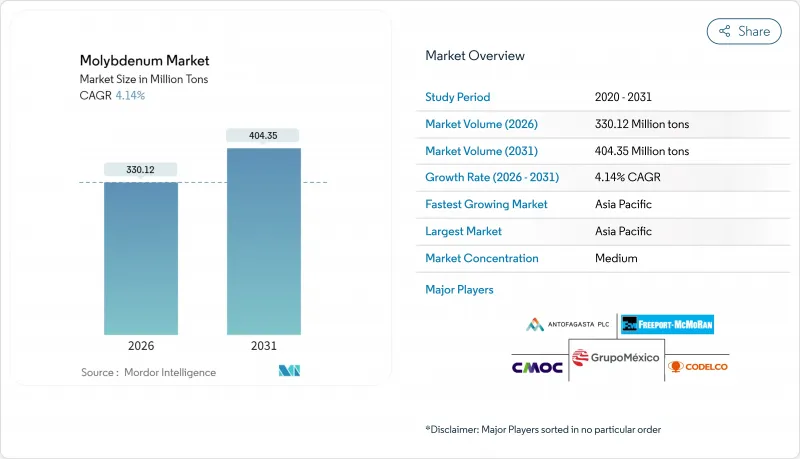
철강 제조는 주요 용도 분야이며, 고강도 저합금강(HSLA) 등급이 건설, 자동차, 에너지 인프라 분야에 널리 보급되었습니다. 화학 용도는 청정 연료, 배출 가스 제어 및 CO2 전환을 위한 촉매 수요 증가를 배경으로 확대되었습니다. 2025년 2월 중국이 몰리브덴을 포함한 중요한 광물에 대한 수출 규제를 발표함으로써 지정학적 위험이 높아지며, 이 정책 전환은 세계 무역 경로와 가격 형성에 변화를 일으킬 수 있습니다. 공급 박박위험을 받고 철강 제조업체, 석유 및 가스 사업자, 재생에너지 기기 제조업체, EV용 파워 일렉트로닉스 공급 기업은 조달 전략의 재검토, 재활용 확대, 대체 불가능한 합금 설계에 대한 투자를 추진하고 있습니다.
세계 몰리브덴 시장 동향과 인사이트
고강도 저합금강 수요 급증
인프라 정비의 급속한 진전과 경량화 및 고강도화가 요구되는 차량 개발의 진전에 의해 고강도 저합금강(HSLA강)은 몰리브덴 시장의 성장을 견인하는 주요 요소가 되고 있습니다. 0.5-1%의 몰리브덴 첨가는 항복 강도를 최대 20% 향상시켜 저온 인성을 강화하고 황화물 응력 부식 균열에 대한 내성을 향상시킵니다. 이러한 기계적 특성 향상은 교량, 터널, 고층 건축물의 상부 구조에서 판 두께의 박형화와 수명 연장을 가능하게 합니다. 한편, 자동차 제조업체는 HSLA강을 이용한 바디 인 화이트 부품을 채택해, 차량 중량의 삭감과 연비 향상, 혹은 EV 항속 거리의 연신을 도모하고 있습니다. 신규 조사에 의해(Ti, Mo) C 석출물의 산성 환경하에 있어서의 균열 저항성의 향상이 확인되어 파이프라인 사업자로부터 높이 평가되는 특성이 되고 있습니다. 각국 정부가 교통 인프라와 재생에너지망에 대한 자극책을 추진하는 가운데 HSLA 강종은 철강 생산량의 점유율을 확대하고 몰리브덴의 기초 수요를 더욱 끌어 올리고 있습니다.
몰리브덴계 합금이 필요한 재생에너지 설비 증가
대규모 풍력 및 수력 발전 설비에서는 염수 분무, 반복 하중, 캐비테이션에 견디기 위해 몰리브덴 함유 마르텐사이트강 및 초합금이 채택되고 있습니다. 해상 풍력 터빈의 타워와 나셀 내부 부품은 25년의 수명 기간에 걸쳐 습도와 염화물 공격을 견뎌야 하며, 이 역할은 몰리브덴 합금 강판과 주조품이 담당하고 있습니다. 모버커사의 2024년 연구에 따르면, 열기계 처리를 실시한 몰리브덴 함유 강은 해수에 장기 노출 후에도 높은 강도와 파괴 인성을 유지하는 것으로 나타났습니다. 전력변환장치에 있어서는 몰리브덴제 히트스프레더가 실리콘의 열팽창율에 적합하고 풍력발전소용 인버터에 채택되는 절연 게이트 바이폴라 트랜지스터(IGBT) 모듈의 신뢰성 높은 기반으로서 기능합니다. 정부의 청정에너지 목표와 해상풍력발전의 기록적인 입찰량으로 이 수요요인은 구조적인 상승압력을 받고 있습니다.
몰리브덴의 높은 비용
가격 변동은 예산주기를 방해하고, 가능한 경우 텅스텐이나 니오븀에 대한 대체를 촉구하며, 소규모 구매자에게 위험 프리미엄 지불을 강요합니다. 중국의 규제로 인한 공급 핍박이 이 영향을 증폭시켜, 미니밀, 주조소, 촉매 제조업체에 있어서 원료의 청구액을 예측 불가능하게 유지해, 몰리브덴 시장에 영향을 주고 있습니다.
부문 분석
철강은 몰리브덴 시장의 대부분을 차지하고 2025년 세계 소비량의 70.62%를 차지했습니다. 고온 석유, LNG 및 화학 공장에서는 염화물 균열을 견디기 위해 2-4%의 몰리브덴을 첨가한 페라이트계 및 오스테나이트계 스테인리스 스틸이 요구됩니다. 사워 가스용 라인 파이프의 사양에서는 통상 1%까지의 몰리브덴 함유가 요구되어, 이것에 의해 두께의 삭감과 용접 비용의 저감이 가능해집니다.
화학 분야는 현시점에서는 규모가 작은 것으로, 2031년까지 연평균 복합 성장률(CAGR) 4.62%로 가장 급속하게 성장하는 수요처로 전망됩니다. 코발트 몰리브덴/알루미나계 수소화 탈황(HDS) 촉매는 초저황 지침에 대응하기 위해 디젤 연료와 제트 연료에서 황을 제거합니다. 한편, 삼산화몰리브덴은 CO2나 재생가능한 원료를 합성연료로 변환하는 촉매에 혼입됩니다. 이 기세로 화학분야는 예측기간 후반에 철강분야 점유율을 점차 빼앗아 몰리브덴 시장에 깊이를 가져올 전망입니다.
본 몰리브덴 시장 보고서는 최종 제품별(철강, 화학, 주조 등), 제품 형태별(몰리브덴 정광, 구이 몰리브덴, 페로몰리브덴 등), 최종 이용 산업(석유 및 가스, 화학 및 석유 화학, 자동차, 산업용, 건축 및 건설 등), 지역(아시아태평양, 북미, 유럽, 세계 기타 지역), 시장 예측은 수량(톤) 단위로 제공됩니다.
지역별 분석
2025년 아시아태평양은 세계 처리량의 53.60%를 차지했습니다. 이는 중국, 일본, 한국, 인도에서 철강 생산, 자동차 조립, 첨단 전자기기 제조의 확대로 인한 것입니다. 이 지역의 CAGR 4.71%로 일대일로 인프라, 에너지 파이프라인, 조선업에 기인하고 있습니다. 2025년 2월에 베이징이 도입한 몰리브덴 수출 허가 제도에 의해 하류의 구매자는 할당 감시하에 놓여져, 재고 적립이 가속하고 있습니다.
북미는 미국의 자원 부존을 활용하고 있으며, 2024년에는 3만 3,000톤을 채굴했습니다. 2025년 3월 대통령령으로 채굴허가의 신속화를 도모해 북미의 자급률 향상이 기대됩니다. 유럽은 공급 부족하면서 독일 및 이탈리아의 스테인리스제강소나 EV 부품 공장에 의한 견고한 수요를 유지하고 있습니다.
유럽위원회의 재생강재 할당안에서는 2030년까지 신차용 강재의 25%를 스크랩 유래로 하는 것을 제안하고 있어 자동차 슈레더로부터의 몰리브덴 회수를 촉진합니다. 중동 정유업자는 수소화 처리 촉매용으로 몰리브덴을 수입하고, 아프리카의 반상 구리 광상 프로젝트에서는 제품별로 몰리브덴이 생산되어 유럽과 아시아를 위한 스팟화물로 공급되고 있습니다.
기타 혜택 :
- 엑셀 형식 시장 예측(ME) 시트
- 애널리스트에 의한 3개월간의 지원
자주 묻는 질문
목차
제1장 서론
- 조사의 전제조건과 시장의 정의
- 조사 범위
제2장 조사 방법
제3장 주요 요약
제4장 시장 상황
- 시장 개요
- 시장 성장 촉진요인
- 고강도 저합금강(HSLA) 수요 급증
- 재생에너지 설비 증가에 수반하는 몰리브덴계 합금 수요 증가
- 심해유 가스 시추의 활성화가 내식성 몰리브덴 합금 수요를 촉진
- 전기자동차 파워 일렉트로닉스용 고온 몰리브덴 부품 채택 확대
- 금속 3D 프린팅에서 몰리브덴 분말의 사용 증가
- 시장 성장 억제요인
- 몰리브덴의 고비용
- 채굴에 관한 정부 규제
- 특수강에 있어서의 텅스텐 및 니오븀으로의 대체
- 리사이클 인프라의 미정비에 의한 2차 공급의 제한
- 밸류체인 분석
- Porter's Five Forces
- 공급기업의 협상력
- 구매자의 협상력
- 신규 참가업체의 위협
- 대체품의 위협
- 경쟁도
- 무역 분석
- 가격 동향
제5장 시장 규모와 성장 예측
- 최종제품별
- 철강
- 화학
- 파운드리
- 몰리브덴 금속
- 니켈 합금
- 제품 형태별
- 몰리브덴 정광
- 볶음 몰리브덴(기술용 산화 몰리브덴)
- 페로몰리브덴
- 몰리브덴 금속 분말
- 몰리브덴 화학제품
- 최종 사용자 업계별
- 석유 및 가스
- 화학 및 석유화학
- 자동차
- 산업
- 건축 및 건설
- 항공우주 및 방위산업
- 기타 산업(에너지 생성 및 저장, 전자기기 및 반도체 등)
- 지역별(생산 분석)
- 중국
- 미국
- 칠레
- 페루
- 멕시코
- 아르메니아
- 기타 생산국
- 지역별(소비 분석)
- 아시아태평양
- 중국
- 인도
- 일본
- 한국
- 기타 아시아태평양
- 북미
- 미국
- 캐나다
- 멕시코
- 유럽
- 독일
- 영국
- 이탈리아
- 프랑스
- 러시아
- 기타 유럽
- 세계 기타 지역
- 남미
- 중동 및 아프리카
- 아시아태평양
제6장 경쟁 구도
- 시장 집중도
- 전략적 동향
- 시장 점유율(%) 분석
- 기업 프로파일
- Air Liquide
- Anglo American plc
- Antamina
- Antofagasta plc
- Centerra Gold Inc.
- China Molybdenum Co. Ltd.
- Codelco
- Freeport-McMoRan
- GRUPO MEXICO
- HONGDA GROUP
- Jiangxi Copper Corporation
- JINDUICHENG MOLYBDENUM CO.,LTD.
- KAZ Minerals
- KGHM
- Moltun International
- MOLYMET SA
- Multi Metal Development Limited
- Rio Tinto
제7장 시장 기회와 장래의 전망
SHW 26.01.26The Molybdenum Market was valued at 317 million tons in 2025 and estimated to grow from 330.12 million tons in 2026 to reach 404.35 million tons by 2031, at a CAGR of 4.14% during the forecast period (2026-2031).
Steelmaking remained the primary outlet, as high-strength, low-alloy (HSLA) grades spread through construction, automotive, and energy infrastructure. Chemical uses advanced on the back of rising catalyst demand for clean fuels, emissions control, and CO2 conversion. Geopolitical exposure intensified after China's February 2025 export-control notice on critical minerals, including molybdenum, a policy shift that threatens to alter trade routes and price formation worldwide. Tight supply risk is prompting steelmakers, oil-and-gas operators, renewable-energy OEMs, and EV power-electronics suppliers to re-evaluate sourcing strategies, expand recycling, and invest in substitute-proof alloy designs.
Global Molybdenum Market Trends and Insights
Surge in High-Strength Low-Alloy Steel Demand
Rapid infrastructure rollouts and the push for lighter yet stronger vehicles have made HSLA steel a central growth lever for the molybdenum market. Adding 0.5-1% Mo boosts yield strength by up to 20%, enhances low-temperature toughness, and reduces susceptibility to sulfide stress corrosion. These mechanical gains allow thinner gauges and longer service life in bridges, tunnels, and high-rise superstructures. Automakers, meanwhile, use HSLA body-in-white parts to shave vehicle mass and raise fuel economy or EV range. New research on (Ti, Mo)C precipitation confirms improved resistance to cracking in sour environments, a property valued by pipeline operators. As governments channel stimulus into transport and renewable grids, HSLA grades are capturing a growing slice of steel output, magnifying baseline demand for molybdenum.
Increasing Renewable-Energy Installations Requiring Mo-Based Alloys
Utility-scale wind and hydropower assets use Mo-containing martensitic steels and superalloys to survive salt spray, cyclic loading, and cavitation. Offshore turbine towers and nacelle internals must tolerate humidity and chloride attack over 25-year lifecycles, a job handled by Mo-alloyed plate and castings. Mohrbacher's 2024 study showed that thermomechanically processed Mo-bearing steels sustain high strength and fracture toughness even after prolonged exposure to seawater. In power converters, molybdenum heatspreaders match silicon's thermal expansion, serving as reliable bases for insulated-gate bipolar transistor (IGBT) modules used in wind farm inverters. Government clean-energy targets and record auction volumes for offshore wind impose a structural uplift on this driver.
High Cost of Molybdenum
Price volatility disturbs budget cycles, prompts substitution with tungsten or niobium where feasible, and forces smaller buyers to pay risk premiums. Supply tightness linked to Chinese controls compounds the effect, keeping feedstock invoices unpredictable for steel minimills, foundries, and catalyst producers, influencing in the molybdenum market.
Other drivers and restraints analyzed in the detailed report include:
- Intensifying Deep-Water Oil and Gas Drilling Boosting Corrosion-Resistant Mo Alloys
- Adoption of High-Temperature Mo Components for Electric-Vehicle Power Electronics
- Government Regulations Concerning Mining
For complete list of drivers and restraints, kindly check the Table Of Contents.
Segment Analysis
Steel retained the lion's share of the molybdenum market, accounting for 70.62% of global offtake in 2025. High-temperature petroleum, LNG, and chemical plants demand ferritic and austenitic stainless varieties enriched with 2-4% Mo to resist chloride cracking. Linepipe specifications for sour gas routinely call for up to 1% Mo, allowing thinner walls and lower welding costs.
Chemicals, although smaller at present, represent the fastest-growing outlet at a 4.62% CAGR through 2031. Hydrodesulfurization (HDS) catalysts based on Co-Mo/Al2O3 remove sulfur from diesel and jet fuel to meet ultra-low sulfur directives, while MoO3 screws into catalysts that convert CO2 and renewable feedstock into synthetic fuels. This momentum positions chemicals to chip away share from steel in the latter half of the forecast window, lending depth to the molybdenum market.
The Molybdenum Market Report is Segmented by End Product (Steel, Chemical, Foundry, and More), Product Form (Molybdenum Concentrates, Roasted Molybdenum, Ferromolybdenum, and More), End-Use Industry (Oil & Gas, Chemical & Petrochemical, Automotive, Industrial, Building & Construction, and More), and Geography (Asia-Pacific, North America, Europe, Rest of the World). The Market Forecasts are Provided in Terms of Volume (Tons).
Geography Analysis
Asia-Pacific held 53.60% of global throughput in 2025 as China, Japan, South Korea, and India escalated steel output, vehicle assembly, and advanced-electronics fabrication. The region's 4.71% CAGR stems from Belt-and-Road infrastructure, energy pipelines, and shipbuilding. Beijing's February 2025 export-license regime for molybdenum puts downstream buyers on allocation watch and accelerates inventory build-ups.
North America is leveraging resource endowment in the United States, which mined 33,000 tons in 2024. A March 2025 executive order now seeks to fast-track mining permits, potentially lifting North American self-reliance. Europe, though supply-short, retains robust demand driven by German and Italian stainless mills and EV-component plants.
The European Commission's recycled-steel quotas propose that 25% of steel in new cars originate from scrap by 2030, stimulating molybdenum recovery from automotive shredders. Middle-East refiners import Mo for hydro-treating catalysts, while African copper porphyry projects contribute by-product molybdenum that feeds spot cargoes into Europe and Asia.
- Air Liquide
- Anglo American plc
- Antamina
- Antofagasta plc
- Centerra Gold Inc.
- China Molybdenum Co. Ltd.
- Codelco
- Freeport-McMoRan
- GRUPO MEXICO
- HONGDA GROUP
- Jiangxi Copper Corporation
- JINDUICHENG MOLYBDENUM CO.,LTD.
- KAZ Minerals
- KGHM
- Moltun International
- MOLYMET SA
- Multi Metal Development Limited
- Rio Tinto
Additional Benefits:
- The market estimate (ME) sheet in Excel format
- 3 months of analyst support
TABLE OF CONTENTS
1 Introduction
- 1.1 Study Assumptions and Market Definition
- 1.2 Scope of the Study
2 Research Methodology
3 Executive Summary
4 Market Landscape
- 4.1 Market Overview
- 4.2 Market Drivers
- 4.2.1 Surge in High-Strength Low-Alloy (HSLA) Steel Demand
- 4.2.2 Increasing Renewable Energy Installations Requiring Mo-based Alloys
- 4.2.3 Intensifying Deep-water Oil and Gas Drilling Boosting Corrosion-Resistant Mo Alloys
- 4.2.4 Adoption of High-Temperature Mo Components for the Electric Vehicle Power Electronics
- 4.2.5 Increasing Usage of Molybdenum Powders for Metal 3-D Printing
- 4.3 Market Restraints
- 4.3.1 High Cost of Molybdenum
- 4.3.2 Government Regulations Concering Mining
- 4.3.3 Substitution by Tungsten and Niobium in Specialty Steels
- 4.3.4 Under-developed Recycling Infrastructure Limiting Secondary Supply
- 4.4 Value Chain Analysis
- 4.5 Porter's Five Forces
- 4.5.1 Bargaining Power of Suppliers
- 4.5.2 Bargaining Power of Buyers
- 4.5.3 Threat of New Entrants
- 4.5.4 Threat of Substitutes
- 4.5.5 Degree of Competition
- 4.6 Trade Analysis
- 4.7 Price Trends
5 Market Size and Growth Forecasts (Volume)
- 5.1 By End Product
- 5.1.1 Steel
- 5.1.2 Chemical
- 5.1.3 Foundry
- 5.1.4 Molybdenum Metal
- 5.1.5 Nickel Alloys
- 5.2 By Product Form
- 5.2.1 Molybdenum Concentrates
- 5.2.2 Roasted Molybdenum (Technical Oxide)
- 5.2.3 Ferromolybdenum
- 5.2.4 Molybdenum Metal Powder
- 5.2.5 Molybdenum Chemicals
- 5.3 By End-user Industry
- 5.3.1 Oil and Gas
- 5.3.2 Chemical and Petrochemical
- 5.3.3 Automotive
- 5.3.4 Industrial
- 5.3.5 Building and Construction
- 5.3.6 Aerospace and Defense
- 5.3.7 Other Industries (Energy Generation and Storage Electronics and Semiconductors, etc.)
- 5.4 By Geography (Production Analysis)
- 5.4.1 China
- 5.4.2 United States
- 5.4.3 Chile
- 5.4.4 Peru
- 5.4.5 Mexico
- 5.4.6 Armenia
- 5.4.7 Other Producer Countries
- 5.5 By Geography (Consumption Analysis)
- 5.5.1 Asia-Pacific
- 5.5.1.1 China
- 5.5.1.2 India
- 5.5.1.3 Japan
- 5.5.1.4 South Korea
- 5.5.1.5 Rest of Asia-Pacific
- 5.5.2 North America
- 5.5.2.1 United States
- 5.5.2.2 Canada
- 5.5.2.3 Mexico
- 5.5.3 Europe
- 5.5.3.1 Germany
- 5.5.3.2 United Kingdom
- 5.5.3.3 Italy
- 5.5.3.4 France
- 5.5.3.5 Russia
- 5.5.3.6 Rest of Europe
- 5.5.4 Rest of the World
- 5.5.4.1 South America
- 5.5.4.2 Middle-East and Africa
- 5.5.1 Asia-Pacific
6 Competitive Landscape
- 6.1 Market Concentration
- 6.2 Strategic Moves
- 6.3 Market Share(%) Analysis
- 6.4 Company Profiles {(includes Global level Overview, Market level overview, Core Segments, Financials as available, Strategic Information, Market Rank/Share for key companies, Products and Services, and Recent Developments)}
- 6.4.1 Air Liquide
- 6.4.2 Anglo American plc
- 6.4.3 Antamina
- 6.4.4 Antofagasta plc
- 6.4.5 Centerra Gold Inc.
- 6.4.6 China Molybdenum Co. Ltd.
- 6.4.7 Codelco
- 6.4.8 Freeport-McMoRan
- 6.4.9 GRUPO MEXICO
- 6.4.10 HONGDA GROUP
- 6.4.11 Jiangxi Copper Corporation
- 6.4.12 JINDUICHENG MOLYBDENUM CO.,LTD.
- 6.4.13 KAZ Minerals
- 6.4.14 KGHM
- 6.4.15 Moltun International
- 6.4.16 MOLYMET SA
- 6.4.17 Multi Metal Development Limited
- 6.4.18 Rio Tinto
7 Market Opportunities and Future Outlook
- 7.1 White-space and Unmet-need Assessment
- 7.2 Rising Demand for Molybdenum-bearing Chemicals in Clean-fuel Processes