|
시장보고서
상품코드
1906038
프랑스의 재생에너지 시장 : 점유율 분석, 업계 동향 및 통계, 성장 예측(2026-2031년)France Renewable Energy - Market Share Analysis, Industry Trends & Statistics, Growth Forecasts (2026 - 2031) |
||||||
 Mordor Intelligence
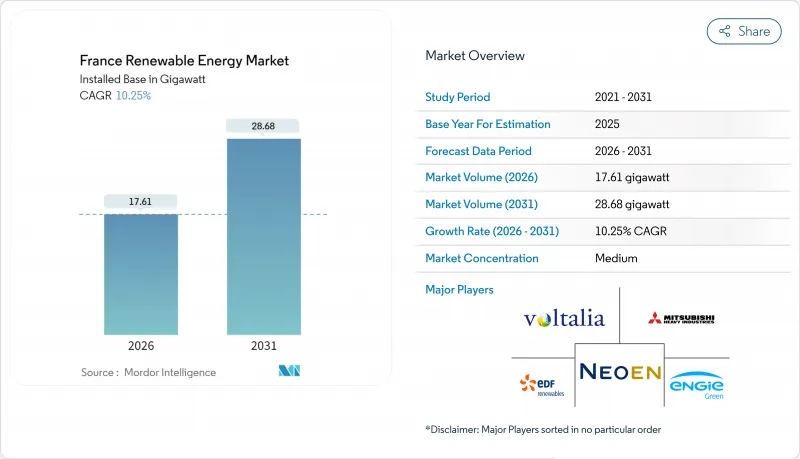
프랑스의 재생에너지 시장은 2025년 15.97기가와트에서 2026년에는 17.61기가와트로 성장하고 2026년에서 2031년에 걸쳐 CAGR 10.25%로 성장을 지속하여 2031년까지 28.68기가와트에 달할 것으로 예측되고 있습니다.
이러한 꾸준한 성장은 구속력 있는 REPowerEU 지침, 국제재생가능에너지기구(IRENA)의 2024년 보고에 따른 태양광 발전 설비 비용의 20% 하락, 2024년 1,842GWh를 돌파한 기업용 전력 구매 계약(PPA) 파이프라인을 반영합니다. 평준화 비용이 감소함에 따라 프로젝트 수익률은 프랑스 연금 기금이 선호하는 8%의 장애물을 극복하고 유틸리티 회사와 독립 발전 사업자(IPP)가 파이프라인 전환을 가속화하는 데 도움이 되었습니다. 다년간 에너지 계획(PPE2)의 개정을 기반으로 한 해상 풍력 입찰은 기술 다양성을 확대하고 국내 은행의 장기 프로젝트 금융을 촉진하고 있습니다. 동시에 2024년에 제정된 아그리볼타이크법은 50만 헥타르의 포도 재배지 및 곡물지역에서 토지의 이중 이용을 허가하여, 상업 규모 태양광발전의 다음 성장단계의 기반을 마련하고 있습니다. EDF Renewables, TotalEnergies, Engie Green과 같은 통합 유틸리티 회사가 Neoen, Voltalia, Akuo Energy와 고정 가격 임베디드 제도 계약 및 기업용 전력 임베디드 계약을 두고 경쟁하면서 경쟁이 치열해지고 있습니다. 한편, 브르타뉴 지방과 프로방스알프코트다쥐르 지역의 송전망 병목 현상을 해소하기 위해서는 2040년까지 1,000억 유로의 송전망 업그레이드가 필요할 것으로 전망되고 있습니다.
프랑스의 재생에너지 시장의 동향 및 분석
EU의 'Fit for 55'와 'REPowerEU' 목표가 프랑스의 재생에너지 도입을 가속화
브뤼셀은 프랑스에 2030년까지 최종 에너지 소비에서 차지하는 재생에너지의 비율을 2024년 20.7%로 42.5%로 늘릴 것을 요구하고 있습니다. 부흥 및 탄력 기금에 의한 54억 유로의 보조금은 송전망 강화, 허가 수속의 디지털화, 통합 촉진을 위한 저장 실증 사업을 뒷받침합니다. 프랑스가 개정한 국가 에너지 및 기후 계획에서는 2030년까지 태양광 54-60GW, 육상 풍력 33-35GW의 도입을 목표로 하므로 연간 설치량을 3배로 늘릴 필요가 있습니다. EU 배출량 거래제도(EU ETS)의 배출권 가격이 톤당 80유로를 넘는 수준에 이르면서 한계경제성이 풍력 및 태양광으로 결정적으로 유리하게 전환되고 있습니다. 동시에 재생가능 열 수송분야의 의무화에 의해 바이오메탄의 도입이 가속화되고 있습니다. 2년 주기의 컴플라이언스 체크포인트가 엄격한 백스톱이 되어, 정책 압력을 고수준으로 유지하는 것과 동시에, 프랑스의 재생에너지 시장에 대한 투자자의 신뢰를 뒷받침하고 있습니다.
다년간 에너지 계획(PPE2)으로 해상 풍력 입찰 파이프라인 확대
PPE2 개정에서는 4회의 입찰 라운드를 통한 합계 17.2GW의 해상 풍력 발전 용량을 계획하고 있습니다. 2024년 AO7 라운드의 낙찰 가격은 69유로/MWh였으며, 종래의 상한 가격을 30%나 밑돌았습니다. 대서양의 고정식 프로젝트는 50% 이상의 가동률을 자랑하며, 지중해 부체식 입찰은 산나제르 및 쉘부르에서 현지 제조 거점의 개발을 촉진하고 있습니다. EU 지역 내에서 나셀 출력의 40%, 기초 구조의 60%를 조달하는 현지 조달 규칙이 공급망의 지역화와 고용 창출을 촉진하고 있습니다. MW당 300만 유로라는 자본 집약성은 BNP 파리바와 소시에테 제너럴이 주도하는 신디케이트 대출에 자금을 집중시키고 있지만, 상용 가동 개시 후 시장 리스크가 낮기 때문에 장기 운용을 요구하는 연금 기금에 매력적인 자산이 되고 있습니다.
허가 절차와 재판 상의 이의신청 장기화가 송전망 연결형 재생에너지 발전의 지연 요인이 되고 있습니다.
육상 풍력발전 프로젝트는 실현가능성 조사부터 상용 가동 개시까지 평균 7-9년을 필요로 하며, 행정절차에 4년, 재판 상의 이의신청에 최대 3년이 추가로 필요합니다. 주택지로부터 500m의 거리를 두는 규정에 의해 기존 개발 가능 구획의 60%가 제한되고, 게다가 군사 비행장 주변의 레이더 규제에 의해 10%가 추가로 제외됩니다. 2024년에는 현지사의 승인의 15%가 이의제기로 무산되었으며 개발자는 조사를 재개할 수밖에 없어 순 현재가치가 손상되었습니다. 이 부담은 사내에 법무팀이 없는 소규모 개발업체들에게 가장 막중하기 때문에 시장 지배력을 대기업 회사로 편중시키고 있습니다.
부문 분석
태양광 발전은 2024년에 2.8GW를 추가했으며, 2031년까지 연평균 CAGR 18.55%로 확대될 것으로 예측되어 프랑스 재생에너지 시장에서 가장 높은 성장률을 보이고 있습니다. 주요 촉진요인은 50만 헥타르의 토지에서 이중 이용을 가능하게 하는 아그리볼타이크법과, 1,000m2를 넘는 신규 상업 빌딩에 대한 옥상 설치 의무화입니다. 수력발전은 2025년 시점에서 설치용량의 33.12%를 차지하였으며, 환경제약에 의해 신규개발이 제한되는 가운데도 필수적인 양수발전 유연성을 제공합니다. 풍력발전은 3기가와트의 리파워링과 17.2기가와트의 해상풍력 입찰에 의해 뒤따르고 있으며, 바이오에너지는 2030년까지 44테라와트시의 바이오메탄 달성을 목표로 성장하고 있습니다. 해양 에너지와 지열 에너지는 실증 단계가 지속되면서 총 용량은 1% 미만으로 유지되고 있습니다.
태양광 발전의 기세는 프랑스의 재생에너지 시장을 가속시키고 있습니다. 양면 수광 모듈의 효율이 22%에 달하고, 옥시타니 지역권과 누벨아키텐 지역권에서 트래커의 보급이 증가하고 있습니다. 해상풍력은 규모와 다양성을 제공하며 대서양의 고정식 프로젝트와 지중해 부체식 풍력발전소가 심해역의 잠재력을 드러내고 있습니다. 노후 수력 발전 설비군에는 중점적인 업그레이드가 실시되어 2030년까지 2GW의 양수 발전이 추가되고 태양광 발전의 잉여 전력을 통합할 전망입니다. 바이오에너지의 성장은 소화 잔류물 처리 규제에 의존하고 있으며, 알자스 지방의 지열 파일럿 사업은 규모 확대 이전에 비용을 획기적으로 개선하고자 합니다.
프랑스의 재생에너지 시장 보고서는 기술별(태양광, 풍력, 수력, 바이오에너지, 지열, 해양 에너지) 및 최종 사용자별(유틸리티, 상업 및 산업, 주택)으로 분류됩니다. 시장 규모와 예측은 설치 용량(GW) 단위로 제공됩니다.
기타 혜택
- 시장 예측(ME) 엑셀 시트
- 3개월 애널리스트 서포트
자주 묻는 질문
목차
제1장 서론
- 조사 전제조건 및 시장 정의
- 조사 범위
제2장 조사 방법
제3장 주요 요약
제4장 시장 상황
- 시장 개요
- 촉진요인
- EU의 'Fit for 55' 및 'REPowerEU' 목표가 프랑스의 재생에너지 도입을 가속화
- 다년간 에너지 계획(PPE2)에 의해 해상 풍력 입찰 건수 증가
- 태양광 발전 및 육상 풍력 발전의 LCOE 저하에 의해 프로젝트 IRR 개선
- CAC40 기업에서 스코프 1-2의 탈탄소화에 따라 기업 간 PPA 급증
- 노후 풍력 발전소의 재가동에 의해 추가 용지 없이 발전량 증가
- 아그리볼타이크법에 의해 농업 지역에서 토지의 이중 이용 가능
- 억제요인
- 허가 절차와 재판 상 이의 제기의 장기화에 의해 재생에너지의 계통 연계 지연
- 브르타뉴 및 PACA 지역에서의 송전망 혼잡으로 추가 용량 제한
- 원자력 발전소의 운전 연장 공사에 의해 숙련 노동자 수 부족
- 리튬 이온 배터리의 공급 부족이 병설형 축전 시스템의 도입을 제약
- 공급망 분석
- 규제 상황
- 기술 전망
- Porter's Five Forces
- 신규 참가업체의 위협
- 공급자의 협상력
- 구매자의 협상력
- 대체품의 위협
- 경쟁 기업 간 경쟁 관계
- PESTEL 분석
제5장 시장 규모 및 성장 예측
- 기술별
- 태양광 에너지(PV 및 CSP)
- 풍력에너지(육상 및 해상)
- 수력 발전(소규모, 대규모, PSH)
- 바이오에너지
- 지열
- 해양 에너지(조력)
- 최종 사용자별
- 유틸리티
- 상업 및 산업
- 주택
제6장 경쟁 구도
- 시장 집중도
- 전략적 움직임(M&A, 합작 사업, 자금 조달, 전력 구입 계약)
- 시장 점유율 분석(주요 기업의 시장 순위 및 점유율)
- 기업 프로파일
- EDF Renewables
- TotalEnergies Renewables
- Engie Green
- Neoen SA
- Voltalia SA
- Akuo Energy
- Albioma SA
- Boralex Inc
- WPD Offshore France
- RWE Renewables France
- Iberdrola(Ailes Marines)
- Enel Green Power France
- Orsted France
- Vestas France
- Siemens Gamesa RE France
- GE Vernova France
- Nordex France
- BayWa re France
- Envision France
제7장 시장 기회 및 미래 전망
CSM 26.01.21The France Renewable Energy Market is expected to grow from 15.97 gigawatt in 2025 to 17.61 gigawatt in 2026 and is forecast to reach 28.68 gigawatt by 2031 at 10.25% CAGR over 2026-2031.
Steady momentum reflects binding REPowerEU mandates, a 20% fall in solar-PV installed costs reported by IRENA in 2024, and a corporate PPA pipeline that surpassed 1,842 GWh during 2024. Falling levelized costs have lifted project returns above the 8% hurdle preferred by French pension funds, helping utilities and independent power producers accelerate the conversion of their pipelines. Offshore wind auctions under the revised Multi-year Energy Programme (PPE2) are broadening the diversity of technology and crowding in long-term project finance from domestic banks. At the same time, agrivoltaics legislation enacted in 2024 is unlocking dual land use across 500,000 hectares of viticulture and cereal zones, laying the groundwork for the next growth leg of commercial-scale solar. Competitive intensity is rising as integrated utilities, such as EDF Renewables, TotalEnergies, and Engie Green, vie with Neoen, Voltalia, and Akuo Energy for feed-in tariff contracts and corporate off-take agreements. Meanwhile, grid bottlenecks in Brittany and Provence-Alpes-Cote d'Azur are expected to require EUR 100 billion of transmission upgrades through 2040.
France Renewable Energy Market Trends and Insights
EU Fit-for-55 And REPowerEU Targets Accelerate French RES Uptake
Brussels requires France to lift the renewable share of final energy consumption to 42.5% by 2030, up from 20.7% in 2024. Recovery and Resilience Facility grants of EUR 5.4 billion support grid reinforcement, permitting digitalization, and storage pilots that ease integration. France's updated National Energy and Climate Plan commits to 54-60 GW of solar and 33-35 GW of onshore wind by 2030, requiring a threefold increase in annual installation rates. Allowance prices above EUR 80 per ton under the EU ETS shift marginal economics decisively in favor of wind and solar, while renewable heat and transport mandates accelerate the injection of biomethane. Compliance checkpoints every two years create a hard back-stop that keeps policy pressure high and maintains investor confidence in the France renewable energy market.
Multi-year Energy Programme (PPE2) Raises Offshore Wind Auction Pipeline
The revised PPE2 schedules 17.2 GW of offshore wind capacity across four auction rounds, with strike prices in the 2024 AO7 round clearing at EUR 69 /MWh, 30% below earlier ceilings. Atlantic fixed-bottom projects boast capacity factors exceeding 50%, while Mediterranean floating auctions are driving the development of local manufacturing hubs in Saint-Nazaire and Cherbourg. Local-content rules that require 40% nacelle value and 60% foundation fabrication within the EU are fostering supply-chain localization and job creation. Capital intensity of EUR 3 million per MW concentrates financing in syndicates led by BNP Paribas and Societe Generale; however, the low merchant exposure after COD makes the assets attractive to pension funds seeking duration.
Lengthy Permitting & Court Appeals Delay Grid-Connected RES
Onshore wind projects average 7-9 years from feasibility to COD, with administrative steps consuming four years and court appeals adding up to three more. Setback distances of 500 m from residences curtail 60% of otherwise viable parcels, while radar rules near military airbases eliminate an additional 10%. Appeals overturned 15% of prefectural approvals in 2024, forcing developers to restart studies and eroding net present value. The burden falls hardest on small developers lacking in-house legal teams, tilting market power toward large utilities.
Other drivers and restraints analyzed in the detailed report include:
- Falling LCOE of Solar-PV & Onshore Wind Improves Project IRR
- Corporate PPAs Surge As CAC-40 Firms Decarbonize Scopes 1-2
- Grid Congestion In Brittany & PACA Limits Additional Capacity
For complete list of drivers and restraints, kindly check the Table Of Contents.
Segment Analysis
Solar added 2.8 GW in 2024 and is forecast to expand at a 18.55% CAGR through 2031, the strongest uplift in the France renewable energy market. Two drivers dominate: agrivoltaics, which open up dual land use on 500,000 hectares, and rooftop mandates on new commercial buildings exceeding 1,000 m2. Hydropower retained 33.12% of installed capacity in 2025, providing indispensable pumped-storage flexibility even as environmental constraints cap greenfield development. Wind energy follows, buoyed by 3 GW of repowering and 17.2 GW of offshore auctions, while bioenergy pursues France's 44 TWh biomethane target for 2030. Ocean and geothermal energy remain at the demonstration stage, adding, accounting for less than 1% combined capacity.
Solar's momentum accelerates the France renewable energy market as bifacial modules reach 22% efficiency and tracker penetration deepens across Occitanie and Nouvelle-Aquitaine. Offshore wind contributes scale and diversity, with fixed-bottom Atlantic projects and floating Mediterranean farms capturing deep-water potential. Hydropower's aging fleet receives targeted upgrades that add 2 GW of pumped storage by 2030 to integrate solar oversupply. Bioenergy growth hinges on digestate disposal regulations, and geothermal pilots in Alsace aim to achieve cost breakthroughs before scaling up.
The France Renewable Energy Market Report is Segmented by Technology (Solar Energy, Wind Energy, Hydropower, Bioenergy, Geothermal, and Ocean Energy) and End-User (Utilities, Commercial and Industrial, and Residential). The Market Sizes and Forecasts are Provided in Terms of Installed Capacity (GW).
List of Companies Covered in this Report:
- EDF Renewables
- TotalEnergies Renewables
- Engie Green
- Neoen SA
- Voltalia SA
- Akuo Energy
- Albioma SA
- Boralex Inc
- WPD Offshore France
- RWE Renewables France
- Iberdrola (?Ailes Marines)
- Enel Green Power France
- Orsted France
- Vestas France
- Siemens Gamesa RE France
- GE Vernova France
- Nordex France
- BayWa r.e. France
- Envision France
Additional Benefits:
- The market estimate (ME) sheet in Excel format
- 3 months of analyst support
TABLE OF CONTENTS
1 Introduction
- 1.1 Study Assumptions & Market Definition
- 1.2 Scope of the Study
2 Research Methodology
3 Executive Summary
4 Market Landscape
- 4.1 Market Overview
- 4.2 Market Drivers
- 4.2.1 EU Fit-for-55 & REPowerEU targets accelerate French RES uptake
- 4.2.2 Multi-year Energy Programme (PPE2) raises offshore wind auction pipeline
- 4.2.3 Falling LCOE of solar-PV & onshore wind improves project IRR
- 4.2.4 Corporate PPAs surge as CAC-40 firms decarbonise scopes 1-2
- 4.2.5 Repowering ageing wind farms doubles yield without extra land
- 4.2.6 Agrivoltaics law unlocks dual-land use in agri-regions
- 4.3 Market Restraints
- 4.3.1 Lengthy permitting & court appeals delay grid-connected RES
- 4.3.2 Grid congestion in Brittany & PACA limits additional capacity
- 4.3.3 Nuclear life-extension works squeeze skilled labour pool
- 4.3.4 Li-ion cell shortages constrain co-located storage roll-outs
- 4.4 Supply-Chain Analysis
- 4.5 Regulatory Landscape
- 4.6 Technological Outlook
- 4.7 Porter's Five Forces
- 4.7.1 Threat of New Entrants
- 4.7.2 Bargaining Power of Suppliers
- 4.7.3 Bargaining Power of Buyers
- 4.7.4 Threat of Substitutes
- 4.7.5 Competitive Rivalry
- 4.8 PESTEL Analysis
5 Market Size & Growth Forecasts
- 5.1 By Technology
- 5.1.1 Solar Energy (PV and CSP)
- 5.1.2 Wind Energy (Onshore and Offshore)
- 5.1.3 Hydropower (Small, Large, PSH)
- 5.1.4 Bioenergy
- 5.1.5 Geothermal
- 5.1.6 Ocean Energy (Tidal and Wave)
- 5.2 By End-User
- 5.2.1 Utilities
- 5.2.2 Commercial and Industrial
- 5.2.3 Residential
6 Competitive Landscape
- 6.1 Market Concentration
- 6.2 Strategic Moves (M&A, JVs, Funding, PPAs)
- 6.3 Market Share Analysis (Market Rank/Share for key companies)
- 6.4 Company Profiles (includes Global-level Overview, Market-level Overview, Core Segments, Financials, Strategic Information, Products & Services, Recent Developments)
- 6.4.1 EDF Renewables
- 6.4.2 TotalEnergies Renewables
- 6.4.3 Engie Green
- 6.4.4 Neoen SA
- 6.4.5 Voltalia SA
- 6.4.6 Akuo Energy
- 6.4.7 Albioma SA
- 6.4.8 Boralex Inc
- 6.4.9 WPD Offshore France
- 6.4.10 RWE Renewables France
- 6.4.11 Iberdrola (?Ailes Marines)
- 6.4.12 Enel Green Power France
- 6.4.13 Orsted France
- 6.4.14 Vestas France
- 6.4.15 Siemens Gamesa RE France
- 6.4.16 GE Vernova France
- 6.4.17 Nordex France
- 6.4.18 BayWa r.e. France
- 6.4.19 Envision France
7 Market Opportunities & Future Outlook
- 7.1 White-space & Unmet-need Assessment