
|
시장보고서
상품코드
1906987
인도의 종이 포장 시장 : 시장 점유율 분석, 업계 동향 및 통계, 성장 예측(2026-2031년)India Paper Packaging - Market Share Analysis, Industry Trends & Statistics, Growth Forecasts (2026 - 2031) |
||||||
 Mordor Intelligence
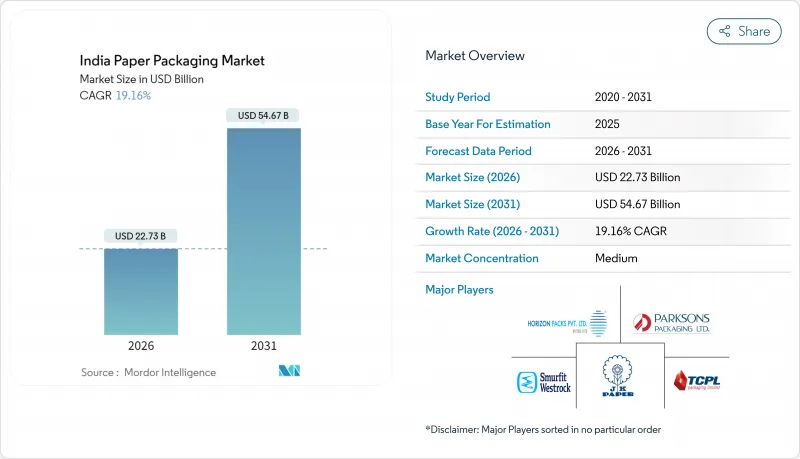
2026년 인도의 종이 포장 시장 규모는 227억 3,000만 달러로 추정되며, 2025년 190억 7,000만 달러에서 성장이 예상됩니다.
2031년까지의 예측으로는 546억 7,000만 달러에 달하고, 2026년부터 2031년에 걸쳐 CAGR 19.16%를 나타낼 전망입니다.
확대되는 전자상거래 사업, 플라스틱 사용제한 및 소비재(FMCG) 수요 증가가 함께 1차 포장·2차 포장 형식을 불문하고 경량으로 재활용 가능한 기재에 대한 수요가 높아지고 있습니다. 전 28개 주에서 특정 일회용 플라스틱의 규제 금지가 대체를 가속화하는 반면, 브랜드 소유자는 지속가능성에 대한 공약과 소비자의 기대에 부응하기 위해 고급 배리어 코팅지판에 투자를 추진하고 있습니다. 디지털 인쇄의 도입은 라벨 라인에서 이미 18%의 보급률을 달성하고 있어 유연한 생산 체제, 최종 단계에서의 커스터마이즈, 위조 방지를 지원하고 있습니다. 한편, 크래프트지 가격 변동에 대한 원재료 리스크와 비용 경쟁력이 있는 무관세 ASEAN 수입품의 압력이 이익률을 압박하고 있으며, 국내 제지 공장은 규모 확대, 후방 통합, 재생 섬유 원료 확보를 촉구하고 있습니다. 전반적으로 인도의 종이 포장 시장 진출 기업은 제품 관리의 신뢰성을 강화하고 밸류체인에서 높은 부가가치 용도를 획득하기 위해 코팅 기술, 성형 섬유 기술, 스마트 라벨 기술에 자본 투입을 추진하고 있습니다.
인도의 종이 포장 시장 동향과 인사이트
가속하는 전자상거래 물류 수요
인도는 2024년 52억 건의 온라인 배송을 처리했으며 전년 38억 건에서 증가했습니다. 이로 인해 골판지 상자 수요가 확대되고 경량 고강도 등급의 채용이 촉진되고 있습니다. 주요 플랫폼은 자동 포장 라인을 도입하여 치수를 표준화하고 공극을 줄였습니다. 빠른 상거래 사업자는 마이크로 완성 센터를 위해 설계된 소형 골판지 형식을 선호합니다. 도시에서의 디지털 결제의 보급률은 87%에 달하여 대금 상환용 봉입물의 폐지와 자재 사용량의 삭감을 가능하게 했습니다. 정기 구매형 상거래 모델은 예측 가능한 수요를 제공하고 컨버터가 전용 라인을 확보하고 원재료 계약을 체결할 수 있게 함으로써 생산량을 안정화시키고 있습니다.
FMCG 및 포장 식품의 수량 확대
포장 식품 부문은 2024년 8.2% 성장해 전국에서 12%, 대도시권에서는 35%에 달한 조직 소매업의 침투가 이를 지원했습니다. 네슬레 인디아는 생산 능력 향상을 위해 2,600캐롤 루피(29억 2,800만 달러)를 투자하여 지속적인 소비 성장에 대한 확신을 보였습니다. 농촌소득지원책은 코팅지판을 선호하는 소용량 포장의 브랜드품 수요를 자극했습니다. 조직화된 유제품 유통 채널의 연간 12% 성장에는 콜드체인 물류를위한 단열 골판지 용기가 필수적입니다. 이러한 변화는 식품 대기업과 포장 공급업체 간의 다년간 계약을 강화하여 인도 종이 포장 시장의 기반이 되는 주문량을 안정화시키고 있습니다.
크래프트 종이 원료 가격 변동
2024년 해상 운임의 상승과 에너지 비용의 변동으로 크래프트지의 스팟 가격은 15-20% 변동했습니다. 이로 인해 헤지 능력이 없는 중소 골판지 제조업체의 이익률이 압박되었습니다. 자체 제조 펄프 공장을 보유한 제지 회사는 영향을 최소화하고 통합의 가치를 부각시켰습니다. 가격 불확실성은 투자 회수 모델이 유동화되기 때문에 생산 능력 향상을 늦추고 안정적인 비용 곡선을 기대하는 브랜드 소유자와의 장기 계약을 방해합니다.
부문 분석
골판지는 2025년 인도 종이 포장 시장의 53.65% 점유율을 유지하면서 EC를 위한 내구성 요구사항과 산업 적재 요구를 배경으로 했습니다. 한편, 습기·유분 배리어를 필요로 하는 고급 FMCG(일용소비재)나 의약품 용도 수요 증가에 의해 코트지는 2031년까지 연평균 복합 성장률(CAGR)20.95%로 성장이 전망됩니다. 인도의 종이 포장 시장 규모는 2025년 59억 달러에서 2031년까지 184억 7,000만 달러에 이를 것으로 예상됩니다. 특히 공공식량유통채널에서 재생 가능한 기재를 우선하는 정부조달도 코트지 수요 증가에 기여하고 있습니다. ITC사가 800캐롤 루피(9억 110만 달러)를 투입한 배리어 코팅 라인의 건설 등, 이러한 구조적인 돌풍을 반영한 투자가 이루어지고 있습니다.
첨단 다층 크래프트 종이의 혁신으로 시멘트 봉투의 중량 삭감과 파열 강도의 유지가 양립해, 폴리프로필렌 뜨개질 봉투로부터의 점유율 획득이 진행되고 있습니다. 재생 섬유 함량의 향상과 FSC 인증의 보급이 함께 브랜드 기업의 스코프 3 탄소 삭감 달성을 지원하고 있습니다. 소재 다양화는 제지 공장을 크래프트 종이 가격 변동으로부터 보호하고, 특수 등급을 위한 인도의 종이 포장 시장을 확대하고 있습니다.
2025년에는 스낵, 과자, 퍼스널케어 제품에 최적화된 파우치·사쉐·랩에 의해 플렉서블 구조가 인도 종이 포장 시장의 53.74%를 차지했습니다. 배리어 코팅에 의한 플라스틱 프리 적층재의 실현에 의해 이 서브 카테고리는 21.55%의 연평균 복합 성장률(CAGR)을 기록하고 있습니다. 디지털 웹 인쇄기는 마이크로마켓의 선호도에 맞는 그래픽 조정을 가능하게 하고 판매 수량 증가를 뒷받침하고 있습니다. 한편, 옴니채널 브랜드가 매장 진열용과 자사 용기 배송용 디자인을 조화시키는 중, 경질 폴딩 카톤과 골판지 케이스가 확대되고 있습니다.
경질 포맷은 마이크로 플루트나 리소라미네이트의 혁신에 의해 섬유 사용량을 8-10% 삭감하면서 인쇄 정밀도를 높여 화장품이나 전자기기 분야에서의 침투를 깊게 하고 있습니다. 의약품 직렬화를 위해 설계된 카톤 보드 라인은 규제 준수에 필수적인 변조 방지 기능을 추가하여 경질 포장의 채용을 가속화하고 있습니다.
기타 혜택 :
- 엑셀 형식 시장 예측(ME) 시트
- 애널리스트 지원(3개월간)
자주 묻는 질문
목차
제1장 서론
- 조사 전제조건 및 시장 정의
- 조사 범위
제2장 조사 방법
제3장 주요 요약
제4장 시장 상황
- 시장 개요
- 시장 성장 촉진요인
- 전자상거래의 풀필먼트 수요의 가속
- 소비재(FMCG) 및 포장 식품의 수량 확대
- 특정 일회용 플라스틱 제품에 대한 정부의 금지 조치
- 브랜드 오너에 의한 고급 경량 판지로의 전환
- 디지털 인쇄 및 온디맨드 인쇄의 급속한 보급
- 공급망의 추적성과 스마트 라벨의 도입 상황
- 시장 성장 억제요인
- 크래프트지의 투입 가격 변동성
- 무관세의 ASEAN 수입품이 이익률 압박
- 인도에서의 재생 섬유의 구조적 부족
- 국내 골판지 제조 설비의 과잉 생산 능력과 시장 세분화
- 업계 밸류체인 분석
- 규제 상황
- 기술의 전망
- Porter's Five Forces 분석
- 공급기업의 협상력
- 구매자의 협상력
- 신규 참가업체의 위협
- 대체품의 위협
- 경쟁 기업 간 경쟁 관계
- 거시경제 요인이 시장에 미치는 영향
- 가격 분석 - 골판지 및 접이식 판지
- 인도 제지 산업 통계
- 종이 및 판지의 현재 생산 능력
- 생산량, 판매량 및 가동률
- 필기 용지·인쇄 용지의 내역
- 판지 및 포장용지의 내역
- 특수지 및 MG 종이의 개요
제5장 시장 규모와 성장 예측
- 재료 유형별
- 크래프트지
- 판지
- 골판지
- 기타 재료 유형
- 제품 유형별
- 유연성 종이 포장
- 파우치 및 백
- 랩 및 필름
- 기타 유연 종이 포장
- 경질 종이 포장
- 접이식 판지
- 골판지 상자
- 기타 경질 종이 포장
- 유연성 종이 포장
- 포장 형태별
- 1차 포장
- 2차 포장
- 3차/운송 포장
- 최종 이용 산업별
- 식품
- 음료
- 의료 및 의약품
- 퍼스널케어 및 화장품
- 산업 및 전자 기기
- 기타 최종 이용 산업
제6장 경쟁 구도
- 시장 집중도
- 전략적 동향
- 시장 점유율 분석
- 기업 프로파일
- Smurfit WestRock
- ITC Ltd.-Paperboards and Specialty Papers Div.
- JK Paper Ltd.
- Parksons Packaging Ltd.
- TCPL Packaging Ltd.
- Horizon Packs Pvt. Ltd.
- Oji Holdings Corp.(Oji India Packaging Pvt. Ltd.)
- Astron Paper and Board Mill Ltd.
- Kapco Packaging Ltd.
- Chaitanya Packaging Pvt. Ltd.
- Trident Paper Box Industries Pvt. Ltd.
- TGI Packaging Pvt. Ltd.
- Packman Packaging Pvt. Ltd.
- Emami Paper Mills Ltd.
- Andhra Paper Ltd.
- Pakka Ltd.
- PR Packagings Ltd.
- Total Pack Ltd.
제7장 시장 기회와 향후 전망
KTH 26.01.20India paper packaging market size in 2026 is estimated at USD 22.73 billion, growing from 2025 value of USD 19.07 billion with 2031 projections showing USD 54.67 billion, growing at 19.16% CAGR over 2026-2031.
Expansive e-commerce operations, plastic-use restrictions, and rising fast-moving consumer goods (FMCG) volumes combine to lift demand for lightweight, recyclable substrates across primary and secondary formats. Regulatory bans on selected single-use plastics in all 28 states accelerate substitution, while brand owners invest in premium barrier-coated paperboard to meet sustainability pledges and consumer expectations. Digital printing adoption, already at 18% penetration in label lines, supports agile production, late-stage customization, and counterfeit deterrence. Amid growth, raw-material exposure to kraft-paper price swings and cost-competitive zero-duty ASEAN imports pressure margins, prompting domestic mills to scale, backward-integrate, and secure recovered-fiber feedstock. Overall, India paper packaging market participants deploy capital toward coating, molded-fiber, and smart-label technologies that strengthen product stewardship credentials and capture higher-value applications along the supply chain.
India Paper Packaging Market Trends and Insights
Accelerating E-commerce Fulfillment Demand
India processed 5.2 billion online shipments in 2024 compared with 3.8 billion a year earlier, boosting corrugated-box volumes and encouraging adoption of lightweight high-strength grades. Large platforms added automated packing lines that standardize dimensions and reduce empty space. Quick-commerce operators favor compact corrugated formats designed for micro-fulfillment centers. Digital payment penetration reached 87% in urban areas, allowing removal of cash-on-delivery inserts and lowering material usage. Subscription-commerce models provide predictable demand, enabling converters to dedicate lines and secure raw-material contracts, thereby stabilizing throughput.
FMCG and Packaged-Food Volume Expansion
The packaged-food sector grew 8.2% in 2024, supported by organized retail penetration of 12% nationally and 35% in metros. Nestle India allocated INR 2,600 crore (USD 29.28 crore ) for capacity upgrades, underscoring confidence in sustained consumption growth. Rural-income support schemes stimulated demand for branded goods sold in small pack sizes that favor coated paperboard. Growth in the organized dairy channel at 12% annually requires insulated corrugated containers for cold-chain logistics. These shifts reinforce multiyear contracting between food majors and packaging suppliers, anchoring baseline order volumes for the India paper packaging market.
Kraft-paper input-price volatility
Spot kraft prices fluctuated 15-20% in 2024 due to ocean-freight spikes and energy-cost swings, eroding SME corrugator margins that lack hedging capacity. Mills with captive pulping muted exposure, underscoring integration's value. Price uncertainty delays capacity upgrades as payback models become fluid, and it hampers long-term contracts with brand owners expecting stable cost curves.
Other drivers and restraints analyzed in the detailed report include:
- Government Ban on Select Single-Use Plastics
- Rapid Adoption of Digital and On-Demand Printing
- Zero-duty ASEAN imports squeezing margins
For complete list of drivers and restraints, kindly check the Table Of Contents.
Segment Analysis
Corrugated board maintained 53.65% India paper packaging market share in 2025, driven by e-commerce durability requirements and industrial stacking needs. Yet coated paperboard registers a 20.95% CAGR to 2031, propelled by premium FMCG and pharmaceutical applications that demand moisture and grease barriers. India paper packaging market size for paperboard is projected to reach USD 18.47 billion by 2031, up from USD 5.9 billion in 2025. Coated variants also leverage government procurement favoring recyclable substrates, particularly in public food-distribution channels. Investments such as ITC's INR 800 crore (USD 9.011 crore) barrier-coating line reflect this structural tailwind.
Advanced multiwall kraft innovations cut weight in cement sacks without sacrificing burst strength, winning share from woven polypropylene. Recovered-fiber content rises alongside FSC certification uptake, helping brands achieve Scope-3 carbon reductions. Material diversification cushions mills against kraft price cycles and broadens the India paper packaging market addressable for specialized grades.
Flexible structures secured 53.74% India paper packaging market share during 2025 thanks to pouches, sachets, and wraps optimized for snack, confectionery, and personal-care items. The sub-category posts a 21.55% CAGR as barrier coatings allow plastic-free laminates. Digital web presses tune graphics to micro-market preferences, reinforcing volume gains. Meanwhile, rigid folding cartons and corrugated cases expand as omnichannel brands harmonize shelf-ready and ship-in-own-container designs.
Rigid formats benefit from micro-flute and litho-lam innovations that reduce fiber by 8-10% yet elevate print fidelity, deepening penetration in cosmetics and electronics. Cartonboard lines tailored for pharmaceutical serialization add tamper evidence crucial to regulatory compliance, accelerating rigid adoption.
The India Paper Packaging Market Report is Segmented by Material Type (Kraft Paper, Paperboard, Corrugated Board, and More), Product Type (Flexible Paper Packaging, Rigid Paper Packaging), Packaging Format (Primary Packaging, Secondary Packaging, Tertiary/Transit Packaging), End-Use Industry (Food, Beverage, Healthcare and Pharmaceuticals, and More). The Market Forecasts are Provided in Terms of Value (USD).
List of Companies Covered in this Report:
- Smurfit WestRock
- ITC Ltd. - Paperboards and Specialty Papers Div.
- JK Paper Ltd.
- Parksons Packaging Ltd.
- TCPL Packaging Ltd.
- Horizon Packs Pvt. Ltd.
- Oji Holdings Corp. (Oji India Packaging Pvt. Ltd.)
- Astron Paper and Board Mill Ltd.
- Kapco Packaging Ltd.
- Chaitanya Packaging Pvt. Ltd.
- Trident Paper Box Industries Pvt. Ltd.
- TGI Packaging Pvt. Ltd.
- Packman Packaging Pvt. Ltd.
- Emami Paper Mills Ltd.
- Andhra Paper Ltd.
- Pakka Ltd.
- P.R. Packagings Ltd.
- Total Pack Ltd.
Additional Benefits:
- The market estimate (ME) sheet in Excel format
- 3 months of analyst support
TABLE OF CONTENTS
1 INTRODUCTION
- 1.1 Study Assumptions and Market Definition
- 1.2 Scope of the Study
2 RESEARCH METHODOLOGY
3 EXECUTIVE SUMMARY
4 MARKET LANDSCAPE
- 4.1 Market Overview
- 4.2 Market Drivers
- 4.2.1 Accelerating e-commerce fulfilment demand
- 4.2.2 FMCG and packaged-food volume expansion
- 4.2.3 Government ban on select single-use plastics
- 4.2.4 Brand-owner switch to premium, lightweight board
- 4.2.5 Rapid adoption of digital and on-demand printing
- 4.2.6 Supply-chain traceability and smart-label adoption
- 4.3 Market Restraints
- 4.3.1 Kraft-paper input-price volatility
- 4.3.2 Zero-duty ASEAN imports squeezing margins
- 4.3.3 Structural shortage of recovered fibre in India
- 4.3.4 Excess domestic corrugator capacity and fragmentation
- 4.4 Industry Value Chain Analysis
- 4.5 Regulatory Landscape
- 4.6 Technological Outlook
- 4.7 Porter's Five Forces Analysis
- 4.7.1 Bargaining Power of Suppliers
- 4.7.2 Bargaining Power of Buyers
- 4.7.3 Threat of New Entrants
- 4.7.4 Threat of Substitute Products
- 4.7.5 Intensity of Competitive Rivalry
- 4.8 Impact of Macroeconomic Factors on the Market
- 4.9 Pricing Analysis - Corrugated and Folding Carton
- 4.10 India Paper Industry Statistics
- 4.10.1 Current Capacity of Paper and Paperboard
- 4.10.2 Production, Sales and Utilisation Rates
- 4.10.3 Writing and Printing Paper Breakdown
- 4.10.4 Paperboard and Packaging Paper Breakdown
- 4.10.5 Specialty and MG Paper Overview
5 MARKET SIZE AND GROWTH FORECASTS (VALUE)
- 5.1 By Material Type
- 5.1.1 Kraft Paper
- 5.1.2 Paperboard
- 5.1.3 Corrugated Board
- 5.1.4 Other Material Types
- 5.2 By Product Type
- 5.2.1 Flexible Paper Packaging
- 5.2.1.1 Pouches and Bags
- 5.2.1.2 Wraps and Films
- 5.2.1.3 Other Flexible Paper Packaging
- 5.2.2 Rigid Paper Packaging
- 5.2.2.1 Folding Carton
- 5.2.2.2 Corrugated Boxes
- 5.2.2.3 Other Rigid Paper Packaging
- 5.2.1 Flexible Paper Packaging
- 5.3 By Packaging Format
- 5.3.1 Primary Packaging
- 5.3.2 Secondary Packaging
- 5.3.3 Tertiary / Transit Packaging
- 5.4 By End-Use Industry
- 5.4.1 Food
- 5.4.2 Beverage
- 5.4.3 Healthcare and Pharmaceuticals
- 5.4.4 Personal Care and Cosmetics
- 5.4.5 Industrial and Electronic
- 5.4.6 Other End-Use Industries
6 COMPETITIVE LANDSCAPE
- 6.1 Market Concentration
- 6.2 Strategic Moves
- 6.3 Market Share Analysis
- 6.4 Company Profiles (includes Global level Overview, Market level overview, Core Segments, Financials as available, Strategic Information, Market Rank/Share for key companies, Products and Services, and Recent Developments)
- 6.4.1 Smurfit WestRock
- 6.4.2 ITC Ltd. - Paperboards and Specialty Papers Div.
- 6.4.3 JK Paper Ltd.
- 6.4.4 Parksons Packaging Ltd.
- 6.4.5 TCPL Packaging Ltd.
- 6.4.6 Horizon Packs Pvt. Ltd.
- 6.4.7 Oji Holdings Corp. (Oji India Packaging Pvt. Ltd.)
- 6.4.8 Astron Paper and Board Mill Ltd.
- 6.4.9 Kapco Packaging Ltd.
- 6.4.10 Chaitanya Packaging Pvt. Ltd.
- 6.4.11 Trident Paper Box Industries Pvt. Ltd.
- 6.4.12 TGI Packaging Pvt. Ltd.
- 6.4.13 Packman Packaging Pvt. Ltd.
- 6.4.14 Emami Paper Mills Ltd.
- 6.4.15 Andhra Paper Ltd.
- 6.4.16 Pakka Ltd.
- 6.4.17 P.R. Packagings Ltd.
- 6.4.18 Total Pack Ltd.
7 MARKET OPPORTUNITIES AND FUTURE OUTLOOK
- 7.1 White-space and Unmet-Need Assessment