

|
시장보고서
상품코드
1907321
기내식 : 시장 점유율 분석, 업계 동향 및 통계, 성장 예측(2026-2031년)Inflight Catering - Market Share Analysis, Industry Trends & Statistics, Growth Forecasts (2026 - 2031) |
||||||
 Mordor Intelligence
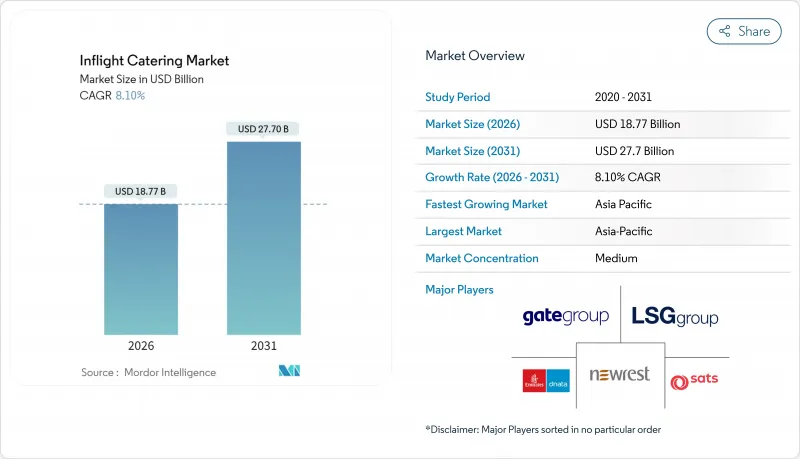
기내식 시장은 2025년 173억 6,000만 달러에서 2026년에는 187억 7,000만 달러로 성장해 2026년부터 2031년에 걸쳐 CAGR 8.10%를 나타낼 전망입니다. 2031년까지 277억 달러에 달할 것으로 예측되고 있습니다.
기록적인 여객수, 프리미엄 캐빈의 쇄신 사이클, 디지털 사전 주문 플랫폼이 합쳐져, 승객 1인당 지출액을 증가시켜, 케이터링 사업자의 가격 결정력을 유지하고 있습니다. 항공사는 갤리의 현대화, 요리사 감수 메뉴의 도입, 부수적 수요를 수익화하는 소매 메커니즘의 통합을 진행하고 있습니다. AI를 활용한 메뉴 계획과 콜드체인 자동화에 대한 투자는 폐기물 감소, 식품 원료 가격 상승에 대한 이익률 유지, 새로운 SKU 도입까지의 시간 단축을 실현합니다. 장거리 노선 증가로 인해 평균 기내식품의 복잡성은 높은 수준을 유지하는 반면, LCC(저비용 캐리어)는 단계적인 종량제 메뉴에서 새로운 수익원을 개척합니다. 할랄, 코셔, 알레르겐 대응 프로토콜에 따른 제휴는 기존 사업자를 보호하고 여러 허브 네트워크에서 전문 분야의 성장 기회를 창출합니다.
세계의 기내식 시장 동향과 인사이트
항공 여객 수 회복과 장거리 노선의 운항 능력 확대
2024년 세계 총 여객 수는 47억 명에 이르렀고, 2025년에는 49억 6,000만 명에 달했습니다. 이것은 와이드 바디기가 운항을 재개한 것으로, 유행 전의 피크를 웃도는 전망입니다. 탑승률은 83.5%로 상승하여 예비 좌석이 감소했기 때문에 케이터링 사업자는 예약 용량에 가까운 수준에서 기내식 탑재를 강요당하고 있습니다. 밸류체인의 지연에 의해 납품은 억제되고 있습니다만, 항공사는 프리미엄 클래스를 충실시킨 A350이나 B787기의 도입을 계속하고 있어, 이것에 의해 비행당의 기내 식가치는 향상하고 있습니다. 2024년 태평양 노선의 수송력은 전년 대비 12% 증가했습니다. 이것은 중국 노선의 재개와 유나이티드 항공에 의한 도쿄 하네다 공항의 새로운 슬롯 확보가 견인하고 있습니다. 12시간 구간편에서는 2시간 단거리편에 비해 1편당 지출이 보통 3배가 되기 때문에 케이터링 회사는 와이드 바디기가 취항하는 허브 공항을 우선해, 왕로와 복귀의 메뉴를 동기시키는 멀티 레그 재고 관리 시스템에 대한 투자를 추진하고 있습니다.
항공 브랜드 차별화를 위한 기내 경험의 프리미엄화
항공사는 2024년 법인 고객과 고수익 레저 수요에 대응하기 위해 프리미엄 캐빈의 개수에 20억 달러 이상을 투자했습니다. 델타항공은 셰프와의 제휴를 도입, 카타르항공은 Q스위트에서 일품요리를 제공 개시, 에미레이트 항공은 미슐랭 감수 메뉴를 쇄신하여 기내식을 코스트센터에서 브랜드 자산으로 전환했습니다. 브리티시 에어웨이즈는 2024년 지역 요리 제공과 디지털 사전 주문을 도입하여 클럽 월드 서비스를 강화했습니다. 6개월 이내에 만족도를 8포인트 향상시켰습니다. 퍼스트 클래스 기내식에는 현재 소량 생산, 전용 콜드체인 물류, 승무원의 높은 참여가 요구되고 있습니다. 이에 대해 기내식 제조업체는 조리 훈련에 대한 투자, 신속한 품질 체크, 프리미엄 식재 조달 네트워크의 구축으로 대응하고 있어 이코노미 클래스에 주력하는 경쟁자에게는 모방할 수 없는 대처입니다.
식품·인건비·광열비에 있어서 급등하는 운영 비용과 인플레이션
2024년 호주 및 아르헨티나와 같은 주요 생산 지역에서 기후 변화의 영향으로 밀, 유제품 및 닭고기의 가격은 8-12% 상승했습니다. 북미 및 유럽에서는 호스피탈리티 업계 고용주가 숙련 인력 확보·유지 경쟁을 격화시킨 결과, 케이터링 업체의 인건비가 6-9% 상승했습니다. 유럽에서는 에너지 보조금의 종료에 따라 광열비가 10-15% 급등해, 운영 경비에 한층 더 압력이 가해지고 있습니다. 또한, 2024년 11월에는 히드로 공항과 맨체스터 공항과 같은 주요 공항에서 dnata 직원이 파업을 실시하여 회사의 비용 구조 취약점이 돋보였습니다. 이러한 과제의 완화책으로서, 사업자는 자동화에 눈을 돌리고, 트레이 라인의 도입이나 에너지 절약형 칠러의 채용에 의해 이익률의 회복을 도모하고 있습니다. 그러나 자본력이 제한되는 중소사업자는 대기업과의 합병이나 시장에서의 철수의 선택을 강요받는 경우가 증가하고 있습니다.
부문 분석
기내식 서비스 시장에서는 2025년 수익의 50.78%를 차지하며 식사는 계속해서 가장 큰 부문을 차지했습니다. 그러나 간식과 간식은 현저한 성장을 보이고 있으며 CAGR 8.52%를 나타낼 전망입니다. 이 성장은 소비자의 취향의 변화를 반영하고 있으며, 항공사는 진화하는 수요에 부응하기 위해 제공 내용을 적응시키고 있습니다. 예를 들어, 카타르항공에서는 사전예약제로 15-25달러의 메제 모듬을 도입하여 가벼운 식사를 요구하는 여행자에게 대응하고 있습니다. 마찬가지로 튀르키예항공에서는 시미트나 바클라바 등 지역 특산 스낵을 메뉴에 넣어 기내 판매를 22% 증가시키고 있습니다. 음료 분야에서도 변화가 일어나고 있으며, 크래프트 맥주나 칵테일의 도입에 의해 갤리의 작업 부하를 늘리지 않고 높은 이익률을 실현하고 있습니다. 이러한 움직임은 기내식 시장이 운영상의 제약에 대처하면서 상품 라인업의 다양화를 도모하고 있음을 보여줍니다.
모듈화는 기내식 시장의 주요 동향으로 부상하며 유연성과 효율성 향상을 실현하고 있습니다. 케이터링 사업자는 현재 항공사가 노선별 요구사항에 따라 조합할 수 있는 부품 레벨 메뉴를 설계하고 있습니다. 이 방법은 소매 플랫폼과의 무결성을 도모하는 동시에 폐기물의 최소화에도 기여합니다. 기존 식사나 간식의 2자 택일을 강요받고 있던 항공사는 현재는 혼합 SKU(재고 관리 단위)를 도입해, 승객의 기호에 맞춘 유연한 대응을 실현하고 있습니다. 이러한 유연성을 통해 케이터링 기업은 폐기물 감소와 부수 수익 창출을 중심으로 새로운 협상 기회를 얻고 있습니다. 모듈화를 채택함으로써 항공사는 케이터링 업무의 최적화, 비용 절감, 승객 체험의 향상을 도모하면서 운영 효율과 지속가능성을 유지할 수 있습니다.
2025년 시점에서 풀서비스 항공사(FSC)는 기내식 시장의 56.98% 점유율을 차지하며 가장 큰 부문이 되었습니다. 이러한 이점은 광범위한 네트워크 커버리지와 다양한 승객의 취향에 부합하는 멀티 캐빈 서비스에 대한 수요에 기인합니다. FSC는 요리사 감수 메뉴와 소믈리에 선정의 와인 페어링 등 다양한 식사 옵션과 프리미엄 서비스를 제공하여 승객 경험을 향상시키고 있습니다. 이러한 제공 내용은 품질과 커스터마이즈를 중시하는 비즈니스 클래스 퍼스트 클래스 이용객에게 특히 매력적입니다. FSC가 이러한 고부가가치 서비스를 제공할 수 있다는 점이 시장에서 주도적 부문으로서의 지위를 확고하게 하고 있습니다.
반면에 저비용 캐리어(LCC)는 시장에서 가장 빠르게 성장하고 있으며 CAGR은 9.12%에 달할 전망입니다. 이 성장은 비용 의식이 높은 승객의 선호에 혁신과 적응으로 대응할 수있는 능력에 의해 뒷받침됩니다. 예를 들어, 라이언 에어는 2024 회계 연도에 식품 판매로 4억 유로의 수익을 올렸으며, 소매 서비스의 잠재력이 기존의 기내 식수익에 필적할 수 있음을 보여주었습니다. 마찬가지로 인디고는 앱 기반 기내식 박스로 거래 금액을 두배로 늘려 가격 의식이 높지만 편의성에는 대가를 지불할 의사가 있음을 보여주었습니다. LCC는 효율성과 수량 중심 전략(SKU 합리화 등)에 주력하여 확대하는 고객 기반 수요에 대응하고 있습니다. 풀서비스 항공사가 프리미엄 서비스에, LCC가 비용 효율적인 솔루션에 각각 주력하는 이 두 세대의 진화는 시장 점유율의 재분배가 아니라 기내식 시장 전체의 확대를 가져오고 있습니다.
지역별 분석
아시아태평양은 가장 큰 부문으로 부상했으며 2025년에는 세계 수익의 32.12%를 차지했습니다. 중국 국내 시장의 회복이 이 지역의 우위를 견인하고 인도에서는 대규모 공항 확장 프로젝트가 진행 중이며 동남아시아에서는 LCC가 급성장하고 있습니다. 이러한 요인들이 함께 이 지역에서 상당한 수량 성장을 지원하고 있습니다. SATS사는 방갈로르의 주방에 4,500만 달러를 투자해, 일일 생산 능력을 4만kg으로 확대했습니다. 인도에서 예측되는 연간 3억 명의 여객 수요에 대응합니다. 베트남항공 케이터링도 론탄공항시설 입찰을 획득하여 2026년까지 하루 3만식 생산을 계획하고 있습니다. 이 지역은 2031년까지 연평균 복합 성장률(CAGR) 8.71%를 나타낼 전망입니다. 한편, 일본이나 한국 등의 성숙시장에서는 ISO규격의 업그레이드 요건을 충족할 수 없는 소규모 사업자가 대기업에 흡수되는 형태로 업계 재편이 진행되고 있습니다.
중동 및 아프리카는 절대 규모야말로 작은 것, 다른 지역에 비해 높은 이익률을 누리고 있습니다. 에미레이트 항공 케이터링은 2023-2024년도에 9억 7,000만 디르함(2억 6,413만 달러)의 외부 수익을 보고해 전년 대비 11% 증가했습니다. 카타르 항공기 케이터링은 2024년 도하에서의 사업 확대로 하루 1만 5,000식의 생산 능력을 추가했습니다. dnata는 사우디아와의 합작 사업을 시작하여 2026년까지 하루 5만식의 생산 능력 달성을 목표로 하고 있습니다. 이러한 진전에도 불구하고 아프리카의 일부 지역에서는 인프라 격차가 여전히 존재합니다. 그러나 에티오피아와 케냐의 허브 항공사는 이 지역에서 초기 단계의 성장을 유지하고 있습니다. 중동 및 아프리카 시장은 이러한 전략적 이니셔티브와 파트너십에 힘입어 꾸준한 발전을 이루려고 합니다.
북미와 유럽은 안정적인 시장이지만 성장 속도는 둔화 경향이 있습니다. 2023년 루프트한자가 LSG를 아우렐리우스에 매각함에 따라 자산 합리화가 진행되어 게이트 그룹, dnata, 플라잉 푸드 그룹이 지역 수익의 약 절반을 차지하는 상황이 되었습니다. 델타 항공은 50개의 미국 거점에서 게이트 그룹과의 10년에 걸친 계약을 갱신하여 퇴비화 가능한 포장이나 폐기물 전용 등 지속가능성 목표에 주력하고 있습니다. 이 지역에서는 입찰 평가에서 기술력, 신뢰성 및 지속가능성이 점점 더 중요해지고 있으며, 저비용 과제에 큰 진입 장벽이 생깁니다. 이러한 시장에서의 성장은 여전히 완만한 것으로, 혁신과 환경 책임에 중점이 경쟁 구도를 형성하고 업무 개선을 추진하고 있습니다.
기타 혜택 :
- 엑셀 형식 시장 예측(ME) 시트
- 애널리스트 지원(3개월간)
자주 묻는 질문
목차
제1장 서론
- 조사 전제조건 및 시장 정의
- 조사 범위
제2장 조사 방법
제3장 주요 요약
제4장 시장 상황
- 시장 개요
- 시장 성장 촉진요인
- 항공 여객수의 회복과 장거리 노선공급력 증가
- 항공 브랜드 차별화를 위한 기내 체험의 프리미엄화
- LCC 및 하이브리드 항공사 확대, 기내 판매 및 사전 주문 모델 확대
- 디지털화 : 사전 주문, 데이터 구동형 메뉴 계획, 주방의 자동화
- 미활용의 냉동 조리 완료 식품(FFM) 네트워크를 활용한 세계의 SKU 표준화
- 항공기·엔진 납품의 병목에 의해 신뢰성이 높고 낭비를 생략한 케이터링에 수요 증진
- 시장 성장 억제요인
- 식품·인건비·광열비에 있어서 급등하는 운영 비용과 인플레이션 압력
- 엄격한 복수 관할 구역에 걸친 식품 안전 기준 및 할랄/코셔 대응
- 단거리 노선에 있어서 시간적 제약과 BYOF(반입식)의 보급이 국내 노선의 서비스 범위 축소
- 계약/소매의 구성 비율의 변화에 의해 수익 증가에도 불구하고 기내식 탑재량 감소
- 밸류체인 분석
- 규제 상황
- 기술의 전망
- Porter's Five Forces 분석
- 신규 참가업체의 위협
- 공급기업의 협상력
- 구매자의 협상력
- 대체품의 위협
- 경쟁 기업 간 경쟁 관계
제5장 시장 규모와 성장 예측
- 식품 유형별
- 식사
- 제빵 및 제과
- 스낵 및 간식류
- 음료
- 비행 유형별
- 풀서비스 항공사(FSC)
- 저비용 항공사(LCC)
- 기타 항공편 유형
- 항공기 좌석 등급별
- 이코노미
- 비즈니스
- 퍼스트
- 기내식 유형별
- 클래식(무료 제공 및 사전 주문)
- 기내 판매(기내 구매)
- 비행 시간별
- 단거리 노선
- 장거리 노선
- 지역별
- 북미
- 미국
- 캐나다
- 멕시코
- 유럽
- 영국
- 프랑스
- 독일
- 이탈리아
- 스페인
- 기타 유럽
- 아시아태평양
- 중국
- 인도
- 일본
- 한국
- 기타 아시아태평양
- 남미
- 브라질
- 기타 남미
- 중동 및 아프리카
- 중동
- 사우디아라비아
- 이스라엘
- 아랍에미리트(UAE)
- 기타 중동
- 아프리카
- 남아프리카
- 기타 아프리카
- 중동
- 북미
제6장 경쟁 구도
- 시장 집중도
- 전략적 동향
- 시장 점유율 분석
- 기업 프로파일
- gategroup
- LSG Group
- Emirates Group
- DO & CO Aktiengesellschaft
- Newrest Group Services SAS
- SATS Ltd.
- CATRION
- Cathay Pacific Catering Services(HK)Limited
- KLM Catering Services
- Qatar Aircraft Catering Company WLL
- GCG
- ANA Catering Service Co., Ltd.
- Air Fayre
- Flying Food Group
- Air Gourmet, Inc.
- Taj SATS Air Catering Limited
- China Eastern Airlines Corporation Limited
- BAC Group
제7장 시장 기회와 향후 전망
KTH 26.01.20The inflight catering market is expected to grow from USD 17.36 billion in 2025 to USD 18.77 billion in 2026 and is forecast to reach USD 27.7 billion by 2031 at 8.10% CAGR over 2026-2031.
Recorded passenger volumes, a premium-cabin refresh cycle, and digital pre-order platforms collectively increase per-passenger spend and sustain pricing power for caterers. Airlines are modernizing galleys, rolling out chef-curated menus, and embedding retail mechanics that monetize ancillary demand. Investments in AI-driven menu planning and cold-chain automation reduce waste, defend margins against food commodity inflation, and shorten the time to introduce new SKUs. Long-haul capacity additions maintain high average meal complexity, while low-cost carriers (LCCs) unlock new revenue through tiered, pay-as-you-go menus. Partnerships that align with halal, kosher, and allergen protocols protect incumbents and open avenues for specialized growth across multi-hub networks.
Global Inflight Catering Market Trends and Insights
Rebound in Air Passenger Traffic and Long-Haul Capacity Additions
Global passenger totals reached 4.7 billion in 2024 and are projected to touch 4.96 billion in 2025, surpassing pre-pandemic peaks as wide-body fleets rejoin service. Load factors rose to 83.5%, reducing buffer seats and forcing caterers to uplift closer to booked capacity. Although supply-chain delays curb deliveries, airlines continue to add premium-heavy A350 and B787 aircraft, thereby increasing the value of per-flight catering. Transpacific capacity increased 12% year-over-year in 2024, driven by the resumption of Chinese routes and United's securing of new Tokyo-Haneda slots. Because a 12-hour sector typically loads triple the per-flight spend of a 2-hour hop, caterers prioritize wide-body hubs and invest in multi-leg inventory systems that synchronize outbound and return menus.
Premiumization of Onboard Experience to Differentiate Airline Brands
Airlines invested over USD 2 billion in premium-cabin retrofits during 2024 to serve corporate travelers and high-yield leisure traffic. Delta introduced chef partnerships, Qatar Airways rolled out a la carte dining in Qsuite, and Emirates refreshed Michelin-inspired menus, shifting catering from a cost center to a brand asset. British Airways enhanced its Club World service in 2024 with regional dishes and digital pre-order, boosting satisfaction by eight points within six months. First-class catering now requires small-batch production, dedicated cold-chain logistics, and higher crew engagement. Caterers respond with investment in culinary training, rapid-response quality checks, and premium-ingredient procurement networks that economy-focused rivals cannot match.
High Operating Costs and Inflation Across Food, Labor, and Utilities
Wheat, dairy, and poultry prices increased by 8-12% in 2024 due to climatic disruptions in key producing regions, such as Australia and Argentina. Labor costs for caterers rose by 6-9% across North America and Europe as employers in the hospitality industry faced intensified competition to attract and retain skilled talent. In Europe, utility costs surged by 10-15% following the termination of energy subsidies, adding further pressure on operational expenses. Additionally, dnata staff at major airports, such as Heathrow and Manchester, staged walkouts in November 2024, highlighting vulnerabilities in their cost structures. To mitigate these challenges, operators have turned to automation, implementing tray lines and adopting energy-efficient chillers to recover profit margins. However, smaller players, constrained by limited capital, are increasingly compelled to either merge with larger entities or exit the market entirely.
Other drivers and restraints analyzed in the detailed report include:
- Expansion of LCCs and Hybrids, Scaling Buy-On-Board and Pre-Order Models
- Digitalization: Pre-Order, Data-Driven Menu Planning, Kitchen Automation
- Stringent Multi-Jurisdiction Food Safety and Halal/Kosher Compliance
For complete list of drivers and restraints, kindly check the Table Of Contents.
Segment Analysis
Meals continue to dominate the inflight catering market, accounting for 50.78% of the revenue in 2025, making it the largest segment. However, snacks and savouries are witnessing significant growth, expanding at a CAGR of 8.52%. This growth reflects changing consumer preferences, with airlines adapting their offerings to meet evolving demands. For instance, Qatar Airways has introduced mezze platters priced between USD 15 and USD 25 for pre-order, catering to travelers seeking lighter meal options. Similarly, Turkish Airlines has increased its onboard sales by 22% by incorporating regional snacks, such as simit and baklava, into its menu. Beverages are also transforming, with the inclusion of craft brews and mocktails that provide higher profit margins without increasing galley workload. These developments highlight the in-flight catering market's efforts to diversify product offerings while addressing operational constraints.
Modularization is emerging as a key trend in the inflight catering market, enabling greater flexibility and efficiency. Caterers are now designing component-level menus that airlines can mix and match based on specific route requirements. This approach not only aligns with retail platforms but also helps in minimizing waste. Airlines that previously faced a binary choice between offering meals or snacks are now deploying mixed stock-keeping units (SKUs), allowing for a more tailored approach to passenger preferences. This flexibility provides caterers with new opportunities to negotiate based on waste reduction and the generation of ancillary revenue. By adopting modularization, airlines can optimize their catering operations, reduce costs, and enhance the overall passenger experience, all while maintaining operational efficiency and sustainability.
Full-service carriers (FSCs) accounted for 56.98% of the market share in 2025, making them the largest segment in the inflight catering market. This dominance is attributed to their extensive network coverage and the demand for multi-cabin services, which cater to a wide range of passenger preferences. FSCs offer a variety of meal options and premium services, including chef-curated menus and sommelier-selected wine pairings, which enhance the overall passenger experience. These offerings are particularly appealing to business and first-class travelers, who prioritize quality and customization. The ability of FSCs to provide such high-touch services has solidified their position as the leading segment in the market.
Meanwhile, low-cost carriers (LCCs) are experiencing the fastest growth in the market, with a CAGR of 9.12%. This growth is driven by their ability to innovate and adapt to the preferences of cost-sensitive passengers. For instance, Ryanair generated EUR 400 million in food sales during fiscal 2024, showcasing the potential of retail offerings to rival traditional catering revenues. Similarly, IndiGo doubled its transaction value through app-based meal boxes, demonstrating that passengers are willing to pay for convenience despite being price-conscious. LCCs focus on efficiency and volume-driven strategies, such as SKU rationalization, to meet the demands of their growing customer base. This dual-track evolution, with FSCs focusing on premium services and LCCs on cost-effective solutions, is expanding the overall inflight catering market rather than redistributing market share.
The Inflight Catering Market Report is Segmented by Food Type (Meals, Bakery and Confectionery, and More), Flight Type (Full-Service Carriers, Low-Cost Carriers, and More), Aircraft Seating Class (Economy, Business, and First), Catering Type (Classic, and More), Flight Duration (Short-Haul, and Long-Haul), and Geography (North America, South America, Europe, and More). The Market Forecasts are Provided in Terms of Value (USD).
Geography Analysis
The Asia-Pacific region emerged as the largest segment, contributing 32.12% of the global revenue in 2025. China's domestic market recovery drives the region's dominance, India's extensive airport expansion projects, and the rapid growth of LCCs in Southeast Asia. These factors collectively underpin the significant growth in volume in the region. SATS has invested USD 45 million in a Bengaluru kitchen, increasing its daily capacity to 40,000 kg to cater to India's projected 300 million annual passengers. Vietnam Airlines Caterers has also secured the Long Thanh facility tender, with plans to produce 30,000 meals daily by 2026. The region is expected to grow at a CAGR of 8.71% through 2031. Meanwhile, mature markets like Japan and South Korea are consolidating as larger players absorb smaller competitors unable to meet ISO upgrade requirements.
The Middle East and Africa, while smaller in absolute scale, enjoy higher margins compared to other regions. Emirates Flight Catering reported AED 970 million (USD 264.13 million) in external revenue for fiscal 2023-24, reflecting an 11% year-on-year increase. Qatar Aircraft Catering expanded its operations in Doha by adding 15,000 meals daily in 2024. dnata has entered into a joint venture with Saudia, aiming to achieve a daily production capacity of 50,000 meals by 2026. Despite these advancements, infrastructure gaps persist in certain parts of Africa. However, hub carriers in Ethiopia and Kenya are sustaining nascent growth in the region. The Middle East and Africa markets are poised for steady development, supported by these strategic initiatives and partnerships.
North America and Europe represent steady but slower-growing markets. Lufthansa's sale of LSG to Aurelius in 2023 triggered asset rationalization, leaving gategroup, dnata, and Flying Food Group with approximately half of the regional revenue. Delta Airlines renewed a decade-long contract with gategroup across 50 US stations, focusing on sustainability goals such as compostable packaging and waste diversion. These regions are increasingly prioritizing technology, reliability, and sustainability in bid evaluations, which has created significant entry barriers for low-cost challengers. While growth in these markets remains moderate, the emphasis on innovation and environmental responsibility is shaping the competitive landscape and driving operational improvements.
- gategroup
- LSG Group
- Emirates Group
- DO & CO Aktiengesellschaft
- Newrest Group Services SAS
- SATS Ltd.
- CATRION
- Cathay Pacific Catering Services (H.K.) Limited
- KLM Catering Services
- Qatar Aircraft Catering Company W.L.L.
- GCG
- ANA Catering Service Co., Ltd.
- Air Fayre
- Flying Food Group
- Air Gourmet, Inc.
- Taj SATS Air Catering Limited
- China Eastern Airlines Corporation Limited
- BAC Group
Additional Benefits:
- The market estimate (ME) sheet in Excel format
- 3 months of analyst support
TABLE OF CONTENTS
1 INTRODUCTION
- 1.1 Study Assumptions and Market Definition
- 1.2 Scope of the Study
2 RESEARCH METHODOLOGY
3 EXECUTIVE SUMMARY
4 MARKET LANDSCAPE
- 4.1 Market Overview
- 4.2 Market Drivers
- 4.2.1 Rebound in air passenger traffic and long-haul capacity additions
- 4.2.2 Premiumization of onboard experience to differentiate airline brands
- 4.2.3 Expansion of LCCs and hybrids, scaling buy-on-board and pre-order models
- 4.2.4 Digitalization: pre-order, data-driven menu planning, automation in kitchens
- 4.2.5 Underutilized fresh-frozen meal (FFM) networks enabling global SKU standardization
- 4.2.6 Aircraft/engine delivery bottlenecks shift demand toward reliable, waste-aware catering
- 4.3 Market Restraints
- 4.3.1 High operating costs and inflation across food, labor, and utilities
- 4.3.2 Stringent, multi-jurisdiction food safety and halal/kosher compliance
- 4.3.3 Short-haul time constraints and BYOF eroding service scope on domestic routes
- 4.3.4 Contract/retail mix shifts reducing meals uplifted despite revenue growth
- 4.4 Value Chain Analysis
- 4.5 Regulatory Landscape
- 4.6 Technological Outlook
- 4.7 Porter's Five Forces Analysis
- 4.7.1 Threat of New Entrants
- 4.7.2 Bargaining Power of Suppliers
- 4.7.3 Bargaining Power of Buyers
- 4.7.4 Threat of Substitutes
- 4.7.5 Intensity of Competitive Rivalry
5 MARKET SIZE AND GROWTH FORECASTS (VALUE)
- 5.1 By Food Type
- 5.1.1 Meals
- 5.1.2 Bakery and Confectionery
- 5.1.3 Snacks and Savouries
- 5.1.4 Beverages
- 5.2 By Flight Type
- 5.2.1 Full-Service Carriers (FSC)
- 5.2.2 Low-Cost Carriers (LCC)
- 5.2.3 Other Flight Types
- 5.3 By Aircraft Seating Class
- 5.3.1 Economy
- 5.3.2 Business
- 5.3.3 First
- 5.4 By Catering Type
- 5.4.1 Classic (Complimentary and Pre-ordered)
- 5.4.2 Retail On Board (Buy-on-board)
- 5.5 By Flight Duration
- 5.5.1 Short-Haul
- 5.5.2 Long-Haul
- 5.6 By Geography
- 5.6.1 North America
- 5.6.1.1 United States
- 5.6.1.2 Canada
- 5.6.1.3 Mexico
- 5.6.2 Europe
- 5.6.2.1 United Kingdom
- 5.6.2.2 France
- 5.6.2.3 Germany
- 5.6.2.4 Italy
- 5.6.2.5 Spain
- 5.6.2.6 Rest of Europe
- 5.6.3 Asia-Pacific
- 5.6.3.1 China
- 5.6.3.2 India
- 5.6.3.3 Japan
- 5.6.3.4 South Korea
- 5.6.3.5 Rest of Asia-Pacific
- 5.6.4 South America
- 5.6.4.1 Brazil
- 5.6.4.2 Rest of South America
- 5.6.5 Middle East and Africa
- 5.6.5.1 Middle East
- 5.6.5.1.1 Saudi Arabia
- 5.6.5.1.2 Israel
- 5.6.5.1.3 United Arab Emirates
- 5.6.5.1.4 Rest of Middle East
- 5.6.5.2 Africa
- 5.6.5.2.1 South Africa
- 5.6.5.2.2 Rest of Africa
- 5.6.5.1 Middle East
- 5.6.1 North America
6 COMPETITIVE LANDSCAPE
- 6.1 Market Concentration
- 6.2 Strategic Moves
- 6.3 Market Share Analysis
- 6.4 Company Profiles (includes Global level Overview, Market level overview, Core Segments, Financials as available, Strategic Information, Market Rank/Share for key companies, Products and Services, and Recent Developments)
- 6.4.1 gategroup
- 6.4.2 LSG Group
- 6.4.3 Emirates Group
- 6.4.4 DO & CO Aktiengesellschaft
- 6.4.5 Newrest Group Services SAS
- 6.4.6 SATS Ltd.
- 6.4.7 CATRION
- 6.4.8 Cathay Pacific Catering Services (H.K.) Limited
- 6.4.9 KLM Catering Services
- 6.4.10 Qatar Aircraft Catering Company W.L.L.
- 6.4.11 GCG
- 6.4.12 ANA Catering Service Co., Ltd.
- 6.4.13 Air Fayre
- 6.4.14 Flying Food Group
- 6.4.15 Air Gourmet, Inc.
- 6.4.16 Taj SATS Air Catering Limited
- 6.4.17 China Eastern Airlines Corporation Limited
- 6.4.18 BAC Group
7 MARKET OPPORTUNITIES AND FUTURE OUTLOOK
- 7.1 White-space and Unmet-Need Assessment


