
|
시장보고서
상품코드
1910433
증거 관리 시장 : 점유율 분석, 업계 동향, 통계, 성장 예측(2026-2031년)Evidence Management - Market Share Analysis, Industry Trends & Statistics, Growth Forecasts (2026 - 2031) |
||||||
 Mordor Intelligence
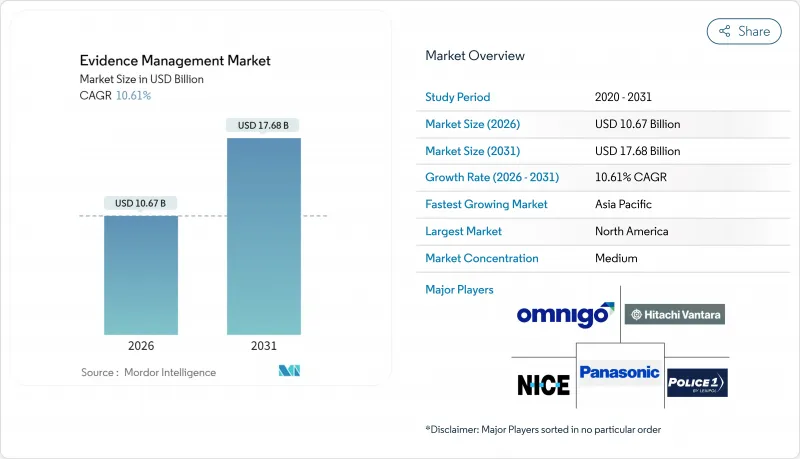
증거 관리 시장은 2025년 96억 5,000만 달러로 평가되었고, 2026년에는 106억 7,000만 달러, 2026년부터 2031년에 걸쳐 CAGR 10.61%로 성장하고 2031년까지 176억 8,000만 달러에 달할 것으로 예상됩니다.

이 급속한 확대는 기관이 기본적인 On-Premise 스토리지에서 급증하는 멀티미디어 증거를 수집, 분류, 분석하는 클라우드 우선 AI 대응 생태계로 전환하고 있음을 반영합니다. 이미 모든 워크플로우의 63.63%를 지원하는 클라우드 도입은 구독 가격, 자동 스케일링, FedRAMP/CJIS 준거에 의한 자본 비용과 조달 마찰의 저감에 의해 On-Premise형을 능가하고 있습니다. 동시에 사법지원국에 의한 4억 달러 규모의 바디카메라 기금 등 연방정부 및 주정부의 적극적인 조성 프로그램이 소규모 부서에서도 증거의 관리 연쇄, 얼굴인식, 음성문자 변환 기능을 표준 장비한 카메라와 소프트웨어의 통합 패키지 도입을 촉진하고 있습니다. 하드웨어는 여전히 가장 큰 수익원이지만, AI 분석, 콜드 스토리지 계층화, 법정 프레젠테이션 모듈의 통합에 벤더의 전문지식을 요구하는 기관이 늘어나는 가운데, 프로페셔널 서비스와 매니지드 서비스가 가장 급성장하고 있는 항목입니다. 병행하여 스마트 시티 모니터링 네트워크, 5G 백홀 및 엣지 컴퓨팅 노드는 매월 페타바이트 규모의 영상을 지자체의 증거 보관실로 유입합니다. 이를 통해 관리자는 사일로화 된 기록 보관실에서 무기, 차량, 번호판을 거의 실시간으로 식별 할 수있는 통합 및 기관 횡단 리포지토리로의 전환을 강요합니다.
세계 증거 관리 시장 동향과 인사이트
세계 범죄율 상승이 디지털 증거 수요를 촉진
폭력 범죄와 사이버 사기의 사건 수는 여전히 높은 수준으로 추이하고 있으며, 검찰 당국은 유죄 판결의 확실성을 높이기 위해 의심의 여지가없는 디지털 증거를 요구하고 있습니다. 순찰 경찰이 매달 생성하는 영상 데이터는 40-60시간에 달하고, 2020년 기준치의 4배로 증가했습니다. 이를 통해 기록 관리 부서는 DVD 아카이브를 폐지하고 모든 클립을 자동 인덱싱하는 확장 가능한 클라우드 라이브러리로 마이그레이션해야 합니다. 증거 관리 플랫폼에 글자와 기능을 통합한 시스템을 도입한 부서에서는 수백 테라바이트의 영상 데이터를 키워드 검색할 수 있기 때문에 증거 공개 프로세스가 몇 주간 단축되고 있습니다. 도시 지역에서 번호판 리더와 음향식 총성 감지 센서가 도입됨에 따라 메타데이터 스트림이 동일한 리포지토리로 유입되어 상황 인식이 강화되고 기소까지의 시간이 단축되고 있습니다. 이러한 AI 지원형 허브가 없으면, 증거의 체류가 발생해, 공공의 신뢰나 재판의 효율성을 손상시키는 리스크가 있습니다.
경찰 조직에서 바디 카메라 및 자동차 카메라의 보급
현재 세계 20,000개 이상의 기관이 바디 카메라를 도입하고 있으며 캐나다 왕립 기마 경찰의 2024년 전국 프로그램과 같은 대규모 도입은 이 기술의 주류화를 증명하고 있습니다. 각 경찰관은 작업 당 8-12GB의 데이터를 생성하고 장치가 도킹되면 자동으로 업로드되므로 수동으로 파일 전송이 필요하지 않습니다. 현대의 증거 관리 시장 소프트웨어는 전송중의 영상을 암호화해, 변조 방지 해시를 할당해, 각 클립을 CAD(컴퓨터 지원 출동 지령) 사건 번호와 연계하는 것으로, 촬영 현장으로부터 법정까지의 감사 추적을 구축합니다. 각 공급업체는 무제한 Tier 1 스토리지와 AI를 통한 정보 숨기기 기능을 번들로 제공하는 사례가 증가하고 있으며, 고객을 여러년계약에 묶어 예측 가능한 운영 비용을 보장합니다. 대시 카메라와 UAV(무인 항공기)의 영상이 더해지는 가운데, 멀티 센서 영상의 통합 기술에 의해 분석 담당자는 용의자를 거리에서 골목까지 추적하여 체포할 수 있으며 배심원에게 원활한 이야기를 제공함으로써 유죄 판결률의 향상에 기여하고 있습니다.
장기 클라우드 콜드 스토리지의 고비용
CJIS(사법정보시스템)의 의무에 따라 경찰서는 살인사건의 영상을 수십년에 걸쳐 보존할 필요가 있으며, 월 1GB당 0.08-0.12달러의 비용이 빠르게 증가하고 있습니다. 연간 5PB를 보관하는 중형 경찰 조직의 경우 스토리지 비용만으로 연간 50만 달러 이상을 지출합니다. 하이브리드 계층화(진행중인 사건용 핫 버킷, 종료 안건용 그레이서 계층)으로 비용이 줄어들지만 검색 수수료와 감사 요구 사항은 예산 편성을 복잡하게 합니다. 벤더는 정액제의 「무제한 보존」플랜으로 대항합니다만, 독자적인 포맷에 기관을 묶어 마이그레이션을 방해합니다. 따라서 지방정부의 재무책임자는 다년간 클라우드 계약을 승인하기 전에 엄격한 총 비용 모델을 요구하고 증거 관리 시장 전체의 전개를 늦추고 있습니다.
부문 분석
클라우드 워크플로우는 2025년 증거 관리 시장 점유율의 62.95%를 차지했고 2031년까지 연평균 복합 성장률(CAGR) 12.03%로 확대될 것으로 전망됩니다. 이 이점은 On-Premise 환경에서 실현하기 어려운 신속한 프로비저닝, 사용량 기반 요금 및 통합 AI 툴킷으로 인해 발생합니다. 운송 보안청이 공항 영상용 클라우드 보관소를 전국 배포한 것은 연방 정부가 타사 인프라를 신뢰하고 있음을 보여줍니다. 각 기관은 세계의 CDN을 활용하고 중요한 영상을 몇 초 안에 검찰관에게 스트리밍 전달함으로써 배송 지연을 해소하고 있습니다. 한편, 하이브리드 모델은 소환장 대응 지연을 우려하는 팀을 만족시키고 있습니다. 최신 영상을 로컬 기기에 캐시하면서 야간 아카이브를 클라우드에 동기화하는 구조입니다. 클라우드의 탄력적인 엣지 노드는 카메라 내 해석조차 가능하게 하고, 무기를 포착 후 불과 몇 초만에 깃발을 붙이기 때문에 복수 기관 합동 임무 부대의 사실상의 기간 기반이 되고 있습니다.
주권 데이터법이나 저지연 자율 운용이 불가결한 환경(기존 데이터센터를 가지는 대도시 경찰 등)에서는 On-Premise 도입이 계속됩니다. 그러나 이러한 환경에서도 대규모 이벤트 시에는 자본 지출의 급증을 피하기 위해 클라우드 버스트 용량을 추가하는 경향이 강해지고 있습니다. 벤더는 이 변화를 감지하고 On-Premise 클라이언트로의 기능 이식에 앞서 클라우드 우선으로 업데이트를 릴리스, 클라우드를 증거 관리 시장의 주요 제공 모델로 정착시키는 선순환을 강화하고 있습니다.
하드웨어는 2025년의 수익의 48.17%를 차지해, 제1세대의 바디 카메라가 4K 및 광다이나믹 레인지 대응 기종이나 5G 백홀 대응의 견고한 대시 카메라에 계속적으로 치환되고 있는 것을 반영하고 있습니다. 각 하드웨어 주문에는 일반적으로 다년간 계약된 SaaS 라이선스가 번들되어 예측 가능한 지속적인 수익원을 확보합니다. 서비스 분야는 절대액으로는 소규모이지만, 11.28%의 연평균 복합 성장률(CAGR)로 성장을 지속하여 있어 각 부서가 데이터 마이그레이션, 사용자 트레이닝, 정책 설정을 벤더 주도의 팀에 위탁하는 경향이 배경에 있습니다. 이 추세는 서비스 분야에 할당된 증거 관리 시장 규모와 일치하며, 2031년까지 44억 7,000만 달러 이상에 달할 것으로 예측됩니다.
소프트웨어 수익은 하드웨어의 발자취를 쫓지만, 기관이 조성금을 고갈시켜 증거 분석, 전사 및 법정 준비 포장으로 전환하면 더욱 가속화됩니다. 크로스 플랫폼 SDK는 제3자 개발자에게 편집 기능, 번호판 인식, 증거 보관 기록 대시보드의 개발을 촉구하여 생태계의 정착성을 높입니다. 시간이 지남에 따라 차별화 가치는 카메라 본체가 아니라 검토 작업을 70% 절감하는 AI 모델에 존재하며 통합된 하드웨어와 소프트웨어의 스택이 우선 조달 패키지로 정착합니다.
지역별 분석
북미는 2025년에 37억 1,000만 달러의 매출을 올렸으며, 이는 전 세계 증거 시장 점유율의 38.48%에 해당합니다. 이는 정착한 바디 카메라 의무화 정책과 조달 사이클을 완충하는 풍부한 보조금 제도의 혜택 때문입니다. 18,000개 지자체 부문에 걸쳐 기관 간 협력이 지속적인 갱신 수요를 촉진하고, 주 의회는 플랫폼 상호 운용성을 입법화하고 있으며, CJIS 및 NIJ 가이드라인에 따른 소프트웨어 업그레이드에 새로운 자금을 이끌고 있습니다. 벤더 각사는 음성 번역 기능이나 경관의 자동 익명화 흐림 처리 등의 연구 개발 기능을, 미국 대도시권의 경찰 조직에서 시험 도입한 후, 해외 전개하는 것이 많습니다.
아시아태평양은 현시점에서는 규모가 작은 것, 인도, 중국, 싱가포르, 일본의 스마트 시티망이 수백만대의 IoT 렌즈를 집중 관리 시스템에 접속하는 움직임에 의해 11.45%라고 하는 가장 빠른 CAGR을 기록하고 있습니다. 각국의 부처는 AI를 활용한 상황 분석을 우선하고, 관민 컨소시엄이 데이터 주권 규칙을 충족시키는 대규모 클라우드 포드의 자금 조달을 담당하고 있습니다. 일본 경찰청은 2026년까지 전체 순회 경찰관에 바디 카메라 배치를 계획하고 있으며 지속적인 하드웨어와 라이선싱 수요를 창출합니다. 한편 인도의 지방도시에서는 델리와 뭄바이의 첨단적인 도입 사례가 모방되어 다국어 문자 발생이나 법정내 재생 툴의 하류 수요를 가속화하고 있습니다.
유럽에서는 회원국 간에 표준화된 증거 형식을 요구하는 국경 간 정보 프레임워크를 배경으로 진전을 볼 수 있습니다. GDPR(EU 개인정보보호규정)은 공급업체에 대한 세분화된 보존 로직과 시민들의 삭제 워크플로우의 통합을 의무화하고 있으며, 이는 현재 다른 지역의 기능 요구에 영향을 미치고 있습니다. 라틴아메리카와 중동은 새로운 프론티어입니다. 도시화와 공공 안전 예산 증가가 드론 영상, 소셜 미디어 스크래핑, 실시간 영상 분석을 조합한 파일럿 프로젝트를 촉진하고 있습니다. 지방부의 대역폭 부족에도 불구하고 위성 백홀과 5G 고정 무선 액세스가 커버리지 확대를 지원하고 새로운 데이터센터를 건설하지 않고 모든 관할 구역이 신뢰할 수 있는 증거 관리 시장 솔루션을 이용할 수 있게 되었습니다.
기타 혜택 :
- 엑셀 형식 시장 예측(ME) 시트
- 애널리스트에 의한 3개월간의 지원
자주 묻는 질문
목차
제1장 서론
- 조사의 전제조건과 시장의 정의
- 조사 범위
제2장 조사 방법
제3장 주요 요약
제4장 시장 상황
- 시장 개요
- 시장 성장 촉진요인
- 세계 범죄율 상승이 디지털 증거 수요를 촉진
- 경찰 조직에 있어서의 바디 카메라 및 차량용 카메라의 보급
- 공공안전기술 업그레이드를 위한 정부 예산 지원 확대
- 스마트시티에 의해 생성되는 멀티미디어 데이터의 폭발적 성장
- AI를 활용한 분석 기술에 의한 증거 처리의 지연 해소
- 부처 간 데이터 상호 운용성 의무화
- 시장 성장 억제요인
- 장기적인 클라우드 및 콜드 스토리지의 고비용
- 사이버 보안 및 데이터 무결성 취약성
- 관할 구역의 데이터 주권에 관한 법적 불확실성(UTR)
- 농어촌 지역 치안 현장의 제한적인 광대역 네트워크 연결성
- 업계 밸류체인 분석
- 규제 상황
- 기술의 전망
- Porter's Five Forces 분석
- 신규 참가업체의 위협
- 구매자의 협상력
- 공급기업의 협상력
- 대체품의 위협
- 경쟁 기업간 경쟁 관계
제5장 시장 규모와 성장 예측
- 전개별
- On-Premise
- 클라우드
- 컴포넌트별
- 하드웨어
- 바디캠
- 차량용 블랙박스 대시캠
- 도시 관제 카메라
- 대중교통 영상 보안 장비
- 소프트웨어
- 서비스(컨설팅, 교육, 지원)
- 하드웨어
- 증거 유형별
- 디지털 증거
- 동영상
- 음성
- 이미지
- 문서
- 물리적 증거 메타데이터
- 디지털 증거
- 최종 사용자별
- 법 집행 기관
- 교통 행정 기관
- 연방 정부 기관 및 국방 기관
- 법원 및 검찰청
- 보험사
- 지역별
- 북미
- 미국
- 캐나다
- 멕시코
- 남미
- 브라질
- 아르헨티나
- 기타 남미
- 유럽
- 독일
- 영국
- 프랑스
- 이탈리아
- 스페인
- 네덜란드
- 기타 유럽
- 아시아태평양
- 중국
- 일본
- 인도
- 한국
- 호주
- 기타 아시아태평양
- 중동 및 아프리카
- 중동
- 사우디아라비아
- 아랍에미리트(UAE)
- 튀르키예
- 기타 중동
- 아프리카
- 남아프리카
- 이집트
- 기타 아프리카
- 중동
- 북미
제6장 경쟁 구도
- 시장 집중도
- 전략적 동향
- 시장 점유율 분석
- 기업 프로파일
- NICE Ltd.
- QueTel Corporation
- Lexipol LLC
- Hitachi Vantara Corporation
- Panasonic Holdings Corporation
- Motorola Solutions, Inc.
- Oracle Corporation
- CaseGuard LLC
- COBAN Technologies, Inc.
- Porter Lee Corporation
- Finalcover LLC
- International Business Machines Corporation
- Axon Enterprise, Inc.
- Genetec Inc.
- Digital Ally, Inc.
- Veritone, Inc.
- Tyler Technologies, Inc.
- Safe Fleet Holdco, Inc.
- Reveal Media Ltd.
- Utility Associates, Inc.
- Getac Technology Corporation
- StorMagic Ltd.
제7장 시장 기회와 장래의 전망
SHW 26.01.26The Evidence Management market is expected to grow from USD 9.65 billion in 2025 to USD 10.67 billion in 2026 and is forecast to reach USD 17.68 billion by 2031 at 10.61% CAGR over 2026-2031.
This swift expansion reflects agencies' shift from basic on-premise storage toward cloud-first, AI-enabled ecosystems that collect, classify, and analyze rapidly growing volumes of multimedia evidence. Cloud deployment, which already supports 63.63% of total workflows, continues to outpace on-premise alternatives because subscription pricing, auto-scaling, and FedRAMP / CJIS compliance reduce both capital cost and procurement friction. At the same time, aggressive federal and state grant programs, such as the Bureau of Justice Assistance's USD 400 million body-camera fund, are pushing even small departments toward integrated camera-plus-software bundles that guarantee chain-of-custody, facial recognition, and speech-to-text functions out of the box. Hardware still contributes the single largest revenue stream, but professional and managed services are the fastest growing line item as agencies seek vendor expertise to integrate AI analytics, cold-storage tiering, and courtroom presentation modules. In parallel, smart-city surveillance networks, 5G backhaul, and edge compute nodes are injecting petabytes of video into municipal evidence vaults every month, compelling administrators to migrate from siloed record rooms to unified, cross-agency repositories able to flag weapons, vehicles, or license plates in near real time.
Global Evidence Management Market Trends and Insights
Rising Global Crime Rate Boosting Digital-Evidence Demand
Violent-crime and cyber-fraud caseloads remain elevated, prompting prosecutors to demand indisputable digital proof for successful convictions.Patrol officers now generate 40-60 hours of video each month, quadruple the 2020 baseline, forcing records units to abandon DVD archives for elastic cloud libraries that auto-index every clip. Departments adopting Evidence Management market platforms with built-in transcription shave weeks off discovery timelines because detectives can keyword search across hundreds of terabytes of footage. As cities add license-plate readers and acoustic gunshot sensors, metadata streams flood into the same repositories, strengthening situational awareness and speeding time-to-charge. Without these AI-assisted hubs, agencies risk evidence backlogs that undermine public trust and trial efficiency.
Proliferation of Body-Worn and In-Car Cameras Among Police Forces
More than 20,000 agencies worldwide now deploy body cameras, and large rollouts, such as the Royal Canadian Mounted Police's 2024 national program, prove the technology's mainstream status. Each officer produces 8-12 GB of data per shift, which is automatically uploaded once the device docks, eliminating the need for manual file transfer. Modern Evidence Management market software encrypts footage in transit, assigns tamper-proof hashes, and links every clip to CAD incident numbers, creating a cradle-to-courtroom audit trail. Vendors increasingly bundle unlimited tier-one storage and AI redaction, locking customers into multi-year contracts while guaranteeing predictable operating expense. As dash-cam and UAV footage join the mix, multi-sensor stitching enables analysts to track a suspect from the street to the alley to arrest, providing jurors with a seamless narrative that enhances conviction rates.
High Long-Term Cloud and Cold-Storage Costs
CJIS mandates push departments to retain homicide footage for decades, and at USD 0.08-0.12 per GB per month, expenses climb quickly. A mid-size force archiving 5 PB per year spends more than USD 500,000 annually just on storage. Hybrid tiers mitigate cost, hot buckets for active cases, glacier tiers for closed files, but retrieval fees and audit requirements complicate budgeting. Vendors counter with flat-rate "all you can store" plans yet lock agencies into proprietary formats that hinder migration. Municipal CFOs therefore demand rigorous total-cost models before greenlighting multi-year cloud contracts, slowing the broader Evidence Management market rollout.
Other drivers and restraints analyzed in the detailed report include:
- Government Funding Waves for Public-Safety Technology Upgrades
- AI-Driven Analytics to Clear Evidence Backlogs
- Cyber-Security and Data-Integrity Vulnerabilities
For complete list of drivers and restraints, kindly check the Table Of Contents.
Segment Analysis
Cloud workflows generated 62.95% of Evidence Management market share in 2025 and are projected to expand at a 12.03% CAGR through 2031. This dominance stems from rapid provisioning, usage-based billing and integrated AI toolkits that on-prem setups rarely match. The Transportation Security Administration's national rollout of a cloud vault for airport footage underlines federal confidence in third-party infrastructure. Agencies tap global CDNs to stream critical clips to prosecutors within seconds, eliminating courier delays. Meanwhile, hybrid models appease teams worried about subpoena latency by caching recent footage in local appliances while syncing archives to the cloud overnight. Cloud's elastic edge nodes even enable in-camera analytics, flagging a weapon just seconds after capture, making it the de-facto backbone for multi-agency task forces.
On-premise deployments persist where sovereign-data statutes or low-latency autonomous operation is critical, such as large metropolitan forces with existing data centers. Yet even those environments increasingly bolt on cloud burst capacity during major events to avoid capital spikes. Vendors, sensing the shift, now release updates cloud-first before porting features to on-prem clients, reinforcing a virtuous cycle that cements the cloud as the primary Evidence Management market delivery model.
Hardware captured 48.17% of 2025 revenues, reflecting continual replacement of first-generation body cameras with 4K, wide-dynamic-range units and rugged dash cams built for 5G backhaul. Each hardware order typically bundles multiyear SaaS licenses, ensuring predictable annuity streams. Services, though smaller in absolute terms, are on pace for an 11.28% CAGR, as departments outsource data migration, user training and policy configuration to vendor-led teams. That trend aligns with the Evidence Management market size allocated to services, which is expected to surpass USD 4.47 billion by 2031.
Software revenue follows hardware footprints yet accelerates once agencies exhaust grant funds and shift to evidence analytics, transcription and courtroom-ready packaging. Cross-platform SDKs invite third-party developers to craft redaction, license-plate recognition and chain-of-custody dashboards, widening ecosystem stickiness. Over time, differentiating value lies not in the camera itself but in AI models that cut review labor by 70%, cementing integrated hardware-plus-software stacks as the preferred procurement package.
The Evidence Management Market Report is Segmented by Deployment (On-Premises and Cloud), Component (Hardware, Software, and Services), Evidence Type (Digital Evidence and Physical Evidence Metadata), End User (Law-Enforcement Agencies, Transportation Agencies, Federal and Defense Agencies, Courts and Prosecutors, and Insurance Companies), and Geography. The Market Forecasts are Provided in Terms of Value (USD).
Geography Analysis
North America generated USD 3.71 billion in 2025, equal to 38.48% of the global Evidence Management market share, and benefits from entrenched body-cam mandates plus rich grant funnels that cushion procurement cycles. Agency collaboration across 18,000 municipal departments drives consistent refresh demand, and state legislatures continue to legislate platform interoperability, funneling new funds into software upgrades that align with CJIS and NIJ guidelines. Vendors often pilot R&D features, speech translation, automatic officer de-identifier blurring, within U.S. metropolitan forces before exporting them.
Asia-Pacific, though smaller today, posts the fastest 11.45% CAGR as smart-city grids in India, China, Singapore and Japan plug millions of IoT lenses into centralized vaults. Regional ministries prioritize AI-enabled situational analytics, and public-private consortia finance large-scale cloud pods to satisfy data-sovereignty rules. Japan's National Police Agency expects to equip every patrol officer with a body camera by 2026, creating an ongoing hardware and license pipeline. Meanwhile, India's tier-2 cities replicate flagship deployments from Delhi and Mumbai, accelerating downstream demand for multilingual transcription and in-courtroom replay tools.
Europe advances on the back of cross-border intelligence frameworks that require standardized evidentiary formats among member states. GDPR compels vendors to embed fine-grained retention logic and citizen-deletion workflows that are now influencing feature requests in other regions. Latin America and the Middle East represent emerging frontiers; urbanization and rising public-safety budgets spur pilot projects that bundle drone video, social-media scraping and real-time video analytics. Despite bandwidth gaps in rural provinces, satellite backhaul and 5G Fixed Wireless Access help extend coverage, ensuring every jurisdiction can now subscribe to a credible Evidence Management market solution without erecting new data centers.
- NICE Ltd.
- QueTel Corporation
- Lexipol LLC
- Hitachi Vantara Corporation
- Panasonic Holdings Corporation
- Motorola Solutions, Inc.
- Oracle Corporation
- CaseGuard LLC
- COBAN Technologies, Inc.
- Porter Lee Corporation
- Finalcover LLC
- International Business Machines Corporation
- Axon Enterprise, Inc.
- Genetec Inc.
- Digital Ally, Inc.
- Veritone, Inc.
- Tyler Technologies, Inc.
- Safe Fleet Holdco, Inc.
- Reveal Media Ltd.
- Utility Associates, Inc.
- Getac Technology Corporation
- StorMagic Ltd.
Additional Benefits:
- The market estimate (ME) sheet in Excel format
- 3 months of analyst support
TABLE OF CONTENTS
1 INTRODUCTION
- 1.1 Study Assumptions and Market Definition
- 1.2 Scope of the Study
2 RESEARCH METHODOLOGY
3 EXECUTIVE SUMMARY
4 MARKET LANDSCAPE
- 4.1 Market Overview
- 4.2 Market Drivers
- 4.2.1 Rising global crime rate boosting digital-evidence demand
- 4.2.2 Proliferation of body-worn and in-car cameras among police forces
- 4.2.3 Government funding waves for public-safety technology upgrades
- 4.2.4 Explosive growth in multimedia data generated by smart cities
- 4.2.5 AI-driven analytics to clear evidence backlogs
- 4.2.6 Cross-agency data-interoperability mandates
- 4.3 Market Restraints
- 4.3.1 High long-term cloud and cold-storage costs
- 4.3.2 Cyber-security and data-integrity vulnerabilities
- 4.3.3 Legal uncertainty over jurisdictional data sovereignty (UTR)
- 4.3.4 Limited broadband connectivity in rural policing (UTR)
- 4.4 Industry Value Chain Analysis
- 4.5 Regulatory Landscape
- 4.6 Technological Outlook
- 4.7 Porter's Five Forces Analysis
- 4.7.1 Threat of New Entrants
- 4.7.2 Bargaining Power of Buyers
- 4.7.3 Bargaining Power of Suppliers
- 4.7.4 Threat of Substitutes
- 4.7.5 Intensity of Competitive Rivalry
5 MARKET SIZE AND GROWTH FORECASTS (VALUE)
- 5.1 By Deployment
- 5.1.1 On-premises
- 5.1.2 Cloud
- 5.2 By Component
- 5.2.1 Hardware
- 5.2.1.1 Body-worn Cameras
- 5.2.1.2 Vehicle Dash Cameras
- 5.2.1.3 Citywide Cameras
- 5.2.1.4 Public Transit Video
- 5.2.2 Software
- 5.2.3 Services (Consulting, Training, Support)
- 5.2.1 Hardware
- 5.3 By Evidence Type
- 5.3.1 Digital Evidence
- 5.3.1.1 Video
- 5.3.1.2 Audio
- 5.3.1.3 Image
- 5.3.1.4 Documents
- 5.3.2 Physical Evidence Metadata
- 5.3.1 Digital Evidence
- 5.4 By End User
- 5.4.1 Law-Enforcement Agencies
- 5.4.2 Transportation Agencies
- 5.4.3 Federal and Defense Agencies
- 5.4.4 Courts and Prosecutors
- 5.4.5 Insurance Companies
- 5.5 By Geography
- 5.5.1 North America
- 5.5.1.1 United States
- 5.5.1.2 Canada
- 5.5.1.3 Mexico
- 5.5.2 South America
- 5.5.2.1 Brazil
- 5.5.2.2 Argentina
- 5.5.2.3 Rest of South America
- 5.5.3 Europe
- 5.5.3.1 Germany
- 5.5.3.2 United Kingdom
- 5.5.3.3 France
- 5.5.3.4 Italy
- 5.5.3.5 Spain
- 5.5.3.6 Netherlands
- 5.5.3.7 Rest of Europe
- 5.5.4 Asia-Pacific
- 5.5.4.1 China
- 5.5.4.2 Japan
- 5.5.4.3 India
- 5.5.4.4 South Korea
- 5.5.4.5 Australia
- 5.5.4.6 Rest of Asia-Pacific
- 5.5.5 Middle East and Africa
- 5.5.5.1 Middle East
- 5.5.5.1.1 Saudi Arabia
- 5.5.5.1.2 United Arab Emirates
- 5.5.5.1.3 Turkey
- 5.5.5.1.4 Rest of Middle East
- 5.5.5.2 Africa
- 5.5.5.2.1 South Africa
- 5.5.5.2.2 Egypt
- 5.5.5.2.3 Rest of Africa
- 5.5.5.1 Middle East
- 5.5.1 North America
6 COMPETITIVE LANDSCAPE
- 6.1 Market Concentration
- 6.2 Strategic Moves
- 6.3 Market Share Analysis
- 6.4 Company Profiles (includes Global-level Overview, Market-level Overview, Core Segments, Financials as available, Strategic Information, Market Rank/Share for key companies, Products and Services, and Recent Developments)
- 6.4.1 NICE Ltd.
- 6.4.2 QueTel Corporation
- 6.4.3 Lexipol LLC
- 6.4.4 Hitachi Vantara Corporation
- 6.4.5 Panasonic Holdings Corporation
- 6.4.6 Motorola Solutions, Inc.
- 6.4.7 Oracle Corporation
- 6.4.8 CaseGuard LLC
- 6.4.9 COBAN Technologies, Inc.
- 6.4.10 Porter Lee Corporation
- 6.4.11 Finalcover LLC
- 6.4.12 International Business Machines Corporation
- 6.4.13 Axon Enterprise, Inc.
- 6.4.14 Genetec Inc.
- 6.4.15 Digital Ally, Inc.
- 6.4.16 Veritone, Inc.
- 6.4.17 Tyler Technologies, Inc.
- 6.4.18 Safe Fleet Holdco, Inc.
- 6.4.19 Reveal Media Ltd.
- 6.4.20 Utility Associates, Inc.
- 6.4.21 Getac Technology Corporation
- 6.4.22 StorMagic Ltd.
7 MARKET OPPORTUNITIES AND FUTURE OUTLOOK
- 7.1 White-space and Unmet-need Assessment