|
시장보고서
상품코드
1934597
미국의 치과용 의료기기 : 시장 점유율 분석, 업계 동향과 통계, 성장 예측(2026-2031년)United States Dental Devices - Market Share Analysis, Industry Trends & Statistics, Growth Forecasts (2026 - 2031) |
||||||
 Mordor Intelligence
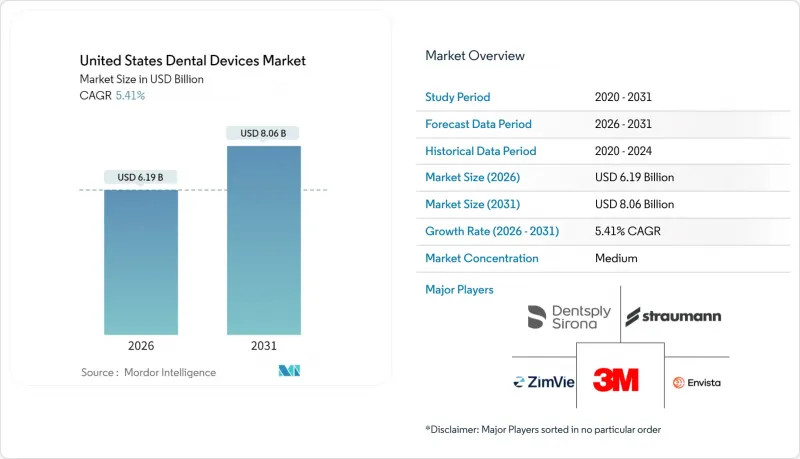
미국의 치과용 의료기기 시장은 2025년 58억 7,000만 달러에서 2026년에는 61억 9,000만 달러로 성장하고, 2026-2031년 CAGR 5.41%로 성장을 지속하여, 2031년까지 80억 6,000만 달러에 이를 것으로 예측되고 있습니다.
다중 거점 치과 서비스 조직(DSO)의 확대, 의료상 필요한 치과 치료에 대한 메디케어 적용 범위 확대, 인공지능(AI) 영상 진단 플랫폼의 급속한 통합으로 구매 우선순위가 재편되고 있습니다. 치과에서는 구강 내 스캔, AI 지원 엑스레이 촬영, 원내 CAD/CAM 밀링, 클라우드 기반 치료 계획을 연계하는 엔드투엔드 디지털 워크플로우로의 전환이 진행되고 있습니다. DSO는 대량 구매 계약을 활용하여 수백 개의 진료실에 걸쳐 이러한 시스템을 표준화함으로써 단위 수요를 주도하는 동시에 독립 개업의가 더 높은 자본 장벽에 직면하는 양극화 환경을 조성하고 있습니다. 동시에 환자의 최소침습적, 미용적 시술에 대한 수요가 증가함에 따라 치과용 레이저, 생체 활성 세라믹, 재생 재료의 사용이 증가하고 있으며, 이 모든 것이 확대되는 디지털 생태계와의 상호 운용성을 보장해야 합니다.
미국 치과용 의료기기 시장 동향 및 인사이트
치과 지원 조직(DSO)의 확대로 장비 대량 구매 가속화
사모펀드 지원 DSO는 연간 17.6%의 속도로 성장하고 있으며, AI 지원 센서, 체어사이드 밀링 장치, 클라우드 구독을 다년 계약으로 묶는 전국 단위의 계약을 협상 중입니다. 표준화된 도입은 제조업체의 예측 가능한 피드백 루프를 형성하고, 기기별이 아닌 플랫폼 기반의 제품 로드맵을 촉진합니다. 여전히 치과 진료소의 75% 이상을 차지하는 독립 개원의들은 이러한 투자를 따라잡기 위해 고군분투하고 있으며, 그 결과 미국 치과 장비 시장의 디지털 격차가 확대되고 있습니다.
메디케어 어드밴티지 치과 혜택 확대로 첨단 영상 진단 수요 증가
2025년부터 말기 신장질환에 대한 투석 관련 치과 검진이 메디케어 급여 대상에 포함됨에 따라, 진료소에서는 청구 근거로 구강과 전신의 연관성을 기록할 수 있는 콘빔 CT나 고해상도 파노라마 장비의 도입이 진행되고 있습니다. 플로리다, 펜실베니아 등 고령화가 진행되고 있는 주에서는 이미 영상진단기기 주문이 급증하고 있습니다.
민간 의료보험에 따른 과도한 비용 부담
2024년 소비자물가지수(CPI)에서 치과 서비스는 의료비 구성 요소의 11%를 차지하며, 고가의 장비가 필요한 첨단 시술에 대한 환자의 수용을 방해하는 비용 부담 문제를 부각시키고 있다(1).
부문 분석
2025년 치과 장비는 미국 치과 장비 시장의 44.05%를 차지했습니다. 이는 DSO(치과 서비스 조직)가 완전 디지털 진료실을 대량으로 구매했기 때문입니다. 연속 촬영 광학 시스템을 갖춘 구강 내 스캐너는 클라우드 기반 CAD 워크플로우의 입구 역할을 하고 있습니다. 치과용 소모품은 6.5%의 연평균 복합 성장률(CAGR)을 보일 것으로 예측되며, 온디맨드 수지, 생체활성 시멘트, 체어사이드 인쇄 가능 재료에 대한 수요 증가가 기여하고 있습니다.
치료용 레이저는 경조직 및 연조직 시술에 보급이 진행되고 있으며, 클라우드 연결형 밀링유닛은 원격 설계 협업이 가능합니다. CAD/CAM 벤더는 생태계에 대한 인클로저를 중시: 덴츠플라이 실로나의 DS Core 플랫폼은 이미지, 계획, 제작 데이터 스트림을 동기화하여 구독 수익의 기반이 되고 있습니다. 장비 서비스 번들은 초기 비용을 상쇄하고, 클리닉이 큰 자본 지출 없이도 프리미엄 기술을 사용할 수 있도록 합니다. 이 방법은 미국 치과 장비 시장 전체에서 점점 더 널리 보급되고 있습니다.
미국 치과 장비 시장 보고서는 제품별(일반 진단 장비, 치료 장비, 치과용 소모품, 기타 치과 장비), 치료별(교정, 근관치료, 치주 치료, 보철 치과), 최종사용자별(병원, 클리닉, 기타 최종사용자)로 분류되어 있습니다. 시장 규모와 예측은 위의 모든 부문에 대해 금액(USD)으로 제공됩니다.
기타 특전:
- 엑셀 형식 시장 예측(ME) 시트
- 애널리스트의 3개월간 지원
자주 묻는 질문
목차
제1장 서론
제2장 조사 방법
제3장 주요 요약
제4장 시장 구도
제5장 시장 규모와 성장 예측
제6장 경쟁 구도
LSH 26.03.05The United States Dental Devices Market is expected to grow from USD 5.87 billion in 2025 to USD 6.19 billion in 2026 and is forecast to reach USD 8.06 billion by 2031 at 5.41% CAGR over 2026-2031.
Expansion of multi-location Dental Service Organizations (DSOs), widening Medicare coverage for medically necessary dentistry, and rapid integration of artificial-intelligence (AI) imaging platforms are reshaping purchasing priorities. Clinics are moving toward end-to-end digital workflows that link intraoral scanning, AI-assisted radiography, in-office CAD/CAM milling, and cloud-based treatment planning. DSOs use bulk-buy agreements to standardize these systems across hundreds of operatories, driving unit demand while creating a two-tier environment in which independent offices face steeper capital hurdles. Simultaneously, patient demand for minimally invasive and cosmetic procedures is increasing the use of dental lasers, bioactive ceramics, and regenerative materials, all of which must be interoperable with the expanding digital ecosystem.
United States Dental Devices Market Trends and Insights
Expansion of Dental Support Organizations (DSOs) Accelerating Bulk Equipment Purchases
Private-equity-backed DSOs are expanding at a rate of 17.6% annually and negotiating national contracts that bundle AI-ready sensors, chairside mills, and cloud subscriptions into multi-year packages. Standardized rollouts create predictable feedback loops for manufacturers, encouraging platform-based rather than device-specific product roadmaps. Independent practices, which still make up over 75% of offices, struggle to match these investments, thereby widening the digital divide within the United States dental device market.
Increased Medicare Advantage Dental Benefits Stimulating Advanced Imaging Demand
Starting in 2025, Medicare will reimburse dental examinations linked to dialysis for end-stage renal disease, triggering clinics to acquire cone-beam CT and high-resolution panoramic units capable of documenting oral-systemic links for claim justification. States with older demographics, such as Florida and Pennsylvania, are reporting early spikes in imaging equipment orders.
Excessive Costs Involved in Private Health Insurance
Dental services account for 11% of the medical-care component in the 2024 Consumer Price Index, underscoring affordability challenges that dampen patient uptake of advanced procedures requiring premium equipment [1].
Other drivers and restraints analyzed in the detailed report include:
- Growing Demand for Minimally Invasive Laser Dentistry in Cosmetic Procedures
- Rising Integration of AI-Enhanced Digital Radiography for Precision Diagnostics
- Up-Front Capital Expenditure Barrier for Small Independent Practices
For complete list of drivers and restraints, kindly check the Table Of Contents.
Segment Analysis
Dental Equipment held 44.05% of the United States dental device market in 2025, as DSOs bulk-purchased fully digital operatories. Intraoral scanners, now equipped with continuous-capture optics, serve as entry points to cloud-based CAD workflows. Dental Consumables, projected at a 6.5% CAGR, are benefiting from on-demand resins, bioactive cements, and chairside printable materials.
Therapeutic lasers are gaining traction for hard and soft tissue procedures, and cloud-connected milling units enable remote design collaboration. CAD/CAM vendors emphasize ecosystem lock-in: Dentsply Sirona's DS Core platform synchronizes imaging, planning, and fabrication data streams, underpinning subscription revenues. Equipment service bundles offset up-front costs, enabling clinics to access premium technology without significant capital outlays-an approach increasingly popular across the United States dental device market.
The United States Dental Devices Market Report is Segmented by Product (General Diagnostics Equipment, Therapeutic Equipment, Dental Consumables, and Other Dental Device), Treatment (Orthodontic, Endodontic, Periodontic, and Prosthodontic), and End User (Hospitals, Clinics, and Other End Users). The Market Sizes and Forecasts are Provided in Terms of Value (USD) for all the Above Segments.
List of Companies Covered in this Report:
- Dentsply Sirona
- Envista
- Align Technology
- Henry Schein
- Straumann Group
- A-dec
- 3 Shape
- Planmeca
- Carestream Dental
- Patterson Companies
- GC Corporation
- OverJet Inc.
- Ivoclar Vivadent
- Midmark
- ZimVie
- Ultradent Products
- Young Innovations
- Air Techniques Inc.
- DEXIS
- Hu-Friedy Group (Cantel)
Additional Benefits:
- The market estimate (ME) sheet in Excel format
- 3 months of analyst support
TABLE OF CONTENTS
1 Introduction
- 1.1 Study Assumptions & Market Definition
- 1.2 Scope of the Study
2 Research Methodology
3 Executive Summary
4 Market Landscape
- 4.1 Market Overview
- 4.2 Market Drivers
- 4.2.1 Expansion of Dental Support Organizations (DSOs) Accelerating Bulk Equipment Purchases
- 4.2.2 Increased Medicare Advantage Dental Benefits Stimulating Advanced Imaging Demand
- 4.2.3 Growing Demand for Minimally-Invasive Laser Dentistry in Cosmetic Procedures
- 4.2.4 Rising Integration of AI-Enhanced Digital Radiography for Precision Diagnostics
- 4.2.5 Rapid Adoption of Chairside CAD/CAM Systems Among U.S. Private Practices
- 4.2.6 State-Level Infection-Control Mandates Fueling Sterilization Equipment Replacement
- 4.3 Market Restraints
- 4.3.1 Excessive Costs Involved in Private Health Insurance
- 4.3.2 Up-Front Capital Expenditure Barrier for Small Independent Practices
- 4.3.3 High Learning Curve & Workflow Disruption Hindering Full-Suite Digital Adoption
- 4.3.4 Supply-Chain Volatility for Electronic Components Lengthening Lead Times
- 4.4 Supply-Chain Analysis
- 4.5 Regulatory Landscape
- 4.6 Technological Outlook
- 4.7 Porter's Five Forces
- 4.7.1 Threat of New Entrants
- 4.7.2 Bargaining Power of Suppliers
- 4.7.3 Bargaining Power of Buyers
- 4.7.4 Threat of Substitutes
- 4.7.5 Competitive Rivalry
5 Market Size & Growth Forecasts (Value, USD Billion)
- 5.1 By Product
- 5.1.1 Diagnostics Equipment
- 5.1.1.1 Dental Laser
- 5.1.1.2 Radiology Equipment
- 5.1.1.3 Dental Chair and Equipment
- 5.1.1.4 Therapeutic Equipment
- 5.1.1.4.1 Dental Hand Pieces
- 5.1.1.4.2 Electrosurgical Systems
- 5.1.1.4.3 CAD/CAM Systems
- 5.1.1.4.4 Milling Equipment
- 5.1.1.4.5 Casting Machine
- 5.1.1.4.6 Other Therapeutic Equipments
- 5.1.1.5 Dental Consumables
- 5.1.1.5.1 Dental Biomaterial
- 5.1.1.5.2 Dental Implants
- 5.1.1.5.3 Crowns and Bridges
- 5.1.1.5.4 Other Dental Consumables
- 5.1.1.6 Other Dental Devices
- 5.1.2 By Treatment
- 5.1.2.1 Orthodontic
- 5.1.2.2 Endodontic
- 5.1.2.3 Peridontic
- 5.1.2.4 Prosthodontic
- 5.1.3 By End User
- 5.1.3.1 Dental Hospitals
- 5.1.3.2 Dental Clinics
- 5.1.3.3 Academic & Research Institutes
- 5.1.1 Diagnostics Equipment
6 Competitive Landscape
- 6.1 Market Share Analysis
- 6.2 Company Profiles (includes Global-level Overview, Market-level Overview, Core Segments, Financials as available, Strategic Information, Market Rank/Share, Products & Services, Recent Developments)
- 6.2.1 Dentsply Sirona Inc.
- 6.2.2 Envista Holdings Corporation
- 6.2.3 Align Technology Inc.
- 6.2.4 Henry Schein Inc.
- 6.2.5 Institut Straumann AG
- 6.2.6 A-dec Inc.
- 6.2.7 3Shape A/S
- 6.2.8 Planmeca Oy
- 6.2.9 Carestream Dental LLC
- 6.2.10 Patterson Companies Inc.
- 6.2.11 GC America Inc.
- 6.2.12 OverJet Inc.
- 6.2.13 Ivoclar Vivadent AG
- 6.2.14 Midmark Corporation
- 6.2.15 ZimVie Inc.
- 6.2.16 Ultradent Products Inc.
- 6.2.17 Young Innovations Inc.
- 6.2.18 Air Techniques Inc.
- 6.2.19 DEXIS
- 6.2.20 Hu-Friedy Group (Cantel)
- 6.3 Market Opportunities & Future Outlook
- 6.3.1 White-Space & Unmet-Need Assessment