|
시장보고서
상품코드
1934824
유럽의 가정용 에너지 관리 시스템 : 시장 점유율 분석, 업계 동향과 통계, 성장 예측(2026-2031년)Europe Home Energy Management System - Market Share Analysis, Industry Trends & Statistics, Growth Forecasts (2026 - 2031) |
||||||
 Mordor Intelligence
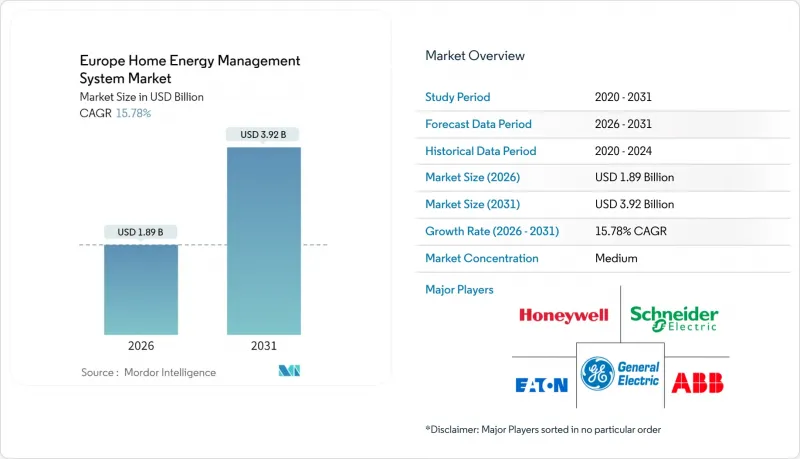
유럽의 가정용 에너지 관리 시스템 시장은 2025년에 16억 3,000만 달러로 평가되었으며, 2026년 18억 9,000만 달러에서 2031년까지 39억 2,000만 달러에 달할 것으로 예측됩니다.
예측 기간(2026-2031년)의 CAGR은 15.78%로 예상됩니다.
EU 청정에너지 패키지에 따른 스마트 미터 의무 도입은 지속적인 주택용 전력 가격 상승, 공간 난방 및 모빌리티의 전기화 가속화와 함께 수요 확대에 유리한 환경을 조성하고 있습니다. 2025년부터 6,000-100,000kWh 소비량 구간에서 스마트 미터 도입을 의무화하는 독일의 규제, 스페인에서 전면 도입된 동적 요금체계, 영국의 단계적 수요 유연성 프로그램 등은 정책의 광범위한 정합성을 보여주고 있습니다. Matter-over-Thread 기술과 인공지능을 활용한 분석 기술의 융합으로 투자 회수 기간이 단축되고 장치 도입이 간소화되었습니다. 경쟁 전략은 현재 에너지, HVAC, 태양광, 배터리, 전기자동차 충전 제어를 통합하고 통합된 사용자 인터페이스로 관리하는 생태계 파트너십을 강조하고 있습니다.
유럽의 가정용 에너지 관리 시스템 시장 동향 및 인사이트
EU 청정에너지 패키지에 따른 스마트 미터 도입 의무화 추진
2023년 개정된 독일의 메세스텐베트리브스게제트(Messstellenbetriebsgesetz)에서는 2025년 말까지 20%, 2030년까지 95%의 보급률을 목표로 하는 중간 목표가 설정되었습니다. 재생에너지 보급률이 증가함에 따라 전력계통 운영자는 유연한 부하 조정을 위해 상세한 소비 데이터를 필요로 하고 있습니다. 2024년 9월까지 100만 대가 설치되어 2023년 이전 도입 속도의 3배에 달합니다. 그러나 회원국마다 기준이 제각각이기 때문에 CEN-CENELEC이 최소한의 사이버 보안 사양을 개발했음에도 불구하고 시장 분열의 위험이 발생하고 있습니다.
에너지 위기 이후 가정용 전기요금 폭등
2024년 말 기준 유럽 평균 주택용 전기요금은 100kWh당 28.72유로이며, 2019년 대비 35% 상승했습니다. 독일 주택의 경우 100kWh당 39.43 유로에 도달하여 수요측면 유연성에 대한 투자 사례에 힘을 실어주고 있습니다. 변동형 계약으로 재생에너지 비율이 높은 기간에는 34%의 요금 인하가 가능하지만, 의무화 요금제 제공이 임박했음에도 불구하고 가구의 인지도는 27%에 불과한 것으로 나타났습니다.
기존 제어장치에 비해 높은 초기 하드웨어 비용 절감
종합적인 HEMS 도입의 평균 비용은 1,000 유로로 50-100 유로의 온도조절기 대체품에 비해 매우 비싸서 가격에 민감한 지역에서는 도입에 어려움을 겪고 있습니다. 구독 모델은 도입 비용을 절감할 수 있지만,월 10-20유로의 이용료가 누적되어 평생 비용에 대한 우려가 커지고 있습니다. 부품 부족으로 인해 2024년 반도체 가격이 15-25% 상승하여 태양광발전 설비가 없는 가정에서는 투자 회수 기간이 3년 이상 소요될 수 있습니다. 태양광발전 설비가 있는 가정에서는 연간 400-500유로를 절약할 수 있는 경우도 마찬가지다.
부문 분석
2025년 기준, 하드웨어는 가정용 에너지 관리 시스템 시장의 54.45%를 차지할 것으로 예상되며, 스마트 미터 게이트웨이와 지능형 컨트롤러의 의무화가 시장에 미치는 영향을 강조하고 있습니다. 유틸리티 클라우드 분석이 수요를 분산시키는 가운데, 서비스 부문의 CAGR 22.90%는 구독형 최적화에 대한 수요 증가를 반영하고 있습니다. 서비스 번들은 유지보수 요건을 완화하고 자본 지출을 운영 지출로 전환하기 때문에 예산 제약이 있는 가정에 매력적입니다. 전압 조정 및 주파수 응답과 같은 지연에 민감한 기능에는 여전히 에지 기반 처리가 필수적입니다. 벤더들은 하드웨어 수명을 연장하는 무선 펌웨어 업데이트를 통합하고 있으며, 구독 계층은 분석의 깊이, 수요 응답 참여, P2P 거래 액세스를 통해 차별화를 꾀하고 있습니다.
스마트 미터 도입 의무화의 지속으로 하드웨어 수익은 견조하게 유지될 것입니다. 그러나 플랫폼 제공 업체들은 2031년까지 지속적인 서비스를 주요 수익원으로 삼고, 서드파티 디바이스 도입 지원과 보험사 연계형 안전진단을 번들로 제공하게 될 것입니다. 하드웨어와 소프트웨어의 융합으로 실시간 양방향 통신이 가능해졌으며, 슈나이더 일렉트릭, ABB, 레그랑은 기존 전기 인프라 기반을 활용하여 서비스 교차판매를 추진하고 있습니다. 주택용 에너지관리 시스템(HEMS) 서비스 시장 규모는 주택 유연성에 대한 규제 인센티브 확대에 힘입어 빠르게 확대될 것으로 예상됩니다.
기타 특전:
- 엑셀 형식의 시장 예측(ME) 시트
- 애널리스트 지원(3개월)
자주 묻는 질문
목차
제1장 소개
제2장 조사 방법
제3장 주요 요약
제4장 시장 구도
제5장 시장 규모와 성장 예측
제6장 경쟁 구도
제7장 시장 기회와 향후 전망
KSM 26.02.27The Europe Home Energy Management System Market was valued at USD 1.63 billion in 2025 and estimated to grow from USD 1.89 billion in 2026 to reach USD 3.92 billion by 2031, at a CAGR of 15.78% during the forecast period (2026-2031).
Mandatory smart meter deployments under the EU Clean Energy Package intersect with sustained residential electricity price inflation and accelerated electrification of space heating and mobility, creating a fertile demand environment. Germany's regulatory mandate for smart meters in the 6,000-100,000 kWh consumption bracket starting 2025, Spain's fully rolled-out dynamic tariff framework, and the United Kingdom's scaled demand-flexibility programs together illustrate widespread policy alignment. Technology convergence around Matter-over-Thread and artificial-intelligence-enabled analytics lowers payback periods and simplifies device onboarding. Competitive strategies now favor ecosystem partnerships that integrate energy, HVAC, solar, battery, and electric-vehicle-charging controls behind unified user interfaces.
Europe Home Energy Management System Market Trends and Insights
Mandatory smart-meter roll-outs under EU Clean Energy Package
Revisions to Germany's Messstellenbetriebsgesetz in 2023 set interim smart-meter milestones of 20% by end-2025, moving toward 95% coverage by 2030. Grid operators require granular consumption data to coordinate flexible loads amid rising renewable penetration. One million units had been installed by September 2024, triple the pre-2023 pace. Variability across member-state standards, however, risks market fragmentation even as CEN-CENELEC develops minimum cybersecurity specifications.
Soaring household electricity prices post-energy crisis
Average European residential tariffs rested at EUR 28.72 per 100 kWh in late 2024, 35% above 2019 levels. German households faced EUR 39.43 per 100 kWh, buttressing investment cases for demand-side flexibility. Dynamic contracts enable 34% bill savings during high-renewable periods, yet household awareness stands at 27% despite upcoming mandatory tariff offerings.
High upfront hardware cost vs. traditional controls
Comprehensive HEMS installations average EUR 1,000, dwarfing EUR 50-100 thermostat alternatives, discouraging adoption in price-sensitive regions. Subscription models cut entry costs but accumulate EUR 10-20 monthly fees, raising lifetime expense concerns. Component shortages raised semiconductor costs 15-25% in 2024, stretching payback times to beyond three years for non-solar homes, even when savings reach EUR 400-500 annually for solar-equipped households.
Other drivers and restraints analyzed in the detailed report include:
- Residential electrification needing load orchestration
- Utility-led demand-response incentive programmes
- Fragmented device standards creating interoperability challenges
For complete list of drivers and restraints, kindly check the Table Of Contents.
Segment Analysis
Hardware captured 54.45% of the home energy management system market in 2025, underscoring the impact of mandatory smart meter gateways and intelligent controllers. Utility cloud analytics are now diverging demand, and the services segment's 22.90% CAGR reflects rising appetite for subscription-based optimization. Services bundles offload maintenance requirements and shift capital expenditure into operating expenditure, attracting budget-constrained households. Edge-based processing remains critical for latency-sensitive functions such as voltage regulation and frequency response. Vendors integrate over-the-air firmware updates that prolong hardware lifespan, yet subscription tiers differentiate on analytics depth, demand-response participation, and peer-to-peer trading access.
Continued smart-meter mandates ensure hardware revenue resilience. Nevertheless, platform providers position recurring services as the primary revenue driver by 2031, bundling third-party device onboarding and insurer-linked safety diagnostics. Hardware-software convergence empowers real-time bidirectional communication, and Schneider Electric, ABB, and Legrand leverage their installed electrical backbones to cross-sell services. The home energy management system market size for services is projected to expand rapidly, supported by growing regulatory incentives for residential flexibility.
The Europe Home Energy Management System Market Report is Segmented by Component (Hardware, Software, and Services), Product Type (Lighting Controls, Self-Monitoring Systems and Services, Programmable Communicating Thermostats, Advanced Central Controllers, Intelligent HVAC Controller, and More), Technology (Z-Wave, Zigbee, Wi-Fi, Internet, and More), and Country. The Market Forecasts are Provided in Terms of Value (USD).
List of Companies Covered in this Report:
- Schneider Electric
- Eaton Corporation
- ABB Group
- General Electric
- Honeywell International
- tado GmbH
- Netatmo
- Legrand Group
- EnergyHub
- Johnson Controls
- OVO Energy
- E.ON Group
- tado GmbH
- Sonnen GmbH
- Netatmo
- Hive (Home Serve)
- Devolo AG
- Legrand Group
- Thermondo
- Deutsche Telekom (Magenta SmartHome)
Additional Benefits:
- The market estimate (ME) sheet in Excel format
- 3 months of analyst support
TABLE OF CONTENTS
1 INTRODUCTION
- 1.1 Study Assumptions and Market Definition
- 1.2 Scope of the Study
2 RESEARCH METHODOLOGY
3 EXECUTIVE SUMMARY
4 MARKET LANDSCAPE
- 4.1 Market Overview
- 4.2 Market Drivers
- 4.2.1 Mandatory smart-meter roll-outs under EU Clean Energy Package
- 4.2.2 Soaring household electricity prices post-energy crisis
- 4.2.3 Residential electrification (heat pumps and EV chargers) needing load orchestration
- 4.2.4 Utility-led demand-response incentive programmes
- 4.2.5 AI-enabled HEMS apps lowering payback to <3 yrs
- 4.2.6 Retail-energy "Flexibility Trading" revenue streams for prosumers (under-reported)
- 4.3 Market Restraints
- 4.3.1 High upfront hardware cost vs. traditional controls
- 4.3.2 Fragmented device standards (Zigbee, Thread, Matter, etc.)
- 4.3.3 Consumer cyber-privacy concerns on granular load data
- 4.3.4 Slow roll-out of dynamic tariffs in several EU states (under-reported)
- 4.4 Value / Supply-Chain Analysis
- 4.5 Regulatory Landscape
- 4.6 Technological Outlook
- 4.7 Porter's Five Forces
- 4.7.1 Threat of New Entrants
- 4.7.2 Bargaining Power of Buyers
- 4.7.3 Bargaining Power of Suppliers
- 4.7.4 Threat of Substitute Products
- 4.7.5 Intensity of Competitive Rivalry
5 MARKET SIZE AND GROWTH FORECASTS (VALUE)
- 5.1 By Component
- 5.1.1 Hardware
- 5.1.2 Software
- 5.1.3 Services
- 5.2 By Product Type
- 5.2.1 Lighting Controls
- 5.2.2 Self-Monitoring Systems and Services
- 5.2.3 Programmable Communicating Thermostats
- 5.2.4 Advanced Central Controllers
- 5.2.5 Intelligent HVAC Controllers
- 5.3 By Technology
- 5.3.1 Zigbee
- 5.3.2 Wi-Fi
- 5.3.3 Internet
- 5.3.4 Z-Wave
- 5.3.5 Others
- 5.4 By Country
- 5.4.1 United Kingdom
- 5.4.2 Germany
- 5.4.3 France
- 5.4.4 Spain
- 5.4.5 Rest of Europe
6 COMPETITIVE LANDSCAPE
- 6.1 Market Concentration
- 6.2 Strategic Moves
- 6.3 Market Share Analysis
- 6.4 Company Profiles (includes Global level Overview, Market level overview, Core Segments, Financials as available, Strategic Information, Market Rank/Share, Products and Services, Recent Developments)
- 6.4.1 Schneider Electric
- 6.4.2 Eaton Corporation
- 6.4.3 ABB Group
- 6.4.4 General Electric
- 6.4.5 Honeywell International
- 6.4.6 tado GmbH
- 6.4.7 Netatmo
- 6.4.8 Legrand Group
- 6.4.9 EnergyHub
- 6.4.10 Johnson Controls
- 6.4.11 OVO Energy
- 6.4.12 E.ON Group
- 6.4.13 tado GmbH
- 6.4.14 Sonnen GmbH
- 6.4.15 Netatmo
- 6.4.16 Hive (Home Serve)
- 6.4.17 Devolo AG
- 6.4.18 Legrand Group
- 6.4.19 Thermondo
- 6.4.20 Deutsche Telekom (Magenta SmartHome)
7 MARKET OPPORTUNITIES AND FUTURE OUTLOOK
- 7.1 White-space and Unmet-need Assessment