|
시장보고서
상품코드
1937344
염소화 폴리에틸렌 : 시장 점유율 분석, 업계 동향과 통계, 성장 예측(2026-2031년)Chlorinated Polyethylene - Market Share Analysis, Industry Trends & Statistics, Growth Forecasts (2026 - 2031) |
||||||
 Mordor Intelligence
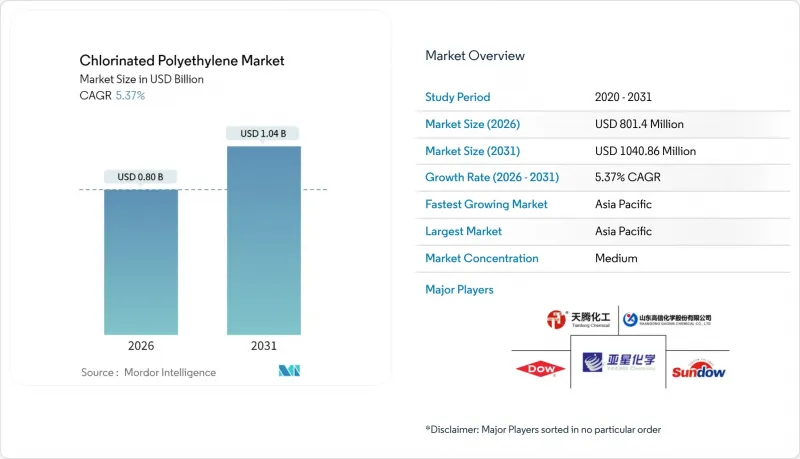
염소화 폴리에틸렌 시장 규모는 2026년에는 8억 140만 달러로 추정되며, 2025년 7억 6,056만 달러에서 성장이 전망됩니다.
2031년에는 10억 4,086만 달러에 달할 것으로 예상되며, 2026년부터 2031년까지 5.37%의 연평균 성장률을 보일 것으로 전망됩니다.
이러한 지속적인 확대는 전통적인 고무와 플라스틱의 기능을 연결하는 열가소성 엘라스토머로서 폴리머의 역할이 확대되어 케이블 피복재, 내충격 개질제, 플렉서블 호스 제품 등에 대한 사용이 증가하고 있음을 반영합니다. 수요의 견조함은 세 가지 뚜렷한 요인에 기인합니다. 전기자동차 보급 가속화, 내구성이 뛰어난 PVC 블렌드를 권장하는 건축 기준 강화, 동아시아 염소-알칼리 통합 클러스터를 통한 경쟁력 있는 가격 책정 등이 그것입니다. 할로겐 프리 화재 안전 기준, 높은 절연 저항, 순환 경제에 대한 노력에 부합하는 배합을 실현하는 공급업체는 자동차 제조업체와 건설업체로부터 사양 채택을 획득하고 있습니다. 산동성의 급속한 생산능력 증설과 자체 염소 조달로 인해 세계 가격 하한선 압력은 지속되고 있지만, 생산규모 확대는 만성적인 공급 부족의 리스크를 줄여주고 있습니다. 한편, 유럽의 염소계 플라스틱의 공공 조달 제한과 원료 가격 변동은 비용 전가 문제를 제기하고 있으며, 기술적으로 민첩한 생산자만이 이 문제를 극복할 수 있습니다.
세계 염소화 폴리에틸렌 시장 동향 및 인사이트
친환경 건축용 PVC 수요 급증
지속가능한 건축 기준에 따라 건축가들이 저온에서도 우수한 내충격 성능을 요구하는 재생 PVC 도어, 창문, 사이딩으로 전환하면서 염소화 폴리에틸렌 소비가 증가하고 있습니다. 염소화 폴리에틸렌 135A는 고재생 배합에서 용융 특성을 최적화하여 가공업체가 별도의 가공 보조제를 줄이면서도 강인성을 유지할 수 있게 해줍니다. LEED나 BREEAM 인증 포인트 획득을 목표로 하는 건설사들은 미개질 PVC보다 넓은 온도대에서 안정된 연성을 보이는 것이 실험 데이터로 확인되어 현재 CPE 개질 프로파일을 지정하고 있습니다. 바이오 기반 가소제가 포함된 폴리머 블렌드는 이러한 이점을 더욱 확대하여 전체 버진 염소 사용량을 줄입니다. 이는 녹색 공공조달 입찰에서 중요한 쟁점입니다. 그 결과, 2차 PVC 스트림에서 안정적인 아이조드 충격값을 입증할 수 있는 염소화 폴리에틸렌 등급이 대도시권 개보수 공사에서 물량 면에서 우위를 점하고 있습니다.
급속한 EV 보급으로 케이블 피복재 수요 견인
전기자동차 플랫폼은 고전압 하네스, 충전 코드, 배터리 냉각 라인에 의존하고 있으며, 이들은 액체가 튀거나 열 사이클, 전자기 간섭을 견뎌내야 합니다. 염소화 폴리에틸렌은 과산화물 경화 EPDM에 부족한 중요한 절연 내력과 저온 유연성을 제공하며, 자동차 제조업체가 400V에서 800V 아키텍처로 전환하는 동안에도 코팅 화합물의 표준화를 가능하게 합니다. 설계 기술자들은 특히 인산염계 냉각액에 대한 내성을 높이 평가하고 있습니다. 이것은 많은 열가소성 가황 고무를 제한하는 고장 모드입니다. 전체 배터리 가열 루프로의 전환에 따라 호스 직경이 확대됨에 따라 염소화 폴리에틸렌 엘라스토머가 본래 가지고 있는 저온에서의 굽힘 반경 유지 성능의 이점이 더욱 두드러지게 나타납니다. UL 94V-0 표준을 획득한 할로겐 프리 컬러 CPE 컴파운드를 제공하는 공급업체들은 현재 수명 종료 시 재활용 목표를 명확히 설정한 OEM 제조업체로부터 다년간의 조달 지정을 받고 있다고 보고하고 있습니다.
염소 및 에틸렌 가격 변동
가성소다 수급 동향이 알루미나 정제 수요 변화에 따라 변동한 결과, 염소 현물 가격이 12개월 동안 60% 이상 변동하여 오픈 마켓에서 염소를 구매하는 비통합형 CPE 제조업체는 압박을 받았습니다. 한편, 미국 멕시코만 연안의 스팀 크래커 가동 중단으로 에틸렌 계약 프리미엄이 확대되고, 다운스트림 공정의 염소화 처리에 필요한 폴리에틸렌 원료 비용이 상승했습니다. 에너지 집약형 막전해는 전력 가격의 급등을 더욱 증폭시켜 변동비를 '다운스트림 전가가 수요 파괴를 초래하는 영역'으로 끌어올렸습니다. 통합 제조업체는 변동성을 견딜 수 있는 능력이 높고, 원자재 재고로 가격 변동을 완충할 필요가 있기 때문에 운전 자금의 구속 금액이 증가하고 있습니다. 컴파운더는 염소 함량을 줄이는 배합 변경으로 영향을 일부 상쇄하고 있지만, 이 전략은 내열 변형 온도의 상한을 제한하고 적용 범위를 좁히는 결과를 낳고 있습니다.
부문 분석
CPE 135A는 분자량 분포의 균형이 좋아 사이딩 및 프로파일 압출 라인에서 경질 PVC의 인성을 확실하게 향상시켜 2025년 판매량의 52.90%를 유지했습니다. 135A 등급의 상대적으로 낮은 무니 점도는 배합 비용을 낮춰 생산성이 높은 건축용 프로파일 압출업체들이 선호하는 제품입니다. 반면, CPE 135B는 호스, 튜브, 내화학성 개스킷 제조사가 우수한 내유성 및 내산성에 대한 프리미엄을 지불하기 때문에 5.46%의 CAGR을 기록할 것으로 예상됩니다. 수요의 가속화는 내압 등급 상승에 따라 투과 한계가 엄격해지는 수소용 호스 분야에 집중되고 있습니다. 맞춤형 염소 함량 특수 등급은 가치의 18%를 차지하며 145 ℃에서 2 시간 동안 오븐 노화 안정성이 필요한 태양전지판 후면 시트의 공 압출 틈새 시장에서 이익을 얻습니다.
제품 영역의 혁신은 135B를 중심으로 한 무할로겐 난연성 변종을 중심으로 전개되고 있습니다.V-0 난연 등급과 300%의 파단 신율을 동시에 만족하는 제품입니다. 제조업체는 반응성 압출 기술을 채택하여 인기를 폴리머 사슬에 직접 고정하여 블룸 현상과 표면 초킹을 줄였습니다. 생산량은 아직 초기 단계이지만, 철도용 개스킷 적용 사례에서 초기 채택 사례가 상업적 실용성을 입증하고 있습니다. 일부 하이지크밀 과산화물 가교형 CPE는 기술적으로 표준 번호 체계를 벗어나지만 금형 변경 없이 과산화물 경화형 EPDM을 대체할 수 있기 때문에 강력한 협상력을 가지고 있습니다. 이러한 추세는 향후 염소화 폴리에틸렌 시장의 제품 구성 변화를 가격뿐만 아니라 성능 차별화가 정의할 것임을 시사합니다.
염소화 폴리에틸렌 시장 보고서는 제품별(CPE 135A, CPE 135B, CPE 135B, 기타 제품), 용도별(내충격 개질제, 전선 및 케이블 피복, 호스 및 튜브, 접착제, 기타 용도), 지역별(아시아태평양, 북미, 유럽, 남미, 중동 및 아프리카)로 분류되어 있습니다. 시장 예측은 금액 기준 및 수량 기준으로 제공됩니다.
지역별 분석
아시아태평양은 2025년 매출의 72.10%를 차지했으며, 중국의 통합 염소-알칼리 복합단지와 지속적으로 확대되고 있는 다운스트림 PVC 산업에 힘입어 아시아태평양의 선도적 위치를 재확인했습니다. 2031년까지 5.70%의 CAGR은 전기자동차 배터리용 기가팩토리가 속속 건설되고 건설 지출이 지속되고 있는 동남아시아, 인도, 한국에서의 모멘텀을 뒷받침하고 있습니다. 현지 자체 염소 공급은 현금 비용 곡선을 압축하고 운임 변동 위험을 헤지하기 위해 위탁 가공 계약을 맺는 유럽 및 미국 컴파운더를 끌어들이고 있습니다. 일본의 특수 케이블 제조업체도 지역 공급에 의존하고 있지만, 독자적인 화재 안전 기준에 대응하기 위해 유럽에서 고부가가치 할로겐 프리 마스터배치를 수입하고 있으며, CPE의 성능 특성을 둘러싼 역내 무역을 반영하고 있습니다.
미국에서는 EV 보조금 정책의 물결로 인해 고전압 케이블 수요가 가속화되고 있습니다. 그러나 북미에는 이 폴리머를 생산하는 공장이 두 곳 밖에 없기 때문에 컨버터 업체들은 태평양 연안에서 수입을 통해 수요를 보충할 수밖에 없습니다. 멕시코의 승용차 조립 라인과 가전제품 공장이 지역 수요를 촉진하고 있으며, USMCA(미국 - 멕시코-캐나다 협정)의 규정이 대륙 내 조달을 촉진하는 배선 부품의 조달을 촉진하고 있습니다.
유럽에서는 염소계 플라스틱의 공공 조달 금지로 인해 확장 속도가 느려지고 있습니다. 그러나 지속가능성에 대한 압박으로 인해 CPE 재활용에 대한 연구 개발이 진행되고 있으며, 독일의 프로파일 압출 제조업체는 창틀 단면에서 CPE 함유 분획을 회수하는 용매 기반 박리 루프 테스트를 진행 중입니다. 중동 및 아프리카에서는 카타르와 사우디의 대형 프로젝트에서 자외선 및 먼지 마모에 강한 내구성 있는 와이어 피복재를 요구하고 있어, 소폭이지만 수요 확대가 예상됩니다. 브라질은 남미의 핵심 시장이며, 주택 건설의 회복으로 CPE 충격 개질 PVC 파이프에 대한 수요가 증가하고 있습니다. 다만 환율 변동이 적극적인 수요 확대를 억제하고 있습니다.
기타 특전:
- 엑셀 형식의 시장 예측(ME) 시트
- 애널리스트의 3개월간 지원
자주 묻는 질문
목차
제1장 소개
제2장 조사 방법
제3장 주요 요약
제4장 시장 구도
제5장 시장 규모와 성장 예측
제6장 경쟁 구도
제7장 시장 기회와 향후 전망
KSM 26.03.05Chlorinated Polyethylene Market size in 2026 is estimated at USD 801.4 million, growing from 2025 value of USD 760.56 million with 2031 projections showing USD 1040.86 million, growing at 5.37% CAGR over 2026-2031.
This sustained expansion mirrors the polymer's expanding role as a thermoplastic elastomer that bridges traditional rubber and plastic functions, finding growing use across cable jacketing, impact modifiers, and flexible hose products. Demand resilience stems from three visible forces: accelerating electric-vehicle electrification, stricter building codes favoring durable PVC blends, and the competitive pricing unlocked by integrated chlor-alkali clusters in East Asia. Suppliers that align formulations with halogen-free fire-safety rules, elevated dielectric thresholds, and circular-economy ambitions are capturing specification wins from automakers and construction contractors. Rapid capacity additions in Shandong, coupled with captive chlorine sourcing, continue to pressure global price floors, yet that same manufacturing scale reduces the risk of chronic shortages. Conversely, public-procurement restrictions on chlorinated plastics in Europe and raw-material price gyrations raise cost-pass-through challenges that only technologically agile producers can navigate.
Global Chlorinated Polyethylene Market Trends and Insights
Surging PVC Demand in Green Building Applications
Sustainable-building rules spur incremental chlorinated polyethylene consumption as architects shift toward recycled PVC doors, windows, and siding that still need robust impact performance at low temperatures. Chlorinated polyethylene 135A optimizes fusion in high-recycled-content formulations, letting converters cut separate processing aids without sacrificing toughness. Builders seeking LEED or BREEAM points now specify CPE-modified profiles because lab data confirm stable ductility across a wider temperature band than unmodified PVC. Polymer blends that integrate bio-based plasticizers push that advantage further by reducing overall virgin chlorine intensity, a key talking point in green-public-procurement bids. Consequently, chlorinated polyethylene grades that can demonstrate consistent Izod impact values in secondary PVC streams are winning volume awards in metropolitan retrofits.
Rapid EV Electrification Driving Cable Jacketing Demand
Electric-vehicle platforms rely on high-voltage harnesses, charging cords, and battery-coolant lines that must withstand fluid splash, thermal cycling, and electromagnetic interference. Chlorinated polyethylene delivers the critical dielectric strength and low-temperature flexibility missing in peroxide-cured EPDM, enabling automakers to standardize jacketing compounds even as they move from 400 V to 800 V architectures. Design engineers particularly value the polymer's resistance to phosphate-ester coolant exposure, a failure mode that limits many thermoplastic vulcanizates. Shifts toward full-battery heating loops enlarge hose diameters, magnifying the benefit of low-temperature bend radius retention inherent to chlorinated polyethylene elastomers. Suppliers offering pre-colored halogen-free CPE compounds with UL 94 V-0 ratings now report multi-year sourcing nominations from original-equipment manufacturers unabashedly targeting end-of-life recyclability targets.
Volatile Chlorine and Ethylene Costs
Spot prices for chlorine swung by more than 60% within 12 months as caustic-soda dynamics shifted with alumina-refining demand, squeezing non-integrated CPE producers that purchase chlorine on the open market. Meanwhile, ethylene contract premiums widened on steam-cracker outages in the U.S. Gulf Coast, raising polyethylene feedstock costs for downstream chlorination. Energy-intensive membrane-cell electrolysis further magnifies electricity price spikes, pushing variable costs into a territory where passing them downstream risks demand destruction. Integrated producers withstand turbulence better, yet even they face higher working-capital locks because raw-material inventories must buffer price whiplash. Compounders offset part of the impact by reformulating with lower chlorination levels, but that strategy caps achievable heat-deflection temperatures and thus limits application windows.
Other drivers and restraints analyzed in the detailed report include:
- Shift Toward Halogen-Free Flame-Retardant CPE Hybrids
- Chinese Supply-Side Expansion Enhancing Price Competitiveness
- EU Public-Procurement Bans on Chlorinated Plastics
For complete list of drivers and restraints, kindly check the Table Of Contents.
Segment Analysis
CPE 135A retained 52.90% of 2025 volumes because its balanced molecular-weight distribution reliably boosts rigid PVC toughness in siding and profile extrusion lines. Grade 135A's relatively low Mooney viscosity keeps compounding costs contained, which appeals to high-throughput construction profile extruders. Conversely, CPE 135B demonstrates a 5.46% CAGR projection as formulators in hose, tubing, and chemical-tolerant gaskets pay premiums for its superior oil and acid resistance. Demand acceleration concentrates in hydrogen-service hoses where permeation limits tighten with rising pressure ratings. Specialty grades with custom chlorine content represent 18% of value, benefitting from co-extrusion niches in solar-panel back-sheets that need two-hour oven-aging stability at 145 °C.
Innovation inside the product landscape orbits around halogen-free flame-retardant variants built on the 135B backbone that marry V-0 flame rating with 300% elongation at break. Producers deploy reactive extrusion to lock phosphorus moieties directly into the polymer chain, reducing blooming and surface chalking. Although volumes remain nascent, early adopters in rail-transit gasket applications validate commercial readiness. Some high-dicumyl-peroxide cross-linkable CPEs, while technically outside standard numbering, command strong bargaining power because they replace peroxide-cured EPDM without tooling changes. These dynamics underline how performance differentiation rather than price alone will define future product-mix shifts inside the chlorinated polyethylene market.
The Chlorinated Polyethylene Market Report is Segmented by Product (CPE 135A, CPE 135B, and Other Products), Application (Impact Modifiers, Wire and Cable Jacketing, Hose and Tubing, Adhesives, and Other Applications), and Geography (Asia-Pacific, North America, Europe, South America, and Middle-East and Africa). The Market Forecasts are Provided in Terms of Value and Volume.
Geography Analysis
Asia-Pacific generated 72.10% of 2025 revenue, reaffirming the region's leadership anchored in China's integrated chlor-alkali complexes and its expansive downstream PVC industries. A 5.70% CAGR to 2031 underscores momentum across Southeast Asia, India, and South Korea, where EV battery gigafactories sprout and construction spending persists. Local captive chlorine supplies compress cash-cost curves, drawing in Western compounders that set up tolling deals to hedge against freight volatility. Japan's specialty cable producers also lean on regional supply, though they import premium halogen-free masterbatches from Europe for distinct fire-safety norms, reflecting an intra-regional trade of performance flavors of CPE.
The United States benefits from an EV subsidy wave that accelerates high-voltage cable demand. However, only two North American plants produce the polymer, forcing converters to backfill via Pacific-coast imports. Mexico's passenger-vehicle assembly lines and appliance factories enhance regional pull, aided by USMCA provisions that favor continental sourcing of wiring content.
Europe faces slower expansion given public procurement bans on chlorinated plastics. Sustainability pressures nonetheless trigger research and development on CPE recycling, with German profile extruders trialing solvent-based delamination loops to harvest CPE-rich fractions from window offcuts. Middle-East and Africa hold modest but rising prospects as megaprojects in Qatar and Saudi Arabia demand durable wire-coating materials that cope with UV and sand abrasion. Brazil anchors South America, where residential-building rebounds lift demand for CPE impact-modified PVC pipes, yet currency volatility tempers aggressive uptake.
- Aurora Material Solutions
- Bontecn Group China Co. Ltd
- Dow
- Dycon Chemicals
- Epigral Limited
- Hangzhou Keli Chemical Co. Ltd
- Jiangsu Tianteng Chemical Industry Co. Ltd
- Resonac Holdings Corporation
- Shandong Gaoxin Chemical Co. Ltd
- Shandong Ketian Chemical Co. Ltd
- Shandong Novista Chemical Ltd (Novista Group)
- Shandong Rike Chemical Co.,Ltd
- Shandong Xiangsheng New Materials Technology Co. Ltd
- Shandong Xuye New Materials Co. Ltd
- Sundow Polymers Co. Ltd
- Weifang Yaxing Chemical Co. Ltd
Additional Benefits:
- The market estimate (ME) sheet in Excel format
- 3 months of analyst support
TABLE OF CONTENTS
1 Introduction
- 1.1 Study Assumptions and Market Definition
- 1.2 Scope of the Study
2 Research Methodology
3 Executive Summary
4 Market Landscape
- 4.1 Market Overview
- 4.2 Market Drivers
- 4.2.1 Surging PVC Demand in Green Building Applications
- 4.2.2 Rapid EV Electrification Driving Cable Jacketing Demand
- 4.2.3 Shift Toward Halogen-Free Flame-Retardant CPE Hybrids
- 4.2.4 Chinese Supply-Side Expansion Enhancing Price Competitiveness
- 4.2.5 Oil-Resistant Hoses for Hydrogen Refuelling Infrastructure
- 4.3 Market Restraints
- 4.3.1 Volatile Chlorine and Ethylene Costs
- 4.3.2 EU Public-Procurement Bans on Chlorinated Plastics
- 4.3.3 TPV Performance Advances as Substitute Elastomers
- 4.4 Value Chain Analysis
- 4.5 Porter's Five Forces
- 4.5.1 Bargaining Power of Suppliers
- 4.5.2 Bargaining Power of Buyers
- 4.5.3 Threat of New Entrants
- 4.5.4 Threat of Substitutes
- 4.5.5 Competitive Rivalry
5 Market Size and Growth Forecasts (Value)
- 5.1 By Product
- 5.1.1 CPE 135A
- 5.1.2 CPE 135B
- 5.1.3 Other Products
- 5.2 By Application
- 5.2.1 Impact Modifiers
- 5.2.2 Wire and Cable Jacketing
- 5.2.3 Hose and Tubing
- 5.2.4 Adhesives
- 5.2.5 Other Applications
- 5.3 By Geography
- 5.3.1 Asia-Pacific
- 5.3.1.1 China
- 5.3.1.2 India
- 5.3.1.3 Japan
- 5.3.1.4 South Korea
- 5.3.1.5 ASEAN
- 5.3.1.6 Rest of Asia-Pacific
- 5.3.2 North America
- 5.3.2.1 United States
- 5.3.2.2 Canada
- 5.3.2.3 Mexico
- 5.3.3 Europe
- 5.3.3.1 Germany
- 5.3.3.2 United Kingdom
- 5.3.3.3 France
- 5.3.3.4 Italy
- 5.3.3.5 Russia
- 5.3.3.6 Rest of Europe
- 5.3.4 South America
- 5.3.4.1 Brazil
- 5.3.4.2 Argentina
- 5.3.4.3 Rest of South America
- 5.3.5 Middle-East and Africa
- 5.3.5.1 Saudi Arabia
- 5.3.5.2 South Africa
- 5.3.5.3 Rest of Middle-East and Africa
- 5.3.1 Asia-Pacific
6 Competitive Landscape
- 6.1 Market Concentration
- 6.2 Strategic Moves
- 6.3 Market Share (%)/Ranking Analysis
- 6.4 Company Profiles (includes Global level Overview, Market level overview, Core Segments, Financials as available, Strategic Information, Market Rank/Share for key companies, Products and Services, and Recent Developments)
- 6.4.1 Aurora Material Solutions
- 6.4.2 Bontecn Group China Co. Ltd
- 6.4.3 Dow
- 6.4.4 Dycon Chemicals
- 6.4.5 Epigral Limited
- 6.4.6 Hangzhou Keli Chemical Co. Ltd
- 6.4.7 Jiangsu Tianteng Chemical Industry Co. Ltd
- 6.4.8 Resonac Holdings Corporation
- 6.4.9 Shandong Gaoxin Chemical Co. Ltd
- 6.4.10 Shandong Ketian Chemical Co. Ltd
- 6.4.11 Shandong Novista Chemical Ltd (Novista Group)
- 6.4.12 Shandong Rike Chemical Co.,Ltd
- 6.4.13 Shandong Xiangsheng New Materials Technology Co. Ltd
- 6.4.14 Shandong Xuye New Materials Co. Ltd
- 6.4.15 Sundow Polymers Co. Ltd
- 6.4.16 Weifang Yaxing Chemical Co. Ltd
7 Market Opportunities and Future Outlook
- 7.1 White-space and Unmet-Need Assessment
- 7.2 Research and Development on Advanced CPE Grades