

|
시장보고서
상품코드
1937369
자동 알약 디스펜서 : 시장 점유율 분석, 업계 동향과 통계, 성장 예측(2026-2031년)Automatic Pill Dispenser - Market Share Analysis, Industry Trends & Statistics, Growth Forecasts (2026 - 2031) |
||||||
 Mordor Intelligence
자동 알약 디스펜서 시장은 2025년에 36억 4,000만 달러로 평가되었으며, 예측 기간(2026-2031년)에서 CAGR 8.03%로 성장하여 2026년 39억 3,000만 달러에서 2031년까지 57억 9,000만 달러에 달할 것으로 추정됩니다.
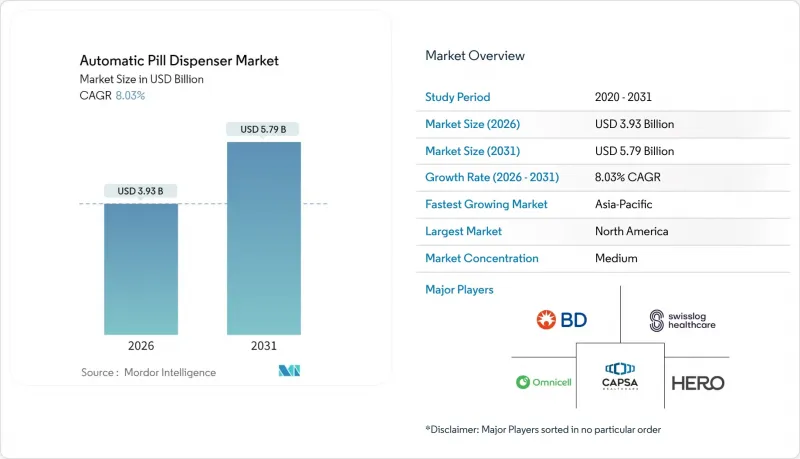
만성질환의 유병률 증가, 복약 불이행으로 인한 경제적 손실, 통신 환경의 급속한 고도화는 병원과 가정에서의 자동조제 솔루션 도입을 촉진하고 있습니다. 의료 서비스 제공자들은 고비용의 응급실 방문을 피하기 위한 예방 도구로 커넥티드 디바이스를 평가하고 있으며, 보험사들은 가치 기반 의료 모델에 따라 비용을 상환하기 시작했습니다. 한편, IoT, 인공지능, 클로즈드 루프 검증 기술의 융합으로 약물 관리는 사후적 보충에서 예측적 모니터링으로 전환되고 있습니다. 기존 기업들은 병원 고객 방어에 주력하는 반면, 데이터 중심 스타트업들은 재택 의료 서비스 이용자들의 증가와 지역 규제 당국의 사이버 보안 요건 강화로 인해 경쟁이 치열해지고 있습니다.
세계 자동 알약 디스펜서 시장 동향 및 인사이트
고령화 사회의 진전은 전용 디스펜서 개발을 촉진합니다.
전 세계 고령화로 인해 자동 알약 디스펜서 시장이 재편되고 있습니다. 각 벤더들은 기억력 장애나 손재주가 떨어지는 사용자들을 위해 인터페이스를 재설계하고 있습니다. 일본에서는 65세 이상 인구가 이미 29%를 넘어섰고, 헬스케어 기술 기업들은 대문자 표시, 음성 안내, 간소화된 약품 카세트 로딩을 우선순위에 둘 수밖에 없습니다. TabTime Medelert와 같은 기기에 탑재된 잠금식 수납공간과 다중 알람 기능은 치매 환자의 복약 혼란을 줄이는 데 도움이 됩니다. 병원에서는 이러한 노인용 기기를 퇴원 계획에 포함시키고, 지역 약국에서는 복약지도 서비스와 함께 제공함으로써 재택 복약지도를 돕고 있습니다. 이러한 설계상의 변화와 함께 인지기능을 지원하는 조제에 특화된 큰 하위 부문이 형성되고 있습니다.
복약 불이행으로 인한 비용 증가가 투자를 촉진합니다.
환자가 약을 복용하지 않을 경우, 보험사는 예방 가능한 입원으로 인해 수십억 달러의 손실을 입게 됩니다. 복약 타이밍을 자동화하는 개입책은 더 이상 선택이 아닌 비용절감 방안으로 자리매김하고 있습니다. 미국 질병예방통제센터(CDC)는 자동 조제 도구를 검증된 심혈관질환 감소 방법 중 하나로 꼽고 있습니다. 병원은 재입원 감소에 따른 3년의 투자회수 기간을 산출하고, 보험사는 고위험 만성질환 환자군을 대상으로 기기 환급 시범운영을 시작했습니다. 이러한 경제적 계산을 통해 통합의료네트워크는 집단건강관리 대시보드에 조제 분석 기능을 내장하고, 처방전 리필 알림과 예측 입원 위험을 연동하여 처방전 보충 알림을 제공하게 되었습니다.
높은 초기 투자 및 유지보수 비용이 도입 장벽으로 작용합니다.
본격적인 집중 조제 로봇을 도입하려면 서비스 계약과 소프트웨어 라이선스를 제외하고 초기 비용만 10만 달러가 넘을 수 있습니다. 소규모 지역 병원과 독립 약국에서는 이러한 투자를 상쇄할 수 있는 상환 메커니즘이 부족한 경우가 많아 수작업이 계속되고, 자원이 풍부한 환경과 자원이 부족한 환경 간의 안전 격차가 확대되고 있습니다. 장비리스, 성과연동형 서비스 수수료 등의 자금조달 모델이 등장하고 있지만, 북미를 제외한 지역에서는 아직은 드뭅니다.
부문 분석
2025년 기준 자동조제시스템 시장 규모의 58.87%를 중앙관리형 시스템이 차지하고 있으며, 로봇팔, 회전식 약품 선반, 바코드 리더기를 중심으로 조제업무를 지원하고 있습니다. 이들은 수천 가지의 품목을 1회 투여 단위로 관리합니다. 그 우위는 오차 감소 효과와 재고 감소 효과가 입증되어 약제부서장들의 관심을 받고 있다는 점입니다. 그러나 분산형 캐비닛도 꾸준히 자리를 잡아가고 있습니다. 간호스테이션에서는 24시간 365일 접근이 가능하고, 약품 반출 이동 거리를 단축하고, 병상에서의 확인 작업과 연동할 수 있다는 점을 높이 평가받고 있습니다. 2031년까지 연평균 9.61%의 CAGR을 기록할 것으로 예상되는 이 하위 부문은 기존 약실에 추가할 수 있는 모듈식 설계, 사용자 접근을 추적하는 생체인식 잠금 장치, 전자 약물 투여 기록 시스템과의 통합 등의 요소에 의해 주도되고 있습니다. 병원이 인력 부족에 직면한 가운데, 자동조제기 시장에서는 중앙집중형 로봇과 진료현장 유닛을 단일 데이터 기반으로 통합하는 하이브리드 구조의 가치가 높아지고 있습니다.
이러한 변화는 전략적 의미가 있습니다. 기존에는 고처리 용량 설치에 집중했던 업체들은 향후 다년간의 서비스 계약을 확보하기 위해 설치 면적이 작은 키오스크형 단말기를 개발하고 있습니다. 한편, 스타트업은 허브와 스포크의 데이터를 통합하는 클라우드 대시보드를 제공함으로써 분석 수익을 창출하고 있습니다. 이러한 제품 로드맵의 수렴은 분산형 성장이 중앙집중형 기반을 잠식하는 것이 아니라, 플랫폼 생태계를 확장하고 전체 약물 관리 회로에서 브랜드 정착성을 확보하는 것을 보여줍니다.
2025년에는 프로그래밍 가능한 전자조제기가 매출의 38.12%를 차지할 것으로 예상되며, 이는 네트워크에 의존하지 않는 확정적 운영을 중시하는 병원 내 기존 벤더들의 확고한 입지를 반영합니다. 그러나 IoT 지원 장치는 12.24%의 CAGR로 성장을 견인할 것으로 예상되며, 이는 구매자의 우선순위가 실시간 데이터로 이동하고 있음을 보여줍니다. 이러한 스마트 기기는 환자 알림 기능 외에도 상세한 복약 순응도 기록을 생성합니다. 이를 통해 예측 분석이 가능해져 임상적 사건으로 발전하기 전에 약물 누출을 감지할 수 있습니다. 최근 기술 연구에서 SPEC 2.0 프로토타입은 Wi-Fi, RFID, 클라우드 AI를 통합하여 예정된 약물 복용량과 실제 약물 복용량을 비교하여 과다 복용을 방지했습니다.
이러한 데이터 중심의 변화로 자동조제기 시장은 하드웨어를 넘어 구독형 대시보드, API 라이선싱, 원격 치료 관리 서비스 등 새로운 수익원을 창출하고 있습니다. 제조사는 통신사와 제휴하여 eSIM 연결을 미리 로드하여 소비자의 설정 없이도 전 세계 로밍을 보장합니다. 사이버 강화형 펌웨어 업데이트, 블록체인 감사 추적, AI 기반 보충 예측이 제품 차별화를 더욱 촉진하고 있습니다. 에어 갭 구조가 필수적인 고보안 병동에서는 기존의 프로그램 가능한 유닛이 계속 사용되지만, 연결성의 임상적 가치로 인해 외래 진료 및 재택 의료 분야에서는 IoT 장치가 표준적인 선택이 되고 있습니다.
기타 특전:
- 엑셀 형식의 시장 예측(ME) 시트
- 애널리스트 지원(3개월)
자주 묻는 질문
목차
제1장 소개
제2장 조사 방법
제3장 주요 요약
제4장 시장 구도
제5장 시장 규모와 성장 예측
제6장 경쟁 구도
제7장 시장 기회와 향후 전망
KSM 26.03.09The automatic pill dispenser market was valued at USD 3.64 billion in 2025 and estimated to grow from USD 3.93 billion in 2026 to reach USD 5.79 billion by 2031, at a CAGR of 8.03% during the forecast period (2026-2031).
Rising chronic-disease prevalence, the economic toll of medication non-adherence, and rapid connectivity upgrades are pushing hospitals and households toward automated dispensing solutions. Healthcare providers view connected devices as preventive tools that avert costly emergency visits; payers have begun to reimburse them under value-based care models. Meanwhile, the convergence of IoT, artificial intelligence, and closed-loop verification is moving medication management from reactive refills to predictive oversight. Competitive intensity is deepening as incumbents defend hospital accounts while data-centric start-ups target the growing home-care user base and regional regulators tighten cyber-security requirements.
Global Automatic Pill Dispenser Market Trends and Insights
Increasing Elderly Population Drives Specialized Dispenser Development
Global aging is recasting the automatic pill dispenser market as vendors redesign interfaces for users with memory loss and reduced dexterity. In Japan, citizens aged 65+ already exceed 29%, forcing health-tech firms to prioritize large-font displays, voice prompts, and simplified loading cassettes. Locked compartments and multi-alarm cues in devices such as TabTime Medelert help mitigate dose confusion among individuals with dementia. Hospitals incorporate these geriatric-friendly units into discharge plans, while community pharmacies bundle them with counseling services to sustain adherence at home. Collectively, these design shifts are carving a sizable subsegment focused on cognitive-supportive dispensing.
Escalating Cost of Medication Non-Adherence Drives Investment
Payers lose billions to preventable admissions when patients miss doses; interventions that automate pill timing now qualify as cost-saving rather than elective. The Centers for Disease Control and Prevention lists automated pharmacy tools among proven cardiovascular-disease mitigation methods. Hospitals calculate three-year payback periods from fewer readmissions, and insurers are piloting device reimbursement for high-risk chronic cohorts. This economic calculus has prompted integrated-delivery networks to embed dispensing analytics inside population-health dashboards, linking refill reminders to predicted hospitalization risk.
High Capital and Maintenance Costs Limit Institutional Adoption
A full-scale central pharmacy robot can exceed USD 100,000 in up-front outlay, exclusive of service contracts and software licenses. Smaller community hospitals and independent pharmacies often lack reimbursement mechanisms to offset this investment, perpetuating manual processes and widening the safety divide between resource-rich and resource-constrained settings. Financing models such as equipment leasing and outcome-based service fees are emerging but remain scarce outside North America.
Other drivers and restraints analyzed in the detailed report include:
- Hospital Demand for Workflow Efficiency Transforms Dispensing Systems
- Expansion of Home Healthcare & Remote Patient Management Models
- Data Security Concerns Complicate Connected Dispenser Adoption
For complete list of drivers and restraints, kindly check the Table Of Contents.
Segment Analysis
Centralized systems generated 58.87% of the automatic pill dispenser market size in 2025, anchoring pharmacy operations with robotic arms, carousels, and bar-code readers that manage thousands of SKUs with single-dose precision. Their dominance stems from proven error-reduction metrics and inventory savings that resonate with chief pharmacy officers. Still, decentralized cabinets are gaining ground; nursing stations favor 24/7 access that shortens retrieval walks and aligns with bedside verification. With a 9.61% CAGR projected through 2031, this subsegment is being propelled by modular designs that retrofit into existing medication rooms, biometric locks that track user access, and integration with electronic medication-administration records. As hospitals grapple with staff shortages, the automatic pill dispenser market increasingly values hybrid architectures that weave central robots with point-of-care units into one data backbone.
The shift has strategic implications. Vendors traditionally focused on high-throughput installations are now developing smaller-footprint kiosks to secure future multiyear service contracts. Meanwhile, start-ups package cloud dashboards that consolidate data from both hub and spoke devices, capturing analytics revenue. Such converging product roadmaps underscore how decentralized growth does not cannibalize the centralized base but rather extends platform ecosystems, ensuring brand stickiness across the entire medication circuit.
Programmable electronic dispensers accounted for 38.12% revenue in 2025, reflecting entrenched incumbency in hospitals that prize deterministic operation without network dependencies. Yet IoT-enabled units are forecast to lead growth at 12.24% CAGR, signaling a pivot in buyer priorities toward real-time data. These smart devices not only remind patients but also generate granular adherence trails, enabling predictive analytics that flag dose omissions before they escalate into clinical events. In a recent engineering study, the SPEC 2.0 prototype combined Wi-Fi, RF-ID, and cloud AI to prevent overdosing by comparing scheduled and actual retrievals.
This data-centric transformation is expanding the automatic pill dispenser market beyond hardware; subscription dashboards, API licensing, and remote therapy management services are emerging revenue lines. Manufacturers collaborate with telecom carriers to preload eSIM connectivity, guaranteeing global roaming without consumer setup. Cyber-hardened firmware updates, blockchain audit trails, and AI-driven refill forecasting further differentiate offerings. Programmable legacy units will persist in high-security wards where air-gapped architectures remain mandatory, but connectivity's clinical value is positioning IoT devices as the default choice in outpatient and home-care arenas.
The Automatic Pill Dispenser Market Report is Segmented by Product Type (Centralized Automatic Dispenser, and Decentralized Automatic Dispenser), Technology (Mechanical Timer-Based, Programmable Electronic, and More), Indication (Physical Disability, and More), End-User (Hospitals, Home Healthcare, and More), and Geography (North America, Europe, and More). The Market Forecasts are Provided in Terms of Value (USD).
List of Companies Covered in this Report:
- Beckton Dickinson
- Omnicell
- Swisslog Healthcare
- Capsa Healthcare
- Hero Health Inc.
- YUYAMA Co.,Ltd
- Medminder
- PharmaCell
- Koninklijke Philips
- PharmAdva, LLC
- e-pill Medication Reminder
- Livi Automated Dispenser (PharmRight)
- Reizen, Inc.
- MedControl Systems GmbH
- Berkshire Biomedical.
- Accu-Chart Plus Healthcare Systems, Inc.
- Cerner
Additional Benefits:
- The market estimate (ME) sheet in Excel format
- 3 months of analyst support
TABLE OF CONTENTS
1 Introduction
- 1.1 Study Assumptions & Market Definition
- 1.2 Scope of the Study
2 Research Methodology
3 Executive Summary
4 Market Landscape
- 4.1 Market Overview
- 4.2 Market Drivers
- 4.2.1 Increasing Elderly Population Along with Growing Burden of Diseases
- 4.2.2 Escalating Cost of Medication Non-Adherence to Health Systems
- 4.2.3 Hospital Demand for Workflow Efficiency & Medication Error Reduction
- 4.2.4 Expansion of Home Healthcare & Remote Patient Management Models
- 4.2.5 Technological Advancements in Healthcare
- 4.2.6 Regulatory Support and Insurance Reimbursement
- 4.3 Market Restraints
- 4.3.1 High Capital & Maintenance Costs of Automated Dispensing Infrastructure
- 4.3.2 Data Security & Patient Privacy Concerns in Connected Dispensers
- 4.3.3 Integration Complexity with Legacy Hospital IT & Pharmacy Systems
- 4.3.4 Shortage of Trained Personnels
- 4.4 Regulatory Outlook
- 4.5 Technological Outlook
- 4.6 Porter's Five Forces Analysis
- 4.6.1 Bargaining Power of Suppliers
- 4.6.2 Bargaining Power of Buyers
- 4.6.3 Threat of New Entrants
- 4.6.4 Threat of Substitutes
- 4.6.5 Intensity of Competitive Rivalry
5 Market Size & Growth Forecasts (Value)
- 5.1 By Product Type
- 5.1.1 Centralized Automatic Dispenser
- 5.1.1.1 Carousels
- 5.1.1.2 Robotic
- 5.1.2 Decentralized Automatic Dispenser
- 5.1.2.1 Ward-Based Automated Dispensing System
- 5.1.2.2 Pharmacy-Based Automated Dispensing System
- 5.1.2.3 Automatic Unit-Dose Dispensing System
- 5.1.1 Centralized Automatic Dispenser
- 5.2 By Technology
- 5.2.1 Mechanical Timer-Based
- 5.2.2 Programmable Electronic
- 5.2.3 IoT-Connected (Bluetooth / Wi-Fi / Cellular)
- 5.2.4 Other Technologies
- 5.3 By Indication
- 5.3.1 Physical Disability
- 5.3.2 Neuro-degenerative Disorders and Dementia
- 5.3.3 Chronic Disease Management
- 5.3.4 Other Indications
- 5.4 By End-User
- 5.4.1 Hospitals
- 5.4.2 Pharmacies and Pharmacy Benefit Managers
- 5.4.3 Home Healthcare
- 5.4.4 Long-Term Care Facilities and Nursing Homes
- 5.5 By Geography
- 5.5.1 North America
- 5.5.1.1 United States
- 5.5.1.2 Canada
- 5.5.1.3 Mexico
- 5.5.2 Europe
- 5.5.2.1 Germany
- 5.5.2.2 United Kingdom
- 5.5.2.3 France
- 5.5.2.4 Italy
- 5.5.2.5 Spain
- 5.5.2.6 Rest of Europe
- 5.5.3 Asia-Pacific
- 5.5.3.1 China
- 5.5.3.2 Japan
- 5.5.3.3 India
- 5.5.3.4 Australia
- 5.5.3.5 South Korea
- 5.5.3.6 Rest of Asia-Pacific
- 5.5.4 Middle East and Africa
- 5.5.4.1 GCC
- 5.5.4.2 South Africa
- 5.5.4.3 Rest of Middle East and Africa
- 5.5.5 South America
- 5.5.5.1 Brazil
- 5.5.5.2 Argentina
- 5.5.5.3 Rest of South America
- 5.5.1 North America
6 Competitive Landscape
- 6.1 Market Concentration
- 6.2 Market Share Analysis
- 6.3 Company Profiles (includes Global level Overview, Market level overview, Core Segments, Financials as available, Strategic Information, Market Rank/Share for key companies, Products & Services, and Recent Developments)
- 6.3.1 Becton Dickinson & Company
- 6.3.2 Omnicell Inc.
- 6.3.3 Swisslog Healthcare
- 6.3.4 Capsa Healthcare
- 6.3.5 Hero Health Inc.
- 6.3.6 YUYAMA Co.,Ltd
- 6.3.7 Medminder Systems, Inc.
- 6.3.8 PharmaCell
- 6.3.9 Koninklijke Philips N.V.
- 6.3.10 PharmAdva, LLC
- 6.3.11 e-pill Medication Reminder
- 6.3.12 Livi Automated Dispenser (PharmRight)
- 6.3.13 Reizen, Inc.
- 6.3.14 MedControl Systems GmbH
- 6.3.15 Berkshire Biomedical.
- 6.3.16 Accu-Chart Plus Healthcare Systems, Inc.
- 6.3.17 Cerner Corporation
7 Market Opportunities & Future Outlook
- 7.1 White-space & Unmet-Need Assessment


