
|
시장보고서
상품코드
1939048
중국의 석유 및 가스 미드스트림 시장 : 시장 점유율 분석, 업계 동향과 통계, 성장 예측(2026-2031년)China Oil And Gas Midstream - Market Share Analysis, Industry Trends & Statistics, Growth Forecasts (2026 - 2031) |
||||||
 Mordor Intelligence
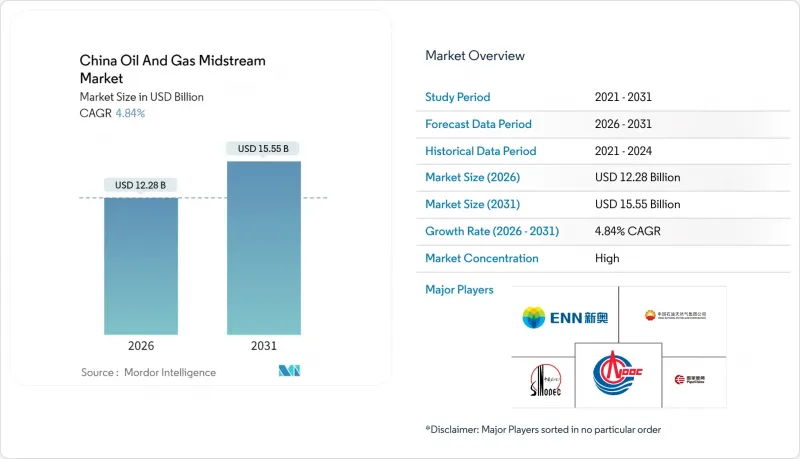
중국 석유 및 가스 미드스트림 시장 규모는 2026년에 122억 8,000만 달러로 추정되고 있으며, 2025년 117억 1,000만 달러에서 성장이 전망됩니다. 2031년의 예측에서는 155억 5,000만 달러에 달하며, 2026-2031년에 CAGR 4.84%로 확대할 전망입니다.
시장의 성장은 에너지 안보와 탄소 중립이라는 중국의 두 가지 목표에 의해 주도되고 있으며, 이는 인프라 탄력성, 공급 경로의 다양화, 측정 가능한 배출량 감축을 우선순위로 삼고 있습니다. 산업 및 주거용 사용자의 천연가스 수요 급증과 안정적인 국내 생산이 결합되어 추가 운송, 수입 처리 및 저장 용량의 필요성이 증가하고 있습니다. 정책적으로 지원되는 파이프라인 연장 거리의 확대, LNG 터미널의 가동 가속화, 의무적인 전략적 비축 목표는 계약업체와 장비 공급업체에게 지속적인 건설 프로젝트를 창출하고 있습니다. 디지털화, 특히 AI를 활용한 모니터링 시스템은 자산 활용률 향상, 운영 비용 절감, 환경 규제 준수 강화, 프로젝트의 경제성을 더욱 향상시킬 수 있습니다.
중국 석유 및 가스 중류 시장 동향과 인사이트
국가 가스관 연장 거리 확대
중국의 14차 5개년 계획은 2025년까지 가스 수송망을 12만km로 확대하는 것을 목표로 하고 있습니다(2020년 대비 25% 증가). 이는 동서 가스 수송 시스템을 핵심으로 하는 계획입니다. 이중화된 간선 파이프라인은 지정학적, 기술적 혼란시 단일 장애 지점 위험을 줄이고 지역 간 균형 조정을 강화합니다. 파이프라인의 통일된 소유권으로 상호 연결이 가속화되고, 유연한 양방향 운송이 가능하여 가동률이 향상됩니다. 2024년 중국-러시아 동부 노선 가동으로 공급원이 다양해져 해상 무역 의존도가 낮아졌습니다. 성을 넘나드는 육상 조정은 복잡하지만, 허가가 나오면 집중적인 계획으로 건설 기간을 단축할 수 있습니다. 이러한 프로젝트는 전문 계약업체, 고사양 파이프 제조업체, 디지털 모니터링 솔루션 프로바이더에게 큰 기회를 제공합니다.
LNG 재기화 터미널의 신속한 정비
2024년 재기화 능력은 연간 1억 3천만 톤에 달할 것이며, 4천만 톤 규모의 시설이 건설 중으로 중국은 세계에서 가장 활발한 LNG 인프라 건설 국가로 자리매김하고 있습니다. 2022년 위기시 대규모 터미널의 혼잡으로 드러난 공급 병목현상을 완화하기 위해 소규모 분산형 시설이 채택되고 있습니다. 연안 지자체는 빠른 배치 속도, 자본 지출의 유연성, 육상 부지 수요 감소로 인해 FSRU(부유식 재기화 설비)에 점점 더 많은 관심을 기울이고 있습니다. 2024년 가동된 주산 III 터미널은 첨단 증기 회수 시스템을 통해 메탄 배출량을 15% 감소시켜 국내의 새로운 기준을 세웠습니다. 평균 65%의 가동률은 전략적 비축을 확보하는 동시에 기회를 포착한 현물화물을 구매할 여지를 남겨둡니다. 이를 통해 수입 다변화를 지원하고 가격 리스크 관리를 강화하는 부문이 되었습니다.
환경 및 토지이용 허가 절차의 장기화
환경 심사는 현재 18-36개월이 소요되며, 생태계 보호구역을 횡단하는 노선에서는 더 많은 지연이 발생합니다. 인구 밀집 지역인 동부 지역의 토지 취득 비용은 1헥타르당 평균 5만 달러에 달하며, 평가액을 둘러싼 분쟁이 빈번하게 발생하여 프로젝트 기간이 연장되는 경우가 적지 않습니다. 그 결과 계획부터 가동까지 5-7년이 소요되어 개발사의 자금조달 리스크가 높아져 내부이익률(IRR)이 낮아지고 있습니다. 2024년 도입된 디지털 원스톱 포털은 심사 주기 단축을 목표로 하고 있지만, 각 기관의 대응 상황은 제각각입니다. 투자자들은 현재 12-18개월의 허가 취득 버퍼를 일정에 반영하고 있으며, 이로 인해 예산이 팽창하고 수익화가 지연되고 있습니다.
부문 분석
터미널 부문은 2026-2031년까지 연평균 복합 성장률(CAGR) 8.16%를 기록하며 파이프라인 부문(2025년 기준 중국 석유 및 가스 중류 시장 규모의 45.12%를 차지하는 주력 부문)을 능가하는 성장세를 보였습니다. FSRU(부유식 재기화 설비)의 도입은 건설 주기를 단축하고, 연안 지역의 혼란을 최소화하여 수요 변동에 신속하게 대응할 수 있습니다. 연안 지역 정부는 착륙 지점의 다양화를 위해 소규모 터미널의 개발을 신속하게 추진하고 있으며, 이를 통해 혼잡을 완화하고 지역적 가격 상승을 억제하고 있습니다. 파이프라인은 여전히 전체 시스템의 근간을 이루고 있으며, 서부의 자원과 러시아로부터의 수입을 소비가 많은 동부 지역과 연결하고 있습니다. AI 강화형 모니터링 시스템을 통해 파이프라인 운영 및 유지보수 비용을 15-20% 절감하고, 안전 기준 준수율을 향상시킴. 이는 추가적인 용량 확장을 위한 플랫폼의 매력도를 높이고 있습니다. 저장시설은 규모는 작지만, 전략적 비축 20% 의무화 정책에 힘입어 고갈된 유전의 재개발과 암염동굴의 침출수 처리로 자본 지출이 이동하고 있습니다. 종합적으로, 복합적인 인프라 투자는 수입의 유연성과 운송의 신뢰성의 균형을 유지하고, 여러 경로를 통한 가스 공급의 탄력성을 보장합니다.
기타 특전:
- 엑셀 형식 시장 예측(ME) 시트
- 애널리스트 지원(3개월)
자주 묻는 질문
목차
제1장 서론
제2장 조사 방법
제3장 개요
제4장 시장 구도
제5장 시장 규모와 성장 예측
제6장 경쟁 구도
제7장 시장 기회와 향후 전망
KSA 26.03.05China Oil And Gas Midstream Market market size in 2026 is estimated at USD 12.28 billion, growing from 2025 value of USD 11.71 billion with 2031 projections showing USD 15.55 billion, growing at 4.84% CAGR over 2026-2031.
The market growth is driven by Beijing's twin goals of energy security and carbon neutrality, which together prioritize infrastructure resilience, diversified supply routes, and measurable reductions in emissions. Surging natural gas demand from industrial and residential users, combined with steady domestic production, intensifies the need for additional transmission, import handling, and storage capacity. Policy-backed pipeline mileage expansion, accelerated LNG terminal commissioning, and mandatory strategic reserve targets create a sustained construction pipeline for contractors and equipment suppliers. Digitalization-especially AI-enabled monitoring-enhances asset utilization, reduces operating costs, and facilitates stricter environmental compliance, thereby further improving project economics.
China Oil And Gas Midstream Market Trends and Insights
Expansion of National Gas-Pipeline Mileage
China's 14th Five-Year Plan raises the transmission grid target to 120,000 km by 2025-a 25% jump over 2020-anchored by the West-to-East system. Redundant trunk lines mitigate the risk of single-point failure during geopolitical or technical disruptions and enhance cross-regional balancing. PipeChina's unified ownership accelerates interconnections, allowing flexible, bidirectional flows that lift utilization rates. The commissioning of the China-Russia East Route in 2024 diversified supply and reduced reliance on seaborne trade. Although cross-provincial land coordination is complex, centralized planning compresses build times once permits are clear. These projects present sizable opportunities for specialist contractors, high-specification pipe manufacturers, and digital monitoring solution providers.
Accelerated Build-out of LNG Regasification Terminals
Regas capacity hit 130 million tpa in 2024, with 40 million tpa under construction, positioning the country as the world's most active LNG-infrastructure builder. Smaller, distributed facilities mitigate supply bottlenecks that were revealed during the 2022 crisis, when large terminals faced congestion. Coastal governments are increasingly favoring FSRUs due to their rapid deployment speed, flexibility in capital expenditure, and reduced demand for onshore land. The 2024-commissioned Zhoushan III terminal reduced methane emissions by 15% through advanced vapor-recovery systems, setting a new domestic benchmark. Average 65% utilization leaves headroom for opportunistic spot cargo buying while serving strategic stockpiles. The segment thereby underpins import diversification and strengthens price-risk management.
Lengthy Environmental & Land-Use Permitting Process
Environmental reviews now last 18-36 months, with extra delays where routes cross ecologically sensitive zones. Land acquisition in the densely populated eastern provinces averages USD 50,000 per hectare, often triggering valuation disputes that prolong project timelines. As a result, planning-to-operation spans stretch 5-7 years, raising financing risk and slicing IRRs for developers. Digital one-stop portals unveiled in 2024 aim to condense review cycles, yet agency adoption is uneven. Investors now incorporate 12-18 month permitting buffers into their schedules, which inflates budgets and delays revenue generation.
Other drivers and restraints analyzed in the detailed report include:
- Coal-to-Gas Switching Mandates in Industrial & Residential Sectors
- AI-Driven Pipeline-Health Analytics Adoption
- Capex Escalation Amid Commodity-Price Volatility
For complete list of drivers and restraints, kindly check the Table Of Contents.
Segment Analysis
Terminals accounted for an 8.16% CAGR growth between 2026 and 2031, outpacing pipelines, which retained a dominant 45.12% 2025 share of the China oil and gas midstream market size. FSRU rollouts shorten build cycles and limit shoreline disruption, enabling rapid response to demand shifts. Coastal governments are fast-tracking the development of smaller terminals to diversify landing points, thereby reducing congestion and regional price spikes. Pipelines still underpin system integrity, linking western resources and Russian imports with high-consumption eastern provinces. AI-enhanced monitoring reduced pipeline O&M costs by 15-20% and improved safety compliance, enhancing the platform's attractiveness for further capacity expansion. Storage facilities, although the smallest, gain policy momentum from the 20% strategic reserve mandate, shifting capital expenditures toward depleted field re-engineering and salt-cavern leaching. Collectively, blended infrastructure investments strike a balance between import flexibility and transmission reliability, thereby securing multi-path gas flow resilience.
The China Oil and Gas Midstream Market Report is Segmented by Infrastructure (Pipelines, Terminals, and Storage Facilities), Product Type (Crude Oil, Natural Gas, Refined Products, and LNG), and Service Type (Pipeline Construction, Pipeline Maintenance and Repair, Storage and Handling Services, and Transportation and Logistics). The Market Sizes and Forecasts are Provided in Terms of Value (USD).
List of Companies Covered in this Report:
- China National Petroleum Corporation (CNPC)
- PipeChina (China Oil & Gas Pipeline Network Corp.)
- China Petroleum & Chemical Corporation (Sinopec Group)
- China National Offshore Oil Corporation (CNOOC)
- PetroChina Pipeline Company
- China Petroleum Pipeline Engineering Co. (CPP)
- Kunlun Energy
- ENN Natural Gas
- Towngas China
- China Gas Holdings
- Guanghui Energy
- Beijing Gas Group
- Shenzhen Gas Corp.
- Guangdong Dapeng LNG Company
- Tian Lun Gas Group
- Xinxing Ductile Iron Pipes Co.
- COSCO Shipping Energy Transportation
- Yantai LNG Co.
- Shanghai Gas Group
- Zhejiang Energy Group
Additional Benefits:
- The market estimate (ME) sheet in Excel format
- 3 months of analyst support
TABLE OF CONTENTS
1 Introduction
- 1.1 Study Assumptions & Market Definition
- 1.2 Scope of the Study
2 Research Methodology
3 Executive Summary
4 Market Landscape
- 4.1 Market Overview
- 4.2 Market Drivers
- 4.2.1 Expansion of national gas-pipeline mileage
- 4.2.2 Accelerated build-out of LNG regasification terminals
- 4.2.3 Coal-to-gas switching mandates in industrial & residential sectors
- 4.2.4 AI-driven pipeline-health analytics adoption
- 4.2.5 Boom in LNG-fueled heavy-duty trucking creating small-scale LNG demand
- 4.2.6 Strategic gas storage capacity mandates
- 4.3 Market Restraints
- 4.3.1 Lengthy environmental & land-use permitting process
- 4.3.2 Capex escalation amid commodity-price volatility
- 4.3.3 Shipping chokepoints inflating landed LNG costs
- 4.3.4 Coastal water-stress limits on new LNG terminals
- 4.4 Supply-Chain Analysis
- 4.5 Regulatory Landscape
- 4.6 Technological Outlook
- 4.7 Installed Pipeline Capacity Analysis
- 4.8 Porter's Five Forces
- 4.8.1 Threat of New Entrants
- 4.8.2 Bargaining Power of Suppliers
- 4.8.3 Bargaining Power of Buyers
- 4.8.4 Threat of Substitutes
- 4.8.5 Competitive Rivalry
- 4.9 PESTLE Analysis
5 Market Size & Growth Forecasts
- 5.1 By Infrastructure
- 5.1.1 Pipelines
- 5.1.2 Terminals
- 5.1.3 Storage Facilities (Underground and Above-ground)
- 5.2 By Product Type
- 5.2.1 Crude Oil
- 5.2.2 Natural Gas
- 5.2.3 Refined Products
- 5.2.4 LNG
- 5.3 By Service Type
- 5.3.1 Pipeline Construction
- 5.3.2 Pipeline Maintenance and Repair
- 5.3.3 Storage and Handling Services
- 5.3.4 Transportation and Logistics
6 Competitive Landscape
- 6.1 Market Concentration
- 6.2 Strategic Moves (M&A, Partnerships, PPAs)
- 6.3 Market Share Analysis (Market Rank/Share for key companies)
- 6.4 Company Profiles (includes Global level Overview, Market level overview, Core Segments, Financials as available, Strategic Information, Products & Services, and Recent Developments)
- 6.4.1 China National Petroleum Corporation (CNPC)
- 6.4.2 PipeChina (China Oil & Gas Pipeline Network Corp.)
- 6.4.3 China Petroleum & Chemical Corporation (Sinopec Group)
- 6.4.4 China National Offshore Oil Corporation (CNOOC)
- 6.4.5 PetroChina Pipeline Company
- 6.4.6 China Petroleum Pipeline Engineering Co. (CPP)
- 6.4.7 Kunlun Energy
- 6.4.8 ENN Natural Gas
- 6.4.9 Towngas China
- 6.4.10 China Gas Holdings
- 6.4.11 Guanghui Energy
- 6.4.12 Beijing Gas Group
- 6.4.13 Shenzhen Gas Corp.
- 6.4.14 Guangdong Dapeng LNG Company
- 6.4.15 Tian Lun Gas Group
- 6.4.16 Xinxing Ductile Iron Pipes Co.
- 6.4.17 COSCO Shipping Energy Transportation
- 6.4.18 Yantai LNG Co.
- 6.4.19 Shanghai Gas Group
- 6.4.20 Zhejiang Energy Group
7 Market Opportunities & Future Outlook
- 7.1 White-space & Unmet-Need Assessment