

|
시장보고서
상품코드
1939577
위성 제조 및 발사체 : 시장 점유율 분석, 업계 동향과 통계, 성장 예측(2026-2031년)Satellite Manufacturing And Launch Vehicle - Market Share Analysis, Industry Trends & Statistics, Growth Forecasts (2026 - 2031) |
||||||
 Mordor Intelligence
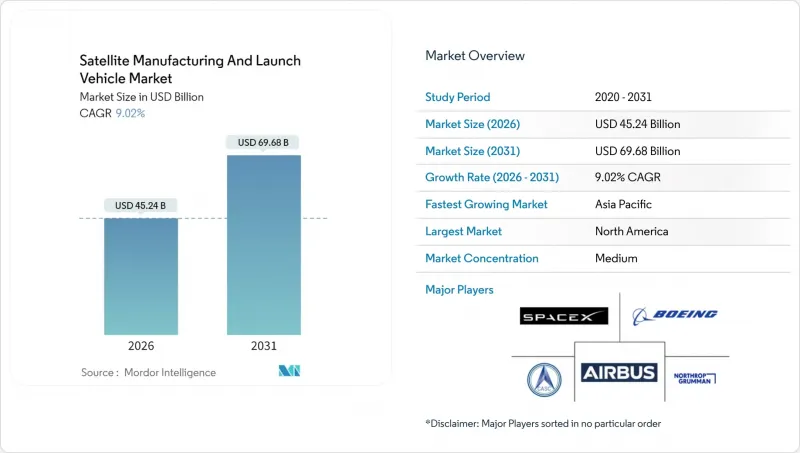
위성 제조 및 발사체 시장은 2025년에 415억 달러로 평가되며, 2026년 452억 4,000만 달러에서 2031년까지 696억 8,000만 달러에 달할 것으로 예측됩니다.
예측 기간(2026-2031년)의 CAGR은 9.02%로 예상됩니다.
이러한 확대는 생산방식이 조립라인 방식으로 전환된 것에 기인합니다. 이를 통해 매월 수백 대의 동일한 우주선을 생산할 수 있게 되었으며, 저궤도 네트워크와 기존 정지궤도 자산을 통합하는 대규모 위성 콘스텔레이션에 필수적인 능력을 갖추게 되었습니다. 상용 전자부품(COTS), 전기 추진 시스템, 소프트웨어 정의 페이로드의 보급으로 표준화 위성의 단가를 50만 달러 미만으로 낮추면서 업그레이드의 유연성을 유지하고 있습니다. 이러한 혁신은 농촌 지역으로의 광대역 제공, 실시간 지구관측 서비스, 강력한 다궤도 연결성을 필요로 하는 국가 안보 아키텍처를 지원할 수 있습니다. 공급 측면에서는 발사 및 우주선 생산의 수직적 통합으로 일정이 단축되고 북미, 유럽 및 아시아태평양의 일부 지역에서 라이선싱 제도의 효율화로 위성 별자리 배치가 가속화될 것입니다.
세계 위성 제조 및 발사체 시장 동향과 인사이트
광대역 인터넷 위성 별자리 배치의 급격한 증가
위성 제조 및 발사체 시장에서 위성 제조 부문은 현재 대량 생산 체제가 주류를 이루고 있으며, 스페이스 X의 레드몬드 시설에서 볼 수 있듯이 하루 최대 8대의 동일한 우주선을 생산하는 조립 라인이 가동되고 있습니다. 표준화된 버스 구조, 모듈식 페이로드 베이, 자동 테스트 스테이션을 통해 제조에서 발사까지의 주기를 3개월 이내로 단축했습니다. 프로젝트 카이퍼, 원웹 등의 사업자들은 비슷한 설계도를 채택하고 있으며, 가입자 수가 100만 명이 넘으면 수익성을 확보할 수 있는 경제성을 실현하고 있습니다. 규제 당국은 면허 심사 기간 단축에 대응하고 있지만, 신규 시장 진출기업에게 주파수 조정은 여전히 장벽으로 작용하고 있습니다. 경쟁 압력으로 인해 위성 세대를 넘어 부품의 공통화가 진행되어 기계적 인터페이스를 변경하지 않고 소프트웨어 정의에 의한 페이로드 교체가 가능해졌습니다.
실시간 지구정보에 대한 수요 증가
민간 및 정부 기관 고객들은 1시간 미만의 재방문 시간을 요구하고 있으며, 소형 합성개구부 레이더와 하이퍼스펙트럼 이미저를 포함한 멀티센서 함대에 대한 수요가 증가하고 있습니다. 신속한 통합 벤치를 통해 새로운 센서는 설계 동결에서 우주 환경 인증까지 9개월 이내에 달성할 수 있습니다. AI 탑재 기내 처리를 통해 원시 이미지를 분석 요약으로 압축하여 다운링크 요구 사항을 60% 감소시킵니다. 재난 대응 및 해양 모니터링에 있으며, 중요한 정보를 제공할 수 있습니다. 가시광선, 레이더, 열대지역을 넘나드는 데이터 융합을 통해 의사결정 수준의 인텔리전스를 제공하고, 전용 태스크 서비스 및 장면 단위 구독 모델의 성장을 가속하고 있습니다.
케이프 커내버럴과 바이코누르의 발사대 용량 병목 현상
케이프 커내버럴은 2024년 44번의 궤도 임무를 수행했으나, 재사용 부스터를 도입했음에도 불구하고 발사대 반납 한계에 다다른 상황이었습니다. 지연은 생산 공정에 파급되어 완성된 우주선을 보관해야 했고, 현금 흐름에 부담을 안겨주었습니다. 제조업체는 현재 최소한의 재인증으로 Falcon 9, Electron 및 신흥 유럽 마이크로 런처 간 전환이 가능한 디스펜서를 설계하고 있습니다. 스코틀랜드, 호주, 한국에 신설되는 상업용 우주항구는 추가 용량을 제공하지만, 페이로드 인터페이스의 업데이트와 환경 테스트의 재검토가 필요합니다.
부문 분석
통신 위성은 2025년 위성 제조 부문의 78.35%를 차지할 것으로 예상되며, 각각 수백 개의 동일한 유닛이 필요한 광대역 위성 별자리를 공급하고 있습니다. 지구관측위성은 2031년까지 연평균 복합 성장률(CAGR) 9.55%로 예상되며, 합성개구레이더 함대가 센서의 다양화를 주도하고 있습니다. 항법위성은 갈릴레오, 북두, NavIC의 확장 계획의 혜택을 누리고 있으며, 과학 임무는 국제우주기구로부터 안정적인 수주를 유지하고 있습니다.
통신 페이로드용 위성 제조 시장 규모는 2025년 325억 2,200만 달러에 달할 것으로 예상되며, 이는 규모의 경제와 수직 통합형 발사 옵션을 반영합니다. 한편, 하이브리드 페이로드 설계는 통신 기능과 광학 이미징을 통합하여 재구성 가능한 버스에 대한 수요를 증가시키고 있습니다. 매출 모델은 용량 서비스형(Capacity-as-a-Service)으로 전환되고 있으며, 이로 인해 사업자들은 새로운 센서가 성숙해지면 궤도에서 교체할 수 있는 플러그 앤 플레이 페이로드 슬롯을 지정하도록 유도하고 있습니다.
무게 100-500kg의 중형 플랫폼은 2025년 63.05%의 점유율을 차지하며, 페이로드 전력과 카풀 경제성의 최적 균형을 이루고 있습니다. 한편, 10-100kg의 소형 위성은 영상관측, IoT, 기상관측 콘스텔레이션의 보급을 배경으로 2031년까지 연평균 복합 성장률(CAGR) 15.20%로 확대될 것으로 예측됩니다.
소형 위성용 위성 제조 및 발사체 시장의 위성 제조 부문은 2025년 73억 6,000만 달러 규모이며, 표준화된 큐브샛 표준의 성능 향상에 따라 2031년까지 2배 이상 확대될 것으로 예측됩니다. 1,000kg 이상의 대형 위성의 경우, 수요는 여전히 플래그십 GEO 미션이나 과학 관측 위성과 같은 틈새 분야에 의존하고 있으며, 이는 주문 제작을 정당화하지만 2031년까지 총 생산량의 15% 미만에 불과할 것으로 예측됩니다.
저궤도 위성군은 2025년 위성 제조 및 발사체 시장에서 위성 제조 부문의 71.40%를 차지할 것으로 예상되며, GEO 위성의 8배에 달하는 연간 8배의 속도로 지속적으로 증가할 것으로 예측됩니다. 중궤도 위성은 항법 시스템 현대화와 새로운 보안 백홀 서비스에 힘입어 10.78%의 가장 빠른 CAGR을 나타낼 것으로 예측됩니다.
제조 라인은 LEO의 가혹한 온도 사이클에 대응하는 내방사선성 및 저비용 설계에 초점을 맞추는 한편, GEO 유닛은 고신뢰성 부품과 전개형 안테나를 유지합니다. 규제 압력으로 인해 임무 종료 후 5년 이내에 통제된 궤도 이탈이 의무화되었고, 버스 공급업체들은 드래그 세일과 전기 추진 폐기 키트를 표준 옵션으로 패키징하고 있습니다.
위성 제조 및 발사체 시장 보고서는 용도별(통신 등), 위성 질량별(10kg 미만 등), 궤도 등급별(LEO, MEO, GEO), 발사체 최대 이륙 중량별(경량 등), 최종사용자별(상업용, 기타), 위성 서브시스템(추진 하드웨어 및 추진제, 기타), 추진 기술(전기식, 기타), 지역(북미, 기타)으로 분류됩니다. 기타), 추진기술(전기식, 기타), 지역(북미, 기타)으로 분류되어 있습니다.
지역별 분석
북미는 SpaceX, 보잉, 록히드마틴 등의 기업이 대표하는 제조부터 발사까지 통합 생태계에 힘입어 2025년 매출의 67.10%를 차지할 것으로 예측됩니다. 워싱턴과 캘리포니아의 자동화 라인은 상업 및 국방 위성군에 모두 공급하고 있으며, 벤처 캐피탈은 서브시스템 스타트업의 안정적인 파이프라인을 확보하고 있습니다. 규제 측면의 지원으로는 연방항공청의 페이로드 승인 절차의 효율화, 우주 하드웨어 수출에 대한 세제 혜택 등이 있습니다. 캐나다는 고속 안테나, 페이로드 프로세서, 지상 부문 제품에서 미국의 리더십을 보완하고 아시아태평양과 유럽 전역에서 틈새 수출의 성공을 보장합니다.
아시아태평양은 2024년 200개 이상의 위성을 출하한 중국의 대량 생산 기지에 힘입어 2031년까지 연평균 복합 성장률(CAGR) 10.95%로 가장 빠르게 성장하는 지역입니다. 인도의 자유화 정책은 국내 기업이 국가의 지원 없이도 상업용 우주선을 건조하고 발사할 수 있도록 장려하고 있습니다. 일본 공급업체는 신뢰성에 대한 오랜 평가를 바탕으로 차세대 소형 위성버스에서 미국 기업과 제휴를 추진하고 있습니다. 한편, 한국의 한화에어로스페이스는 지역 사업자를 위한 턴키 공장에 대한 투자를 추진하고 있습니다.
유럽은 에어버스, 탈레스 아레니아 스페이스 등을 통해 확고한 점유율을 유지하고 있지만, 계획의 파편화와 엄격한 수출 규제로 인해 성장 둔화에 직면해 있습니다. 유럽우주기구의 주권화 구상은 보안 프로세서, 태양전지, 전기 스러스터 등 국산 부품 라인을 지원하고 있습니다. 남미와 중동 및 아프리카에서는 통신 및 정보 서비스를 위한 위성 대역폭에 대한 수요가 증가하고 있지만, 여전히 수입에 의존하고 있으며, 현지 조립 시설과 해외산 버스 모듈을 결합한 합작 투자 기회가 열려 있습니다.
기타 특전:
- 엑셀 형식 시장 예측(ME) 시트
- 애널리스트의 3개월간 지원
자주 묻는 질문
목차
제1장 서론
제2장 조사 방법
제3장 개요
제4장 시장 구도
제5장 시장 규모와 성장 예측
제6장 경쟁 구도
제7장 시장 기회와 향후 전망
제8장 CEO에 대한 주요 전략적 질문
KSA 26.03.06The satellite manufacturing and launch vehicle market was valued at USD 41.50 billion in 2025 and estimated to grow from USD 45.24 billion in 2026 to reach USD 69.68 billion by 2031, at a CAGR of 9.02% during the forecast period (2026-2031).
The expansion stems from a production shift toward assembly-line methods, which enable hundreds of identical spacecraft to be produced per month, a capability essential for proliferated constellations that blend low Earth orbit networks with traditional geostationary assets. The broader adoption of commercial-off-the-shelf (COTS) electronics, electric propulsion, and software-defined payloads reduces unit costs to below USD 500,000 for standardized satellites, while preserving upgrade flexibility. These innovations unlock broadband coverage for rural populations, create real-time Earth observation services, and support national security architectures that demand resilient, multi-orbit connectivity. From a supply-side perspective, vertical integration of launch and spacecraft production compresses schedules, while streamlined licensing regimes in North America, Europe, and parts of Asia-Pacific accelerate constellation deployment.
Global Satellite Manufacturing And Launch Vehicle Market Trends and Insights
Surge in Broadband-Internet Constellation Deployments
Volume production now defines the satellite manufacturing segment of the satellite manufacturing and launch vehicle market, with assembly lines producing up to eight identical spacecraft daily, as seen at SpaceX's Redmond facility. Standardized buses, modular payload bays, and automated test stations reduce build-to-launch cycles to under three months. Operators such as Project Kuiper and OneWeb follow similar blueprints, allowing break-even economics once subscriber numbers exceed 1 million users. Regulatory bodies have responded by shortening license review times, though spectrum coordination remains a hurdle for newcomers. Competitive pressure is driving component commonality across satellite generations, enabling software-defined payload swaps without altering mechanical interfaces.
Growing Demand for Real-Time Earth Intelligence
Commercial and government customers seek sub-hour revisit times, pushing demand for multi-sensor fleets that include compact synthetic-aperture radar and hyperspectral imagers. Rapid integration benches allow a new sensor to move from design freeze to space qualification in under nine months. AI-enabled onboard processing now condenses raw imagery into analytics summaries, lowering downlink requirements by 60% and enabling critical insights for disaster response and maritime monitoring. Data fusion across visible, radar, and thermal bands provides decision-quality intelligence, driving growth in dedicated tasking services and per-scene subscription models.
Launch-Site Capacity Bottlenecks at Cape Canaveral and Baikonur
Cape Canaveral handled 44 orbital missions in 2024, flirting with pad turnaround limits despite reusable boosters. Delays ripple back through production, forcing completed spacecraft into storage and straining cash flows. Manufacturers now design dispensers that can switch between Falcon 9, Electron, and emerging European microlaunchers with minimal re-qualification. New commercial spaceports in Scotland, Australia, and South Korea offer additional capacity but require updates to payload interfaces and revised environmental tests.
Other drivers and restraints analyzed in the detailed report include:
- National Security Focus on Resilient Multi-Orbit Architectures
- Commercial-Off-The-Shelf Component Cost Deflation
- Geopolitical Export-Control Tightening
For complete list of drivers and restraints, kindly check the Table Of Contents.
Segment Analysis
Communication satellites accounted for 78.35% of the satellite manufacturing segment in 2025, supplying broadband constellations that each demand several hundred identical units. Earth-observation satellites are forecast to post a 9.55% CAGR through 2031, with synthetic-aperture radar fleets driving sensor diversity. Navigation satellites benefit from Galileo, BeiDou, and NavIC extensions, while science missions sustain steady orders from international space agencies.
The satellite manufacturing market size for communication payloads reached USD 32.52 billion in 2025, reflecting economies of scale and vertically integrated launch options. Meanwhile, hybrid payload designs blend connectivity with optical imaging, creating incremental demand for reconfigurable buses. Revenue models are shifting toward capacity-as-a-service, prompting operators to specify plug-and-play payload slots that can be swapped in-orbit as new sensors mature.
Mid-class platforms with a weight range of 100-500 kg held a 63.05% share in 2025, representing the optimal balance between payload power and rideshare economics. In contrast, smallsats weighing 10-100 kg are expected to expand at a 15.20% CAGR to 2031, driven by the proliferation of imaging, IoT, and weather constellations.
The satellite manufacturing segment of the satellite manufacturing and launch vehicle market size for small satellites stood at USD 7.36 billion in 2025 and is set to more than double by 2031 as standardized CubeSat formats reach higher performance levels. For heavier classes exceeding 1,000 kg, demand remains tied to flagship GEO missions and science observatories, niches that still justify bespoke manufacturing but are expected to contribute less than 15% of the total build count by 2031.
Low Earth orbit fleets captured 71.40% of the satellite manufacturing segment of the satellite manufacturing and launch vehicle market in 2025 and are expected to continue adding units at an annual rate eight times that of GEO satellites. Medium Earth orbit is forecast to record the fastest 10.78% CAGR, powered by navigation modernization and new secure-backhaul services.
Manufacturing lines focus on radiation-tolerant yet low-cost designs for LEO's harsh cycling, while GEO units retain high-reliability components and deployable antennas. Regulatory pressure now mandates controlled deorbit within five years of mission end, prompting bus suppliers to package drag sails or electric-propulsion disposal kits as standard options.
The Satellite Manufacturing and Launch Vehicle Market Report is Segmented by Application (Communication, and More), Satellite Mass (Below 10 Kg, and More), Orbit Class (LEO, MEO, GEO), Launch Vehicle MTOW (Light, and More), End User (Commercial, and More), Satellite Subsystem (Propulsion Hardware and Propellant, and More), Propulsion Technology (Electric, and More), and Geography (North America, and More).
Geography Analysis
North America accounted for 67.10% of 2025 revenue, driven by integrated manufacturing-to-launch ecosystems exemplified by companies such as SpaceX, Boeing, and Lockheed Martin. Automated lines in Washington and California feed both commercial and defense constellations, while venture capital ensures a steady pipeline of subsystem startups. Regulatory support includes streamlined Federal Aviation Administration payload approvals and tax incentives for the export of space hardware. Canada complements US leadership with high-rate antenna, payload processor, and ground segment products, securing niche export wins across Asia-Pacific and Europe.
The Asia-Pacific region is the fastest-growing region, with a 10.95% CAGR through 2031, driven by Chinese mass-production hubs that shipped over 200 satellites in 2024. India's liberalized policies encourage domestic firms to build and launch commercial spacecraft without state sponsorship. Japanese suppliers leverage their long-standing reputations for reliability to partner with the US companies on next-generation smallsat buses. At the same time, South Korea's Hanwha Aerospace invests in turnkey factories aimed at regional operators.
Europe retains a solid share through Airbus and Thales Alenia Space but faces slower growth due to programmatic fragmentation and strict export frameworks. The European Space Agency's sovereignty initiatives support indigenous component lines for secure processors, solar cells, and electric thrusters. South America and the Middle East & Africa show rising demand for satellite bandwidth for connectivity and intelligence services, but remain reliant on imports, opening opportunities for joint ventures that pair local integration facilities with foreign-built bus modules.
- Airbus SE
- The Boeing Company
- China Aerospace Science and Technology Corporation
- ISRO
- Lockheed Martin Corporation
- Lanteris Space LLC (Maxar Technologies)
- Mitsubishi Heavy Industries, Ltd.
- Northrop Grumman Corporation
- Sierra Nevada Company, LLC
- Space Exploration Technologies Corp.
- Thales Alenia Space (Thales Group and Leonardo S.p.A)
- United Launch Alliance, LLC
- Eutelsat Communications SA
- Blue Origin Enterprises, L.P.
- Rocket Lab Corporation
- Relativity Space, Inc.
- Arianespace SA
- Astroscale Holdings Inc.
- OHB SE
- Spire Global, Inc.
- Planet Labs PBC
Additional Benefits:
- The market estimate (ME) sheet in Excel format
- 3 months of analyst support
TABLE OF CONTENTS
1 INTRODUCTION
- 1.1 Study Assumptions and Market Definition
- 1.2 Scope of the Study
2 RESEARCH METHODOLOGY
3 EXECUTIVE SUMMARY
4 MARKET LANDSCAPE
- 4.1 Market Overview
- 4.2 Market Drivers
- 4.2.1 Surge in broadband-internet constellation deployments
- 4.2.2 Growing demand for real-time Earth intelligence (EO/ISR)
- 4.2.3 National security focus on resilient multi-orbit architectures
- 4.2.4 Commercial-off-the-shelf (COTS) component cost deflation
- 4.2.5 Emergence of in-orbit servicing and assembly ecosystems
- 4.2.6 Lunar and cis-lunar exploration programs
- 4.3 Market Restraints
- 4.3.1 Launch-site capacity bottlenecks at Cape Canaveral and Baikonur
- 4.3.2 Persistent spectrum-allocation congestion at ITU
- 4.3.3 Geopolitical export-control tightening
- 4.3.4 Space-debris mitigation cost compliance
- 4.4 Value Chain Analysis
- 4.5 Regulatory Landscape
- 4.6 Technological Outlook
- 4.7 Porter's Five Forces Analysis
- 4.7.1 Threat of New Entrants
- 4.7.2 Threat of Substitutes
- 4.7.3 Bargaining Power of Buyers
- 4.7.4 Bargaining Power of Suppliers
- 4.7.5 Intensity of Competitive Rivalry
5 MARKET SIZE AND GROWTH FORECASTS (VALUE)
- 5.1 By Application
- 5.1.1 Communication
- 5.1.2 Earth Observation
- 5.1.3 Navigation
- 5.1.4 Space Observation
- 5.1.5 Others
- 5.2 By Satellite Mass
- 5.2.1 Below 10 kg
- 5.2.2 10 - 100 kg
- 5.2.3 100 - 500 kg
- 5.2.4 500 - 1,000 kg
- 5.2.5 Above 1,000 kg
- 5.3 By Orbit Class
- 5.3.1 LEO
- 5.3.2 MEO
- 5.3.3 GEO
- 5.4 By Launch-Vehicle MTOW
- 5.4.1 Light
- 5.4.2 Medium
- 5.4.3 Heavy
- 5.5 By End-user
- 5.5.1 Commercial
- 5.5.2 Military and Government
- 5.5.3 Other
- 5.6 By Satellite Subsystem
- 5.6.1 Propulsion Hardware and Propellant
- 5.6.2 Satellite Bus and Sub-systems
- 5.6.3 Solar Array and Power Hardware
- 5.6.4 Structures, Harness and Mechanisms
- 5.7 By Propulsion Technology
- 5.7.1 Electric
- 5.7.2 Liquid Fuel
- 5.7.3 Gas-based/Hybrid
- 5.8 By Geography
- 5.8.1 North America
- 5.8.1.1 United States
- 5.8.1.2 Canada
- 5.8.2 South America
- 5.8.2.1 Brazil
- 5.8.2.2 Rest of South America
- 5.8.3 Europe
- 5.8.3.1 Germany
- 5.8.3.2 France
- 5.8.3.3 United Kingdom
- 5.8.3.4 Russia
- 5.8.3.5 Rest of Europe
- 5.8.4 Asia-Pacific
- 5.8.4.1 China
- 5.8.4.2 India
- 5.8.4.3 Japan
- 5.8.4.4 South Korea
- 5.8.4.5 Rest of Asia-Pacific
- 5.8.5 Middle East and Africa
- 5.8.5.1 Middle East
- 5.8.5.1.1 United Arab Emirates
- 5.8.5.1.2 Saudi Arabia
- 5.8.5.1.3 Rest of Middle East
- 5.8.5.2 Africa
- 5.8.5.2.1 South Africa
- 5.8.5.2.2 Rest of Africa
- 5.8.5.1 Middle East
- 5.8.1 North America
6 COMPETITIVE LANDSCAPE
- 6.1 Market Concentration
- 6.2 Strategic Moves
- 6.3 Market Share Analysis
- 6.4 Company Profiles (includes Global Level Overview, Market Level Overview, Core Segments, Financials as available, Strategic Information, Market Rank/Share, Products and Services, and Recent Developments)
- 6.4.1 Airbus SE
- 6.4.2 The Boeing Company
- 6.4.3 China Aerospace Science and Technology Corporation
- 6.4.4 ISRO
- 6.4.5 Lockheed Martin Corporation
- 6.4.6 Lanteris Space LLC (Maxar Technologies)
- 6.4.7 Mitsubishi Heavy Industries, Ltd.
- 6.4.8 Northrop Grumman Corporation
- 6.4.9 Sierra Nevada Company, LLC
- 6.4.10 Space Exploration Technologies Corp.
- 6.4.11 Thales Alenia Space (Thales Group and Leonardo S.p.A)
- 6.4.12 United Launch Alliance, LLC
- 6.4.13 Eutelsat Communications SA
- 6.4.14 Blue Origin Enterprises, L.P.
- 6.4.15 Rocket Lab Corporation
- 6.4.16 Relativity Space, Inc.
- 6.4.17 Arianespace SA
- 6.4.18 Astroscale Holdings Inc.
- 6.4.19 OHB SE
- 6.4.20 Spire Global, Inc.
- 6.4.21 Planet Labs PBC
7 MARKET OPPORTUNITIES AND FUTURE OUTLOOK
- 7.1 White-space and Unmet-Need Assessment


