|
시장보고서
상품코드
1939700
자동차용 인공지능 : 시장 점유율 분석, 업계 동향과 통계, 성장 예측(2026-2031년)Automotive Artificial Intelligence - Market Share Analysis, Industry Trends & Statistics, Growth Forecasts (2026 - 2031) |
||||||
 Mordor Intelligence
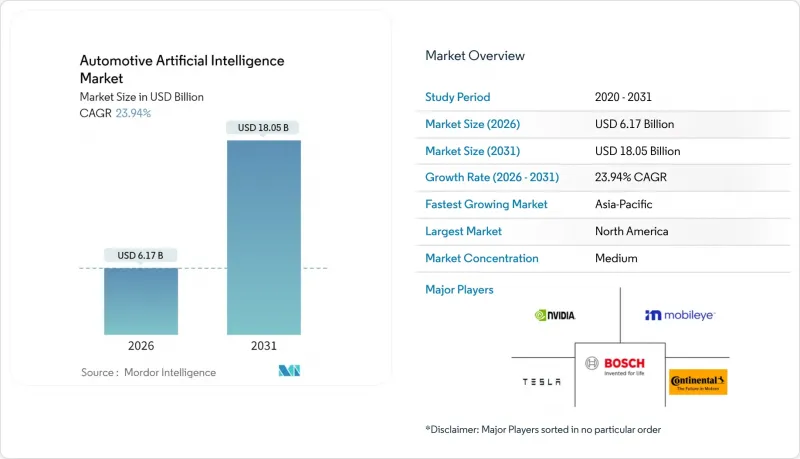
자동차용 AI 시장은 2025년 49억 8,000만 달러에서 2026년에는 61억 7,000만 달러로 성장하며, 2026-2031년에 CAGR 23.94%로 추이하며, 2031년에는 180억 5,000만 달러에 달할 것으로 예측됩니다.
소프트웨어 정의 차량의 급속한 보급, EU와 미국의 레벨 2 ADAS 의무화 규제, 자동차 등급 AI 컴퓨팅 비용의 하락으로 경쟁 우위는 기계 설계에서 알고리즘 성능으로 이동하고 있습니다. 자동차 제조업체들은 출하된 모든 차량을 매출을 창출하는 엣지 노드로 전환하는 OTA(Over-The-Air) 업데이트 플랫폼을 확장하고 있습니다. 한편, 칩셋 기반의 SoC(시스템온칩)를 통해 중급형 모델에서도 높은 TOPS 성능을 합리적인 가격으로 구현할 수 있게 되었습니다. 테슬라가 선구적으로 도입한 차량 학습 프레임워크는 중국의 주요 OEM 업체들도 채택하고 있으며, 폐쇄형 루프 검증으로는 따라잡을 수 없는 속도로 인식 정확도를 향상시키고 있습니다. 이러한 배경에서 자동차 제조업체, 1차 협력사, 하이퍼스케일러, AI 스타트업 간의 전략적 제휴가 수직적 통합을 대체하고 전문 분야에서의 차별화를 촉진하는 모듈형 혁신 생태계를 조성하고 있습니다.
세계 자동차 인공지능 시장 동향 및 인사이트
레벨 2+ADAS 안전 기능에 대한 규제 요건
2024년 7월 시행된 EU 일반안전규정 II(GSE II)에 따라 유럽에서 판매되는 모든 신차에는 자동 긴급 제동, 긴급 차선 유지, 지능형 속도 보조 시스템 탑재가 의무화되었습니다. 미국이나 일본에서도 비슷한 요구사항이 도입되고 있으며, 전 세계 자동차 제조업체들은 '한번 설계하면 어디서나 인증이 가능한' 설계를 요구받고 있습니다. 이러한 컴플라이언스 요구사항으로 인해 과거에는 프리미엄 추가 장비였던 기능이 기본 설계 요소로 전환되어 Tier 1 공급업체로부터의 지각 스택 주문량 증가를 촉진하고 있습니다. 유엔 ECE 규정 171(운전제어지원시스템에 관한 규정)은 AI 기능의 가상 테스트 규칙을 상세하게 규정함으로써 이러한 변화를 더욱 가속화하고 있습니다. 그 결과, 과거 기계적인 정교함으로 차별화를 꾀하던 자동차 제조업체들은 소프트웨어 성숙도 일정으로 경쟁하게 되었고, 명확한 규칙서가 단편적인 지역적 요건을 대체하면서 신규 시장 진출기업 시장 진입 장벽이 낮아지고 있습니다.
자동차용 SoC의 AI 연산 능력과 TOPS의 급격한 하락세
엔비디아의 Thor 프로세서는 2,000 TOPS를 약속했고, 테슬라가 개발중인 AI5 칩은 2,500 TOPS를 목표로 하고 있습니다. 이는 현재 차량 탑재 성능의 10배이며, 2022년 이후 매년 TOPS 단가를 약 40% 절감할 수 있습니다. 비용 절감은 공유 데이터센터 규모, 첨단 파운드리 노드, 레티클 크기의 모놀리식 칩을 모듈식 타일로 대체하는 칩렛 분할 기술에 기인합니다. Imec의 자동차 칩렛 프로그램은 Bosch, BMW를 비롯한 선구적인 기업과 협력하여 상호 운용 가능한 다이 간 프로토콜을 구축했습니다. 이를 통해 개발 주기 단축과 차종 간 플랫폼 재사용을 실현할 수 있습니다. 실리콘의 희소성이 사라지는 가운데, 차별화는 소프트웨어로 이동. 기존 반도체 공급업체들은 자동차 제조업체의 대규모 도입을 지원하는 툴체인, 미들웨어, 레퍼런스 스택을 구축해야 하는 상황에 처해 있습니다.
관할권별로 분절된 기능 안전 규정
ISO 26262, ISO/IEC 5469:2024 및 향후 제정될 ISO/TS 5083:2025는 각각 자율주행 기술 스택의 각기 다른 영역의 안전 프로세스를 정의하고 있으며, OEM(Original Equipment Manufacturer)는 중복과 모순을 조정해야 하는 상황에 처해 있습니다. 유럽의 GSR II는 미국 연방 가이드라인이나 중국의 GB/T 표준과 다른 방향을 제시하고 있으며, 전 세계 플랫폼은 지역별로 별도의 적합성 증명을 유지해야 합니다. 중소 공급업체들은 여러 트랙의 검증에 따른 부담으로 인해 출시가 지연되거나 지역적 범위가 축소되는 경우가 많습니다. 업계 단체는 '안전 사례 교환'을 주창하며 인증기관 간 감사 결과물을 상호 운용할 수 있도록 하자는 구상을 내세우고 있지만, 아직 합의에 이르지 못하고 있습니다. 통합이 이루어질 때까지 이러한 패치워크 상태는 비반복적인 엔지니어링 비용을 증가시키고, 자동차 AI 시장의 성장을 저해하는 요인으로 작용할 것입니다.
부문 분석
2025년, 소프트웨어는 자동차 인공지능 시장 매출의 64.78%를 차지했습니다. 이는 차량의 가치 창출이 철강에서 코드 라인으로 이동한 결과입니다. 자동차 제조업체들은 현재 구매 후 몇 년이 지나도 기능을 추가할 수 있는 신경망 업그레이드를 제공하고 있으며, 모든 커넥티드카를 살아있는 과금 서비스 노드로 바꾸고 있습니다. 하드웨어 부문은 예측 기간 중 13.84%의 연평균 복합 성장률(CAGR)을 보일 것이지만, 칩렛 생태계가 TOPS를 상품화하면 이익률은 압축될 것입니다. 따라서 자동차 AI 시장에서는 실리콘 단품을 판매하는 기업보다 코드, 툴체인, 수명주기 지원을 묶어 판매할 수 있는 기업이 더 큰 보상을 받게 될 것입니다.
Cerence CaLLM Edge와 같은 엣지 상주형 언어 모델은 네트워크 비용 없이 지능을 향상시키고, 유럽과 중국의 프라이버시 가이드라인을 충족하는 소프트웨어의 힘을 보여주고 있습니다. 브레이크 및 차선 유지에 대한 지속적인 개선이 요구되는 규제 요건은 신규 생산 차량뿐만 아니라 모든 운행 차량에 대한 적합성 업데이트를 제공해야 하므로 소프트웨어 매출이 더욱 고정화됩니다. 그 결과, 자동차 AI 시장에서 Tier 1 기업은 DevOps 인력과 OTA 사이버 보안에 수십억을 투자하여 소프트웨어를 주요 경쟁 우위로 삼고 있습니다.
머신러닝은 투명한 의사결정 트리가 ISO 26262 감사 요건을 충족하므로 2025년 자동차 AI 시장 점유율의 41.12%를 차지할 것으로 예측됩니다. 그러나 딥러닝의 15.86%의 연평균 복합 성장률(CAGR)은 기존 알고리즘으로는 분석할 수 없는 멀티센서 융합 기술로 제조업체들이 전환하고 있음을 시사합니다. 컴퓨터 비전, 자연 언어 처리, 상황 인식 기술은 조종석 사용자 경험과 연동되어 자동차 AI 시장을 안전 영역을 넘어 자동차 AI 시장을 확장하고 있습니다.
테슬라가 계획하고 있는 AI5 칩은 고속도로 주행시 4D 레이더, LiDAR, HD 카메라의 융합 처리가 가능한 것은 심층 컨볼루션 모델뿐임을 보여주고 있습니다. 중국 업체들은 이에 발맞추어 주차 보조 모듈 내에 트랜스포머 네트워크를 내장함으로써, 과거에는 특수한 영역이었던 AI를 쇼룸의 차별화 요소로 삼고 있습니다. 그 결과, 공급망 파트너들은 주석이 달린 데이터, 확장 가능한 훈련 인프라, 불투명한 신경 잠재 공간을 다루는 검증 툴공급 경쟁을 가속화하고 있습니다.
지역별 분석
북미는 2025년 자동차 인공지능 시장 매출의 35.89%를 차지할 것으로 예상되며, 테슬라의 데이터 우위, 텍사스주의 관대한 테스트 규제, 엔비디아 실리콘밸리 본사 주변의 국내 AI 컴퓨팅 클러스터가 그 기반이 될 것입니다. 한편, 제너럴 모터스, 포드, 웨이모는 피닉스에서 오스틴으로 무인운전 사업을 확장하여 수익성을 입증하고, 차량 전체에 대한 원격 지원 규제의 격차를 강조하고 있습니다.
아시아태평양은 22.98%의 연평균 복합 성장률(CAGR)을 보이고, 세계에서 가장 빠른 성장세를 보이고 있습니다. 중국은 수출 지향적 EV 리더십과 비교적 통일된 규제 샌드박스를 결합하고, 지리자동차는 30개 모델에 AI 도입을 약속했으며, 화웨이는 2025년까지 50만 대의 자율주행차량을 목표로 하고 있습니다. 일본의 도요타, 닛산, 혼다는 국내 AI 인력 부족 대책으로 반도체 컨소시엄을 설립했습니다. 한편, 한국의 현대자동차는 공장지대와 항만을 연결하는 자율주행 물류회랑에 7조원을 투자했습니다. 현지 배터리 및 라이더 공급업체가 지역 OEM의 부품 비용을 절감하고, 중급 차량용 자동차 AI 시장의 보급을 촉진하고 있습니다.
유럽은 엄격한 데이터 프라이버시 규정을 유지하면서 GSR II에 기반한 AI 안전 기능을 의무화하여 양산 플랫폼 전체에 대한 컴플라이언스 기준을 확립하고 있습니다. BMW가 2025년 중국에서 DeepSeek AI를 통합하는 움직임은 현지화 전략을 강조하는 한편, 폭스바겐은 유럽에서 수백만 대의 차량에 Cerence Chat Pro OTA를 배포하고 있습니다. GDPR(EU 개인정보보호규정)의 제약으로 인해 엣지 추론에 대한 수요가 증가하고 있으며, 공급업체들은 프라이버시 보호 모델 업데이트 파이프라인 설계를 촉진하고 있습니다. 절대적인 성장률에서는 아시아에 뒤처지지만, 차량 당 부가가치가 높기 때문에 운전자 모니터링 및 사이버 보안 OTA 스택을 전문으로 하는 전문 벤더들에게 유럽 시장은 여전히 수익성이 높은 시장입니다.
기타 특전:
- 엑셀 형식 시장 예측(ME) 시트
- 애널리스트 지원(3개월)
자주 묻는 질문
목차
제1장 서론
제2장 조사 방법
제3장 개요
제4장 시장 구도
제5장 시장 규모와 성장 예측
제6장 경쟁 구도
제7장 시장 기회와 향후 전망
KSA 26.03.05The Automotive AI market is expected to grow from USD 4.98 billion in 2025 to USD 6.17 billion in 2026 and is forecast to reach USD 18.05 billion by 2031 at 23.94% CAGR over 2026-2031.
Rapid software-defined vehicle adoption, mandatory Level-2 ADAS regulations in the EU and the United States, and falling costs of automotive-grade AI compute are shifting competitive advantage from mechanical engineering to algorithm performance. Automakers are scaling over-the-air (OTA) update platforms that turn every delivered vehicle into a revenue-generating edge node, while chiplet-based system-on-chips (SoCs) make high TOPS performance affordable for mid-range models. Fleet-learning frameworks pioneered by Tesla and replicated by leading Chinese OEMs raise perception accuracy at a pace no closed-loop validation can match. Against this backdrop, strategic partnerships between carmakers, Tier-1s, hyperscalers, and AI start-ups are replacing vertical integration, creating a modular innovation ecosystem that encourages specialist differentiation.
Global Automotive Artificial Intelligence Market Trends and Insights
Regulatory Mandates For Level-2+ ADAS Safety Features
The EU General Safety Regulation II, which came into force in July 2024, obliges every new car sold in Europe to include automatic emergency braking, emergency lane-keeping, and intelligent speed assistance. Comparable requirements are gaining traction in the United States and Japan, nudging global automakers to design once and certify everywhere. Compliance needs have therefore transformed what used to be premium add-ons into baseline design elements, stimulating larger order volumes for perception stacks from Tier-1 suppliers. The United Nations ECE Regulation 171 on Driver Control Assistance Systems reinforces this shift by detailing virtual-testing rules for AI functions. As a result, OEMs that once differentiated through mechanical refinement now compete on software maturity timelines, and market entry barriers for newcomers fall when a clear rulebook replaces fragmented local requirements.
Rapid Decline In AI Compute And TOPS For Automotive SoCs
NVIDIA's Thor processor promises 2,000 TOPS, and Tesla's forthcoming AI5 chip targets 2,500 TOPS-ten times today's in-car performance while cutting cost per TOPS by roughly 40% every year since 2022. Cost deflation comes from shared data-center volumes, advanced foundry nodes, and chiplet partitioning that substitutes reticle-size monoliths with modular tiles. Imec's Automotive Chiplet Programme unites Bosch, BMW, and other pioneers around interoperable die-to-die protocols that compress development cycles and enable platform reuse across vehicle lines. As silicon ceases to be scarce, differentiation migrates to software, forcing traditional semiconductor suppliers to embed toolchains, middleware, and reference stacks that help automakers deploy at scale.
Fragmented Functional-Safety Regulations Across Jurisdictions
ISO 26262, ISO/IEC 5469:2024, and forthcoming ISO/TS 5083:2025 each define safety processes for different slices of the autonomy stack, leaving OEMs to reconcile overlaps and contradictions. Europe's GSR II departs from emerging US federal guidelines and China's GB/T standards, forcing global platforms to maintain separate compliance evidence for each region. Smaller suppliers struggle with the overhead of multi-track validation, often delaying launches or narrowing geographic scope. Industry consortia advocate a "safety case exchange" where audit artefacts could be ported between homologation authorities, but consensus remains distant. Until unification arrives, the patchwork saps the Automotive AI market growth by raising non-recurring engineering costs.
Other drivers and restraints analyzed in the detailed report include:
- Explosion of Over-the-Air SW Updates Enabling AI Feature Monetisation
- Fleet-Learning Architectures Accelerating Perception Model Accuracy
- High Validation Cost Of AI Models For Edge-Case Scenarios
For complete list of drivers and restraints, kindly check the Table Of Contents.
Segment Analysis
Software generated 64.78% of the automotive artificial intelligence market revenue in 2025 as vehicle value creation migrated from iron and steel to lines of code. Automakers now ship neural-network upgrades that add features years after purchase, turning every connected car into a living, billed service node. Hardware segment grows at a CAGR of 13.84% during the forecast period, yet its margin compresses when chiplet ecosystems commoditise TOPS. The Automotive AI market, therefore, rewards companies able to bundle code, toolchains, and life-cycle support rather than those selling silicon alone.
Edge-resident language models like Cerence CaLLM Edge illustrate how software can boost perceived intelligence without network fees, meeting privacy guidelines in Europe and China. Regulatory mandates that require continuous improvement of braking or lane-keeping further lock in software revenues, because compliance updates must reach every in-use unit, not just fresh builds. As a result, the Automotive AI market sees Tier-1s investing billions in DevOps talent and OTA cybersecurity, cementing software as the primary moat.
Machine learning owns 41.12% of the automotive artificial intelligence market share in 2025 because its transparent decision trees satisfy ISO 26262 audit needs. Still, deep learning's 15.86% CAGR indicates manufacturers' migration toward multi-sensor fusion that classic algorithms cannot parse. Computer vision, natural language processing, and context awareness tie into cockpit user experience, widening the Automotive AI market beyond safety alone.
Tesla's planned AI5 chip demonstrates that only deep convolutional models can manage 4D radar, LiDAR, and HD-camera fusion at freeway speed. Chinese suppliers follow by embedding transformer networks inside parking-assist modules, making once-exotic AI a showroom differentiator. Consequently, supply-chain partners race to supply annotated data, scalable training infrastructure, and verification tools that handle opaque neural latent spaces.
The Automotive Artificial Intelligence Market is Segmented by Offering (Hardware and Software), Technology (Machine Learning, Deep Learning, and More), Process (Data Mining, Image Recognition, and More), Application (Autonomous Driving, and More), Vehicle Type (Passenger Cars, and More), and Geography. The Market Forecasts are Provided in Terms of Value (USD).
Geography Analysis
North America generated 35.89% of the automotive artificial intelligence market in 2025 revenue, anchored by Tesla's data advantage, Texas's permissive testing statutes, and a domestic AI-compute cluster around NVIDIA's Silicon Valley headquarters. In the meantime, General Motors, Ford, and Waymo are scaling driverless operations from Phoenix to Austin, validating monetisation and spotlighting gaps in fleet-wide remote assistance regulation.
Asia-Pacific records a 22.98% CAGR, the fastest worldwide. China combines export-oriented EV leadership with a comparatively unified regulatory sandbox, letting Chery pledge AI rollout across 30 models and Huawei target 500,000 autonomous-capable vehicles by 2025. Japan's Toyota, Nissan, and Honda have formed a semiconductor consortium to address domestic AI shortages. In contrast, South Korea's Hyundai invests KRW 7 trillion in self-driving logistics corridors linking factory zones with ports. Local battery and lidar suppliers reduce the bill of materials for regional OEMs, boosting the Automotive AI market adoption in mid-segment vehicles.
Europe maintains strict data-privacy rules yet mandates AI safety functions under GSR II, creating a compliance-driven baseline for every volume platform. BMW's 2025 integration of DeepSeek AI in China underscores its localisation strategy, while Volkswagen rolls out Cerence Chat Pro OTA to millions of European vehicles. GDPR constraints amplify demand for edge inference, spurring suppliers to design privacy-preserving model-update pipelines. Although the market trails Asia in absolute growth, high per-vehicle content keeps Europe profitable for specialist vendors focusing on driver-monitoring and cyber-secure OTA stacks.
- Tesla Inc.
- Waymo LLC (Alphabet)
- NVIDIA Corporation
- Intel Corporation / Mobileye
- Horizon Robotics Inc.
- Aptiv PLC
- Continental AG
- Robert Bosch GmbH
- Qualcomm Incorporated
- Huawei Technologies Co.
- Microsoft Corporation
- Amazon Web Services Inc.
- Mercedes-Benz Group AG
- ZF Friedrichshafen AG
- BMW AG
- Toyota Motor Corporation
- Uber Technologies Inc.
- Hyundai Motor Company
- Hyundai Mobis Co. Ltd.
- Magna International Inc.
Additional Benefits:
- The market estimate (ME) sheet in Excel format
- 3 months of analyst support
TABLE OF CONTENTS
1 Introduction
- 1.1 Study Assumptions & Market Definition
- 1.2 Scope of the Study
2 Research Methodology
3 Executive Summary
4 Market Landscape
- 4.1 Market Overview
- 4.2 Market Drivers
- 4.2.1 Regulatory Mandates for Level-2+ ADAS Safety Features
- 4.2.2 Rapid Decline in AI-compute and TOPS for Automotive SoCs
- 4.2.3 Explosion of Over-the-air (OTA) SW Updates Enabling AI Feature Monetization
- 4.2.4 Fleet-learning Architectures Accelerating Perception Model Accuracy
- 4.2.5 On-device Multimodal Foundation Models Reducing Cloud Dependency
- 4.2.6 Emerging Chiplet-Based ECUs Lowering BOM for Mass-market Vehicles
- 4.3 Market Restraints
- 4.3.1 Fragmented Functional-Safety Regulations Across Jurisdictions
- 4.3.2 High Validation Cost of AI Models for Edge-case Scenarios
- 4.3.3 Persistent Scarcity of Automotive-grade AI Talent in Tier-1s
- 4.3.4 Supply-chain Exposure to Advanced-node Foundry Capacity
- 4.4 Value / Supply-Chain Analysis
- 4.5 Regulatory Landscape
- 4.6 Technological Outlook
- 4.7 Porter's Five Forces Analysis
- 4.7.1 Threat of New Entrants
- 4.7.2 Bargaining Power of Buyers
- 4.7.3 Bargaining Power of Suppliers
- 4.7.4 Threat of Substitutes
- 4.7.5 Intensity of Competitive Rivalry
5 Market Size & Growth Forecasts (Value, USD)
- 5.1 By Offering
- 5.1.1 Hardware
- 5.1.2 Software
- 5.2 By Technology
- 5.2.1 Machine Learning
- 5.2.2 Deep Learning
- 5.2.3 Computer Vision
- 5.2.4 Natural Language Processing
- 5.2.5 Context Awareness
- 5.3 By Process
- 5.3.1 Data Mining
- 5.3.2 Image Recognition
- 5.3.3 Signal Recognition
- 5.4 By Application
- 5.4.1 Autonomous Driving
- 5.4.2 Advanced Driver-Assistance Systems (ADAS)
- 5.4.3 Human-Machine Interface
- 5.4.4 Predictive Maintenance & Diagnostics
- 5.5 By Vehicle Type
- 5.5.1 Passenger Cars
- 5.5.2 Light Commercial Vehicles
- 5.5.3 Heavy Commercial Vehicles
- 5.6 By Geography
- 5.6.1 North America
- 5.6.1.1 United States
- 5.6.1.2 Canada
- 5.6.1.3 Rest of North America
- 5.6.2 South America
- 5.6.2.1 Brazil
- 5.6.2.2 Argentina
- 5.6.2.3 Rest of South America
- 5.6.3 Europe
- 5.6.3.1 Germany
- 5.6.3.2 United Kingdom
- 5.6.3.3 France
- 5.6.3.4 Spain
- 5.6.3.5 Italy
- 5.6.3.6 Russia
- 5.6.3.7 Rest of Europe
- 5.6.4 Asia-Pacific
- 5.6.4.1 China
- 5.6.4.2 Japan
- 5.6.4.3 South Korea
- 5.6.4.4 India
- 5.6.4.5 Indonesia
- 5.6.4.6 Philippines
- 5.6.4.7 Vietnam
- 5.6.4.8 Australia
- 5.6.4.9 Rest of Asia-Pacific
- 5.6.5 Middle East and Africa
- 5.6.5.1 United Arab Emirates
- 5.6.5.2 Saudi Arabia
- 5.6.5.3 Turkey
- 5.6.5.4 South Africa
- 5.6.5.5 Nigeria
- 5.6.5.6 Egypt
- 5.6.5.7 Rest of Middle East and Africa
- 5.6.1 North America
6 Competitive Landscape
- 6.1 Market Concentration
- 6.2 Strategic Moves
- 6.3 Market Share Analysis
- 6.4 Company Profiles (includes Global Level Overview, Market Level Overview, Core Segments, Financials as Available, Strategic Information, Market Rank/Share for Key Companies, Products and Services, SWOT Analysis, and Recent Developments)
- 6.4.1 Tesla Inc.
- 6.4.2 Waymo LLC (Alphabet)
- 6.4.3 NVIDIA Corporation
- 6.4.4 Intel Corporation / Mobileye
- 6.4.5 Horizon Robotics Inc.
- 6.4.6 Aptiv PLC
- 6.4.7 Continental AG
- 6.4.8 Robert Bosch GmbH
- 6.4.9 Qualcomm Incorporated
- 6.4.10 Huawei Technologies Co.
- 6.4.11 Microsoft Corporation
- 6.4.12 Amazon Web Services Inc.
- 6.4.13 Mercedes-Benz Group AG
- 6.4.14 ZF Friedrichshafen AG
- 6.4.15 BMW AG
- 6.4.16 Toyota Motor Corporation
- 6.4.17 Uber Technologies Inc.
- 6.4.18 Hyundai Motor Company
- 6.4.19 Hyundai Mobis Co. Ltd.
- 6.4.20 Magna International Inc.