

|
시장보고서
상품코드
2035007
화재 경보 시스템 시장 : 점유율 분석, 업계 동향 및 통계, 성장 예측(2026-2031년)Fire Alarm Systems - Market Share Analysis, Industry Trends & Statistics, Growth Forecasts (2026 - 2031) |
||||||
 Mordor Intelligence
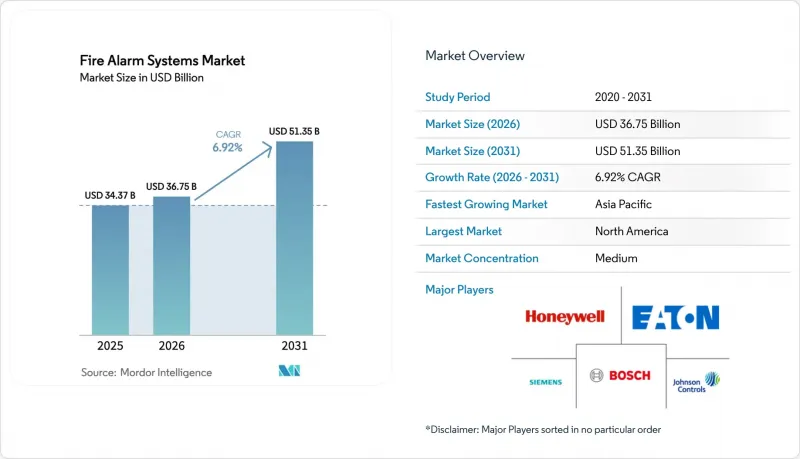
화재 경보 시스템 시장 규모는 2025년에 343억 7,000만 달러로 평가되었고 2026년 367억 5,000만 달러에서 2031년까지 513억 5,000만 달러에 이를 것으로 예측되며, 예측 기간(2026-2031년) CAGR은 6.92%를 나타낼 전망입니다.
2024년과 2025년에는 엄격한 법규의 시행, 스마트 빌딩 프로젝트의 확산, 기존 유선 패널에서 커넥티드 및 주소 지정이 가능한 플랫폼으로의 광범위한 전환이 이러한 성장 궤도를 뒷받침할 것으로 예상됐습니다. 상업용 개발업체들은 보다 광범위한 빌딩 관리 소프트웨어와 통합 가능한 네트워크 지원 시스템을 선호하는 반면, 데이터센터 운영자와 배터리 저장소 소유주들은 민감한 전자 장비를 보호하기 위해 전문적인 감지 및 화재 진압 시스템을 원했습니다. NFPA 72(2025년) 등 급격한 법규 개정으로 사이버 보안 의무화, 열화상 감지, 음향 누출 감지 등이 도입되면서 벤더들은 제품을 재설계하고, 설치업체들은 기술력 향상에 박차를 가하고 있습니다. 사모펀드는 전국 규모의 서비스 플랫폼 구축을 위한 롤업에 박차를 가하고 있습니다. 이는 인건비 상승과 애프터마켓의 수익 기회를 확대한 기술자 부족에 대한 대응이었습니다. 지역별로는 아시아태평양으로 지출 모멘텀이 이동했지만, 북미는 스마트 시설로의 개보수를 일찍 도입한 덕분에 규모의 우위를 유지했습니다.
세계 화재 경보 시스템 시장 동향 및 인사이트
전 세계 소방안전 규제 및 기준의 강화 추세
2024년부터 2025년까지는 표준 개정이 수요에 영향을 미쳤습니다. NFPA 72의 2025년 개정판에서는 해커가 레거시 시스템에서 악용할 수 있는 버퍼 오버플로우 취약점이 연방정부의 경고로 밝혀짐에 따라, 새로운 주소 지정형 패널에 사이버 보안 대책, 음향 누출 감지 및 열화상 기능 탑재가 의무화되었습니다. 유럽의 EN 54 표준도 이와 병행하여 개정되었으며, 기능적 무결성을 보장하기 위해 인증 기준이 부품 수준에서 전체 시스템 시험으로 전환되었습니다. 북미에서는 UL 217 및 UL 268의 연기 감지기 규정으로 인해 주방의 오작동 경보가 억제되어 주택 건설업체가 새로운 센서 알고리즘을 채택하도록 강요당하고 있습니다. 그 결과, 화재 경보 시스템 시장에서는 특히 의료시설이나 교육기관 캠퍼스에서 환자나 학생이 있는 민감한 구역에서 '음향모드 제한운전'이 의무화되면서 개보수 공사 수주가 급증했습니다.
상업용 부동산 및 스마트 빌딩 건설 가속화
개발사들은 자재비 폭등 속에서도 디지털 대응을 우선시했습니다. 오픈 API를 갖춘 화재 경보 플랫폼은 에너지 대시보드, 방문자 관리, 보안 영상 피드와 연동하여 시설 운영자를 위한 '단일 창'을 실현했습니다. 새로운 패널 내부의 엣지 컴퓨터가 연기 센서의 데이터를 로컬에서 처리함으로써 억제 명령의 지연을 줄이고, 클라우드는 전체 시스템 분석에 집중할 수 있게 되었습니다. 배관공사 비용이 엄청나게 들었던 개보수 대상 타워빌딩에 무선감지기와 경보장치를 도입하여 설치시간을 최대 35%까지 단축시켰습니다. 공급의 병목현상에도 불구하고, 스마트 대응 프로젝트는 더 높은 임대료를 받을 수 있기 때문에 시공업체들은 높은 도입률을 유지하며 화재 경보 시스템 시장의 상승 추세를 이끌었습니다.
높은 초기 설치 및 개보수 비용
2025년까지 주소 지정형 기술 및 특수 감지기는 기존 장비에 비해 15-25%의 가격 프리미엄이 붙었습니다. 병원 및 역사적 건물의 개조 프로젝트에서 석면 제거 및 감염 방지용 파티션과 같은 추가 장벽에 직면하여 작업 시간이 두 배로 늘어났습니다. 기술자 부족(북미 서비스 기업의 절반이 인력 부족을 보고)으로 인해 임금 수준이 상승하고 프로젝트 공사 기간이 길어졌습니다. 중소기업은 업그레이드를 미루거나 최저 비용으로 제한된 기능의 패널을 선택하여 광범위한 화재 경보 시스템 시장 내에서 수요 곡선이 양극화되었습니다.
부문 분석
2025년 기준 화재 경보 시스템 시장 중 감지기가 35.12%를 차지했으며, 2031년까지 연평균 복합 성장률(CAGR) 8.07%를 나타낼 것으로 예측됩니다. 플랫폼 제조업체는 마이크로 포그형 연기 감지기, 온도 상승률형 열 감지기, 일산화탄소(CO) 감지기 및 공기질 센서를 단일 인클로저에 통합하여 알고리즘이 신호를 상호 참조하여 오경보를 억제할 수 있도록 했습니다. 클라우드 연결형 감지기는 자가 진단 데이터를 스트리밍으로 전송하여 서비스 사업자에게 오염 및 배터리 방전 예고를 미리 알려줍니다. IoT 프레임워크가 성숙해짐에 따라 감지기는 주소 지정이 가능한 노드가 되어 디지털 트윈에 실시간 상태 정보를 제공합니다. 이는 다운타임 제로를 지향하는 제약 공장에서 높이 평가하고 있는 기능입니다.
제어반 또한 병행하여 혁신이 진행되었습니다. 새로운 보드에는 듀얼 IP 포트, LTE 페일오버, NFPA 72 사이버 강화 지침을 준수하는 TPM 칩이 내장되어 있습니다. 전원 모듈은 24시간 대기 가능한 리튬이온 백업 팩으로 전환하여 랙의 설치 면적을 절반으로 줄였습니다. 알림 장치는 접근성 규제를 준수하기 위해 얇은 LED 스트로브와 선명한 음성 경적을 채택했습니다. BACnet 게이트웨이 및 PoE 스위치 랙과 같은 액세서리가 모든 패널과 함께 판매됨에 따라 구성 요소의 조합은 시스템 수준의 패키지가 되어 평균 판매 가격을 높이고 화재 경보 시스템 시장의 성장을 가속하고 있습니다.
2025년에는 주소 지정형 화재 경보 시스템이 화재 경보 시스템 시장 점유율의 64.12%를 차지할 것으로 예상됐으며, 가격 차이가 줄어들면서 그 우위는 더욱 강화될 것으로 보입니다. 한편, 하이브리드 시스템은 2031년까지 연평균 복합 성장률(CAGR) 10.03%로 확대될 것으로 예측됩니다. 건설사들은 정확한 발생 지점 파악과 출장 대응을 20% 줄일 수 있는 원격 서비스 기능 때문에 이를 선호하고 있습니다. 모듈식 주소 지정형 루프는 무선 트랜스레이터를 지원하며, 단계적 개조에 적합한 하이브리드 토폴로지를 구현했습니다.
기존 패널은 저층 소매점이나 지방 창고에서 일정한 지위를 유지했지만, 구리 가격 상승에 따라 그 점유율은 해마다 감소했습니다. 한때 틈새 기술이었던 음성 피난유도 시스템은 NFPA가 병원 내 환자들의 스트레스를 줄이기 위해 '제한적 음성모드 운영'을 도입하면서 주류로 자리 잡게 되었습니다. 이에 따라 패널 제조업체들은 음성 증폭기나 사전 녹음된 메시지 라이브러리를 세트 판매하기 시작했습니다. 이와 함께, 석조 벽에 구멍을 뚫는 것이 제한되어 있는 역사적 건축물에서는 무선 전용 시스템이 보급되어 화재 경보 시스템 시장에서 가장 빠르게 수익이 증가하고 있는 분야가 되었습니다.
화재 경보 시스템 시장은 구성 요소(감지기, 제어반, 경보 장치 등), 시스템 유형(기존 화재 경보 시스템, 하이브리드 시스템 등), 기술(IoT 지원 스마트 알람 등), 최종 사용자 산업(상업, 산업, 주거, 정부 및 공공 기관 등), 지역별로 세분화되어 있습니다. 시장 예측은 금액(USD) 기준으로 제시됩니다.
지역별 분석
북미는 화재 경보 시스템 시장에서 선두를 유지하며 2025년 매출의 40.02%를 차지할 것으로 예측됐습다. NFPA 72의 사이버 보안 규정 및 UL의 오경보 경보 규정을 준수하기 위해 기존 설비의 노후화된 패널을 업데이트하면서 도입률은 높은 수준을 유지했습니다. 서비스 기업들은 인력 부족을 해소하기 위해 e-러닝 프로그램을 확대했고, 사모펀드의 지원을 받아 지역 계약업체를 전국적인 컴플라이언스 네트워크에 통합하는 롤업(roll-up)을 진행했습니다. 또한, 학교 시설 개보수를 위한 지자체 인센티브는 음성 대피 안내 및 네트워크 모니터링에 의존하고 있으며, 이는 수요 기반을 뒷받침하고 있습니다.
아시아태평양이 가장 빠른 성장세를 보이며 2031년까지 연평균 9.42%의 연평균 복합 성장률(CAGR)을 기록했습니다. 인도, 인도네시아, 베트남의 도시 인프라 프로젝트에서 내진성 인클로저를 갖춘 주소 지정형 시스템이 사양으로 채택되었습니다. 일본 규제 당국은 커넥티드 빌딩 서브시스템에 대한 사이버 보안 대책을 요구하는 가이드라인을 추진했습니다. 아직 전국적으로 법제화되지는 않았지만, 이러한 태도가 암호화된 패널 통신의 조기 도입에 힘을 실어주었습니다. 국내 연구기관은 고층건물 주방의 오경보를 줄이는 AI 연기 감지 알고리즘을 시연하여 국내 업체의 임베디드 분석 기능에 대한 투자를 촉진했습니다.
유럽에서는 EN 54 표준 개정으로 시스템 전체에 대한 인증이 의무화되면서 저가 수입품의 진입장벽이 높아진 결과, 한 자릿수 중반의 견조한 성장세를 기록했습니다. 독일 공장에서는 노동 감독관의 요구 사항을 충족하기 위해 컴플라이언스 로그의 자동화가 진행되었고, 디지털 이벤트 보고서 내보내기 기능을 갖춘 패널의 판매가 확대되었습니다. 한편, 영국과 북유럽의 서비스 기업들이 예측 가능한 코드에 기반한 유지보수 요금에 매료되어 국경을 넘어 인수에 나서면서 합병이 가속화되었습니다. 그 결과, 규모 확대, 부품 조달에 대한 협상력 강화, 인플레이션 압력 억제, 이 지역 화재 경보 시스템 시장에서의 수익률 보호 등 다양한 이점을 얻게 되었습니다.
기타 특전:
- 엑셀 형식 시장 예측(ME) 시트
- 3개월간 애널리스트 지원
자주 묻는 질문
목차
제1장 서론
제2장 조사 방법
제3장 주요 요약
제4장 시장 구도
제5장 시장 규모와 성장 예측
제6장 경쟁 구도
제7장 시장 기회와 향후 전망
JHS 26.05.20The fire alarm systems market size was valued at USD 34.37 billion in 2025 and estimated to grow from USD 36.75 billion in 2026 to reach USD 51.35 billion by 2031, at a CAGR of 6.92% during the forecast period (2026-2031).
Strong code enforcement, the spread of smart-building projects, and a broad transition from hard-wired conventional panels to connected, addressable platforms sustained this growth path during 2024 and 2025. Commercial developers favored networkable systems that integrate with wider building-management software, while data-center operators and battery-storage owners demanded specialized detection and suppression that protect sensitive electronics. Rapid code revisions, such as NFPA 72 (2025), introduced cybersecurity obligations, thermal-imaging detection, and acoustic leak sensing, forcing vendors to redesign products and installers to upskill. Private-equity funds accelerated roll-ups to create national service platforms, a response to the technician shortage that lifted labour costs but widened aftermarket revenue opportunities. Regionally, spending momentum shifted toward the Asia-Pacific, while North America maintained scale advantages through earlier adoption of smart-facility retrofits.
Global Fire Alarm Systems Market Trends and Insights
Stringent Global Fire-Safety Regulations and Codes
Code revisions shaped demand during 2024-2025. The 2025 update of NFPA 72 made cybersecurity controls, acoustic leak detection, and thermal-imaging capabilities mandatory for new addressable panels, following federal alerts that exposed buffer-overflow flaws that hackers could exploit in legacy systems. European EN 54 standards moved in parallel, shifting certification from component-level to full-system testing to assure functional integrity. In North America, UL 217 and UL 268 smoke-alarm rules suppressed kitchen nuisance alarms, compelling residential builders to specify new sensor algorithms. As a result, the fire alarm systems market experienced a surge in retrofit orders, particularly on healthcare and education campuses, where "Restricted Audible Mode Operation" became mandatory for patient- and student-sensitive zones.
Acceleration of Commercial Real Estate and Smart Building Construction
Developers prioritized digital readiness even amid material-cost inflation. Fire alarm platforms with open APIs linked to energy dashboards, visitor management, and security video feeds, creating a single pane of glass for facility operators. Edge computers inside new panels processed smoke-sensor data locally, trimming latency for suppression commands while reserving the cloud for fleet-wide analytics. Wireless detectors and annunciators were chosen for retrofit towers where conduit labour had become cost-prohibitive, cutting installation time by up to 35%. Even with supply bottlenecks, contractors kept adoption high because smart-ready projects earned higher lease rates, reinforcing the upward trajectory of the fire alarm systems market.
High Upfront Installation and Retrofitting Costs
Addressable technology and specialty detectors carried price premiums of 15-25% over conventional gear through 2025. Retrofit projects in hospitals and heritage sites faced extra hurdles such as asbestos abatement and infection-control partitions, doubling labour hours. The technician shortfall, half of North American service firms reported vacancies amplified wage benchmarks and stretched project timelines. Small enterprises delayed upgrades or opted for the lowest-cost, limited-feature panels, creating a bifurcated demand curve inside the broader fire alarm systems market.
Other drivers and restraints analyzed in the detailed report include:
- Migration from Conventional to Addressable and Networked Systems
- Rapid Expansion of Datacenters and Li-ion Battery Storage Facilities
- Nuisance/False-Alarm Frequency and Associated Fines
For complete list of drivers and restraints, kindly check the Table Of Contents.
Segment Analysis
Detectors accounted for 35.12% of the fire alarm systems market in 2025 and are projected to grow at an 8.07% CAGR through 2031. Platform makers embedded micro-fog smoke, rate-of-rise heat, CO, and air-quality chambers in one housing, allowing algorithms to cross-reference signals and silence spurious alarms. Cloud-linked detectors streamed self-diagnostic data, giving service firms advance notice of contamination or impending battery depletion. As IoT frameworks mature, detectors become addressable nodes that feed real-time status into digital twins, a capability prized by pharmaceutical plants pursuing zero-downtime goals.
Control panels followed a parallel path of innovation. New boards incorporated dual IP ports, LTE failover, and TPM chips that meet NFPA 72 cyberhardening guidance. Power-supply modules switched to lithium-ion backup packs rated for 24-hour standby, halving rack footprint. Notification appliances utilized low-profile LED strobes and intelligible voice horns to comply with accessibility regulations. As accessories such as BACnet gateways and PoE switch racks are sold alongside every panel, the component mix becomes a system-level package that expands the average selling price, reinforcing growth within the fire alarm systems market.
Addressable fire alarm systems accounted for 64.12% of the fire alarm systems market share in 2025, a dominance that deepened as price gaps narrowed, while hybrid systems are set to expand at a 10.03% CAGR through 2031. Builders preferred them for precise point identification and for remote service functions that cut truck rolls by 20%. Modular addressable loops accepted wireless translators, creating hybrid topologies suited to phased renovations.
Conventional panels retained footholds in low-rise retail and rural warehouses, yet their share slid each year as copper costs rose. Voice evacuation systems, once a niche technology, gained mainstream traction after the NFPA introduced Restricted Audible Mode Operation to reduce patient stress in hospitals. This pushed panel makers to bundle audio amplifiers and prerecorded message libraries. In parallel, wireless-only systems blossomed in historic buildings where drilling masonry is restricted, delivering the fastest incremental revenue segment of the fire alarm systems market.
Fire Alarm Systems Market is Segmented by Component (Detector, Control Panels, Notification Devices, and More), System Type (Conventional Fire Alarm Systems, Hybrid Systems, and More), Technology (IoT-Enabled Smart Alarms, and More), End-User Industry (Commercial, Industrial, Residential, Government and Institutional, and More), and Geography. The Market Forecasts are Provided in Terms of Value (USD).
Geography Analysis
North America retained leadership in the fire alarm systems market, accounting for 40.02% of 2025 revenue. Adoption remained high because existing stock replaced legacy panels to comply with NFPA 72 cyber provisions and UL nuisance-alarm rules. Service companies widened e-learning programs to close talent gaps, and private-equity backed roll-ups stitched regional contractors into nationwide compliance networks. Municipal incentive funds for school retrofits hinged on voice evacuation and network supervision supported baseline demand.
Asia-Pacific delivered the fastest expansion, clocking a 9.42% CAGR to 2031. Urban infrastructure projects in India, Indonesia, and Vietnam specified addressable systems with seismic-resistant enclosures. Japanese regulators advanced guidelines urging cybersecurity safeguards for connected building subsystems; while not yet codified nationally, the stance spurred early uptake of encrypted panel communications. South Korean research institutes demonstrated AI smoke algorithms that trimmed false dispatches in high-rise kitchens, catalysing local vendor investment in embedded analytics.
Europe posted steady mid-single-digit growth after EN 54 revisions compelled whole-system certification, elevating barriers for low-cost imports. German factories automated compliance logs to satisfy workplace inspectors, expanding sales of panels equipped with digital event-report exports. Meanwhile, mergers accelerated as UK and Nordic service firms dove into cross-border acquisitions, drawn by predictable code-driven maintenance fees. The resulting scale increased bargaining power on component sourcing, curbing inflationary pressure, and safeguarding margin in the region's portion of the fire alarm systems market.
- Honeywell International Inc.
- Johnson Controls International plc
- Siemens Aktiengesellschaft
- Robert Bosch GmbH (Bosch Building Technologies)
- Eaton Corporation plc
- Halma plc
- Hochiki Corporation
- Nittan Company, Limited
- Carrier Global Corporation (Kidde & Edwards)
- Gentex Corporation
- Fike Corporation
- Mircom Group of Companies
- Apollo Fire Detectors Ltd
- Xtralis Pty Ltd
- System Sensor LLC
- Notifier
- Vigilant Fire & Security Systems
- Space Age Electronics Inc.
- Advanced Electronics Ltd
- Kentec Electronics Ltd
- Fike Corporation
- EMS Security Group Ltd
- Electro Detectors Ltd
- Cerberus (Phoenix Contact)
- Det-Tronics (Detector Electronics Corporation)
- Securiton AG
Additional Benefits:
- The market estimate (ME) sheet in Excel format
- 3 months of analyst support
TABLE OF CONTENTS
1 INTRODUCTION
- 1.1 Study Assumptions and Market Definition
- 1.2 Scope of the Study
2 RESEARCH METHODOLOGY
3 EXECUTIVE SUMMARY
4 MARKET LANDSCAPE
- 4.1 Market Overview
- 4.2 Market Drivers
- 4.2.1 Stringent global fire-safety regulations and codes
- 4.2.2 Acceleration of commercial real-estate and smart-building construction
- 4.2.3 Migration from conventional to addressable and networked systems
- 4.2.4 Rapid expansion of data-centers and Li-ion battery storage facilities
- 4.2.5 NFPA 915-driven remote inspection and predictive-maintenance adoption
- 4.2.6 Private-equity consolidation accelerating product innovation
- 4.3 Market Restraints
- 4.3.1 High upfront installation and retrofitting costs
- 4.3.2 Nuisance/false-alarm frequency and associated fines
- 4.3.3 Shortage of certified technicians for advanced systems
- 4.3.4 Cyber-vulnerabilities in cloud-connected alarm networks
- 4.4 Value Chain Analysis
- 4.5 Regulatory Landscape
- 4.6 Technological Outlook
- 4.7 Porter's Five Forces Analysis
- 4.7.1 Bargaining Power of Suppliers
- 4.7.2 Bargaining Power of Buyers
- 4.7.3 Threat of New Entrants
- 4.7.4 Threat of Substitutes
- 4.7.5 Intensity of Competitive Rivalry
- 4.8 Imapct of Macroeconomic Factors
5 MARKET SIZE AND GROWTH FORECASTS (VALUE)
- 5.1 By Component
- 5.1.1 Detectors
- 5.1.2 Control Panels
- 5.1.3 Notification Devices
- 5.1.4 Power Supplies
- 5.1.5 Accessories
- 5.2 By System Type
- 5.2.1 Conventional Fire Alarm Systems
- 5.2.2 Addressable Fire Alarm Systems
- 5.2.3 Hybrid Systems
- 5.2.4 Wireless Fire Alarm Systems
- 5.2.5 Voice Evacuation Systems
- 5.3 By Technology
- 5.3.1 IoT-Enabled Smart Alarms
- 5.3.2 AI-Based Analytics and Predictive Detection
- 5.3.3 Cloud-Connected Monitoring Platforms
- 5.3.4 Edge-Computing Enabled Devices
- 5.4 By End-User Industry
- 5.4.1 Commercial
- 5.4.2 Industrial
- 5.4.3 Residential
- 5.4.4 Government and Institutional
- 5.4.5 Transportation and Infrastructure
- 5.4.6 Energy and Utilities
- 5.5 By Geography
- 5.5.1 North America
- 5.5.1.1 United States
- 5.5.1.2 Canada
- 5.5.1.3 Mexico
- 5.5.2 South America
- 5.5.2.1 Brazil
- 5.5.2.2 Argentina
- 5.5.2.3 Rest of South America
- 5.5.3 Europe
- 5.5.3.1 Germany
- 5.5.3.2 United Kingdom
- 5.5.3.3 France
- 5.5.3.4 Italy
- 5.5.3.5 Spain
- 5.5.3.6 Rest of Europe
- 5.5.4 Asia-Pacific
- 5.5.4.1 China
- 5.5.4.2 Japan
- 5.5.4.3 India
- 5.5.4.4 South Korea
- 5.5.4.5 Southeast Asia
- 5.5.4.6 Rest of Asia-Pacific
- 5.5.5 Middle East and Africa
- 5.5.5.1 Middle East
- 5.5.5.1.1 Saudi Arabia
- 5.5.5.1.2 United Arab Emirates
- 5.5.5.1.3 Turkey
- 5.5.5.1.4 Rest of Middle East
- 5.5.5.2 Africa
- 5.5.5.2.1 South Africa
- 5.5.5.2.2 Nigeria
- 5.5.5.2.3 Kenya
- 5.5.5.2.4 Rest of Africa
- 5.5.5.1 Middle East
- 5.5.1 North America
6 COMPETITIVE LANDSCAPE
- 6.1 Market Concentration
- 6.2 Strategic Moves
- 6.3 Market Share Analysis
- 6.4 Company Profiles (includes Global Level Overview, Market Level Overview, Core Segments, Financials, Strategic Information, Market Rank/Share, Products and Services, Recent Developments)
- 6.4.1 Honeywell International Inc.
- 6.4.2 Johnson Controls International plc
- 6.4.3 Siemens Aktiengesellschaft
- 6.4.4 Robert Bosch GmbH (Bosch Building Technologies)
- 6.4.5 Eaton Corporation plc
- 6.4.6 Halma plc
- 6.4.7 Hochiki Corporation
- 6.4.8 Nittan Company, Limited
- 6.4.9 Carrier Global Corporation (Kidde & Edwards)
- 6.4.10 Gentex Corporation
- 6.4.11 Fike Corporation
- 6.4.12 Mircom Group of Companies
- 6.4.13 Apollo Fire Detectors Ltd
- 6.4.14 Xtralis Pty Ltd
- 6.4.15 System Sensor LLC
- 6.4.16 Notifier
- 6.4.17 Vigilant Fire & Security Systems
- 6.4.18 Space Age Electronics Inc.
- 6.4.19 Advanced Electronics Ltd
- 6.4.20 Kentec Electronics Ltd
- 6.4.21 Fike Corporation
- 6.4.22 EMS Security Group Ltd
- 6.4.23 Electro Detectors Ltd
- 6.4.24 Cerberus (Phoenix Contact)
- 6.4.25 Det-Tronics (Detector Electronics Corporation)
- 6.4.26 Securiton AG
7 MARKET OPPORTUNITIES AND FUTURE OUTLOOK
- 7.1 White-space and Unmet-Need Assessment


