|
시장보고서
상품코드
2035015
자산 토큰화 시장 : 점유율 분석, 업계 동향 및 통계, 성장 예측(2026-2031년)Asset Tokenization - Market Share Analysis, Industry Trends & Statistics, Growth Forecasts (2026 - 2031) |
||||||
 Mordor Intelligence
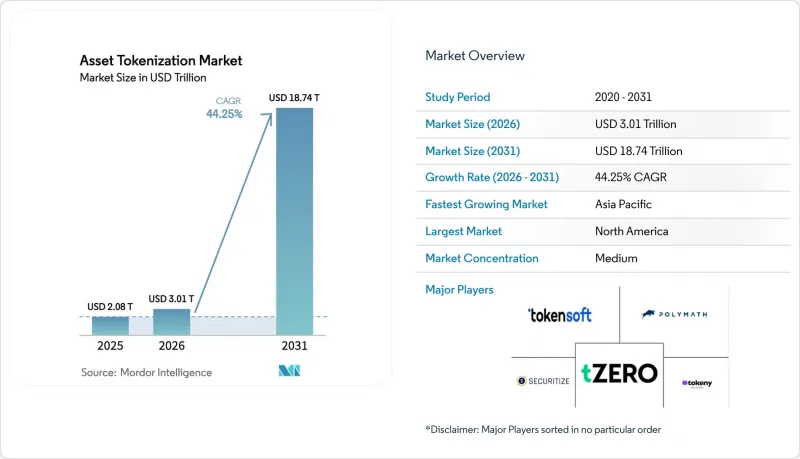
자산 토큰화 시장 규모는 2025년에 2조 800억 달러로 평가되었고 2026년 3조 100억 달러에서 2031년까지 18조 7,400억 달러에 이를 것으로 예측되며, 예측 기간(2026-2031년) CAGR은 44.25%를 나타낼 전망입니다.
북미와 유럽연합(EU)의 규제 명확화, 기관 투자자들의 자본 재분배의 빠른 진전, 그리고 크로스체인 상호운용성의 성숙은 현재 대규모 토큰 발행 및 유통 시장의 상업적 타당성을 뒷받침하고 있습니다. 발행량 측면에서는 여전히 허가형 아키텍처가 주류를 이루고 있지만, 오픈 네트워크에 대한 수요가 급증하고 있는 것은 컴플라이언스 툴의 개선과 함께 분산형 유동성에 대한 수용도가 높아지고 있음을 시사합니다. 기업들이 ESG 관련 부채와 인플레이션 위험을 헤지하기 위해 탄소배출권이나 귀금속 토큰을 활용하는 가운데, 어셋 토큰화는 분명한 성장 분야로 떠오르고 있습니다. 강력한 법적 래퍼와 원활한 ISO-20022 메시징을 통합할 수 있는 벤더는 1등급 은행으로부터 주문을 받는 데 있어 분명한 우위를 점하고 있습니다.
세계 자산 토큰화 시장 동향 및 인사이트
기관투자자의 채택 확대와 토큰화 펀드
토큰화된 머니마켓 및 고정수익률 상품에 대한 기관투자자들의 자금 배분이 가속화되고 있습니다. 블랙록의 USD 기관 디지털 유동성 펀드(USD Institutional Digital Liquidity Fund)는 출시 후 몇 달 만에 5억 5,000만 달러 이상의 자금을 모으며, 매일 배당금 분배와 일중 상환 창구를 제공하는 온체인 금융 대안에 대한 분명한 수요를 보여주었습니다. 골드만삭스는 2025년 말까지 3개의 토큰화 상품을 출시할 준비를 하고 있으며, JP모건의 Kinexys 네트워크는 2024년 말까지 1조 5,000억 달러 규모의 토큰화 거래를 처리하고, 2025년 초 출시를 목표로 온체인 외환 결제 시범운영을 진행하고 있습니다. 이러한 움직임은 네트워크 효과를 창출하고, 커스터디안, 펀드매니저, 자산운용사가 호환 가능한 인프라를 구축하도록 유도하고 있습니다.
부동산 지분 소유에 대한 수요
토큰을 활용한 분할 소유 구조는 최소 투자금액을 낮춰 더 많은 투자자들이 우량 부동산 시장에 진입할 수 있도록 합니다. T-RIZE Group의 3억 달러 규모의 주택 개발 프로젝트의 토큰화는 스폰서가 시장 도달 범위를 확대하여 자금 조달 비용을 절감하고 다양한 투자자 층을 확보한 실례를 보여주고 있습니다. 불변의 성과 데이터를 통한 투명성 향상은 상업용 부동산 투자의 오랜 장벽이었던 정보 비대칭성을 완화하고, 2차 시장의 유동성을 높일 수 있습니다. 미국 및 유럽연합(EU)의 토큰화 프레임워크와 일치하는 크라우드펀딩 규제는 일반 투자자가 접근할 수 있는 부동산 상품의 성장 가능성을 더욱 강화하고 있습니다.
사이버 보안과 스마트 계약의 취약성
주목을 끄는 공격이 잇따르면서 시장의 신뢰를 계속 떨어뜨리고 있습니다. 2024년 1월, 탈중앙화 거래소 킬로엑스(KiloEx)는 공격자가 온체인 가격 Oracle을 조작한 결과 700만 달러의 손실을 입었고, 실시간 데이터 검증의 결함을 드러냈습니다. 이에 따라 보험사들이 리스크 평가를 재검토하면서 스마트컨트랙트 보험의 보험료가 상승하고 있습니다. 현재 플랫폼 업체들은 신뢰 회복을 위해 다층적 감사, 자동 회로 차단기, 실시간 모니터링을 의무화하고 있습니다. 그러나 위협 상황은 시시각각 변화하고 있으며, 엄격하게 검토된 코드조차도 잠재적인 결함이 있을 수 있기 때문에 보안은 토큰화 제공업체 경영진의 최우선 순위로 남아 있습니다.
부문 분석
부동산 부문은 2025년 자산 토큰화 시장에서 30.12%를 차지했으며 가장 큰 수익원입니다. 기관투자자 수요는 예측 가능한 현금흐름을 창출하는 주요 오피스 타워와 물류 자산에 집중되어 있지만, 토큰 구조는 진입장벽을 낮추고 지역 간 포트폴리오의 분산투자를 촉진합니다. 이 부문에서는 감사된 스마트 계약이 자동으로 임대 수익을 분배하는 허가형 네트워크를 채택하여 펀드 관리자의 대조 작업을 용이하게 합니다. 현재 규모는 작지만 ESG 요구사항에 따른 탄소배출권 및 귀금속 토큰 발행에 힘입어 2031년까지 연평균 복합 성장률(CAGR) 48.35%로 가장 빠른 성장세를 보이고 있는 분야는 원자재입니다. 재생에너지 생산자들은 토큰을 검증된 배출 감축량을 현금화할 수 있는 유동성 높은 수단으로 간주하고 있으며, 이는 디지털 상품 거래소의 양방향 거래량을 증가시키고 있습니다. 채무증권에 대한 관심도 꾸준히 증가하고 있으며, 미국에서는 지방채 토큰 시범사업이 실시되어 당일 결제 및 발행수수료 인하를 실현하고 있습니다.
국경을 초월한 투자자 층을 찾는 부동산 스폰서에게 규제 조화는 매우 중요합니다. 아랍에미리트, 룩셈부르크 등의 관할권에서는 현재 온체인 주식 명부를 허용하고 있으며, 2차 양도 및 담보 설정이 용이합니다. 상품 분야에서는 런던귀금속시장협회(LBMA)의 블록체인 프로비던스 프로젝트와 같은 표준화 노력이 디지털 금 상품에 대한 신뢰를 높이고 있습니다. 탄소배출권 토큰은 기업 구매자를 위한 컴플라이언스 보고를 지원하는 투명한 라이프사이클 데이터라는 장점이 있습니다. 상호운용성 프레임워크가 성숙해짐에 따라 거래소는 부동산 및 원자재 토큰을 묶은 다중 자산 풀을 상장할 수 있게 되어 기관투자자의 포트폴리오에서 위험 조정 후 수익률을 향상시키고 대상 자산 토큰화 시장을 확대할 수 있습니다.
2025년에는 기관 투자자가 투입 자본의 69.10%를 차지할 것으로 예상됐으며, 이는 복잡한 법적 구조를 헤쳐나갈 준비가 되어 있고, 방대한 대차대조표를 보유하고 있음을 반영합니다. 자산운용사는 토큰화된 펀드를 활용하여 거의 즉각적인 주식 발행, 자동화된 기업 액션 처리 등 업무 효율성을 높이고 있습니다. Securitize는 MG Stover의 인수를 통해 발행된 토큰 총액이 10억 달러를 돌파했으며, 현재 715개 펀드에서 380억 달러를 운용하고 있으며, 1차 발행과 2차 마켓플레이스를 연결하는 엔드투엔드 서비스 제공업체로 자리매김하고 있습니다. 연기금 역시 유동성 향상을 기대할 수 있다는 점에서 토큰화된 부동산이나 인프라를 장기 부채와 매칭하는 것으로 보고 있습니다.
컴플라이언스를 준수하는 크라우드펀딩 면제 규정과 블록체인의 복잡성을 감추는 직관적인 모바일 지갑에 힘입어 개인 투자자의 참여는 CAGR 50.20%의 속도로 빠르게 확대되고 있습니다. 인증된 개인 투자자층은 평균 투자금액이 높고, 벤처펀드의 토큰과 상업용 부동산에 대한 소액 투자로 혜택을 누리는 등 가교역할을 하고 있습니다. 발행 플랫폼에 내장된 교육 포털은 지갑 생성, 위험 공개, 세금 서류 절차를 통해 신규 시장 진출기업을 안내하고, 유입 경로의 전환율을 높이고 있습니다. 향후 네오뱅크와 임베디드 금융(Embedded Finance)의 통합으로 온보딩 장벽이 더욱 낮아지고, 신흥 경제국의 서비스 소외계층을 끌어들여 자산 토큰화 시장 전체가 확대될 것으로 예측됩니다.
자산 토큰화 시장은 자산 클래스(부동산, 채무증권, 투자펀드, 사모펀드, 사모펀드 등), 투자자 유형(기관투자자, 공인 개인투자자 등), 토큰화 플랫폼 유형(허가형(프라이빗) 블록체인 등), 제공 형태(토큰화 플랫폼/미들웨어 등), 지역별로 구분됩니다. 시장 예측은 금액(USD) 기준으로 제공됩니다.
지역별 분석
북미는 여전히 가장 규모가 큰 지역으로, 2025년에는 전 세계 매출의 39.10%를 차지할 것으로 예측됐습니다. 미국은 2025년 4월 SEC의 가이던스에서 특정 USD 기반 스테이블 코인이 증권에 해당하지 않는다는 점을 명확히 한 덕분에 은행의 토큰화 예금 시범사업 참여가 촉진되고 있습니다. 캐나다의 규제 샌드박스는 토큰화된 모기지 풀에 대한 실험을 지원하고 있으며, 캐나다의 연금 기금은 인프라 담보형 증권형 토큰의 소수 지분을 취득하기 시작했습니다. 피치북에 따르면, 전문 블록체인 펀드는 2024년 24억 달러의 신규 자금 조달을 완료하여 혁신의 선순환을 더욱 강화할 것이라고 합니다.
아시아태평양은 가장 빠르게 성장하는 지역으로 2031년까지 연평균 복합 성장률(CAGR) 53.75%로 성장하고 있습니다. 싱가포르의 '프로젝트 가디언'에는 현재 40개 이상의 금융기관이 참여하고 있으며, 싱가포르 금융관리국(MAS)이 관리하는 상호 운용 가능한 원장에서 토큰화된 채권, 예금, 펀드를 시범 운용하고 있습니다. 홍콩의 2025년 6월 발표된 디지털 자산 로드맵에는 스테이블 코인 라이선스 제도와 정부의 토큰화 채권 발행이 도입되어 있으며, 이는 당국의 공식적인 지원으로 지역 은행과 보험사를 동원할 가능성이 높습니다. 일본은 특정 디지털 자산을 재분류하는 프레임워크를 추진하고 있으며, 토큰화된 상장지수펀드(ETF)의 길을 열어 일반 투자자들의 대체자산에 대한 접근성을 확대되고 있습니다.
유럽에서는 암호자산 서비스 제공업체에 대한 여권 제도(크로스보더 라이선스)를 규정한 '암호자산 시장 규제(MiCA)'에 따라 꾸준한 진전을 보이고 있습니다. 독일 전자증권법은 DLT(분산원장기술) 원장에 무기명 채권 및 뮤추얼 펀드 구좌를 허용하고 있으며, 이를 통해 공공 부문 발행사들이 완전한 디지털 워크플로우를 시험하기 시작했습니다. 프랑스의 퍼블릭 블록체인 샌드박스에서 그린본드 유통에 초점을 맞춘 3개의 토큰화 프로젝트가 승인되어 유럽 대륙의 기후 금융에 대한 노력을 반영하고 있습니다. 한편, 중동 및 아프리카에서는 아부다비와 요하네스버그의 규제 샌드박스 내에서 에너지 기반 보안 토큰의 실증 실험이 진행되고 있으며, 남미에서는 인프라가 구축됨에 따라 개념증명(PoC)에서 제한적인 공모로 전환되고 있습니다.
기타 특전:
- 엑셀 형식 시장 예측(ME) 시트
- 3개월간 애널리스트 지원
자주 묻는 질문
목차
제1장 서론
제2장 조사 방법
제3장 주요 요약
제4장 시장 구도
제5장 시장 규모와 성장 예측
제6장 경쟁 구도
제7장 시장 기회와 향후 동향
JHS 26.05.20The asset tokenization market size was valued at USD 2.08 trillion in 2025 and estimated to grow from USD 3.01 trillion in 2026 to reach USD 18.74 trillion by 2031, at a CAGR of 44.25% during the forecast period (2026-2031).
Regulatory clarity in North America and the European Union, rapid institutional capital re-allocation, and the maturing of cross-chain interoperability now underpin the commercial viability of large-scale token issuance and secondary trading. Permissioned architectures still dominate issuance volumes, yet surging demand for open networks signals rising comfort with decentralized liquidity as compliance tooling improves. Commodities tokenization is emerging as the clear growth frontier as corporates use carbon-credit and precious-metal tokens to hedge ESG liabilities and inflation exposure. Platform vendors that can fuse robust legal wrappers with seamless ISO-20022 messaging are gaining a tangible advantage in winning tier-1 banking mandates.
Global Asset Tokenization Market Trends and Insights
Rising Institutional Adoption and Tokenized Funds
Institutional allocations into tokenized money-market and fixed-income products are accelerating. BlackRock's USD Institutional Digital Liquidity Fund attracted over USD 550 million within months of launch, showing clear appetite for on-chain treasury alternatives that offer daily dividend distribution and intraday redemption windows. Goldman Sachs is preparing three tokenized products for roll-out by year-end 2025, while JPMorgan's Kinexys network has processed USD 1.5 trillion in tokenized transactions by end-2024 and is piloting on-chain foreign-exchange settlement for early-2025 release. These moves create network effects that encourage custodians, fund administrators, and asset managers to build compatible rails.
Demand for Fractional Real-Estate Ownership
Token-enabled fractional structures lower minimum ticket sizes, allowing a broader investor base to enter prime property markets. T-RIZE Group's USD 300 million residential development tokenization illustrates how sponsors are securing diverse investor pools while reducing financing costs through wider market reach . Enhanced transparency from immutable performance data also mitigates information asymmetry, a long-standing barrier in commercial real-estate investing, which in turn boosts secondary liquidity. Crowdfunding regulations aligned with tokenization frameworks in the United States and the European Union further reinforce growth potential for retail-accessible real-estate products.
Cyber-Security and Smart-Contract Vulnerabilities
High-profile exploits continue to dent market confidence. In January 2024 the KiloEx decentralized exchange lost USD 7 million after attackers manipulated an on-chain price oracle, exposing gaps in real-time data validation. Insurance premiums for smart-contract cover have since risen as underwriters reprice risk. Platforms are now mandating multi-layer audits, automated circuit breakers, and real-time monitoring to regain trust. Yet the evolving threat landscape means even rigorously vetted code can harbor latent flaws, keeping security a top-tier boardroom concern for tokenization providers.
Other drivers and restraints analyzed in the detailed report include:
- Advancements in Blockchain Interoperability
- ISO-20022 Integration Enabling Seamless Settlement
- Custodial Liability During Insolvency Events
For complete list of drivers and restraints, kindly check the Table Of Contents.
Segment Analysis
Real-estate contributes the largest revenue slice, accounting for 30.12% of the asset tokenization market in 2025. Institutional demand centers on flagship office towers and logistics assets that deliver predictable cash flows, while token structures reduce entry thresholds and amplify portfolio diversification across regions. The segment uses permissioned networks where audited smart contracts automatically distribute rental income, thus easing reconciliation for fund administrators. Commodities, though smaller today, are posting the fastest trajectory with a 48.35% CAGR through 2031, powered by carbon-credit and precious-metal token launches underpinned by ESG mandates. Renewable energy producers see tokens as a liquid instrument for monetizing verified emission reductions, which boosts bilateral trading volumes on digital commodity exchanges. Debt instruments also show steady interest, with municipal-bond token pilots in the United States offering same-day settlement and lower issuance fees.
Regulatory harmonization is pivotal for real-estate sponsors seeking cross-border investor pools. Jurisdictions such as the United Arab Emirates and Luxembourg now recognize on-chain share registries, easing secondary transfers and collateral pledges. For commodities, standardization initiatives like the London Bullion Market Association's blockchain provenance project are spurring confidence in digital gold products. Carbon-credit tokens benefit from transparent lifecycle data that supports compliance reporting for corporate buyers. As interoperability frameworks mature, exchanges can list multi-asset pools that bundle real-estate and commodities tokens, improving risk-adjusted returns for institutional portfolios and enlarging the addressable asset tokenization market.
Institutional investors controlled 69.10% of deployed capital in 2025, reflecting their readiness to navigate complex legal structures and their sizeable balance sheets. Asset managers leverage tokenized funds to gain operational efficiencies, including near-instant share issuance and automated corporate-action processing. Securitize has crossed USD 1 billion in issued tokens and now administers USD 38 billion across 715 funds after acquiring MG Stover, positioning itself as an end-to-end service provider linking primary issuance and secondary marketplaces. Pension funds also view tokenized real-estate and infrastructure as a match for long-duration liabilities given the potential for improved liquidity.
Retail participation is scaling swiftly at 50.20% CAGR, helped by compliant crowdfunding exemptions and intuitive mobile wallets that mask blockchain complexity. Accredited retail segments occupy a bridging role, bringing higher average ticket sizes yet still benefiting from fractional exposure to venture-fund tokens and commercial real-estate. Education portals embedded into issuance platforms guide new entrants through wallet creation, risk disclosures, and tax documentation, broadening funnel conversion rates. Looking ahead, embedded-finance integrations with neobanks will further lower onboarding friction, expanding the overall asset tokenization market by tapping under-served demographics in emerging economies.
Asset Tokenization Market is Segmented by Asset Class (Real Estate, Debt Instruments, Investment Funds, Private Equity, and More), Investor Type (Institutional Investors, Accredited Retail Investors, and More), Tokenization Platform Type (Permissioned (Private) Blockchains, and More), Offering (Tokenization Platforms / Middleware, and More), and Geography. The Market Forecasts are Provided in Terms of Value (USD).
Geography Analysis
North America remains the largest regional contributor, holding 39.10% of global revenue in 2025. The United States benefits from April 2025 SEC guidance clarifying that certain USD-backed stablecoins are not securities, which in turn catalyzes bank participation in tokenized deposit pilots. Canada's regulatory sandbox supports experimentation with tokenized mortgage pools, and its pension funds are beginning to acquire minority stakes in infrastructure-backed security tokens. Venture investment also concentrates in the region, with specialized blockchain funds closing USD 2.4 billion in fresh capital in 2024 according to PitchBook, further reinforcing the innovation loop.
Asia-Pacific is the fastest-growing region, expanding at a 53.75% CAGR through 2031. Singapore's Project Guardian now involves over 40 financial institutions testing tokenized bonds, deposits, and funds on interoperable ledgers governed by the Monetary Authority of Singapore. Hong Kong's June 2025 digital-asset roadmap introduces a stablecoin licensing regime and government tokenized-bond issuance, signaling official endorsement that will likely mobilize regional banks and insurers. Japan is advancing a framework that reclassifies certain digital assets, paving the way for tokenized exchange-traded funds and broadening retail access to alternative assets .
Europe posts steady progress under the Markets in Crypto-Assets (MiCA) regulation that sets passport-able licensing for crypto-asset service providers. Germany's electronic securities law recognizes bearer bonds and fund units on DLT registers, prompting public-sector issuers to test fully digital workflows. France's public blockchain sandbox accepted three tokenization projects focused on green-bond distribution, reflecting the continent's climate-finance focus. Meanwhile, the Middle East and Africa are piloting energy-backed security tokens inside regulatory sandboxes in Abu Dhabi and Johannesburg, and South America is evolving from proof-of-concepts toward limited public offerings as infrastructure matures.
- Securitize Markets, LLC
- tZERO Group, Inc.
- Tokensoft Inc.
- Polymath Research Inc.
- Tokeny Solutions SA
- Fireblocks Inc.
- Chainlink Labs, Inc.
- INX Digital Company, Inc.
- Anchorage Digital Bank N.A.
- Bitbond GmbH
- Tassat Group LLC
- Rialto Markets, LLC
- ADDX Pte. Ltd.
- DigiShares A/S
- Smartlands Platform Ltd.
- Blockstream Corporation Inc.
- Figure Technologies, Inc.
- Provenance Blockchain, Inc.
- Maple Finance Ltd.
- Stokr S.A.
Additional Benefits:
- The market estimate (ME) sheet in Excel format
- 3 months of analyst support
TABLE OF CONTENTS
1 INTRODUCTION
- 1.1 Market Definition and Study Assumptions
- 1.2 Scope of the Study
2 RESEARCH METHODOLOGY
3 EXECUTIVE SUMMARY
4 MARKET LANDSCAPE
- 4.1 Market Overview
- 4.2 Market Drivers
- 4.2.1 Regulatory clarity in key financial hubs
- 4.2.2 Rising institutional adoption and tokenized funds
- 4.2.3 Demand for fractional real-estate ownership
- 4.2.4 Advancements in blockchain interoperability
- 4.2.5 ISO-20022 integration enabling seamless settlement
- 4.2.6 Emergence of tokenized carbon-credit instruments
- 4.3 Market Restraints
- 4.3.1 Regulatory fragmentation and compliance costs
- 4.3.2 Cyber-security and smart-contract vulnerabilities
- 4.3.3 Oracle manipulation and off-chain data risks
- 4.3.4 Custodial liability during insolvency events
- 4.4 Value / Supply-Chain Analysis
- 4.5 Evaluation of Critical Regulatory Framework
- 4.6 Impact Assessment of Key Stakeholders
- 4.7 Technological Outlook
- 4.8 Porter's Five Forces Analysis
- 4.8.1 Bargaining Power of Suppliers
- 4.8.2 Bargaining Power of Consumers
- 4.8.3 Threat of New Entrants
- 4.8.4 Threat of Substitutes
- 4.8.5 Intensity of Competitive Rivalry
- 4.9 Impact of Macro-economic Factors
5 MARKET SIZE AND GROWTH FORECASTS (VALUE)
- 5.1 By Asset Class
- 5.1.1 Real-Estate
- 5.1.2 Debt Instruments
- 5.1.3 Investment Funds
- 5.1.4 Private Equity
- 5.1.5 Public Equity
- 5.1.6 Commodities
- 5.2 By Investor Type
- 5.2.1 Institutional Investors
- 5.2.2 Accredited Retail Investors
- 5.2.3 Retail Investors
- 5.3 By Tokenization Platform Type
- 5.3.1 Permissioned (Private) Blockchains
- 5.3.2 Permissionless (Public) Blockchains
- 5.3.3 Hybrid Models
- 5.4 By Offering
- 5.4.1 Tokenization Platforms / Middleware
- 5.4.2 Smart-Contract Development and Audit
- 5.4.3 Custody and Wallet Services
- 5.4.4 Compliance and Legal-Tech Services
- 5.4.5 Secondary Trading and Exchanges
- 5.5 By Geography
- 5.5.1 North America
- 5.5.1.1 United States
- 5.5.1.2 Canada
- 5.5.1.3 Mexico
- 5.5.2 South America
- 5.5.2.1 Brazil
- 5.5.2.2 Argentina
- 5.5.2.3 Rest of South America
- 5.5.3 Europe
- 5.5.3.1 Germany
- 5.5.3.2 United Kingdom
- 5.5.3.3 France
- 5.5.3.4 Italy
- 5.5.3.5 Spain
- 5.5.3.6 Russia
- 5.5.3.7 Rest of Europe
- 5.5.4 Asia-Pacific
- 5.5.4.1 China
- 5.5.4.2 Japan
- 5.5.4.3 India
- 5.5.4.4 South Korea
- 5.5.4.5 Australia and New Zealand
- 5.5.4.6 Rest of Asia-Pacific
- 5.5.5 Middle East and Africa
- 5.5.5.1 Middle East
- 5.5.5.1.1 Saudi Arabia
- 5.5.5.1.2 United Arab Emirates
- 5.5.5.1.3 Turkey
- 5.5.5.1.4 Rest of Middle East
- 5.5.5.2 Africa
- 5.5.5.2.1 South Africa
- 5.5.5.2.2 Nigeria
- 5.5.5.2.3 Egypt
- 5.5.5.2.4 Rest of Africa
- 5.5.5.1 Middle East
- 5.5.1 North America
6 COMPETITIVE LANDSCAPE
- 6.1 Market Concentration
- 6.2 Strategic Moves
- 6.3 Market Share Analysis
- 6.4 Company Profiles (includes Global level Overview, Market level overview, Core Segments, Financials as available, Strategic Information, Market Rank/Share for key companies, Products and Services, and Recent Developments)
- 6.4.1 Securitize Markets, LLC
- 6.4.2 tZERO Group, Inc.
- 6.4.3 Tokensoft Inc.
- 6.4.4 Polymath Research Inc.
- 6.4.5 Tokeny Solutions SA
- 6.4.6 Fireblocks Inc.
- 6.4.7 Chainlink Labs, Inc.
- 6.4.8 INX Digital Company, Inc.
- 6.4.9 Anchorage Digital Bank N.A.
- 6.4.10 Bitbond GmbH
- 6.4.11 Tassat Group LLC
- 6.4.12 Rialto Markets, LLC
- 6.4.13 ADDX Pte. Ltd.
- 6.4.14 DigiShares A/S
- 6.4.15 Smartlands Platform Ltd.
- 6.4.16 Blockstream Corporation Inc.
- 6.4.17 Figure Technologies, Inc.
- 6.4.18 Provenance Blockchain, Inc.
- 6.4.19 Maple Finance Ltd.
- 6.4.20 Stokr S.A.
7 MARKET OPPORTUNITIES AND FUTURE TRENDS
- 7.1 White-space and Unmet-need Assessment