|
시장보고서
상품코드
2035068
아라미드 섬유 시장 : 점유율 분석, 업계 동향 및 통계, 성장 예측(2026-2031년)Aramid Fiber - Market Share Analysis, Industry Trends & Statistics, Growth Forecasts (2026 - 2031) |
||||||
 Mordor Intelligence
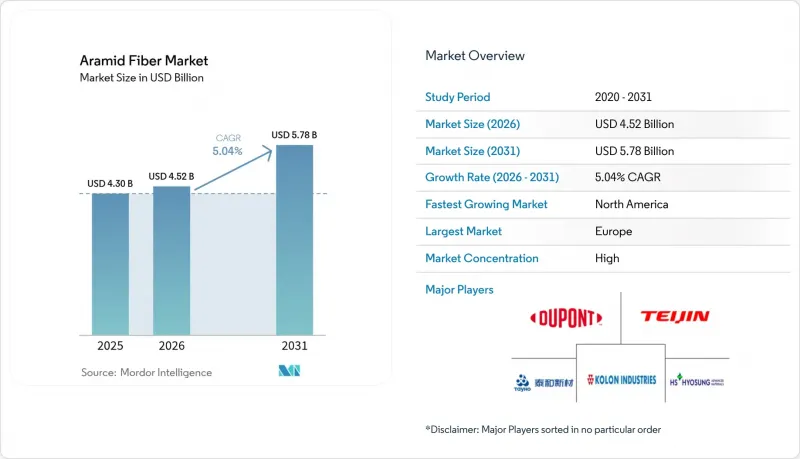
2026년 아라미드 섬유 시장 규모는 45억 2,000만 달러로 추정되며 2025년 43억 달러에서 성장하여 2031년에는 57억 8,000만 달러에 이를 것으로 예측됩니다.
2026년부터 2031년까지 연평균 복합 성장률(CAGR) 5.04%를 나타낼 것으로 예측됩니다.
자동차, 항공우주, 통신 및 첨단 개인보호장비(PPE) 분야에서 수요 증가가 수요를 견인하고 있으며, 섬유의 중량 대비 강도와 열 안정성이 장기적인 중요성을 뒷받침하고 있습니다. 전기 모빌리티의 소재 경량화 목표, 5G 네트워크 구축, 극초음속 및 우주 프로그램에 대한 투자 확대로 인해 상업적 기회가 지속적으로 확대되고 있습니다. 한편, 주로 MPD와 PPD의 원재료 가격 변동으로 인해 수익률이 지속적으로 압박을 받고 있으며, 이는 대형 업체들의 수직계열화 움직임을 촉진하고 있습니다. 지적재산권 관련 제약도 경쟁 구도를 더욱 형성하여 연구개발(R&&D)에 대한 자금 지원이 가능하고, 크로스 라이선싱의 틀을 잘 활용할 수 있는 기존 기업의 지위를 확고히 하고 있습니다.
세계 아라미드 섬유 시장 동향 및 인사이트
아시아 제조 거점에서의 PPE 안전 규제 강화
중국, 인도 및 동남아시아 신흥 경제국의 산업 안전 규정 강화로 아라미드 섬유 강화 장갑, 헬멧, 내열 작업복에 대한 주문이 증가하고 있습니다. 아라미드 복합소재로 만든 산업용 헬멧은 ABS 소재에 비해 내충격성이 37% 더 높으며, 이러한 성능 차이가 공장에서의 채택을 가속화하고 있습니다. 파라-아라미드를 내장한 내절단성 장갑은 레벨 5의 보호 성능을 30% 경량화하여 장시간 착용 시 편안함을 향상시켰습니다. 메타-아라미드가 함유된 난연성 작업복은 425℃에서도 구조적 무결성을 유지하며, 주조소 및 석유화학 공장의 엄격한 안전 기준을 충족합니다. 따라서 이 지역에 공급하는 제조업체들은 아라미드 원사 및 아라미드 직물의 조달량을 늘리고 있으며, 이는 아라미드 섬유 시장의 성장 추세를 촉진하고 있습니다.
EU 그린딜: 아라미드 강화로 경량 EV 타이어를 촉진하는 EU 그린 딜
유럽 자동차 제조업체들은 전기차의 주행거리를 늘리기 위해 차량 무게를 줄이는 타이어 재설계 프로그램에 박차를 가하고 있습니다. 아라미드 강화 타이어는 최대 25%의 경량화를 실현하며, 이러한 감축 효과는 그린딜의 운송 부문 탈탄소화 목표와 직결되어 있습니다. 1kg의 경량화 당 0.7km의 항속거리가 향상되기 때문에 OEM 업체들은 폴리에스테르나 스틸 코드 대신 아라미드를 채택하고 있습니다. 컴파운더 업체들은 회전 저항을 줄이면서도 내구성을 유지하는 아라미드 충진 고무 배합재를 상용화하고 있으며, 이로 인해 유럽과 곧 북미에서도 아라미드 섬유 시장 수요가 더욱 증가할 것으로 예측됩니다.
MPD 및 PPD 원료 가격 변동
원유 가격의 급격한 변동과 지역적 공급 혼란으로 인해 MPD와 PPD의 비용 곡선이 상승하여 생산자의 수익률을 압박하고 장기 계약에 대한 불안감을 불러일으키고 있습니다. 미국 상무부는 방향족 디아민을 지정학적으로 생산이 집중되어 있는 화학적으로 중요한 투입물로 지목하고 있어 공급 안정성에 대한 리스크가 높아지고 있습니다. 제조업체들은 바이오 중간체 및 아라미드 스크랩의 폐쇄 루프 회수를 모색하여 이에 대응하고 있지만, 단기적인 가격 변동은 여전히 아라미드 섬유 시장의 성장 모멘텀을 둔화시키고 있습니다.
부문 분석
파라-아라미드 부문은 방탄, 항공우주, 마찰재 수요에 힘입어 2025년 아라미드 섬유 시장에서 64.35%의 압도적인 점유율을 차지했습니다. 파라 아라미드 원사는 3.8GPa에 가까운 인장강도를 발휘하여 방탄조끼 및 항공기용 벌집 구조에서 그 지위를 유지하고 있습니다. 미국의 국방 예산 증액과 자동차 경량 복합소재에 대한 관심이 재점화되면서 아라미드 섬유 시장에서 파라-아라미드의 안정적인 수요 전망을 보장하고 있습니다. 도레이의 한국 공장의 3,000톤 생산능력 증설 등 대규모 투자는 이 섬유 클래스에 대한 자본 배분 규모를 뒷받침하고 있습니다.
메타-아라미드는 시장 규모는 작지만 2031년까지 연평균 복합 성장률(CAGR) 5.28%의 가장 빠른 성장 궤도를 그리며 2031년까지 가장 빠른 성장세를 보이고 있습니다. 첨단 습식방적 필라멘트는 현재 1,255MPa의 인장강도에 도달했으며, 장기간 자외선 조사 후에도 90% 이상의 강도를 유지하여 송전선로 커버 등 옥외용도로의 전개가 가능합니다. 난연성 섬유, 절연지, 여과 백에 내장된 메타 아라미드는 전자, 산업 안전, 환경 보호 분야의 열 안정성 요구에 부응하고 있습니다. 아시아 전역의 반도체 생산능력 확대와 EU의 친환경 전환 프로젝트를 배경으로 메타 아라미드 아라미드 섬유 시장 규모는 꾸준히 확대될 것으로 예상되며, 가격뿐만 아니라 소재의 특성이 고객의 전환을 결정짓는 경쟁 환경이 형성되고 있습니다.
2025년, 습식 방적은 아라미드 섬유 시장 점유율의 59.40%를 차지했고 5.71%의 연평균 복합 성장률(CAGR)로 전체 시장을 능가하는 성장세를 이어갈 것입니다. 이 공정은 균일한 고분자 응고를 실현하여 전기 절연지 및 여과재의 필수 조건인 높은 유전체 안정성을 갖춘 균일하고 고밀도 섬유를 생산합니다. 개선된 용제 재활용 모듈은 배출량과 비용을 절감하고, 지속가능성을 중시하는 최종 사용자들 사이에서 채택을 촉진하고 있습니다. 습식방사에 의한 아라미드 섬유 시장 규모는 전동화와 여과재 수요 증가에 따라 확대될 것으로 전망됩니다.
드라이 제트 습식 방적은 사슬 배향에 따라 매우 높은 인장 특성이 요구되는 파라-아라미드 섬유에서 여전히 필수적인 공정입니다. 폴리이미드 유사체의 실험실 테스트에서 최대 2.72GPa의 인장강도와 114GPa 이상의 탄성률이 확인되어 향후 파라-아라미드 섬유의 성능 향상 여지가 있음을 입증했습니다. 전체 점유율은 작지만,이 공정은 고급 방탄사 공급을 지원하고 있으며, 국방부 및 고급 스포츠 용품 브랜드의 요구에 부응하고 있습니다. 처리 능력의 효율화와 용제 회수 기술을 위한 지속적인 생산 라인 업그레이드를 통해 아라미드 섬유 시장에서 이 공정의 틈새 시장 기여도는 계속 유지될 것입니다.
지역별 분석
유럽은 2025년 매출의 34.65%를 차지했으며 세계 아라미드 섬유 시장의 핵심을 차지하고 있습니다. 엄격한 산업안전법, ISO에 따른 난연성 기준, 유럽연합(EU)의 그린 딜(Green Deal)은 자동차 및 산업 분야에서 고부가가치 제품의 채택을 촉진하고 있습니다. 수출 중심의 자동차 산업 기반을 가진 독일이 지역 생산량 확대를 주도하는 반면, 프랑스와 네덜란드는 고급 여과재 및 항공우주용 적층재를 전문으로 하고 있습니다. 전기자동차 배터리 공장에 대한 정부의 인센티브는 고분자 복합재료의 채택을 더욱 촉진하고 있습니다.
북미는 2026년부터 2031년까지 5.21%의 가장 높은 CAGR을 나타낼 것으로 예측됩니다. 연방 정부의 국방 예산은 파라-아라미드 방탄 소재에 대한 지속적인 수요를 뒷받침하고 있으며, NASA와 민간 로켓 발사 업체들은 메타-아라미드 열 차폐에 투자하고 있습니다. 미국 통신사업자들은 허리케인 피해에 취약한 지역의 공중 광섬유 백본을 갱신하고 있으며, 폭풍으로 인한 피해를 줄이기 위해 아라미드 보강재를 채택하고 있습니다. 캐나다도 비슷한 추세를 보이고 있으며, 특히 광업과 에너지 인프라에서 공공의 안전에 중점을 두고 있습니다.
아시아태평양은 아라미드 섬유 시장의 다음 성장의 개척지가 될 것입니다. 중국은 수입 의존도를 낮추기 위해 국내 생산을 확대하고 있으며, 2020년대 중반까지 파라 아라미드 자급자족을 목표로 하고 있습니다. 스마트 팩토리, 전기차 배터리 공장, 재생에너지 인프라의 대규모 건설로 인해 경량화 및 내열성 소재에 대한 수요가 급증하고 있습니다. 일본과 한국에서는 반도체 및 5G 하드웨어에 첨단 기술 도입이 진행되고 있으며, 아라미드가 제공하는 유전체 안정성과 기계적 내구성이 요구되고 있습니다. 인도의 'Make in India' 국방 프로그램과 개정된 산업 안전 보건 기준은 현지 개인보호구(PPE)(PPE)와 방탄복의 소비를 확대하여 지역 성장에 더욱 박차를 가하고 있습니다.
기타 특전:
- 엑셀 형식 시장 예측(ME) 시트
- 3개월간 애널리스트 지원
자주 묻는 질문
목차
제1장 서론
제2장 조사 방법
제3장 주요 요약
제4장 시장 구도
제5장 시장 규모와 성장 예측
제6장 경쟁 구도
제7장 시장 기회와 향후 전망
JHS 26.05.20Aramid Fiber Market size in 2026 is estimated at USD 4.52 billion, growing from 2025 value of USD 4.30 billion with 2031 projections showing USD 5.78 billion, growing at 5.04% CAGR over 2026-2031.
Increasing penetration in automotive, aerospace, telecom, and advanced personal protective equipment elevates demand, while the fiber's strength-to-weight ratio and thermal stability anchor long-term relevance. Material-lightweighting targets in electric mobility, the build-out of 5G networks, and rising investment in hypersonic and space programs continuously widen commercial opportunities. At the same time, feedstock price swings, mainly for MPD and PPD, keep margins under pressure, prompting vertical-integration moves by large producers. Intellectual-property constraints further shape competitive dynamics, cementing the position of incumbents that can finance R&D and navigate cross-licensing frameworks.
Global Aramid Fiber Market Trends and Insights
Escalating PPE Safety Mandates Across Asian Manufacturing Hubs
Growing enforcement of industrial-safety rules in China, India, and emerging Southeast Asian economies is lifting orders for aramid-reinforced gloves, helmets, and heat-resistant workwear. Industrial helmets made with aramid composites show 37% higher impact resistance than ABS counterparts, a performance gap that accelerates factory adoption. Cut-resistant gloves incorporating para-aramid deliver Level 5 protection with 30% less weight, improving comfort for continuous wear. Fire-retardant workwear formulated with meta-aramid maintains structural integrity at 425 °C, aligning with stricter foundry and petrochemical safety codes. Manufacturers supplying this region therefore raise allocation for aramid yarns and fabrics, strengthening the growth profile of the aramid fiber market.
EU Green-Deal Push for Lightweight EV Tires Reinforced with Aramid
European automakers accelerate tire redesign programs that shave vehicle mass to extend electric-car range. Aramid-reinforced tire carcasses cut weight by up to 25%, a saving directly linked to the Green Deal's transport decarbonization targets . Every kilogram trimmed offers a 0.7 km range gain, motivating OEMs to substitute polyester or steel cords with aramid. Compounders are commercializing aramid-filled rubber mixes that lower rolling resistance yet keep durability, reinforcing demand for the aramid fiber market in Europe and soon North America.
MPD & PPD Feedstock Price Volatility
Surging crude-oil swings and regional supply disruptions elevate MPD and PPD cost curves, compressing producer margins and unsettling long-term contracts. The U.S. Department of Commerce lists aromatic diamines among chemically critical inputs subject to geopolitically concentrated production, heightening supply-security risks . Manufacturers counter by exploring bio-based intermediates and closed-loop recovery of aramid scrap, yet near-term volatility still shaves growth momentum within the aramid fiber market.
Other drivers and restraints analyzed in the detailed report include:
- 5G Roll-out Surge Elevating Demand for Aramid-Reinforced Optical-Fiber Cables
- Hypersonic & Space Defense Investments Raising Meta-Aramid Thermal-Shield Consumption
- Patent Cross-Licensing Barriers Deterring New Para-Aramid Entrants
For complete list of drivers and restraints, kindly check the Table Of Contents.
Segment Analysis
The para-aramid segment held a commanding 64.35% aramid fiber market share in 2025, supported by ballistic protection, aerospace, and friction-material demand. Para-aramid yarns deliver tensile strength near 3.8 GPa, sustaining their position in body armor and aviation honeycombs. Defense-budget uplifts in the United States and renewed interest in lightweight automotive composites ensure stable volume pipelines for para-aramid within the aramid fiber market. Significant investments, such as a 3,000-ton capacity addition at Toray's South Korea site, underscore the scale of capital allocation toward this fiber class.
Meta-aramid, while smaller in base, stages the fastest trajectory at a 5.28% CAGR through 2031. Advanced wet-spun filaments now reach 1,255 MPa tensile strength and retain over 90% strength after prolonged UV exposure, unlocking outdoor applications like transmission-line covers. Embedded in fire-retardant fabrics, insulation papers, and filtration bags, meta-aramid addresses thermal stability demands in electronics, industrial safety, and environmental protection. The aramid fiber market size for meta-aramid is forecast to expand steadily because of expanding semiconductor capacity across Asia and EU green-transition projects, setting a competitive dynamic where material attributes, not only price, decide customer conversion.
Wet spinning captured 59.40% of aramid fiber market share in 2025 and continues to out-pace the headline market with a 5.71% CAGR. The process offers homogeneous polymer coagulation, producing uniformly dense fibers that achieve high dielectric stability, a prerequisite for electrical papers and filtration media. Upgraded solvent-recycling modules reduce emissions and cost, supporting adoption even among sustainability-minded end-users. The aramid fiber market size for wet-spun output is projected to widen in line with electrification and filter-media demand growth.
Dry-jet wet spinning remains indispensable for para-aramid where chain orientation drives extreme tensile metrics. Lab runs of polyimide analogues display tensile strength up to 2.72 GPa and modulus above 114 GPa, confirming pathway headroom for future para-aramid enhancement. Although overall share is smaller, the process anchors high-end ballistic yarn supply, aligning with the needs of defense ministries and premium sports-equipment brands. Continuous line upgrades aimed at throughput efficiency and solvent-capture technology will safeguard its niche contribution to the aramid fiber market.
The Aramid Fiber Market Report Segments the Industry by Product Type (Para-Aramid, Meta-Aramid), Spinning Process (Wet Spinning, Dry Wet Spinning), Application (Security and Protection Equipment, Frictional and Brake Materials, and More), End-User Industry (Safety and Protection Equipment, Aerospace, and More), and Geography (Asia-Pacific, North America, Europe, and More). The Market Forecasts are Provided in Terms of Value (USD).
Geography Analysis
Europe anchors the global aramid fiber market with 34.65% revenue in 2025. Stringent worker-safety laws, ISO-aligned flame standards, and the European Union's Green Deal propel high-value adoption in automotive and industrial settings. Germany, with its export-oriented automotive base, leads regional volume expansion, while France and the Netherlands specialize in advanced filtration and aerospace laminates. Government incentives for electric-vehicle battery plants further stimulate polymer-composite uptake.
North America posts the fastest CAGR at 5.21% for 2026-2031. Federal defense appropriations feed continuous demand for para-aramid ballistic materials, whereas NASA and private launch providers channel investments into meta-aramid thermal shields. U.S. telecom carriers renew aerial fiber backbones across hurricane-prone corridors, specifying aramid strength members to mitigate storm damage. Canada follows similar trends with a public-safety focus, particularly in mining and energy infrastructure.
Asia-Pacific represents the next frontier of scale for the aramid fiber market. China escalates domestic output to cut reliance on imports and targets self-sufficiency in para-aramid by mid-decade. Massive construction of smart factories, EV battery plants, and renewable infrastructure multiplies demand for lightweight, heat-resistant materials. Japan and South Korea refine high-tech deployment in semiconductors and 5G hardware, requiring dielectric stability and mechanical resilience that aramid delivers. India's Make-in-India defense program and updated occupational-safety codes build local PPE and armor consumption, adding depth to regional growth.
- Aramid Hpm, LLC.
- China National Bluestar (Group) Co. Ltd.
- DuPont
- HS HYOSUNG ADVANCED MATERIALS
- Huvis Corp.
- Kolon Industries, Inc.
- Sinochem Internation Corporation
- SINOPEC YIZHENG CHEMICAL FIBRE LIMITED
- SRO Aramid
- Suzhou Zhaoda Specially Fiber Technical Co.,Ltd.
- TAEKWANG INDUSTRIAL CO., LTD.
- Teijin Limited
- Toray Industries Inc.
- TOYOBO MC Corporation
- Wuxi City Shengte Carbon Fiber Products Co.,Ltd
- X-FIPER NEW MATERIAL CO.,LTD
- Yantai Tayho Advanced Materials Co.,Ltd.
Additional Benefits:
- The market estimate (ME) sheet in Excel format
- 3 months of analyst support
TABLE OF CONTENTS
1 Introduction
- 1.1 Study Assumptions and Market Definition
- 1.2 Scope of the Study
2 Research Methodology
3 Executive Summary
4 Market Landscape
- 4.1 Market Overview
- 4.2 Market Drivers
- 4.2.1 Escalating PPE Safety Mandates Across Asian Manufacturing Hubs
- 4.2.2 EU Green Deal Push for Lightweight EV Tires Reinforced with Aramid
- 4.2.3 5G Rollout Surge Elevating Demand for Aramid-Reinforced Optical-Fiber Cables
- 4.2.4 Increase in Defense Spending by Many Countries
- 4.2.5 Hypersonic and Space Defense Investments Raising Meta Aramid Thermal Shield Consumption
- 4.3 Market Restraints
- 4.3.1 MPD and PPD Feedstock Price Volatility
- 4.3.2 Patent Cross Licensing Barriers Deterring New Para-Aramid Entrants
- 4.3.3 High Production Costs
- 4.4 Value Chain Analysis
- 4.5 Porter's Five Forces
- 4.5.1 Bargaining Power of Suppliers
- 4.5.2 Bargaining Power of Buyers
- 4.5.3 Threat of New Entrants
- 4.5.4 Threat of Substitutes
- 4.5.5 Industry Rivalry
5 Market Size and Growth Forecasts (Value)
- 5.1 By Product Type
- 5.1.1 Para Aramid
- 5.1.2 Meta Aramid
- 5.2 By Spinning Process
- 5.2.1 Wet Spinning
- 5.2.2 Dry Jet Wet Spinning
- 5.3 By Application
- 5.3.1 Security and Protection Equipment
- 5.3.2 Frictional and Brake Materials
- 5.3.3 Optical Fiber Cables
- 5.3.4 Aerospace Components
- 5.3.5 Automotive Composites
- 5.3.6 Electrical Insulation
- 5.3.7 Others (industrial filtration, rubber and tire reinforcement)
- 5.4 By End User Industry
- 5.4.1 Safety and Protection Equipment
- 5.4.2 Aerospace
- 5.4.3 Automotive
- 5.4.4 Electronics and Telecommunication
- 5.4.5 Other End User Industries
- 5.5 Geography
- 5.5.1 Asia Pacific
- 5.5.1.1 China
- 5.5.1.2 India
- 5.5.1.3 Japan
- 5.5.1.4 South Korea
- 5.5.1.5 Rest of Asia Pacific
- 5.5.2 North America
- 5.5.2.1 United States
- 5.5.2.2 Canada
- 5.5.2.3 Mexico
- 5.5.3 Europe
- 5.5.3.1 Germany
- 5.5.3.2 United Kingdom
- 5.5.3.3 France
- 5.5.3.4 Italy
- 5.5.3.5 Russia
- 5.5.3.6 Rest of Europe
- 5.5.4 South America
- 5.5.4.1 Brazil
- 5.5.4.2 Argentina
- 5.5.4.3 Rest of South America
- 5.5.5 Middle East and Africa
- 5.5.5.1 Saudi Arabia
- 5.5.5.2 South Africa
- 5.5.5.3 Rest of Middle East and Africa
- 5.5.1 Asia Pacific
6 Competitive Landscape
- 6.1 Market Concentration
- 6.2 Strategic Moves
- 6.3 Market Share Analysis
- 6.4 Company Profiles (includes Global Overview, Market Overview, Core Segments, Financials, Strategic Info, Market Rank/Share, Products and Services, Recent Developments)
- 6.4.1 Aramid Hpm, LLC.
- 6.4.2 China National Bluestar (Group) Co. Ltd.
- 6.4.3 DuPont
- 6.4.4 HS HYOSUNG ADVANCED MATERIALS
- 6.4.5 Huvis Corp.
- 6.4.6 Kolon Industries, Inc.
- 6.4.7 Sinochem Internation Corporation
- 6.4.8 SINOPEC YIZHENG CHEMICAL FIBRE LIMITED
- 6.4.9 SRO Aramid
- 6.4.10 Suzhou Zhaoda Specially Fiber Technical Co.,Ltd.
- 6.4.11 TAEKWANG INDUSTRIAL CO., LTD.
- 6.4.12 Teijin Limited
- 6.4.13 Toray Industries Inc.
- 6.4.14 TOYOBO MC Corporation
- 6.4.15 Wuxi City Shengte Carbon Fiber Products Co.,Ltd
- 6.4.16 X-FIPER NEW MATERIAL CO.,LTD
- 6.4.17 Yantai Tayho Advanced Materials Co.,Ltd.
7 Market Opportunities and Future Outlook
- 7.1 White-Space and Unmet-Need Assessment
- 7.2 Market Expansion of Unmanned Aerial Vehicles (UAV)