|
시장보고서
상품코드
2035076
대시보드 카메라 시장 : 점유율 분석, 업계 동향 및 통계, 성장 예측(2026-2031년)Dashboard Camera - Market Share Analysis, Industry Trends & Statistics, Growth Forecasts (2026 - 2031) |
||||||
 Mordor Intelligence
대시보드 카메라 시장 규모는 2025년에 54억 달러로 평가되었고 2026년 59억 6,000만 달러에서 2031년까지 97억 6,000만 달러에 이를 것으로 예측되며, 예측 기간(2026-2031년) CAGR은 10.36%를 나타낼 전망입니다.
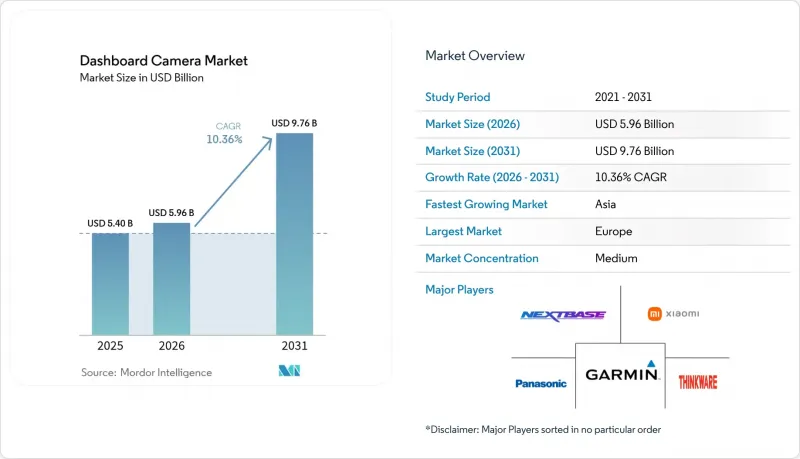
이러한 확대는 유럽에서의 차량용 데이터 레코더 의무화, 북미에서의 보험 텔레매틱스 프로그램 확대, 그리고 차량 사업자의 인식 가치를 높이는 AI의 급속한 통합에 기인합니다. 유럽의 강력한 규제 정책으로 인해 공장 출고 시 표준 장착이 새로운 표준으로 자리 잡고 있는 반면, 아시아의 활황을 보이는 자동차 생산 기지와 텔레매틱스에 적극적인 보험사들이 지역별로 가장 빠른 성장의 원동력이 되고 있습니다. 기술적 차별화의 초점은 하드웨어에서 소프트웨어로 옮겨가고 있습니다. 클라우드 연결형 분석, GDPR(EU 개인정보보호규정) 준수 스토리지, 내열 설계는 이제 브랜드 선택을 좌우하는 요인이 되고 있습니다. 애프터마켓 전문업체, 차량용 텔레매틱스 공급업체, OEM 업체들이 동일한 커넥티드 비디오 비즈니스 기회에 뛰어들면서 경쟁이 치열해지고 새로운 파트너십과 화이트 라벨 공급 모델을 구축하는 등 경쟁이 심화되고 있습니다.
세계 대시보드 카메라 시장 동향 및 인사이트
유럽 eCall 이벤트 데이터 레코더 의무화, 공장 장착형 대시보드 카메라 추진
2024년 7월 규정에 따라 EU의 모든 신형 승용차는 충돌 관련 데이터를 저장해야 하며, 동영상 녹화 기능은 OEM이 생산 라인에 자연스럽게 추가해야 하는 확장 기능입니다. 제조업체는 컴플라이언스 측면에서 차별화 요소를 확보하고, 공급업체는 장기적인 플랫폼 공급량을 확보해야 하며, 애프터마켓 브랜드는 딜러용 액세서리 및 차량용 개조 시장으로 전환해야 합니다. 독일의 Tier 1 전자기기 제조업체들은 GDPR(EU 개인정보보호규정)에 대응하는 펌웨어와 암호화 스토리지를 빠르게 도입하고 있으며, EU에서 검증된 기술을 다른 시장으로 확장할 수 있는 세계 플랫폼으로 우위를 점하고 있습니다.
미국 및 영국 물류업계의 AI 기반 차량 영상 텔레매틱스 도입에 대한 자료입니다.
대형 운송업체들은 사고 사후 검증에서 예측적 지도로 전환하고 있습니다. AI 분석을 통해 차간거리 부족, 주의산만, 피로운전을 자동으로 감지하여 안전관리자가 조기에 개입하여 보험금 청구를 줄이고 보험료 인하를 협상할 수 있습니다. 확장성이 뛰어난 클라우드 검증을 통해 수작업으로 영상을 일일이 검토하는 수고를 줄이고, 수천 대의 트랙터와 밴에 대한 기업 도입이 가능해집니다. 독자적인 컴퓨터 비전 기술 스택을 보유한 벤더는 영상을 최우선으로 차별화를 원하는 텔레매틱스 통합업체와 전략적 파트너십을 주도하고 있습니다.
독일과 오스트리아의 GDPR(EU 개인정보보호규정)에 따른 녹화 규제
루프 레코딩, 익명화, 최소 보존 기간 준수가 의무화되면서 펌웨어의 복잡성과 비용이 증가하고 있습니다. 오스트리아 교통 당국은 위반 시 최대 2,000만 유로(2,180만 달러)의 벌금을 부과하고 있습니다. 독일 연방 법원이 소송에서 드라이브 레코더의 증거 채택을 허용하면서 법적 명확성이 높아졌지만, 하드웨어 공급업체는 여전히 지역별로 SKU를 필요로 하고 있어 규모의 경제가 훼손되고 있습니다.
부문 분석
2025년에는 기본형 블랙박스 기술이 57.40%로 가장 큰 시장 점유율을 유지했지만, 스마트/AI 통합형 유닛은 2031년까지 연평균 복합 성장률(CAGR) 11.83%로 가장 높은 성장률을 나타낼 것으로 예측됩니다. 스마트 모델은 동영상을 운전 지도 경고로 변환하여 차량 사업자가 보험 청구를 줄이고 보험료 인하 협상을 할 수 있도록 돕습니다. 개인 사용자들은 여전히 기본형 모델을 구입하는 것이 비용 효율적이라는 증거로 여전히 기본형 모델을 구입하고 있지만, 고급형 구매자들은 클라우드 업로드 기능을 갖춘 앱 연동형 기기를 점점 더 많이 선택하고 있습니다. 컴퓨터 비전 관련 지적재산권을 보유한 공급업체는 지속적인 구독 수익을 확보하고 있으며, 이를 통해 대시보드 카메라 시장에서 하드웨어의 상품화를 완화하고 있습니다.
동시에 보험사는 보험료 협상에서 AI가 생성한 위험 프로파일을 인용하고 있으며, 이는 보험사와 자체 보험을 채택한 기업 모두 수요를 강화하고 있습니다. 개인 차량 소유자는 여전히 가격을 중시하는 반면, 고소득층 구매자는 비상시 업로드 및 원격 모니터링을 통해 안심할 수 있는 앱 기능 강화형 디바이스에 매력을 느끼고 있습니다. 무선 업데이트가 보편화됨에 따라 대시보드 카메라 시장에서 브랜드 충성도의 기반이 되는 것은 광학 성능이 아닌 펌웨어 로드맵이 될 것입니다.
2025년에는 단일 채널 설계가 71.30%의 매출 점유율을 차지했지만, 전방 및 차량 내 영상 증거를 원하는 차량 수요를 배경으로 듀얼 채널 시스템은 CAGR 10.78%로 성장하고 있습니다. 물류 기업들은 차내 영상이 있을 경우 분쟁 해결이 30% 더 빨라진다고 보고하고 있으며, 이는 높은 설비 투자에 대한 정당성을 뒷받침하고 있습니다. 라이드셰어 운전자 및 보호자는 멀티뷰 키트의 틈새 일반 소비자층을 형성하고 있으며, OEM 업체들은 기존 주차 보조 센서를 통합하여 선택적 차량 내 녹화를 트리거하여 프라이버시 준수와 촬영 범위 확장을 동시에 달성하고 있습니다.
리어뷰와 차량 내부 뷰의 조합에 대한 일반 소비자 보급이 늦어지고 있습니다. 설치의 복잡성과 프라이버시에 대한 우려가 보급을 가로막고 있기 때문입니다. 하지만 라이드셰어 운전자나 보호자는 360° 촬영 범위에 대한 비용을 기꺼이 지불할 의향이 있는 틈새 시장입니다. OEM 업체들은 기존 주차 보조 센서를 활용하여 선택적 차내 녹화를 작동시키는 실험을 진행하여 안전과 프라이버시 컴플라이언스를 동시에 만족시키고 있습니다.
지역별 분석
2025년에는 유럽이 34.60%의 점유율로 1위를 차지했으며, 영상증거를 제도화한 eCall-이벤트 데이터 레코더(EDR)의 의무화가 이를 견인했습니다. 북유럽 시장에서는 보험사들이 보험금 청구의 초기 심사에 영상을 활용하고 있어 평균 이상의 도입률을 보이고 있습니다. 자동 얼굴 흐림 등 프라이버시 보호 기능은 현재 기본 사양이 되어 개발의 복잡성은 높아지지만, 소비자의 신뢰를 높이고 있습니다.
아시아는 2031년까지 연평균 복합 성장률(CAGR) 11.25%로 가장 높은 성장률을 나타낼 것으로 예측됩니다. 중국은 대규모 제조에 따른 경제적 효과와 커넥티드카메라를 권장하는 지자체의 스마트시티 보조금 혜택을 누리고 있습니다. 국내 보험사들은 체계적인 텔레매틱스 할인을 제공하고 있어 일반 가정에서의 도입이 가속화되고 있습니다. 인도의 2026년 상용 ADAS 의무화는 인도를 주요 수요 촉매제 역할을 하고 있습니다. 현지 공급업체들은 이미 도로교통부 지침에 따라 몬순 시즌의 습도에 대응하는 견고한 유닛을 시험 가동하고 있습니다.
북미에서는 함대 시장에서 견조한 성장세를 보이고 있습니다. 운송업체들은 기존 ELD(전자식 주행기록장치) 및 경로 최적화 시스템에 영상 기능을 통합하고 있으며, 선진 보험사 및 리스크 관리 풀은 소송 비용 절감을 위해 카메라 증거 채택을 권장하고 있습니다. 남서부의 혹서 지역과 중동 및 아프리카의 기후 조건에서 하드웨어의 신뢰성 문제가 여전히 장벽으로 작용하고 있지만, 내열 설계에 투자하는 업체들은 실제 검증 데이터가 축적됨에 따라 잠재적인 수요를 개척할 수 있을 것으로 예측됩니다.
기타 특전:
- 엑셀 형식 시장 예측(ME) 시트
- 3개월간 애널리스트 지원
자주 묻는 질문
목차
제1장 서론
제2장 조사 방법
제3장 주요 요약
제4장 시장 구도
제5장 시장 규모와 성장 예측
제6장 경쟁 구도
제7장 시장 기회와 향후 전망
JHS 26.05.20The dashboard camera market size was valued at USD 5.40 billion in 2025 and estimated to grow from USD 5.96 billion in 2026 to reach USD 9.76 billion by 2031, at a CAGR of 10.36% during the forecast period (2026-2031).
This expansion stems from compulsory in-vehicle data recorders in Europe, expanding insurance telematics programs in North America, and rapid AI integration that raises perceived value among fleet operators. Europe's firm regulatory stance has positioned factory-fit units as the new norm, while Asia's thriving automotive production base and telematics-friendly insurers underpin the fastest regional growth momentum. Technological differentiation has pivoted from hardware to software; cloud-connected analytics, GDPR-compliant storage, and heat-resistant designs now determine brand preference. Competition is intensifying as aftermarket specialists, fleet telematics vendors, and OEMs converge on the same connected-video opportunity, prompting new partnerships and white-label supply models.
Global Dashboard Camera Market Trends and Insights
European eCall-Event Data Recorder mandate driving factory-fit dashcams
The July 2024 regulation obliges every new passenger vehicle in the EU to store crash-related data, making video capture a logical extension that OEMs are embedding at the production line . Manufacturers gain a compliance differentiator, suppliers secure long-term platform volume, and aftermarket brands must pivot toward dealer accessories and fleet retrofits. German Tier-1 electronics firms have moved quickly with GDPR-ready firmware and encrypted storage, giving them an edge as global platforms export EU-validated technology to other markets.
AI-enabled fleet video telematics adoption in US and UK logistics
Large carriers have transitioned from incident review to predictive coaching. AI analytics automatically flag tail-gating, distraction, or fatigue, enabling safety managers to intervene early, cut claims, and negotiate lower premiums . Scalable cloud review reduces manual footage trawling and makes enterprise deployments feasible across thousands of tractors and vans. Vendors that own proprietary computer-vision stacks now command strategic partnerships with telematics integrators eager for video-first differentiation.
GDPR-driven recording restrictions in Germany and Austria
Loop recording, anonymization, and minimal retention periods are compulsory, raising firmware complexity and cost. The Austrian traffic authority enforces fines up to EUR 20 million (USD 21.8 million) for non-compliance. Legal clarity improved after Germany's Federal Court allowed dashcam evidence in lawsuits, but hardware vendors still need region-specific SKUs, eroding economies of scale.
Other drivers and restraints analyzed in the detailed report include:
- OEM-installed dashcams by global automakers accelerating APAC uptake
- Insurance telematics discounts in Canada and selected APAC markets
- Heat-induced device failures in Middle East markets
For complete list of drivers and restraints, kindly check the Table Of Contents.
Segment Analysis
Basic dashcam technology retained the largest 57.40% market share in 2025, while smart/AI-integrated units register the fastest 11.83% CAGR through 2031. Smart models convert video into coaching alerts, helping fleets cut claims and negotiate lower premiums. Personal users still buy basic units for cost-effective evidence, yet upscale buyers increasingly choose app-linked devices with cloud uploads. Suppliers that control computer-vision IP secure recurring subscription revenue, buffering hardware commoditization within the dashboard camera market.
Concurrently, insurers cite AI-generated risk profiles when negotiating premiums, reinforcing demand from both carriers and self-insured corporates. Personal vehicle owners remain price-focused, yet upscale buyers gravitate to app-enhanced devices offering emergency upload and remote-viewing peace of mind. As over-the-air updates become commonplace, firmware road-maps rather than optics will anchor brand stickiness within the dashboard camera market.
Single-channel designs led with 71.30% revenue share in 2025, but dual-channel systems are growing at an 10.78% CAGR on the strength of fleet demand for forward-plus-cabin evidence. Logistics firms report 30% faster dispute resolution when interior footage is available, validating higher capital spend. Ride-hailing drivers and parents form a niche retail audience for multi-view kits, whereas OEMs integrate existing park-assist sensors to trigger selective cabin recording, merging privacy compliance with expanded coverage.
Consumer adoption of rear-plus-cabin views is slower; installation complexity and privacy hesitancy dampen uptake. Nonetheless, ride-hailing drivers and parents are niche segments willing to pay for 360° coverage. OEMs are experimenting with leveraging existing park-assist sensors to trigger selective interior recording, blending safety with privacy compliance.
The Dashboard Camera Market Report is Segmented by Technology (Basic, Advanced, Smart/AI-Integrated), Product Type (Single-Channel, Dual-Channel, Rear-View/Surround), Video Quality (SD and HD, Full-HD, 4K/UHD), Application (Personal Vehicles, Commercial Fleets), Distribution Channel (In-Store, and Online), and Geography. The Market Forecasts are Provided in Terms of Value (USD).
Geography Analysis
Europe led with 34.60% share in 2025, anchored by the eCall-Event Data Recorder mandate that institutionalized video evidence. Northern markets exhibit above-average attach rates as insurers embrace footage for claims triage. Privacy safeguards such as automatic face blurring are now baseline specifications, adding development complexity yet raising consumer trust.
Asia posts the fastest 11.25% CAGR to 2031. China benefits from scale manufacturing economies and municipal smart-city grants that endorse connected cameras. South Korea's insurers offer structured telematics credits, accelerating household adoption. India's 2026 commercial ADAS requirement positions the country as a major demand catalyst; localized suppliers already pilot rugged units tuned for monsoon humidity under guidelines from the Ministry of Road Transport and Highways.
North America shows robust fleet momentum. Carriers integrate video with existing ELD and route-optimization stacks, while progressive insurers and risk-management pools endorse camera evidence to curb litigation costs. Extreme-heat regions of the Southwest, alongside Middle-Eastern and African climates, remain constrained by hardware reliability issues; vendors investing in thermal-resistant designs stand to unlock latent potential as validated field data emerges.
- Garmin Ltd.
- Nextbase
- Thinkware Corporation
- Cobra Electronics (Cedar Electronics)
- Pittasoft Co. Ltd. (BlackVue)
- Xiaomi Corp.
- DOD Tech
- HP Inc.
- Lukas (Qronetek)
- Kenwood Corp. (JVC Kenwood)
- Philips N.V. (Dashcam Line)
- Steelmate Automotive
- Papago Inc.
- RoadHawk UK
- AsusTek Computer Inc.
- Vantrue
- Viofo Ltd.
- Panasonic Corporation
Additional Benefits:
- The market estimate (ME) sheet in Excel format
- 3 months of analyst support
TABLE OF CONTENTS
1 INTRODUCTION
- 1.1 Study Assumptions and Market Definition
- 1.2 Scope of the Study
2 RESEARCH METHODOLOGY
3 EXECUTIVE SUMMARY
4 MARKET LANDSCAPE
- 4.1 Market Overview
- 4.2 Market Drivers
- 4.2.1 European eCall-Event Data Recorder Mandate Driving Factory-Fit Dashcams
- 4.2.2 AI-Enabled Fleet Video Telematics Adoption in US and UK Logistics
- 4.2.3 OEM-Installed Dashcams by Tesla, BMW and Hyundai Accelerating APAC Uptake
- 4.2.4 Insurance Telematics Discounts in Canada and South Korea
- 4.2.5 Government Commercial Fleet Video Evidence Regulation (e.g. India 2026 Regulation)
- 4.2.6 Insurer-driven 4K/UHD video-quality adoption for claim clarity
- 4.3 Market Restraints
- 4.3.1 GDPR?Driven Recording Restrictions in Germany and Austria
- 4.3.2 Cyber-Vulnerability Disclosures in Connected Dashcams
- 4.3.3 Heat-Induced Device Failures (e.g., Middle-East (>15 % RMA))
- 4.3.4 Installation complexity and privacy hesitancy for dual/in-cabin cameras
- 4.4 Value / Supply-Chain Analysis
- 4.5 Regulatory Outlook
- 4.6 Technological Outlook
- 4.7 Porter's Five Forces
- 4.7.1 Bargaining Power of Suppliers
- 4.7.2 Bargaining Power of Buyers
- 4.7.3 Threat of New Entrants
- 4.7.4 Threat of Substitutes
- 4.7.5 Intensity of Competitive Rivalry
- 4.8 Investment Analysis
5 MARKET SIZE AND GROWTH FORECASTS (VALUE)
- 5.1 By Technology
- 5.1.1 Basic
- 5.1.2 Advanced
- 5.1.3 Smart / AI-Integrated
- 5.2 By Product Type
- 5.2.1 Single-Channel
- 5.2.2 Dual-Channel
- 5.2.3 Rear-View/Surround
- 5.3 By Video Quality
- 5.3.1 SD and HD
- 5.3.2 Full-HD
- 5.3.3 4K / UHD
- 5.4 By Application
- 5.4.1 Personal Vehicles
- 5.4.2 Commercial Fleets
- 5.5 By Distribution Channel
- 5.5.1 In-store
- 5.5.2 Online
- 5.6 By Geography
- 5.6.1 North America
- 5.6.1.1 United States
- 5.6.1.2 Canada
- 5.6.1.3 Mexico
- 5.6.2 South America
- 5.6.2.1 Brazil
- 5.6.2.2 Argentina
- 5.6.2.3 Rest of South America
- 5.6.3 Europe
- 5.6.3.1 Germany
- 5.6.3.2 United Kingdom
- 5.6.3.3 France
- 5.6.3.4 Italy
- 5.6.3.5 Spain
- 5.6.3.6 Nordics (Sweden, Norway, Denmark, Finland)
- 5.6.3.7 Rest of Europe
- 5.6.4 Asia Pacific
- 5.6.4.1 China
- 5.6.4.2 Japan
- 5.6.4.3 India
- 5.6.4.4 South Korea
- 5.6.4.5 ASEAN (Indonesia, Thailand, Malaysia, Vietnam, Philippines)
- 5.6.4.6 Rest of Asia Pacific
- 5.6.5 Middle East and Africa
- 5.6.5.1 Middle East
- 5.6.5.1.1 Saudi Arabia
- 5.6.5.1.2 United Arab Emirates
- 5.6.5.1.3 Turkey
- 5.6.5.1.4 Rest of Middle East
- 5.6.5.2 Africa
- 5.6.5.2.1 South Africa
- 5.6.5.2.2 Nigeria
- 5.6.5.2.3 Rest of Africa
- 5.6.5.1 Middle East
- 5.6.1 North America
6 COMPETITIVE LANDSCAPE
- 6.1 Market Concentration
- 6.2 Strategic Moves
- 6.3 Market Share Analysis
- 6.4 Company Profiles (Includes Global-level Overview, Market-level Overview, Core Segments, Financials, Strategic Info, Market Rank/Share, Products and Services, Recent Developments)
- 6.4.1 Garmin Ltd.
- 6.4.2 Nextbase
- 6.4.3 Thinkware Corporation
- 6.4.4 Cobra Electronics (Cedar Electronics)
- 6.4.5 Pittasoft Co. Ltd. (BlackVue)
- 6.4.6 Xiaomi Corp.
- 6.4.7 DOD Tech
- 6.4.8 HP Inc.
- 6.4.9 Lukas (Qronetek)
- 6.4.10 Kenwood Corp. (JVC Kenwood)
- 6.4.11 Philips N.V. (Dashcam Line)
- 6.4.12 Steelmate Automotive
- 6.4.13 Papago Inc.
- 6.4.14 RoadHawk UK
- 6.4.15 AsusTek Computer Inc.
- 6.4.16 Vantrue
- 6.4.17 Viofo Ltd.
- 6.4.18 Panasonic Corporation
7 MARKET OPPORTUNITIES AND FUTURE OUTLOOK
- 7.1 White-space and Unmet-Need Assessment