

|
시장보고서
상품코드
2043839
민간 항공기 애프터마켓 부품 : 시장 점유율 분석, 업계 동향 및 통계, 성장 예측(2026-2031년)Commercial Aircraft Aftermarket Parts - Market Share Analysis, Industry Trends & Statistics, Growth Forecasts (2026 - 2031) |
||||||
 Mordor Intelligence
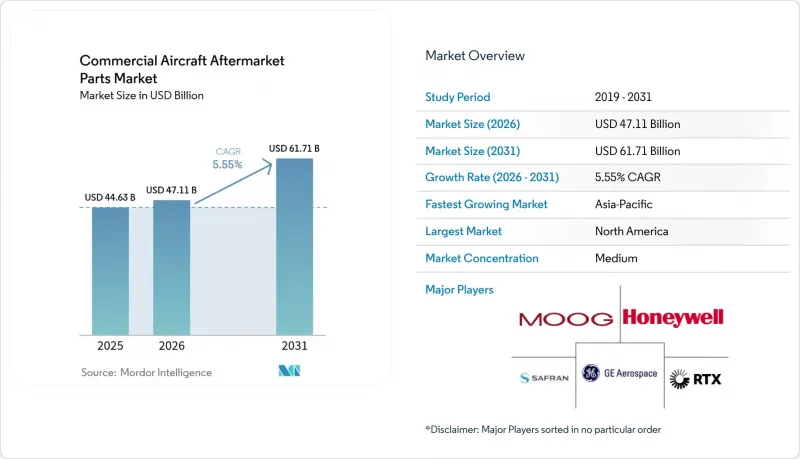
민간 항공기 애프터마켓 부품 시장 규모는 2025년 446억 3,000만 달러로 평가되었습니다. 2026년 471억 1,000만 달러로 확대되어 CAGR 5.55%를 나타내, 2031년까지 617억 1,000만 달러에 이를 것으로 예측됩니다.
이러한 성장 궤적은 OEM의 납기 지연이 지속되고, 노후화된 협동체 항공기가 더 오래 운영되고 있으며, 차세대 엔진의 정비 빈도가 증가하고 있음을 반영하고 있습니다. 항공사들은 긴 리드타임과 높은 신품 부품 가격에 대한 대책으로 정비 가능한 부품의 조달을 확대되고 있습니다. 동시에 부품 계획의 디지털화 및 예지보전을 통해 가동률 향상을 지원하고 있습니다. 적층 가공 기술(적층 가공)은 승인된 내장재 및 보조 구조 부품의 롱테일 납기를 단축하고, 항공사 및 MRO(정비, 수리 및 정비) 사업자가 재고와 서비스 수준 목표의 균형을 맞추는 데 도움을 주고 있습니다. 공급망 마찰은 여전히 비용과 복잡성을 증가시키고 있으며, 민간 항공기 애프터마켓 부품 시장은 일회성 현물 구매보다는 탄력성 및 수명주기 지원 성과에 초점을 맞출 것입니다.
수주잔고와 인증상의 안전장치가 단기적인 추세를 좌우하고 있습니다. 1만 7,000대가 넘는 전 세계 주문 잔량으로 구형 항공기의 운항 기간이 연장되고 신형 항공기 생산 속도가 느려지고 있음에도 불구하고 부품 수요는 유지되고 있습니다. 항공사는 공급업체의 제약으로 인한 추가 비용을 계속 흡수하고 있으며, 규제 당국은 항공기의 내항성에 필수적인 부품에 대한 문서화 및 추적성을 강조하고 있습니다. OEM 업체들은 안정적인 부품 공급을 위해 디지털 채널과 USM(Universal Supply Management) 프로그램을 강화하고 있으며, 주요 MRO 업체들은 항공기 운항 지속성을 보장하기 위해 데이터 기반 계획 수립을 확대되고 있습니다. 이를 통해 민간 항공기 애프터마켓 부품 시장에서 물리적 부품, 정비소 운영 능력, 커넥티드 애널리틱스를 결합하여 운항 신뢰성을 보호하는 통합 생태계를 구축할 수 있는 유리한 입지를 확보했습니다.
세계의 민간 항공기 애프터마켓 부품 시장 동향과 인사이트
OEM의 생산 지연을 배경으로 한 세계 단일 통로 항공기(싱글 아일) 기단의 노후화
세계 수주잔량은 교체주기를 제한하고 있으며, 이로 인해 운항사는 구형 항공기를 연장 운영할 수밖에 없어 주기 구동형 부품의 소비가 증가하고 있습니다. 1만 7,000대 이상의 항공기 주문 잔고는 자산을 운용 가능한 상태로 유지하기 위한 수년 단위의 대기자 명단을 나타내며, 민간 항공기 애프터마켓 부품 시장 전체에서 교체 가능한 부품 및 소모품에 대한 지속적인 수요를 견인하고 있습니다. 또한, 수명이 길어짐에 따라 고주기 기종에 대해 내공성 지침에서 의무화되어 있는 구조 검사 및 지정 개조의 필요성이 더욱 강화되고 있습니다. 규제 당국은 지속적인 내항성 및 운영자 컴플라이언스에 대한 최신 지침을 발표했으며, 이는 정기 점검 대상인 비행 제어 장치, 착륙 장치 및 시스템 부품에 대한 안정적인 수요를 뒷받침하고 있습니다. 항공사는 공급망 전반의 마찰로 인한 운영 비용 상승에 직면하고 있으며, 이로 인해 자재 조달이 지연되고 대규모 점검을 위한 계획상의 여유 기간이 확대되고 있습니다. 단기적인 영향으로는 협폭동체 기종에 대한 애프터마켓 수요 증가가 지속되고 있으며, 민간 항공기 애프터마켓 부품 시장에서 납품 지연을 보완하기 위한 타겟화된 업그레이드가 이루어지고 있습니다.
차세대 엔진의 내구성 문제로 인한 예정에 없던 정비가 들어왔습니다.
항공사 및 MRO 업체들은 특정 차세대 엔진에 대한 점검 캠페인 및 조기 정비 입고 관리를 계속하고 있으며, 이로 인해 모듈 및 LRU 공급이 타이트한 상황입니다. 기어드 터보팬 프로그램의 점검 및 복구 계획은 2026년까지 생산 능력의 주요 변동 요인으로 남아 있으며, 단조 부품 및 주요 교체 부품에 대한 투자는 애프터마켓 수리 파이프라인으로 유입되는 구조적 공급 수요에 대응하기 위한 것입니다. 엔진 OEM과 공인 정비소는 모듈의 흐름을 조정하고 있지만, 처리 시간이 길어지면 항공기 전체에 파급되어 예비 엔진 및 교체 가능한 부품의 재고 요구 사항이 부풀어 오를 수 있습니다. 그 결과, 민간 항공기 애프터마켓 부품 시장에서는 운항 신뢰성을 보장하기 위해 예측 계획, 조기 자재 배치 및 대체 조달에 대한 중요성이 더욱 강조되고 있습니다. 수리 데이터 및 내공성 문서에 대한 규제 당국의 모니터링은 핵심 모듈에 대한 대규모 작업을 수행하는 정비소 및 운항 회사에 지속적으로 영향을 미치고 있으며, 중기적으로 OEM 산하 및 독립 정비소의 생산 능력에 대한 균형을 형성하고 있습니다. 다양한 엔진 구성을 관리하는 항공사는 서비스 브리핑 실시, 정비소 운영 계획 등 단기적인 위험 완화 조치와 장기적인 정비 전략의 균형을 맞추고 있습니다.
전 세계 정비사 부족으로 처리 시간이 길어지고 있습니다.
정비 인력 공급 부족은 여전히 구조적인 제약으로 작용하고 있으며, 기체, 엔진 및 부품 정비 공장 전체의 처리 능력을 저하시키고 비용을 증가시키고 있습니다. 세계 예측에 따르면, 신규 항공 정비사에 대한 장기적인 수요는 현재 양성된 인원보다 훨씬 많으며, 그 격차는 고도의 기술을 필요로 하는 엔진 및 항공전자 작업 분야에서 가장 두드러집니다. MRO 사업자와 항공사는 교육 프로그램 확대와 교육기관과의 제휴를 통해 이 문제를 해결하고 있습니다. 그러나 자격 취득까지의 기간과 실무 경험의 필요성은 여전히 정비 능력과 처리시간의 과제로 남아있습니다. 그 결과, 중정비 공장 입고 간격이 길어지고, 교체용 자산과 리스 모듈의 사용 빈도가 증가하여 항공기가 시장에서 계속 가동되는 상황이 발생하고 있습니다. 규제 당국은 확립된 기준에 따라 훈련과 인증을 지속적으로 감독하고 있으며, 이는 안전성과 신뢰성을 유지하지만 전문 기술의 급속한 확장을 제한하고 있습니다. 장기적으로는 자동화, 디지털 작업지시서, AI 기반 진단이 생산성 향상에 기여할 것으로 예상되지만, 단기적으로는 여전히 인력 부족 현상이 지속될 것으로 예측됩니다.
부문 분석
2025년, 협폭동체 항공기는 민간 항공기 애프터마켓 부품 시장의 59.87%를 차지하고 있으며, 이는 비행 횟수가 많기 때문에 바퀴, 브레이크, 환경 제어 시스템 및 라인 교체 가능한 항공 전자 공학의 마모가 가속화되고 있음을 반영합니다. 항공사가 고빈도 단거리 노선을 우선시하는 가운데, 이용률과 처리 시간 단축으로 인해 라인에서 교체 가능한 소모품 및 교체 가능한 부품에 대한 안정적인 수요가 창출되고 있습니다. 와이드 바디 기계는 도입 기수가 적고, 작업 범위가 더 복잡하며, 검사 기간도 길어집니다. 그 결과, 2026년부터 2031년까지의 성장률은 기단 평균을 상회할 것으로 예측됩니다. 리저널 제트는 여전히 포인트 투 포인트 네트워크와 지방 공항에서 필수적인 역할을 하고 있으며, 이는 지역 MRO 허브에서 유압, 공압 및 특수 항공전자에 대한 수요를 유지합니다. 노후화된 항공기의 검사에 대한 규제 지침도 사이클 수가 많기 때문에 협폭동체 항공기를 장려하고 있으며, 이로 인해 검사 주도의 자재 흐름이 증가하고 있습니다.
와이드바디 항공기는 항공사가 장거리 항공기의 수명을 연장하고 승객의 기대에 부응하기 위해 객실 및 연결 환경을 개조하는 것을 배경으로 2031년까지 연평균 복합 성장률(CAGR) 6.45%를 나타낼 것으로 예측됩니다. 항공사는 엄격한 지속적 항행안전 기준을 충족해야 하는 구조 작업과 시스템 점검 사이에서 정비 작업 부하를 조정하고 있으며, 이는 착륙 장치, 비행 제어 장치 및 객실 시스템의 부품 소비를 안정적으로 증가시키고 있습니다. 서비스 브레틴 및 내공성 지침으로 인해 고사이클의 협폭동체 항공기에 대한 검사 절차가 강화되면서 인증된 교체용 하드웨어 및 구조용 키트에 대한 수요가 증가하고 있습니다. 공급업체와 MRO(정비, 수리, 오버홀) 업체들은 다운타임을 줄이기 위해 항공기 가동률이 높은 운항사 근처에 로터리 풀과 교체 프로그램을 배치하고 있습니다. 이러한 추세로 인해 블록 시간과 사이클 수가 가장 많은 지역에서 부품 회전율이 유지되고 있으며, 이는 민간 항공기 애프터마켓 부품 시장에서 매우 중요한 요소입니다.
2025년 기준, 엔진 부품은 민간 항공기 애프터마켓 부품 시장 규모의 48.70%를 차지하며, 터빈 하드웨어, 고온 부품, 연료 시스템, 제어 전자장치에 가치가 집중되어 있음을 알 수 있습니다. 차세대 엔진은 첨단 합금, 코팅 및 적층 가공 기술을 통한 기능을 도입하고 있으며, OEM 인증 수리 및 문서화된 추적성을 필요로 합니다. 계획적인 제거와 예기치 못한 상황을 모두 관리해야 하는 운항사에게 정비 공장의 능력과 모듈의 가용성은 여전히 중요한 변수가 되고 있습니다. 항공 전자공학은 가장 빠르게 성장하는 카테고리로, 신뢰성과 승객 경험을 향상시키는 연결성 업그레이드, 기내 엔터테인먼트(IFE) 업데이트 주기, 조종석 현대화에 힘입어 2031년까지 연평균 6.35%의 성장률을 나타낼 것으로 예측됩니다. 기체 부품의 경우, 노후화된 기체가 FAA 및 EASA의 프로그램에 따라 구조 검사 및 부식 방지 처리를 받기 때문에 안정적인 수요가 유지되고 있습니다.
디지털 시스템의 보급과 함께 하드웨어 교체에는 소프트웨어 구성 관리 및 사이버 보안 업데이트가 수반되며, 이는 공인된 항공전자 공급업체에게 지속적인 서비스 라인을 만들어 내고 있습니다. 기술표준지침(TSO) 및 설계 승인은 안전상 중요한 장비에 대한 공급자의 자격을 규정하고 있으며, 그 결과 TCAS, EGPWS, SATCOM 유닛 등의 분야에서 PMA(생산형 개조)의 보급이 제한적으로 이루어지고 있습니다. 항공사들이 USB-C 전원, Wi-Fi, 슬림 라인 시트를 표준화하고 있는 가운데, 기내 현대화는 여전히 명확한 우선순위이며, 그 결과 수년에 걸쳐 전 기종에 걸쳐 멀티쉽셋 프로그램이 진행되고 있습니다. MRO 네트워크 내에서는 새로운 기체 플랫폼과 제어면에 대응하기 위해 복합재 수리 능력이 확대되고 있으며, 각 정비소에서는 Part 145에 따른 승인된 수리를 수행하기 위해 도구와 교육을 확대되고 있습니다. 이러한 상황으로 인해 민간 항공기 애프터마켓 부품 시장에서 엔진과 항공전자 분야가 계속해서 성장의 중심이 되고 있는 반면, 기체 및 인테리어 분야는 꾸준하고 계획적인 속도로 성장하고 있습니다.
'민간 항공기 애프터마켓 부품 보고서'는 플랫폼(협동체, 와이드바디, 리저널 제트), 부품 유형(엔진, 기체, 인테리어 등), 부품 카테고리(MRO 부품 및 교체 가능 부품), 최종 사용자(항공사 및 화물 운항사), 지역(북미, 아시아, 남미 등)별로 분류되어 있습니다. 등), 지역(북미, 유럽, 아시아태평양, 남미 등) 별로 분류되어 있습니다. 시장 예측은 금액(USD) 기준으로 제시됩니다.
지역별 분석
2025년 북미는 민간 항공기 애프터마켓 부품 시장의 36.54%를 차지했습니다. 이는 광범위한 운항사 기반, 강력한 OEM 서비스 체계 및 FAA 승인 MRO 시설의 촘촘한 네트워크에 의해 뒷받침됩니다. 이 지역 항공사들은 높은 가동률을 유지하고, 디지털화 및 예지보전 프로세스를 조기에 도입하여 전 기종에 걸친 계획 수립 및 예비 부품 배분을 강화하고 있습니다. FAA의 내공성 지침 준수에 따라, 고주기 운항 협동체 항공기의 시스템, 구조, 엔진용 부품에 대한 수요가 견조하게 증가하고 있습니다. 보잉이나 에어버스의 통합 채널과 같은 OEM의 유통 플랫폼은 거래 효율성과 문서 흐름을 개선하고, 감사 및 신뢰성 관련 요구 사항을 지원합니다.
아시아태평양은 항공사들이 운항 역량을 강화하고 국제선 운항을 재개함에 따라 2031년까지 연평균 7.10%의 성장률을 나타낼 것으로 예측되며, 이는 각 지역 중 가장 높은 성장률입니다. 향후 20년간 9,570대에 달할 것으로 예상되는 중국의 항공기 보유량 증가 추세는 미래의 대규모 서비스 기반을 뒷받침하고 엔진, 부품 및 객실 개조에 대한 장기적인 수요를 창출할 것입니다. 인도의 항공 네트워크 확장 계획에 따라 새로운 도시 간 노선이 추가되고, 협동체 항공기의 가동률이 향상되고 있습니다. 이에 따라 일일 사이클 수 증가에 대응하기 위한 교체 가능한 부품 및 소모품에 대한 수요가 증가하고 있습니다. 지역적 MRO(정비, 수리, 오버홀) 능력은 지속적으로 확대되고 있으며, 기존 거점 및 신규 진출기업들이 라인 정비, 기체 정비, 엔진 정비 및 부품 정비에 대한 인가를 취득하고 있습니다. 운항사가 예기치 못한 문제를 줄이고 신뢰성을 높이기 위해 예지보전 플랫폼과 OEM(Original Equipment Manufacturer)의 서비스 패키지를 채택하는 것이 확산되고 있습니다.
유럽은 견고한 MRO 네트워크와 검사 및 문서화 기준을 계획의 최우선 순위로 삼는 엄격한 EASA의 감독 체제를 갖춘 성숙한 고부가가치 지역으로 남아 있습니다. 국적항공사 및 LCC는 기내 개조 및 노선망 확충을 통해 기존 항공기의 경제적 수명을 연장하고, 공급 부족을 관리하면서 수요에 대응하고 있습니다. 중동에서는 주요 허브 항공사를 중심으로 와이드바디 항공기 정비 및 부품 서비스가 지속적으로 확대되고 있습니다. 한편, 아프리카와 남미에서는 북미와 유럽 운항사의 니어쇼어링 업무에 대응하기 위해 시설과 인허가를 강화하고 있습니다. 관세 및 물류 측면의 고려로 인해 미국 운항사에게 비용 및 지리적 이점을 제공할 수 있는 카리브해 및 중남미 기지로의 부품 흐름의 니어쇼어링이 촉진되고 있습니다. 또한, 첨단 소재 및 공정 기술에 자금을 지원하는 공공 프로그램도 미래 부품 수요에 대비한 지역 공급 탄력성 및 인력 양성에 기여하고 있습니다.
기타 혜택 :
- 엑셀 형식 시장 예측(ME) 시트
- 3개월간 애널리스트 지원
자주 묻는 질문
목차
제1장 서론
제2장 조사 방법
제3장 주요 요약
제4장 시장 구도
제5장 시장 규모와 성장 예측
제6장 경쟁 구도
제7장 시장 기회와 향후 전망
KTH 26.05.29The commercial aircraft aftermarket parts market size is expected to grow from USD 44.63 billion in 2025 to USD 47.11 billion in 2026 and is projected to reach USD 61.71 billion by 2031 at a 5.55% CAGR.
The growth path reflects persistent OEM delivery delays, aging narrowbody fleets staying in service longer, and higher shop-visit intensity on next-generation engines. Airlines are expanding the use of serviceable material sourcing as a hedge against long lead times and high new-part pricing. At the same time, digitization of parts planning and predictive maintenance supports improved uptime. Additive manufacturing reduces long-tail lead times for approved interior and secondary structure components, helping airlines and MROs balance inventory and service-level goals. Supply chain friction still adds cost and complexity, keeping the commercial aircraft aftermarket parts market focused on resiliency and life-cycle support outcomes rather than transactional spot buys.
Backlogs and certification safeguards shape near-term dynamics. A global order backlog that exceeds 17,000 aircraft extends the in-service life of legacy fleets and sustains parts demand despite slower new-build ramp rates. Airlines continue to absorb extra costs linked to supplier constraints, while regulators emphasize documentation and traceability for airworthiness-critical parts. OEMs strengthen digital channels and USM programs to stabilize availability, and leading MROs scale data-driven planning to keep aircraft on wing. This favors integrated ecosystems that combine physical parts, shop capacity, and connected analytics to protect operational reliability in the commercial aircraft aftermarket parts market.
Global Commercial Aircraft Aftermarket Parts Market Trends and Insights
Aging Global Single-Aisle Fleet Amid OEM Production Delays
Global order backlogs constrain replacement cycles, which pushes operators to extend legacy aircraft and sustain higher parts consumption for cycle-driven items. The backlog above 17,000 units indicates a multi-year queue that keeps assets on wing and drives recurring demand for rotables and consumables across the commercial aircraft aftermarket parts market. The longer service lives also reinforce the need for structural inspections and directed modifications mandated by airworthiness directives for high-cycle fleets. Regulators have issued updated guidance on continuing airworthiness and operator compliance, which supports stable demand for flight controls, landing gear, and systems parts subject to recurring checks. Airlines face elevated operating costs from broader supply chain friction, which slows material availability and increases planning buffers for heavy checks. The near-term effect is sustained aftermarket intensity for narrowbody fleets and targeted upgrades that bridge to delayed delivery slots in the commercial aircraft aftermarket parts market.
Unscheduled Shop Visits from Next-Gen Engine Durability Issues
Airlines and MROs continue to manage inspection campaigns and accelerated shop visits on select next-generation engines, which tighten module and LRU availability. The inspection and recovery plans on geared turbofan programs remain a major capacity variable through 2026, and investments in forging and critical rotating parts aim to address structural supply needs that flow into aftermarket repair pipelines. Engine OEMs and authorized shops coordinate module flow, but elongated turnaround times can cascade across fleets and inflate spare engine and rotable pool requirements. The result is greater emphasis on predictive planning, early material positioning, and alternative sourcing to protect dispatch reliability in the commercial aircraft aftermarket parts market. Regulatory oversight of repair data and airworthiness documentation continues to influence shops and operators performing major work on critical modules, shaping the balance between OEM-captive and independent capacity in the medium term. Airlines managing mixed engine portfolios balance short-term mitigation efforts with long-term maintenance strategies, including service bulletin implementation and shop load planning.
Global Technician Shortage Lengthening Turnaround Times
The maintenance labor pipeline remains a structural constraint, slowing throughput and raising costs across airframe, engine, and component shops. Global forecasts indicate that long-term demand for new aviation technicians significantly exceeds current training output, with the gap most pronounced in high-skill engine and avionics work scopes. MROs and airlines are addressing the issue by expanding training programs and forming partnerships with educational institutions. However, certification timelines and the need for experience continue to challenge capacity and turnaround times. The effect is longer intervals between heavy shop visits and more frequent use of exchange assets and leased modules, keeping aircraft available in the market. Regulators continue to oversee training and certification under established standards, which maintains safety and reliability but limits the rapid scaling of specialized skills. Over time, automation, digital work instructions, and AI-based diagnostics can help amplify productivity, but the near-term profile still points to tight labor conditions.
Other drivers and restraints analyzed in the detailed report include:
- Rapid Expansion of Used-Serviceable-Material (USM) Ecosystems
- AI-Enabled Predictive Maintenance Improving Parts Planning
- OEM IP/Licensing Limits on Independent Part Repairs
For complete list of drivers and restraints, kindly check the Table Of Contents.
Segment Analysis
Narrowbody aircraft held 59.87% of the commercial aircraft aftermarket parts market share in 2025, reflecting higher cycle counts that accelerate wear on wheels, brakes, environmental control systems, and line-replaceable avionics. As airlines prioritize high-frequency short-haul routes, utilization and turn times generate steady demand for consumables and rotables that can be exchanged on the line. Widebody platforms constitute a smaller installed base; however, they involve more complex work scopes and longer check durations. As a result, their projected growth from 2026 to 2031 is expected to surpass the fleet average. Regional jets remain essential in point-to-point networks and secondary airports, which sustains demand for hydraulics, pneumatics, and specialized avionics at regional MRO hubs. Regulatory directives for aging aircraft checks also favor narrowbody platforms due to higher cycles, which amplify inspection-driven material flows.
Widebody platforms are expected to grow at a CAGR of 6.45% through 2031, driven by airlines extending the service life of long-haul aircraft and retrofitting cabins and connectivity to meet passenger expectations. Airlines balance shop workloads between structural work and systems overhauls that must meet strict continuing airworthiness standards, which drives steady parts consumption for landing gear, flight controls, and cabin systems. Service bulletins and airworthiness directives reinforce inspection routines for high-cycle narrowbody fleets, increasing demand for certified replacement hardware and structural kits. Suppliers and MROs position rotable pools and exchange programs near operators with high aircraft utilization to reduce downtime. These patterns maintain strong parts velocity in areas where block hours and cycles are highest, which is crucial to the commercial aircraft aftermarket parts market.
Engine components accounted for 48.70% of the commercial aircraft aftermarket parts market size in 2025, highlighting the concentration of value in turbine hardware, hot-section materials, fuel systems, and control electronics. Next-generation engines introduce advanced alloys, coatings, and additively manufactured features that require OEM-authorized repairs and documented traceability. Shop capacity and module availability remain central variables for operators that must manage planned removals alongside unscheduled events. Avionics is the fastest-growing category, projected to grow at a 6.35% CAGR through 2031, driven by connectivity upgrades, IFE refresh cycles, and cockpit modernization that improve reliability and the passenger experience. Airframe components sustain steady demand as aging fleets undergo structural inspections and corrosion-prevention treatments under FAA and EASA programs.
As digital systems proliferate, software configuration control and cybersecurity updates accompany hardware swaps, which create recurring service lines for approved avionics providers. Technical standard orders and design approvals define supplier eligibility for safety-critical boxes, thereby limiting PMA penetration in classes such as TCAS, EGPWS, and SATCOM units. Cabin modernization remains a clear priority as airlines standardize on USB-C power, Wi-Fi, and slimline seating, resulting in multi-shipset programs that roll out across fleets over several years. Composites repair capability is expanding within MRO networks to support newer airframe platforms and control surfaces, and shops add tooling and training to execute approved repairs under Part 145. These conditions keep the engine and avionics at the center of growth, while the airframe and interiors maintain a steady, programmatic cadence in the commercial aircraft aftermarket parts market.
The Commercial Aircraft Aftermarket Parts Report is Segmented by Platform (Narrowbody, Widebody, and Regional Jets), Component Type (Engine, Airframe, Interior, and More), Parts Category (MRO Parts and Rotable Replacement Parts), End User (Airlines and Cargo Operators, and More), and Geography (North America, Europe, Asia-Pacific, South America, and More). The Market Forecasts are Provided in Terms of Value (USD).
Geography Analysis
North America accounted for 36.54% of the commercial aircraft aftermarket parts market in 2025, supported by an extensive operator base, a strong OEM services presence, and a dense network of FAA-approved MRO facilities. Operators in the region maintain high utilization and adopt digital and predictive processes early, thereby strengthening planning and sparing allocation across fleets. Compliance with FAA airworthiness directives drives steady demand for parts for systems, structures, and engines on high-cycle narrow-body aircraft. OEM distribution platforms, such as Boeing's and Airbus's integrated channels, improve transactional efficiency and documentation flow, supporting audit and reliability needs.
Asia Pacific is projected to grow at a 7.10% CAGR through 2031, the fastest among regions, as carriers add capacity and restore international connectivity. China's fleet growth trajectory toward 9,570 aircraft by the next two decades underpins a large future services base and creates long-run demand for engines, components, and cabin upgrades. India's connectivity programs add new city pairs and stimulate narrow-body utilization, increasing the need for rotables and consumables to support higher daily cycles. Regional MRO capability continues to expand, with established hubs and new entrants receiving approvals for line, airframe, engine, and component maintenance. Predictive platforms and OEM service packages are seeing broader adoption as operators seek to reduce unplanned events and improve reliability.
Europe remains a mature, high-value region with robust MRO networks and strict EASA oversight that keeps inspection and documentation standards at the forefront of planning. Flag carriers and low-cost operators extend the economic life of existing fleets through cabin modernization and connectivity retrofits to manage delivery shortfalls and match demand. The Middle East continues to scale wide-body maintenance and component services around large hub carriers, while Africa and South America strengthen facilities and approvals to nearshore work from North American and European operators. Tariff and logistics considerations encourage nearshoring of parts flows to Caribbean and Central American sites that can offer cost and proximity advantages for US operators. Public programs that fund advanced materials and process technologies also contribute to regional supply resilience and talent development for future parts demand.
- Aventure International Aviation Services
- Honeywell International Inc.
- RTX Corporation
- Parker-Hannifin Corporation
- General Electric Company
- Moog Inc.
- GKN Aerospace Services Limited
- A J Walter Aviation Limited
- Bombardier Inc.
- The Boeing Company
- Safran SA
- Rolls-Royce Holdings plc
- Lufthansa Technik AG
- Singapore Technologies Engineering Ltd.
- AAR Corp.
- StandardAero, Inc.
- Eaton Corporation plc
- Kellstrom Aerospace
- VAS Aero Services, LLC
Additional Benefits:
- The market estimate (ME) sheet in Excel format
- 3 months of analyst support
TABLE OF CONTENTS
1 INTRODUCTION
- 1.1 Study Assumptions and Market Definition
- 1.2 Scope of the Study
2 RESEARCH METHODOLOGY
3 EXECUTIVE SUMMARY
4 MARKET LANDSCAPE
- 4.1 Market Overview
- 4.2 Market Drivers
- 4.2.1 Aging global single-aisle fleet amid OEM production delays
- 4.2.2 Unscheduled shop visits from next-gen engine durability issues
- 4.2.3 Rapid expansion of used-serviceable-material (USM) ecosystems
- 4.2.4 AI-enabled predictive maintenance improving parts planning
- 4.2.5 On-demand 3D printing shortening long-tail parts lead-times
- 4.2.6 Tariff-driven near-shoring of parts supply chains
- 4.3 Market Restraints
- 4.3.1 Global technician shortage lengthening turnaround times
- 4.3.2 OEM IP/licensing limits on independent part repairs
- 4.3.3 Counterfeit-part risk tightening certification compliance
- 4.3.4 Raw-material cost and forging/casting bottlenecks
- 4.4 Value Chain Analysis
- 4.5 Regulatory Landscape
- 4.6 Technological Outlook
- 4.7 Porter's Five Forces Analysis
- 4.7.1 Threat of New Entrants
- 4.7.2 Bargaining Power of Buyers
- 4.7.3 Bargaining Power of Suppliers
- 4.7.4 Threat of Substitutes
- 4.7.5 Intensity of Rivalry
5 MARKET SIZE AND GROWTH FORECASTS (VALUE)
- 5.1 By Platform
- 5.1.1 Narrowbody
- 5.1.2 Widebody
- 5.1.3 Regional Jets
- 5.2 By Component Type
- 5.2.1 Engine
- 5.2.2 Airframe
- 5.2.3 Interior
- 5.2.4 Avionics and Others
- 5.3 By Parts Category
- 5.3.1 MRO Parts
- 5.3.2 Rotable Replacement Parts
- 5.4 By End User
- 5.4.1 Airlines and Cargo Operators
- 5.4.2 Independent MRO Providers
- 5.4.3 Aircraft Leasing Companies
- 5.5 By Geography
- 5.5.1 North America
- 5.5.1.1 United States
- 5.5.1.2 Canada
- 5.5.1.3 Mexico
- 5.5.2 Europe
- 5.5.2.1 United Kingdom
- 5.5.2.2 Germany
- 5.5.2.3 France
- 5.5.2.4 Russia
- 5.5.2.5 Rest of Europe
- 5.5.3 Asia-Pacific
- 5.5.3.1 China
- 5.5.3.2 India
- 5.5.3.3 Japan
- 5.5.3.4 South Korea
- 5.5.3.5 Rest of Asia-Pacific
- 5.5.4 South America
- 5.5.4.1 Brazil
- 5.5.4.2 Rest of South America
- 5.5.5 Middle East and Africa
- 5.5.5.1 Middle East
- 5.5.5.1.1 Israel
- 5.5.5.1.2 Saudi Arabia
- 5.5.5.1.3 United Arab Emirates
- 5.5.5.1.4 Rest of Middle East
- 5.5.5.2 Africa
- 5.5.5.2.1 South Africa
- 5.5.5.2.2 Rest of Africa
- 5.5.5.1 Middle East
- 5.5.1 North America
6 COMPETITIVE LANDSCAPE
- 6.1 Market Concentration
- 6.2 Strategic Moves
- 6.3 Market Share Analysis
- 6.4 Company Profiles (includes Global level Overview, Market level overview, Core Segments, Financials as available, Strategic Information, Market Rank/Share for key companies, Products and Services, and Recent Developments)
- 6.4.1 Aventure International Aviation Services
- 6.4.2 Honeywell International Inc.
- 6.4.3 RTX Corporation
- 6.4.4 Parker-Hannifin Corporation
- 6.4.5 General Electric Company
- 6.4.6 Moog Inc.
- 6.4.7 GKN Aerospace Services Limited
- 6.4.8 A J Walter Aviation Limited
- 6.4.9 Bombardier Inc.
- 6.4.10 The Boeing Company
- 6.4.11 Safran SA
- 6.4.12 Rolls-Royce Holdings plc
- 6.4.13 Lufthansa Technik AG
- 6.4.14 Singapore Technologies Engineering Ltd.
- 6.4.15 AAR Corp.
- 6.4.16 StandardAero, Inc.
- 6.4.17 Eaton Corporation plc
- 6.4.18 Kellstrom Aerospace
- 6.4.19 VAS Aero Services, LLC
7 MARKET OPPORTUNITIES AND FUTURE OUTLOOK
- 7.1 White-space and Unmet-need Assessment


