
|
시장보고서
상품코드
2043940
콜라겐 펩티드 : 시장 점유율 분석, 업계 동향 및 통계, 성장 예측(2026-2031년)Collagen Peptides - Market Share Analysis, Industry Trends & Statistics, Growth Forecasts (2026 - 2031) |
||||||
 Mordor Intelligence
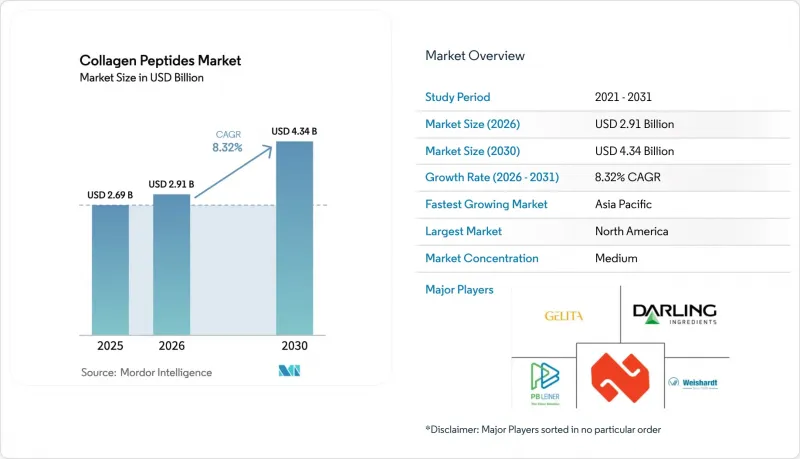
콜라겐 펩티드 시장 규모는 2025년 26억 9,000만 달러로 평가되었습니다. 2026년 29억 1,000만 달러로 확대되어 2026-2031년에 걸쳐 CAGR 8.32%를 나타내, 2031년에는 43억 4,000만 달러에 이를 것으로 예측됩니다.
고령화 진행, 예방의학에 대한 관심 증가, 미용 효과를 기대하는 소비자들의 건강기능식품에 대한 관심 증가가 이러한 성장을 견인하고 있습니다. 이 시장은 기존 의약품 용도에 그치지 않고, 고가대의 스포츠 영양식품과 코스메슈티컬로 용도를 확대하며 그 강점을 발휘하고 있습니다. 고령 소비자들은 관절 건강, 피부 탄력, 뼈의 강도를 높이는 제품을 점점 더 많이 찾고 있으며, 고령화라는 인구 통계학적 추세는 시장 성장의 주요 원동력이 되고 있습니다. 건강 의식이 높은 소비자들은 예방 의학의 흐름에 힘입어 콜라겐 보충제를 일상적인 건강 관리의 일부로 받아들이고 있습니다. 또한, '내면의 아름다움'에 대한 관심이 높아지면서 음료, 보충제, 건강기능식품 등 다양한 카테고리에서 콜라겐 함유 제품에 대한 수요가 증가하고 있습니다.
세계의 콜라겐 펩티드 시장 동향 및 인사이트
피부 건강과 '내면의 아름다움'에 대한 소비자들의 인식이 높아짐
피부 건강에 대한 소비자의 인식이 높아지고 '내면의 아름다움'에 대한 솔루션의 인기가 높아지면서 콜라겐 펩티드 시장 확대에 큰 힘을 실어주고 있습니다. 소비자들은 외용 제품에만 의존하지 않고 피부의 수분 공급, 탄력, 전반적인 외모를 내부에서 촉진하는 섭취형 제품으로 전환하고 있습니다. 이러한 경향은 예방적이고 장기적인 피부 관리 효과를 원하는 젊은 층과 중장년층에서 특히 두드러지게 나타나고 있습니다. 콜라겐 펩티드는 피부 구조 개선에 도움이 되는 성분으로 널리 알려져 있으며, 이로 인해 건강기능식품, 기능성 식품, 음료에 콜라겐 펩티드가 많이 함유되고 있습니다. 소셜 미디어의 영향, 웰빙 트렌드, 제품 정보에 대한 접근성 향상과 함께 이러한 솔루션에 대한 소비자의 관심은 더욱 높아지고 있습니다. 각 브랜드는 비타민과 항산화 물질이 풍부하게 함유된 미용에 특화된 혁신적인 콜라겐 성분을 함유한 제품을 출시하며 이 기세를 이어나가고 있습니다. 영양과 퍼스널케어의 융합은 소비자의 취향을 총체적 웰니스 접근 방식으로 바꾸고 있습니다.
건강기능식품 및 건강보조식품에 대한 수요가 급증하고 있습니다.
기능성 식품 및 건강보조식품에 대한 수요 증가는 콜라겐 펩티드 시장 확대에 매우 중요한 역할을 하고 있습니다. 이는 소비자들이 기본적인 영양 이상의 건강 효과를 제공하는 제품을 원하기 때문입니다. 관절 건강, 피부 활력, 근육 회복, 전반적인 건강 등 특정 기능을 지원하는 식품 및 음료에 대한 선호도가 높아지고 있습니다. 콜라겐 펩티드는 그 다재다능함과 입증된 건강 효과로 인해 단백질 바, 영양 강화 음료, 영양 보충제, 즉석 식품에 널리 사용되고 있습니다. 이러한 추세는 건강에 대한 인식 증가, 고령화, 예방의학에 대한 관심 증가로 인해 더욱 가속화되고 있습니다. 제조업체들은 소비자의 관심과 편의성을 높이기 위해 새로운 배합, 맛, 섭취 형태를 끊임없이 개발하고 있습니다. 콜라겐이 일상적인 소비재에 포함되면서 소비자들은 일상 생활에 콜라겐을 더 쉽게 접할 수 있게 되었습니다.
높은 생산비용과 원자재 가격 변동
높은 생산 비용과 원료 가격의 변동은 콜라겐 펩티드 시장의 성장에 큰 도전이 되고 있습니다. 제조 공정에는 소 가죽, 생선 껍질, 뼈 등 동물성 원료의 조달부터 복잡한 추출 및 가수분해 과정을 거치는 등 여러 단계가 포함되며, 이 모든 것이 제조 비용 상승으로 이어집니다. 공급망 혼란, 가축 공급 상황, 환경 요인 등의 영향을 받기 쉬운 원자재 가격 변동은 생산 계획과 비용 구조에 불확실성을 더하고 있습니다. 이러한 변동은 제조업체의 수익률에 영향을 미치고, 최종 소비자 가격 설정에 변동을 가져올 수 있습니다. 특히 중소규모의 사업자는 비용변동을 효과적으로 흡수할 수 있는 규모가 부족하기 때문에 그 영향을 크게 받습니다. 또한, 품질 유지 및 규제 준수는 특히 프리미엄 제품 및 인증 제품의 경우 운영 비용을 증가시킵니다. 그 결과, 가격에 민감한 시장에서는 가격 상승이 소비자의 구매 기회를 제한할 수 있습니다.
부문 분석
2025년 소 콜라겐은 광범위한 가용성, 비용 효율성, 건강 및 웰빙 산업에서 확고한 입지를 바탕으로 콜라겐 펩티드 시장에서 가장 큰 점유율을 차지하며 전체 매출의 42.18%를 차지했습니다. 소 콜라겐은 영양 보충제, 기능성 식품, 음료, 건강 보조 식품에 널리 사용되고 있으며, 다재다능하고 널리 채택된 원료가 되었습니다. 소비자들은 피부 탄력, 관절 건강, 뼈의 강도에 도움을 주는 것으로 입증된 소 유래 콜라겐을 점점 더 많이 선택하고 있습니다. 높은 단백질 함량과 더불어 분말, 캡슐, 강화 음료 등 다양한 제품 형태에 대한 적응성이 높다는 점도 시장에서의 우위를 더욱 강화하고 있습니다. 또한, 광범위한 조사와 임상적 증거를 통해 소 유래 콜라겐 제품에 대한 소비자의 신뢰가 높아지고 있습니다. 전통 있는 브랜드는 제품 포트폴리오를 확장하고 소 유래 콜라겐의 효능을 강조함으로써 이러한 이점을 계속 활용하고 있습니다.
반면, 해양성 콜라겐은 프리미엄급 생체 이용률이 높은 콜라겐 제품에 대한 수요 증가에 힘입어 2031년까지 연평균 성장률(CAGR) 9.14%로 견조한 성장세를 보이며 가장 빠르게 성장하는 원료 부문이 될 것으로 예측됩니다. 어류 및 기타 해양생물에서 추출한 해양성 콜라겐은 다른 원료에 비해 흡수성이 뛰어나고 효과가 높은 것으로 알려져 있습니다. 마린 콜라겐은 특히 미용 및 스킨케어 부문에서 인기가 높으며, 피부 보습력, 탄력, 전반적인 외모를 개선하는 능력을 판매합니다. 또한, 지속가능성 및 친환경적인 조달 방식도 환경에 대한 관심이 높은 소비자층 사이에서 그 매력을 높이고 있습니다. 이 부문은 특수 배합, 향이 첨가된 분말, 즉석 음료 등 다양한 혁신이 이루어지고 있으며, 젊은 층과 건강 지향적 계층으로 그 대상이 확대되고 있습니다.
지역별 분석
2025년 북미는 콜라겐 펩티드 시장을 주도하며 전체 매출의 37.69%를 차지했습니다. 이는 건강, 웰빙, 안티에이징 효과에 대한 소비자들의 높은 인식에 힘입은 것입니다. 이 지역은 높은 가처분 소득, 확립된 영양 보충제 시장, 세계 주요 콜라겐 브랜드의 강력한 존재감의 혜택을 누리고 있습니다. 미국과 캐나다 소비자들은 예방의학 및 미용에 대한 관심이 높아지면서 건강기능식품, 음료, 퍼스널케어 제품에 콜라겐을 함유하는 경향이 증가하고 있습니다. 미국 식품의약국(FDA)의 새로운 식품 성분에 대한 가이드라인은 제품 개발 및 시장 성장을 가속하는 명확한 규제 환경을 제공합니다. 또한, 피부, 관절, 뼈 건강에 대한 콜라겐의 효능을 강조하는 강력한 마케팅 캠페인이 콜라겐의 보급을 촉진하고 있습니다.
반면, 아시아태평양은 가처분 소득 증가, 도시화, 건강 인식 증가에 힘입어 2031년까지 연평균 9.48%의 성장률을 보이며 가장 빠르게 성장하는 지역이 될 것으로 예측됩니다. 특히 피부, 모발, 관절 건강에 대한 콜라겐의 효능에 대한 인식이 높아지면서 도시 젊은 층 수요에 큰 영향을 미치고 있습니다. 전자상거래와 현대적인 소매 채널의 확장으로 중국, 일본, 한국, 인도 및 기타 국가에서 콜라겐 펩티드에 대한 접근성이 향상되었습니다. 또한, '내면의 아름다움'을 추구하는 트렌드 증가와 기능성 음료의 인기가 시장 확대를 견인하고 있습니다. 국제 브랜드와 현지 브랜드는 다양한 소비자의 기호를 충족시키기 위해 지역에 특화된 배합과 맛을 적극적으로 전개하고 있습니다.
유럽, 남미, 중동 및 아프리카를 포함한 기타 중동 및 아프리카도 비록 속도는 느리지만 콜라겐 펩티드 시장에 크게 기여하고 있습니다. 유럽에서는 성숙한 건강 웰빙 문화, 건강기능식품에 대한 수요 증가, 고급 콜라겐 함유 화장품에 힘입어 꾸준한 성장세를 보이고 있습니다. 유럽식품안전청(EFSA)의 새로운 식품에 대한 지침 개정은 새로운 콜라겐 용도에 대한 명확한 가이드라인을 제공합니다. 남미에서는 도시화의 진전과 영양 및 미용 보조제에 대한 소비자의 인식이 높아짐에 따라 시장이 점차 확대되고 있으며, 브라질, 아르헨티나 등의 국가에서 눈에 띄는 보급을 볼 수 있습니다. 중동 및 아프리카는 가처분 소득 증가, 건강 의식 증가, 소매 및 전자상거래의 보급 확대에 힘입어 신흥 시장으로 부상하고 있습니다. 각 브랜드는 시장 침투를 촉진하기 위해 제품 다양화, 현지에 맞는 배합 개발, 마케팅 캠페인에 주력하고 있습니다.
기타 혜택
- 엑셀 형태 시장 예측(ME) 시트
- 3개월간 애널리스트 지원
자주 묻는 질문
목차
제1장 서론
제2장 조사 방법
제3장 주요 요약
제4장 시장 구도
제5장 시장 규모와 성장 예측
제6장 경쟁 구도
제7장 시장 기회와 향후 전망
KTH 26.05.29The collagen peptides market size is expected to grow from USD 2.69 billion in 2025 to USD 2.91 billion in 2026 and is forecast to reach USD 4.34 billion by 2031 at 8.32% CAGR over 2026-2031.
Aging populations, a heightened emphasis on preventive healthcare, and a growing consumer interest in beauty-enhancing supplements drive this growth. The market demonstrates its strength through diverse applications, expanding beyond traditional pharmaceutical uses into sports nutrition and cosmeceuticals, both of which command higher price points. Older consumers increasingly seek products for joint health, skin elasticity, and bone strength, making the aging demographic trend a key driver of market growth. Health-conscious consumers have incorporated collagen supplements into their daily wellness routines, propelled by the preventive healthcare movement. Additionally, the rising "beauty-from-within" trend has fueled demand for collagen-infused products across various categories, including beverages, supplements, and functional foods.
Global Collagen Peptides Market Trends and Insights
Rising consumer awareness of skin health, and beauty-from-within products
Increasing consumer awareness around skin health and the growing popularity of "beauty-from-within" solutions are significantly supporting the expansion of the collagen peptides market. Consumers are shifting toward ingestible products that promote skin hydration, elasticity, and overall appearance from within, rather than relying solely on topical applications. This trend is particularly strong among younger and middle-aged demographics seeking preventative and long-term skincare benefits. Collagen peptides are widely recognized for their role in improving skin structure, which has boosted their incorporation into supplements, functional foods, and beverages. Social media influence, wellness trends, and increased access to product information are further amplifying consumer interest in these solutions. Brands are capitalizing on this momentum by launching innovative, beauty-focused collagen formulations enriched with vitamins and antioxidants. The convergence of nutrition and personal care is reshaping consumer preferences toward holistic wellness approaches.
Surging demand for functional foods and nutraceuticals
The increasing demand for functional foods and nutraceuticals is playing a pivotal role in expanding the collagen peptides market, as consumers seek products that offer added health benefits beyond basic nutrition. There is a growing preference for foods and beverages that support specific functions such as joint health, skin vitality, muscle recovery, and overall wellness. Collagen peptides are widely incorporated into protein bars, fortified drinks, dietary supplements, and ready-to-consume products due to their versatility and proven health benefits. This trend is strongly supported by rising health consciousness, aging populations, and an increased focus on preventive healthcare. Manufacturers are continuously innovating with new formulations, flavors, and delivery formats to enhance consumer appeal and convenience. The integration of collagen into everyday consumables has made it easier for consumers to incorporate it into their daily routines.
High production cost and raw-material price swings
High production costs and fluctuations in raw material prices pose a significant challenge to the growth of the collagen peptides market. The production process involves multiple stages, including sourcing animal-based raw materials such as bovine hides, fish skins, and bones, followed by complex extraction and hydrolysis processes, all of which contribute to elevated manufacturing expenses. Price volatility in raw materials, often influenced by supply chain disruptions, livestock availability, and environmental factors, further adds uncertainty to production planning and cost structures. These fluctuations can impact profit margins for manufacturers and lead to inconsistent pricing for end consumers. Smaller and mid-sized players are particularly affected, as they may lack the scale to absorb cost variations effectively. Additionally, maintaining quality and regulatory compliance increases operational costs, especially for premium and certified products. As a result, higher prices may limit consumer accessibility in price-sensitive markets.
Other drivers and restraints analyzed in the detailed report include:
- Growing aging population driving joint and bone health supplementation
- Increasing use in food and beverage applications (beverages, bars, dairy)
- Concerns over animal sourcing and sustainability issues
For complete list of drivers and restraints, kindly check the Table Of Contents.
Segment Analysis
Bovine collagen held the largest share of the collagen peptides market in 2025, accounting for 42.18% of total revenue, due to its widespread availability, cost-effectiveness, and established presence in the health and wellness industry. It is commonly used in dietary supplements, functional foods, beverages, and nutraceuticals, making it a versatile and highly adopted source. Consumers increasingly choose bovine collagen for its proven benefits in supporting skin elasticity, joint health, and bone strength. The high protein content and compatibility with various product formats, including powders, capsules, and fortified drinks, further reinforce its market dominance. Additionally, extensive research and clinical evidence have strengthened consumer confidence in bovine collagen products. Established brands continue to leverage these advantages by expanding product portfolios and emphasizing the efficacy of bovine-derived collagen.
In contrast, marine collagen is projected to be the fastest-growing source segment, with a robust CAGR of 9.14% through 2031, driven by increasing demand for premium, high-bioavailability collagen products. Derived from fish and other marine organisms, it is perceived to offer superior absorption and enhanced efficacy compared to other sources. Marine collagen is particularly popular in the beauty and skincare sector, where it is marketed for its ability to improve skin hydration, elasticity, and overall appearance. Sustainability and eco-friendly sourcing practices also contribute to its rising appeal among environmentally conscious consumers. The segment is witnessing innovation through specialized formulations, flavored powders, and ready-to-drink beverages, expanding its reach to younger and health-focused demographics.
The Collagen Peptides Market Report is Segmented by Source (Bovine, Porcine, Marine, Poultry, Others), Form (Dry and Liquid), Application (Food and Beverages, Supplements, Cosmetics and Personal Care, Pharmaceuticals and Medical, Animal Nutrition and Pet Food), and Geography (North America, Europe, Asia-Pacific, South America, Middle East and Africa). The Market Forecasts are Provided in Terms of Value (USD).
Geography Analysis
North America led the collagen peptides market in 2025, capturing 37.69% of total revenue, driven by strong consumer awareness of health, wellness, and anti-aging benefits. The region benefits from high disposable income, well-established dietary supplement markets, and a strong presence of leading global collagen brands. Consumers in the U.S. and Canada increasingly incorporate collagen into functional foods, beverages, and personal care products, reflecting the growing emphasis on preventive health and beauty. The FDA's guidelines on new dietary ingredients provide a clear regulatory environment that facilitates product development and market growth. Additionally, strong marketing campaigns highlighting the efficacy of collagen for skin, joint, and bone health have helped boost adoption.
In contrast, Asia-Pacific is projected to be the fastest-growing region, expected to expand at a CAGR of 9.48% through 2031, driven by rising disposable incomes, urbanization, and increasing health consciousness. Growing awareness of collagen's benefits for skin, hair, and joint health is particularly influencing demand among younger, urban populations. The expansion of e-commerce and modern retail channels has improved accessibility to collagen peptides across countries like China, Japan, South Korea, and India. Additionally, the rise of beauty-from-within trends, along with the growing popularity of functional foods and beverages, is fueling adoption. International and local brands are actively launching region-specific formulations and flavors to appeal to diverse consumer preferences.
Other regions, including Europe, South America, and the Middle East and Africa, also contribute significantly to the collagen peptides market, albeit at a more moderate pace. Europe shows steady growth, supported by a mature health and wellness culture, rising demand for functional foods, and premium collagen-based cosmetics. The European Food Safety Authority's updated novel food guidance provides clarity for emerging collagen applications. South America is gradually expanding as urbanization and consumer awareness of nutrition and beauty supplements increase, with countries like Brazil and Argentina showing notable adoption. The Middle East and Africa region is emerging, driven by rising disposable income, increased health awareness, and growing retail and e-commerce penetration. Across these regions, brands are focusing on product diversification, localized formulations, and marketing campaigns to boost penetration.
- Darling Ingredients
- Gelita AG
- Nitta Gelatin Inc.
- PB Gelatins GmbH
- Weishardt Group
- Tessenderlo Group NV
- Lapi Gelatine S.p.A.
- Gelnex Industria e Comercio Ltda.
- Junca Gelatines S.L.
- Trobas Gelatine B.V.
- Ewald-Gelatine GmbH
- Nippi, Inc.
- Foodmate Co., Ltd.
- Baotou Dongbao Bio-Tech Co., Ltd.
- Hangzhou Nutrition Biotechnology Co., Ltd.
- Jilin Aodong Pharmaceutical Group Co., Ltd.
- Great Lakes Gelatin Company
- Titan Biotech Limited
- Amicogen, Inc.
- Norland Products Inc.
Additional Benefits:
- The market estimate (ME) sheet in Excel format
- 3 months of analyst support
TABLE OF CONTENTS
1 INTRODUCTION
- 1.1 Study Assumptions and Market Definition
- 1.2 Scope of the Study
2 RESEARCH METHODOLOGY
3 EXECUTIVE SUMMARY
4 MARKET LANDSCAPE
- 4.1 Market Overview
- 4.2 Market Drivers
- 4.2.1 Rising consumer awareness of skin health, and beauty-from-within products
- 4.2.2 Surging demand for functional foods and nutraceuticals
- 4.2.3 Growing aging population driving joint and bone health supplementation
- 4.2.4 Increasing use in food and beverage applications (beverages, bars, dairy)
- 4.2.5 Growth in dietary supplements and ingestible beauty products
- 4.2.6 Expanding applications in pharmaceuticals and medical nutrition
- 4.3 Market Restraints
- 4.3.1 High production cost and raw-material price swings
- 4.3.2 Concerns over animal sourcing and sustainability issues
- 4.3.3 Regulatory challenges across regions for health claims
- 4.3.4 Fluctuations in raw material supply
- 4.4 Supply Chain Analysis
- 4.5 Regulatory Landscape
- 4.6 Technological Outlook
- 4.7 Porter's Five Forces
- 4.7.1 Bargaining Power of Suppliers
- 4.7.2 Bargaining Power of Buyers
- 4.7.3 Threat of New Entrants
- 4.7.4 Threat of Substitutes
- 4.7.5 Competitive Rivalry
5 MARKET SIZE AND GROWTH FORECASTS (VALUE)
- 5.1 By Source
- 5.1.1 Bovine
- 5.1.2 Porcine
- 5.1.3 Marine
- 5.1.4 Poultry
- 5.1.5 Others
- 5.2 By Form
- 5.2.1 Dry
- 5.2.2 Liquid
- 5.3 By Application
- 5.3.1 Food and Beverages
- 5.3.2 Supplements
- 5.3.3 Cosmetics and Personal Care
- 5.3.4 Pharmaceuticals and Medical
- 5.3.5 Animal Nutrition and Pet Food
- 5.4 Segmentation by Geography
- 5.4.1 North America
- 5.4.1.1 United States
- 5.4.1.2 Canada
- 5.4.1.3 Mexico
- 5.4.1.4 Rest of North America
- 5.4.2 Europe
- 5.4.2.1 Germany
- 5.4.2.2 United Kingdom
- 5.4.2.3 Italy
- 5.4.2.4 France
- 5.4.2.5 Spain
- 5.4.2.6 Netherlands
- 5.4.2.7 Poland
- 5.4.2.8 Belgium
- 5.4.2.9 Sweden
- 5.4.2.10 Rest of Europe
- 5.4.3 Asia-Pacific
- 5.4.3.1 China
- 5.4.3.2 India
- 5.4.3.3 Japan
- 5.4.3.4 Australia
- 5.4.3.5 Indonesia
- 5.4.3.6 South Korea
- 5.4.3.7 Thailand
- 5.4.3.8 Singapore
- 5.4.3.9 Rest of Asia-Pacific
- 5.4.4 South America
- 5.4.4.1 Brazil
- 5.4.4.2 Argentina
- 5.4.4.3 Colombia
- 5.4.4.4 Chile
- 5.4.4.5 Peru
- 5.4.4.6 Rest of South America
- 5.4.5 Middle East and Africa
- 5.4.5.1 South Africa
- 5.4.5.2 Saudi Arabia
- 5.4.5.3 United Arab Emirates
- 5.4.5.4 Nigeria
- 5.4.5.5 Egypt
- 5.4.5.6 Morocco
- 5.4.5.7 Turkey
- 5.4.5.8 Rest of Middle East and Africa
- 5.4.1 North America
6 COMPETITIVE LANDSCAPE
- 6.1 Market Concentration
- 6.2 Strategic Moves
- 6.3 Market Ranking Analysis
- 6.4 Company Profiles (includes Global level Overview, Market level overview, Core Segments, Financials (if available), Strategic Information, Market Rank/Share, Products, Recent Developments)
- 6.4.1 Darling Ingredients
- 6.4.2 Gelita AG
- 6.4.3 Nitta Gelatin Inc.
- 6.4.4 PB Gelatins GmbH
- 6.4.5 Weishardt Group
- 6.4.6 Tessenderlo Group NV
- 6.4.7 Lapi Gelatine S.p.A.
- 6.4.8 Gelnex Industria e Comercio Ltda.
- 6.4.9 Junca Gelatines S.L.
- 6.4.10 Trobas Gelatine B.V.
- 6.4.11 Ewald-Gelatine GmbH
- 6.4.12 Nippi, Inc.
- 6.4.13 Foodmate Co., Ltd.
- 6.4.14 Baotou Dongbao Bio-Tech Co., Ltd.
- 6.4.15 Hangzhou Nutrition Biotechnology Co., Ltd.
- 6.4.16 Jilin Aodong Pharmaceutical Group Co., Ltd.
- 6.4.17 Great Lakes Gelatin Company
- 6.4.18 Titan Biotech Limited
- 6.4.19 Amicogen, Inc.
- 6.4.20 Norland Products Inc.