

|
시장보고서
상품코드
2044031
파이버 모바일 백홀 시스템 : 시장 점유율 분석, 업계 동향 및 통계, 성장 예측(2026-2031년)Fiber Mobile Backhaul System - Market Share Analysis, Industry Trends & Statistics, Growth Forecasts (2026 - 2031) |
||||||
 Mordor Intelligence
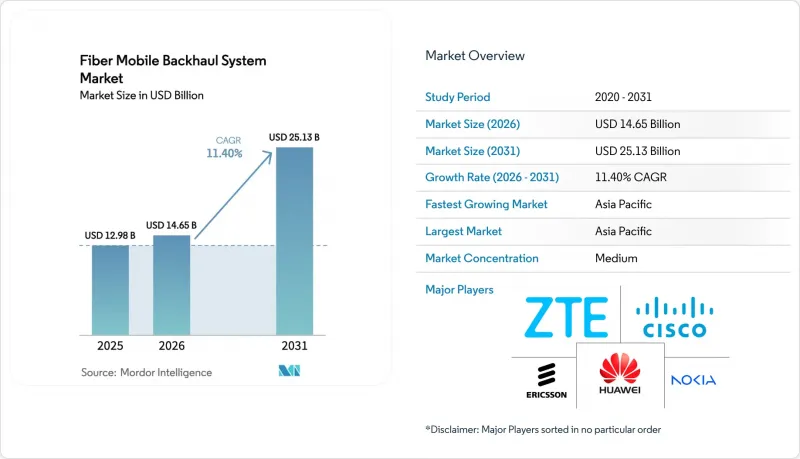
파이버 모바일 백홀 시스템 시장 규모는 2025년 129억 8,000만 달러로 평가되었습니다. 2026년 146억 5,000만 달러에서 2031년까지 251억 3,000만 달러로 확대되며 2026년부터 2031년까지 연평균 복합 성장률(CAGR)은 11.40%를 나타낼 전망입니다.
통신사업자들이 용량이 제한된 마이크로웨이브 링크를 고밀도 5G 클러스터에서 발생하는 멀티 테라비트급 트래픽을 집약할 수 있는 파이버 루트로 업그레이드하면서 시장 성장세가 가속화되고 있습니다. 아시아태평양의 통신사업자들은 현재 4G 시대와는 반대로 무선보다 전송에 더 많은 예산을 투자하고 있으며, 북미의 Tier 1 통신사업자들은 모든 신규 매크로 사이트에 100Gbps 파장을 표준화하고 있습니다. 또한, 파이버 모바일 백홀 시스템 시장은 단일 섀시 내에 IP 계층과 광 계층을 통합하는 코히런트 플러그형 광학에 의해 재편되고 있습니다. 이를 통해 전력 비용을 절반 이상 절감하고, 서비스 개통까지의 주기를 몇 분 단위로 단축하고 있습니다. 타워 회사 및 중립 호스트 제공업체가 다크 파이버를 직접 구매하면서 기존 벤더의 매니지드 서비스 수익률을 압박하고 있습니다. 또한, Telecom Infra Project가 발표한 개방형 전송 규격으로 인해 멀티 벤더 도입이 가속화되고 있습니다.
세계의 파이버 모바일 백홀 시스템 시장 동향 및 인사이트
5G의 밀도 향상과 데이터 트래픽의 급격한 증가
2025년 모바일 데이터 트래픽은 전년 대비 28% 증가했으며, 5G 가입자의월평균 데이터 소비량은 이미 42GB에 달하며 이는 4G 기준치의 3배에 해당합니다. 도시 지역 통신 사업자들은 한 구역당 8-12개의 스몰셀을 일상적으로 배치하고 있으며, 각 셀은 피크 시간대 처리량으로 10Gbps 이상의 처리량을 필요로 합니다. 이 부하는 총 용량이 25Gbps를 초과하면 마이크로웨이브에서는 대응할 수 없습니다. 버라이즌은 밀집된 도시 지역에서 혼잡한 마이크로웨이브 링크를 광섬유로 전환한 후 지연이 34% 감소하고 업링크 처리량이 19% 증가했다고 보고했습니다. 차이나모바일은 2025년 예산안에서 광섬유 전송에 82억 달러의 예산을 책정했는데, 이는 5G의 경제성에서 백홀이 전략적으로 최우선 순위임을 반영합니다. 통신사업자들은 현재 신규 매크로 사이트에서 100Gbps의 파장을 표준으로 채택하고 있으며, 2028년까지 사이트당 50Gbps를 초과할 계획입니다. 따라서 트래픽의 지속적인 증가는 모바일 백홀 시스템 시장에 대한 수년간 수요를 보장하고 있습니다.
코히런트 플러그형 광학(400G/800G ZR/ZR+) 채택
400G ZR 및 ZR+와 같은 코히런트 플러그형 트랜시버는 장거리 전송 비용과 설치 면적을 줄여줍니다. 시스코의 루티드 옵티컬 네트워킹 플랫폼은 개별 트랜스폰더에 비해 전송되는 테라비트당 전력 소비를 62% 절감했습니다. 이 광모듈은 증폭장치 없이 메트로 DWDM 링크를 120km 연장하고, 재생 사이트가 필요 없어 권리구획 비용을 약 30% 절감할 수 있습니다. 주니퍼에 따르면, 2026년 1분기 출하된 라우터의 18%가 이미 ZR+ 광모듈을 탑재하고 있으며, 이는 전년 동기 4%에서 증가한 수치입니다. 루멘텀은 2025년 4분기에 5만개 이상의 코히런트 모듈을 출하했으며, 2026년 하반기까지 수주 잔량을 보유하고 있습니다. 이러한 발전으로 통신 사업자는 IP 계층과 광 계층을 통합하고, 10분 이내에 파장 활성화를 자동화하고, 전체 선반을 교체하는 대신 광 모듈을 교체하여 용량을 확장할 수 있습니다. 이러한 패러다임의 변화가 파이버 모바일 백홀 시스템 시장의 두 자릿수 성장을 뒷받침하고 있습니다.
광섬유 구축에 있어 고가의 설비투자 및 부지 확보에 대한 장벽
도시 지역에서의 광케이블 구축은 1km당 8만-15만 달러의 비용이 소요되는 경우가 많으며, 인허가 비용이 총 비용의 최대 절반을 차지합니다. 미국의 많은 도시에서는 1피트당 2.50-6달러의 수수료를 부과하고, 굴착 공사 전에 50만 달러 이상의 이행 보증금을 요구하고 있으며, 이러한 부담으로 인해 중립 호스트의 건설이 지연되고 있습니다. AT&&T는 주요 주에서 타워 파이버 프로젝트 승인 주기가 평균 24개월에 달하며, 이로 인해 잠정적인 마이크로웨이브 링크에 의존할 수밖에 없다고 밝혔습니다. 연방법에 따른 환경 심사로 인해 일정이 3년을 초과하는 경우도 있고, 2025년 설치 인건비 18% 상승으로 인해 프로젝트 수익률이 압박을 받았습니다. 이러한 마찰은 원래는 견조한 성장이 예상되는 파이버 모바일 백홀 시스템 시장의 성장을 둔화시키고 있습니다.
부문 분석
DWDM은 수백 개의 셀 사이트 파장을 한 쌍으로 통합하여 2025년 모바일 백홀 광섬유 시장에서 43.78%의 점유율을 차지했습니다. 이 부문은 10×10Gbps 그리드에서 QSFP-DD 슬롯에 맞는 400Gbps ZR+ 플러그인 모듈로 전환하고 있으며, 기존 트랜스폰더 3랙 분량의 트랜스폰더를 단일 모듈로 통합하고 있습니다. Ciena의 WaveLogic 6 Extreme은 메트로 구간에서 파장당 1.6Tbps를 전송하며, 새로운 광섬유를 깔지 않고도 용량을 4배로 확장할 수 있습니다. 통신 사업자들은 몇년전에 획득한 다크 파이버 위에 새로운 DWDM 레이어를 오버레이하여 비용이 많이 드는 굴착 및 광섬유 인입을 미루고 코히런트 광 플랫폼용 모바일 백홀 시스템 시장 규모를 확대되고 있습니다.
XGS-PON과 NG-PON2가 주도하는 패시브 광 네트워크 솔루션은 지방 구축 시 최대 1 : 64의 분할 비율을 활용하여 유휴 설비 투자를 최소화함으로써 2031년까지 연평균 12.01%씩 성장하고 있습니다. 노키아의 Lightspan은 1억 2,000만 달러 규모의 계약에 따라 동남아시아의 8,000개 지역 타워에 25Gbps의 대칭형 PON을 제공했습니다. 기업용 프라이빗 5G에서는 스펙트럼 효율보다 결정론적 지연이 중요하기 때문에 파이버를 통한 이더넷이 여전히 주류를 이루고 있으며, 광케이블이 풍부한 교외 지역에서는 CWDM이 정착하고 있습니다. 주파수 대역이 면허를 필요로 하지 않아 규제 부담은 낮지만, 신규 노선 허가 취득은 여전히 지역별로 장벽으로 작용하고 있습니다. 코히런트 DWDM과 PON 간의 경쟁은 보다 광범위한 파이버 모바일 백홀 시스템 시장을 주도하는 양극화된 수요 추세를 여실히 보여주고 있습니다.
지역별 분석
아시아태평양은 2025년 세계 매출의 29.67%를 차지했으며 2031년까지 연평균 복합 성장률(CAGR) 13.32%를 기록해 어느 지역보다 빠른 성장률을 나타낼 것으로 예측됩니다. 차이나모바일은 2025년까지 교통 분야에 184억 달러를 투자하여 2, 3급 도시에 있는 58만 개의 기지국을 100Gbps 코히런트 백홀로 업그레이드할 계획입니다. Bharti Airtel은 BharatNet III에 따라 12만 개의 지방 타워를 광섬유화하는 데 21억 달러를 투자하고, 주 정부의 공동 출자를 활용하여 서비스 지역을 확장하고 있습니다. NTT도코모는 2025년 3월에 전국 100Gbps 구축을 완료하고, 2026년에는 지연에 민감한 XR 서비스를 지원하기 위해 800Gbps의 ZR+ 광통신 기술을 시험 운용하고 있습니다. 국내 통신사들은 사용자당 1Gbps가 필요한 홀로그램 통화를 시험하고 있으며, 이는 이 지역의 광 모바일 백홀 시장에 대한 장기적인 수요를 촉진하고 있습니다.
북미는 2025년 매출의 26%를 차지하며 10.8% 성장했습니다. Verizon과 AT&&T는 2025년까지 총 47억 달러를 광 백홀에 투자하고, 30Gbps 이상의 트래픽이 발생하는 C-band 사이트에 집중 투자하기로 했습니다. Rogers와 Telus는 온타리오와 브리티시컬럼비아 주 전역의 통신 타워를 광섬유로 전환하는 데 10억 캐나다 달러(7억 4,000만 달러) 이상을 투자했습니다. 통신 타워 전문 기업인 아메리칸 타워와 크라운 캐슬은 광섬유의 루트 마일 수를 두 배로 늘려 중소 통신사의 5G 고밀도화를 가속화하는 중립 호스트형 전송 서비스를 제공했습니다. 이러한 움직임은 미국과 캐나다의 광파이버 모바일 백홀 시스템 시장에서 상당한 점유율을 유지하고 있습니다.
유럽은 2025년 매출의 23%를 차지했으며, 지속가능성 의무화 및 개방형 운송을 배경으로 10.2%의 성장률로 확대되고 있습니다. Deutsche Telekom은 광 백홀이 마이크로웨이브 백홀에 비해 전송되는 테라비트 당 58% 적은 에너지를 소비하는 것을 확인했으며, 이는 회사의 순 제로 약속을 달성하는 데 기여하고 있습니다. 보더폰은 벤더 종속을 피하기 위해 Ciena와 ADVA의 디애그리게이티드 트랜스포트(Disaggregated Transport)를 채택하여 영국과 독일의 2,500개 지점에 Open RAN을 구축했습니다. 오렌지는 2025년까지 45,000개의 기지국을 100Gbps 코히런트 링크로 업그레이드하기 위해 12억 유로를 투자했습니다. STC를 비롯한 중동 통신사업자들은 리야드 및 제다의 스마트시티 회랑을 위해 미화 2억 8,000만 달러 상당의 DWDM 장비를 주문했습니다. 아프리카에서의 전개는 여전히 고르지 않습니다. 남아공과 나이지리아가 도시 중심부의 광섬유화를 주도하고 있는 반면, 다른 지역에서는 여전히 마이크로파가 주류를 이루고 있으며, 이 지역의 모바일 백홀용 광섬유 시스템 산업은 아직 성숙도가 낮은 단계에 머물러 있습니다.
기타 혜택 :
- 엑셀 형식 시장 예측(ME) 시트
- 3개월간 애널리스트 지원
자주 묻는 질문
목차
제1장 서론
제2장 조사 방법
제3장 주요 요약
제4장 시장 구도
제5장 시장 규모와 성장 예측
제6장 경쟁 구도
제7장 시장 기회와 향후 전망
KTH 26.05.29The Fiber Mobile Backhaul System Market size is projected to expand from USD 12.98 billion in 2025 and USD 14.65 billion in 2026 to USD 25.13 billion by 2031, registering a CAGR of 11.40% between 2026 to 2031.
Momentum is accelerating because operators are upgrading constrained microwave links to fiber routes that can aggregate multi-terabit traffic generated by dense 5G clusters. Asia-Pacific carriers now budget more for transport than for radio, a reversal of the 4G era, while North American tier-1s are standardizing 100 Gbps wavelengths for every new macro site. The fiber mobile backhaul system market is also being reshaped by coherent pluggable optics that merge IP and optical layers inside a single chassis, trimming power bills by more than half and shortening service-activation cycles to minutes. Tower companies and neutral-host providers are buying dark fiber directly, eroding incumbent vendors' managed-service margins, and open transport specifications published by the Telecom Infra Project are accelerating multi-vendor deployments.
Global Fiber Mobile Backhaul System Market Trends and Insights
5G Densification and Exponential Data Traffic Growth
Mobile data traffic jumped 28% year-on-year in 2025, and 5G subscribers are already consuming a median of 42 GB monthly, triple the 4G baseline. Urban operators routinely deploy 8-12 small cells per city block, each demanding peak-hour throughput above 10 Gbps, a load that microwave cannot support once aggregate capacity tops 25 Gbps. Verizon reported 34% lower latency and 19% higher uplink throughput after migrating congested microwave links to fiber in dense metros. China Mobile earmarked USD 8.2 billion for fiber transport in its 2025 budget, reflecting the strategic primacy of backhaul within 5G economics. Operators now default to 100 Gbps wavelengths for new macro sites and plan to exceed 50 Gbps per site by 2028. Continuous traffic growth, therefore, locks in multi-year demand for the fiber mobile backhaul system market.
Adoption of Coherent Pluggable Optics (400G/800G ZR/ZR+)
Coherent pluggable transceivers, such as 400 G ZR and ZR+, reduce the cost and footprint of long-haul transport. Cisco's Routed Optical Networking platforms recorded a 62% reduction in power consumption per transported terabit compared with separate transponders. The optics extend metro DWDM links by 120 km without amplification, eliminating regeneration sites and reducing right-of-way costs by roughly 30%. Juniper said 18% of its routers shipped in Q1 2026 already carry embedded ZR+ optics, up from 4% a year earlier. Lumentum shipped more than 50,000 coherent modules in Q4 2025 and faces a backlog into late 2026. These advances allow operators to converge IP and optical layers, automate wavelength activation in under 10 minutes, and scale capacity by swapping optics rather than overhauling shelves, a paradigm that sustains double-digit growth for the fiber mobile backhaul system market.
High CAPEX and Right-of-Way Hurdles for Fiber Deployment
Deploying urban fiber often costs USD 80,000-150,000 per route-kilometer, with permitting accounting for up to half of that total. Many U.S. cities levy linear-foot fees of USD 2.50-6.00 and require performance bonds of USD 500,000 or more before trenching, a burden that delays neutral-host builds. AT&T disclosed 24-month average approval cycles for tower-fiber projects in key states, forcing reliance on interim microwave links. Environmental reviews under national statutes can push timelines past 3 years, while an 18% rise in installation labor costs in 2025 squeezed project margins. Such frictions temper the otherwise robust expansion of the fiber mobile backhaul system market.
Other drivers and restraints analyzed in the detailed report include:
- Proliferation of Small-Cell and C-RAN Architectures
- Government-Funded Rural Fiber Initiatives
- Supply-Chain Volatility for Specialty Fiber and Coherent DSPs
For complete list of drivers and restraints, kindly check the Table Of Contents.
Segment Analysis
DWDM secured 43.78% of the fiber mobile backhaul market share in 2025 by aggregating hundreds of cell-site wavelengths on a single pair. The segment is migrating from 10X10 Gbps grids to 400 Gbps ZR+ pluggables that fit into QSFP-DD slots, collapsing three rack units of legacy transponders into a single module. Ciena's WaveLogic 6 Extreme pushes 1.6 Tbps per wavelength over metro spans, quadrupling capacity without laying new fiber. Operators overlay fresh DWDM layers on dark fiber acquired years earlier, deferring costly trenching and lifting the fiber, and boosting the mobile backhaul system market size for coherent optics platforms.
Passive optical network solutions, led by XGS-PON and NG-PON2, are growing at 12.01% through 2031 as rural builds exploit split ratios of up to 1:64 to minimize stranded capex. Nokia's Lightspan delivered 25 Gbps symmetrical PON to 8,000 rural towers in Southeast Asia under a USD 120 million deal. Ethernet over fiber stays dominant in enterprise private 5G because deterministic latency matters more than spectral efficiency, and CWDM persists in fiber-abundant suburbs. Regulatory overhead is low because the spectrum is unlicensed, but obtaining permits for new routes remains a local hurdle. The competition between coherent DWDM and PON illustrates the bifurcated demand profile that propels the broader fiber mobile backhaul system market.
The Fiber Mobile Backhaul System Market Report is Segmented by Fiber Technology (DWDM, CWDM, Ethernet Over Fiber, and More), Bandwidth Capacity Tier (<=10 Gbps, 10-25 Gbps, 25-100 Gbps, >100 Gbps), End-User Industries (Mobile Network Operators, Neutral Host and TowerCos, Enterprises and Private 5G Networks, and More), and Geography. The Market Forecasts are Provided in Terms of Value (USD).
Geography Analysis
Asia-Pacific generated 29.67% of 2025 global revenue and will post a 13.32% CAGR to 2031, the fastest of any region. China Mobile spent USD 18.4 billion on transport in 2025, upgrading 580,000 base stations in tier-2 and tier-3 cities with 100 Gbps coherent backhaul. Bharti Airtel committed USD 2.1 billion to fiberize 120,000 rural towers under BharatNet III, leveraging state co-funding to extend reach. NTT Docomo finished a nationwide 100 Gbps rollout in March 2025 and is trialing 800 Gbps ZR+ optics to support latency-sensitive XR services in 2026. South Korean carriers are testing holographic calling that requires 1 Gbps per user, reinforcing the long-term pull on the fiber mobile backhaul market in the region.
North America captured 26% of 2025 revenue and is forecast to expand at 10.8%. Verizon and AT&T invested USD 4.7 billion combined in fiber backhaul during 2025, focusing on C-band sites that exceed 30 Gbps peak traffic. Rogers and Telus earmarked more than CAD 1 billion (USD 740 million) to fiberize towers across Ontario and British Columbia. Tower specialists American Tower and Crown Castle boosted fiber route-miles by double digits, offering neutral-host transport that accelerates 5G densification for smaller carriers. These moves sustain a sizable share of the fiber mobile backhaul system market in the United States and Canada.
Europe represented 23% of 2025 revenue and is expanding at 10.2% on the back of sustainability mandates and open transport. Deutsche Telekom found that fiber backhaul consumes 58% less energy per transported terabit than microwave backhaul, helping it meet its net-zero pledge. Vodafone is rolling out Open RAN across 2,500 sites in the UK and Germany with disaggregated Ciena and ADVA transport to curb vendor lock-in. Orange devoted EUR 1.2 billion in 2025 to upgrade 45,000 cell sites with 100 Gbps coherent links. Middle Eastern carriers such as STC ordered USD 280 million in DWDM gear for Riyadh and Jeddah smart-city corridors. African rollouts remain uneven; South Africa and Nigeria lead with fiberized urban cores, while microwave endures elsewhere, keeping the regional fiber mobile backhaul system industry at an earlier stage of maturity.
- Huawei Technologies Co., Ltd.
- Telefonaktiebolaget LM Ericsson (Ericsson)
- Nokia Corporation
- Cisco Systems, Inc.
- ZTE Corporation
- Ciena Corporation
- Infinera Corporation
- ADTRAN Holdings, Inc.
- Fujitsu Limited
- NEC Corporation
- Ribbon Communications Inc.
- Corning Incorporated
- Prysmian S.p.A.
- Sterlite Technologies Limited
- CommScope Holding Company, Inc. (Amphenol Corporation)
- Juniper Networks, Inc.
- Tejas Networks Limited
- FiberHome Telecommunication Technologies Co., Ltd.
- VIAVI Solutions Inc.
- Coherent Corp.
- Lumentum Holdings Inc.
- Broadcom Inc.
- Accelink Technologies Co., Ltd.
- AFL Telecommunications LLC
- Calix, Inc.
Additional Benefits:
- The market estimate (ME) sheet in Excel format
- 3 months of analyst support
TABLE OF CONTENTS
1 INTRODUCTION
- 1.1 Study Assumptions and Market Definition
- 1.2 Scope of the Study
2 RESEARCH METHODOLOGY
3 EXECUTIVE SUMMARY
4 MARKET LANDSCAPE
- 4.1 Market Overview
- 4.2 Market Drivers
- 4.2.1 5G Densification and Exponential Data Traffic Growth
- 4.2.2 Proliferation of Small-Cell and C-RAN Architectures
- 4.2.3 Government-Funded Rural Fiber Initiatives
- 4.2.4 Adoption of Coherent Pluggable Optics (400 G/800 G ZR/ZR+)
- 4.2.5 Open and Disaggregated Transport Ecosystems (TIP OOPT, OpenZR+)
- 4.2.6 Sustainability-Linked Financing Replacing Microwave with Energy-Efficient Fiber
- 4.3 Market Restraints
- 4.3.1 High CAPEX and Right-of-Way Hurdles for Fiber Deployment
- 4.3.2 Terrain Constraints Favoring Wireless Alternatives in Remote Areas
- 4.3.3 Supply-Chain Volatility for Specialty Fiber and Coherent DSPs
- 4.3.4 Escalating Cyber-Physical Threats to Critical Fiber Routes
- 4.4 Industry Value Chain Analysis
- 4.5 Regulatory Landscape
- 4.6 Technological Outlook
- 4.7 Porter's Five Forces Analysis
- 4.7.1 Competitive Rivalry
- 4.7.2 Threat of New Entrants
- 4.7.3 Threat of Substitutes
- 4.7.4 Bargaining Power of Suppliers
- 4.7.5 Bargaining Power of Buyers
- 4.8 Backhaul Architecture Analysis
- 4.8.1 Point-to-Point (P2P)
- 4.8.2 Ring
- 4.8.3 Daisy Chain
- 4.8.4 Others
5 MARKET SIZE AND GROWTH FORECASTS (VALUE)
- 5.1 By Fiber Technology
- 5.1.1 DWDM
- 5.1.2 CWDM
- 5.1.3 Ethernet over Fiber
- 5.1.4 Passive Optical Network (XGS-PON, NG-PON 2)
- 5.1.5 Other Fiber Technologies
- 5.2 By Bandwidth Capacity Tier
- 5.2.1 <=10 Gbps
- 5.2.2 10-25 Gbps
- 5.2.3 25-100 Gbps
- 5.2.4 >100 Gbps
- 5.3 By End-user Industry
- 5.3.1 Mobile Network Operators
- 5.3.2 Neutral Host and TowerCos
- 5.3.3 Enterprises and Private 5G Networks
- 5.3.4 Government and Public Safety
- 5.3.5 Cloud and OTT Providers
- 5.3.6 Other End-user Industries
- 5.4 By Geography
- 5.4.1 North America
- 5.4.1.1 United States
- 5.4.1.2 Canada
- 5.4.1.3 Mexico
- 5.4.2 South America
- 5.4.2.1 Brazil
- 5.4.2.2 Argentina
- 5.4.2.3 Rest of South America
- 5.4.3 Europe
- 5.4.3.1 Germany
- 5.4.3.2 United Kingdom
- 5.4.3.3 France
- 5.4.3.4 Russia
- 5.4.3.5 Rest of Europe
- 5.4.4 Asia-Pacific
- 5.4.4.1 China
- 5.4.4.2 Japan
- 5.4.4.3 India
- 5.4.4.4 South Korea
- 5.4.4.5 Rest of Asia-Pacific
- 5.4.5 Middle East and Africa
- 5.4.5.1 Middle East
- 5.4.5.1.1 Saudi Arabia
- 5.4.5.1.2 United Arab Emirates
- 5.4.5.1.3 Rest of the Middle East
- 5.4.5.2 Africa
- 5.4.5.2.1 South Africa
- 5.4.5.2.2 Nigeria
- 5.4.5.2.3 Rest of Africa
- 5.4.5.1 Middle East
- 5.4.1 North America
6 COMPETITIVE LANDSCAPE
- 6.1 Market Concentration
- 6.2 Strategic Moves
- 6.3 Market Share Analysis
- 6.4 Company Profiles (includes Global level Overview, Market level overview, Core Segments, Financials, Strategic Information, Market Rank/Share, Products and Services, Recent Developments)
- 6.4.1 Huawei Technologies Co., Ltd.
- 6.4.2 Telefonaktiebolaget LM Ericsson (Ericsson)
- 6.4.3 Nokia Corporation
- 6.4.4 Cisco Systems, Inc.
- 6.4.5 ZTE Corporation
- 6.4.6 Ciena Corporation
- 6.4.7 Infinera Corporation
- 6.4.8 ADTRAN Holdings, Inc.
- 6.4.9 Fujitsu Limited
- 6.4.10 NEC Corporation
- 6.4.11 Ribbon Communications Inc.
- 6.4.12 Corning Incorporated
- 6.4.13 Prysmian S.p.A.
- 6.4.14 Sterlite Technologies Limited
- 6.4.15 CommScope Holding Company, Inc. (Amphenol Corporation)
- 6.4.16 Juniper Networks, Inc.
- 6.4.17 Tejas Networks Limited
- 6.4.18 FiberHome Telecommunication Technologies Co., Ltd.
- 6.4.19 VIAVI Solutions Inc.
- 6.4.20 Coherent Corp.
- 6.4.21 Lumentum Holdings Inc.
- 6.4.22 Broadcom Inc.
- 6.4.23 Accelink Technologies Co., Ltd.
- 6.4.24 AFL Telecommunications LLC
- 6.4.25 Calix, Inc.
7 MARKET OPPORTUNITIES AND FUTURE OUTLOOK
- 7.1 White-Space and Unmet-Need Assessment
- 7.2 Analyst Recommendations and Suggestions


