

|
시장보고서
상품코드
2044154
나노셀룰로오스 시장 : 점유율 분석, 산업 동향 및 통계, 성장 예측(2026-2031년)Nanocellulose - Market Share Analysis, Industry Trends & Statistics, Growth Forecasts (2026 - 2031) |
||||||
 Mordor Intelligence
2026년 나노셀룰로오스 시장 규모는 13억 6,000만 달러로 추정되고 있으며 2025년 11억 2,000만 달러에서 성장하여 2031년에는 35억 3,000만 달러에 이를 것으로 예측됩니다.
2026-2031년에는 CAGR 21.1%를 나타낼 것으로 예측됩니다.
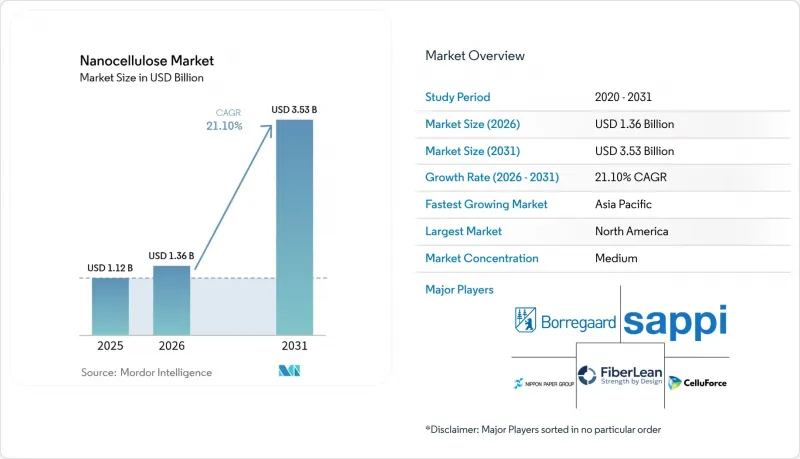
지속가능성에 대한 요구 증가, 석유화학제품의 가격 변동, 재료 과학의 급속한 발전과 함께 두 자릿수 성장에 대한 명확한 경로가 형성되고 있습니다. 자동차 경량화, 재활용 가능한 배리어 필름, 바이오 의료용 스캐폴드가 단기적인 수요의 주축이 될 것이며, 효소를 이용한 저에너지 공정이 미래의 비용경쟁을 이끌어 낼 것입니다. 북미의 기존 기업들은 성숙한 파일럿 라인과 OEM(Original Equipment Manufacturer)과의 견고한 관계를 활용하고 있지만, 아시아 생산자들은 낮은 전환 비용과 전자제품 포장 산업 클러스터와의 근접성을 무기로 그 격차를 좁혀가고 있습니다. 원료의 유연성이 목재 펄프에서 농업 잔재물로 전환되면서 공급망 리스크가 더욱 감소하고, 순환 경제 비즈니스 모델이 정착될 수 있습니다. 기존 펄프 대기업들은 경쟁의 최전선에서 생산량을 늘리는 반면, 바이오테크 스타트업들은 고부가가치 치료 부문의 틈새 시장을 추구하고 있으며, 그 결과 애플리케이션 개발을 가속화하는 활발한 파트너십과 라이선싱이 활발하게 이루어지고 있습니다.
세계 나노셀룰로오스 시장 동향 및 인사이트
우수한 기계적 특성 및 배리어 특성
나노셀룰로오스의 인장강도는 4.9-7.5GPa(기가파스칼), 탄성률은 100-200 GPa로 무게가 중요한 부품에서 탄소섬유에 가까운 성능을 발휘합니다. 따라서 나노셀룰로오스 시장에서 자동차 차체 패널이나 항공기 내장재로 주목받고 있습니다. 오크리지 국립연구소는 2025년 탄소나노섬유로 강화된 나노셀룰로오스 복합재료가 기존 유리섬유 대체품에 비해 인장강도가 50% 더 높고 인성이 거의 2배 더 높다는 것을 입증하여 그 가능성을 입증했습니다. 높은 종횡비와 표면적은 폴리머 매트릭스와의 견고한 결합을 촉진하여 박리 위험을 최소화하고 피로 수명을 향상시킵니다. 일본 자동차 제조업체들은 나노셀룰로오스가 특정 금속 및 플라스틱 부품을 대체할 경우, 차량 1대당 20kg의 경량화를 기대할 수 있으며, 이는 상당한 연료 절감과 수명주기 배출량 감소로 이어질 것으로 예상하고 있습니다. 초박형 나노셀룰로오스 필름은 하중을 지지하는 부품 외에도 에틸렌-비닐 알코올(EVOH)이나 폴리염화비닐리덴(PVDC)보다 우수한 산소 및 수증기 차단성을 발휘하며, 재활용 및 퇴비화가 가능합니다. 이러한 기계적 특성과 배리어 특성으로 인해 가전제품 케이스부터 의약품 블리스터 팩에 이르기까지 이 소재는 다양한 시장으로 확대되고 있습니다.
지속 가능한 포장에 대한 수요 급증
소매, 전자상거래, 식품 브랜드들은 석유 유래 필름을 대체하기 위해 서두르고 있으며, 바이오 배리어 소재에 대한 수요가 급증하고 있습니다. 벨기에, 프랑스, 룩셈부르크의 유럽 체인점은 2024년 R3PACK 검사에서 시범적으로 플라스틱 트레이를 셀룰로오스 포장으로 대체하여 수천 톤의 일회용 플라스틱을 줄였습니다. 유럽연합(EU)의 지침은 2030년까지 모든 포장재를 재사용 또는 재활용이 가능하도록 의무화하고 있으며, 이에 따라 가공업체들은 일반 판지를 개선하는 나노셀룰로오스 코팅에 대한 인증을 추진하고 있습니다. 박테리아 셀룰로오스 필름은 우수한 자외선(UV) 차단성과 인장 강도를 나타내며, 빛에 민감한 식품의 열화를 방지하고 콜드체인 물류 흐름에서도 그 성능을 유지합니다. 스웨덴의 스타트업 기업은 건조 에너지와 롤투롤 코팅 속도를 최적화하여 LDPE(LDPE) 랩과의 비용 패리티를 달성하여 마지막 경제적 장벽을 제거했습니다. 미국 식품의약국(FDA)이 식품 접촉 용도의 피브릴화 셀룰로오스에 대해 '일반적으로 인정된 안전성(GRAS)'을 승인함에 따라 북미 공급업체들의 도입 리스크가 더욱 낮아졌습니다. 브랜드 소유주들이 다년간공급 계약을 체결함에 따라 나노셀룰로오스 시장은 생산 능력 확장에 사용되는 예측 가능한 수익 기반을 확보하고 있습니다.
높은 생산 비용과 스케일업 리스크
가수분해 공정의 최적화가 진행되어도 산성법은 건조톤당 1,31달러, 현재 효소법 수율로 건조톤당 6만 5,740달러의 최저 판매가격이 유지되고 있어 범용 폴리머의 기준가격을 크게 상회하고 있습니다. 연속 제지 파일럿 공정에서는 생산 Kg당 설비투자(Capex)를 절반으로 줄일 수 있지만, 유지율이 73%가 한계이기 때문에 지속적인 품질관리는 여전히 어려운 상황입니다. 설비투자가 많아 대규모 플랜트 건설은 펄프 대기업과 국영기업에 국한되어 있고, 장기적인 자금조달 능력이 부족한 신흥 시장 혁신기업은 진입할 수 있는 여지가 좁아졌습니다. 수명주기 평가에 따르면, 플랜트의 연간 생산량이 2 만 톤을 초과하면 환경적 이점이 6.5 배 증가하지만, 이러한 규모의 설비에 대한 자금 조달을 위해서는 현재 다운 스트림 사용자가 보장 할 수있는 사람이 거의없는 확실한 인수 계약이 필요합니다. 이러한 '닭이 먼저냐 달걀이 먼저냐'와 같은 상황은 본래 강한 수요의 조짐을 둔화시키고, 그린필드에 거대한 제지공장 건설이 아닌 단계적인 병목현상 해소를 촉구하고 있습니다.
부문 분석
나노섬유화 셀룰로오스(NFC)는 2025년 나노셀룰로오스 시장에서 41.35%의 시장 점유율을 차지해, 이는 이미 구축된 생산 인프라와 제지 가공 및 복합재료 응용 분야에서 폭넓은 적용 가능성을 반영합니다. 그러나 2031년까지 35.40%의 연평균 복합 성장률(CAGR)로 가장 높은 성장세를 보일 것으로 예상되는 박테리아 셀룰로오스는 초순도 특성과 제약 및 바이오메디컬 분야에서의 프리미엄 포지셔닝이 성장을 주도할 것으로 보입니다. 이러한 생산 형태의 양극화는 NFC가 기계적 가공의 확장성을 활용하는 반면, 박테리아 셀룰로오스는 고부가가치 응용 분야를 대상으로 발효 비용을 정당화하는 전략적 포지셔닝을 강조하고 있습니다.
나노 결정질 셀룰로오스(NCC)는 강화 응용 분야에서 결정 구조의 장점, 특히 치수 안정성과 내열성이 매우 중요한 부문에서 꾸준한 성장을 유지하고 있습니다. 미세섬유화 셀룰로오스(MFC)는 종이 및 포장용도에서 기존 첨가제와 비용 경쟁력을 유지하면서 기존 셀룰로오스보다 우수한 특성을 제공하는 교량적 기술입니다.
목재 펄프는 수십년동안 펄프 및 제지 산업이 발전하면서 구축된 공급망과 가공 인프라를 활용하여 2025년 57.80%의 시장 점유율을 유지하며 지배적인 지위를 유지합니다. 그러나 원료로서의 농업잔재물은 CAGR 22.95%의 가장 강력한 성장 궤적을 보이고 있으며, 비용 우위와 순환 경제에 대한 적합성을 통해 목재 펄프의 장기적 우위에 근본적인 문제에 직면하고 있습니다. 농업잔재물로의 전환은 미활용 자원의 소비보다 폐기물의 효율적 활용을 우선시하는 경제적 최적화와 지속가능성에 대한 요구를 반영하고 있습니다.
미세조류, 해조류, 박테리아 숙주는 절대적인 순도가 비용보다 우선시되는 화장품용 세럼 및 안과용 용액용 특수용도 원료를 공급하고 있습니다. 이러한 바이오 원료는 폐쇄순환형 재배를 가능하게 하고, 농약 잔류량을 최소화하며, 유전자변형생물체(GMO) 프리 인증 획득을 용이하게 합니다. 유럽 컨소시엄은 펄프재 부족을 보완하기 위해 지역 섬유 작물을 활용하고, 대마의 하르드나 아마의 시브를 원료로 연구하고 있습니다. 그러나 잔류물 물류는 여전히 복잡합니다. 계절별 공급 상황에 대응하기 위해서는 습식 저장 사일로와 고밀도 펠릿이 필요하며, 숨겨진 설비투자(CAPEX)가 발생합니다. 이에 대해 목재펄프 제조업체는 생산이력인증(Chain of Custody)과 연중 안정적인 공급을 무기로 대량생산용 포장용도에 대한 신뢰성을 주장하고 있습니다. 이러한 경쟁은 지속적인 혁신을 촉진하고, 나노셀룰로오스 시장을 다원화 미래로 이끌고 있습니다.
지역별 분석
북미는 미국 농무부(USDA)와 에너지부(DOE)의 초기 보조금 지원과 자동차 및 항공우주 부문의 OEM(Original Equipment Manufacturer)의 강력한 수요에 힘입어 2025년 43.25%의 매출 점유율로 나노셀룰로오스 시장을 선도하고 있습니다. 이 지역은 펄프 및 제지 산업의 물류망이 깊게 통합되어 있어 제지 공장은 신규 설비투자(CAPEX) 없이도 소화조를 셀룰로오스 나노섬유 생산으로 빠르게 전환할 수 있습니다. Tier 1 공급업체는 주립대학과 협력하여 미국 도로안전보험협회(IIHS)의 충돌 안전 기준을 충족하는 자동차 시트 성형 컴파운드를 최적화하기 위해 노력하고 있습니다. 지속가능 포장에 대한 규제 프레임워크는 유럽연합(EU)만큼 엄격하지는 않지만, 대형 유통업체들의 브랜드 의약품속으로 안정적인 물량을 확보할 수 있었습니다. 그 결과, 북미의 전체 나노셀룰로오스 시장 규모는 전 세계 생산자들이 가격을 책정하는 기준의 기축으로 계속 작용하고 있습니다.
아시아태평양은 2031년까지 연평균 복합 성장률(CAGR) 23.70%를 기록하며 북미의 주도권을 위협할 것으로 예측됩니다. 일본 기업은 감가상각이 끝난 제지 기계를 전용하여 경쟁사보다 몇년앞서 셀룰로오스 나노섬유 상용화에 성공했습니다. 한편, 중국 스타트업 기업들은 수입 관세를 피하기 위해 국내에서 제조된 저가의 고압 균질화기를 도입하고 있습니다. 심천의 전자제품 조립업체들은 OLED(유기발광다이오드) 모듈을 산소의 침입으로부터 보호하기 위해 나노셀룰로오스 배리어 필름을 지정하고 있으며, 이는 독점적인 수요를 창출하고 공급업체의 인증 주기를 단축시키고 있습니다. 인도와 태국의 풍부한 농업 잔류물은 원료 비용을 40% 절감하고, 효소 라이선싱 계약은 도입에 박차를 가하고 있습니다. 그 결과, 나노셀룰로오스 시장은 수출 물류가 집중되는 아세안 항만 주변에서 잇따른 공장 건설 발표가 이어지고 있습니다.
유럽에서는 세계에서 가장 엄격한 일회용 플라스틱 금지 조치를 배경으로 15%대 중반의 성장이 예상됩니다. 벨기에 및 북유럽 컨버터 업체들은 종이 재활용률 95% 기준을 충족하기 위해 나노셀룰로오스 코팅의 인증을 추진하고 있습니다. 에너지 가격의 급등으로 수익률을 압박하는 반면, EU의 혁신 보조금은 순환형 바이오 경제의 리더십을 보여주는 시범 투자에 대한 리스크를 줄여주고 있습니다. 남미는 사탕수수 바가스 공급에 힘입어 CelOCE의 효소 플랜트가 상용화되면 저비용 수출 거점으로 부상할 것으로 보입니다. 중동 및 아프리카는 아직 소규모로 시작했지만, 사막지대 건설로 인한 분진을 억제하기 위해 나노셀룰로오스를 강화한 시멘트 복합재료에 주목하고 있으며, 다국적 시멘트 대기업이 걸프 지역 메가 프로젝트 인근에서 시험 타설에 자금을 지원하고 있습니다. 지역별로 다양한 상황은 정책, 자원, 산업 구조의 차이를 반영하고 있으며, 이는 나노셀룰로오스 시장의 균형 잡힌 세계 성장상을 뒷받침하고 있습니다.
기타 혜택
- 엑셀 형태 시장 예측(ME) 시트
- 3개월간 애널리스트 지원
자주 묻는 질문
목차
제1장 서론
제2장 조사 방법
제3장 주요 요약
제4장 시장 구도
제5장 시장 규모와 성장 예측
제6장 경쟁 구도
제7장 시장 기회와 향후 전망
JHS 26.06.02Nanocellulose market size in 2026 is estimated at USD 1.36 billion, growing from 2025 value of USD 1.12 billion with 2031 projections showing USD 3.53 billion, growing at 21.1% CAGR over 2026-2031.
Escalating sustainability mandates, volatile petrochemical prices, and rapid material science breakthroughs converge to create a clear runway for double-digit expansion. Automotive lightweighting, recyclable barrier films, and biomedical scaffolds headline near-term demand, while enzymatic low-energy processes unlock future cost competitiveness. North American incumbents leverage mature pilot lines and close original equipment manufacturer (OEM) ties, yet Asian producers narrow the gap through lower conversion costs and proximity to electronics and packaging clusters. Raw-material flexibility shifting from wood pulp to agricultural residues further de-risks supply chains and anchors circular-economy business models. Established pulp majors expand tonnage on the competitive front, whereas biotech start-ups chase premium therapeutic niches, resulting in an active partnership and licensing landscape that accelerates application rollout.
Global Nanocellulose Market Trends and Insights
Superior Mechanical and Barrier Properties
Nanocellulose's tensile strength of 4.9-7.5 GPa (Gigapascals) and elastic modulus of 100-200 GPa position it close to carbon fiber in weight-sensitive components, making it attractive for automotive body panels and aircraft interiors within the nanocellulose market. Oak Ridge National Laboratory validated this potential in 2025 by showing 50% higher tensile strength and nearly double toughness in carbon-nanofiber-enhanced nanocellulose composites versus conventional glass-fiber alternatives. The high aspect ratio and surface area foster tight bonding with polymer matrices, minimizing delamination risk and boosting fatigue life. Japanese automakers project a 20 kg per-vehicle weight cut when nanocellulose substitutes selected metal and plastic parts, translating into meaningful fuel savings and lower lifecycle emissions. Beyond load-bearing parts, ultrathin nanocellulose films block oxygen and water vapor better than Ethylene Vinyl Alcohol (EVOH) or Polyvinylidene Chloride (PVDC), yet remain recyclable and compostable. These dual mechanical and barrier advantages underpin the material's broad addressable market, from consumer electronics casings to pharmaceutical blister packs.
Sustainable Packaging Demand Surge
Retail, e-commerce, and food brands rush to replace petroleum films, driving a steep demand curve for bio-based barriers. European chains in Belgium, France, and Luxembourg replaced pilot-scale plastic trays with cellulose packs in the 2024 R3PACK trial, eliminating thousands of tonnes of single-use plastics. European Union (EU) directives mandate that all packaging be reusable or recyclable by 2030, prompting converters to qualify nanocellulose coatings that upgrade ordinary paperboard. Bacterial cellulose films show superior ultraviolet (UV) shielding and tensile strength, reducing spoilage in light-sensitive foods while holding up under cold-chain logistics. Swedish start-up lines achieved cost parity with Low Density Polyethylene (LDPE) wrap by optimizing drying energy and roll-to-roll coating speeds, removing the final economic roadblock. Food and Drug Administration (FDA)'s Generally Recognized As Safe (GRAS) nod for fibrillated cellulose in food contact further derisks adoption for North American suppliers . As brand owners lock in multi-year supply contracts, the nanocellulose market secures a predictable revenue base for capacity expansions.
High Production Cost and Scale-up Risk
Even with hydrolysis optimization, minimum selling prices hover at USD 10,031 per dry tonne for acid routes, and USD 65,740 per dry tonne for current enzymatic yields, dwarfing commodity polymer benchmarks. Continuous papermaking pilots halve capex per output kilogram, yet sustained quality control remains elusive as retention tops out at 73%. Capex intensity restricts large-scale units to pulp majors and state-backed entities, marginalizing innovators in emerging markets that lack patient capital. Life-cycle assessments show a 6.5-fold environmental win once plants exceed 20,000 tpa, but financing such nameplates requires off-take certainty that few downstream users can underwrite today. This chicken-and-egg dynamic tempers otherwise strong demand signals and prompts phased debottlenecking rather than greenfield mega-mills.
Other drivers and restraints analyzed in the detailed report include:
- Regulatory Push to Replace Single-use Plastics
- Rising R&D Pilot Facilities and Funding
- Competition From Other Bio-nanomaterials
For complete list of drivers and restraints, kindly check the Table Of Contents.
Segment Analysis
Nanofibrillated Cellulose (NFC) commands 41.35% market share in 2025 within the nanocellulose market, reflecting its established production infrastructure and broad applicability across paper processing and composites applications. However, Bacterial Cellulose is the fastest-growing segment with 35.40% CAGR through 2031, driven by its ultra-pure properties and premium positioning in pharmaceuticals and biomedical applications. The production dichotomy reveals strategic positioning where NFC leverages mechanical processing scalability, while bacterial cellulose targets high-value applications, justifying fermentation costs.
Nanocrystalline Cellulose (NCC) maintains steady growth through its crystalline structure advantages in reinforcement applications, particularly where dimensional stability and thermal resistance prove critical. Microfibrillated Cellulose (MFC) is a bridge technology, offering enhanced properties over conventional cellulose while remaining cost-competitive with traditional additives in paper and packaging applications.
Wood Pulp maintains its dominant position with 57.80% market share in 2025, leveraging established supply chains and processing infrastructure developed over decades of pulp and paper industry evolution. Yet, Agricultural Residues as a source demonstrate the strongest growth trajectory at 22.95% CAGR, fundamentally challenging wood pulp's long-term dominance through cost advantages and circular economy alignment. The shift toward agricultural residues reflects economic optimization and sustainability mandates favoring waste valorization over virgin resource consumption.
Micro-algae, seaweed, and bacterial hosts supply specialty volumes for cosmetic serums and ophthalmic solutions where absolute purity trumps cost. These bio-sources allow closed-loop cultivation, minimizing pesticide carry-over and easing Genetically Modified Organism (GMO)-free certification. European consortiums study hemp hurd and flax shive feedstocks, leveraging regional fiber crops to offset pulpwood shortages. However, residue logistics remain complex: seasonal availability demands wet-storage silos or densification pellets, adding hidden capex. Wood pulp producers counter with chain-of-custody certification and guaranteed year-round supply, arguing reliability for mass-market packaging volumes. The competitive dance ensures continuous innovation and locks the nanocellulose market into a multi-feedstock future.
The Nanocellulose Market Report is Segmented by Product Type (Nanofibrillated Cellulose, Bacterial Cellulose, and More), Source (Wood Pulp, Agricultural Residues, and More), Form (Dry, Gel, and Suspension), End-Use Industry (Paper Processing, Oil and Gas, Composites, and More), and Geography (Asia-Pacific, North America, Europe, South America, and Middle East and Africa). The Market Forecasts are Provided in Terms of Value (USD)
Geography Analysis
North America leads the Nanocellulose market with a 43.25% revenue share in 2025, backed by early USDA and DOE grants that underwrote pilot lines and strong pull from automotive and aerospace original equipment manufacturers (OEMs). The region enjoys deeply integrated pulp-and-paper logistics, letting mills quickly pivot digesters toward cellulose nanofibrils without greenfield capital expenditure (CAPEX). Tier-1 suppliers collaborate with state universities to optimize automotive sheet-molding compounds that meet Insurance Institute for Highway Safety (IIHS) crash standards. Regulatory frameworks on sustainable packaging are less stringent than in the European Union (EU), yet brand commitments by big box retailers ensure stable offtake. As a result, the nanocellulose market size across North America remains the anchor against which global producers benchmark pricing.
Asia-Pacific records a 23.70% CAGR that challenges North America's leadership by 2031. Japanese corporations commercialized cellulose nanofiber years ahead of rivals by repurposing depreciated paper machines, while Chinese start-ups deploy low-cost, high-pressure homogenizers built domestically to evade import duties. Electronics assemblers in Shenzhen specify nanocellulose barrier films to protect Organic Light Emitting Diode (OLED) modules from oxygen ingress, creating captive demand and shortening supplier qualification cycles. Agricultural residue abundance in India and Thailand cuts feedstock bills by 40%, and enzyme licensing deals accelerate adoption. Consequently, the Nanocellulose market attracts continuous plant announcements around ASEAN ports where export logistics converge.
Europe secures mid-teen growth on the back of the world's strictest single-use-plastic bans. Converters in Belgium and the Nordics qualify Nanocellulose coatings to meet 95% paper recyclability thresholds. While higher energy prices squeeze margins, EU innovation grants de-risk pilot investments that showcase circular-bioeconomy leadership. South America, buoyed by sugarcane bagasse supplies, emerges as a low-cost export hub once CelOCE enzyme plants go commercial. Middle East and Africa start from a small base yet eye nanocellulose enhanced cement composites to curb desert construction dust, with multinational cement majors funding test pours near Gulf megaprojects. This geographic mosaic mirrors differing policy, resource, and industrial profiles, underpinning a balanced global growth picture for the nanocellulose market.
- Axcelon Biopolymers Corporation
- Borregaard AS
- CelluComp
- CelluForce
- Chuetsu Pulp & Paper Co., Ltd.
- Daicel Corporation
- FiberLean
- GranBio Technologies
- Melodea
- NIPPON PAPER INDUSTRIES CO., LTD.
- Norske Skog ASA
- Oji Holdings Corporation
- Sappi Ltd
- Stora Enso
- UPM
Additional Benefits:
- The market estimate (ME) sheet in Excel format
- 3 months of analyst support
TABLE OF CONTENTS
1 Introduction
- 1.1 Study Assumptions & Market Definition
- 1.2 Scope of the Study
2 Research Methodology
3 Executive Summary
4 Market Landscape
- 4.1 Market Overview
- 4.2 Market Drivers
- 4.2.1 Superior Mechanical and Barrier Properties
- 4.2.2 Sustainable Packaging Demand Surge
- 4.2.3 Regulatory Push to Replace Single-use Plastics
- 4.2.4 Rising R&D Pilot Facilities and Funding
- 4.2.5 Enzymatic Low-energy Production Breakthroughs
- 4.3 Market Restraints
- 4.3.1 High Production Cost and Scale-up Risk
- 4.3.2 Competition From Other Bio-nanomaterials
- 4.3.3 Food-contact Safety and Inhalation Concerns
- 4.4 Value Chain Analysis
- 4.5 Porter's Five Forces
- 4.5.1 Bargaining Power of Suppliers
- 4.5.2 Bargaining Power of Buyers
- 4.5.3 Threat of New Entrants
- 4.5.4 Threat of Substitutes
- 4.5.5 Degree of Competition
5 Market Size & Growth Forecasts (Value)
- 5.1 By Product Type
- 5.1.1 Nanofibrillated Cellulose (NFC)
- 5.1.2 Nanocrystalline Cellulose (NCC)
- 5.1.3 Bacterial Cellulose
- 5.1.4 Microfibrillated Cellulose (MFC)
- 5.1.5 Others
- 5.2 By Source
- 5.2.1 Wood Pulp
- 5.2.2 Agricultural Residues
- 5.2.3 Micro-algae & Other Bio-sources
- 5.2.4 Others
- 5.3 By Form
- 5.3.1 Dry (Powder)
- 5.3.2 Gel
- 5.3.3 Suspension
- 5.4 By End-use Industry
- 5.4.1 Paper Processing
- 5.4.2 Paints and Coatings
- 5.4.3 Oil and Gas
- 5.4.4 Food and Beverage
- 5.4.5 Composites
- 5.4.6 Pharmaceuticals and Cosmetics
- 5.4.7 Other End-user Industries
- 5.5 By Geography
- 5.5.1 Asia-Pacific
- 5.5.1.1 China
- 5.5.1.2 India
- 5.5.1.3 Japan
- 5.5.1.4 South Korea
- 5.5.1.5 Malaysia
- 5.5.1.6 Thailand
- 5.5.1.7 Indonesia
- 5.5.1.8 Vietnam
- 5.5.1.9 Rest of Asia-Pacific
- 5.5.2 North America
- 5.5.2.1 United States
- 5.5.2.2 Canada
- 5.5.2.3 Mexico
- 5.5.3 Europe
- 5.5.3.1 Germany
- 5.5.3.2 United Kingdom
- 5.5.3.3 France
- 5.5.3.4 Italy
- 5.5.3.5 Spain
- 5.5.3.6 NORDIC Countries
- 5.5.3.7 Turkey
- 5.5.3.8 Russia
- 5.5.3.9 Rest of Europe
- 5.5.4 South America
- 5.5.4.1 Brazil
- 5.5.4.2 Argentina
- 5.5.4.3 Colombia
- 5.5.4.4 Rest of South America
- 5.5.5 Middle East and Africa
- 5.5.5.1 Saudi Arabia
- 5.5.5.2 South Africa
- 5.5.5.3 Nigeria
- 5.5.5.4 Qatar
- 5.5.5.5 Egypt
- 5.5.5.6 United Arab Emirates
- 5.5.5.7 Rest of Middle East and Africa
- 5.5.1 Asia-Pacific
6 Competitive Landscape
- 6.1 Market Concentration
- 6.2 Strategic Moves
- 6.3 Market Share Analysis
- 6.4 Company Profiles (includes Global level Overview, Market level overview, Core Segments, Financials as available, Strategic Information, Market Rank/Share for key companies, Products & Services, and Recent Developments)
- 6.4.1 Axcelon Biopolymers Corporation
- 6.4.2 Borregaard AS
- 6.4.3 CelluComp
- 6.4.4 CelluForce
- 6.4.5 Chuetsu Pulp & Paper Co., Ltd.
- 6.4.6 Daicel Corporation
- 6.4.7 FiberLean
- 6.4.8 GranBio Technologies
- 6.4.9 Melodea
- 6.4.10 NIPPON PAPER INDUSTRIES CO., LTD.
- 6.4.11 Norske Skog ASA
- 6.4.12 Oji Holdings Corporation
- 6.4.13 Sappi Ltd
- 6.4.14 Stora Enso
- 6.4.15 UPM
7 Market Opportunities & Future Outlook
- 7.1 White-space & Unmet-need Assessment
- 7.2 Enzymatic and Biological Methods for Nanocellulose Production


