

|
시장보고서
상품코드
2044160
트럭 플래투닝 시장 : 점유율 분석, 산업 동향 및 통계, 성장 예측(2026-2031년)Truck Platooning - Market Share Analysis, Industry Trends & Statistics, Growth Forecasts (2026 - 2031) |
||||||
 Mordor Intelligence
트럭 플래투닝 시장 규모는 2025년에 8억 1,000만 달러로 평가되었고 2026년 9억 9,000만 달러에서 2031년까지 26억 9,000만 달러에 이를 것으로 예측되며, 예측 기간(2026-2031년) CAGR은 22.12%를 나타낼 전망입니다.
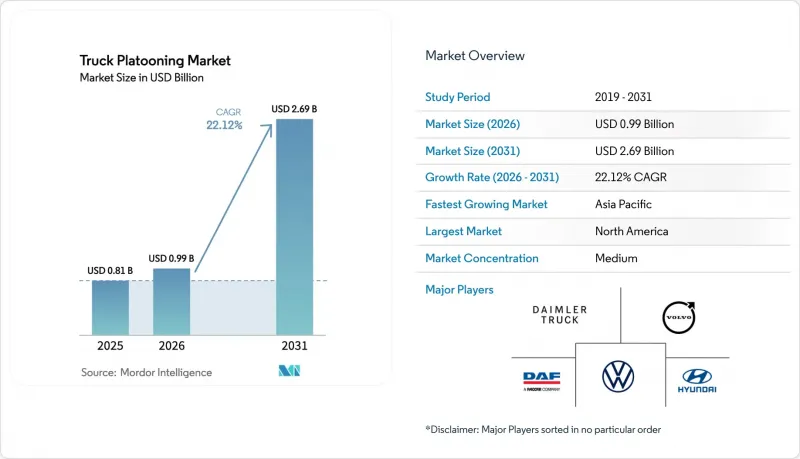
플릿 사업자들은 플라토닝을 통한 공기역학적 효과로 인한 연료 절감의 회수 기간이 온실가스(GHG) 배출에 대한 규제 처벌이 강화됨에 따라 도입을 가속화하고 있습니다. 미국의 주간 고속도로, 유럽의 TEN-T 회랑, 중국의 베이징-상하이 고속도로에 5세대 C-V2X가 도입되면서 지연의 제약이 사라졌습니다. 이 발전으로 최소한의 시간으로 더 좁은 차간 거리에서 차간 통신이 가능해져 연비가 크게 향상될 수 있습니다. 동시에 OEM은 구독형 가격 체계로 전환을 추진하고 있습니다. 이러한 전환을 통해 설비투자가 운영비용으로 전환되고, 보통 중형 트랙터를 운영하는 중형 운송업체를 잠재적인 고객층으로 끌어들일 수 있게 됩니다. 화주들은 장기 화물 운송 계약에 플래투닝 조항을 포함시킴으로써 그 도입을 더욱 촉진하고 있습니다. 이 전략은 검증 가능한 Scope 3 배출량 감축을 보장할 뿐만 아니라, 플래투닝을 단순한 비용 절감 도구에서 수익을 보호하는 중요한 조치로 재정의합니다.
세계 트럭 플래투닝 시장 동향과 인사이트
전 세계 온실가스 규제와 연비 기준의 강화
대형 차량의 배기가스 규제는 일반적인 차량 교체 주기보다 빠르게 강화되고 있으며, 운송 사업자들은 단기적인 규제 준수 방안을 모색해야 하는 상황에 처해 있습니다. 유럽연합(EU)은 2019년 기준치 대비 2030년까지 트럭의 CO2 배출량을 45% 감축하도록 의무화하고 있으며, 기준을 충족하지 못할 경우 규정된 주행거리당 벌금이 부과됩니다. 캘리포니아주의 '선진 클린 플릿(ACF)' 규정은 우선순위가 높은 운송업체가 2027년 이후 신규 구매하는 클래스 8 트럭의 상당 부분을 무공해 또는 거의 무공해 차량으로 구매하도록 의무화하고 있습니다. 2024년 7월부터 시행되는 중국의 '6단계(Stage VI)' 배출가스 기준은 질소산화물 배출 제한을 더욱 엄격하게 하고 있으며, 차량 간 거리가 좁은 대열 주행의 전형적인 연료 절약으로 인한 경제적 이점을 더욱 높이고 있습니다. 이러한 처벌 제도로 인해 플래투닝은 단순한 효율화 수단이 아닌 규제에 대한 헤지 수단으로 자리 잡게 되었습니다.
5G-C-V2X 상용 서비스 개시, 50밀리초 이하 지연 시간 실현
독립형 5G 코어 네트워크는 현재 미국 주간 고속도로의 대부분을 커버하고 있으며, 종단간 네트워크 지연을 30밀리초 이하로 낮추고, 고속도로 주행 시 10-15미터의 안전한 차간 거리를 실현하고 있습니다. 차이나모바일이 베이징-상하이 회랑에 5G-어드밴스드(5G-Advanced)를 배치하여 5대의 트럭 플래투닝에서 동기식 브레이크를 지원합니다. 3GPP 표준 릴리즈 17에서는 직접 사이드 링크가 도입되어 지방 통신권 밖에서도 트럭이 대열을 유지할 수 있게 되었습니다. 반도체의 대량 출하가 그 규모를 뒷받침하고 있습니다. NXP는 2025년 C-V2X 칩셋을 대량 출하하며 전년 대비 큰 폭의 성장세를 보였습니다.
화물 사이클의 침체로 운송업체들의 설비투자 억제
2025년 운임과 물동량이 크게 감소하여 유상운송업체가 일반적으로 기술 업그레이드에 사용할 수 있는 여유 자금이 감소했습니다. 미국 트럭 운송 현물 운임은 많은 운송 사업자의 손익분기점을 밑돌면서 많은 사업자가 한정된 자금을 플래투닝 개조 투자 대신 부채 상환에 사용하도록 강요당했습니다. 유럽에서는 2025년 3분기 도로 화물 운송량이 전년 동기 대비 감소하여 4분기 연속 감소했습니다. 이로 인해 매출은 더욱 감소했고, 설비 발주는 미뤄졌습니다. 2025년에는 높은 자금 조달 비용으로 인해 신기술에 대한 투자 회수를 기대할 수 없게 되면서 유상운송사업자의 설비투자가 감소했습니다. 공급과잉 문제는 상황을 더욱 악화시켰고, 미국에서는 트럭과 화물의 비율이 불균형을 이루었습니다. 이러한 불균형은 자산의 가동률을 떨어뜨렸을 뿐만 아니라, 플래투닝용 하드웨어의 투자 회수 기간을 연장시켰습니다.
부문 분석
2025년에는 운전 지원 구성이 트럭 플래투닝 시장에서 62.15%의 큰 점유율을 차지해, 이는 규제 당국이 인간 모니터링이 운영에 필수적이라는 것을 보장하는 레벨 2 시스템을 선호하고 있음을 보여줍니다. 이러한 우위는 운전자가 적극적으로 참여하는 시스템에 대한 규제 당국의 안도감을 반영하며, 기술 발전과 안전의 균형을 유지하고 있습니다. 한편, 입법자들이 종합적인 레벨 4 고속도로 규정을 수립하고 보험 프레임 워크가 더욱 정교 해짐에 따라 자율 주행 플래투닝은 CAGR 23.54%의 높은 성장률로 성장할 것으로 예측됩니다. 현재와 같은 도입 추세가 지속된다면, 기술 발전과 지원적인 규제의 발전에 힘입어 2031년까지 자율 주행 트럭 플래투닝 시장 규모는 크게 성장할 것으로 예측됩니다.
현재 차량 사업자들은 주로 운전자 지원형 플래투닝을 선택하고 있습니다. 이는 이러한 시스템에서 운전자가 차량 운행에 대한 책임이 계속 유지되도록 보장하기 때문입니다. 이러한 접근 방식은 기존 상업용 운전면허 규제와도 일치하며, 보험사가 이러한 시스템에 대한 보험을 쉽게 인수할 수 있도록 도와줍니다. 그러나 국경 간 책임 분담에 대한 합의가 마무리되고 표준화가 진행됨에 따라 자율주행의 도입은 가속화될 것으로 예측됩니다. 자율 주행 시스템은 연료비 절감과 노동 효율성 향상이라는 큰 이점을 가지고 있으며, 이는 예측 기간 동안 트럭 플래투닝 시장에서의 점유율을 꾸준히 확대하는 요인이 될 것으로 보입니다.
2025년 매출의 33.25%를 차지한 적응형 크루즈 컨트롤(ACC)은 모든 상용화된 플래투닝의 기본 계층으로 자리매김하고 있습니다. 보험 인수 회사는 차량 그룹에 이중화 브레이크 시스템 도입을 점점 더 많이 권장하고 있으며, 이는 액티브 브레이크 어시스트의 견고한 예측 CAGR 26.11%를 달성하는 데 도움이 될 것입니다. 이러한 추세는 2024년 11월부터 모든 신형 트럭에 자동 긴급 제동 시스템 장착을 의무화하는 유럽 연합(EU)의 규제에 의해 더욱 강화될 것으로 예상되며, 유럽 전역에 걸쳐 광범위한 도입이 이루어질 것으로 보입니다.
OEM 업체들은 차량의 안전성과 성능을 향상시키기 위해 센서퓨전 아키텍처를 양산차에 순차적으로 적용하고 있습니다. 이러한 아키텍처는 레이더의 장거리 감지 능력, LiDAR의 높은 정확도, 카메라의 고도화된 물체 분류 기능을 결합한 것입니다. 이러한 시스템은 제조 비용 증가를 가져오지만, 사고 발생 확률을 크게 낮추고, 안전과 운영 효율을 향상시키기 위해 규모의 경제를 활용하는 것에 대한 업계의 관심이 높아지고 있음을 보여줍니다.
2025년에는 차량간(V2V) 통신이 전체 매출의 50.13%를 차지했습니다. 이는 주로 고정된 도로변 시설에 의존하지 않고 운영할 수 있는 능력에 기인합니다. 이 기능을 통해 호환 가능한 트럭이 모이면 언제든지 임시 대열을 구성할 수 있어 유연성과 비용 효율성이 크게 향상됩니다. 인프라에 대한 의존성이 없기 때문에 이 연결 모델은 역동적인 환경에서 운영을 최적화하고자 하는 차량 운영자에게 특히 매력적입니다. 한편, 차량-인프라 간 연결(V2I)은 미국 전역과 유럽 연합(EU)의 주요 화물 운송 회랑에 도로변 장비 구축에 대한 연방 정부의 대규모 투자에 힘입어 CAGR 22.87%의 견조한 성장이 예상됩니다. 이러한 성장은 고도의 커넥티드 솔루션을 지원하기 위한 인프라 구축에 대한 중요성이 높아지고 있음을 보여줍니다.
고속도로 관리 기관은 차선 이용률 향상, 교통 체증 완화, 더 나은 의사 결정을 위한 상세한 화물 데이터 수집을 위한 전략적 도구로 V2I 기술을 적극적으로 도입하고 있습니다. 또한, NXP의 RoadLINK와 같이 차량-차량 간(V2V) 및 차량-인프라 간(V2I) 프로토콜을 통합한 컨버지드 칩셋은 하드웨어의 차이를 최소화하고 있습니다. 이 칩셋은 소프트웨어 업데이트와 새로운 서비스 및 기능의 도입을 가능하게 함으로써 커넥티드카 기술의 가치 제안을 더욱 향상시키고 있습니다.
지역별 분석
북미는 잘 정비된 주간 고속도로 네트워크, 광범위한 5G 커버리지, 연방정부의 보조금 지원 등에 힘입어 2025년 매출의 43.15%를 차지했습니다. 그러나 주마다 다른 규제 차이로 인해 운송업체들은 여전히 캘리포니아, 애리조나, 텍사스의 주 경계를 넘나들 때 플래툰 구성을 변경해야 하는 등 효율성이 떨어지고 있습니다. '인프라 투자 및 고용법'에 따라 더 많은 커넥티드카 프로젝트에 자금이 투입됨에 따라 연간 도입률은 더욱 가속화될 것으로 예측됩니다.
유럽은 엄격한 CO2 배출량 제한과 TEN-T 현대화 프로그램에 힘입어 2위를 차지했지만, 국경 간 책임 소재에 대한 불일치와 독일의 경제 침체로 인해 단기적인 확장은 억제되고 있습니다. 현재 논의되고 있는 UNECE(유엔유럽경제위원회)의 규제 조정을 통해 여러 국가를 아우르는 플라톤 주행이 가능해져 현재의 분절로 인한 불이익이 해소될 수 있습니다.
아시아태평양은 CAGR 25.56%로 가장 빠른 성장세를 보이고 있으며, 2026년 이후 판매되는 신규 트럭의 상당수가 레벨 2 자동화를 의무화하는 중국의 화물 디지털화 로드맵이 그 원동력이 되고 있습니다. 일본의 '사회 5.0' 프로그램에서는 인증된 플라톤에 대해 통행료 할인을 대폭 제공하고 있으며, 인도의 '골든 쿼드럴(Golden Quadrilar)' 개선 계획에서는 V2I 파일럿 사업에 많은 비용을 배정하고 있습니다. 인프라 미비, 규제 불일치 등이 남아있어 보급 속도는 국가마다 다르지만 성장 가능성은 매우 크다고 할 수 있습니다.
기타 혜택
- 엑셀 형태 시장 예측(ME) 시트
- 3개월간 애널리스트 지원
자주 묻는 질문
목차
제1장 서론
제2장 조사 방법
제3장 주요 요약
제4장 시장 구도
제5장 시장 규모와 성장 예측(금액(달러))
제6장 경쟁 구도
제7장 시장 기회와 향후 전망
JHS 26.06.02The truck platooning market size was valued at USD 0.81 billion in 2025 and estimated to grow from USD 0.99 billion in 2026 to reach USD 2.69 billion by 2031, at a CAGR of 22.12% during the forecast period (2026-2031).
Fleet operators are accelerating deployment because regulatory penalties on greenhouse-gas (GHG) emissions now exceed the payback period for the aerodynamic fuel savings that platooning delivers. With the roll-out of fifth-generation C-V2X along United States interstates, Europe's TEN-T corridors, and China's Beijing-Shanghai expressway, latency constraints have been eliminated. This advancement facilitates vehicle-to-vehicle signaling in minimal time and with tighter following gaps, significantly boosting fuel economy. Concurrently, original-equipment manufacturers (OEMs) are transitioning to subscription pricing. This shift transforms capital expenditures into operating costs, thereby attracting mid-sized carriers - typically operating a moderate number of tractors - into the potential customer fold. Shippers are further bolstering adoption by incorporating platooning clauses in long-term freight contracts. This strategy not only ensures verifiable Scope-3 emission reductions but also redefines platooning from a mere cost-saving tool to a crucial revenue-protection measure.
Global Truck Platooning Market Trends and Insights
Stringent Global GHG Mandates and Fuel-Economy Standards
Heavy-duty emission rules are toughening faster than typical replacement cycles, forcing carriers to search for near-term compliance tools. The European Union requires a 45% reduction in truck CO2 by 2030 relative to 2019 baselines, with non-compliance fines per required kilometer . California's Advanced Clean Fleets rule obliges high-priority carriers to make a significant share of new Class 8 purchases zero- or near-zero-emission from 2027. China's Stage VI standards, effective since July 2024, impose stricter nitrogen-oxide limits, magnifying the economic benefit of the fuel savings typical of tight-gap convoys. Penalty frameworks now make platooning not merely an efficiency upgrade but a regulatory hedge.
Commercial Launch of 5G-C-V2X Enabling Sub-50 ms Latency
Standalone 5G cores now blanket the bulk of United States interstates, achieving end-to-end network latencies below 30 milliseconds and enabling safe inter-vehicle gaps of 10-15 meters at highway speeds. China Mobile's 5G-Advanced build-out on the Beijing-Shanghai corridor supports synchronized braking across five-truck platoons. Release 17 of the 3GPP standard introduced direct sidelink, letting trucks maintain cohesion even in rural coverage gaps . Semiconductor volume shipments confirm scale: NXP delivered a significant volume of C-V2X chipsets in 2025, a notable jump year-on-year.
Freight-Cycle Downturn Curbing Cap-Ex by For-Hire Fleets
In 2025, freight rates and volumes significantly declined, reducing the discretionary cash that for-hire fleets typically allocate for technology upgrades. United States truckload spot rates dropped below the break-even point for numerous carriers, forcing many to divert limited funds towards servicing debts rather than investing in platooning retrofits. In Europe, road-freight tonnage experienced a year-over-year decline in Q3 2025, marking the fourth consecutive quarterly drop. This trend further diminished revenues and postponed equipment orders. Capital expenditures among for-hire carriers decreased in 2025, as high financing costs made the math for new-technology paybacks less appealing. An overcapacity issue exacerbated the situation, with the United States truck-to-load ratio becoming imbalanced. This imbalance not only depressed asset utilization but also extended payback periods for platooning hardware.
Other drivers and restraints analyzed in the detailed report include:
- Government-Funded Multi-State/Trans-EU Pilot Corridors
- Rising Diesel Prices Widening ROI Gap vs. Conventional Convoys
- High Retrofit and Sensor-Suite Cost per Truck
For complete list of drivers and restraints, kindly check the Table Of Contents.
Segment Analysis
In 2025, driver-assistive configurations are expected to dominate the truck platooning market with a significant 62.15% share, highlighting regulators' preference for Level 2 systems that ensure human oversight remains integral to operations. This dominance reflects the comfort of regulatory bodies with systems that keep drivers actively involved, maintaining a balance between technological advancement and safety. At the same time, autonomous platooning is anticipated to grow at a strong 23.54% CAGR as lawmakers work on drafting comprehensive Level 4 highway regulations and as insurance frameworks become more sophisticated. If the current adoption trends continue, the market size for autonomous truck platooning is likely to experience substantial growth by 2031, driven by advancements in technology and supportive regulatory developments.
At present, fleets predominantly opt for driver-assistive platoons, as these systems ensure that drivers remain responsible for vehicle operations. This approach aligns well with existing commercial-license regulations, making it easier for insurers to underwrite policies for such systems. However, as cross-border liability agreements are finalized and become more standardized, the adoption of autonomous operations is expected to accelerate. Autonomous systems offer significant advantages, including superior fuel savings and enhanced labor efficiencies, which are likely to drive their increasing market share in truck platooning steadily throughout the forecast period.
Adaptive cruise control, which accounts for 33.25% of 2025 revenues, has established itself as the foundational layer for every commercially deployed platoon. Insurance underwriters are increasingly advocating for redundant braking systems in fleets, which is driving active brake assist to achieve a robust forecast CAGR of 26.11%. This trend is further reinforced by the European Union's mandate requiring automated emergency braking systems in all new trucks, set to take effect in November 2024, ensuring widespread adoption across the region.
OEMs are progressively integrating sensor-fusion architectures into their factory builds to enhance vehicle safety and performance. These architectures combine radar's long-range detection capabilities, lidar's high precision, and the advanced object classification features of cameras. While these systems introduce incremental production costs, they significantly lower accident probabilities, emphasizing the industry's growing focus on leveraging scale advantages to improve safety and operational efficiency.
In 2025, vehicle-to-vehicle links generated 50.13% of total revenue, primarily due to their ability to operate without relying on fixed roadside assets. This capability allows fleets to form ad-hoc platoons whenever compatible trucks converge, offering significant flexibility and cost efficiency. The absence of infrastructure dependency makes this connectivity model particularly appealing for fleet operators aiming to optimize operations in dynamic environments. Meanwhile, vehicle-to-infrastructure connectivity is projected to grow at a strong 22.87% CAGR, driven by substantial federal investments in roadside-unit deployments across the United States and major freight corridors in the European Union. This growth underscores the increasing emphasis on infrastructure enhancements to support advanced connectivity solutions.
Highway agencies are actively adopting V2I technology as a strategic tool to improve lane utilization, reduce congestion, and collect detailed freight data for better decision-making. Additionally, converged chipsets like NXP's RoadLINK, which integrate both vehicle-to-vehicle and vehicle-to-infrastructure protocols, are minimizing hardware differentiation. These chipsets also enable software updates, allowing the introduction of new services and functionalities, further enhancing the value proposition of connected vehicle technologies.
The Truck Platooning Market Report is Segmented by Platooning Type (Driver-Assistive Truck Platooning and Autonomous Truck Platooning), Technology Type (Adaptive Cruise Control, and More), Infrastructure Connectivity (Vehicle-To-Vehicle (V2V), and More), Truck Class (Class 8 and More), Fleet Type (Private and More), Application, Ownership/Business Model, and Geography. Market Forecasts are Provided in Terms of Value (USD).
Geography Analysis
North America accounts for 43.15% of the 2025 revenue, driven by a well-connected interstate network, extensive 5G coverage, and supportive federal grants. Yet state-level rule divergence still forces carriers to alter platoon configurations, trimming efficiency when crossing borders between California, Arizona, and Texas. Annual adoption, nevertheless, is set to quicken as the Infrastructure Investment and Jobs Act funds more connected-vehicle projects.
Europe ranked second, underpinned by stringent CO2 caps and the TEN-T modernization program, but cross-border liability gaps and economic stagnation in Germany moderate near-term expansion. Harmonized UNECE regulations under discussion could unlock multi-country platoons, erasing current fragmentation penalties.
Asia-Pacific shows the fastest trajectory at 25.56% CAGR, propelled by China's freight-digitization roadmap that mandates Level 2 automation on a significant share of new trucks sold from 2026. Japan's Society 5.0 program offers a notable share of toll rebates for certified platoons, while India's Golden Quadrilateral upgrade earmarks high costs for V2I pilots. Remaining infrastructure gaps and regulatory inconsistencies mean ramp-up will vary by nation, but upside potential is significant.
- Daimler Truck AG
- AB Volvo
- Paccar Inc (DAF Trucks)
- Volkswagen Group
- Hyundai Motor Company
- Iveco Group
- ZF Friedrichshafen AG
- Continental AG
- Robert Bosch GmbH
- Knorr-Bremse AG
- NXP Semiconductors N.V.
- Einride AB
Additional Benefits:
- The market estimate (ME) sheet in Excel format
- 3 months of analyst support
TABLE OF CONTENTS
1 Introduction
- 1.1 Study Assumptions and Market Definition
- 1.2 Scope of the Study
2 Research Methodology
3 Executive Summary
4 Market Landscape
- 4.1 Market Overview
- 4.2 Market Drivers
- 4.2.1 Stringent Global GHG Mandates and Fuel-Economy Standards
- 4.2.2 Commercial Launch of 5G-C-V2X Enabling Sub-50 ms Latency
- 4.2.3 Government-Funded Multi-State/Trans-EU Pilot Corridors
- 4.2.4 Rising Diesel Prices Widening ROI Gap vs. Conventional Convoys
- 4.2.5 OEM Platooning-as-a-Service Subscription Models
- 4.2.6 Scope-3 Decarbonization Credits Demanded by Shippers
- 4.3 Market Restraints
- 4.3.1 Freight-Cycle Downturn Curbing Cap-Ex by For-Hire Fleets
- 4.3.2 High Retrofit and Sensor-Suite Cost per Truck
- 4.3.3 Cross-Border Liability and Data-Ownership Uncertainty
- 4.3.4 Cyber-Attack Exposure Driving Insurance Premium Spikes
- 4.4 Value/Supply-Chain Analysis
- 4.5 Technological Roadmap
- 4.6 Porter's Five Forces
- 4.6.1 Threat of New Entrants
- 4.6.2 Bargaining Power of Buyers
- 4.6.3 Bargaining Power of Suppliers
- 4.6.4 Threat of Substitutes
- 4.6.5 Intensity of Competitive Rivalry
5 Market Size & Growth Forecasts (Value (USD))
- 5.1 By Platooning Type
- 5.1.1 Driver-Assistive Truck Platooning (DATP)
- 5.1.2 Autonomous Truck Platooning
- 5.2 By Technology Type
- 5.2.1 Adaptive Cruise Control
- 5.2.2 Forward Collision Warning
- 5.2.3 Automated Emergency Braking
- 5.2.4 Active Brake Assist
- 5.2.5 Lane Keep Assist
- 5.2.6 Other ADAS (Blind-Spot Warning, etc.)
- 5.3 By Infrastructure Connectivity
- 5.3.1 Vehicle-to-Vehicle (V2V)
- 5.3.2 Vehicle-to-Infrastructure (V2I)
- 5.3.3 Global Positioning System (GPS)
- 5.4 By Truck Class
- 5.4.1 Class 8 (Heavy-Duty)
- 5.4.2 Class 6-7 (Medium-Duty)
- 5.5 By Fleet Type
- 5.5.1 Private/Dedicated Fleets
- 5.5.2 For-Hire Common Carriers
- 5.6 By Application
- 5.6.1 Long-Haul Line-haul
- 5.6.2 Regional / Hub-to-Hub
- 5.6.3 Port and Intermodal Drayage
- 5.7 By Ownership / Business Model
- 5.7.1 OEM-Integrated Subscription
- 5.7.2 Third-Party Technology Provider
- 5.8 By Geography
- 5.8.1 North America
- 5.8.1.1 United States
- 5.8.1.2 Canada
- 5.8.1.3 Rest of North America
- 5.8.2 South America
- 5.8.2.1 Brazil
- 5.8.2.2 Argentina
- 5.8.2.3 Rest of South America
- 5.8.3 Europe
- 5.8.3.1 Germany
- 5.8.3.2 United Kingdom
- 5.8.3.3 France
- 5.8.3.4 Spain
- 5.8.3.5 Italy
- 5.8.3.6 Russia
- 5.8.3.7 Rest of Europe
- 5.8.4 Asia-Pacific
- 5.8.4.1 China
- 5.8.4.2 Japan
- 5.8.4.3 India
- 5.8.4.4 South Korea
- 5.8.4.5 Rest of Asia-Pacific
- 5.8.5 Middle East and Africa
- 5.8.5.1 United Arab Emirates
- 5.8.5.2 Saudi Arabia
- 5.8.5.3 Egypt
- 5.8.5.4 Turkey
- 5.8.5.5 South Africa
- 5.8.5.6 Rest of the Middle East and Africa
- 5.8.1 North America
6 Competitive Landscape
- 6.1 Market Concentration
- 6.2 Strategic Moves
- 6.3 Market Share Analysis
- 6.4 Company Profiles (Includes Global Level Overview, Market Level Overview, Core Segments, Financials as Available, Strategic Information, Market Rank/Share for Key Companies, Products and Services, SWOT Analysis, and Recent Developments)
- 6.4.1 Daimler Truck AG
- 6.4.2 AB Volvo
- 6.4.3 Paccar Inc (DAF Trucks)
- 6.4.4 Volkswagen Group
- 6.4.5 Hyundai Motor Company
- 6.4.6 Iveco Group
- 6.4.7 ZF Friedrichshafen AG
- 6.4.8 Continental AG
- 6.4.9 Robert Bosch GmbH
- 6.4.10 Knorr-Bremse AG
- 6.4.11 NXP Semiconductors N.V.
- 6.4.12 Einride AB


