
|
시장보고서
상품코드
2061630
항공기 인터페이스 디바이스 : 시장 점유율 분석, 업계 동향 및 통계, 성장 예측(2026-2031년)Aircraft Interface Device - Market Share Analysis, Industry Trends & Statistics, Growth Forecasts (2026 - 2031) |
||||||
 Mordor Intelligence
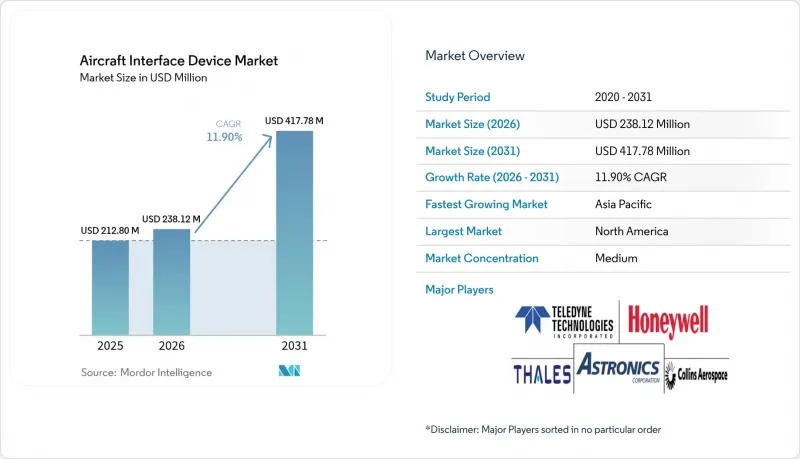
Mordor Intelligence에 의하면, 2026년 항공기 인터페이스 디바이스 시장 규모는 2억 3,812만 달러에 달할 것으로 추정됩니다. 2025년 2억 1,280만 달러에서 성장하여 2031년에는 4억 1,778만 달러에 이를 것으로 예측됩니다.
2026년부터 2031년까지의 연평균 성장률(CAGR)은 11.90%를 나타낼 것으로 전망됩니다.
본 보고서는 적용 유형(라인 핏 및 레트로핏), 연결 방식(유선 및 무선), 플랫폼(하드웨어 및 소프트웨어), 항공기 유형(민간, 군용, 일반 항공 및 무인 시스템), 지역(북미, 유럽, 아시아태평양, 남미, 중동 및 아프리카)별로 분류되어 있습니다. 시장 전망은 금액(달러) 기준으로 제공됩니다.
세계의 항공기 인터페이스 디바이스 시장 동향 및 분석
항공 운항의 디지털화로 인해 AID에 대한 수요가 증가하고 있습니다.
각 항공사는 종이 항법도 및 성능 계산을, 안전하고 대용량 데이터 브리지에 의존하는 완전한 디지털 프로세스로 대체하고 있습니다. 콜린스 에어로스페이스의 InteliSight 제품군과 같은 인증된 태블릿 인터페이스 모듈은 실시간 항공 전자 장비 데이터를 클라우드 분석 플랫폼으로 전송하여 승무원의 의사 결정을 지원합니다. 예지 유지보수 대시보드는 현재 기내 센서에서 직접 데이터를 수집하고 있어, 각 인터페이스 디바이스에 필요한 처리 능력이 높아지고 있습니다. 에어버스가 전사적으로 전자 비행 가방(EFB) 사용을 의무화함에 따라, 기존 항공기 네트워크와 최신 앱을 연결하는 인증된 게이트웨이에 대한 전 세계적인 수요가 급증했습니다. 또한, 운항사는 새로 도입되는 성능 기반 항법(PBN) 규정 및 실시간 비행 추적 이니셔티브를 준수하기 위해 이러한 장치를 통합하고 있습니다.
실시간 항공기 건전성 모니터링 및 예측 유지보수 생태계의 확대
최신 AID(항공기 인터페이스 디바이스)에 탑재된 엣지 컴퓨팅 기능은 지상 서버로 전송하기 전에 원시 데이터를 필터링 및 압축하여, 진단 정확도를 유지하면서 대역폭 비용을 절감합니다. Aireon의 우주 기반 ADS-B 데이터 스트림은 보잉의 분석 플랫폼과 연동되어 기존 정비의 한계를 넘어선 비행 매개변수를 모니터링하며, 항공기 전체 건전성 프로그램에서 인터페이스 게이트웨이가 수행하는 전략적 역할을 부각시키고 있습니다. 아스트로닉스사는 이에 대응하여 서버와 라우터 기능을 통합한 ‘스마트 항공기 인터페이스 디바이스’를 개발했습니다. 이 장치에는 기밀성이 높은 텔레메트리 데이터를 보호하기 위한 연방정보처리표준(FIPS) 수준의 암호화 기능이 내장되어 있습니다.
사이버 보안 규정 준수 부담 증가
DO-326A 및 DO-356A 표준에는 엄격한 설계, 검증 및 침투 테스트 절차가 추가되어 있어, 이로 인해 인증 일정이 1년 이상 연장될 가능성이 있습니다. FAA의 항공기 네트워크 보안 프로그램에서는 연결형 항공기 운항 사업자에게 승인을 받기 전에 위협 모델과 완화 조치를 문서화할 것을 요구하고 있으며, 이로 인해 중소 공급업체의 개발 비용이 증가하고 있습니다. AIDA 등 유럽의 연구 컨소시엄은 필요한 방어 능력의 범위가 급속히 확대되고 있음을 반영하여, 항공전자 네트워크를 실시간으로 감시하는 AI 기반 사이버 에이전트의 프로토타입 개발을 추진하고 있습니다.
부문별 분석
2025년 기준, 라인 핏(제조 라인 표준 사양) 옵션이 항공기 인터페이스 디바이스 시장의 49.89%를 차지했으나, 2031년까지의 연평균 성장률(CAGR) 14.12%를 나타낼 것으로 예상되며, 레트로핏(사후 개조) 프로그램이 신규 제조기의 인도 대수를 상회하고 있습니다. 각 항공사는 특히 중기 점검 시기를 맞이하는 지역 제트기나 비즈니스 제트기의 경우, 조종실 업그레이드 패키지를 신조 기체를 대체할 수 있는 비용 대비 효과가 높은 선택지로 보고 있습니다. 콜린스 에어로스페이스는 차세대 공역 규제 요건을 충족하면서 합성 시야(합성 비전) 및 첨단 비행 관리 기능을 제공하는 ‘Pro Line Fusion’ 개조 서비스를 제공합니다. 규제상의 ADS-B 및 FANS 1/A 요건은 모든 대륙에서 개조 수요를 더욱 촉진하고 있습니다.
라인핏은 OEM이 조립 공정에서 게이트웨이를 직접 통합함으로써 추가적인 가동 중단 시간을 방지하고, 다른 항공전자 장비 세트와의 긴밀한 통합을 보장할 수 있다는 규모의 이점을 유지하고 있습니다. 그러나 납품 지연으로 인해 운항사는 개조를 통한 즉각적인 운항 능력 향상을 요구받고 있으며, 이로 인해 해당 채널에서의 장기적인 성장 우위가 더욱 공고해지고 있습니다. 레트로핏 솔루션을 위한 항공기 인터페이스 디바이스 시장 규모는 2031년까지 2억 2,560만 달러에 육박할 것으로 예상되며, 이는 현대화 일정과 인증 절차가 구매자의 행동에 얼마나 큰 영향을 미치는지를 여실히 보여주고 있습니다.
2025년에는 유선 네트워크가 매출의 65.22%를 차지하며, 결정론적 지연과 검증된 전자기 호환성의 이점을 바탕으로 시장을 독점했습니다. 그럼에도 불구하고, 항공사들이 다중 궤도 위성 및 5G 공대지 링크를 도입함에 따라 무선 AID 시장은 연평균 성장률(CAGR) 16.10%로 성장하고 있습니다. 델타항공이 저궤도와 정지궤도의 대역폭을 통합할 수 있는 퓨전 플랫폼을 선정한 것은 항공사들이 다양한 네트워크 간 원활한 로밍을 기대하고 있음을 보여줍니다.
봄바르디아의 대륙 횡단적인 5G 구축은 고밀도 노선에서 지상 통신망으로의 전환이 진행되고 있음을 보여줍니다. 무선 게이트웨이는 과거에는 여러 대의 독립된 장치가 필요했던 트래픽 우선순위 지정, 암호화 및 안테나 핸드오버를 처리합니다. 안전성이 극히 중요한 용도의 경우, 인증 요건이 도입을 지연시키고 있기 때문에 플라이-바이-와이어 및 항법 분야에서는 유선 백본이 계속해서 필수적일 것입니다. 무선 솔루션에 연결되는 항공기 인터페이스 디바이스 시장 규모는 끊김 없는 광대역 서비스를 원하는 승객들 수요에 부응하며, 2031년까지 두 자릿수 성장률을 기록하며 확대될 것으로 전망됩니다.
지역별 분석
북미는 대규모 항공기 보유 대수, FAA(연방항공청)의 엄격한 연결 요건, 그리고 견조한 국방 지출에 힘입어 2025년에는 35.96%의 점유율로 항공기 인터페이스 디바이스 시장을 주도했습니다. UH-60M의 항공전자 장비 업그레이드 등 군사 현대화 계약은 높은 판매량을 유지하며 장기적인 지원 수익을 보장하고 있습니다. 이 지역의 성숙한 MRO 생태계는 정비 주기를 가속화하고 있으며, 한편 FAA의 차세대 항공교통관리 로드맵은 인증된 게이트웨이에 대한 수요를 더욱 촉진하고 있습니다.
아시아태평양은 2031년까지 연평균 성장률(CAGR)이 13.25%로, 가장 강력한 성장 전망을 보이고 있습니다. 중산층의 여행 수요 증가, 저비용 항공사(LCC)의 항공기 수 급증, 그리고 지역 안보에 대한 우려 고조가 민간 및 군용 항공기 조달을 견인하고 있습니다. Mi-17 헬기 기단을 대상으로 최근 수년에 걸쳐 진행된 현대화 프로그램은 동남아시아 및 인도의 운용사들이 첨단 인터페이스 장비에 의존하는 글래스콕핏으로의 전환을 우선시하고 있음을 보여줍니다. 일본, 중국, 호주의 항공기 적합성 당국은 현재 DO-178C 등의 규격을 승인하고 있어, 공급업체가 국경을 넘어 제품을 공급하기가 더 쉬워졌습니다.
유럽에서는 상세한 비행 데이터 분석에 기반한 공동 방위 이니셔티브와 지속가능성 관련 노력을 통해 꾸준한 성장을 이어가고 있습니다. EASA의 지침에 따라 인증 절차가 통일되어, 개방형 아키텍처 항공 전자 장비의 원활한 도입이 가능해졌습니다. 탈레스의 코브햄 에어로스페이스 커뮤니케이션즈 인수를 상징하는 기업 통합은 현지 공급 체제의 견고성과 경쟁력을 높이고 있습니다. 남미, 중동 및 아프리카는 여전히 초기 단계에 있는 지역으로, 특히 자산의 수명을 연장하면서 진화하는 항법 요건을 충족하는 개조 솔루션에 있어 매력적인 시장입니다.
기타 혜택 :
- 엑셀 형식 시장 예측(ME) 시트
- 3개월간의 애널리스트 지원
자주 묻는 질문
목차
제1장 서론
제2장 조사 방법
제3장 주요 요약
제4장 시장 구도
제5장 시장 규모 및 성장 예측
제6장 경쟁 구도
제7장 시장 기회 및 향후 전망
KTH 26.06.19According to Mordor Intelligence, the aircraft interface device market size in 2026 is estimated at USD 238.12 million, growing from 2025 value of USD 212.80 million with 2031 projections showing USD 417.78 million, growing at 11.90% CAGR over 2026-2031.
This report is Segmented by Fit (Line Fit and Retrofit), Connectivity (Wired and Wireless), Platform (Hardware and Software), Aircraft Type (Commercial, Military, General Aviation, and Unmanned Systems), and Geography (North America, Europe, Asia-Pacific, South America, and the Middle East and Africa). The Market Forecasts are Provided in Terms of Value (USD).
Global Aircraft Interface Device Market Trends and Insights
Digitized flight operations elevate demand for AIDs
Airlines have replaced paper charts and performance calculations with fully digital processes dependent on secure, high-capacity data bridges. Certified tablet interface modules like Collins Aerospace's InteliSight suite stream real-time avionics data to cloud analytics platforms for flight-crew decision support. Predictive-maintenance dashboards now draw directly from onboard sensors, increasing the required processing power of each interface device. Airbus's company-wide mandate for electronic flight bag usage accelerated global demand for certified gateways connecting legacy aircraft networks to modern apps. Operators also integrate these devices to comply with emerging performance-based navigation rules and real-time flight tracking initiatives.
Expansion of real-time aircraft health-monitoring and predictive-maintenance ecosystems
Edge-based computing capabilities inside modern AIDs filter and compress raw data before transmission to ground servers, reducing bandwidth costs while preserving diagnostic fidelity. Aireon's space-based ADS-B data stream combines with Boeing's analytics platform to monitor flight parameters beyond traditional maintenance limits, underscoring the strategic role of interface gateways in fleet-wide health programs. Astronics has responded with Smart Aircraft Interface Devices, integrating server and router functionality, incorporating Federal Information Processing Standards-level encryption to protect sensitive telemetry.
Escalating cybersecurity compliance burden
DO-326A and DO-356A standards add rigorous design, verification, and penetration-testing steps that can extend certification schedules by over a year. The FAA's Aircraft Network Security Program requires operators of connected aircraft to document threat models and mitigation strategies before receiving approvals, raising development costs for smaller suppliers. European research consortia such as AIDA are prototyping AI-driven cyber agents to monitor avionics networks in real time, reflecting the rapidly expanding scope of required defensive capabilities.
Other drivers and restraints analyzed in the detailed report include:
- Military ISR platforms require high-speed data exfiltration
- Adoption of open-architecture avionics standards
- Supply-chain volatility in multi-protocol data-bus components
For complete list of drivers and restraints, kindly check the Table Of Contents.
Segment Analysis
Retrofit programs are outpacing new-build deliveries with a 14.12% CAGR through 2031, even though line-fit options still held 49.89% of the aircraft interface device market share in 2025. Airlines view cockpit upgrade packages as a cost-effective alternative to new airframes, particularly for regional and business jets approaching mid-life checks. Collins Aerospace offers Pro Line Fusion conversions that deliver synthetic vision and advanced flight-management functions while satisfying next-generation airspace mandates. Regulatory ADS-B and FANS 1/A requirements further stimulate retrofit demand across every continent.
Line-fit retains scale advantage because OEMs embed gateways during assembly, avoiding additional downtime and ensuring tight integration with other avionics suites. Yet delivery backlogs push operators toward immediate capability gains through retrofit, reinforcing the long-term growth advantage in that channel. The aircraft interface device market size for retrofit solutions is forecast to approach USD 225.6 million by 2031, underscoring how modernization schedules and certification paths shape buyer behavior.
Wired networks dominated with 65.22% revenue in 2025, benefitting from deterministic latency and proven electromagnetic compatibility. Nevertheless, wireless AIDs are growing at 16.10% CAGR as airlines adopt multi-orbit satellite and 5G air-to-ground links. Delta's selection of the Hughes Fusion platform, which can blend low-earth and geostationary bandwidth, illustrates how carriers expect seamless roaming across diverse networks.
Bombardier's continental 5G roll-out highlights a shift toward terrestrial links for high-density routes. Wireless gateways handle traffic prioritization, encryption, and antenna handovers that used to require multiple discrete boxes. Certification hurdles slow adoption for safety-critical applications, so wired backbones will remain essential inside fly-by-wire and navigation domains. The aircraft interface device market size attached to wireless solutions is projected to expand at double-digit rates through 2031, matching passenger demand for uninterrupted broadband.
Geography Analysis
North America led the aircraft interface device market with a 35.96% share in 2025, supported by large fleets, strict FAA connectivity mandates, and robust defense spending. Military modernization contracts such as the UH-60M avionics upgrade sustain high unit volumes and guarantee long-term support revenues. The region's mature MRO ecosystem accelerates retrofit cycles, while the FAA's roadmap for next-generation air-traffic management further stimulates demand for certified gateways.
Asia-Pacific registers the strongest growth outlook, with a 13.25% CAGR to 2031. Expanding middle-class travel, rapid low-cost carrier fleet additions, and heightened regional security considerations drive commercial and military aircraft procurement. Recent multi-year modernization programs for Mi-17 rotary fleets showcase how operators across Southeast Asia and India prioritize glass-cockpit conversions that depend on advanced interface devices. National airworthiness authorities in Japan, China, and Australia now recognize standards such as DO-178C, making it easier for suppliers to transfer products across borders.
Europe maintains measured growth through joint defense initiatives and sustainability commitments that rely on granular flight-data analytics. EASA guidance harmonizes certification pathways, enabling coordinated adoption of open-architecture avionics. Corporate consolidation, highlighted by Thales's acquisition of Cobham Aerospace Communications, enhances local supply resilience and competitive positioning. South America, the Middle East, and Africa remain early-stage yet attractive, especially for retrofit solutions that extend asset life while meeting evolving navigation mandates.
- Astronics Corporation
- Collins Aerospace (RTX Corporation)
- Teledyne Technologies Incorporated
- Honeywell International Inc.
- Thales Group
- SKYTRAC Systems Ltd.
- Elbit Systems Ltd.
- SCI Technology, Inc. (Sanmina Corporation)
- Avionics Interface Technologies (Teradyne, Inc.)
- Curtiss-Wright Corporation
- Anuvu Operations LLC
- The Boeing Company
- L3Harris Technologies, Inc.
- Garmin Ltd.
- Panasonic Avionics Corporation
- Lufthansa Technik AG
- Safran S.A.
Additional Benefits:
- The market estimate (ME) sheet in Excel format
- 3 months of analyst support
TABLE OF CONTENTS
1 INTRODUCTION
- 1.1 Study Assumptions and Market Definition
- 1.2 Scope of the Study
2 RESEARCH METHODOLOGY
3 EXECUTIVE SUMMARY
4 MARKET LANDSCAPE
- 4.1 Market Overview
- 4.2 Market Drivers
- 4.2.1 Digitized flight operations elevates demand for AIDs
- 4.2.2 Expansion of real-time aircraft health-monitoring and predictive-maintenance ecosystems
- 4.2.3 Military ISR platforms demand for high-speed data-exfiltration interfaces
- 4.2.4 Adoption of open-architecture avionics standards
- 4.2.5 Accelerating retrofit cycles for Electronic Flight Bag (EFB) upgrades across narrowbody and business jet fleets
- 4.2.6 Proliferation of high-throughput satellite constellations (GEO VHTS, LEO)
- 4.3 Market Restraints
- 4.3.1 Escalating cybersecurity compliance burden
- 4.3.2 Supply-chain volatility in multi-protocol data-bus components (ARINC 664)
- 4.3.3 Prolonged and expensive certification cycles (DO-178C/254, DO-160G, FAA/EASA STC)
- 4.3.4 Space-based ADS-B reducing need for on-board data gateways on new-gen aircraft
- 4.4 Value/Supply-Chain Analysis
- 4.5 Regulatory Outlook
- 4.6 Technological Outlook
- 4.7 Porter's Five Forces Analysis
- 4.7.1 Threat of New Entrants
- 4.7.2 Bargaining Power of Buyers
- 4.7.3 Bargaining Power of Suppliers
- 4.7.4 Threat of Substitutes
- 4.7.5 Intensity of Competitive Rivalry
5 MARKET SIZE AND GROWTH FORECASTS (VALUE)
- 5.1 By Fit
- 5.1.1 Line Fit
- 5.1.2 Retrofit
- 5.2 By Connectivity
- 5.2.1 Wired
- 5.2.2 Wireless
- 5.3 By Platform
- 5.3.1 Hardware
- 5.3.2 Software
- 5.4 By Aircraft Type
- 5.4.1 Commercial
- 5.4.1.1 Narrowbody Aircraft
- 5.4.1.2 Widebody Aircraft
- 5.4.1.3 Regional Jets
- 5.4.2 Military
- 5.4.2.1 Combat
- 5.4.2.2 Non-Combat
- 5.4.3 General Aviation
- 5.4.3.1 Business Jets
- 5.4.3.2 Helicopters
- 5.4.4 Unmanned Systems
- 5.4.1 Commercial
- 5.5 By Geography
- 5.5.1 North America
- 5.5.1.1 United States
- 5.5.1.2 Canada
- 5.5.1.3 Mexico
- 5.5.2 Europe
- 5.5.2.1 United Kingdom
- 5.5.2.2 Germany
- 5.5.2.3 France
- 5.5.2.4 Italy
- 5.5.2.5 Rest of Europe
- 5.5.3 Asia-Pacific
- 5.5.3.1 China
- 5.5.3.2 Japan
- 5.5.3.3 India
- 5.5.3.4 South Korea
- 5.5.3.5 Rest of Asia-Pacific
- 5.5.4 South America
- 5.5.4.1 Brazil
- 5.5.4.2 Rest of South America
- 5.5.5 Middle East and Africa
- 5.5.5.1 Middle East
- 5.5.5.1.1 United Arab Emirates
- 5.5.5.1.2 Israel
- 5.5.5.1.3 Rest of Middle East
- 5.5.5.2 Africa
- 5.5.5.2.1 South Africa
- 5.5.5.2.2 Rest of Africa
- 5.5.5.1 Middle East
- 5.5.1 North America
6 COMPETITIVE LANDSCAPE
- 6.1 Market Concentration
- 6.2 Strategic Moves
- 6.3 Market Share Analysis
- 6.4 Company Profiles (includes Global-level Overview, Market-level Overview, Core Segments, Financials as available, Strategic Information, Market Rank/Share, Products and Services, Recent Developments)
- 6.4.1 Astronics Corporation
- 6.4.2 Collins Aerospace (RTX Corporation)
- 6.4.3 Teledyne Technologies Incorporated
- 6.4.4 Honeywell International Inc.
- 6.4.5 Thales Group
- 6.4.6 SKYTRAC Systems Ltd.
- 6.4.7 Elbit Systems Ltd.
- 6.4.8 SCI Technology, Inc. (Sanmina Corporation)
- 6.4.9 Avionics Interface Technologies (Teradyne, Inc.)
- 6.4.10 Curtiss-Wright Corporation
- 6.4.11 Anuvu Operations LLC
- 6.4.12 The Boeing Company
- 6.4.13 L3Harris Technologies, Inc.
- 6.4.14 Garmin Ltd.
- 6.4.15 Panasonic Avionics Corporation
- 6.4.16 Lufthansa Technik AG
- 6.4.17 Safran S.A.
7 MARKET OPPORTUNITIES AND FUTURE OUTLOOK
- 7.1 White-space and Unmet-Need Assessment