

|
시장보고서
상품코드
2061640
3D 식품 프린팅 시장 : 시장 점유율 분석, 업계 동향 및 통계, 성장 예측(2026-2031년)3D Food Printing - Market Share Analysis, Industry Trends & Statistics, Growth Forecasts (2026 - 2031) |
||||||
 Mordor Intelligence
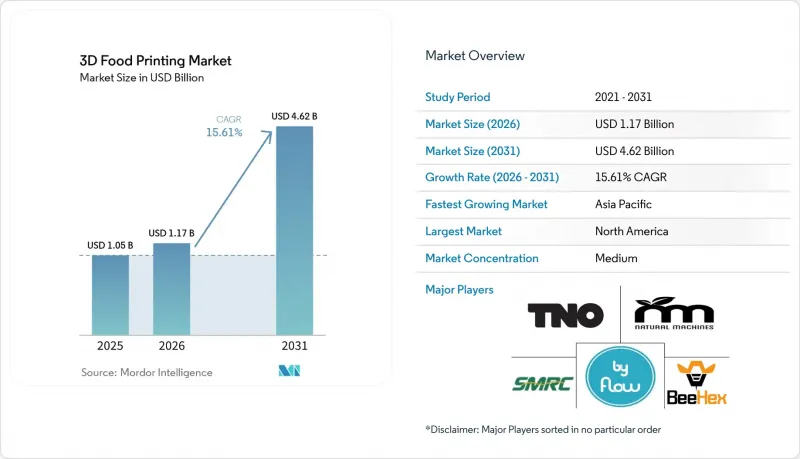
Mordor Intelligence에 의하면, 3D 식품 프린팅 시장 규모는 2026년에 11억 7,000만 달러로 추정되고, 2025년 10억 5,000만 달러에서 확대해, 2031년까지 46억 2,000만 달러에 이를 것으로 예측됩니다.
연평균 성장률(CAGR)은 15.61%가 될 것으로 전망됩니다.
본 보고서는 제품 유형별(초콜릿 및 과자, 제과, 육류 및 수산물, 기타), 최종 사용자별(정부, 상업, 주거) 및 지역별(북미, 유럽, 아시아태평양, 남미, 중동 및 아프리카)로 세분화되어 있습니다. 본 보고서에서는 상기 모든 부문에 대해 시장 규모 및 예측치(달러)를 제시하고 있습니다.
세계의 3D 식품 프린팅 시장 동향 및 인사이트
맞춤형 영양 및 맞춤형 식품에 대한 수요 증가
3D 식품 프린터는 맞춤형 영양을 혁신하며, 이를 마케팅 개념에서 실용적인 현실로 전환시키고 있습니다. 야마가타 대학은 부드러운 젤 형태의 재료를 사용하여, 연하 장애가 있는 고령 환자를 위해 식감을 조절한 식사를 제조하는 3D 식품 프린터를 개발했습니다. 이러한 혁신은 단일 생산 공정 내에서 경도, 영양 밀도, 알레르기 유발 물질 함량을 조절할 수 있는 디지털 설계의 능력을 여실히 보여주고 있습니다. 이 기술은 시설 내 급식 서비스의 중대한 과제를 해결합니다. 그동안 당뇨병, 알레르기, 연하 장애 등 특정 식이 제한이 있는 입소자들을 돌보기 위해서는 별도의 조리 과정이 필요하여 인건비 증가를 초래하고 있었습니다. 그러나 이 기술의 적용 범위는 노인 간병에만 국한되지 않습니다. 병원이나 전문 클리닉에서는 별도의 생산 라인을 마련하지 않고도 치료식 요건을 준수하면서, 개별 환자의 요구에 맞춘 식사를 효율적으로 제공할 수 있게 되었습니다. 무사시 엔지니어링은 독자적인 Mu-SLICER 소프트웨어를 통합한 3D 프린터 ‘FOODMASTER’로 시장을 선도하고 있습니다. 이 회사는 압출과 동작을 동시에 정밀하게 제어하는 이 프린터의 성능을 강조하며, 특정 고객의 요구에 맞춘 안정적이고 고품질의 식품 형태 생산을 보장하고 있습니다. 기존의 일괄 생산에서 대량 맞춤 생산으로의 이러한 전환은 틈새 식품 부문의 경제성을 재정의하고 있으며, 이전에는 수익성을 확보할 수 없었던 소규모 환자 및 소비자 그룹에게 수익성 높은 서비스를 제공할 수 있게 하고 있습니다.
육류, 수산물, 영양이 풍부한 제품 분야의 바이오 프린팅 혁신
바이오 프린팅은 그동안 정체되어 있던 설비 투자라는 장벽을 허문 규제 당국의 승인을 발판으로, 학술 연구 단계에서 상업적으로 확장 가능한 프로그램으로 발전했습니다. 2023년 12월, Aleph Farms사는 배양 소고기 스테이크의 제조 및 판매와 관련하여 이스라엘 보건부로부터 예비 승인을 획득했습니다. 이 스테이크들은 블랙 앵거스 품종 소의 수정란에서 채취한 세포를 이용해 개발되었습니다. 최종 표시 승인 및 검사를 거친 후, 이 제품들은 소비자에게 전달될 전망입니다. 이러한 획기적인 진전은 3D 바이오 프린팅을 통한 ‘전체 근육 절단’의 기술적·규제적 틀을 확립하는 데 있어 매우 중요합니다. 전부위 근육은 다진 고기나 조직이 불규칙한 세포 유래 제품에 비해 더 높은 이익률을 가져다주기 때문입니다. 동시에, Revo Foods와 Paleo는 3D 프린팅 기술을 활용한 비건 연어를 개발하기 위해 EU가 자금을 지원하는 220만 유로(240만 달러) 규모의 프로젝트를 주도하고 있습니다. 두 회사의 노력은 하이브리드 식물 및 세포 부문에 초점을 맞추고 있으며, 배양 지방과 식물성 단백질을 결합함으로써 완전한 세포 배양 방식으로 생산된 수산물에 비해 시장 진출을 앞당기고 생산 비용을 절감할 수 있게 됩니다. 이러한 접근 방식은 세포 배양 기술의 경제성이 지속적으로 발전함에 따라, 얼리 어답터들이 수익을 극대화하기 위해 순수 배양육, 하이브리드, 식물 유래 단백질 등 각 플랫폼으로 사업을 다각화하고 있는 실태를 여실히 보여주고 있습니다. 또한, Aleph Farms는 2024년 5월 BioRaptor와 제휴를 맺고, AI를 활용한 바이오프로세스 최적화를 통해 배양육 생산 확대를 도모했습니다. 이번 제휴는 기존 육류와의 비용 경쟁력을 확보하는 데 있어 계산 도구가 수행하는 매우 중요한 역할을 강조하는 것입니다.
3D 프린터와 재료에 드는 높은 초기 비용
자본 집약성은 산업용 3D 식품 프린터의 보급에 있어 여전히 주요 장애물로 남아 있습니다. 이러한 시스템에는 막대한 초기 투자가 필요하며, 명확한 투자 회수 전망이 없다면 중소규모 사업자는 그 투자를 정당화하기 어렵습니다. 스테이크홀더 푸드의 2024년 상반기 결산은 이 과제의 규모를 여실히 보여주고 있습니다. 연구개발비를 전년 동기 대비 54% 삭감해 160만 달러로 줄였음에도 불구하고, 이 회사는 440만 달러의 순손실을 기록했으며, 같은 규모의 영업 현금흐름을 소진했습니다. 이는 자본 집약적인 식품 기술 플랫폼의 상용화에 수반되는 장기적인 현금 소모(자금의 급격한 감소)를 여실히 드러내고 있습니다. 최종 사용자들도 마찬가지로 경제적 과제에 직면해 있습니다. 안정적인 처리 능력과 식품 안전성을 확보하기 위해 필요한 업무용 시스템은 대개 10만 달러 이상의 비용이 듭니다. 또한, 독자적인 식품용 잉크와 프리믹스 블렌드는 공급업체 간의 경쟁이 제한적이기 때문에 가격이 상대적으로 높게 책정되어 있습니다. 2023년 8월에 설립된 LaserCook사는 레이저 조사를 이용해 액체 원료의 특정 부위를 고형화하는 레이저 방식의 3D 식품 프린터를 도입하고 있습니다. 이 회사는 Apptec사가 제공하는 스크류 압출 시스템에 비해 자사의 시스템이 비용이 저렴하고 기계적 복잡성도 줄어든다고 주장하고 있습니다. 이러한 혁신은 장비 제조업체들이 획기적인 비용 절감 전략을 추구하는 노력을 반영하고 있습니다. 그러나 시장은 여전히 고가의 기존 플랫폼이 지배하고 있습니다. 전략적으로, 제조업체가 프리미엄 호스피탈리티 업계나 기관용 푸드서비스 이외 시장에 진출하기 위해서는 장비 임대 모델을 도입하거나 하드웨어 비용을 대폭 절감해야 합니다.
부문별 분석
육류 및 수산물 부문은 2026-2031년 연평균 성장률(CAGR) 18.02%를 나타낼 것으로 예측되며, 2025년에 38.58%의 시장 점유율을 차지한 것으로 평가된 초콜릿 및 과자류를 제외하고는 다른 모든 제품 카테고리를 능가하는 성장세를 보일 것으로 전망됩니다. 이러한 괴리는 가치 창출에 있어 근본적인 변화를 반영하고 있습니다. 과자류의 경우, 이미 확립된 소비자 수용도와 낮은 기술적 장벽을 통해 수익을 창출하고 있는 반면, 구조화 단백질 제품은 대체육 및 수산물 분야에서 높은 수익률을 기대할 수 있는 기회를 목표로 하고 있습니다. 이 분야에서는 3D 프린팅이 압출 성형으로는 해결할 수 없는 식감이나 외관상의 문제를 해결하고 있습니다. 2024년 1월 Aleph Farms가 배양 소고기 스테이크에 대한 규제 승인을 획득한 것은 바이오 프린팅을 통한 덩어리 고기 제품의 기술적 실현 가능성을 입증하는 것이며, 이러한 제품은 다진 고기나 구조화되지 않은 세포 유래 제품에 비해 높은 가격에 판매될 수 있게 됩니다.
제빵 분야로의 응용은 3D 프린팅을 활용하여 복잡한 형태와 정교한 디자인을 구현하고, 호텔 및 레스토랑 업계 및 소매 업계에서 프리미엄 상품의 차별화를 도모함으로써 계속해서 안정적인 기여를 하고 있습니다. 야마가타 대학이 개발한 고령자용 식품 3D 푸드 프린터는 일반 식사와 유사한 시각적으로 매력적인 식감이 조절된 요리를 생산할 수 있어, 단백질 및 제과 분야를 넘어선 이 기술의 범용성을 보여주고 있습니다. 소스, 유제품 대체품, 기능성 식품 등 다른 제품 유형들은 3D 프린팅을 통해 정확한 영양소 층별 배열과 맞춤형 배합이 가능해짐으로써 새로운 기회를 상징하고 있습니다. 무사시 엔지니어링이 도쿄 의과치과대학 및 연하 장애를 고려한 프랑스 요리를 전문으로 하는 셰프와 공동으로 개발한 2D 및 3D 무스는 고령 환자의 영양 상태와 식사 즐거움을 향상시키는 것을 목적으로 하고 있으며, 무사시 엔지니어링이 지적한 바와 같이, 틈새 시장용 제품이 시설 내 도입을 촉진할 수 있음을 입증하고 있습니다. 전략적 측면에서 볼 때, 제과 업계의 기존 기업들은 맞춤화 및 디자인의 복잡화라는 측면에서 혁신을 가속화함으로써 시장 점유율을 지켜내야 합니다. 한편, 육류 및 수산물 분야의 혁신 기업들은 자본 시장이 인내심을 잃기 전에 기존 단백질 원료와 비용 경쟁력을 확보하기 위해 치열한 경쟁을 벌이고 있습니다.
지역별 분석
2026-2031년 아시아태평양은 연평균 성장률(CAGR) 17.85%를 기록할 전망이며, 다른 모든 지역을 앞지를 것으로 예측됩니다. 이러한 성장은 일본 정부가 지원하는 연구개발 컨소시엄, 중국의 신속한 상용화 노력, 그리고 싱가포르의 우호적인 규제 정책에 힘입어 이루어지고 있으며, 3D 식품 프린팅 도입에 이상적인 환경을 조성하고 있습니다. 2024년 5월, GOOD Meat는 싱가포르에서 세계 최초로 배양 닭고기의 소매 판매를 시작하여 획기적인 성과를 거두었습니다. 120그램이 들어 있는 1팩에 7.20 싱가포르 달러(5.30 달러)라는 가격 책정은 승인 절차의 효율화를 통해 각 관할 구역이 3D 프린팅 식품이나 배양 식품을 소비자에게 공급하는 측면에서 유럽 및 미국 시장을 능가할 수 있음을 보여줍니다. 식품 업계의 이해관계자들과 협력하여 3D 식품 프린터의 연구 개발을 추진하기 위해 설립된 일본의 ‘Soft3D 공동창조 컨소시엄’은 눈부신 진전을 보이고 있습니다. 일본 과학미래관에서 개최된 2024년 스시 전시회 등 공개 행사는 식품 폐기물을 최소화하고, 저가 식재료를 고급 제품으로 변환하는 이 기술의 가능성을 강조하고 있습니다. 중국과 인도는 대체 단백질 관련 인프라를 강화하고 있으며, 경쟁력 있는 가격으로 국내 시장에 제품을 공급하는 현지 제조업체와 공급업체들이 등장하고 있습니다. 호주의 외식 산업은 고급 호스피탈리티 분야에서 3D 프린팅의 활용 방안을 모색하고 있는 반면, 한국은 세포 배양 식품 및 3D 프린팅 식품에 대응하기 위해 규제 체계를 개정하고 있습니다.
2025년, 북미는 41.12%의 시장 점유율을 차지했습니다. 이는 확립된 외식 산업 인프라, 세포 배양 제품에 관한 FDA와 USDA의 공동 프레임워크를 통한 조기 규제 명확화, 그리고 식품 기술 스타트업에 대한 막대한 벤처 캐피털 투자에 힘입은 결과입니다. 스테이크홀더 푸즈가 2024년에 와일러 팜 및 대만의 산업기술연구원(ITRI)과 제휴한 것은 북미가 국내 시장과 아시아태평양 시장을 모두 목표로 하는 전략을 보여줍니다. 이 기업들은 독자적인 기술을 활용하여 기기 판매를 촉진할 뿐만 아니라, 식재료 공급을 통해 지속적인 수익을 창출하고 있습니다. 미국은 여전히 최대의 단일 국가 시장이며, 고급 레스토랑, 호텔 및 외식업에서의 도입이 시장을 주도하고 있습니다. 그러나 플로리다주의 2024년 배양육 판매 금지 조치 등 주 차원의 규제 불일치는 규정 준수상의 문제를 야기하고, 시장 성장을 저해할 가능성이 있습니다. 캐나다와 멕시코는 2차 시장으로 부상하고 있으며, 캐나다 기업들은 특수 식이요법을 위한 3D 프린팅에 주력하고 있고, 멕시코의 외식 체인점들은 메뉴 맞춤화를 시도하고 있습니다.
유럽의 3D 식품 프린팅 시장은 유럽식품안전청(EFSA)이 시행하는 엄격한 신규 식품 규제에 의해 형성되고 있습니다. 이러한 규제는 장기간에 걸친 심사와 방대한 양의 자료 제출을 필요로 하기 때문에 스타트업보다는 기존 기업에 유리하게 작용하는 경향이 있습니다. 독일, 영국, 프랑스, 이탈리아가 도입을 주도하고 있습니다. 독일의 한 엔지니어링 기업은 유럽 전역의 외식 업체에 산업용 3D 프린터를 공급하고 있는 반면, 영국의 한 호텔 및 레스토랑 체인은 계절 메뉴의 맞춤화를 시범적으로 도입하고 있습니다. 남미, 중동 및 아프리카에서는 3D 식품 프린팅 시장이 아직 초기 단계에 있습니다. 인프라 부족, 높은 설비 비용, 소비자의 낮은 인지도와 같은 문제들이 보급을 저해하고 있습니다. 그러나 도시 지역이나 고급 호텔 및 레스토랑 업계에서는 이에 대한 관심이 높아지기 시작하고 있습니다.
기타 혜택 :
- 엑셀 형식 시장 예측(ME) 시트
- 3개월간의 애널리스트 지원
자주 묻는 질문
목차
제1장 서론
제2장 조사 방법
제3장 주요 요약
제4장 시장 구도
제5장 시장 규모 및 성장 예측
제6장 경쟁 구도
제7장 시장 기회 및 향후 전망
AJY 26.06.26According to Mordor Intelligence, the 3D food printing market size is valued at USD 1.17 billion in 2026, growing from the 2025 value of USD 1.05 billion, and is forecast to climb to USD 4.62 billion by 2031, advancing at a 15.61% CAGR.
This report is Segmented by Product Type (Chocolates and Confectionery, Bakery, Meat and Seafood, and Other Product Types), End User (Government, Commercial, and Residential), and Geography (North America, Europe, Asia-Pacific, South America, and Middle East and Africa). The Report Offers Market Size and Forecasts in Value (USD) for all the Above Segments.
Global 3D Food Printing Market Trends and Insights
Rising demand for personalized nutrition and customized foods
3D food printers are transforming personalized nutrition, shifting it from a marketing concept to a practical reality. Yamagata University has developed 3D food printers that use soft gel materials to create texture-modified meals for elderly patients with swallowing difficulties. This innovation highlights the capabilities of digital design: modifying hardness, nutrient density, and allergen content within a single production run. This technology addresses a critical gap in institutional food services, where accommodating residents with specific dietary needs, such as diabetes, allergies, or dysphagia, traditionally required separate kitchen workflows, increasing labor costs. However, the applications of this technology extend beyond eldercare. Hospitals and specialty clinics can now efficiently provide meals customized to individual patient requirements, adhering to therapeutic diets without the need for parallel production lines. Musashi Engineering leads the market with its FOODMASTER 3D printer, integrated with proprietary Mu-SLICER software. The company emphasizes the printer's ability to precisely control both extrusion and motion simultaneously, ensuring the production of stable, high-quality food shapes tailored to specific customer needs. This shift from conventional batch production to mass customization is redefining the economics of niche food segments, enabling the profitable service of smaller patient or consumer groups that were previously unviable.
Innovations in bio-printing for meat, seafood, and nutrient-rich products
Bio-printing has progressed from academic research to commercially scalable programs, driven by regulatory approvals that have unlocked previously stalled capital investments. In December 2023, Aleph Farms obtained preliminary approval from the Israeli Health Ministry to produce and sell cultivated beef steaks. These steaks are developed from cells sourced from a fertilized egg of a Black Angus cow. Following final label approval and inspection, these products are expected to reach consumers. This milestone is crucial as it establishes the technical and regulatory framework for 3D-bioprinted whole-muscle cuts, which yield higher profit margins compared to ground or less structured cell-based products. Concurrently, Revo Foods and Paleo are leading a EUR 2.2 million (USD 2.4 million) EU-funded initiative to create 3D-printed vegan salmon. Their efforts focus on the hybrid plant-cell segment, where combining cultivated fats with plant proteins enables faster market entry and reduces production costs compared to fully cell-cultured seafood. This approach highlights how early adopters are diversifying across pure cultivated, hybrid, and plant-based protein platforms to optimize revenue as cell-culture economics continue to develop. Additionally, Aleph Farms partnered with BioRaptor in May 2024 to leverage AI-driven bioprocess optimization for scaling cultivated meat production. This collaboration emphasizes the critical role of computational tools in achieving cost competitiveness with conventional meat.
High initial costs of 3D printers and materials
Capital intensity remains a major obstacle to the broader adoption of industrial 3D food printers. These systems require significant upfront investments, which small and mid-sized operators struggle to justify without clear payback timelines. Steakholder Foods' financial results for the first half of 2024 illustrate the scale of this challenge. Despite cutting research and development expenses by 54% year-over-year to USD 1.6 million, the company reported a net loss of USD 4.4 million and consumed an equivalent amount in operating cash, highlighting the prolonged cash burn associated with commercializing capital-intensive food technology platforms. End users face similar economic challenges: commercial-grade systems, necessary for consistent throughput and food-safe operations, often cost more than USD 100,000. Furthermore, proprietary food-grade inks and premix blends are priced at a premium due to limited supplier competition. LaserCook Inc., established in August 2023, is introducing a laser-based 3D food printer that uses laser irradiation to solidify specific regions of a liquid feedstock. The company claims its system offers lower costs and reduced mechanical complexity compared to the screw-extrusion systems provided by Apptec. This innovation reflects efforts by equipment manufacturers to pursue disruptive cost-reduction strategies. However, the market remains dominated by higher-priced legacy platforms. Strategically, for manufacturers to penetrate markets beyond premium hospitality and institutional food services, they will need to adopt equipment leasing models or achieve significant reductions in hardware costs.
Other drivers and restraints analyzed in the detailed report include:
- Food waste reduction through precise portioning and on-demand production
- Growth in plant-based alternatives using 3D printing
- Regulatory hurdles on food safety, hygiene, and labeling
For complete list of drivers and restraints, kindly check the Table Of Contents.
Segment Analysis
Meat and seafood segments are forecast to grow at 18.02% CAGR from 2026 to 2031, outpacing all other product categories despite chocolates and confectionery holding a 38.58% share in 2025. This divergence reflects a fundamental shift in value capture: confectionery applications monetize established consumer acceptance and low technical barriers, while structured protein formats target the higher-margin opportunity in alternative meat and seafood, where 3D printing solves texture and appearance challenges that extrusion cannot address. Aleph Farms' January 2024 regulatory approval for cultivated beef steaks validates the technical pathway for bioprinted whole-muscle cuts, which command premium pricing relative to ground or unstructured cell-based products.
Bakery applications remain a steady contributor, leveraging 3D printing to produce complex shapes and intricate designs that differentiate premium offerings in hospitality and retail. Yamagata University's development of 3D food printers for eldercare foods, which can produce visually appealing texture-modified dishes resembling regular meals, illustrates the technology's versatility beyond protein and confectionery. Other product types, including sauces, dairy analogs, and functional foods, represent emerging opportunities where 3D printing enables precise nutrient layering and customized formulations. Musashi Engineering's collaboration with Tokyo Medical and Dental University and a chef specializing in dysphagia-friendly French cuisine produced 2D and 3D mousse forms aimed at improving nutrition and meal enjoyment for elderly patients, demonstrating that niche applications can drive adoption in institutional settings, as noted by Musashi Engineering. The strategic implication is that incumbents in confectionery must defend share by accelerating innovation in customization and design complexity, while disruptors in meat and seafood race to achieve cost parity with conventional proteins before capital markets lose patience.
Geography Analysis
From 2026 to 2031, the Asia-Pacific region is expected to grow at a CAGR of 17.85%, surpassing all other regions. This growth is driven by Japan's government-supported Research and Development consortia, China's rapid commercialization efforts, and Singapore's favorable regulatory policies, creating an ideal environment for 3D food printing adoption. In May 2024, GOOD Meat achieved a milestone by launching the world's first retail sale of cultivated chicken in Singapore. Priced at SGD 7.20 (USD 5.30) for a 120-gram package, this development highlights how streamlined approval processes can enable jurisdictions to outpace Western markets in delivering 3D-printed and cultivated foods to consumers. Japan's Soft3D Co-Creation Consortium, established to advance 3D food printer R&D in collaboration with food industry stakeholders, has demonstrated significant progress. Public showcases, such as the 2024 sushi exhibition at Miraikan's National Museum of Emerging Science, emphasize the technology's potential to minimize food waste and transform low-cost ingredients into premium products. China and India are strengthening their alternative protein infrastructures, with local manufacturers and suppliers emerging to serve domestic markets at competitive prices. Australia's foodservice industry is exploring 3D printing for high-end hospitality applications, while South Korea is updating its regulatory framework to accommodate cell-cultured and 3D-printed foods.
In 2025, North America held a 41.12% market share, supported by its well-established foodservice infrastructure, early regulatory clarity under the FDA-USDA joint framework for cell-cultured products, and substantial venture capital investments in food technology startups. Steakholder Foods' 2024 partnerships with Wyler Farm and Taiwan's Industrial Technology Research Institute illustrate North America's strategy to target both domestic and Asia-Pacific markets. By utilizing proprietary technologies, these companies are not only driving equipment sales but also generating recurring revenue from ingredient supplies. The United States remains the largest single-country market, fueled by adoption in premium restaurants, hotels, and institutional food services. However, state-level regulatory inconsistencies, such as Florida's 2024 ban on cultivated meat sales, create compliance challenges that could hinder market growth. Canada and Mexico are emerging as secondary markets, with Canadian companies focusing on 3D printing for specialized diets and Mexican foodservice chains experimenting with menu customization.
Europe's 3D food printing market is shaped by strict novel food regulations enforced by the European Food Safety Authority. These regulations, which require lengthy reviews and extensive data submissions, tend to favor established players over startups. Germany, the United Kingdom, France, and Italy are leading adoption efforts. German engineering firms are supplying industrial 3D printers to foodservice operators across Europe, while United Kingdom, hospitality chains are testing customization for seasonal menus. In South America, the Middle East, and Africa, the 3D food printing market is still in its early stages. Challenges such as limited infrastructure, high equipment costs, and low consumer awareness hinder adoption. However, interest is beginning to grow in urban areas and premium hospitality segments.
- BeeHex
- byFlow
- Natural Machines
- TNO
- SMRC
- Choc Edge
- NuFood
- CandyFab
- Redefine Meat
- SavorEat
- Modern Meadow
- Print2Taste GmbH
- Procusini
- Barilla (BluRhapsody)
- Revo Foods
- Aleph Farms
- Steakholder Foods
- Upprinting Food
- North Branch Everbright
- Wiiboox
- Dovetailed
- WASP
Additional Benefits:
- The market estimate (ME) sheet in Excel format
- 3 months of analyst support
TABLE OF CONTENTS
1 INTRODUCTION
- 1.1 Study Assumptions and Market Definition
- 1.2 Scope of the Study
2 RESEARCH METHODOLOGY
3 EXECUTIVE SUMMARY
4 MARKET LANDSCAPE
- 4.1 Market Overview
- 4.2 Market Drivers
- 4.2.1 Rising Demand for Personalized Nutrition and Customized Foods
- 4.2.2 Food Waste Reduction Through Precise Portioning and On-Demand Production
- 4.2.3 Innovations in Bio-Printing for Meat, Seafood, and Nutrient-Rich Products
- 4.2.4 Busy Lifestyles Drive Need for Quick, Indulgent Snacks
- 4.2.5 Growth in Plant-Based Alternatives Using 3D Printing
- 4.2.6 Rising Technology Innovations by Manufacturers
- 4.3 Market Restraints
- 4.3.1 High Initial Costs of 3D Printers and Materials
- 4.3.2 Regulatory Hurdles on Food Safety, Hygiene, and Labeling
- 4.3.3 Consumer Unfamiliarity and Skepticism Toward 3D-Printed Food
- 4.3.4 Supply Chain Issues for Specialized Inks and Powders
- 4.4 Supply Chain Analysis
- 4.5 Regulatory Outlook
- 4.6 Porter's Five Forces
- 4.6.1 Threat of New Entrants
- 4.6.2 Bargaining Power of Buyers/Consumers
- 4.6.3 Bargaining Power of Suppliers
- 4.6.4 Threat of Substitute Products
- 4.6.5 Intensity of Competitive Rivalry
5 MARKET SIZE AND GROWTH FORECAST (VALUE)
- 5.1 By Product Type
- 5.1.1 Chocolates and Confectionery
- 5.1.2 Bakery
- 5.1.3 Meat & Seafood
- 5.1.4 Other Product Types
- 5.2 By End User
- 5.2.1 Government
- 5.2.2 Commercial
- 5.2.3 Residential
- 5.3 By Geography
- 5.3.1 North America
- 5.3.1.1 United States
- 5.3.1.2 Canada
- 5.3.1.3 Mexico
- 5.3.1.4 Rest of North America
- 5.3.2 Europe
- 5.3.2.1 Germany
- 5.3.2.2 United Kingdom
- 5.3.2.3 France
- 5.3.2.4 Italy
- 5.3.2.5 Rest of Europe
- 5.3.3 Asia-Pacific
- 5.3.3.1 India
- 5.3.3.2 China
- 5.3.3.3 Japan
- 5.3.3.4 Australia
- 5.3.3.5 Rest of Asia-Pacific
- 5.3.4 South America
- 5.3.5 Middle East and Africa
- 5.3.1 North America
6 COMPETITIVE LANDSCAPE
- 6.1 Market Concentration
- 6.2 Strategic Moves
- 6.3 Market Ranking Analysis
- 6.4 Company Profiles (includes Global-level Overview, Market-level Overview, Core Segments, Financials (if available), Strategic Information, Market Rank/Share, Products & Services, Recent Developments)
- 6.4.1 BeeHex
- 6.4.2 byFlow
- 6.4.3 Natural Machines
- 6.4.4 TNO
- 6.4.5 SMRC
- 6.4.6 Choc Edge
- 6.4.7 NuFood
- 6.4.8 CandyFab
- 6.4.9 Redefine Meat
- 6.4.10 SavorEat
- 6.4.11 Modern Meadow
- 6.4.12 Print2Taste GmbH
- 6.4.13 Procusini
- 6.4.14 Barilla (BluRhapsody)
- 6.4.15 Revo Foods
- 6.4.16 Aleph Farms
- 6.4.17 Steakholder Foods
- 6.4.18 Upprinting Food
- 6.4.19 North Branch Everbright
- 6.4.20 Wiiboox
- 6.4.21 Dovetailed
- 6.4.22 WASP


