

|
시장보고서
상품코드
2061682
타겟팅 포드 시장 : 시장 점유율 분석, 업계 동향 및 통계, 성장 예측(2026-2031년)Targeting Pods - Market Share Analysis, Industry Trends & Statistics, Growth Forecasts (2026 - 2031) |
||||||
 Mordor Intelligence
Mordor Intelligence에 의하면, 2026년 타겟팅 포드 시장 규모는 60억 9,000만 달러로 추정되고, 2025년 56억 5,000만 달러에서 확대해, 2031년에는 88억 4,000만 달러에 이를 것으로 예측됩니다.
2026-2031년 연평균 성장률(CAGR) 7.74%로 성장할 것으로 전망됩니다.
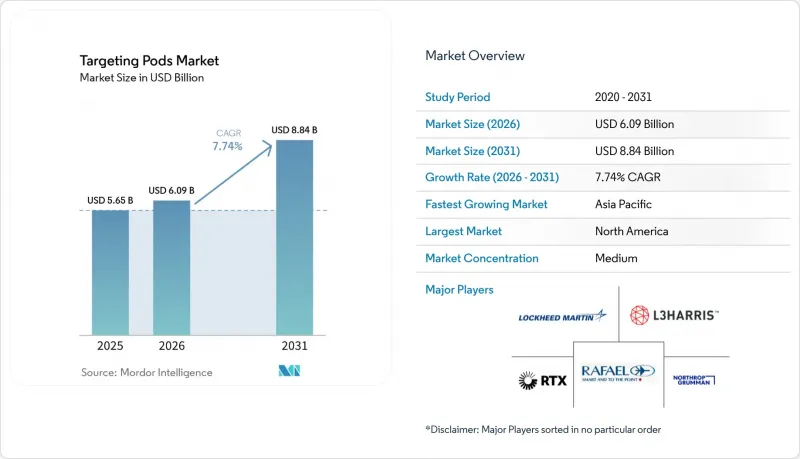
본 보고서는 플랫폼별(전투기, 무인 전투 항공기 시스템, 공격 헬기, 폭격기), 탑재 형태별(OEM 및 개조), 포드 유형별(FLIR 및 레이저 조준 포드 등), 기술별(전기광학 이미징 등), 지역별(북미, 유럽, 아시아태평양, 남미 등)로 분류되어 있습니다. 시장 전망은 금액(달러) 기준으로 제시되어 있습니다.
세계의 타겟팅 포드 시장 동향 및 인사이트
신흥 경제국에서의 첨단 전투기 도입 확대
중소득 국가들은 지역적 위협을 견제하기 위해 전투기 보유 대수를 늘리고 있으며, 이로 인해 고성능 타겟팅 포드 시장 솔루션에 대한 수요가 증가하고 있습니다. 필리핀은 첨단 전투기 및 관련 센서 시스템을 포함하는 10년간의 현대화 프로그램에 350억 달러를 배정했습니다. 동남아시아 공군들은 기체당 약 6,500만 달러 수준의 한국산 KF-21 보라메에 대한 아랍에미리트(UAE)의 관심 등 다양한 조달 방안을 검토하고 있습니다. 이러한 조달은 기체 수보다 정밀 공격을 우선시하고 있어, 비용 효율이 뛰어난 전력 증강 수단으로서 타겟팅 포드 시장의 중요성을 높이고 있습니다.
제4·제5세대 항공기 부대의 업그레이드 계획
대규모 개보수 계획에 따라 타겟팅 포드 공급업체와의 장기 계약이 유지되고 있습니다. 폴란드가 FA-50용으로 9,068만 달러에 ‘스나이퍼’ 포드를 구매한 사례는 공군이 완전히 새로운 기체를 도입하지 않고도 전투 능력을 유지하고 있음을 보여줍니다. 미국 공군의 ‘LITENING’ 대형 개구부 업그레이드는 해상도와 감지 거리를 50% 향상시켜 기존 플랫폼의 성능을 단계적으로 강화합니다.
높은 도입 비용과 수명 주기 비용
항공기 가격의 급등은 비용 대비 효과 문제를 더욱 심각하게 만들고 있습니다. F-35는 초기 생산분 기준 기체당 1억 4,000만 달러를 초과하며, 차세대 전투기는 3억 달러를 초과할 가능성이 있어, 고성능 포드는 상당한 추가 비용이 발생합니다. 장기적인 유지 관리를 위해서는 전문적인 소프트웨어 유지 보수 및 센서 재교정이 필요하며, 이로 인해 운영 예산에 대한 부담이 커집니다.
부문별 분석
2025년에는 방위 예산 증가와 첨단 조준 시스템에 대한 수요 증가를 배경으로, 전투기가 타겟팅 포드 시장의 62.05%라는 압도적인 점유율을 차지한 것으로 평가되었습니다. 한편, 무인 전투 항공 시스템은 2026-2031년 연평균 성장률(CAGR) 9.63%로 성장할 것으로 전망됩니다. MQ-9 리퍼에 SkyTower II를 통합한 사례는 가볍고 열 효율이 뛰어난 포드가 엄격한 크기·중량·전력 제약을 충족시킨 좋은 예입니다. 제너럴 아토믹스(General Atomics)가 MQ-9B를 통해 실시한 공중 레이저 포드 시험은 첨단 냉각 및 전력 관리 솔루션을 추진함으로써 확대되는 임무 범위를 더욱 부각시키고 있습니다. 공격 헬기와 전략 폭격기는 근접 지원 및 장거리 정밀 공격을 위해 전용 포드를 장착하고 있습니다. 동시에, E-7A 웨지테일과 병행하여 진행되는 MQ-28 고스트배트의 운용과 같은 협력적인 팀 구성은 차세대 포드만이 충족할 수 있는 까다로운 네트워크 요건을 요구하고 있습니다.
자율적인 표적 포착을 포드에 의존하는 각국의 드론 프로그램에서도 추가적인 수요가 발생하고 있습니다. 해병대의 MQ-9 시스템용 스마트 센서 패키지는 유인 및 무인 임무 프로파일의 융합을 여실히 보여주고 있습니다. 그 결과, 표적 포착 포드 시장은 기존 항공기와 저가시성 드론 모두와 호환되는 더 가볍고 모듈식인 페이로드로 계속 진화하고 있으며, 이는 센서 통합 업체들에게 지속적인 수익을 보장하고 있습니다.
2025년 수익 중 68.10%를 순정 장비가 차지했으며, 이는 신규 건조 플랫폼에서의 표준적인 통합을 보여줍니다. 그러나 연평균 성장률(CAGR) 8.78%로 확대되고 있는 사후 장착 수요는 공군이 단계적인 현대화를 선호하고 있음을 시사합니다. 사후 장착에 따른 타겟팅 포드 시장 규모는 싱가포르의 F-16V 프로그램과 같은 계획적인 중기 개조를 통해 확대되고 있습니다. 이 프로그램에서는 포드 교체 외에도 AESA 레이더와 새로운 항공 전자 장비가 추가되었습니다. 각 OEM 업체들은 레거시 시스템을 네트워크 지원 자산으로 전환하기 위한 하드웨어 키트와 소프트웨어 패치를 제공합니다.
레트로핏은 리드타임을 단축하고, 조종사의 재교육 비용을 절감합니다. 많은 전투기에 탑재된 디지털 백본은 플러그 앤 플레이 방식을 통해 포드 장착 절차를 간소화함으로써, 예산 측면에서 더욱 매력적인 선택지가 되고 있습니다. 그 결과, 완전히 새로운 플랫폼이 등장했음에도 불구하고, 레트로핏 기회는 타겟팅 포드 업계에서 안정적인 수익의 주축으로 남아 있을 것입니다.
지역별 분석
북미는 미국 국방부의 지속적인 조달 자금이 차세대 센서 통합 및 포드 업그레이드를 뒷받침하고 있어, 2025년 매출의 37.90%를 차지했으며, 계속해서 주도적인 위치를 유지하고 있습니다. 2026 회계연도 미국의 조달 요청액 2,050억 달러는 첨단 미사일과 무인 시스템을 우선시하고 있으며, 이에 따라 타겟팅 포드 시장의 파이프라인이 확대되고 있습니다. 캐나다의 MQ-9B 드론 발주와 영국의 항공모함 탑재형 F-35B 배치는 동맹국 각국의 함대 전반에 걸쳐 지속되고 있는 센서 업그레이드 주기를 다시 한번 보여주고 있습니다.
아시아태평양은 2031년까지 연평균 성장률(CAGR) 8.83%를 기록할 전망이며, 가장 빠르게 성장하고 있는 지역입니다. 인도네시아의 라팔 42대 계약, 싱가포르의 F-16V 및 F-35B 통합 프로그램, 그리고 일본이 인도에 제안한 6세대 GCAP 전투기 개발 참여 제안은 이 지역의 활기를 뒷받침하고 있습니다. 타겟팅 포드 수요는 방위산업 협력 확대와 유지보수의 현지화를 도모하는 기술 이전 협정의 혜택을 받고 있습니다.
유럽에서는 토네이도 및 구형 타이푼의 퇴역 주기에 힘입어 꾸준한 교체 수요가 유지되고 있습니다. 한편, 중동의 고객들은 정밀 조준 능력을 갖춘 한국이나 튀르키예의 플랫폼을 도입하는 등 공급 기반의 다각화를 추진하고 있습니다. 라틴아메리카에서는 규모는 작지만 꾸준한 개보수가 진행되고 있으며, 포드 업그레이드와 항공기 정비 패키지를 세트로 제공하는 미국의 대외군사판매(FMS) 융자 제도를 활용하고 있습니다. 전반적으로, 각 지역 수요 곡선은 전 세계적으로 분산된 항공기용 조준 포드 시장의 견조한 성장세를 뒷받침하고 있습니다.
기타 혜택 :
- 엑셀 형식 시장 예측(ME) 시트
- 3개월간의 애널리스트 지원
자주 묻는 질문
목차
제1장 서론
제2장 조사 방법
제3장 주요 요약
제4장 시장 구도
제5장 시장 규모 및 성장 예측
제6장 경쟁 구도
제7장 시장 기회 및 향후 전망
AJY 26.06.26According to Mordor Intelligence, the targeting pods market size in 2026 is estimated at USD 6.09 billion, growing from 2025 value of USD 5.65 billion with 2031 projections showing USD 8.84 billion, growing at 7.74% CAGR over 2026-2031.
This report is Segmented by Platform (Combat Aircraft, Unmanned Combat Aerial Systems, Attack Helicopters, and Bombers), Fit (OEM and Retrofit), Pod Type (FLIR and Laser-Designator Pods, and More), Technology (Electro-Optical Imaging, and More), and Geography (North America, Europe, Asia-Pacific, South America, and More). The Market Forecasts are Provided in Terms of Value (USD).
Global Targeting Pods Market Trends and Insights
Growing Procurement of Advanced Combat Aircraft in Emerging Economies
Middle-income nations are expanding fighter inventories to deter regional threats, elevating demand for high-end targeting pods market solutions. The Philippines earmarked USD 35 billion for a ten-year modernization program that includes advanced fighters and associated sensor suites. Southeast Asian air forces are evaluating diversified supply options, such as the UAE's interest in South Korea's KF-21 Boramae priced near USD 65 million per unit. These procurements prioritize precision engagement over fleet size, reinforcing the targeting pods market as a cost-effective force multiplier.
Up-gradation Programs for 4th/5th-Generation Aircraft Fleets
Extensive retrofit initiatives sustain long-term contracts for targeting pod vendors. Poland's USD 90.68 million purchase of Sniper pods for FA-50s illustrates how air forces extend combat relevance without acquiring entirely new fleets. The US Air Force LITENING Large Aperture upgrade boosts resolution and range by 50%, providing incremental capability gains on installed platforms.
High Acquisition and Life-Cycle Costs
Escalating aircraft prices amplify affordability challenges; the F-35 exceeded USD 140 million per unit in earlier lots, and next-generation fighters may cross USD 300 million, making high-spec pods a sizeable additive cost. Long-term sustainment demands specialized software maintenance and sensor recalibration, adding pressure on operating budgets.
Other drivers and restraints analyzed in the detailed report include:
- Rising Demand for Precision-Guided Munitions
- Increasing Global Defense Budgets
- Export-Control/ITAR Restrictions
For complete list of drivers and restraints, kindly check the Table Of Contents.
Segment Analysis
Combat aircraft are set to command a dominant 62.05% share of the targeting pods market in 2025, driven by increasing defense budgets and the growing need for advanced targeting systems. Yet, unmanned combat aerial systems are set to grow at 9.63% CAGR as of 2026-2031. SkyTower II integration on MQ-9 Reapers exemplifies how lightweight, thermally efficient pods meet stringent size-weight-power limits. General Atomics' airborne-laser pod trials on the MQ-9B further highlight the expanding mission envelope that drives advanced cooling and power-management solutions. Attack helicopters and strategic bombers employ specialized pods for close support and long-range precision strike. At the same time, collaborative teaming-such as MQ-28 Ghost Bat operations alongside E-7A Wedgetail-imposes stringent networking requirements that only next-generation pods can fulfill.
Follow-on demand arises from national drone programs that rely on pods for autonomous targeting. The Marine Corps' smart-sensor package for MQ-9 systems highlights convergence between manned and unmanned mission profiles. Consequently, the targeting pods market continues evolving toward lighter, modular payloads compatible with both traditional aircraft and low-observable drones, ensuring sustained revenues for sensor integrators.
Original-equipment fits represent 68.10% of 2025 revenue, illustrating the baseline integration on newly built platforms. Yet retrofit demand, growing at 8.78% CAGR, signals the air force's preference for phased modernization. The targeting pods market size attached to retrofit installations gains from planned mid-life upgrades such as Singapore's F-16V program, which adds AESA radar and new avionics alongside pod replacements. OEMs supply hardware kits and software patches that convert legacy systems into network-ready assets.
Retrofits compress lead times and reduce pilot-retraining costs. Digital backbones installed on many fighters simplify plug-and-play pod insertion, reinforcing budgetary appeal. As a result, retrofit opportunities will remain a stable revenue pillar within the targeting pods industry despite the emergence of all-new platforms.
Geography Analysis
North America retains leadership with 37.90% 2025 revenue as sustained Pentagon procurement funds next-generation sensor integration and pod upgrades. The FY 2026 US procurement request of USD 205 billion prioritizes high-tech missiles and unmanned systems, expanding the targeting pods market pipeline. Canada's order for MQ-9B drones and the U.K.'s carrier-borne F-35B deployments reiterate ongoing sensor-upgrade cycles throughout allied fleets.
Asia-Pacific is the fastest-growing region at an 8.83% CAGR through 2031. Indonesia's deal for 42 Rafales, Singapore's combined F-16V and F-35B programs, and Japan's invitation to India to join the sixth-generation GCAP fighter underline regional momentum. Targeting pod demand benefits from broader defense-industrial cooperation and technology-transfer agreements that localize sustainment.
Europe maintains steady replacement demand driven by Tornado and older Typhoon retirement cycles. At the same time, Middle Eastern customers diversify their supplier bases to include South Korean and Turkish platforms equipped with advanced targeting capabilities. Latin America shows smaller but consistent retrofits, leveraging US Foreign Military Sales financing mechanisms that often bundle pod upgrades with aircraft maintenance packages. Collectively, regional demand curves affirm a resilient, globally distributed aircraft targeting pods market.
- ASELSAN A.S.
- Teledyne Technologies Incorporated
- Israel Aerospace Industries Ltd.
- L3Harris Technologies Inc.
- Lockheed Martin Corporation
- Northrop Grumman Corporation
- Rafael Advanced Defense Systems Ltd.
- RTX Corporation
- Thales Group
- BAE Systems plc
- Leonardo S.p.A
- Elbit Systems Ltd.
- Controp Precision Technologies Ltd.
Additional Benefits:
- The market estimate (ME) sheet in Excel format
- 3 months of analyst support
TABLE OF CONTENTS
1 INTRODUCTION
- 1.1 Study Assumptions and Market Definition
- 1.2 Scope of the Study
2 RESEARCH METHODOLOGY
3 EXECUTIVE SUMMARY
4 MARKET LANDSCAPE
- 4.1 Market Overview
- 4.2 Market Drivers
- 4.2.1 Growing procurement of advanced combat aircraft in emerging economies
- 4.2.2 Upgrade programs for 4th/5th-generation aircraft fleets
- 4.2.3 Rising demand for precision-guided munitions
- 4.2.4 Increasing global defense budgets
- 4.2.5 Integration of AI-enabled sensor fusion within targeting pods
- 4.2.6 NATO push for networked multi-platform "kill-web" architecture
- 4.3 Market Restraints
- 4.3.1 High acquisition and life-cycle costs
- 4.3.2 Export-control/ITAR restrictions
- 4.3.3 Cooling-technology limits for SWaP-constrained UAV pods
- 4.3.4 Vulnerability to cyber and datalink jamming in contested A2AD zones
- 4.4 Value Chain Analysis
- 4.5 Regulatory Landscape
- 4.6 Technological Outlook
- 4.7 Porter's Five Forces Analysis
- 4.7.1 Bargaining Power of Suppliers
- 4.7.2 Bargaining Power of Buyers
- 4.7.3 Threat of New Entrants
- 4.7.4 Threat of Substitutes
- 4.7.5 Intensity of Competitive Rivalry
5 MARKET SIZE AND GROWTH FORECASTS (VALUE)
- 5.1 By Platform
- 5.1.1 Combat Aircraft
- 5.1.2 Unmanned Combat Aerial Systems (UCAS)
- 5.1.3 Attack Helicopters
- 5.1.4 Bombers
- 5.2 By Fit
- 5.2.1 Original Equipment Manufacturer (OEM)
- 5.2.2 Retrofit/Upgrade
- 5.3 By Pod Type
- 5.3.1 FLIR and Laser-Designator Pods
- 5.3.2 Laser Spot-Tracker Pods
- 5.3.3 Multispectral/Networked Pods
- 5.3.4 IRST-Integrated Pods
- 5.4 By Technology
- 5.4.1 Electro-Optical Imaging
- 5.4.2 Infrared Imaging
- 5.4.3 Multispectral/Hyperspectral Sensing
- 5.4.4 AI-Enabled Sensor Fusion
- 5.4.5 5G/Mesh Networking Enabled
- 5.5 By Geography
- 5.5.1 North America
- 5.5.1.1 United States
- 5.5.1.2 Canada
- 5.5.1.3 Mexico
- 5.5.2 Europe
- 5.5.2.1 United Kingdom
- 5.5.2.2 Germany
- 5.5.2.3 France
- 5.5.2.4 Russia
- 5.5.2.5 Rest of Europe
- 5.5.3 Asia-Pacific
- 5.5.3.1 China
- 5.5.3.2 Japan
- 5.5.3.3 India
- 5.5.3.4 South Korea
- 5.5.3.5 Australia
- 5.5.3.6 Rest of Asia-Pacific
- 5.5.4 South America
- 5.5.4.1 Brazil
- 5.5.4.2 Rest of South America
- 5.5.5 Middle East and Africa
- 5.5.5.1 Middle East
- 5.5.5.1.1 Saudi Arabia
- 5.5.5.1.2 United Arab Emirates
- 5.5.5.1.3 Israel
- 5.5.5.1.4 Rest of Middle East
- 5.5.5.2 Africa
- 5.5.5.2.1 South Africa
- 5.5.5.2.2 Rest of Africa
- 5.5.5.1 Middle East
- 5.5.1 North America
6 COMPETITIVE LANDSCAPE
- 6.1 Market Concentration
- 6.2 Strategic Moves
- 6.3 Market Share Analysis
- 6.4 Company Profiles (includes Global level Overview, Market level overview, Core Segments, Financials as available, Strategic Information, Market Rank/Share, Products and Services, Recent Developments)
- 6.4.1 ASELSAN A.S.
- 6.4.2 Teledyne Technologies Incorporated
- 6.4.3 Israel Aerospace Industries Ltd.
- 6.4.4 L3Harris Technologies Inc.
- 6.4.5 Lockheed Martin Corporation
- 6.4.6 Northrop Grumman Corporation
- 6.4.7 Rafael Advanced Defense Systems Ltd.
- 6.4.8 RTX Corporation
- 6.4.9 Thales Group
- 6.4.10 BAE Systems plc
- 6.4.11 Leonardo S.p.A
- 6.4.12 Elbit Systems Ltd.
- 6.4.13 Controp Precision Technologies Ltd.
7 MARKET OPPORTUNITIES AND FUTURE OUTLOOK
- 7.1 White-Space and Unmet-Need Assessment


