

|
시장보고서
상품코드
2061712
일회용 의료용 장갑 시장 : 시장 점유율 분석, 업계 동향 및 통계, 성장 예측(2026-2031년)Disposable Medical Gloves - Market Share Analysis, Industry Trends & Statistics, Growth Forecasts (2026 - 2031) |
||||||
 Mordor Intelligence
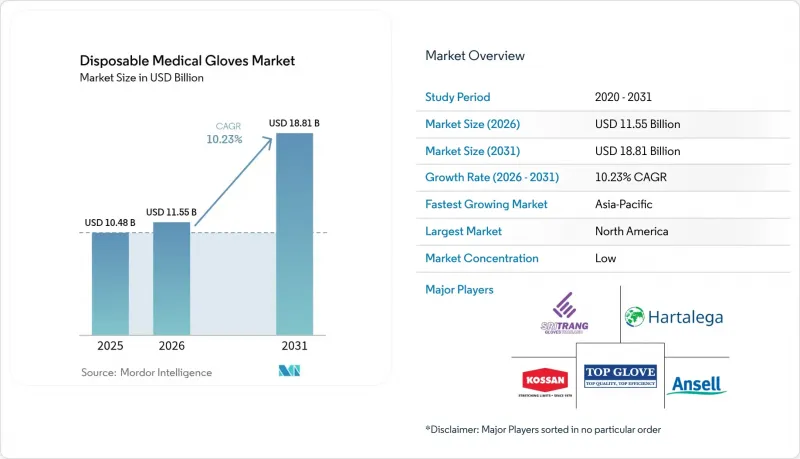
Mordor Intelligence에 의하면, 일회용 의료용 장갑 시장 규모는 2025년에 104억 8,000만 달러로 평가되었고, 2026년 115억 5,000만 달러로 추정되고, 2031년까지 188억 1,000만 달러에 이를 것으로 예측되며, 예측 기간(2026-2031년) CAGR은 10.23%를 나타낼 전망입니다.
본 보고서는 용도별(외과 수술, 진찰, 화학요법, 클린룸), 소재별(니트릴, 라텍스 등), 형태별(파우더 프리, 파우더 처리), 멸균 상태별(멸균 처리, 비멸균), 최종 사용자별(병원 등), 지역별(북미, 유럽, 아시아태평양, 중동 및 아프리카 등)로 분류되어 있습니다. 시장 규모 및 전망은 금액(달러) 기준으로 제시되어 있습니다.
세계의 일회용 의료용 장갑 시장 동향 및 분석
세계 의료시설 전반에 걸친 감염 관리 기준의 강화
의료 시스템에서는 장갑 사용 규정이 엄격해지고 있으며, 범용 진료용 장갑에서 특정 업무에 특화된 유형로 전환되고 있습니다. 2024년 11월에 발표된 미국 적십자사의 최신 지침에 따르면, 구급대원은 환자와 접촉할 때마다 의료용 진찰 장갑을 착용해야 하며, 이 권고 사항은 현재 많은 국가의 프로토콜에도 채택되어 있습니다. 호주의 2024년 안전 프레임워크에 기반한 중환자실 감사 결과, 12시간 교대 근무당 환자 1명당 평균 30세트가 소모되는 것으로 나타났으며, 이는 프로토콜이 소모량에 어떻게 반영되는지를 여실히 보여주고 있습니다. 이러한 변화로 인해 조달 팀은 SKU의 다양화를 피할 수 없게 되었으며, 이에 따른 복잡성으로 인해 병원들은 재고 부족 징후를 실시간으로 알려주는 재고 관리 소프트웨어의 도입을 서두르고 있습니다.
고령화와 만성 질환으로 인한 외과 및 진단 시술 건수 증가
시술 건수 증가는 일회용 의료용 장갑 시장의 성장을 뒷받침하는 핵심 요인으로 자리 잡고 있습니다. 메디케어 데이터에 따르면, 최근 분기만 해도 56곳의 새로운 외래수술센터(ASC)가 인증되었으며, 이는 65세 이상 연령층 증가하는 수술 수요를 외래 진료 수용 능력이 얼마나 잘 감당하고 있는지를 보여줍니다. 'Journal of Medicine, Surgery, and Public Health'의 예측에 따르면, 2034년까지 65세 이상 환자가 미국 전체 수술 건수의 39%를 차지할 가능성이 있으며, 이는 멸균 장갑 수요 증가로 직결됩니다. 유럽에서도 유사한 인구 동향이 나타나고 있으며, 2050년까지 고령 인구가 30%에 육박할 가능성이 있는 만큼, 수술 1건당 장갑 사용량이 정체되더라도 수술 건수에 연동된 장갑 수요량은 높은 수준을 유지할 것으로 보입니다.
천연고무 및 니트릴 부타디엔 원료 가격 변동
2024년 하반기, 태국의 홍수로 인해 천연 라텍스 가격이 상승하면서 중소 장갑 제조업체들은 단기간 내에 공급 계약 재협상을 해야만 했습니다. 동시에, 아시아 주요 통화에 대한 달러의 약세로 인해 수출 마진이 축소됨에 따라, 말레이시아의 주요 생산자들은 2024년 4분기를 앞두고 1,000장당 21-22달러로 평균 판매 가격을 인상하는 방안에 대해 협의를 시작했습니다. 아크릴로니트릴 가격은 하락하여 니트릴 계열 제조업체에 일시적인 이익률 개선을 가져왔지만, 석유화학제품의 가격 변동은 여전히 계획 수립에 있어 골칫거리로 남아 있습니다. 이러한 상황은 원자재 공급망에 대한 수직 통합을 촉진하고, 상품 가격에 대한 민감도가 낮은 대체 엘라스토머에 대한 연구 개발을 뒷받침하고 있습니다.
부문별 분석
2025년 일회용 의료용 장갑 시장에서 진찰용 장갑은 57.70%의 시장 점유율을 차지했으며, 이는 임상 및 비임상 분야의 모든 상황에서 폭넓게 사용되고 있음을 반영합니다. 병원의 보고에 따르면, 표준 진료용 장갑 SKU가 월간 장갑 발주량의 4분의 3 가량을 차지하고 있어, 꾸준한 기초 수요가 있음을 보여주고 있습니다. 현재, 보다 광범위한 처방 기준을 충족하기 위해 항암 치료용 니트릴 장갑 시장 점유율이 확대되고 있으며, 카테고리 간의 경계가 점차 모호해지는 한편, 평균 판매 가격도 상승하고 있습니다. 이러한 변화는 성숙한 하위 부문 내에서도 수익을 더욱 향상시킬 여지가 있음을 시사합니다.
항암 치료용 장갑 시장은 종양학 서비스의 확대와 ASTM D6978의 투과 시간 요건에 힘입어, 2031년까지 연평균 성장률(CAGR) 11.15%라는 가장 빠른 성장세를 보일 것으로 전망됩니다. 미국의 대규모 암 네트워크에서 계약을 수주한 사례를 보면, 화학요법제의 투과성에 관한 종합적인 시험 데이터를 제공하는 공급업체가 다년 계약을 따내고 있음을 알 수 있습니다. 두 자릿수 성장률을 기록하고 있는 수술용 장갑은 수술 건수 증가의 혜택을 보고 있는 반면, 클린룸용 장갑은 더욱 엄격한 오염 기준을 적용하는 반도체 팹의 확장으로 인해 수요가 확대되고 있습니다. 이러한 용도의 특수성으로 인해 규제 준수가 실질적인 진입 장벽이 되어, 적격 생산자의 가격 결정력을 보호하고 있습니다.
니트릴은 일회용 의료용 장갑 시장에서 53.10%의 점유율을 차지하고 있으며, 저알레르기성과 내약성 덕분에 여전히 주류 제품으로 자리 잡고 있습니다. 구매 데이터베이스에 따르면, 니트릴의 판매량은 2010-2024년 약 5배로 급증했으며, 이는 이 소재로의 전환이 정착되고 있음을 시사합니다. 생산 라인의 자동화가 진행됨에 따라 평균 단가가 하락했고, 비용에 민감한 고객층을 대상으로 니트릴 제조업체들은 저가 비닐 제품과 경쟁하며 시장 점유율을 유지할 수 있게 되었습니다. 안정적인 니트릴 수요와 원자재 가격의 완만한 하락이 맞물려 공급업체의 현금 흐름을 뒷받침하고 있으며, 이는 생산 능력의 추가 확충을 가능하게 하고 있습니다.
네오프렌은 연평균 성장률(CAGR) 11.98%로 가장 높은 성장률을 보이고 있으며, 그 주된 이유는 라텍스와 유사한 착용감 덕분에 의료진이 기존 소재에서 원활하게 전환할 수 있다는 점에 있습니다. 고급 치과 및 외과용 장갑 사용자들은 네오프렌의 탄력성 덕분에 장시간 시술 중 발생하는 손의 피로에 대한 불만이 줄어들며, 이것이 브랜드 충성도에 미묘한 영향을 미치고 있다고 지적하고 있습니다. 라텍스는 알레르기 대책이 그리 엄격하지 않은 지역에서 점유율이 줄어들고는 있지만, 여전히 상당한 시장 점유율을 유지하고 있습니다. 반면, 비닐(PVC)이나 폴리에틸렌은 예산이 제한적인 경우나 중요도가 낮은 용도로 사용됩니다. 지속가능성에 대한 고려로, 성능과 환경 기준을 모두 충족하는 생분해성 니트릴 블렌드에 대한 연구 개발이 진행되고 있으며, 이는 차기 제품 주기에서 제품 포트폴리오가 재편될 가능성이 높음을 시사합니다.
지역별 분석
북미는 1인당 의료비 수준이 높고 엄격한 감염 관리 규제가 뒷받침되어 일회용 의료용 장갑 시장에서 33.85%의 점유율을 차지하며 선두 자리를 유지하고 있습니다. 메디케어 및 메디케이드 서비스 센터(CMS)가 제안한 국내 생산 개인보호장비(PPE)에 대한 지급액 조정안은 미국산 장갑의 비용적 불리함을 장갑 1장당 약 0.13달러 정도 줄여주는 것입니다. 이 정책의 영향으로 텍사스주와 앨라배마주 등에서는 기존 제조업체들의 생산 능력 확대가 촉진되고 있으며, 초기 징후에 따르면 리드타임 단축이 병원의 조달 결정에 영향을 미치고 있는 것으로 나타났습니다. 또한, 해당 지역에서는 업무별 장갑 사용 지침의 도입이 활발히 이루어지고 있어, 병원 처방 목록 내 SKU 증가에 기여하고 있습니다.
아시아태평양의 연평균 성장률(CAGR) 11.05%는 의료 인프라 확충, 보험 적용 범위 확대, 그리고 호황을 누리고 있는 의료 관광에 힘입은 결과입니다. 말레이시아 공장에서는 인더스트리 4.0 로봇 기술을 도입하여 생산 라인 속도를 시간당 4만 5,000장 이상으로 높임으로써 임금 상승 압력을 완화하고 있습니다. 무역 정책의 전환, 특히 중국산 장갑에 대한 미국의 관세 인상은 주문이 다른 지역으로 이동함에 따라 동남아시아 수출업체들에게 이익을 가져다주고 있습니다. 인도 정부의 157개 신규 의과대학에 대한 투자는 진료용 장갑 및 수술용 장갑 수요를 촉진하고 있으며, 2선 도시에 현지 물류센터를 설립함으로써 유통업체의 라스트 마일 비용을 절감하고 있습니다.
유럽은 여전히 상당한 시장 점유율을 유지하고 있으며, 그 배경에는 친환경 장갑에 대한 수요를 높이는 엄격한 환경 지침이 있습니다. 각국의 의료 제도에서는 가격뿐만 아니라 탄소 발자국도 고려한 조달 체계의 시범 도입이 진행되고 있으며, 공급업체들에게 생분해성 니트릴 장갑으로의 전환을 권장하고 있습니다. 중동 및 아프리카에서는 각국 정부가 3차 병원 및 국민건강보험 제도에 투자하고 있어 시장 침투율이 높아지고 있습니다. 남미에서는 브라질이 도입을 주도하고 있으며, 주 정부의 구매 프로그램에는 장갑의 올바른 폐기 방법에 관한 교육이 점점 더 많이 포함되고 있어, 이는 전반적인 감염 예방 역량 강화에 기여하는 요소가 되고 있습니다.
기타 혜택 :
- 엑셀 형식 시장 예측(ME) 시트
- 3개월간의 애널리스트 지원
자주 묻는 질문
목차
제1장 서론
제2장 조사 방법
제3장 주요 요약
제4장 시장 구도
제5장 시장 규모 및 성장 예측
제6장 경쟁 구도
제7장 시장 기회 및 향후 전망
AJY 26.06.22According to Mordor Intelligence, the disposable medical gloves market size was valued at USD 10.48 billion in 2025 and estimated to grow from USD 11.55 billion in 2026 to reach USD 18.81 billion by 2031, at a CAGR of 10.23% during the forecast period (2026-2031).
This report is Segmented by Application (Surgical, Examination, Chemotherapy, and Clean-Room), Material (Nitrile, Latex, and More), Form (Powder-Free and Powdered), Sterility (Sterile and Non-Sterile), End-User (Hospitals, and More), and Geography (North America, Europe, Asia-Pacific, Middle East and Africa and More). The Market Sizes and Forecasts are Provided in Terms of Value (USD).
Global Disposable Medical Gloves Market Trends and Insights
Stricter Global Infection-Control Standards Across Healthcare Facilities
Healthcare systems are tightening glove usage protocols, moving from generic examination gloves to highly task-specific variants. According to updated American Red Crossguidelines released in November 2024, first-aid responders must don medical examination gloves for every patient interaction, a recommendation now echoed in many national protocols. Intensive-care audits under Australia's 2024 safety frameworkshow average consumption of 30 pairs per patient per 12-hour shift, underscoring how protocols translate into volume. The shift obliges procurement teams to diversify SKUs, and that complexity spurs hospitals to adopt inventory-management software that flags impending stock-outs in real time.
Rising Surgical & Diagnostic Procedure Volumes Driven by Aging & Chronic-Disease Burden
Procedure growth remains a pillar of the Disposable Medical Gloves market expansion. Medicare data indicate 56 new ambulatory surgical centers certified in one recent quarter, illustrating how outpatient capacity absorbs rising surgical demand from the 65+ age cohort. Journal of Medicine, Surgery, and Public Health projections show patients over 65 could account for 39% of all U.S. surgeries by 2034, translating directly into higher sterile-glove pull-through. A similar demographic trend in Europe, where the senior population could approach 30% by mid-century, suggests that procedure-linked glove volumes will stay elevated even if per-procedure glove counts stabilize.
Volatility in Natural Rubber & Nitrile-Butadiene Feedstock Prices
Flooding in Thailand nudged natural latex prices higher in late 2024, forcing smaller glove makers to renegotiate supply contracts on shorter cycles. At the same time, a weakening USD versus Asian currencies narrowed export margins, prompting leading Malaysian producers to discuss average selling-price increases toward USD 21-22 per 1,000 pieces for Q4 2024. Acrylonitrile prices eased, giving nitrile-focused manufacturers brief margin relief, yet petrochemical volatility remains a planning headache. The pattern incentivizes vertical integration into raw-material streams and fuels R&D into alternative elastomers that display less commodity price sensitivity.
Other drivers and restraints analyzed in the detailed report include:
- Industry-Wide Shift to Synthetic (Nitrile/Neoprene) Gloves for Allergy Compliance
- Expansion of Healthcare Infrastructure & Insurance Coverage in Emerging Economies
- Intensifying Environmental & Sustainability Regulations on Single-Use Plastics
For complete list of drivers and restraints, kindly check the Table Of Contents.
Segment Analysis
Examination gloves hold a 57.70% market share in the Disposable Medical Gloves market in 2025, reflecting their universal role across clinical and non-clinical settings. Hospitals report that standard examination SKUs account for nearly three-quarters of monthly glove lines on purchase orders, illustrating entrenched baseline demand. A growing share now features chemo-tested nitrile to satisfy broader formularies, subtly blending categories and lifting average selling prices. That shift suggests incremental revenue upside even within a mature subsegment.
Chemotherapy gloves post the fastest forecast expansion at 11.15% CAGR through 2031, propelled by oncology service growth and ASTM D6978 breakthrough-time requirements. Contract wins in large U.S. cancer networks show that suppliers offering full chemo-drug permeation panels secure multi-year agreements. Surgical gloves, growing at a significant percentage, benefit from rising procedure counts, while clean-room gloves gain from semiconductor fab expansions that impose stricter contamination thresholds. The specialized nature of these uses makes regulatory compliance a practical barrier that protects pricing power for qualified producers.
Nitrile commands 53.10% Disposable Medical Gloves market share and remains the mainstream choice due to hypoallergenic properties and chemical resistance. Purchasing databases indicate that nitrile volume surged nearly fivefold from 2010 to 2024, suggesting that the material shift is durable. Increased line-speed automation brings average unit cost down, enabling nitrile producers to defend share against lower-priced vinyl in cost-sensitive accounts. Stable nitrile demand, paired with moderate feedstock relief, underpins supplier cash flows for further capacity upgrades.
Neoprene exhibits the highest growth at 11.98% CAGR, mainly because its latex-like comfort eases clinician transition from legacy materials. Premium dental and surgical users note that neoprene's elasticity reduces hand-fatigue complaints during long procedures, subtly influencing brand loyalty. Latex keeps a shrinking but sizeable foothold in regions where allergy policies are less stringent, while vinyl (PVC) and polyethylene serve budget-constrained or non-critical tasks. Sustainability considerations are steering R&D toward biodegradable nitrile blends that meet both performance and environmental criteria, indicating likely portfolio rebalancing in the next product-cycle.
Geography Analysis
North America leads with a 33.85% Disposable Medical Gloves market share, supported by high per-capita healthcare spending and rigorous infection-control regulations. The Centers for Medicare & Medicaid Services' proposal to adjust payments for domestically manufactured PPE narrows the cost disadvantage of U.S.-made gloves by approximately USD 0.13 per unit. That policy momentum spurs existing producers to expand capacity in states such as Texas and Alabama, and early evidence shows shorter lead times influencing hospital sourcing choices. The region also exhibits strong adoption of task-specific glove protocols, contributing to SKU proliferation within hospital formularies.
Asia Pacific's 11.05% CAGR rests on healthcare infrastructure expansion, rising insurance coverage, and thriving medical tourism. Malaysian plants incorporate Industry 4.0 robotics to raise line speeds above 45,000 pieces per hour, cushioning wage inflation. Trade policy shifts, especially higher U.S. duties on Chinese gloves, benefit Southeast Asian exporters through order diversion. India's government investment in 157 new medical colleges accelerates demand for examination and surgical gloves, and localized warehousing in Tier-2 cities reduces last-mile costs for distributors.
Europe sustains a notable share, underpinned by stringent environmental directives that elevate demand for eco-friendly glove alternatives. National health systems are piloting procurement frameworks that weigh carbon footprint alongside price, nudging suppliers toward biodegradable nitrile. The Middle East and Africa show rising penetration as governments invest in tertiary hospitals and universal health coverage schemes. In South America, Brazil leads adoption, and state purchase programs increasingly include training on correct glove disposal, an element contributing to broader infection-prevention capacity building.
- Ansell
- Cardinal Health
- Dynarex Corp.
- Hartalega Holdings Bhd
- Kimberly-Clark Corp.
- Kossan Rubber Industries
- Molnlycke Health Care
- Rubberex Bhd
- Semperit
- Supermax Corp. Bhd
- Top Glove Corp. Bhd
- American Nitrile LLC
- Sri Trang Gloves PLC
- Medline Industries
- Intco Medical Technology
- Mercator Medical SA
- Careplus Group Bhd
- Showa Group
- Winner Medical Co. Ltd.
- Zhonghong Pulin Medical
- Smart Glove Corp.
- Eagle Protect PBC
- Shield Scientific BV
- Adenna LLC
- Honeywell International
Additional Benefits:
- The market estimate (ME) sheet in Excel format
- 3 months of analyst support
TABLE OF CONTENTS
1 Introduction
- 1.1 Study Assumptions & Market Definition
- 1.2 Scope of the Study
2 Research Methodology
3 Executive Summary
4 Market Landscape
- 4.1 Market Overview
- 4.2 Market Drivers
- 4.2.1 Stricter Global Infection-Control Standards Across Healthcare Facilities
- 4.2.2 Rising Surgical & Diagnostic Procedure Volumes Driven by Aging & Chronic-Disease Burden
- 4.2.3 Industry-Wide Shift to Synthetic (Nitrile/Neoprene) Gloves for Allergy Compliance
- 4.2.4 Expansion of Healthcare Infrastructure & Insurance Coverage in Emerging Economies
- 4.2.5 Process & Automation Advances Delivering High-Volume, Low-Cost Production
- 4.2.6 E-procurement Platforms Enabling Bulk Ordering by Small Clinics in Emerging Markets
- 4.3 Market Restraints
- 4.3.1 Volatility in Natural Rubber & Nitrile-Butadiene Feed-stock Prices
- 4.3.2 Intensifying Environmental & Sustainability Regulations on Single-Use Plastics
- 4.3.3 Global Overcapacity Post-Pandemic Triggering Persistent Price Competition
- 4.3.4 U.S. Withhold-Release Orders (WRO) on Labor Practices Creating Import Uncertainty
- 4.4 Supply Chain Analysis
- 4.5 Regulatory Outlook
- 4.6 Technological Outlook
- 4.7 Porter's Five Forces Analysis
- 4.7.1 Threat of New Entrants
- 4.7.2 Bargaining Power of Buyers
- 4.7.3 Bargaining Power of Suppliers
- 4.7.4 Threat of Substitute Products
- 4.7.5 Intensity of Competitive Rivalry
5 Market Size & Growth Forecasts (Value, USD)
- 5.1 By Application
- 5.1.1 Surgical
- 5.1.2 Examination
- 5.1.3 Chemotherapy
- 5.1.4 Clean-Room
- 5.2 By Material
- 5.2.1 Nitrile (NBR)
- 5.2.2 Latex (Natural Rubber)
- 5.2.3 Vinyl (PVC)
- 5.2.4 Neoprene (Polychloroprene)
- 5.2.5 Polyethylene (CPE/TPE)
- 5.3 By Form
- 5.3.1 Powder-Free
- 5.3.2 Powdered
- 5.4 By Sterility
- 5.4.1 Sterile
- 5.4.2 Non-Sterile
- 5.5 By End-User
- 5.5.1 Hospitals
- 5.5.2 Diagnostic Laboratories
- 5.5.3 Ambulatory Surgical Centers
- 5.5.4 Dental Clinics
- 5.5.5 Home-Care Settings
- 5.6 Geography
- 5.6.1 North America
- 5.6.1.1 United States
- 5.6.1.2 Canada
- 5.6.1.3 Mexico
- 5.6.2 Europe
- 5.6.2.1 Germany
- 5.6.2.2 United Kingdom
- 5.6.2.3 France
- 5.6.2.4 Italy
- 5.6.2.5 Spain
- 5.6.2.6 Rest of Europe
- 5.6.3 Asia-Pacific
- 5.6.3.1 China
- 5.6.3.2 Japan
- 5.6.3.3 India
- 5.6.3.4 South Korea
- 5.6.3.5 Australia
- 5.6.3.6 Rest of Asia-Pacific
- 5.6.4 Middle East and Africa
- 5.6.4.1 GCC
- 5.6.4.2 South Africa
- 5.6.4.3 Rest of Middle East and Africa
- 5.6.5 South America
- 5.6.5.1 Brazil
- 5.6.5.2 Argentina
- 5.6.5.3 Rest of South America
- 5.6.1 North America
6 Competitive Landscape
- 6.1 Market Concentration
- 6.2 Market Share Analysis
- 6.3 Company Profiles (includes Global level Overview, Market level overview, Core Segments, Financials as available, Strategic Information, Market Rank/Share for key companies, Products & Services, and Recent Developments)
- 6.3.1 Ansell Ltd.
- 6.3.2 Cardinal Health Inc.
- 6.3.3 Dynarex Corp.
- 6.3.4 Hartalega Holdings Bhd
- 6.3.5 Kimberly-Clark Corp.
- 6.3.6 Kossan Rubber Industries Bhd
- 6.3.7 Molnlycke Health Care AB
- 6.3.8 Rubberex Bhd
- 6.3.9 Semperit AG Holding
- 6.3.10 Supermax Corp. Bhd
- 6.3.11 Top Glove Corp. Bhd
- 6.3.12 American Nitrile LLC
- 6.3.13 Sri Trang Gloves PLC
- 6.3.14 Medline Industries LP
- 6.3.15 Intco Medical Technology
- 6.3.16 Mercator Medical SA
- 6.3.17 Careplus Group Bhd
- 6.3.18 Showa Group
- 6.3.19 Winner Medical Co. Ltd.
- 6.3.20 Zhonghong Pulin Medical
- 6.3.21 Smart Glove Corp.
- 6.3.22 Eagle Protect PBC
- 6.3.23 Shield Scientific BV
- 6.3.24 Adenna LLC
- 6.3.25 Honeywell International Inc.
7 Market Opportunities & Future Outlook
- 7.1 White-space & Unmet-Need Assessment


