|
시장보고서
상품코드
2061740
군용 통신 : 시장 점유율 분석, 업계 동향 및 통계, 성장 예측(2026-2031년)Military Communications - Market Share Analysis, Industry Trends & Statistics, Growth Forecasts (2026 - 2031) |
||||||
 Mordor Intelligence
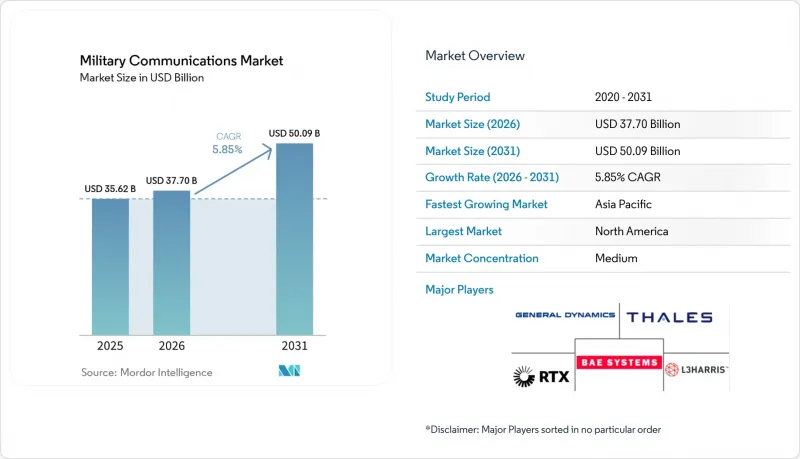
Mordor Intelligence에 의하면, 2026년 군용 통신 시장 규모는 377억 달러에 달할 것으로 추정됩니다. 2025년 356억 2,000만 달러에서 확대해, 2031년에는 500억 9,000만 달러에 이를 것으로 예측됩니다.
2026년부터 2031년까지 연평균 성장률(CAGR) 5.85%를 나타낼 것으로 전망됩니다.
본 보고서는 통신 유형(함재형, 지상 기반 등), 구성 요소(군용 위성 통신 시스템, 군사 무선 시스템 등), 용도(지휘통제, 정보·감시·정찰 등), 플랫폼(육상 부대, 해군 부대 등) 및 지역(북미, 유럽 등)별로 분류되어 있습니다. 시장 전망은 금액(달러) 기준으로 제시되어 있습니다.
세계의 군용 통신 시장 동향과 인사이트
미국 국방부(DoD)의 통합 전영역 지휘통제(JADC2)의 전개
138억 달러 규모의 JADC2 이니셔티브는 지상, 공중, 우주, 사이버 각 영역의 센서 데이터를 단일 작전 상황도로 통합함으로써 부대 구조를 혁신합니다. 실시간 융합으로 인해 처리량, 지연 시간, 보안에 대한 요구 수준이 높아짐에 따라, 공급업체들은 여러 파형을 동시에 지원하고 신속한 무선 업데이트가 가능한 소프트웨어 정의 단말기를 제공해야 하는 상황에 직면해 있습니다. L3Harris와 Palantir가 진행한 현장 시연에서는 기존 센서를 AI 분석과 결합함으로써 데이터 채널의 과부하를 유발하지 않으면서 의사결정 주기를 단축할 수 있음이 입증되었습니다. 동맹국들 사이에서 개방형 아키텍처 표준이 보급됨에 따라, 상호 운용성과 수명 주기 비용 절감을 중시하는 조달 개혁으로 인해 군용 통신 시장은 성장세를 보이고 있습니다.
저궤도(LEO) 방어 위성군 체계의 보급
LEO(저궤도)에 수백 기의 소형 위성을 배치함으로써 지연 시간이 단축되고 경로의 다양성이 확대되며, 단일 노드가 물리적 또는 사이버 공격을 받더라도 통신 연결을 유지할 수 있습니다. 2025년에 100기 이상의 위성을 발사하겠다는 미국 우주군의 계획은 다른 국가들에게 지침이 되고 있습니다. 다중 대역 사용자 단말기는 몇 분 간격으로 위성 간 핸드오버를 수행해야 하므로, 적응형 안테나 및 빔 스티어링 모듈에 대한 수요를 견인하고 있습니다. 클라우드 기반 임무 제어 소프트웨어가 트래픽을 조절하여, 기밀 채널과 상용 채널 간의 균형을 실시간으로 조정합니다. 공급업체는 이러한 혼합 링크를 인증함으로써 장기 서비스 계약을 확보할 수 있습니다. 내결함성이 뛰어난 우주 통신 계층이 성숙해짐에 따라, 군은 분산형 아키텍처를 틈새 기술이 아닌 표준으로 인식하게 되었습니다.
혼잡하고 치열한 경쟁이 벌어지는 주파수 대역이 상호 운용성의 병목 현상을 초래하고 있습니다.
민간용 5G, 메가 콘스텔레이션, 적대 세력의 전파 방해 장치가 과거 국방용으로 확보되었던 주파수 대역을 점유하고 있어, 연합군은 실시간으로 주파수 충돌을 해소해야만 하는 상황에 처해 있습니다. NATO 규격은 파형 보급 속도를 따라가지 못하고 있어, 합동 작전 중 호환되지 않는 무전기가 마주치게 되면 임무 수행에 필수적인 핸드오프가 지연되고 맙니다. 벤더는 스펙트럼 감지 기능과 크로스밴드 게이트웨이를 통합해야 하지만, 이러한 요소들은 비용과 복잡성을 증가시켜 단기적인 도입을 저해하는 요인이 되고 있습니다.
부문별 분석
해군이 비밀 해상 통신망의 격차를 해소해 나감에 따라, 수중 통신은 9.12%라는 최고 수준의 연평균 성장률(CAGR)을 보일 것으로 전망됩니다. 2025년에도 군용 통신 시장 점유율의 35.78%를 차지한 지상 기반 노드이지만, 이들은 포화 속에서도 자동으로 경로를 재설정하는 메쉬 아키텍처로 진화하고 있습니다. 장갑차의 무전기 업그레이드와 여단급 5G 노드가 지상 시스템 분야의 군용 통신 시장 규모를 뒷받침하고 있습니다. 음향 모뎀과 레이저 기반의 청록색 광통신을 통해 잠수함은 수면 위로 떠오르지 않고도 상황 인식 정보를 공유할 수 있게 되었으며, 이러한 능력은 AUKUS 혁신 챌린지에서 주목을 받았습니다. 함재 플랫폼은 악천후 시 기동 중에도 통신을 유지하기 위해 멀티밴드 SATCOM 및 L-밴드 안테나를 채택하고 있습니다. CH-47 치누크 헬리콥터에 AN/PRC-158을 탑재함으로써 공대지 상호운용성이 향상되었으며, 회전익기 부대가 전술 IP 네트워크에 직접 연결되게 되었습니다.
저감지확률(LPD) 파형의 발전으로 인해, 엄격한 크기 및 전력 제약이 있음에도 불구하고 항공기への 채택이 확대되고 있습니다. 주파수 대역 확보 경쟁이 치열해지는 가운데, 항공기용 무선기는 방사량을 최소화하기 위해 적응형 부호화와 지향성 안테나를 통합하고 있습니다. 한편, 연안의 HF 방송국은 위성 및 이동통신이 두절되었을 때 대체 경로를 제공함으로써, 군용 통신 시장 전체의 하이브리드형 내결함성을 더욱 공고히 하고 있습니다.
2025년, 군사 무선 시스템은 군용 통신 시장 규모의 30.22%를 차지했습니다. 그럼에도 불구하고, 암호화, 제로 트러스트 액세스, 엔드포인트 감지 기능이 전송 하드웨어와 통합됨에 따라 사이버 보안 하위 시스템은 8.02%라는 가장 높은 연평균 성장률(CAGR)을 기록했습니다. 미 육군의 ‘차세대 지휘통제(Next Generation Command and Control)’ 프로그램에 기반한 스마트폰형 견고한 단말기는 직관적인 사용자 인터페이스를 도입하는 동시에, 파형 적응성을 위해 SDR 코어를 활용하고 있습니다. 통합 안테나 어퍼처는 하나의 패널로 UHF에서 Ka 대역까지를 커버하여 마스트의 설치 면적을 줄이는 동시에, 차량 탑재형으로의 개조를 가속화하고 있습니다.
고정식 사이트 전반에서는 대용량 데이터 전송과 전자파 누출 저감을 목적으로, 광 링크와 내환경성 광섬유가 구리선을 대체하고 있습니다. Link-16이나 MADL 등의 전술 데이터 링크는 IP 오버레이로 전환되어, 클라우드 애플리케이션과의 연동이 용이해졌습니다. LEO(저궤도) 통신 트래픽의 급증에 따라, 멀티밴드 RF 프론트엔드는 GEO(정지궤도)와 LEO 자산 간의 조정을 수행하도록 발전하여, 군용 통신 시장에서 가동 시간을 극대화하고 있습니다.
지역별 분석
북미는 2025년, 미 국방부의 JADC2 및 통신·전자 장비 관련 2025년도 예산 86억 달러에 힘입어 군용 통신 시장 점유율 41.11%를 유지했습니다. 해당 지역에 본사를 둔 주요 방위 기업들은 설계, 제조, 유지보수 등 각 공정을 수직 통합함으로써 실전 배치까지의 속도를 높이고 있습니다. 캐나다는 NORAD(북미항공우주방위사령부) 네트워크에 연결되는 북극권용 위성통신(SATCOM) 및 HF 게이트웨이 개발을 추진 중이며, 한편 멕시코는 안전한 국경 감시를 위한 무전기를 조달하고 있습니다. AI를 활용한 스펙트럼 관리 도구와 프라이빗 5G 아키텍처 분야에서 이 지역이 보여준 리더십은 군용 통신 시장에서 세계적인 기술 허브로서의 위상을 확고히 하고 있습니다.
아시아·태평양 지역은 2031년까지의 연평균 성장률(CAGR)이 6.45%로 가장 높습니다. 중국과 인도의 예산은 외국산 암호화 칩에 대한 의존도를 줄이기 위해 국산 소프트웨어 정의 무선(SDR) 프로그램으로 전환되고 있습니다. 78억 1,000만 대만 달러(2억 3,844만 달러) 규모의 대만의 ‘야전 정보통신 시스템’은 대만 해협의 긴장이 고조되는 가운데, 내결함성이 높고 상호 운용이 가능한 백본에 대한 지역 내 수요를 여실히 보여주고 있습니다. 일본과 한국은 보급로를 확보하기 위해 수중 및 우주 중계 프로젝트에 자금을 투입하고 있는 반면, 호주의 AUKUS 파트너십은 미국의 전술 IP 네트워크에 직접 연결되는 음향 잠수함 링크를 추진하고 있습니다. 이러한 다층적인 투자를 통해 아시아태평양은 군용 통신 시장의 두 번째 성장 축으로서의 입지를 확고히 하고 있습니다.
유럽은 NATO의 상호운용성 요건과 우크라이나 분쟁 이후 국방 예산 증액으로 인한 혜택을 누리고 있습니다. 독일의 32억 유로(37억 달러) 규모의 디지털 전환과 네덜란드의 14억 2,000만 달러 규모의 AN/PRC 무선기 발주는 표준화되어 연합군 운용에 즉시 대응 가능한 무선기로의 전환 추세를 상징하고 있습니다. 영국은 지연이 발생하고 있음에도 불구하고, 모피어스(Morpheus) 계획에 따라 지상군 네트워크 개편을 계속하고 있습니다. 북유럽 국가들은 북극권 진출을 우선시하며, 고위도 지역을 위한 L대역 위성과 HF 폴백 메쉬에 대한 시험을 진행하고 있습니다. 남유럽 국가들은 중요한 해상 항로를 감시하기 위한 해상 위성통신(SATCOM)에 주력하고 있습니다. 전반적으로 유럽은 군용 통신 시장에서 5%대 초반의 성장세를 유지하고 있습니다.
기타 혜택 :
- 엑셀 형식 시장 예측(ME) 시트
- 3개월간의 애널리스트 지원
자주 묻는 질문
목차
제1장 서론
제2장 조사 방법
제3장 주요 요약
제4장 시장 구도
제5장 시장 규모 및 성장 예측
제6장 경쟁 구도
제7장 시장 기회 및 향후 전망
KTH 26.06.22According to Mordor Intelligence, military communications market size in 2026 is estimated at USD 37.7 billion, growing from 2025 value of USD 35.62 billion with 2031 projections showing USD 50.09 billion, growing at 5.85% CAGR over 2026-2031.
This report is Segmented by Communication Type (Shipborne, Ground-Based, and More), Component (Military SATCOM Systems, Military Radio Systems, and More), Application (Command and Control, Intelligence Surveillance and Reconnaissance, and More), Platform (Land Forces, Naval Forces, and More), and Geography (North America, Europe, and More). The Market Forecasts are Provided in Terms of Value (USD).
Global Military Communications Market Trends and Insights
DoD Joint All-Domain Command and Control (JADC2) Roll-outs
The USD 13.8 billion JADC2 initiative transforms force structure by merging sensor data from ground, air, space, and cyber sources into a single operational picture. Real-time fusion raises the bar on throughput, latency, and security, forcing suppliers to deliver software-defined terminals that support multiple simultaneous waveforms and rapid over-the-air updates. L3Harris and Palantir field demonstrations show that leveraging existing sensors with AI analytics can shorten decision loops without adding congestive data channels. As open-architecture standards spread among allies, the military communications market gains momentum from procurement reforms that favor interoperability and lifecycle cost savings.
Proliferation of Low-Earth-Orbit Defense Constellations
Hundreds of small satellites in LEO reduce latency and extend path diversity, keeping links alive when single nodes face kinetic or cyber attacks. The US Space Force's plan to launch more than 100 satellites in 2025 sets the tone for other nations. Multi-band user terminals must hand off between satellites every few minutes, driving demand for adaptive antennas and beam-steering modules. Cloud-based mission-control software coordinates traffic, balancing classified and commercial channels on the fly. Suppliers can certify these mixed links and secure long-run service contracts. As resilient space layers mature, armed forces view proliferated architectures as baseline rather than niche.
Congested and Contested Spectrum Causing Interoperability Bottlenecks
Civil 5G, mega-constellations, and adversary jammers crowd bands once reserved for defense, forcing coalition forces to deconflict frequencies in real time. NATO standards lag behind the pace of waveform proliferation, causing mission-critical handoffs to stall when incompatible radios meet on joint operations. Vendors must embed spectrum-sense functions and cross-band gateways, yet these add cost and complexity that dampen near-term adoption.
Other drivers and restraints analyzed in the detailed report include:
- Demand Spike for Jam-Resilient SATCOM on the Move
- AI-Enabled Radio Resource Management in Contested Spectrum
- Cost Over-runs in Multi-Domain Integration Programs
For complete list of drivers and restraints, kindly check the Table Of Contents.
Segment Analysis
Underwater communications recorded the highest 9.12% CAGR outlook as navies close gaps in covert maritime connectivity. Though still holding 35.78% of the military communications market share in 2025, ground-based nodes evolve into mesh architectures that reroute automatically under fire. Armored vehicle radio upgrades and brigade-level 5G nodes anchored the military communications market size for ground systems. Acoustic modems and laser-based blue-green links enable submarines to share situational awareness without surfacing, a capability spotlighted by the AUKUS innovation challenge. Shipborne platforms adopt multi-band SATCOM and L-band antennas to maintain links during high-sea-state maneuvers. Air-ground interoperability improves through AN/PRC-158 installations on CH-47 Chinook helicopters, linking rotary fleets directly into tactical IP networks.
Advances in low-probability-detection waveforms boost airborne adoption despite stringent size and power constraints. As spectrum becomes contested, aircraft radios integrate adaptive coding and directional antennas to minimize emissions. Meanwhile, coastal HF stations provide fallback paths if satellites or cellular links are denied, cementing hybrid resilience across the military communications market.
Military radio systems accounted for 30.22% of the military communications market size in 2025. Still, cybersecurity subsystems posted the fastest 8.02% CAGR as encryption, zero-trust access, and endpoint detection merged with transport hardware. Smartphone-style rugged devices under the US Army's Next Generation Command and Control program introduce intuitive user interfaces while leveraging SDR cores for waveform agility. Integrated antenna apertures cover UHF through Ka-band with one panel, shrinking mast footprints and accelerating vehicle-mount retrofits.
Across fixed sites, photonic links and hardened fiber replace copper for high data volumes and reduced electromagnetic leakage. Tactical data links such as Link-16 and MADL migrate to IP overlays, easing interface with cloud applications. As proliferated LEO traffic surges, multiband RF front ends learn to arbitrate between GEO and LEO assets, maximizing uptime inside the military communications market.
Geography Analysis
North America retained 41.11% of the military communications market share in 2025, driven by the Pentagon's JADC2 and a USD 8.6 billion 2025 budget line for communications and electronics. Defense primes headquartered in the region house vertically integrated design, manufacturing, and sustainment streams, accelerating speed-to-field. Canada advances Arctic SATCOM and HF gateways that join NORAD networks, while Mexico procures secure border-monitoring radios. The region's leadership in AI-enabled spectrum tools and private 5G architectures cements its status as a global technology hub in the military communications market.
Asia-Pacific posts the highest 6.45% CAGR through 2031. China and India's channel budget rises into indigenous software-defined radio programs to cut reliance on foreign encryption chips. Taiwan's NTD 7.81 billion (USD 238.44 million) Field Information Communications System illustrates regional appetite for resilient, interoperable backbones amid rising Strait tensions. Japan and South Korea fund underwater and space-relay projects to secure supply lanes, while Australia's AUKUS partnership spurs acoustic submarine links that plug directly into US tactical IP nets. These multi-layer investments solidify Asia-Pacific as the second growth pillar of the military communications market.
Europe benefits from NATO interoperability mandates and elevated defense budgets after the Ukraine conflict. Germany's EUR 3.2 billion (USD 3.7 billion) digital transformation and the Netherlands' USD 1.42 billion AN/PRC radio order exemplify momentum toward standardized, coalition-ready radios. The UK continues to overhaul land-force networks under Morpheus despite delays. Nordic states prioritize Arctic outreach, trialing high-latitude L-band satellites and HF fallback mesh. Southern European nations focus on maritime SATCOM to monitor critical sea lanes. Collectively, Europe sustains mid-single-digit growth within the military communications market.
- BAE Systems plc
- Northrop Grumman Corporation
- RTX Corporation
- General Dynamics Corporation
- Lockheed Martin Corporation
- L3Harris Technologies, Inc.
- Thales Group
- Leonardo S.p.A.
- Elbit Systems Ltd.
- Israel Aerospace Industries Ltd.
- ASELSAN A.S.
- Viasat Inc.
- Rohde & Schwarz USA, Inc.
- Saab AB
- Airbus SE
- Curtiss-Wright Corporation
- Frequentis AG
- Honeywell International Inc.
Additional Benefits:
- The market estimate (ME) sheet in Excel format
- 3 months of analyst support
TABLE OF CONTENTS
1 INTRODUCTION
- 1.1 Study Assumptions and Market Definition
- 1.2 Scope of the Study
2 RESEARCH METHODOLOGY
3 EXECUTIVE SUMMARY
4 MARKET LANDSCAPE
- 4.1 Market Overview
- 4.2 Market Drivers
- 4.2.1 DoD "Joint All-Domain Command and Control" roll-outs
- 4.2.2 Proliferation of low-earth-orbit (LEO) defense constellations
- 4.2.3 Demand spike for jam-resilient SATCOM on the Move (SOTM)
- 4.2.4 AI-enabled radio resource management in contested spectrum
- 4.2.5 Private 5G/6G tactical mesh networks for brigade-level autonomy
- 4.2.6 Increased Arctic and Indo-Pacific deployments requiring beyond-line-of-sight (BLOS) links
- 4.3 Market Restraints
- 4.3.1 Congested and contested spectrum causing interoperability bottlenecks
- 4.3.2 Cost over-runs in multi-domain integration programs
- 4.3.3 Export-control limits on crypto-grade components
- 4.3.4 Reliance on legacy waveforms delaying software-defined upgrades
- 4.4 Value Chain Analysis
- 4.5 Regulatory Landscape
- 4.6 Technological Outlook
- 4.7 Porter's Five Forces Analysis
- 4.7.1 Bargaining Power of Suppliers
- 4.7.2 Bargaining Power of Buyers
- 4.7.3 Threat of New Entrants
- 4.7.4 Threat of Substitutes
- 4.7.5 Intensity of Competitive Rivalry
5 MARKET SIZE AND GROWTH FORECASTS (VALUE)
- 5.1 By Communication Type
- 5.1.1 Shipborne
- 5.1.2 Ground-based
- 5.1.3 Underwater
- 5.1.4 Air to Ground
- 5.1.5 Airborne
- 5.2 By Component
- 5.2.1 Military SATCOM Systems
- 5.2.2 Military Radio Systems
- 5.2.3 Military Security/Cyber Systems
- 5.2.4 Tactical Data-Links
- 5.2.5 Integrated Antenna and RF Front-Ends
- 5.2.6 Fiber-optic and Photonic Links
- 5.3 By Application
- 5.3.1 Command and Control (C2/C3)
- 5.3.2 Intelligence, Surveillance, and Reconnaissance (ISR)
- 5.3.3 Routine Operations and Logistics
- 5.3.4 Electronic Warfare (EW) Support
- 5.3.5 Humanitarian and Disaster Relief
- 5.4 By Platform
- 5.4.1 Land Forces
- 5.4.2 Naval Forces
- 5.4.3 Air Forces
- 5.4.4 Space Forces
- 5.5 By Geography
- 5.5.1 North America
- 5.5.1.1 United States
- 5.5.1.2 Canada
- 5.5.1.3 Mexico
- 5.5.2 Europe
- 5.5.2.1 United Kingdom
- 5.5.2.2 France
- 5.5.2.3 Germany
- 5.5.2.4 Russia
- 5.5.2.5 Rest of Europe
- 5.5.3 Asia-Pacific
- 5.5.3.1 China
- 5.5.3.2 India
- 5.5.3.3 Japan
- 5.5.3.4 South Korea
- 5.5.3.5 Australia
- 5.5.3.6 Rest of Asia-Pacific
- 5.5.4 South America
- 5.5.4.1 Brazil
- 5.5.4.2 Rest of South America
- 5.5.5 Middle East and Africa
- 5.5.5.1 Middle East
- 5.5.5.1.1 Saudi Arabia
- 5.5.5.1.2 Israel
- 5.5.5.1.3 United Arab Emirates
- 5.5.5.1.4 Rest of Middle East
- 5.5.5.2 Africa
- 5.5.5.2.1 Egypt
- 5.5.5.2.2 South Africa
- 5.5.5.2.3 Rest of Africa
- 5.5.5.1 Middle East
- 5.5.1 North America
6 COMPETITIVE LANDSCAPE
- 6.1 Market Concentration
- 6.2 Strategic Moves
- 6.3 Market Share Analysis
- 6.4 Company Profiles (includes Global level Overview, Market level overview, Core Segments, Financials as available, Strategic Information, Market Rank/Share for key companies, Products and Services, and Recent Developments)
- 6.4.1 BAE Systems plc
- 6.4.2 Northrop Grumman Corporation
- 6.4.3 RTX Corporation
- 6.4.4 General Dynamics Corporation
- 6.4.5 Lockheed Martin Corporation
- 6.4.6 L3Harris Technologies, Inc.
- 6.4.7 Thales Group
- 6.4.8 Leonardo S.p.A.
- 6.4.9 Elbit Systems Ltd.
- 6.4.10 Israel Aerospace Industries Ltd.
- 6.4.11 ASELSAN A.S.
- 6.4.12 Viasat Inc.
- 6.4.13 Rohde & Schwarz USA, Inc.
- 6.4.14 Saab AB
- 6.4.15 Airbus SE
- 6.4.16 Curtiss-Wright Corporation
- 6.4.17 Frequentis AG
- 6.4.18 Honeywell International Inc.
7 MARKET OPPORTUNITIES AND FUTURE OUTLOOK
- 7.1 White-space and Unmet-Need Assessment