

|
시장보고서
상품코드
2061795
싱가포르의 히트펌프 시장 : 시장 점유율 분석, 업계 동향 및 통계, 성장 예측(2026-2031년)Singapore Heat Pump - Market Share Analysis, Industry Trends & Statistics, Growth Forecasts (2026 - 2031) |
||||||
 Mordor Intelligence
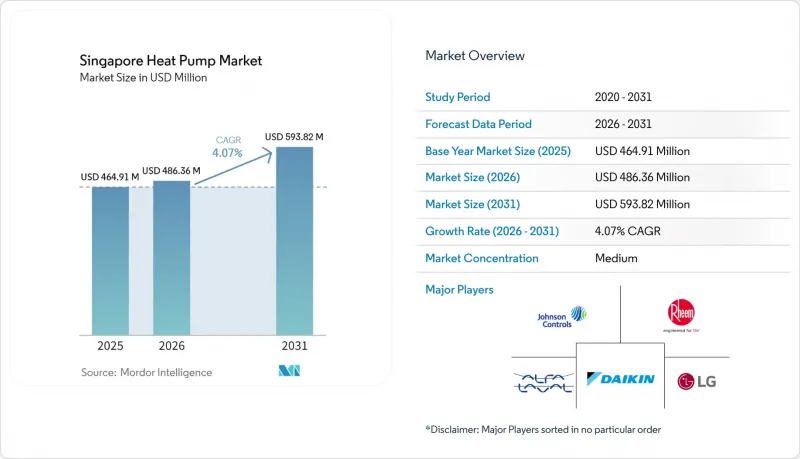
Mordor Intelligence에 의하면, 싱가포르의 히트펌프 시장 규모는 2025년에 4억 6,491만 달러로 평가되었고, 2026년에 4억 8,636만 달러로 추정되고, 2031년까지 5억 9,382만 달러에 이를 것으로 예측되며, 2026-2031년 CAGR 4.07%로 성장할 전망입니다.
본 보고서는 열원 유형별(공기원, 수원 등), 기술별(공기-공기, 공기-물 등), 용량별(10kW 미만, 10-50kW 등), 용도별(공간 난방, 산업 및 공정 가열 등), 최종 사용자별(주택, 상업시설 등), 설치 형태별(신규 설치, 개보수), 지역별로 분류되어 있습니다. 시장 전망은 금액(달러) 기준으로 제시되어 있습니다.
싱가포르의 히트펌프 시장 동향 및 인사이트
‘싱가포르 그린 플랜 2030’에 따른 공공 부문 개보수 보조금의 급증
정부는 상업시설 및 지자체 소유주가 HVAC 시스템을 업그레이드할 수 있도록 지원하기 위해 ‘기존 건축물 에너지 절약 대책 보조금 2.0’에 6,300만 싱가포르 달러(4,700만 달러)를 배정하고, 그 적용 기간을 2027년 3월까지 연장했습니다. 지원 대상 프로젝트에서는 히트펌프와 건물 관리 소프트웨어, 그리고 칠러 교체를 결합한 종합적인 패키지가 우선적으로 고려되며, 턴키 방식으로 개보수를 제공할 수 있는 공급업체가 우대받습니다. 대상 바닥 면적은 중앙 비즈니스 지구(CBD)나 신흥 다극형 허브에 집중되어 있기 때문에 해당 지역에서 이미 거래 실적이 있는 시공업체들이 조기에 수주를 확보하고 있습니다. 또한, 건물 소유주는 그린마크 신청 절차와 에너지 성능 검증을 원활하게 진행하고, 보조금 지급 조건을 충족할 수 있는 파트너를 중요하게 여기고 있습니다. 3년간의 시행 기간 덕분에 공급업체들은 여러 해에 걸친 수주 파이프라인을 확보할 수 있게 되어, 대용량 공기-물식 유닛을 둘러싼 경쟁이 치열해지고 있습니다.
에너지 표시 의무화가 고효율 히트펌프 보급을 촉진
국가환경청은 2025년 4월 1일부터 온수기에 대해 5단계 평가 라벨과 통일된 에너지 효율 시험을 도입했습니다. 히트펌프식 온수기는 항상 4단계 또는 5단계의 평가를 받는 반면, 기존의 전기저항식 제품은 2단계에 도달하는 경우가 드물기 때문에 이로 인해 구매자들은 고효율 제품으로 유도되고 있습니다. 제조업체는 판매 전에 해당 기관에 모델을 등록해야 하기 때문에 인증 시험소를 보유하지 않은 소규모 브랜드는 시장 진입 장벽에 직면해 있습니다. 투명성이 높은 라벨 표시를 통해 수명 주기 전반에 걸친 비용 절감 효과가 부각되면서, 과거에는 자본 집약적인 히트펌프의 판매를 어렵게 만들었던 정보 격차가 줄어들고 있습니다. 그 결과, 판매업체 측에서는 4월 마감 기한을 앞두고 발주 패턴에 변화가 나타나고 있다는 보고가 있었으며, 특히 가시적인 형태로 지속가능성을 입증해 줄 것을 요구하는 호텔 체인 측 수요가 증가하고 있습니다.
가스 온수기와 비교했을 때 높은 초기 투자 비용
주거용 히트펌프 온수기의 60리터 모델은 약 3,400 싱가포르 달러(2,520 달러)인 반면, 가스 온수기는 1,000 싱가포르 달러(740 달러) 미만입니다. 추가 배선, 배수, 환기 공사에는 500-1,000 싱가포르 달러(370-740 달러)가 추가로 소요됩니다. 에너지 효율 보조금 대상에서 개인 주택 소유자가 제외되어 있어, 투자 회수 기간을 단축해 줄 보조금이 없기 때문에 많은 소유자가 여전히 저렴한 가스식 모델을 선택하고 있습니다. 중고 아파트 거주자나 아파트 관리조합은 고장이 발생할 때까지 업그레이드를 미루는 경우가 많아, 3년 동안 500싱가포르달러(370미국달러)의 운영 비용 절감이 예상에도 불구하고, 10kW 미만 등급의 연간 판매 대수는 정체되어 있습니다.
부문별 분석
2025년, 싱가포르 히트펌프 시장 점유율의 48.78%를 공기원형 유닛이 차지했습니다. 25°C 이상의 따뜻한 외부 공기는 고비용의 시추공이나 해수 취수구를 필요로 하지 않으면서도 일년내내 안정적인 성능 계수(COP)를 유지합니다. 초기 비용이 비슷하고 허가 절차도 간단하기 때문에 이 방식은 주택 개조나 소규모 사무실에서 가장 흔히 선택되는 방식이 되었습니다. 하이브리드 시스템 도입과 관련하여, 시설 관리자가 공기열원 히트펌프에 백업용 가스 보일러나 전기 히터를 결합하고, 요금 변동에 따른 차익 거래를 수행함으로써, 2031년까지의 연평균 성장률(CAGR)은 4.81%로 예측되고 있습니다. 수원 모델은 해수가 풍부한 연안 지역이나 석유화학 플랜트와 같은 특수한 현장에서 이용되고 있지만, 부식 방지 비용이나 배수 규제로 인해 도입 규모에는 한계가 있습니다. 지열 이용은 여전히 드문 선택지입니다. 이는 토지가 제한된 부지에서는 수직 굴착 비용이 터무니없이 비싸지기 때문입니다. 건축건설청(BCA)의 제도에 따라 인증받은 감사관들은 종종 공기열원 히트펌프를 권장하는 경향이 있으며, 이로 인해 기존 시스템의 인기가 더욱 높아지고 있습니다.
시스템 공급업체들은 싱가포르의 높은 습도에 대응하기 위해 팬 회전 수나 제상 주기를 조절하는 스마트 컨트롤러를 사전에 설치하는 사례가 늘어나고 있으며, 이로 인해 유지보수를 위한 재방문 횟수가 줄어들고 있습니다. 코플랜드 등 부품 제조업체들은 열대 기후에 맞추어 미세 조정된 디지털 스크롤 압축기를 출시하며, 더 높은 SE-ef 효율 등급에 대한 시장의 수용을 촉진하고 있습니다. 그럼에도 불구하고, 서비스 업체에 따르면 고객들은 샤프트나 옥상 설비 내 냉매 충전량 제한에 대해 여전히 신중한 태도를 보이고 있으며, 그로 인해 오래된 고층 빌딩의 개보수 보급률은 잠재적 수준에 미치지 못하고 있습니다.
2025년 매출에서 공기-물 플랫폼이 차지하는 비중은 51.31%이며, 2031년까지 연평균 성장률(CAGR) 5.02%를 나타낼 것으로 전망되는데, 이는 기술 그룹 내에서 가장 빠른 성장 속도입니다. 마리나 베이 및 주롱 레이크 디스트릭트의 지역 냉방 네트워크는 냉수를 공급하기 때문에 공기-물 히트펌프는 단일 쉘 앤 튜브식 열교환기를 통해 실내 냉방과 60℃ 온수 공급 부하를 모두 충족시킬 수 있어 설비 중복을 줄일 수 있습니다. 발코니에 스플릿형 에어컨이 이미 설치된 공영주택의 복도에서는 여전히 공기 대 공기식 유닛이 일반적이지만, 소유주가 열회수를 중시하는 고급 오피스에서는 온수 시스템에 시장 점유율을 빼앗기고 있습니다. 물-물 방식이나 지하수-물 방식은 이론상 효율은 높지만, 해수 이용 허가나 시추공 굴착이 필요하기 때문에 프로젝트가 수개월 지연될 가능성이 있어, 빡빡한 공사 일정을 안고 있는 개발업체에게는 불안 요인으로 작용하고 있습니다.
현재 각 제조업체들은 제한된 공간의 기계실에 설치할 수 있으며, 50kW 단위로 용량을 확장할 수 있는 모듈식 스키드를 출하하고 있는데, 이는 복합 용도 프로젝트의 확장 단계에서 매력적인 특징입니다. 국가환경청의 제품 등록 데이터베이스에 따르면, 2025년 이후 R290 및 R1234ze를 사용한 공기-물형 장치의 등록 건수가 3배로 증가했으며, 이는 해당 기술이 규제 대응을 향해 나아가고 있음을 뒷받침하고 있습니다. 새로운 포디움형 플랜트실을 설계하는 엔지니어들은 결정적인 요인이 대개 공간 문제라고 인정하고 있습니다. 단일 멀티서비스 모듈을 통해 그린마크 점수를 높이고, 기업의 탄소중립 선언을 충족하는 태양광 발전 설비를 설치할 수 있을 만큼 충분한 지붕 공간을 확보할 수 있기 때문입니다.
기타 혜택 :
- 엑셀 형식 시장 예측(ME) 시트
- 3개월간의 애널리스트 지원
자주 묻는 질문
목차
제1장 서론
제2장 조사 방법
제3장 주요 요약
제4장 시장 구도
제5장 시장 규모 및 성장 예측
제6장 경쟁 구도
제7장 시장 기회 및 향후 전망
AJY 26.06.26According to Mordor Intelligence, the singapore heat pump market size is projected to be USD 464.91 million in 2025, USD 486.36 million in 2026, and reach USD 593.82 million by 2031, growing at a CAGR of 4.07% from 2026 to 2031.
This report is Segmented by Source Type (Air Source, Water Source, and More), Technology (Air-To-Air, Air-To-Water, and More), Capacity (Below 10 KW, 10-50 KW, and More), Application (Space Heating, Industrial and Process Heating, and More), End User (Residential, Commercial, and More), Installation (New Installation, and Retrofit), and Geography. The Market Forecasts are Provided in Terms of Value (USD).
Singapore Heat Pump Market Trends and Insights
Surge in Public Sector Retrofit Grants Under Singapore Green Plan 2030
The Government earmarked SGD 63 million (USD 47 million) for the Grant for Energy Efficient Measures in Existing Buildings 2.0, extended to March 2027, to help commercial and municipal owners upgrade HVAC systems. Grant-related projects prioritize comprehensive packages that couple heat pumps with building-management software and chiller replacements, rewarding vendors that can deliver turnkey retrofits. Because eligible floor space is concentrated in the Central Business District and emerging polycentric hubs, contractors with prior relationships in those zones are winning early orders. Building owners also lean on partners that can navigate Green Mark paperwork and energy-performance verification to unlock disbursements. The three-year runway allows suppliers to lock in multiyear pipelines, tightening competition for high-capacity air-to-water units.
Mandatory Energy-Labeling Pushing Premium-Efficiency Heat Pumps
The National Environment Agency introduced a five-tick label and a uniform energy-factor test for water heaters effective 1 April 2025. Heat-pump water heaters consistently achieve four or five ticks, while conventional electric resistance units rarely reach two ticks, guiding buyers toward premium efficiency. Because manufacturers must lodge models with the agency before sales, smaller brands without accredited laboratories face entry barriers. Transparent labels highlight lifecycle savings and shrink the information gap that once made capital-intensive heat pumps a hard sell. As a result, distributors report a pivot in ordering patterns ahead of the April deadline, especially from hospitality chains seeking visible sustainability credentials.
High Initial Capex Versus Gas Water Heaters
Residential heat-pump water heaters cost about SGD 3,400 (USD 2,520) for a 60-liter unit against gas heaters under SGD 1,000 (USD 740). The extra wiring, drainage, and ventilation work adds another SGD 500 to 1,000 (USD 370 to 740). Because the Energy Efficiency Grant excludes individual homeowners, no offsetting subsidy shortens payback, so many owners still choose cheaper gas models. Resale-flat dwellers and condominium management committees often postpone upgrades until failures occur, constraining annual unit sales in the sub-10 kW class, even though operating savings reach SGD 500 (USD 370) over three years.
Other drivers and restraints analyzed in the detailed report include:
- Commercial and Municipal District-Cooling Expansion
- Growing Demand for Ultra-Low-GWP Refrigerant Systems Ahead of 2028 HFC Phase-Down
- Limited Roof and Plant Space in High-Rise Buildings
For complete list of drivers and restraints, kindly check the Table Of Contents.
Segment Analysis
Air-source units delivered 48.78% of the Singapore heat pump market share in 2025. Warm ambient air of 25 °C and above supports stable year-round coefficients of performance while avoiding costly boreholes or seawater intakes. Comparable upfront pricing and simpler permitting make the format the default for residential retrofits and small offices. In hybrid deployments, facility managers pair an air-source heat pump with a back-up gas boiler or electric element to arbitrage tariff fluctuations, driving a 4.81% CAGR forecast up to 2031. Water-source models serve niche maritime and petrochemical sites where seawater is plentiful, yet anti-corrosion expenses and discharge rules cap volume. Ground-source options remain rare because vertical drilling is price-prohibitive on land-scarce plots. Auditors certified under the Building and Construction Authority scheme often default to air-source recommendations, reinforcing incumbent momentum.
System suppliers increasingly pre-install smart controllers that modulate fan speeds and defrost cycles to handle Singapore's high humidity, reducing maintenance callbacks. Component makers such as Copeland rolled out digital scroll compressors fine-tuned for the tropical envelope, nudging market acceptance of higher-se efficiency classes. Even so, service companies report that customers remain cautious about refrigerant-charge limits inside shafts and rooftops, which keeps retrofit penetration below potential in older tower blocks.
Air-to-water platforms represented 51.31% of 2025 revenue and are set for a 5.02% CAGR through 2031, the quickest pace among technology groups. District-cooling networks in Marina Bay and Jurong Lake District distribute chilled water, so an air-to-water heat pump can supply both space-cooling and 60 °C domestic hot-water loads from a single shell-and-tube exchanger, cutting duplicate equipment. Air-to-air units remain common in public-housing corridors where split-unit air conditioners already populate balconies, but they lose share to hydronic systems in premium offices where owners value heat recovery. Water-to-water and ground-to-water selections, despite higher theoretical efficiencies, demand either seawater permits or boreholes that can delay projects for months, unsettling developers working on tight construction calendars.
Manufacturers now ship modular skids that fit inside constrained mechanical rooms and scale upward in 50 kW steps, an attractive feature for expansion phases in mixed-use projects. The National Environment Agency product-registration database shows a threefold increase in R290 and R1234ze air-to-water listings since 2025, confirming the technology's compliance momentum. Engineers who specify new podium plantrooms confess the deciding factor is often spatial: one multi-service module frees enough roof for PV arrays that boost Green Mark scores, satisfying corporate net-zero declarations.
List of Companies Covered in this Report:
- Johnson Controls International plc
- Rheem Manufacturing Company
- Alfa Laval AB
- Daikin Industries, Ltd.
- LG Electronics Inc.
- Carrier Global Corporation
- Mitsubishi Electric Asia Pte. Ltd.
- Copeland LP
- Panasonic Holdings Corporation
- AOS Bath Pte. Ltd.
- DENSO Corporation
- Danfoss A/S
- Temperzone Ltd.
- Gree Electric Appliances, Inc. of Zhuhai
- Trane Technologies plc
- Risen Thermohygro Services Pte. Ltd.
- Midea Group Co., Ltd.
- Ariston Holding N.V.
- Samsung Electronics Co., Ltd.
- Robert Bosch GmbH
Additional Benefits:
- The market estimate (ME) sheet in Excel format
- 3 months of analyst support
TABLE OF CONTENTS
1 INTRODUCTION
- 1.1 Study Assumptions and Market Definition
- 1.2 Scope of the Study
2 RESEARCH METHODOLOGY
3 EXECUTIVE SUMMARY
4 MARKET LANDSCAPE
- 4.1 Market Overview
- 4.2 Market Drivers
- 4.2.1 Surge in Public Sector Retrofit Grants under Singapore Green Plan 2030
- 4.2.2 Mandatory Energy-labeling Pushing Premium-Efficiency Heat Pumps
- 4.2.3 Commercial and Municipal District-Cooling Expansion (Marina Bay, Jurong Lake District, Tengah)
- 4.2.4 Rising Carbon-Tax Trajectory Incentivizing Electrified HVAC
- 4.2.5 Integration of High-COP Heat Pumps with Floating PV and Thermal Storage Pilots
- 4.2.6 Growing Demand for Ultra-Low-GWP Refrigerant Systems Ahead of 2028 HFC Phase-Down
- 4.3 Market Restraints
- 4.3.1 High Initial Capex Versus Gas Water Heaters
- 4.3.2 Installation and Technical Expertise Gaps
- 4.3.3 Limited Roof and Plant Space in High-Rise Buildings
- 4.3.4 Seasonal Grid-Reserve Margin Shortfalls during Peak Cooling Hours
- 4.4 Industry Value Chain Analysis
- 4.5 Regulatory Landscape
- 4.6 Technological Outlook
- 4.7 Porter's Five Forces Analysis
- 4.7.1 Bargaining Power of Suppliers
- 4.7.2 Bargaining Power of Buyers
- 4.7.3 Threat of New Entrants
- 4.7.4 Threat of Substitutes
- 4.7.5 Intensity of Competitive Rivalry
- 4.8 Impact of Macroeconomic Factors on the Market
5 MARKET SIZE AND GROWTH FORECASTS (VALUE)
- 5.1 By Source Type
- 5.1.1 Air Source
- 5.1.2 Water Source
- 5.1.3 Ground Source
- 5.1.4 Hybrid
- 5.2 By Technology
- 5.2.1 Air-to-Air
- 5.2.2 Air-to-Water
- 5.2.3 Water-to-Water
- 5.2.4 Ground-to-Water
- 5.3 By Capacity
- 5.3.1 Below 10 kW
- 5.3.2 10-50 kW
- 5.3.3 50-200 kW
- 5.3.4 Above 200 kW
- 5.4 By Application
- 5.4.1 Space Heating
- 5.4.2 Space Cooling
- 5.4.3 Domestic and Sanitary Hot Water
- 5.4.4 Industrial and Process Heating
- 5.4.5 Other Applications
- 5.5 By End User
- 5.5.1 Residential
- 5.5.2 Commercial
- 5.5.3 Industrial
- 5.6 By Installation
- 5.6.1 New Installation
- 5.6.2 Retrofit
6 COMPETITIVE LANDSCAPE
- 6.1 Market Concentration
- 6.2 Strategic Moves
- 6.3 Vendor Positioning Analysis
- 6.4 Company Profiles (includes Global Level Overview, Market Level Overview, Core Segments, Financials as available, Strategic Information, Market Rank/Share, Products and Services, Recent Developments)
- 6.4.1 Johnson Controls International plc
- 6.4.2 Rheem Manufacturing Company
- 6.4.3 Alfa Laval AB
- 6.4.4 Daikin Industries, Ltd.
- 6.4.5 LG Electronics Inc.
- 6.4.6 Carrier Global Corporation
- 6.4.7 Mitsubishi Electric Asia Pte. Ltd.
- 6.4.8 Copeland LP
- 6.4.9 Panasonic Holdings Corporation
- 6.4.10 AOS Bath Pte. Ltd.
- 6.4.11 DENSO Corporation
- 6.4.12 Danfoss A/S
- 6.4.13 Temperzone Ltd.
- 6.4.14 Gree Electric Appliances, Inc. of Zhuhai
- 6.4.15 Trane Technologies plc
- 6.4.16 Risen Thermohygro Services Pte. Ltd.
- 6.4.17 Midea Group Co., Ltd.
- 6.4.18 Ariston Holding N.V.
- 6.4.19 Samsung Electronics Co., Ltd.
- 6.4.20 Robert Bosch GmbH
7 MARKET OPPORTUNITIES AND FUTURE OUTLOOK
- 7.1 White-Space and Unmet-Need Assessment


