

|
시장보고서
상품코드
2062016
님 추출물 : 시장 점유율 분석, 산업 동향 및 통계 데이터, 성장 예측(2026-2031년)Neem Extract - Market Share Analysis, Industry Trends & Statistics, Growth Forecasts (2026 - 2031) |
||||||
 Mordor Intelligence
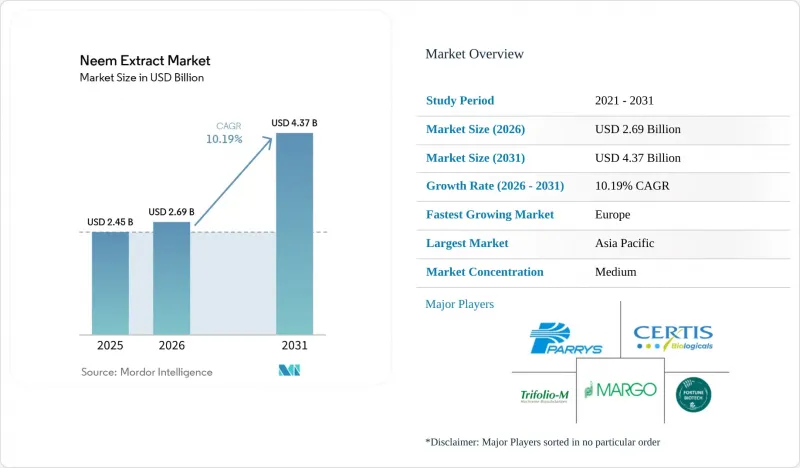
Mordor Intelligence에 의하면, 님 추출물 시장 규모는 2025년에 24억 5,000만 달러로 평가되었습니다. 2026년 26억 9,000만 달러에서 2031년까지 43억 7,000만 달러에 이를 것으로 예상되며, 예측 기간(2026-2031년) CAGR은 10.19%를 나타낼 전망입니다.
본 보고서는 유형별(과실·종자 추출물, 잎 추출물, 나무껍질 추출물), 용도별(농약, 퍼스널케어 및 화장품, 의약품·영양보조식품 등), 제형별(액체, 분말, 과립·펠릿), 지역별(아시아태평양, 북미, 유럽, 남미, 중동 및 아프리카)로 분류되어 있습니다. 시장 전망은 금액(달러) 기준으로 제시되어 있습니다.
세계의 님 추출물 시장 동향 및 인사이트
천연·유기농 퍼스널케어 제품에 대한 수요 증가
각 브랜드가 논란을 일으키는 방부제를 배제하는 움직임에 따라, 전 세계 클린 뷰티 제품의 재처방 주기가 가속화되고 있습니다. in vitro 시험에 따르면, 님 추출물은 500µ g/mL 미만의 최소 성장 억제 농도에서 황색포도상구균 및 칸디다 알비칸스를 억제하는 것으로 나타났으며, 이를 통해 제형 개발자는 세안제나 데오도란트 제품에서 파라벤이나 트리클로산을 대체할 수 있게 됩니다. 유럽연합(EU) 규정 2019/2164에 따라, 인증 유기농 화장품에 아자지락틴을 최대 0.1%까지 사용할 수 있게 되어, 님 추출물 시장의 규제 장벽이 해소되었습니다. 초임계 CO₂ 추출법에서는 씨앗 1그램당 3.4mg의 아자지락틴을 얻을 수 있으며, 이는 헥산법보다 40% 높은 수율일 뿐만 아니라, 안전 기준 준수를 위협할 수 있는 잔류 용매 문제도 피할 수 있습니다. 지속가능성에 관한 이야기도 많은 공감을 불러일으키고 있습니다. 성숙한 님 나무는 최소한의 관개만으로도 연간 약 20kg의 CO2를 흡수합니다. 이러한 성장세를 반영하여 히말라야 웰니스는 인도네시아와 베트남에서 두 자릿수 성장을 기록한 데 이어, 2025년에 동남아시아 15개 시장에서 새로운 니임 성분이 함유된 세안제를 출시했습니다.
지속 가능한 농업에서 님계 바이오 농약의 도입
종합 해충 관리 프로그램에서는 유기농지에서 최우선으로 선택해야 할 대책으로 님 기반 살포제를 지정하는 사례가 늘고 있습니다. 인도 마하라슈트라 주에서 실시된 면화 실험 결과, 아자지락틴을 1,500 ppm 농도로 10일마다 살포함으로써 면나방 피해를 75% 줄일 수 있는 것으로 나타났습니다. 이는 내성을 유발하지 않으면서 피레스로이드계 농약과 동등한 효과를 발휘한 것입니다. 유럽의 ‘농장에서 식탁까지(Farm-to-Fork)’ 전략에 따라, 인증받은 유기농 농가에게 투입 비용의 최대 60%를 보전해 주는 보조금이 제공되고 있으며, 이는 님 추출물 시장에 직접적인 자극 요인이 되고 있습니다. 중국은 잔류물 저감 목표의 일환으로, 2025년에 채소용으로 12종의 새로운 님 제제를 승인했습니다. 테라메라의 ‘액티게이트(TM)’ 전달 플랫폼은 아자지락틴의 흡수율을 3배로 높였으며, 2018년 EPA 승인 이후 북미 유기농 채소 시장의 8%를 차지하고 있습니다. 효과는 향상되었으나, 아자지락틴은 7일 이내에 광분해되므로 살포 빈도를 높여야 하며, 이로 인해 인건비가 증가하고 있습니다.
저렴한 합성 대체품이 가격 경쟁력을 잠식하고 있습니다.
피레스로이드계 농약은 1헥타르당 8-12달러인 반면, 동등한 해충 방제 효과를 지닌 님 살포제는 18-25달러로, 인도, 인도네시아, 사하라 이남 아프리카의 가격에 민감한 농가에서 님 사용을 저해하고 있습니다. 네오니코티노이드계 농약은 토양에 한 번만 시용해도 30-45일간 전신 방제 효과를 발휘하지만, 아자지락틴은 자외선 아래에서 1주일 이내에 분해되기 때문에 살포 빈도가 증가하여 인건비가 40-60% 더 많이 듭니다. 일반 소비자용 화장품 시장에서 페녹시에탄올의 가격은 1kg당 3-5달러인 반면, 표준화된 님 추출물의 소매 가격은 1kg당 25-40달러이며, 님 추출물 시장의 배합 비율은 1% 이하로 제한되어 있습니다. 합성 화학물질의 사용이 금지되고 소비자가 15-20%의 추가 비용을 부담하는 유기농 분야에서는 이러한 격차가 줄어들고 있지만, 인증을 받은 재배 면적은 여전히 전 세계 경작지의 2% 미만에 그치고 있습니다. UPL사의 ‘PlasmaNeem’은 저온 플라즈마 활성화 기술을 활용하여 아자지락틴의 효능을 30% 향상시켰으며, 이를 통해 사용량을 줄여 비용 측면의 불리함을 부분적으로 상쇄하고 있습니다.
부문별 분석
과실 및 종자 추출물은 2025년 매출의 51.10%를 차지하며, 님 추출물 시장의 기반을 이루었습니다. 한편, 나무 껍질 추출물은 탄닌을 풍부하게 함유한 안티에이징 세럼 수요에 힘입어 2031년까지 연평균 성장률(CAGR) 11.34%를 기록하며 성장할 것으로 전망됩니다. 종자유는 3,000-5,000 ppm의 아자지락틴을 함유하고 있으며, 바이오 농약 및 의약품 등급 원료의 기초가 되고 있습니다. 한편, 나무 껍질에서는 피부과 연구소가 필요로 하는 닌비진을 얻을 수 있습니다. 초임계 추출물은 고급 브랜드들 사이에서 1kg당 80-120달러에 거래되는 반면, 범용 헥산 오일은 15-25달러에 그치고 있어 시장 내 가격 격차가 뚜렷이 드러나고 있습니다.
인도의 니임 코팅 요소 의무화 프로그램만으로도, 니임 추출물 산업에서 고사병이 지역 내 종자 공급을 압박하고 있는 상황에서도 처리량을 보장하고, 니임 핵유에 대한 구조적인 수요를 확보하고 있습니다. 폴리페놀 함량이 15%를 초과하는 영양보조식품용 티백에 널리 사용되는 잎 추출물은 1%를 배합했을 때 콕시듐증을 30% 감소시키는 것으로 연구 결과 밝혀져 가금류 사료 제조업체들의 관심을 끌고 있습니다. 나노에멀션 기술에 대한 특허 덕분에 닌비진의 피부 침투율이 4배로 높아졌으며, 제제 개발자들은 수피의 배합량을 3%에서 0.75%로 줄여도 효능을 저해하지 않으면서, 수피 추출물의 프리미엄화 추세를 뒷받침하고 있습니다.
지역별 분석
아시아태평양은 인도의 비료 피복 의무화와 중국 내 12종 채소 작물에 대한 신규 등록에 힘입어, 2025년 님 추출물 시장 매출의 54.20%를 차지했습니다. 그러나 인도의 연간 오일 생산량은 고작 3,000톤에 불과해 국내 수요의 15%밖에 충당하지 못하고 있으며, 병해가 없는 농장을 유지하고 있는 동아프리카로부터 수입할 수밖에 없는 실정입니다. 아세안 지역에서의 성장세는 인도네시아와 베트남에서 두드러졌으며, 2025년에는 히말라야사의 세안제 출하량이 두 자릿수 성장률을 기록했습니다. 일본에서는 유기농지가 경작지의 고작 0.5%에 불과함에도 불구하고, 특산 농산물 수출업체들이 EU의 잔류 기준을 충족하기 위해 니임을 활용하고 있습니다.
유럽은 2031년까지 연평균 성장률(CAGR) 11.76%를 기록하며 가장 빠른 성장이 예상됩니다. ‘농장에서 식탁까지(Farm-to-Fork)’ 보조금에 더해, 규정 2019/2164에 따른 화장품 승인 절차가 독일과 이탈리아의 추출 시설에 대한 투자를 촉진하고 있습니다. 이 지역의 유기농 경작 면적은 연간 8-12%의 속도로 확대되고 있어, 님에 대한 기초 수요를 높이고 있습니다. 한편, Rovensa Next와 같은 기업들은 EU 수출용 과일의 잔류 기준을 확실히 충족하기 위해 라틴아메리카에서 님 함유 제제의 등록 절차를 진행하고 있습니다. 북미에서의 보급은 유기농 인증의 중심지인 캘리포니아주와 오리건주가 주도하고 있으며, Certis USA의 ‘Neemix 4.5’는 30%의 프리미엄 가격에 판매되고 있습니다.
라틴아메리카에서는 수출용 포도와 아보카도가 EU 및 미국의 잔류 기준 요건을 충족할 수 있도록 니임을 활용하고 있습니다. 브라질의 유기농 재배 면적은 2024년에 20% 급증했으며, 님(Neem)은 바이오 농약 배합 비율의 12%를 차지했습니다. 아르헨티나에서는 알칼리성 팜파스 토양에서 질소의 휘발을 25-30% 억제하기 위해 님 코팅된 요소의 시범 도입이 이루어지고 있지만, 가격이 비싸기 때문에 보급률은 5% 미만에 그치고 있습니다. 중동 및 아프리카에서는 수단, 케냐, 탄자니아가 종자를 공급하고 있으며, 사우디아라비아와 남아프리카공화국이 바이오 농약 수입을 장려하고 있어, 님 추출물 시장에 대한 지역적 진출이 점차 확대되고 있습니다.
기타 혜택 :
- 엑셀 형식 시장 예측(ME) 시트
- 3개월간의 애널리스트 지원
자주 묻는 질문
목차
제1장 서론
제2장 분석 방법
제3장 주요 요약
제4장 시장 구도
제5장 시장 규모 및 성장률 예측
제6장 경쟁 구도
제7장 시장 기회 및 향후 전망
KTH 26.06.24According to Mordor Intelligence, the neem extract market size was valued at USD 2.45 billion in 2025 and is estimated to grow from USD 2.69 billion in 2026 to reach USD 4.37 billion by 2031, at a CAGR of 10.19% during the forecast period (2026-2031).
This report is Segmented by Type (Fruit and Seed Extract, Leaf Extract, and Bark Extract), Application (Agrochemicals, Personal Care and Cosmetics, Pharmaceuticals and Nutraceuticals, and More), Formulation (Liquid, Powder, and Granular/Pellets), and Geography (Asia-Pacific, North America, Europe, South America, and Middle East and Africa). The Market Forecasts are Provided in Terms of Value (USD).
Global Neem Extract Market Trends and Insights
Rising Demand for Natural and Organic Personal-Care Products
Global clean-beauty reformulation cycles are intensifying as brands eliminate controversial preservatives. In vitro assays show neem extract inhibits Staphylococcus aureus and Candida albicans at minimum inhibitory concentrations below 500 µg/mL, allowing formulators to replace parabens and triclosan in cleansers and deodorants. European Union Regulation 2019/2164 now permits azadirachtin in certified organic cosmetics up to 0.1%, removing a regulatory bottleneck for the neem extract market. Supercritical CO2 extraction yields 3.4 mg of azadirachtin per gram of seed, 40% higher than hexane methods, and avoids residual solvents that jeopardize safety compliance. Sustainability narratives also resonate: a mature neem tree sequesters about 20 kg of CO2 annually while requiring minimal irrigation. Reflecting this momentum, Himalaya Wellness launched new neem face-wash variants in 15 Southeast Asian markets in 2025 after recording double-digit growth in Indonesia and Vietnam.
Adoption of Neem-Based Biopesticides in Sustainable Agriculture
Integrated pest-management programs increasingly specify neem-based sprays as first-line interventions on organic acreage. Cotton trials in India's Maharashtra region showed azadirachtin at 1,500 ppm cut bollworm infestation by 75% when applied every 10 days, matching pyrethroid performance without inducing resistance. The European Farm-to-Fork strategy offers subsidies that offset up to 60% of input costs for certified organic farmers, a direct stimulus to the neem extract market. China approved 12 new neem formulations for vegetables in 2025 as part of residue-reduction goals. Terramera's Actigate(TM) delivery platform triples azadirachtin uptake and has captured 8% of the North American organic-vegetable sector since its 2018 EPA approval. Despite efficacy gains, azadirachtin photodegrades within seven days, compelling more frequent sprays and raising labor costs.
Cheaper Synthetic Substitutes Eroding Price Competitiveness
Pyrethroids cost USD 8-12 per hectare versus USD 18-25 for neem sprays delivering similar pest control, undercutting neem adoption among price-sensitive farmers in India, Indonesia, and sub-Saharan Africa. Neonicotinoids achieve 30-45 days of systemic protection after a single soil dose, whereas azadirachtin degrades within a week under UV light, driving up application frequency and labor outlays 40-60%. In mass-market cosmetics, phenoxyethanol costs USD 3-5 per kg, yet standardized neem extract retails for USD 25-40 per kg, limiting inclusion rates to 1% or less in the neem extract market. The gap narrows inside the organic segment, where synthetic chemistry is barred, and consumers absorb a 15-20% premium, but certified acreage still accounts for under 2% of global cropland. UPL's PlasmaNeem leverages cold-plasma activation to raise azadirachtin potency 30%, enabling lower field doses and partially offsetting cost disadvantages.
Other drivers and restraints analyzed in the detailed report include:
- Government Mandates for Neem-Coated Urea and Other Organic Inputs
- Surging Awareness of Neem's Broad-Spectrum Medicinal Benefits
- Inconsistent Quality and Fragmented Raw-Material Supply Chains
For complete list of drivers and restraints, kindly check the Table Of Contents.
Segment Analysis
Fruit and seed extract secured 51.10% of 2025 revenue, anchoring the neem extract market, while bark extract is slated for an 11.34% CAGR to 2031, propelled by tannin-rich anti-aging serums. Kernel oils deliver 3,000-5,000 ppm azadirachtin, the backbone for biopesticides and pharma-grade inputs, whereas bark yields nimbidin profiles coveted by dermatology labs. Supercritical output fetches USD 80-120 per kg among prestige brands, contrasting with USD 15-25 for commodity hexane oil, illustrating price stratification inside the market.
India's mandatory neem-coated urea program alone locks in structural demand for kernel oil, guaranteeing throughput even as dieback crimps local seed supply in the neem extract industry. Leaf extract, broadly used in nutraceutical tea bags with polyphenol content above 15%, is receiving interest from poultry formulators after studies showed 30% coccidiosis reduction at 1% inclusion. Nano-emulsion patents quadruple nimbidin skin penetration, letting formulators cut bark inclusion from 3% to 0.75% without efficacy loss, reinforcing bark extract's premium trajectory.
Geography Analysis
Asia-Pacific generated 54.20% of 2025 revenue for the neem extract market, anchored by India's fertilizer-coating mandate and China's 12 new vegetable-crop registrations. Yet India's output of just 3,000 tons of oil annually covers 15% of domestic needs, forcing imports from East Africa, whose plantations remain disease-free. ASEAN momentum is visible in Indonesia and Vietnam, where Himalaya face-wash volumes grew double digits in 2025. Japan's specialty-crop exporters deploy neem to meet EU residue ceilings despite organic farmland totaling only 0.5% of arable land.
Europe is on track for the fastest growth at an 11.76% CAGR through 2031. Farm-to-Fork subsidies, plus Regulation 2019/2164's cosmetic clearance, are spurring extraction-plant investments in Germany and Italy. Organic acreage here is expanding 8-12% annually, raising baseline neem demand, while firms such as Rovensa Next register neem blends in Latin America to ensure residue compliance for EU-bound fruit. North America's uptake is led by the certified-organic strongholds of California and Oregon, where Certis USA's Neemix 4.5 sells at a 30% premium.
Latin America leverages neem to clear EU and U.S. residue hurdles for export grapes and avocados. Brazil's organic acreage jumped 20% in 2024, with neem forming 12% of the biopesticide mix. Argentina pilots neem-coated urea on alkaline Pampas soils to curb 25-30% nitrogen volatilization, though uptake is under 5% due to premium pricing. In the Middle East and Africa, Sudan, Kenya, and Tanzania supply seeds, while Saudi Arabia and South Africa incentivize biological imports, slowly widening regional participation in the neem extract market.
- Agro Extracts Ltd.
- Andermatt Anthesis AG
- Bros India Group
- Certis Europe BV
- Certis USA L.L.C.
- Coromandel International Ltd.
- Dhanuka Agritech Ltd.
- E.I.D. Parry (India) Ltd.
- FORTUNEBIOTECH
- Gramin India Agri BusiNest
- Green Earth Products Pvt Ltd.
- GreeNeem Agri Pvt Ltd.
- Kimitec Group
- Neeming Australia Pty Ltd.
- Ozone Biotech Pvt Ltd.
- Parker Biotech Pvt Ltd.
- Parry America Inc.
- PJ Margo Private Limited
- Promotora Tecnica Industrial SA de CV
- Rovensa Next
- Sunrise Agriland & Research Pvt Ltd.
- Terramera Inc.
- The Indian Neem Tree Company
- Trifolio-M GmbH
- UPL Ltd. (PlasmaNeem division)
Additional Benefits:
- The market estimate (ME) sheet in Excel format
- 3 months of analyst support
TABLE OF CONTENTS
1 Introduction
- 1.1 Study Assumptions and Market Definition
- 1.2 Scope of the Study
2 Research Methodology
3 Executive Summary
4 Market Landscape
- 4.1 Market Overview
- 4.2 Market Drivers
- 4.2.1 Rising demand for natural and organic personal-care products
- 4.2.2 Adoption of neem-based biopesticides in sustainable agriculture
- 4.2.3 Government mandates for neem-coated urea and other organic inputs
- 4.2.4 Surging awareness of neem's broad-spectrum medicinal benefits
- 4.2.5 Super-critical CO2 extraction unlocking premium cosmetic grades
- 4.3 Market Restraints
- 4.3.1 Cheaper synthetic substitutes eroding price competitiveness
- 4.3.2 Inconsistent quality and fragmented raw-material supply chains
- 4.3.3 Regulatory uncertainty on azadirachtin residue limits in food
- 4.4 Value Chain Analysis
- 4.5 Porter's Five Forces
- 4.5.1 Bargaining Power of Suppliers
- 4.5.2 Bargaining Power of Buyers
- 4.5.3 Threat of New Entrants
- 4.5.4 Threat of Substitutes
- 4.5.5 Competitive Rivalry
5 Market Size and Growth Forecasts (Value)
- 5.1 By Type
- 5.1.1 Fruit and Seed Extract
- 5.1.2 Leaf Extract
- 5.1.3 Bark Extract
- 5.2 By Application
- 5.2.1 Agrochemicals (Biopesticides, Fertilizers)
- 5.2.2 Personal Care and Cosmetics
- 5.2.3 Pharmaceuticals and Nutraceuticals
- 5.2.4 Food and Beverage Additives
- 5.2.5 Animal Feed and Veterinary
- 5.2.6 Other Industrial Uses
- 5.3 By Formulation
- 5.3.1 Liquid
- 5.3.2 Powder
- 5.3.3 Granular/Pellets
- 5.4 By Geography
- 5.4.1 Asia-Pacific
- 5.4.1.1 India
- 5.4.1.2 China
- 5.4.1.3 Japan
- 5.4.1.4 Australia
- 5.4.1.5 ASEAN Countries
- 5.4.1.6 Rest of Asia-Pacific
- 5.4.2 North America
- 5.4.2.1 United States
- 5.4.2.2 Canada
- 5.4.2.3 Mexico
- 5.4.3 Europe
- 5.4.3.1 Germany
- 5.4.3.2 United Kingdom
- 5.4.3.3 France
- 5.4.3.4 Italy
- 5.4.3.5 Spain
- 5.4.3.6 Russia
- 5.4.3.7 Rest of Europe
- 5.4.4 South America
- 5.4.4.1 Brazil
- 5.4.4.2 Argentina
- 5.4.4.3 Rest of South America
- 5.4.5 Middle-East and Africa
- 5.4.5.1 Saudi Arabia
- 5.4.5.2 South Africa
- 5.4.5.3 Rest of Middle-East and Africa
- 5.4.1 Asia-Pacific
6 Competitive Landscape
- 6.1 Market Concentration
- 6.2 Strategic Moves
- 6.3 Market Share(%)/Ranking Analysis
- 6.4 Company Profiles (includes Global level Overview, Market level overview, Core Segments, Financials as available, Strategic Information, Products and Services, and Recent Developments)
- 6.4.1 Agro Extracts Ltd.
- 6.4.2 Andermatt Anthesis AG
- 6.4.3 Bros India Group
- 6.4.4 Certis Europe BV
- 6.4.5 Certis USA L.L.C.
- 6.4.6 Coromandel International Ltd.
- 6.4.7 Dhanuka Agritech Ltd.
- 6.4.8 E.I.D. Parry (India) Ltd.
- 6.4.9 FORTUNEBIOTECH
- 6.4.10 Gramin India Agri BusiNest
- 6.4.11 Green Earth Products Pvt Ltd.
- 6.4.12 GreeNeem Agri Pvt Ltd.
- 6.4.13 Kimitec Group
- 6.4.14 Neeming Australia Pty Ltd.
- 6.4.15 Ozone Biotech Pvt Ltd.
- 6.4.16 Parker Biotech Pvt Ltd.
- 6.4.17 Parry America Inc.
- 6.4.18 PJ Margo Private Limited
- 6.4.19 Promotora Tecnica Industrial SA de CV
- 6.4.20 Rovensa Next
- 6.4.21 Sunrise Agriland & Research Pvt Ltd.
- 6.4.22 Terramera Inc.
- 6.4.23 The Indian Neem Tree Company
- 6.4.24 Trifolio-M GmbH
- 6.4.25 UPL Ltd. (PlasmaNeem division)
7 Market Opportunities and Future Outlook
- 7.1 White-space and Unmet-need Assessment


