

|
시장보고서
상품코드
2062094
건축 및 건설용 플라스틱 : 시장 점유율 분석, 업계 동향 및 통계, 성장 예측(2026-2031년)Building And Construction Plastics - Market Share Analysis, Industry Trends & Statistics, Growth Forecasts (2026 - 2031) |
||||||
 Mordor Intelligence
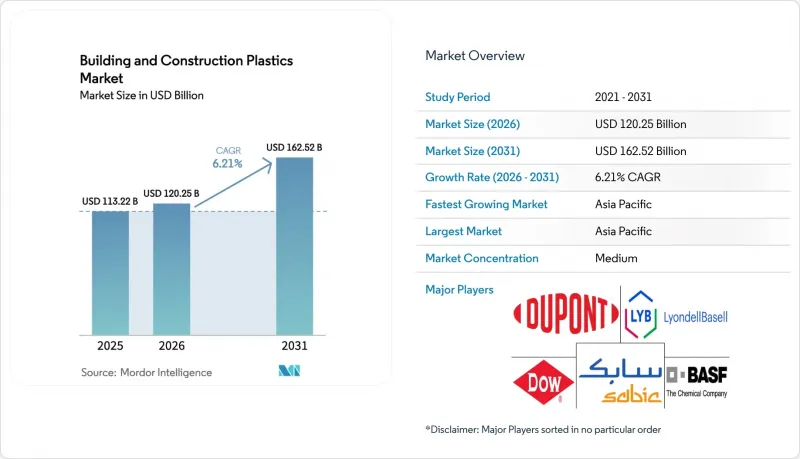
Mordor Intelligence에 의하면, 건축 및 건설용 플라스틱 시장 규모는 2025년에 1,132억 2,000만 달러로 평가되었습니다. 2026년에 1,202억 5,000만 달러에 달하고, 2031년까지 1,625억 2,000만 달러에 이를 것으로 예측되며, 2026-2031년에 걸쳐 CAGR은 6.21%를 나타낼 전망입니다.
본 보고서는 제품 유형(폴리염화비닐(PVC), 폴리에틸렌(PE), 기타), 용도(배관 시스템 및 이음쇠, 단열재, 기타), 최종 사용자 산업(주택 건설, 상업용 건설, 기타), 지역(아시아태평양, 북미, 유럽, 기타)별로 분류되어 있습니다. 시장 전망은 금액(달러) 기준으로 제시되어 있습니다.
세계의 건축 및 건설용 플라스틱 시장 동향과 인사이트
아시아태평양의 급속한 도시 인프라 투자
인도, 중국, 동남아시아의 지방 자치 단체에서는 예산 부족이 지속되고 있어, 설치 공수를 최대 40%까지 줄일 수 있는 폴리머 시스템이 선호되고 있습니다. 인도의 플라스틱 파이프 매출액은 2024 회계연도에 5,410억 루피(65억 달러)에 달했으며, ‘잘 지반 미션(Jal Jeevan Mission)’의 적극적인 농촌 용수 공급 계획에 따라 2027 회계연도까지 8,050억 루피(97억 달러)에 달할 전망입니다. 중국의 건축용 파이프 시장은 부식에 취약한 주철 배관망이 누수율 10% 이하를 실현하는 HDPE 및 PVC 배관으로 대체됨에 따라, 2030년까지 연평균 성장률(CAGR) 9.2%를 나타낼 것으로 전망됩니다. BASF가 말레이시아에서 확장한 컴파운딩 거점은 리드타임을 단축하고 인도네시아로의 배송 비용을 최대 15% 절감함으로써, 2025년 아시아태평양의 매출 점유율을 대폭 확대하는 데 기여했습니다. 따라서 건축 및 건설용 플라스틱 시장은 해당 지역의 지속적인 인프라 정비 계획으로부터 직접적인 혜택을 받고 있으며, 주택 착공 건수가 둔화되더라도 기초적인 수요를 지탱하고 있습니다.
전 세계의 엄격한 건축물 에너지 효율 기준
주요 경제권에서 2030년 탄소 집약도 기준치를 달성하지 못한 개발업체들은 현재 프로젝트 가치의 15-20%에 해당하는 벌금이나 입주 허가 지연을 겪고 있습니다. 중국의 GB 55015-2021 규격, 유럽연합의 2024/1275 에너지 성능 지침, 캘리포니아주의 2025년판 타이틀 24개정안은 모두 최소 R값을 상향 조정하고 있으며, 열전도율 0.035 W/(m·K) 이하를 달성하는 폴리우레탄 및 폴리스티렌 보드를 신축 및 리모델링 모두의 외벽 자재로 채택하도록 권장하고 있습니다. 2024년판 국제 에너지 절약 규정(IECC)에는 연속 외단열을 권장하는 성능 기준이 추가됨에 따라, 미네랄 울로는 두께 요건을 충족할 수 없는 기후대에서 경질 발포체 수요가 실질적으로 두 배로 증가하게 될 것입니다. 규제 준수가 필수화됨에 따라 폴리머 단열재 공급업체들은 장기적인 수주를 확보하고 있으며, 이것이 건축 및 건설용 플라스틱 시장의 견조한 성장을 뒷받침하는 주된 요인이 되고 있습니다.
에틸렌 및 프로파일렌 원자재 가격 변동
2025년부터 2026년에 걸쳐 분기별 가격 변동이 최대 40%에 달하면서 컨버터의 매출 총 이익률이 압박을 받게 되었고, 이에 따라 비용 전가 조항을 적용할 수밖에 없게 되어 계약 체결이 정체되었습니다. 2026년 3월 호르무즈 해협에서 발생한 혼란으로 인해 아시아의 크래커용 나프타 출하량이 감소한 결과, 폴리올 시세는 불과 1주일 만에 톤당 450달러 상승했습니다. 중국이 프로판 탈수소 설비에 크게 의존하고 있는 탓에, 지정학적 긴장이 국내 프로파일렌 공급에 직접적인 영향을 미쳐 2026년 1월에는 FOB 가격이 톤당 868달러까지 상승했습니다. 가공업체들은 8% 미만의 영업이익률에 직면해 있으며, 일부에서는 생산 능력 확충을 연기하는 움직임도 나타나고 있어, 이러한 상황이 건축 및 건설용 플라스틱 시장의 단기적인 확장을 억제하고 있습니다.
부문별 분석
폴리염화비닐(PVC)은 2025년 매출의 42.21%를 차지하며, 배관, 창틀, 사이딩 분야에서 규격 적합성을 반영했습니다. 그러나 폴리우레탄은 가장 빠른 성장세를 보이고 있으며,인치당 R-6의 단열 성능을 달성하고, EU의 2030년 에너지 목표를 충족하는 스프레이 폼을 이용한 개보수 공사를 배경으로 2031년 연평균 성장률(CAGR)은 6.82%로 성장을 지속하고 있습니다. 코베스트로의 바이오 보드 ‘LINITHERM’과 BASF의 ‘WALLTITE RSB’ 폼은 재생 가능 원료 인증이 현재 입찰 성공의 핵심 요소임을 보여주고 있습니다.
중밀도 폴리에틸렌은 압력관에 채택됨에 따라 15% 중반대 시장 점유율을 유지하고 있는 반면, 폴리프로필렌은 알칼리성 콘크리트에 내성을 지닌 배수용 복합재 분야에서 시장 점유율을 확대되고 있습니다. 발포 폴리스티렌은 시장 점유율이 한 자릿수에 그치고 있지만, 2024년 건축 기준 개정에 따라 최대 75피트까지의 연속 단열이 허용되면서 그 혜택을 누리고 있으며, 중층 공동주택 시장에서 수요를 확대되고 있습니다. 전반적으로, 저탄소화에 초점을 맞춘 제품 혁신은 건축 및 건설용 플라스틱 시장에서 공급업체의 차별화를 강화하고 있습니다.
지역별 분석
아시아태평양은 2025년에 전 세계 매출의 45.16%를 차지하며 여전히 주요 수요 거점으로 남아 있을 것으로 보이며, 2031년까지 연평균 성장률(CAGR) 7.12%를 나타낼 것으로 전망됩니다. 도시 지역으로의 인구 유입이 급증함에 따라, 지자체는 누수율을 10% 이하로 억제하고 노동 투입량을 3분의 1로 줄일 수 있는 조립식 폴리머 시스템의 도입을 피할 수 없게 되었습니다. 인도의 건축 및 건설용 플라스틱 시장 규모는 농촌 지역을 대상으로 한 적극적인 상수도 공급 정책에 힘입어, 파이프 부문만으로도 2027년도까지 97억 달러에 달할 것으로 전망됩니다.
북미에서는 주택담보대출 금리 상승이 걸림돌이 되고 있지만, 데이터센터 확장에 따른 단열재 수요가 이를 뒷받침하고 있습니다. 국제건축기준(IBC) 2024년판에서 18층 높이의 건축물에 대규모 목조(Mass Timber) 사용이 허용됨에 따라 치열한 경쟁이 벌어지고 있는 가운데, 폴리머 공급업체들은 바이오 PVC 및 순환형 폴리프로필렌 제품으로 이에 대응하고 있습니다.
유럽에서는 ‘건축물의 에너지 성능에 관한 지침(EPBD)’에 따라 2030년까지 신축 건물에서 화석 연료를 이용한 난방이 단계적으로 폐지될 예정이며, 이는 간접적으로 폴리우레탄과 EPS 수요를 끌어올리고 있습니다. 독일의 개보수 촉진 정책과 영국의 화재 안전법은 서로 다른 폴리머 범주에 대해 동시에 호재와 악재를 동시에 가져오고 있으며, 이는 건축 및 건설용 플라스틱 시장의 지역별 동향이 정책에 따라 얼마나 복잡해지고 있는지를 보여주고 있습니다.
기타 혜택
- 엑셀 형식 시장 예측(ME) 시트
- 3개월간의 애널리스트 지원
자주 묻는 질문
목차
제1장 서론
제2장 조사 방법
제3장 주요 요약
제4장 시장 구도
제5장 시장 규모 및 성장 예측
제6장 경쟁 구도
제7장 시장 기회 및 향후 전망
KTH 26.06.22According to Mordor Intelligence, the building and construction plastics market size is projected to be USD 113.22 billion in 2025, USD 120.25 billion in 2026, and reach USD 162.52 billion by 2031, growing at a CAGR of 6.21% from 2026 to 2031.
This report is Segmented by Product Type (Polyvinyl Chloride (PVC), Polyethylene (PE), and More), Application (Piping Systems and Fittings, Insulation Materials, and More), End-User Industry (Residential Construction, Commercial Construction, and More), and Geography (Asia-Pacific, North America, Europe, and More). The Market Forecasts are Provided in Terms of Value (USD).
Global Building And Construction Plastics Market Trends and Insights
Rapid Urban Infrastructure Investment in Asia-Pacific
Tier-2 municipalities across India, China, and Southeast Asia continue to face budget gaps that favor polymer systems able to cut installation labor by up to 40%. India's plastic-pipes turnover reached INR 54,100 crore (USD 6.5 billion) in fiscal 2024 and is headed for INR 80,500 crore (USD 9.7 billion) by fiscal 2027 under the Jal Jeevan Mission's aggressive rural-water timetable. China's building-pipe segment is tracking a 9.2% CAGR to 2030 as corrosion-prone cast-iron networks give way to HDPE and PVC lines delivering leakage rates below 10%. BASF's expanded compounding hub in Malaysia shortens lead times and trims delivered costs into Indonesia by up to 15%, reinforcing Asia-Pacific's outsized 2025 revenue share. The building and construction plastics market therefore benefits directly from the region's sustained infrastructure pipeline, lifting baseline demand even when residential starts soften.
Strict Global Energy-Efficiency Building Codes
Across major economies, developers who miss 2030 carbon-intensity thresholds now face fines or delayed occupancy permits worth 15-20% of project value. China's GB 55015-2021 standard, the European Union's 2024/1275 Energy Performance Directive, and California's 2025 Title 24 update all raise minimum R-values, pushing polyurethane and polystyrene boards that achieve thermal conductivities below 0.035 W/(m*K) into both new-build and retrofit envelopes. The 2024 International Energy Conservation Code adds a performance path that rewards continuous exterior insulation, effectively doubling demand for rigid foams in climates where mineral wool cannot meet thickness targets. Because compliance is now non-negotiable, polymer-insulation suppliers secure long-dated order books, anchoring a resilient growth column for the building and construction plastics market.
Volatile Ethylene and Propylene Feedstock Pricing
Quarter-over-quarter swings of up to 40% in 2025-2026 eroded converters' gross margins and forced pass-through clauses that stalled contract awards. The March 2026 Strait of Hormuz disruption trimmed naphtha shipments to Asian crackers, lifting polyol quotes by USD 450 per tonne in a single week. China's heavy reliance on propane dehydrogenation units links geopolitical flashpoints directly to domestic propylene supply, pushing FOB prices to USD 868 per tonne in January 2026. Fabricators faced sub-8% operating margins, leading some to defer capacity builds, a scenario that tempers near-term expansion in the building and construction plastics market.
Other drivers and restraints analyzed in the detailed report include:
- Shift Toward Lightweight Plumbing and Conduits
- Prefabricated and 3-D-Printed Plastic Components
- Insurance-Driven Bans on PVC in High-Rise Facades
For complete list of drivers and restraints, kindly check the Table Of Contents.
Segment Analysis
Polyvinyl chloride delivered 42.21% of 2025 revenue, reflecting code familiarity in pipes, window profiles, and siding. Yet polyurethane exhibits the quickest trajectory, posting a 6.82% CAGR to 2031 on the back of spray-foam retrofits that achieve R-6 per inch and satisfy EU 2030 energy targets. Covestro's LINITHERM bio-attributed boards and BASF's WALLTITE RSB foams underscore how renewable-feedstock certifications are now pivotal to bid success.
Medium-density polyethylene holds a mid-teen slice thanks to pressure-pipe adoption, while polypropylene gains ground in drainage composites that resist alkaline concrete. Expanded polystyrene, though single-digit in share, benefits from 2024 code revisions permitting continuous insulation up to 75 feet, unlocking mid-rise multifamily demand. Collectively, product innovation focused on lower-carbon footprints strengthens supplier differentiation within the building and construction plastics market.
Geography Analysis
Asia-Pacific remained the primary demand center with 45.16% of global revenue in 2025, and is projected to clock a 7.12% CAGR through 2031. Surging urban migration forces municipalities to choose prefabricated polymer systems that deliver leakage rates under 10% and cut labor inputs by a third. India's building and construction plastics market size for pipes alone will crest USD 9.7 billion by fiscal 2027 thanks to aggressive rural-water mandates.
North America is constrained by elevated mortgage rates yet bolstered by insulation demand in data-center expansions. The International Building Code's 2024 allowance for mass timber in 18-story structures creates head-to-head competition, but polymer suppliers are countering with bio-attributed PVC and circular-polypropylene grades.
In Europe, Energy Performance of Buildings Directive phases out fossil-fuel heating in new builds by 2030, indirectly boosting polyurethane and EPS demand. Germany's retrofit drive and the UK's fire-safety legislation simultaneously aid and restrict different polymer categories, illustrating the policy-driven complexity of regional trends in the building and construction plastics market.
- Arkema
- BASF
- Celanese Corporation
- Covestro AG
- Dow
- DuPont
- ExxonMobil
- Formosa Group
- Huntsman Corporation
- INEOS
- LG Chem
- LyondellBasell Industries Holdings B.V.
- SABIC
- Shin-Etsu Chemical Co., Ltd.
- Toray Industries, Inc.
- Westlake Corporation
Additional Benefits:
- The market estimate (ME) sheet in Excel format
- 3 months of analyst support
TABLE OF CONTENTS
1 Introduction
- 1.1 Study Assumptions and Market Definition
- 1.2 Scope of the Study
2 Research Methodology
3 Executive Summary
4 Market Landscape
- 4.1 Market Overview
- 4.2 Market Drivers
- 4.2.1 Rapid urban infrastructure investment in Asia-Pacific
- 4.2.2 Strict global energy-efficiency building codes
- 4.2.3 Shift toward lightweight plumbing and conduits
- 4.2.4 Prefabricated and 3-D-printed plastic components
- 4.2.5 Commercial adoption of recycled/Bio-PVC blends
- 4.3 Market Restraints
- 4.3.1 Volatile ethylene and propylene feedstock pricing
- 4.3.2 Insurance-driven bans on PVC in high-rise facades
- 4.3.3 Engineered timber carbon-credit advantage
- 4.4 Value Chain Analysis
- 4.5 Porter's Five Forces
- 4.5.1 Bargaining Power of Suppliers
- 4.5.2 Bargaining Power of Buyers
- 4.5.3 Threat of New Entrants
- 4.5.4 Threat of Substitutes
- 4.5.5 Degree of Competition
5 Market Size and Growth Forecasts (Value)
- 5.1 By Product Type
- 5.1.1 Polyvinyl Chloride (PVC)
- 5.1.2 Polyethylene (PE)
- 5.1.3 Polypropylene (PP)
- 5.1.4 Polyurethane (PU)
- 5.1.5 Expanded Polystyrene (EPS)
- 5.1.6 Polycarbonate (PC)
- 5.1.7 Other Product Types
- 5.2 By Application
- 5.2.1 Piping Systems and Fittings
- 5.2.2 Insulation Materials
- 5.2.3 Doors and Windows
- 5.2.4 Flooring
- 5.2.5 Roofing
- 5.2.6 Wall Panels and Cladding
- 5.2.7 Other Applications
- 5.3 By End-user Industry
- 5.3.1 Residential Construction
- 5.3.2 Commercial Construction
- 5.3.3 Industrial Construction
- 5.3.4 Infrastructure Projects
- 5.4 By Geography
- 5.4.1 Asia-Pacific
- 5.4.1.1 China
- 5.4.1.2 India
- 5.4.1.3 Japan
- 5.4.1.4 South Korea
- 5.4.1.5 Rest of Asia-Pacific
- 5.4.2 North America
- 5.4.2.1 United States
- 5.4.2.2 Canada
- 5.4.2.3 Mexico
- 5.4.3 Europe
- 5.4.3.1 Germany
- 5.4.3.2 United Kingdom
- 5.4.3.3 France
- 5.4.3.4 Italy
- 5.4.3.5 Rest of Europe
- 5.4.4 South America
- 5.4.4.1 Brazil
- 5.4.4.2 Argentina
- 5.4.4.3 Rest of South America
- 5.4.5 Middle-East and Africa
- 5.4.5.1 Saudi Arabia
- 5.4.5.2 South Africa
- 5.4.5.3 Rest of Middle-East and Africa
- 5.4.1 Asia-Pacific
6 Competitive Landscape
- 6.1 Market Concentration
- 6.2 Strategic Moves
- 6.3 Market Share (%)/Ranking Analysis
- 6.4 Company Profiles (includes Global level Overview, Market level overview, Core Segments, Financials as available, Strategic Information, Products and Services, and Recent Developments)
- 6.4.1 Arkema
- 6.4.2 BASF
- 6.4.3 Celanese Corporation
- 6.4.4 Covestro AG
- 6.4.5 Dow
- 6.4.6 DuPont
- 6.4.7 ExxonMobil
- 6.4.8 Formosa Group
- 6.4.9 Huntsman Corporation
- 6.4.10 INEOS
- 6.4.11 LG Chem
- 6.4.12 LyondellBasell Industries Holdings B.V.
- 6.4.13 SABIC
- 6.4.14 Shin-Etsu Chemical Co., Ltd.
- 6.4.15 Toray Industries, Inc.
- 6.4.16 Westlake Corporation
7 Market Opportunities and Future Outlook
- 7.1 White-space and Unmet-need Assessment
- 7.2 Technological Advances in High-performance Recyclable Polymers
- 7.3 Opportunities in Emerging Urban Infrastructure Megaprojects


