|
시장보고서
상품코드
2062243
통신용 폴리시 관리 : 시장 점유율 분석, 산업 동향 및 통계 데이터, 성장 예측(2026-2031년)Policy Management In Telecom - Market Share Analysis, Industry Trends & Statistics, Growth Forecasts (2026 - 2031) |
||||||
 Mordor Intelligence
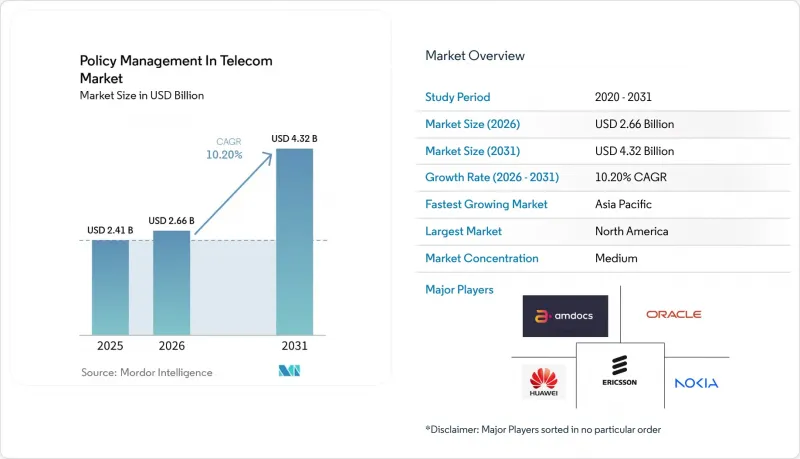
Mordor Intelligence에 의하면, 통신용 폴리시 관리 시장 규모는 2025년 24억 1,000만 달러로 평가되었습니다. 2026년 26억 6,000만 달러에서 2031년까지 43억 2,000만 달러로 확대되어 2026년부터 2031년까지 연평균 복합 성장률(CAGR)은 10.20%를 나타낼 것으로 예측됩니다.
본 보고서는 구성 요소(솔루션 등), 배포 방식(클라우드 기반 등), 용도(모바일 데이터 정책 제어, 음성/VoLTE 및 IMS 정책, 보안/자녀 보호 및 컨텐츠 정책 등), 사업자 유형(모바일 네트워크 사업자, 유선/광대역 사업자 등) 및 지역(유럽 등)별로 분류되어 있습니다. 시장 전망은 금액(달러) 기준으로 제시되어 있습니다.
세계의 통신용 폴리시 관리 시장 동향 및 인사이트
증가하는 모바일 데이터 트래픽과 적정 이용의 철저한 이행
동영상 스트리밍, 클라우드 게임, 증강현실(AR)이 데이터 사용량을 증가시키고 있어, 통신 사업자들은 네트워크 혼잡을 억제하면서도 고객 경험을 유지하기 위해 공정 이용 규정을 더욱 세밀하게 마련해야 하는 상황에 직면해 있습니다. 클라우드 네이티브 정책 엔진을 통해 실현되는 100밀리초 미만의 의사결정 주기로 인해, 셀이 용량 한계에 도달하는 순간 네트워크는 트래픽 대역폭 제한 및 우선순위 재설정을 수행할 수 있게 됩니다. 따라서 고성장 시장의 통신 사업자들은 과거 몇 시간이 걸리던 수동 정책 업데이트에 의존하지 않고, 규칙 실행을 자동화하고 있습니다. 400 Gbps 인터넷 익스체인지 백본으로의 업그레이드는 데이터량 증가에 대응하기 위해 필요한 투자 규모를 보여주고 있으며, 이러한 노력은 실시간 혼잡 완화가 이제 모든 전략적 로드맵의 핵심으로 자리 잡고 있는 이유를 여실히 보여줍니다.
CSP를 통한 클라우드 네이티브 5G 코어 아키텍처로의 전환
3GPP Release 15 및 Release 16 사양을 준수하는 컨테이너화된 정책 제어 기능 마이크로서비스가 모놀리식 어플라이언스를 대체하여, 지속적인 통합 파이프라인과 탄력적인 확장을 실현하고 있습니다. 이러한 아키텍처로 전환하는 통신 사업자들은 초기 하드웨어 비용을 40% 가까이 절감하고, 새로운 규칙의 적용 기간을 몇 주에서 몇 시간으로 단축하고 있습니다. 하이브리드 환경에서는 데이터 거주지 관련 규정을 준수하기 위해 지연 시간에 민감한 트랜잭션을 On-Premise에 유지하면서, 중요도가 낮은 분석 처리는 퍼블릭 클라우드로 이전함으로써 규정 준수 및 비용 간의 균형을 맞추고 있습니다. 통합과 관련된 과제를 가장 먼저 해결한 시장은 네트워크 슬라이싱과 같은 서비스 기반의 수익화 모델을 조기에 활용할 수 있게 됩니다.
기존 PCRF 및 BSS 통합의 복잡성
구식 과금 플랫폼과 레거시 정책 엔진 사이에서 독자적인 인터페이스를 운영하고 있는 통신 사업자들은 대개 수년이 소요되는 전환 과정에 직면해 있으며, 이는 운영 효율성에 큰 영향을 미치고 있습니다. 이 전환 기간 동안에는 병행 운영이 필요하며, 폐지 절차가 완료될 때까지 실질적으로 간접비가 두 배로 늘어납니다. 이처럼 장기화되는 전환 과정은 예산을 압박할 뿐만 아니라, 수익 창출을 위한 이용 사례의 개발 및 개선에 활용할 수 있는 중요한 엔지니어링 인력을 할당해야 하는 결과로 이어집니다. 게다가, 맞춤형 중재 계층에 대한 의존은 투자 회수 기간을 더욱 연장시켜 투자 수익을 실현하는 시기를 늦추게 됩니다. 이러한 과제는 첨단 서비스 기반 아키텍처 기능의 적시 도입을 방해하고, 고객에게 혁신적인 서비스를 제공할 수 있는 능력을 제한합니다. 그 결과, 통신 사업자들은 인프라 현대화와 운영상의 민첩성 확보에 있어 상당한 지연을 겪게 될 것입니다.
부문별 분석
이 솔루션은 2025년 통신용 폴리시 관리 시장 매출의 61.90%를 차지했으며, 정책 제어 기능 인스턴스나 통합 과금 엔진과 같은 라이선스 기반 소프트웨어 요소의 중요성을 부각시키고 있습니다. 이러한 솔루션은 통신 사업자가 네트워크 정책을 효과적으로 관리하면서 원활한 고객 경험을 보장하는 데 필수적입니다. 통신 사업자들이 핵심 업무에 집중하기 위해 운영 리스크를 외부 전문가에게 맡기는 경향이 강해지는 가운데, 매니지드 서비스는 연평균 성장률(CAGR) 12.40%를 기록하며 성장하고 있습니다. 성과 기반 계약에서의 과금, 정책 오케스트레이션, 수익 보장의 통합은 통신 사업자들에게 바람직한 접근 방식으로 자리 잡고 있습니다. 이러한 추세는 예산을 압박할 가능성이 있는 정기적인 설비 투자의 급증보다는 예측 가능한 운영비를 원하는 수요에 의해 주도되고 있습니다. 또한, 통신 네트워크가 점점 더 복잡해짐에 따라, 견고한 폴리시 관리 솔루션의 중요성이 더욱 커지고 있습니다.
통신 업계의 기술 인력 부족도 종합적인 솔루션을 제공하는 서비스 제공업체에 대한 수요를 부추기고 있습니다. 이러한 서비스 제공업체들은 전환 컨설팅, 슬라이스 라이프사이클 관리, AI를 활용한 보증 서비스를 다년 계약에 포함시키는 경우가 많으며, 통신 사업자가 직면한 운영상의 과제를 해결하고 있습니다. 더 많은 통신 사업자가 클라우드 네이티브 코어로 전환함에 따라, 매니지드 서비스에 대한 수요가 크게 확대될 것으로 예측됩니다. 지속적인 최적화 및 규정 준수 검증에는 외부로부터의 지속적인 지원이 필요하기 때문에 서비스 수익은 솔루션 수익과의 격차를 점차 좁혀 나갈 것입니다. 이러한 변화는 현대 통신 네트워크의 복잡성을 관리하기 위해 외부 전문 지식에 대한 의존도가 높아지고 있음을 여실히 보여주고 있습니다. 또한, 첨단 기술의 도입과 규제 준수 요건으로 인해 예측 기간 동언매니지드 서비스의 성장이 지속될 것으로 전망됩니다.
2025년에는 클라우드 기반 솔루션이 71.20%의 시장 점유율을 차지하며, 클라우드가 새로운 정책 배포의 주요 플랫폼으로서의 입지를 확고히 했습니다. 퍼블릭 클라우드는 대규모 데이터센터를 운영할 자원이 없는 중소규모의 통신 사업자에게 적합합니다. 반면, 프라이빗 클라우드와 소버린 클라우드는 엄격한 데이터 상주 요건 및 보안 규제를 준수해야 하는 Tier 1 통신 사업자들에게 선호되고 있습니다. On-Premise에서의 실시간 적용과 하이퍼스케일러 리전으로 오프로드된 분석 기능을 결합한 하이브리드 모델이 주목을 받고 있습니다. 이러한 접근 방식을 통해 사업자는 규정 준수 요건과 클라우드 솔루션이 제공하는 확장성 및 유연성 간의 균형을 맞출 수 있습니다. 그 결과, 통신 업계의 폴리시 관리 방안으로서 클라우드가 여전히 주류를 이루고 있습니다.
On-Premise 시스템 시장 점유율은 감소 추세를 보이고 있지만, 퍼블릭 클라우드 인프라가 제한적인 지역이나 엄격한 국가 안보 규제가 적용되는 지역에서는 여전히 중요한 역할을 하고 있습니다. 규제나 기술적 장벽으로 인해 퍼블릭 클라우드 도입이 저해되고 있는 관할 구역에서는 이러한 시스템이 유일한 현실적인 선택지가 되는 경우가 적지 않습니다. 그러나 하이브리드 클라우드 모델은 On-Premise와 클라우드 기반 솔루션 양쪽의 장점을 결합한 성공적인 활용 사례를 제시함으로써 이러한 격차를 서서히 좁혀가고 있습니다. 향후 이러한 하이브리드 방식의 도입을 통해 클라우드 도입에 대한 거부감이 줄어들고, 멀티테넌트형 인프라로의 전환이 촉진될 것으로 예측됩니다. 이러한 전환을 통해, 통신 폴리시 관리 분야에서 성장을 이끄는 핵심 동력으로서 클라우드의 역할이 더욱 공고해질 것으로 전망됩니다.
지역별 분석
북미는 조기 5G 독립형(SA) 구축, 견고한 하이퍼스케일러 생태계, 그리고 사설 네트워크에 대한 기업 수요 덕분에 2025년 통신용 폴리시 관리 시장 매출의 28.20%를 차지했습니다. 통신 사업자들은 Citizens Broadband Radio Service(CBRS) 규정을 활용하여 On-Premise 기업 네트워크 내에 정책 제어 기능을 통합함으로써, 기존 소비자층을 넘어선 잠재 수요를 확대되고 있습니다. 인공지능(AI)을 활용한 오케스트레이션은 시범 운영 단계에서 본 운영 환경으로의 전환 주기가 급속히 진행되면서 성장을 뒷받침하고 있습니다.
아시아태평양은 중국의 5G 가입자 수가 대폭 증가하고, 인도의 정책 연계형 정부 프로그램이 신규 확장을 뒷받침하는 가운데, 2031년까지 연평균 성장률(CAGR) 15.80%를 기록하며 세계에서 가장 빠른 성장세를 보일 것으로 전망됩니다. 수십만 개의 기지국으로의 독립형 코어 확장은 전례 없는 규모의 정책 처리를 초래하며, 통신 사업자들이 탄력적인 클라우드 네이티브 제어 플레인을 도입하도록 압박하고 있습니다. 일본과 한국에서 인텐트 기반 네트워킹을 조기에 도입함으로써, 이 지역의 발전 기세가 더욱 공고해지고 있습니다.
유럽에서는 실시간 로밍 알림 의무화 및 아키텍처를 하이브리드 클라우드로 전환하도록 유도하는 강력한 데이터 개인정보 보호 규제의 영향으로 꾸준한 진전이 나타나고 있습니다. 중동의 통신 사업자들은 6G 연구 및 주파수 대역 조화에 적극적으로 투자하고 있으며, 걸프협력회의(GCC)를 차세대 정책 아키텍처의 테스트베드로 삼고 있습니다. 사하라 이남 아프리카와 남미는 여전히 자본 예산의 제약을 받고 있지만, 막대한 초기 비용이 아닌 수익 분배에 연동된 관리형 서비스 모델이 현대화를 향한 지속 가능한 길을 열어가고 있습니다.
기타 혜택 :
- 엑셀 형식 시장 예측(ME) 시트
- 3개월간의 애널리스트 지원
자주 묻는 질문
목차
제1장 서론
제2장 분석 방법
제3장 주요 요약
제4장 시장 구도
제5장 시장 규모 및 성장률 예측
제6장 경쟁 구도
제7장 시장 기회 및 향후 전망
KTH 26.06.24According to Mordor Intelligence, the policy management in the telecom industry market size is projected to expand from USD 2.41 billion in 2025 and USD 2.66 billion in 2026 to USD 4.32 billion by 2031, registering a CAGR of 10.20% between 2026 and 2031.
This report is Segmented by Component (Solutions, and More), Deployment Model (Cloud-Based, and More), Application (Mobile Data Policy Control, Voice/VoLTE and IMS Policy, Security/Parental-Control and Content Policy, and More), Operator Type (Mobile Network Operators, Fixed/Broadband Operators, and More), and Geography (Europe, and More). The Market Forecasts are Provided in Terms of Value (USD).
Global Policy Management In Telecom Market Trends and Insights
Rising Mobile-Data Traffic And Fair-Usage Enforcement
Video streaming, cloud gaming, and augmented reality push data volumes upward, compelling operators to refine fair-usage rules that preserve customer experience while curbing congestion. Sub-100-millisecond decision cycles enabled by cloud-native policy engines let networks throttle or reprioritize flows the instant a cell reaches capacity. Operators in high-growth markets are therefore automating rule execution instead of relying on manual policy updates that once took hours. Upgrades to 400 Gbps internet-exchange backbones show the investment scale needed to match data growth, and the practice illustrates why real-time congestion mitigation now sits at the heart of every strategic roadmap.
CSP Transition To Cloud-Native 5G-Core Architectures
Containerized policy control function micro-services conforming to 3GPP Release 15 and Release 16 specifications replace monolithic appliances, unlocking continuous integration pipelines and elastic scaling. Operators migrating to these architectures trim upfront hardware spending by nearly 40% and roll out new rules in hours rather than weeks. Hybrid deployments keep latency-sensitive transactions on premises to meet data residency laws, while non-critical analytics move to public clouds, balancing compliance with cost. Markets that solve integration pain points first gain earlier access to service-based monetization models such as network slicing.
Legacy PCRF And BSS Integration Complexity
Operators running proprietary interfaces between older billing platforms and legacy policy engines often face multi-year cutovers, which significantly impact operational efficiency. During this transition, parallel operations are required, effectively doubling overhead costs until the decommissioning process is complete. This prolonged migration not only stretches budgets but also diverts critical engineering talent that could be utilized to develop and refine monetization use cases. Additionally, the reliance on custom mediation layers further extends payback periods, delaying the realization of returns on investment. These challenges also hinder the timely deployment of advanced service-based architecture features, limiting the ability to offer innovative services to customers. As a result, operators face significant delays in modernizing their infrastructure and achieving operational agility.
Other drivers and restraints analyzed in the detailed report include:
- Regulatory Push For Real-Time Roaming Bill-Shock Prevention
- Monetisation Needs For Network Slicing And Enterprise SLAs
- Operator CAPEX Constraints In Low-ARPU Markets
For complete list of drivers and restraints, kindly check the Table Of Contents.
Segment Analysis
Solutions held 61.90% of 2025 revenue within the policy management in telecom industry market size, underscoring the importance of license-driven software elements such as policy control function instances and convergent charging engines. These solutions are critical for enabling telecom operators to manage network policies effectively while ensuring seamless customer experiences. Managed services are growing at a 12.40% CAGR as carriers increasingly shift operational risks to external specialists to focus on core business functions. The convergence of charging, policy orchestration, and revenue assurance within outcome-based contracts is becoming a preferred approach for operators. This trend is driven by the need for predictable operating expenses over periodic capital expenditure spikes, which can strain budgets. Additionally, the growing complexity of telecom networks further emphasizes the importance of robust policy management solutions.
Skills shortages in the telecom industry are also driving demand for service providers who offer comprehensive solutions. These providers often bundle migration consulting, slice lifecycle management, and artificial-intelligence-driven assurance into multi-year agreements, addressing the operational challenges faced by carriers. As more telecom operators transition to cloud-native cores, the demand for managed services is expected to grow significantly. Service revenue is likely to close the gap with solutions revenue, as ongoing optimization and compliance validation require continuous external support. This shift highlights the increasing reliance on external expertise to manage the complexities of modern telecom networks. Furthermore, the adoption of advanced technologies and regulatory compliance needs are expected to sustain the growth of managed services in the forecast period.
Cloud variants commanded 71.20% market share in 2025, establishing the cloud as the primary platform for new policy deployments. Public clouds cater to small and mid-size operators that lack the resources to maintain large-scale data centers. In contrast, private and sovereign clouds are preferred by tier-one operators that must adhere to stringent data residency and security regulations. Hybrid models are gaining traction, combining on-premises real-time enforcement with analytics offloaded to hyperscaler regions. This approach allows operators to balance compliance requirements with the scalability and flexibility offered by cloud solutions. As a result, the cloud continues to dominate as the preferred choice for policy management in the telecom industry.
On-premises systems are experiencing a decline in market share but remain relevant in regions with limited public-cloud infrastructure or strict national-security restrictions. These systems are often the only viable option in jurisdictions where public-cloud adoption is hindered by regulatory or technological barriers. However, hybrid cloud models are gradually bridging this gap by demonstrating successful use cases that combine the benefits of both on-premises and cloud-based solutions. Over time, these hybrid deployments are expected to reduce resistance to cloud adoption and encourage a shift toward multi-tenant infrastructure. This transition is anticipated to further solidify the cloud's role as a critical driver of growth in telecom policy management.
Geography Analysis
North America delivered 28.20% of 2025 revenue for the policy management in telecom industry market thanks to early 5G standalone deployments, robust hyperscaler ecosystems, and enterprise appetite for private networks. Operators leverage Citizens Broadband Radio Service rules to embed policy control inside on-premises enterprise networks, broadening addressable demand beyond traditional consumer bases. Artificial-intelligence-powered orchestration sees rapid pilot-to-production cycles, buttressing growth.
Asia-Pacific is forecast to record a 15.80% CAGR through 2031, the fastest globally, as massive 5G subscriber additions in China and policy-linked government programs in India fuel new rollouts. Standalone core expansion to hundreds of thousands of base stations generates unprecedented volumes of policy transactions, forcing carriers to adopt elastic, cloud-native control planes. Early adoption of intent-based networking in Japan and South Korea further solidifies the region's forward momentum.
Europe shows measured progress, paced by mandates for real-time roaming alerts and strong data privacy regimes that skew architecture toward hybrid clouds. Middle Eastern operators invest aggressively in 6G research and spectrum harmonization, positioning the Gulf Cooperation Council as a test bed for next-generation policy architectures. Sub-Saharan Africa and South America remain constrained by capital budgets, yet managed service models, tied to revenue share rather than heavy upfront fees, carve a sustainable pathway to modernization.
- Amdocs Ltd.
- Telefonaktiebolaget LM Ericsson
- Nokia Corporation
- Huawei Technologies Co., Ltd.
- Oracle Corporation
- Netcracker Technology Corporation
- Cisco Systems, Inc.
- Hewlett Packard Enterprise Company
- MATRIXX Software, Inc.
- Comarch S.A.
- Intracom Telecom S.A.
- CSG Systems International, Inc.
- Openet Telecom Ltd. (Amdocs Subsidiary)
- ZTE Corporation
- Tecnotree Oyj
- Optiva Inc.
- Alepo Technologies, Inc.
- Sterlite Technologies Ltd.
- DigitalRoute AB
- Accuris Networks Ltd.
Additional Benefits:
- The market estimate (ME) sheet in Excel format
- 3 months of analyst support
TABLE OF CONTENTS
1 INTRODUCTION
- 1.1 Study Assumptions and Market Definition
- 1.2 Scope of the Study
2 RESEARCH METHODOLOGY
3 EXECUTIVE SUMMARY
4 MARKET LANDSCAPE
- 4.1 Market Overview
- 4.2 Market Drivers
- 4.2.1 Rising Mobile-Data Traffic and Fair-Usage Enforcement
- 4.2.2 CSP Transition to Cloud-Native 5G-Core Architectures
- 4.2.3 Regulatory Push for Real-Time Roaming Bill-Shock Prevention
- 4.2.4 Monetisation Needs for Network Slicing and Enterprise SLAs
- 4.2.5 AI-Assisted Dynamic QoS and Intent-Based Policies
- 4.2.6 Private-Network PCC Demand from Industry 4.0 Campuses
- 4.3 Market Restraints
- 4.3.1 Legacy PCRF/BSS Integration Complexity
- 4.3.2 Operator CAPEX Constraints in Low-ARPU Markets
- 4.3.3 Security Concerns Around Multi-Vendor Cloud Deployments
- 4.3.4 Edge-Cloud Orchestration Immaturity
- 4.4 Industry Value Chain Analysis
- 4.5 Regulatory Landscape
- 4.6 Technological Outlook
- 4.7 Impact of Macroeconomic Factors on the Market
- 4.8 Porter's Five Forces Analysis
- 4.8.1 Threat of New Entrants
- 4.8.2 Bargaining Power of Suppliers
- 4.8.3 Bargaining Power of Buyers
- 4.8.4 Threat of Substitutes
- 4.8.5 Industry Rivalry
5 MARKET SIZE AND GROWTH FORECASTS (VALUE)
- 5.1 By Component
- 5.1.1 Solutions
- 5.1.2 Services
- 5.2 By Deployment Model
- 5.2.1 On-Premises
- 5.2.2 Cloud-Based (Public, Private, Hybrid)
- 5.3 By Application
- 5.3.1 Mobile Data Policy Control
- 5.3.2 Voice/VoLTE and IMS Policy
- 5.3.3 Roaming and Interconnect Policy
- 5.3.4 Security/Parental-Control and Content Policy
- 5.4 By Operator Type
- 5.4.1 Mobile Network Operators (MNO)
- 5.4.2 Fixed/Broadband Operators
- 5.4.3 Mobile Virtual Network Operators (MVNO)
- 5.5 By Geography
- 5.5.1 North America
- 5.5.1.1 United States
- 5.5.1.2 Canada
- 5.5.1.3 Mexico
- 5.5.2 Europe
- 5.5.2.1 Germany
- 5.5.2.2 United Kingdom
- 5.5.2.3 France
- 5.5.2.4 Italy
- 5.5.2.5 Spain
- 5.5.2.6 Netherlands
- 5.5.2.7 Russia
- 5.5.2.8 Rest of Europe
- 5.5.3 Asia-Pacific
- 5.5.3.1 China
- 5.5.3.2 Japan
- 5.5.3.3 India
- 5.5.3.4 South Korea
- 5.5.3.5 Australia and New Zealand
- 5.5.3.6 ASEAN
- 5.5.3.7 Rest of Asia-Pacific
- 5.5.4 Middle East
- 5.5.4.1 Saudi Arabia
- 5.5.4.2 United Arab Emirates
- 5.5.4.3 Turkey
- 5.5.4.4 Rest of Middle East
- 5.5.5 Africa
- 5.5.5.1 South Africa
- 5.5.5.2 Nigeria
- 5.5.5.3 Egypt
- 5.5.5.4 Rest of Africa
- 5.5.6 South America
- 5.5.6.1 Brazil
- 5.5.6.2 Argentina
- 5.5.6.3 Rest of South America
- 5.5.1 North America
6 COMPETITIVE LANDSCAPE
- 6.1 Market Concentration
- 6.2 Strategic Moves
- 6.3 Market Share Analysis
- 6.4 Company Profiles (includes Global Level Overview, Market Level Overview, Core Segments, Financials as available, Strategic Information, Market Rank/Share, Products and Services, Recent Developments)
- 6.4.1 Amdocs Ltd.
- 6.4.2 Telefonaktiebolaget LM Ericsson
- 6.4.3 Nokia Corporation
- 6.4.4 Huawei Technologies Co., Ltd.
- 6.4.5 Oracle Corporation
- 6.4.6 Netcracker Technology Corporation
- 6.4.7 Cisco Systems, Inc.
- 6.4.8 Hewlett Packard Enterprise Company
- 6.4.9 MATRIXX Software, Inc.
- 6.4.10 Comarch S.A.
- 6.4.11 Intracom Telecom S.A.
- 6.4.12 CSG Systems International, Inc.
- 6.4.13 Openet Telecom Ltd. (Amdocs Subsidiary)
- 6.4.14 ZTE Corporation
- 6.4.15 Tecnotree Oyj
- 6.4.16 Optiva Inc.
- 6.4.17 Alepo Technologies, Inc.
- 6.4.18 Sterlite Technologies Ltd.
- 6.4.19 DigitalRoute AB
- 6.4.20 Accuris Networks Ltd.
7 MARKET OPPORTUNITIES AND FUTURE OUTLOOK
- 7.1 White-Space and Unmet-Need Assessment