

|
시장보고서
상품코드
2062279
식품 가공용 씰 시장 : 점유율 분석, 업계 동향과 통계, 성장 예측(2026-2031년)Food Processing Seals - Market Share Analysis, Industry Trends & Statistics, Growth Forecasts (2026 - 2031) |
||||||
 Mordor Intelligence
Mordor Intelligence에 의하면, 식품 가공용 씰 시장 규모는 2025년 34억 8,000만 달러, 2026년 36억 달러에서 2031년까지 42억 3,000만 달러로 확대되어 2026년부터 2031년까지 연평균 복합 성장률(CAGR)은 3.31%를 나타낼 것으로 예측됩니다.
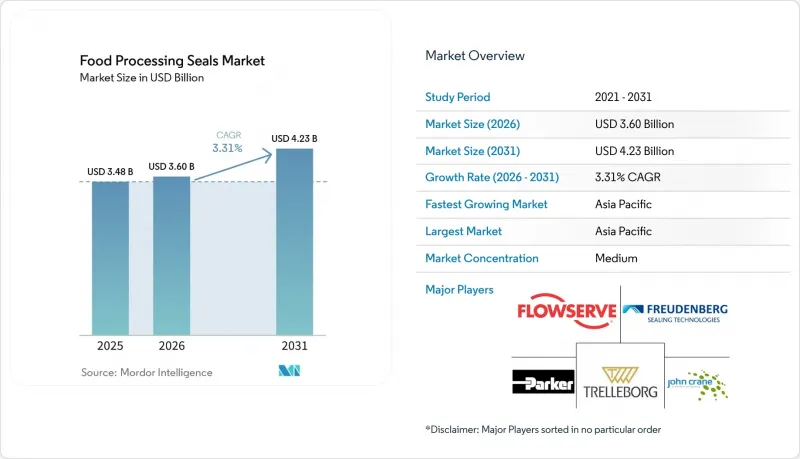
본 보고서는 소재 유형(엘라스토머, 폴리테트라플루오로에틸렌(PTFE) 등), 씰 유형(O-링, 개스킷 등), 용도(가공 장비, 포장 장비 등), 최종 사용자 산업(육류, 가금류·수산물, 제빵 및 제과 등), 지역(아시아태평양, 북미 등)에 따라 분류되어 있습니다. 시장 전망은 금액(달러) 기준으로 제시되어 있습니다.
전 세계 식품 가공용 씰 시장 동향 및 분석
전 세계 식품 접촉 규제의 시행
미국 21 CFR 177.2600과 EU 규정 1935/2004의 조화에 따라, 가공업체는 씰의 적합성을 문서화해야 할 의무가 있으며, 클린룸 성형 시설이나 배치 기록 시스템을 갖춘 공급업체가 유리한 입장에 있습니다. 리콜 위험이 높아짐에 따라 단가가 높음에도 불구하고 인증 마크 도입이 확대되고 있으며, 사우디아라비아의 개정 식품법에 따라 이러한 추세는 중동 전역으로 확산되고 있습니다.
완전 자동 가공 시스템 도입
고속 충전기 및 로봇식 뼈 제거기에서는 현재 연속 멸균 사이클이 가동되고 있으며, 이를 위해서는 6년 이상의 가동 기간을 견딜 수 있는 FFKM 립 씰과 실리콘 카바이드 재질의 기계적 접촉면이 필요합니다. 인라인 금속 감지기의 도입으로 인해 X선 검사가 가능한 밀봉재에 대한 수요가 증가하고 있으며, 가공 업체들은 장기 서비스 계약을 체결하게 되었습니다.
엘라스토머를 열화시키는 강력한 알칼리성 CIP 세정제
pH 12-13의 수산화나트륨은 씰의 수명을 12개월 미만으로 단축시키며, 내알칼리성 EPDM 및 FFKM 등급이 보급될 때까지 유지보수 비용을 증가시킵니다. 트렐보르그사의 기술 보고서에 따르면, 80°C의 2% NaOH 용액에 500시간 동안 노출시킨 후, EPDM의 쇼어 A 경도는 10-15포인트 상승하고, 부피 팽창률은 20%를 초과하는 것으로 보고되었습니다. 마찬가지로, BASF의 세정제 적합성 매트릭스에 따르면, 표준 바이톤(FKM) 컴파운드는 동등한 조건에서 인장 강도가 30% 감소하는 것으로 나타났습니다.
부문별 분석
엘라스토머는 2025년 식품 가공용 씰 시장의 매출의 34.47%를 차지해, 2031년까지 연평균 성장률(CAGR) 3.56%로 성장할 전망입니다. 이는 150℃까지의 증기 세척이 이루어지는 유제품 및 음료 공장에서 EPDM이 주류를 이루고 있다는 점이 배경에 있습니다. 니트릴은 유지류에 노출될 가능성이 높은 육류 가공 라인에서 사용되고 있지만, 식물성 원료 제품을 취급하는 시설에서 알칼리 세척을 실시할 경우 FKM 및 FFKM으로의 이온 이동이 가속화되고 있습니다. 2025년에는 불화칼슘 광석 가격 급등으로 인해 불소계 엘라스토머 가격이 12% 상승하여 예산이 빠듯해졌지만, 교체에 따른 가동 중단 비용이 여전히 더 높았기 때문에 소재 전환이 촉진되었습니다. PTFE는 고온 분야의 틈새 시장을 차지하고 있으며, UHT 시스템에 필수적인 260℃까지의 화학적 불활성 특성을 제공합니다. 또한, 유제품 충전기에 사용되는 PTFE 벨로우즈식 기계식 씰에 필수적인 소재입니다. 소매업체들이 이물질 감지 프로토콜을 강화함에 따라, 페라이트 입자가 내장된 감지 가능 화합물이 가장 빠르게 성장하는 하위 부문으로 부상하고 있습니다.
O링은 그 보급률과 표준화 덕분에 2025년 기준 시장 매출의 37.78%를 차지했으나, 가공업체들이 CIP/SIP를 자동화함에 따라 기계식 씰은 2031년까지 연평균 성장률(CAGR) 3.66%로 성장을 지속하고, 있습니다. 이글버그만(Eagle Bergman)사의 실리콘 카바이드 면 씰은 UHT 라인에서 6년의 수명을 달성함으로써, 고품질 조립품이 어떻게 성장을 주도하는지 보여주고 있습니다. 클램프 개스킷은 공구 없이 분해할 때 여전히 필수적이며, 특히 향료 교체가 일상적으로 이루어지는 제과점이나 스낵 공장에서 중요합니다. 샤프트 씰과 립 씰은 믹서나 컨베이어에 사용되며, 무균 밸브 내부의 다이어프램 씰은 무균 상태를 유지하면서 수백만 회의 사이클을 견뎌야 합니다.
지역별 분석
아시아태평양은 2025년 매출의 43.34%를 차지하며, 인도의 PLISFPI와 중국의 두 자릿수 성장을 지속하는 콜드체인 창고에 힘입어 2031년까지 연평균 성장률(CAGR) 4.08%로 성장하고 있습니다. 인도에서 추진 중인 4,000억 루피 규모의 AI 기반 푸드 파크와 394건의 승인된 콜드체인 프로젝트 모두에서 블라스트 프리저용 극저온 PTFE 씰이 지정되었습니다. 중국의 수출업체들은 프리미엄 시장에 진출하기 위해 FDA 및 EU 인증을 받은 개스킷을 필요로 하는 반면, 아세안(ASEAN)의 수산 가공업체들은 공장을 EHEDG 기준에 부합하도록 개조하고 있으며, 이는 해당 지역의 애프터마켓 수요를 견인하고 있습니다.
북미에서도 가공업체들이 FSMA의 예방적 관리 기준을 준수하기 위해 구형 설비를 업그레이드하고, 출처가 불분명한 씰을 추적성이 확보된 FFKM 소재 부품으로 교체함에 따라 수요가 확대되고 있습니다. 브라질에 위치한 네슬레 퓨리나의 5억 달러 규모 습식 반려동물사료 공장과 같은 자본 투자 프로젝트는 여전히 미국의 원료 기준을 반영하고 있으며, 고품질 씰에 대한 국경을 초월한 수요를 뒷받침하고 있습니다.
유럽의 성숙한 가공업체들은 위생 기준이 매우 엄격한 유제품 및 제과 공장에 사용되는 특수 컴파운드를 중요하게 여기며, 북유럽에서는 지속가능성 지표를 충족하기 위해 내구성이 뛰어난 씰을 요구하고 있습니다. 남미의 성장은 브라질의 냉동 감자 및 유제품 시장의 확대에 힘입고 있으며, 이곳에서 사용되는 급속 냉동고에는 저온 환경에 적합한 불소 엘라스토머가 필요합니다. 중동에서는 SFDA의 디지털 HACCP 도구에 맞추어 씰 재고 갱신이 진행되고 있으며, 남아프리카의 음료 업계에서는 연속 냉장 설비가 없는 농촌 지역에서 유통되는 장기 보존이 가능한 UHT 우유에 FFKM 씰을 채택하고 있습니다.
기타 혜택:
- 엑셀 형식 시장 예측(ME) 시트
- 3개월간의 애널리스트 지원
자주 묻는 질문
목차
제1장 서론
제2장 조사 방법
제3장 주요 요약
제4장 시장 구도
제5장 시장 규모와 성장 예측
제6장 경쟁 구도
제7장 시장 기회와 향후 전망
JHS 26.06.19According to Mordor Intelligence, the food processing seals market size is projected to expand from USD 3.48 billion in 2025 and USD 3.60 billion in 2026 to USD 4.23 billion by 2031, registering a CAGR of 3.31% between 2026 to 2031.
This report is Segmented by Material Type (Elastomers, Polytetrafluoroethylene (PTFE), and More), Seal Type (O-Rings, Gaskets, and More), Application (Processing Equipment, Packaging Equipment, and More), End-User Industry (Meat, Poultry and Seafood, Bakery and Confectionery, and More), and Geography (Asia-Pacific, North America, and More). The Market Forecasts are Provided in Terms of Value (USD).
Global Food Processing Seals Market Trends and Insights
Enforcement of Global Food-Contact Regulations
Convergence of U.S. 21 CFR 177.2600 and EU Regulation 1935/2004 obliges processors to document seal compliance, favoring suppliers with clean-room molding and batch-record systems. Recall exposure drives adoption of certified seals despite higher unit prices, and Saudi Arabia's updated Food Law extends this pressure across the Middle-East.
Adoption of Fully Automated Processing Systems
High-speed fillers and robotic deboners now run continuous sterilization cycles that require FFKM lip seals and silicon-carbide mechanical faces capable of 6+-year duty. Inline metal detectors spur demand for X-ray-detectable seal materials, locking processors into long-term service contracts.
Aggressive Alkaline CIP Cleaners Degrading Elastomers
Sodium hydroxide at pH 12-13 cuts seal life to under 12 months, inflating maintenance costs until alkaline-resistant EPDM and FFKM grades scale.Trelleborg's technical bulletins report an increase in EPDM hardness by 10-15 Shore A points and volume swelling exceeding 20% after 500 hours of exposure to 2% NaOH at 80°C. Similarly, BASF's cleaning-agent compatibility matrices indicate that standard Viton (FKM) compounds experience a 30% reduction in tensile strength under comparable conditions.
Other drivers and restraints analyzed in the detailed report include:
- Shift Toward Plant-Based Protein Processing
- Aseptic High-Viscosity Lines Needing FDA-Grade Perfluoro-Elastomers
- Shortage of Certified Clean-Room Molding Capacity
For complete list of drivers and restraints, kindly check the Table Of Contents.
Segment Analysis
Elastomers held 34.47% of the food processing seals market revenue in 2025 and are on track for a 3.56% CAGR to 2031, supported by EPDM dominance in dairy and beverage plants that steam clean up to 150 °C. Nitrile serves meat lines where fat exposure is high, while alkaline cleaning in plant-based facilities accelerates migration to FKM and FFKM. Raw fluorspar inflation lifted fluoro-elastomer pricing by 12% in 2025, tightening budgets but reinforcing the switch because replacement downtime costs remain higher. PTFE occupies the high-temperature niche, providing chemical inertness to 260 °C, critical for UHT systems, and it is integral to PTFE-bellows mechanical seals used in dairy fillers. Detectable compounds embedded with ferrite particles are the fastest-growing sub-segment as retailers tighten foreign-object detection protocols.
O-rings retained 37.78% of the market revenue in 2025 given their ubiquity and standardization, yet mechanical seals are registering a 3.66% CAGR through 2031 as processors automate CIP/SIP. EagleBurgmann's silicon-carbide faced seals deliver six-year service in UHT lines and illustrate how premium assemblies capture growth. Clamp gaskets remain vital for tool-free disassembly, particularly in bakery and snack plants where rapid flavor changeovers are routine. Shaft and lip seals serve mixers and conveyors, and diaphragm seals in aseptic valves must survive millions of cycles while maintaining sterility.
Geography Analysis
Asia-Pacific held 43.34% revenue in 2025 and is advancing at a 4.08% CAGR to 2031, powered by India's PLISFPI and China's double-digit cold-chain warehouse growth. India's ₹40,000 crore AI-driven food parks and 394 sanctioned cold-chain projects each specify cryogenic PTFE seals for blast-freezers. China's exporters demand FDA and EU-certified gaskets to access premium markets, while ASEAN seafood processors retrofit plants to EHEDG standards, fueling regional after-market demand.
North America's demand is also growing as processors upgrade legacy equipment to comply with FSMA preventive controls, replacing undocumented seals with traceable FFKM parts. Capital programs such as Nestle Purina's USD 500 million wet pet-food plant in Brazil still mirror U.S. material standards, reinforcing cross-border demand for high-grade seals.
Europe's mature processors emphasize specialty compounds for ultra-hygienic dairy and confectionery plants, and the Nordic region targets seals with extended service life to meet sustainability metrics. South America's growth pivots on Brazil's frozen-potato and dairy expansions, where blast freezers require low-temperature fluoro-elastomers. The Middle-East upgrades seal inventories in line with SFDA's digital HACCP tools, and South Africa's beverage sector adopts FFKM seals for long-life UHT milk distributed in rural areas without continuous refrigeration.
- A.W. Chesterton Company
- DXP Enterprises, Inc.
- EagleBurgmann
- Eclipse Engineering, Inc.
- Enpro Inc.
- ERIKS Group
- Flowserve Corporation
- Freudenberg Sealing Technologies
- Huhnseal AB
- James Walker Group
- John Crane
- PARKER HANNIFIN CORP
- Precision Polymer Engineering/IDEX
- SEPCO, INC.
- SKF
- SSP Manufacturing Inc.
- Technetics Group
- Trelleborg AB
Additional Benefits:
- The market estimate (ME) sheet in Excel format
- 3 months of analyst support
TABLE OF CONTENTS
1 Introduction
- 1.1 Study Assumptions and Market Definition
- 1.2 Scope of the Study
2 Research Methodology
3 Executive Summary
4 Market Landscape
- 4.1 Market Overview
- 4.2 Market Drivers
- 4.2.1 Enforcement of global food-contact regulations
- 4.2.2 Adoption of fully-automated processing systems
- 4.2.3 Shift toward plant-based protein processing
- 4.2.4 Aseptic high-viscosity lines needing FDA-grade perfluoro-elastomers
- 4.2.5 Regional micro-cold-chain expansion boosting cryogenic seal grades
- 4.3 Market Restraints
- 4.3.1 Aggressive alkaline CIP cleaners degrading elastomers
- 4.3.2 Shortage of certified clean-room molding capacity
- 4.3.3 Rise of adhesive-less, gasket-less equipment designs
- 4.4 Value Chain Analysis
- 4.5 Porter's Five Forces
- 4.5.1 Threat of New Entrants
- 4.5.2 Bargaining Power of Buyers
- 4.5.3 Bargaining Power of Suppliers
- 4.5.4 Threat of Substitutes
- 4.5.5 Competitive Rivalry
5 Market Size and Growth Forecasts (Value)
- 5.1 By Material Type
- 5.1.1 Elastomers
- 5.1.2 Polytetrafluoroethylene (PTFE)
- 5.1.3 Polyurethane
- 5.1.4 Other Material Types (metal-detectable or X-ray-able materials)
- 5.2 By Seal Type
- 5.2.1 O-rings
- 5.2.2 Gaskets
- 5.2.3 Lip Seals
- 5.2.4 Mechanical Seals
- 5.2.5 Diaphragms
- 5.2.6 Shaft/Rotary Seals
- 5.2.7 Hygienic Clamp Seals and Tri-Clamp Gaskets
- 5.3 By Application
- 5.3.1 Processing Equipment
- 5.3.2 Packaging Equipment
- 5.3.3 Cleaning Systems (CIP/SIP)
- 5.3.4 Refrigeration and Freezing Equipment
- 5.4 By End-user Industry
- 5.4.1 Meat, Poultry and Seafood
- 5.4.2 Bakery and Confectionery
- 5.4.3 Dairy Products
- 5.4.4 Beverage
- 5.4.5 Other End-user Industries (Fruits and Vegetables, Ready Meals and Snacks, etc.)
- 5.5 By Geography
- 5.5.1 Asia-Pacific
- 5.5.1.1 China
- 5.5.1.2 Japan
- 5.5.1.3 India
- 5.5.1.4 South Korea
- 5.5.1.5 ASEAN Countries
- 5.5.1.6 Rest of Asia-Pacific
- 5.5.2 North America
- 5.5.2.1 United States
- 5.5.2.2 Canada
- 5.5.2.3 Mexico
- 5.5.3 Europe
- 5.5.3.1 Germany
- 5.5.3.2 United Kingdom
- 5.5.3.3 France
- 5.5.3.4 Italy
- 5.5.3.5 Spain
- 5.5.3.6 Russia
- 5.5.3.7 NORDIC Countries
- 5.5.3.8 Rest of Europe
- 5.5.4 South America
- 5.5.4.1 Brazil
- 5.5.4.2 Argentina
- 5.5.4.3 Rest of South America
- 5.5.5 Middle-East and Africa
- 5.5.5.1 Saudi Arabia
- 5.5.5.2 South Africa
- 5.5.5.3 Rest of Middle-East and Africa
- 5.5.1 Asia-Pacific
6 Competitive Landscape
- 6.1 Market Concentration
- 6.2 Strategic Moves
- 6.3 Market Share(%)/Ranking Analysis
- 6.4 Company Profiles (includes Global Overview, Market Overview, Core Segments, Financials, Strategic Information, Products and Services, and Recent Developments)
- 6.4.1 A.W. Chesterton Company
- 6.4.2 DXP Enterprises, Inc.
- 6.4.3 EagleBurgmann
- 6.4.4 Eclipse Engineering, Inc.
- 6.4.5 Enpro Inc.
- 6.4.6 ERIKS Group
- 6.4.7 Flowserve Corporation
- 6.4.8 Freudenberg Sealing Technologies
- 6.4.9 Huhnseal AB
- 6.4.10 James Walker Group
- 6.4.11 John Crane
- 6.4.12 PARKER HANNIFIN CORP
- 6.4.13 Precision Polymer Engineering/IDEX
- 6.4.14 SEPCO, INC.
- 6.4.15 SKF
- 6.4.16 SSP Manufacturing Inc.
- 6.4.17 Technetics Group
- 6.4.18 Trelleborg AB
7 Market Opportunities and Future Outlook
- 7.1 White-space and Unmet-need Assessment


