

|
시장보고서
상품코드
2062387
흰개미 방제 시장 : 점유율 분석, 업계 동향과 통계, 성장 예측(2026-2031년)Termite Control - Market Share Analysis, Industry Trends & Statistics, Growth Forecasts (2026 - 2031) |
||||||
 Mordor Intelligence
Mordor Intelligence에 의하면, 흰개미 방제 시장 규모는 2025년 58억 9,000만 달러에서 2026년에는 62억 7,000만 달러로 확대되어 2026년부터 2031년까지 CAGR 6.39%로 성장을 지속하여, 2031년까지 85억 4,000만 달러에 이를 것으로 예측됩니다.
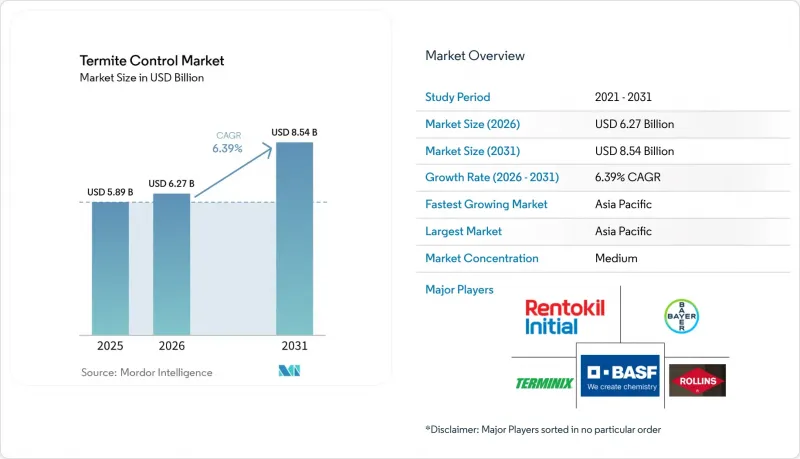
본 보고서는 방제 방법(화학적 방제, 물리적·기계적 방제, 생물학적 방제 등), 종(지하성 흰개미, 건재성 흰개미 등), 용도(주택, 상업·공업용 등), 지역(아시아태평양, 북미, 유럽, 남미, 중동 및 아프리카)별로 분류되어 있습니다. 시장 전망은 금액(달러) 기준으로 제시되어 있습니다.
세계 흰개미 방제 시장 동향과 인사이트
구조적 손상 복구 비용 증가
미국에서는 흰개미 피해로 인한 연간 수리비가 상당한 수준에 달하고 있습니다. 이 수치에는 부동산 가치 하락이나 보험료 증가와 같은 간접적인 손실은 포함되어 있지 않습니다. 습도가 높은 지역에서는 유지보수가 미뤄진 노후 주택들이 흰개미 피해에 대한 취약성을 높이고 있습니다. 그 결과, 금융 기관들은 심사 기준을 강화하고 있으며, 보험사들은 유효한 보증 계약에 대해 보험료를 할인해 주고 있습니다. 지방 자치 단체는 현재 교량, 전신주, 공공 건축물의 유지 관리 예산에 다년 계약 형태의 흰개미 방제 계약을 포함하고 있습니다. 이러한 변화로 인해, 과거에는 재량적 지출이었던 것이 계획적인 자본 지출로 전환되었습니다. 그 결과, 발견률이 높아지고 복구 비용이 증가하며 예방 조치가 자금 조달의 필수 요건으로 간주됨에 따라 전 세계 흰개미 방제 시장은 확대되고 있습니다. 예방 조치로 절감된 수리 비용을 정량화하는 데 탁월한 역량을 갖춘 서비스 제공업체는 공공 및 민간 소유주 모두와 장기 계약을 체결하고 있습니다.
흰개미 피해가 빈번한 신흥 시장의 건설 붐
인도의 국가 인프라 계획과 중국의 ‘일대일로’ 이니셔티브는 열대 및 아열대 지역의 교통 회랑과 주택 프로젝트에 막대한 자원을 투입하고 있습니다. 베트남, 인도네시아, 태국에서는 20년 이상 사용될 것으로 예상되는 구조물에 대해, 새로운 건축기준법에 따라 착공 전 토양용 흰개미 방제제 사용 또는 물리적 장벽 설치가 의무화되어 있습니다. 개발업체들은 현재 흰개미 방제를 에너지 효율과 동등한 품질 지표로 간주하고 있습니다. 이러한 변화에 따라 전 세계 흰개미 방제 업체들은 공급망 및 인증 프로그램의 현지화를 추진하고 있습니다. 스테인리스 메쉬 및 자갈 방호벽 공급업체들 수요가 증가하고 있습니다. 이러한 비화학적 솔루션은 고급 도시 프로젝트에서 널리 채택되고 있는 그린 빌딩 인증과 잘 어울립니다. 앞으로 바닥 면적 확대와 사양 채택률 상승이 맞물려, 아시아태평양의 세계 흰개미 방제 시장의 지속적인 성장을 견인할 것으로 전망됩니다. 기후 변화로 인한 흰개미 서식지의 극지방으로의 확대
기존 흰개미 방제제에 대한 엄격한 환경 규제
최근 캘리포니아주에서는 비펜트린과 클로르피리포스의 주거용 사용이 금지되었습니다. 한편, 유럽연합(EU)은 피프로닐의 수생 독성에 대한 우려로 인해 해당 물질의 재심사를 시작했습니다. 같은 시기, 호주의 규제 당국은 몇 가지 유기인계 살충제의 사용을 중단했습니다. 그 결과, 서비스 기업들은 현재 작업원의 재교육, 정밀 주입 장비에 대한 투자, 그리고 예산에 민감한 주택 소유주들이 더 비싼 화학적 처리나 물리적 방제 방법을 선택하도록 설득해야 하는 과제에 직면해 있습니다. 각 제조업체는 제품의 성분 조정을 서두르고 있지만, 라벨 수정과 현장 효능 확인에는 막대한 자금과 시간이 소요되는 것으로 밝혀졌습니다. 이로 인해 단기적인 이익이 압박을 받게 되고, 사업자가 서비스 가격을 조정하며 고객이 새로운 약제군에 적응할 때까지 전 세계 흰개미 방제 시장의 성장은 둔화될 것입니다.
부문별 분석
화학적 방제는 2025년 매출의 54.67%를 차지하고 있으며, 이는 건설 전 토양 장벽 설치 및 시정 조치를 위한 주변 살포 분야에서 수십 년간 이어져 온 지배적인 위치를 반영한 것입니다. 규제 당국이 유기인계 살충제와 피레스로이드계 살충제의 사용을 제한함에 따라, 이 부문 시장 점유율은 점차 감소하고 있으며, 부동산 관리자들은 독성이 낮은 대체 수단으로 전환하고 있습니다. 베이트 시스템 시장은 2026년부터 2031년까지 연평균 성장률(CAGR) 6.92%로 성장할 것으로 전망됩니다. 전 세계 흰개미 방제 시장에서 키틴 합성 억제제를 사용하는 ‘Sentricon’이나 ‘Trelona ATBS’는 비교적 단기간에 개미 군집을 박멸할 수 있습니다. 이러한 방법은 실내 공기질 기준과 그린빌딩 기준도 충족하므로, 병원, 학교 및 LEED(에너지 및 환경 설계 리더십) 인증 프로젝트에 적합합니다. 한편, 화학 약품을 사용하지 않는 해결책을 의무화하는 건축 기준이 있는 지역에서는 스테인리스 메쉬, 폴리머 필름, 입도 조절된 석재 등의 물리적 장벽이 점차 보급되고 있습니다. 그러나 설치 비용이 높기 때문에 이러한 방법은 고가 건물로 제한됩니다.
진동 센서가 탑재된 스마트 베이트 스테이션은 섭식 데이터를 실시간으로 전송합니다. 이 혁신적인 기술은 기술자의 출장 업무를 최소화할 뿐만 아니라, 계약 갱신율 향상에도 기여하고 있습니다. 화학적 접근 방식에서 두드러진 변화로는 BASF사의 ‘테르미돌 HE’를 들 수 있습니다. 이 제제는 효능을 저해하지 않으면서 유효 성분의 함량을 대폭 낮췄으며, 엄격한 잔류 기준 준수를 용이하게 합니다. Metarhizium anisopliae와 같은 생물학적 방제법은 야외에서의 지속성에 편차가 있어 여전히 시험 단계에 있지만, 종합 해충 방제 프로그램에서는 화학 약품에 대한 의존도를 줄이기 위해 위생 관리, 습도 관리 및 표적 집중 처리가 이미 포함되어 있습니다. 부동산 소유주들이 수명 주기 비용 계산의 가치를 인식함에 따라, 기존의 토양 일괄 살포 방식보다 예측형 프로그램에 대한 수요가 현저히 증가하고 있으며, 이는 전 세계 흰개미 방제 시장의 제품 포트폴리오 변화로 이어지고 있습니다.
지역별 분석
아시아태평양은 2025년 매출의 44.93%를 차지하고 있으며, 2026년부터 2031년까지 연평균 성장률(CAGR) 7.14%로 성장할 것으로 전망됩니다. 열대 지역의 습도, 몬순으로 인한 다습한 기후, 급속한 도시화가 맞물리면서 아시아태평양은 세계 흰개미 방제 시장에서 확고한 우위를 점하고 있습니다. 중국의 건축 기준에서는 착공 전 토양 처리가 의무화되어 있으며, 인도의 마하라슈트라주나 카르나타카주 등에서는 중층 저가 주택에 대해 물리적 방충 장벽의 설치가 의무화되어 있습니다. 베트남과 인도네시아에서는 개발사가 관리비에 연간 모니터링 비용을 포함시키고 있어, 서비스 기업에게 안정적인 수익원이 되고 있습니다. 당분간 건설 프로젝트 파이프라인에서 둔화 조짐이 보이지 않아, 해당 지역 세계 시장 내 주도적 지위는 확고부동합니다.
북미는 미국 보훈부가 가까운 시일 내에 검사 의무화 대상 카운티를 확대할 예정인 만큼, 시장 규모 면에서 2위를 차지하고 있습니다. 이러한 확대에 따라, 이전에는 선택 사항이었던 많은 절차가 주택담보대출 계약 체결 시 필수 요건으로 바뀌었습니다. 겨울철 기온 상승으로 인해 지하성 흰개미가 중서부 및 캐나다 남부로 이동하게 되었습니다. 이 지역들에서는 그동안 건축 기준상 흰개미 방제 대책이 소홀히 다뤄져 왔습니다. 이러한 새로운 위험 지역에 대응하기 위해 보험사들은 현재 보상 범위에 대한 증명을 의무화하고 있으며, 이는 원격 기록 기능을 갖춘 스마트 모니터링 솔루션에 대한 수요 증가를 촉진하고 있습니다. 또한, 캐나다 각 주에서는 건축 기준 개정이 검토되고 있어, 향후 몇년내에 새로운 수요층이 형성될 가능성이 있습니다.
유럽에서는 주로 지중해 연안 국가들을 중심으로 레티쿨리테르메스(Reticulitermes)의 활동이 활발해지고 있으며, 서서히 개체 수가 증가하고 있습니다. 유럽연합(EU)의 식물검역 규정에 따르면, 특정 위도 이남의 신축 건물에 대해 건설업체가 흰개미 방제 대책을 마련하도록 의무화하고 있습니다. 스페인과 이탈리아에서는 인구 밀도가 높은 역사적 중심지에서 화학적 토양 처리가 환경 문제를 야기하기 때문에 역사적 건축물의 석조 부분에 스테인리스제 보호 덮개를 사후에 설치하고 있습니다. 한편, 흰개미 피해가 북쪽으로 확산됨에 따라 독일과 프랑스의 건축 당국은 위험도 지도 작성 조사를 시작했습니다.
남미에서는 브라질이 주도적인 역할을 하고 있으며, 농장에서는 목재와 관개 시스템을 보호하기 위해 예방적인 흰개미 방제제가 사용되고 있습니다. 아르헨티나의 도시 지역에서는 사회주택 단지 입찰 서류에 붕산염을 이용한 사전 처리가 명시되게 되었습니다. 중동 및 아프리카에서는 도입이 늦어졌지만, 사우디아라비아의 ‘비전 2030’ 주택 계획부터 카타르의 물류 단지에 이르기까지, 걸프협력회의(GCC) 지역 내 메가 프로젝트에서는 국제 보험사의 기준을 충족하기 위해 흰개미 방제 장벽 설치가 의무화되고 있습니다. 일본은 시장이 성숙 단계에 접어들었음에도 불구하고, 1인당 지출액은 여전히 높은 수준을 유지하고 있습니다. 이는 주로 정기적인 검사 및 방충 처리 구역의 갱신을 의무화하는 일본의 엄격한 건축 기준에 따른 것입니다. 이러한 지역별 동향은 전 세계 흰개미 방제 시장의 다양한 성장 궤적을 여실히 보여주고 있습니다.
기타 혜택:
- 엑셀 형식 시장 예측(ME) 시트
- 3개월간의 애널리스트 지원
자주 묻는 질문
목차
제1장 서론
제2장 조사 방법
제3장 주요 요약
제4장 시장 구도
제5장 시장 규모와 성장 예측
제6장 경쟁 구도
제7장 시장 기회와 향후 전망
JHS 26.06.19According to Mordor Intelligence, the termite control market size is expected to grow from USD 5.89 billion in 2025 to USD 6.27 billion in 2026 and is forecast to reach USD 8.54 billion by 2031 at 6.39% CAGR over 2026-2031.
This report is Segmented by Control Method (Chemical Control, Physical and Mechanical Barriers, Biological Control, and More), Species (Subterranean Termites, Drywood Termites, and More), Application (Residential, Commercial and Industrial, and More), and Geography (Asia-Pacific, North America, Europe, South America, Middle-East and Africa). The Market Forecasts are Provided in Terms of Value (USD).
Global Termite Control Market Trends and Insights
Growing Structural-Damage Remediation Costs
In the United States, annual repair bills due to termite damage have reached significant levels. This figure does not account for the indirect losses, such as property devaluation and increased insurance premiums. In humid regions, an aging housing stock with postponed maintenance heightens vulnerability to termite damage. As a result, lenders are tightening their inspection criteria, and insurers are offering premium discounts for active warranties. Municipal agencies are now incorporating multi-year termite contracts into their budgets for bridge, pole, and public-building maintenance. This shift turns what was once discretionary spending into planned capital outlays. Consequently, detection rates have risen, remediation spending has increased, and the global termite control market has expanded, with preventive treatments now seen as a financing necessity. Service providers adept at quantifying avoided repair costs are securing long-term contracts with both public and private owners.
Construction Boom in Termite-Prone Emerging Markets
India's National Infrastructure Pipeline and China's Belt and Road Initiative are investing significant resources into transport corridors and housing projects in tropical and subtropical regions. In Vietnam, Indonesia, and Thailand, new building codes mandate pre-construction soil termiticides or physical barriers for structures intended to last over two decades. Developers now view termite protection as a quality metric, on par with energy efficiency. This shift is prompting global termite control vendors to localize their supply chains and certification programs. Suppliers of stainless-steel mesh and graded-stone barriers are experiencing increased demand. These non-chemical solutions resonate with green-building labels, which are prevalent in premium urban projects. Looking ahead, the combination of expanding floor space and rising specification rates is set to drive the continued growth of the global termite control market in the Asia-Pacific region.Climate-Change Driven Pole-Ward Termite Range Expansion
Stringent Environmental Bans on Legacy Termiticides
In recent years, California prohibited the residential use of bifenthrin and chlorpyrifos. Meanwhile, the European Union initiated a review of fipronil due to concerns over its aquatic toxicity. Around the same period, regulatory authorities in Australia canceled the use of several organophosphates. As a result, service firms are now faced with the challenge of retraining their crews, investing in precision-injection rigs, and convincing budget-conscious homeowners to opt for more expensive chemical treatments or physical barriers. While manufacturers are hastening the reformulation of their products, they find that amending labels and validating in the field require significant capital and time investments. This has led to a compression in near-term profits, slowing the growth of the global termite control market until operators adjust their service prices and customers become accustomed to the new range of chemicals.
Other drivers and restraints analyzed in the detailed report include:
- Climate-Change Driven Pole-Ward Termite Range Expansion
- Rapid Adoption of Smart/IoT Termite Monitoring Platforms
- Accelerating Genetic and Behavioral Resistance to Chemical Actives
For complete list of drivers and restraints, kindly check the Table Of Contents.
Segment Analysis
Chemical Control held 54.67% of 2025 revenue, reflecting decades-long dominance in pre-construction soil barriers and corrective perimeter drenches. The segment's share edges downward as regulators restrict organophosphates and pyrethroids, nudging property managers toward lower-toxicity alternatives. Bait systems are expanding at a projected 6.92% CAGR between 2026 and 2031. In the global termite control market, Sentricon and Trelona ATBS, utilizing chitin-synthesis inhibitors, can collapse colonies within a relatively short period. These methods also meet indoor-air and green-building standards, making them suitable for hospitals, schools, and Leadership in Energy and Environmental Design-certified projects. Meanwhile, physical barriers like stainless-steel mesh, polymer films, and graded stone are gaining popularity in regions with building codes that mandate chemical-free solutions. However, their installation costs confine them to high-value structures.
Smart bait stations, now equipped with vibration sensors, relay real-time feeding data. This innovation not only minimizes technician callouts but also enhances subscription renewals. A notable shift in chemical approach is evident with BASF's Termidor HE: this formulation reduces active-ingredient loading significantly without compromising efficacy, making it easier to adhere to stringent residue limits. While biological controls like Metarhizium anisopliae are still in the pilot phase due to inconsistent field persistence, integrated pest-management programs are already incorporating sanitation, moisture management, and targeted spot treatments to reduce chemical dependency. As property owners recognize the value of life-cycle cost calculations, there's a noticeable shift in demand towards predictive programs over traditional blanket soil drenches, leading to a transformation in product portfolios within the global termite control market.
Geography Analysis
Asia-Pacific anchored 44.93% of 2025 revenue and is projected to grow at 7.14% CAGR between 2026 and 2031. As tropical humidity, monsoon moisture, and rapid urbanization converge, Asia-Pacific solidifies its dominance in the global termite control market. Chinese construction standards mandate pre-construction soil treatments, while states like Maharashtra and Karnataka in India now require physical barriers for mid-rise affordable housing. In Vietnam and Indonesia, developers incorporate annual monitoring into strata fees, creating a steady revenue stream for service firms. With construction pipelines showing no signs of slowing down in the foreseeable future, the region's lead in the global market remains unchallenged.
North America, with the United States Department of Veterans Affairs expanding mandatory inspection counties in the near future, ranks second in market value. This expansion has turned many previously discretionary treatments into essential mortgage closing requirements. Warmer winters have enabled subterranean termites to migrate into the Midwest and southern Canada, regions where building codes have traditionally overlooked termite barriers. In response to emerging risk zones, insurance carriers are now mandating proof of coverage, spurring a rise in smart monitoring solutions equipped with remote documentation features. Furthermore, Canadian provinces are contemplating code amendments, potentially introducing a new layer of demand in the coming years.
Europe witnesses moderate growth, predominantly in Mediterranean nations where Reticulitermes activity is on the rise. European Union phytosanitary regulations mandate builders to integrate termite protection in new constructions south of a specific latitude. In Spain and Italy, heritage masonry is being retrofitted with stainless-steel shields, as chemical soil treatments face environmental challenges in densely populated historic centers. Meanwhile, the northern spread of termite risks has led German and French building authorities to initiate hazard mapping studies.
In South America, Brazil takes the lead, with plantations using preventive termiticides to protect timber and irrigation systems. Argentine urban centers are now specifying borate pre-treatments in tender documents for social housing blocks. While the Middle-East and Africa have been slow to adopt, megaprojects in the Gulf Cooperation Council, from Saudi Vision housing initiatives to Qatari logistics parks, are now mandating termite barriers to meet international insurer standards. Japan, despite its maturity in the market, continues to command a premium per-capita spend. This is largely due to stringent Japanese construction standards, which necessitate periodic inspections and the renewal of chemical zones. These regional dynamics collectively underscore the diverse growth trajectory of the global termite control market.
- Anticimex
- Arrow Exterminators
- BASF
- Bayer AG
- Corteva Agriscience
- Dow
- Ecolab Inc.
- Ensystex
- FMC Corporation
- Rentokil Initial plc
- Rentokil North America, Inc.
- Rollins, Inc.
- SEMCO co.Ltd.
- Sumitomo Chemical Co., Ltd.
- Syngenta
- UPL
- Woodstream Corporation
Additional Benefits:
- The market estimate (ME) sheet in Excel format
- 3 months of analyst support
TABLE OF CONTENTS
1 Introduction
- 1.1 Study Assumptions and Market Definition
- 1.2 Scope of the Study
2 Research Methodology
3 Executive Summary
4 Market Landscape
- 4.1 Market Overview
- 4.2 Market Drivers
- 4.2.1 Growing structural-damage remediation costs (mainstream)
- 4.2.2 Construction boom in termite-prone emerging markets (mainstream)
- 4.2.3 Insurance-mandated termite inspections for mortgaged assets (mainstream)
- 4.2.4 Climate-change driven pole-ward termite range expansion (under-the-radar)
- 4.2.5 Rapid adoption of smart/IoT termite monitoring platforms (under-the-radar)
- 4.2.6 Rise of engineered-timber high-rise projects requiring preventive barriers (under-the-radar)
- 4.3 Market Restraints
- 4.3.1 Stringent environmental bans on legacy termiticides (mainstream)
- 4.3.2 Health and indoor-air-quality concerns among homeowners (mainstream)
- 4.3.3 Accelerating genetic and behavioural resistance to chemical actives (under-the-radar)
- 4.3.4 High up-front cost of smart bait and monitoring contracts in price-sensitive regions (under-the-radar)
- 4.4 Value Chain Analysis
- 4.5 Porter's Five Forces
- 4.5.1 Threat of New Entrants
- 4.5.2 Bargaining Power of Buyers
- 4.5.3 Bargaining Power of Suppliers
- 4.5.4 Threat of Substitutes
- 4.5.5 Competitive Rivalry
5 Market Size and Growth Forecasts (Value)
- 5.1 By Control Method
- 5.1.1 Chemical Control
- 5.1.2 Physical and Mechanical Barriers
- 5.1.3 Biological Control
- 5.1.4 Bait Systems
- 5.1.5 Integrated Pest Management (IPM)
- 5.2 By Species
- 5.2.1 Subterranean Termites
- 5.2.2 Drywood Termites
- 5.2.3 Dampwood Termites
- 5.2.4 Other Termite Types
- 5.3 By Application
- 5.3.1 Residential
- 5.3.2 Commercial and Industrial
- 5.3.3 Agricultural Lands
- 5.3.4 Public Infrastructure
- 5.4 By Geography
- 5.4.1 Asia-Pacific
- 5.4.1.1 China
- 5.4.1.2 India
- 5.4.1.3 Japan
- 5.4.1.4 South Korea
- 5.4.1.5 ASEAN Countries
- 5.4.1.6 Rest of Asia-Pacific
- 5.4.2 North America
- 5.4.2.1 United States
- 5.4.2.2 Canada
- 5.4.2.3 Mexico
- 5.4.3 Europe
- 5.4.3.1 Germany
- 5.4.3.2 United Kingdom
- 5.4.3.3 France
- 5.4.3.4 Italy
- 5.4.3.5 Spain
- 5.4.3.6 Russia
- 5.4.3.7 Nordic Countries
- 5.4.3.8 Rest of Europe
- 5.4.4 South America
- 5.4.4.1 Brazil
- 5.4.4.2 Argentina
- 5.4.4.3 Rest of South America
- 5.4.5 Middle-East and Africa
- 5.4.5.1 Saudi Arabia
- 5.4.5.2 South Africa
- 5.4.5.3 Rest of Middle-East and Africa
- 5.4.1 Asia-Pacific
6 Competitive Landscape
- 6.1 Market Concentration
- 6.2 Strategic Moves
- 6.3 Market Share/(%)Ranking Analysis
- 6.4 Company Profiles {(includes Global level Overview, Market level overview, Core Segments, Financials as available, Strategic Information, Products and Services, and Recent Developments)}
- 6.4.1 Anticimex
- 6.4.2 Arrow Exterminators
- 6.4.3 BASF
- 6.4.4 Bayer AG
- 6.4.5 Corteva Agriscience
- 6.4.6 Dow
- 6.4.7 Ecolab Inc.
- 6.4.8 Ensystex
- 6.4.9 FMC Corporation
- 6.4.10 Rentokil Initial plc
- 6.4.11 Rentokil North America, Inc.
- 6.4.12 Rollins, Inc.
- 6.4.13 SEMCO co.Ltd.
- 6.4.14 Sumitomo Chemical Co., Ltd.
- 6.4.15 Syngenta
- 6.4.16 UPL
- 6.4.17 Woodstream Corporation
7 Market Opportunities and Future Outlook
- 7.1 White-space and Unmet-Need Assessment
- 7.2 Expansion of smart termite monitoring systems


