|
시장보고서
상품코드
2062452
모바일 TV : 시장 점유율 분석, 업계 동향 및 통계, 성장 예측(2026-2031년)Mobile TV - Market Share Analysis, Industry Trends & Statistics, Growth Forecasts (2026 - 2031) |
||||||
 Mordor Intelligence
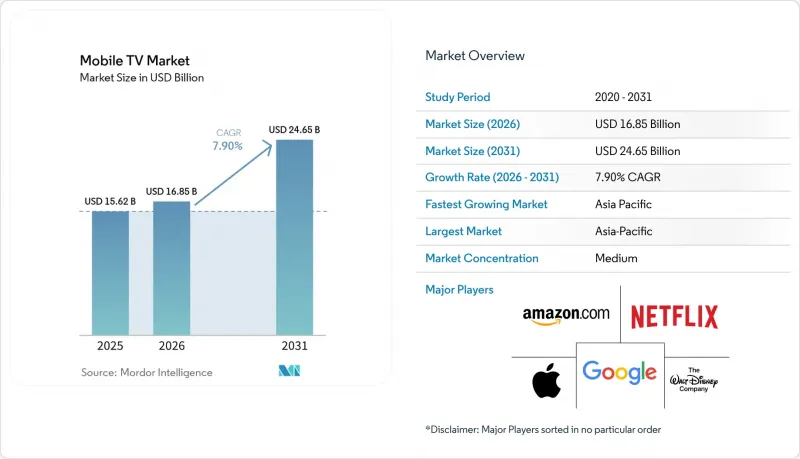
Mordor Intelligence에 의하면, 모바일 TV시장 규모는 2025년 156억 2,000만 달러로 평가되었습니다. 2026년 168억 5,000만 달러로 확대되어 2031년까지 246억 5,000만 달러에 이를 것으로 예측되며, 2026년부터 2031년에 걸쳐 CAGR은 7.9%를 나타낼 전망입니다.
본 보고서는 배포 플랫폼(OTT 유니캐스트 스트리밍 등), 기기 유형별(태블릿 등), 수익 모델별(SVOD 등), 컨텐츠 유형별(엔터테인먼트·영화 등), 네트워크 기술(4G LTE 등), 운영 체제(iOS 등), 시청 현황(온디맨드 재생 등), 지역(북미 등)별로 분류되어 있습니다. 시장 전망은 금액(달러) 기준으로 제시되어 있습니다.
세계의 모바일 TV 시장 동향과 인사이트
5G 미드밴드 네트워크의 확대
전국적인 5G 구축으로 500 Mbps를 초과하는 지속적인 처리량이 가능해졌으며, 4K 스트림의 동시 전송과 인터랙티브 오버레이가 지원되고 있습니다. 한국에서는 2025년에 5G 가입자 수가 1,749만 명에 달했으며, 평균 다운로드 속도는 1,064 Mbps를 기록했습니다. 이로써 쿠팡 플레이에서는 200만 명이 동시에 K리그 경기를 시청할 수 있게 되었습니다. 미국의 통신 사업자는 같은 해 C-밴드 구축을 완료했으며, 초기 5G 방송 시범 운영에서는 스트림당 추가 비용을 발생시키지 않고 수천 명에게 FIFA 월드컵 영상을 전송했습니다. 전송 비용 절감으로 인해 사업자는 절감된 비용을 독점 전송권이나 제로레이팅 번들에 재투자할 수 있게 되어, 가입자 수 증가를 촉진하고 있습니다.
하이브리드형 AVOD+SVOD 수익 모델의 부상
현재 각 플랫폼은 높은 ARPU를 기록하는 가입자를 유지하면서 도달 범위를 극대화하기 위해, 프리미엄 요금제 아래에 광고 포함 요금제를 배치하고 있습니다. 넷플릭스와 디즈니+는 2025년에 신규 가입자의 대부분을 저가형 광고 포함 요금제로 전환시켰으며, SVOD 전용 가입자층에 비해 해지율이 낮다는 사실을 확인했습니다. 파라마운트의 Pluto TV는 스트림당 비용을 0.10달러 미만으로 억제함으로써 250개 이상의 FAST 채널을 보유하며 흑자 전환에 성공했습니다. 하이브리드 모델은 선진 지역 시장 포화 현상에 대응하는 동시에, 구매 의향이 여전히 제한적인 신흥 시장에서 합리적인 가격을 실현합니다.
컨텐츠 라이선스 비용의 급등
Via LA는 2025년, H.264 특허 풀에 대한 연간 지불 상한액을 450만 달러로 인상했습니다. 이는 2022년 대비 29% 증가한 수치입니다. 이와 동시에 할리우드의 각 영화사는 극장 독점 상영 기간을 연장하고, 모바일 SVOD 서비스를 통한 공개 시기를 늦추고 있습니다. 로열티 급등으로 인해 이익률이 압박받고 있습니다. 왜냐하면 컨텐츠의 유형이 줄어들면 모바일 사용자들은 곧바로 해지해 버리기 때문입니다. 여러 플랫폼이 오리지널 컨텐츠로 전환을 추진하고 있는 가운데, CJ ENM은 막대한 투자를 단행했음에도 불구하고 2025년 4분기에 영업손실을 기록하며 실행 위험이 부각되고 있습니다.
부문별 분석
2025년에는 유니캐스트 OTT가 매출의 72.1%를 차지했으나, 5G 브로드캐스트는 연평균 성장률(CAGR) 9.4%로 확대될 것으로 전망됩니다. 통신 사업자들은 한 번의 전송으로 무제한의 시청자에게 컨텐츠를 전송할 수 있고, 피크 시간대의 비용을 절감할 수 있기 때문에 eMBMS를 선호합니다. 미국 내 미드밴드 주파수 대역의 60MHz 주파수 할당은 상용 시험을 뒷받침하고 있습니다. 통신 사업자 과금 방식의 ‘TV-everywhere’는 생방송 뉴스나 스포츠 번들 서비스 분야에서 틈새 수요를 유지하고 있는 반면, 위성 하이브리드 방식은 광섬유가 보급되지 않은 지방 지역을 커버하고 있습니다.
2025년 월드컵 시범 운영에서 eMBMS가 유니캐스트와 동등한 성능(1080p60에서 200밀리초 미만의 지연)을 갖는다는 사실이 입증되었습니다. 유럽방송연합(EBU) 내에서 국경을 초월한 표준화를 위한 규제 측면의 움직임이 도입을 가속화할 가능성이 있습니다. 글로보 산하의 ‘GloboPop’ 등 기존 방송사들이 직접 앱으로의 전환을 추진하고 있는 것은 도매형 배포에서 소비자 주도형 소유 형태로의 전환을 여실히 보여주고 있습니다.
스마트폰은 2025년 매출의 82.8%를 차지하며, 모바일 TV 시장의 주요 시청 기기로 자리매김하고 있습니다. VR 및 AR 안경을 포함한 웨어러블 기기는 메타의 799달러짜리 ‘Ray-Ban Display’나 1,000달러 미만으로 출시될 예정인 애플의 ‘N50’과 같은 제품들이 기동성을 높여감에 따라 연평균 성장률(CAGR) 9.1%로 증가할 것으로 전망됩니다. 태블릿은 공동 이용이나 교육과 같은 틈새 시장을 공략하고 있으며, 동영상 재생 기능이 탑재된 피처폰은 가격 면에서의 격차를 해소하고 있습니다. 스마트폰 및 웨어러블 기기의 보급 확대는 기술의 발전, 가격 하락, 그리고 외출 시 즐길 수 있는 엔터테인먼트 솔루션에 대한 수요 증가에 힘입어 이루어지고 있습니다.
웨어러블 단말기에는 새로운 화면 비율과 공간 오디오가 요구되기 때문에 컨텐츠 제작 팀은 제작 방식을 재검토해야 할 필요에 직면해 있습니다. 넷플릭스는 2026년 4월 세로형 클립 피드를 도입하여, 세로 화면 중심의 시청 습관에 대응했습니다. 한편, 애플의 Vision Pro는 보급률은 제한적이었지만, 3D 스토리텔링에 대한 개발자들의 관심을 조기에 불러일으켰습니다. 웨어러블 기기 및 몰입형 기술로의 전환은 컨텐츠 제작 전략을 재정의할 것으로 예상되며, 각 기업은 변화하는 소비자의 취향에 부응하기 위해 혁신적인 형식에 대한 투자를 확대되고 있습니다.
2025년 매출에서 SVOD가 차지하는 비중은 49.3%였으나, 하이브리드·프리미엄 및 FAST는 연평균 성장률(CAGR) 9.7%로 확대되고 있습니다. 구독형 비디오 온 디맨드(SVOD) 부문은 프리미엄 컨텐츠와 독점 스트리밍을 제공할 수 있다는 점을 강점으로 삼아 계속해서 시장을 주도하고 있습니다. 그러나 하이브리드 프리미엄 모델과 무료 광고 지원 스트리밍 TV(FAST) 플랫폼의 성장이 경쟁 구도를 재편하고 있습니다. Pluto TV는 FAST 플랫폼의 저비용 경제성을 잘 보여주고 있으며, 사용자 1인당 평균 수익(ARPU)이 낮더라도 수익성을 유지하고 있습니다. 넷플릭스(Netflix)나 디즈니+(Disney+)와 같은 주요 업체들은 광고 포함 요금제를 도입하고 있으며, 이는 구독자의 해지율을 낮추고 시청자층을 확대하는 데 효과적인 것으로 입증되었습니다. 페이퍼뷰는 이벤트당 70-80달러에 제공되는 UFC 경기 등 주목도가 높은 이벤트에서 여전히 중요한 역할을 하고 있지만, 그 시장 점유율은 서서히 감소하고 있습니다.
현재의 규제에서는 하이브리드 모델이 허용되고 있지만, 개인정보 보호 규정에 따라 행동 타겟팅 광고에는 제한이 부과되어 있어, 플랫폼들은 컨텍스트 광고로 전환해야 하는 상황에 놓여 있습니다. 특히 선진국 시장의 개인정보 보호 규제는 행동 타겟팅 광고의 사용을 제한하고 있어, 플랫폼들은 대신 컨텍스트 광고를 게재할 수밖에 없는 실정입니다. 신흥 시장에서는 무료 요금제와 구매 가능한 커머스 링크를 결합함으로써, 이전에는 컨텐츠를 불법 다운로드하던 사용자층으로부터 수익을 창출하고 있습니다. 이 지역들에서 플랫폼은 무료 요금제 컨텐츠에 전자상거래 링크를 통합하는 등 혁신적인 수익화 전략을 활용하여, 기존에는 불법 컨텐츠에 의존하던 사용자층으로부터 수익을 창출하고 있습니다.
지역별 분석
아시아태평양은 2025년 매출의 35.8%를 차지하며 1위를 기록했으며, 2031년까지 8.8%라는 가장 높은 연평균 성장률(CAGR)을 유지할 것으로 예측됩니다. 텐센트 비디오, iQIYI, Douyin을 합친 중국의 월간 모바일 동영상 이용자 수 12억 명은 단일 국가로서는 가장 큰 시장 기회를 형성하고 있습니다. 인도에서는 크리켓 중계권이 포함된 선불 번들이 가입자 수 증가를 뒷받침하고 있으며, 한국의 AVOD 시장이 급속히 성장하고 있는 것은 하이브리드 모델이 성숙 단계에 접어들었음을 시사합니다. 일본은 애니메이션을 중요하게 여기고 있어, 전 세계의 스트리밍 사업자들은 현지에서 IP 라이선싱을 진행해야 합니다.
북미와 유럽의 성장세는 완만하지만, 여전히 두 지역을 합친 매출의 약 55%를 차지하고 있습니다. 2026년에 발표된 파라마운트와 워너 브라더스 디스커버리의 1,110억 달러 규모 합병은 업계 재편의 압력을 보여주고 있습니다. EU의 네트워크 중립성 시행으로 제로레이팅이 폐지됨에 따라, 각 플랫폼 기업들은 차별화를 꾀하기 위해 무료 데이터 제공 대신 서비스 품질(QoE)에 대한 투자를 해야 하는 상황에 놓이게 되었습니다.
남미, 중동 및 아프리카에서는 인프라와 소득 격차가 여전히 존재하지만, 연평균 성장률(CAGR)은 7-8%입니다. 2026년 4월 글로보가 브라질에서 ‘GloboPop’을 출시한 것은 지역 방송사들이 선별된 세로형 동영상으로 사업 중심을 옮기고 있음을 보여줍니다. 만안 국가들은 국제 대회 중계를 확실하게 보장하기 위해 위성 백홀에 투자하고 있는 반면, 나이지리아, 케냐, 탄자니아에서는 40달러의 보조금이 지원되는 스마트폰이 스트리밍 서비스를 처음 이용하는 사람들을 늘리고 있습니다.
기타 혜택 :
- 엑셀 형식 시장 예측(ME) 시트
- 3개월간의 애널리스트 지원
자주 묻는 질문
목차
제1장 서론
제2장 조사 방법
제3장 주요 요약
제4장 시장 구도
제5장 시장 규모 및 성장 예측
제6장 경쟁 구도
제7장 시장 기회 및 향후 전망
KTH 26.06.22According to Mordor Intelligence, the mobile TV market size is expected to increase from USD 15.62 billion in 2025 to USD 16.85 billion in 2026 and reach USD 24.65 billion by 2031, growing at a CAGR of 7.9% over 2026-2031.
This report is Segmented by Delivery Platform (OTT Unicast Streaming, and More), Device Type (Tablets, and More), Revenue Model (SVOD, and More), Content Type (Entertainment and Movies, and More), Network Technology (4G LTE, and More), Operating System (iOS, and More), Viewing Context (On-Demand Playback, and More), and Geography (North America, and More). The Market Forecasts are Provided in Terms of Value (USD).
Global Mobile TV Market Trends and Insights
Expansion of 5G Mid-Band Networks
Nationwide 5G rollouts are enabling sustained throughput above 500 Mbps, which supports simultaneous 4K streams and interactive overlays. South Korea reported 17.49 million 5G subscribers in 2025 with average download speeds of 1,064 Mbps, allowing 2 million concurrent viewers of K-League matches on Coupang Play. U.S. carriers completed C-band deployments the same year, and early 5G Broadcast trials delivered FIFA World Cup feeds to thousands without per-stream cost penalties. Lower delivery costs let operators reinvest savings in exclusive rights or zero-rated bundles, spurring subscriber growth.
Rise Of Hybrid AVOD + SVOD Monetization
Platforms now layer ad-supported plans beneath premium tiers to maximize reach while preserving high-ARPU subscribers. Netflix and Disney+ shifted large portions of 2025 sign-ups to lower-priced ad tiers, noting lower churn compared with SVOD-only cohorts. Paramount's Pluto TV achieved profitability with over 250 FAST channels by keeping per-stream costs below USD 0.10. Hybrid models combat saturation in developed regions and improve affordability in emerging markets where willingness to pay remains limited.
Escalating Content-Licensing Inflation
Via LA raised annual H.264 patent-pool caps to USD 4.5 million in 2025, up 29% since 2022. Hollywood studios simultaneously lengthened exclusive theatrical windows, delaying availability on mobile SVOD services. Rising rights costs squeeze margins because mobile users churn quickly when catalogs shrink. Several platforms have pivoted toward originals, yet CJ ENM's heavy investment still produced an operating loss in Q4 2025, underscoring execution risk.
Other drivers and restraints analyzed in the detailed report include:
- Smartphone Affordability In Emerging Markets
- Telco-Satellite Aggregation For Live Events
- Regulatory Backlash On Data Zero-Rating
For complete list of drivers and restraints, kindly check the Table Of Contents.
Segment Analysis
Unicast OTT accounted for 72.1% of revenue in 2025, yet 5G Broadcast is projected to expand at a 9.4% CAGR. Operators favor eMBMS because one transmission serves unlimited viewers, cutting peak costs. U.S. spectrum allocations of 60 MHz in mid-band spectrum support commercial trials. Carrier-billed TV-everywhere retains niche relevance for live news and sports bundles, while satellite-hybrid paths cover rural zones where fiber is scarce.
eMBMS performance parity with unicast, sub-200 ms latency for 1080p60, was proven during the 2025 World Cup trials. Regulatory momentum in the European Broadcasting Union for cross-border standards may accelerate adoption. Traditional broadcasters transitioning to direct apps, such as Globo-owned GloboPop, highlight a shift from wholesale carriage to consumer ownership.
Smartphones captured 82.8% of 2025 revenue and remain the core viewing device of the mobile TV market. Wearables, including VR and AR glasses, are forecast to rise 9.1% CAGR as products like Meta's USD 799 Ray-Ban Display and Apple's forthcoming N50 under USD 1,000 improve mobility. Tablets serve communal and educational niches, while video-capable feature phones bridge affordability gaps. The increasing adoption of smartphones and wearables is driven by advancements in technology, affordability, and the growing demand for on-the-go entertainment solutions.
Wearables require new video ratios and spatial audio, prompting content teams to rethink production. Netflix introduced a vertical-clip feed in April 2026, meeting portrait-first habits, while Apple's Vision Pro triggered early developer interest in 3D storytelling despite limited adoption. The shift towards wearables and immersive technologies is expected to redefine content creation strategies, with companies investing in innovative formats to cater to evolving consumer preferences.
SVOD represented 49.3% of 2025 revenue, but hybrid freemium and FAST are advancing at a 9.7% CAGR. The Subscription Video on Demand (SVOD) segment continues to dominate the market, driven by its ability to offer premium content and exclusive releases. However, the growth of hybrid freemium models and Free Ad-Supported Streaming Television (FAST) platforms is reshaping the competitive landscape. Pluto TV exemplifies the lean-cost economics of FAST platforms, which sustain profitability even at low Average Revenue Per User (ARPU). Major players like Netflix and Disney+ have introduced ad-supported tiers, which have proven effective in reducing subscriber churn and expanding their audience reach. Pay-per-view remains relevant for high-profile events, such as UFC fights priced at USD 70-80 per event, although its market share is gradually declining.
Regulations currently allow hybrid models, yet privacy rules cap behaviorally targeted ads, nudging platforms toward contextual placement. Privacy regulations, particularly in developed markets, limit the use of behaviorally targeted advertisements, compelling platforms to adopt contextual ad placements instead. For emerging markets, free tiers paired with shoppable commerce links monetize audiences that previously pirated content. In these regions, platforms are leveraging innovative monetization strategies, such as integrating e-commerce links into free-tier content, to capture revenue from audiences that historically relied on pirated material.
Geography Analysis
Asia-Pacific led with 35.8% of 2025 revenue and will keep the highest 8.8% CAGR to 2031. China's 1.2 billion monthly mobile video users across Tencent Video, iQIYI, and Douyin form the largest single-country opportunity. India's prepaid bundles that feature cricket rights maintain subscriber momentum, and South Korea's rapid AVOD growth points to the maturation of hybrid models. Japan emphasizes anime, forcing global streamers to license local IP.
North America and Europe grow more slowly but still account for roughly 55% of revenue combined. A USD 111 billion merger between Paramount and Warner Bros. Discovery, announced in 2026, illustrates consolidation pressure. EU net-neutrality enforcement eliminates zero-rating, requiring platforms to invest in quality of experience rather than free data to stand out.
South America, the Middle East, and Africa present 7-8% CAGR prospects, though infrastructure and income gaps remain. Globo's April 2026 launch of GloboPop in Brazil displays regional broadcasters' pivot to curated vertical video. Gulf states invest in satellite backhaul to guarantee coverage of global tournaments, while subsidized USD 40 smartphones in Nigeria, Kenya, and Tanzania catalyze first-time streaming.
- Netflix, Inc.
- Amazon.com, Inc.
- Google LLC
- The Walt Disney Company
- Apple Inc.
- Tencent Holdings Ltd.
- Baidu, Inc.
- Alibaba Group Holding Ltd.
- Hulu, LLC
- Warner Bros. Discovery, Inc.
- Paramount Global
- Rakuten Group, Inc.
- Reliance Industries Limited
- Kuaishou Technology
- SEA Ltd.
- PCCW Ltd.
- Globo Comunicacao e Participacoes S.A.
- CJ ENM Co., Ltd.
- Eros International Plc
- TelevisaUnivision Inc.
Additional Benefits:
- The market estimate (ME) sheet in Excel format
- 3 months of analyst support
TABLE OF CONTENTS
1 INTRODUCTION
- 1.1 Study Assumptions and Market Definition
- 1.2 Scope of the Study
2 RESEARCH METHODOLOGY
3 EXECUTIVE SUMMARY
4 MARKET LANDSCAPE
- 4.1 Market Overview
- 4.2 Market Drivers
- 4.2.1 Expansion of 5G Mid-Band Networks
- 4.2.2 Rise of Hybrid AVOD + SVOD Monetisation
- 4.2.3 Smartphone Affordability in Emerging Markets
- 4.2.4 Telco-Satellite Aggregation for Live Events
- 4.2.5 Edge-Native AI Predictive Pre-Caching
- 4.2.6 Shoppable Video Integration Boosting ARPU
- 4.3 Market Restraints
- 4.3.1 Escalating Content-Licensing Inflation
- 4.3.2 Spectrum Scarcity for eMBMS Broadcast
- 4.3.3 Regulatory Backlash on Data Zero-Rating
- 4.3.4 Battery-Thermal Limits on 6 GHz Streaming
- 4.4 Industry Value Chain Analysis
- 4.5 Impact of Macroeconomic Factors on the Market
- 4.6 Regulatory Landscape
- 4.7 Technological Outlook
- 4.8 Porter's Five Forces Analysis
- 4.8.1 Threat of New Entrants
- 4.8.2 Bargaining Power of Buyers
- 4.8.3 Bargaining Power of Suppliers
- 4.8.4 Threat of Substitutes
- 4.8.5 Competitive Rivalry
5 MARKET SIZE AND GROWTH FORECASTS (VALUE)
- 5.1 By Delivery Platform
- 5.1.1 OTT/Unicast Streaming
- 5.1.2 Carrier-Billed TV-Everywhere
- 5.1.3 5G Broadcast (eMBMS)
- 5.1.4 Satellite-Terrestrial Hybrid
- 5.2 By Device Type
- 5.2.1 Smartphones
- 5.2.2 Tablets
- 5.2.3 Feature Phones
- 5.2.4 Connected Wearables (VR/AR Glasses)
- 5.3 By Revenue Model
- 5.3.1 Subscription Video-on-Demand (SVOD)
- 5.3.2 Advertising Video-on-Demand (AVOD)
- 5.3.3 Transactional (TVOD/PPV)
- 5.3.4 Hybrid (Freemium and FAST)
- 5.4 By Content Type
- 5.4.1 Entertainment and Movies
- 5.4.2 Live Sports
- 5.4.3 News and Information
- 5.4.4 Education and Kids
- 5.5 By Network Technology
- 5.5.1 4G/LTE
- 5.5.2 5G NR
- 5.5.3 Wi-Fi 6/6E
- 5.5.4 Legacy 3G/2G
- 5.6 By Operating System
- 5.6.1 Android
- 5.6.2 iOS
- 5.6.3 HarmonyOS and Other Operating Systems
- 5.7 By Viewing Context
- 5.7.1 On-Demand Playback
- 5.7.2 Live Linear Streaming
- 5.7.3 Download-to-Go
- 5.8 By Geography
- 5.8.1 North America
- 5.8.1.1 United States
- 5.8.1.2 Canada
- 5.8.1.3 Mexico
- 5.8.2 Europe
- 5.8.2.1 Germany
- 5.8.2.2 United Kingdom
- 5.8.2.3 France
- 5.8.2.4 Russia
- 5.8.2.5 Rest of Europe
- 5.8.3 Asia-Pacific
- 5.8.3.1 China
- 5.8.3.2 Japan
- 5.8.3.3 India
- 5.8.3.4 South Korea
- 5.8.3.5 Australia
- 5.8.3.6 Rest of Asia-Pacific
- 5.8.4 South America
- 5.8.5 Middle East and Africa
- 5.8.1 North America
6 COMPETITIVE LANDSCAPE
- 6.1 Market Concentration
- 6.2 Strategic Moves
- 6.3 Market Share Analysis
- 6.4 Company Profiles (includes Global Level Overview, Market Level Overview, Core Segments, Financials as available, Strategic Information, Market Rank/Share, Products and Services, Recent Developments)
- 6.4.1 Netflix, Inc.
- 6.4.2 Amazon.com, Inc.
- 6.4.3 Google LLC
- 6.4.4 The Walt Disney Company
- 6.4.5 Apple Inc.
- 6.4.6 Tencent Holdings Ltd.
- 6.4.7 Baidu, Inc.
- 6.4.8 Alibaba Group Holding Ltd.
- 6.4.9 Hulu, LLC
- 6.4.10 Warner Bros. Discovery, Inc.
- 6.4.11 Paramount Global
- 6.4.12 Rakuten Group, Inc.
- 6.4.13 Reliance Industries Limited
- 6.4.14 Kuaishou Technology
- 6.4.15 SEA Ltd.
- 6.4.16 PCCW Ltd.
- 6.4.17 Globo Comunicacao e Participacoes S.A.
- 6.4.18 CJ ENM Co., Ltd.
- 6.4.19 Eros International Plc
- 6.4.20 TelevisaUnivision Inc.
7 MARKET OPPORTUNITIES AND FUTURE OUTLOOK
- 7.1 White-Space and Unmet-Need Assessment