

|
시장보고서
상품코드
2063299
비상 정지 스위치 시장 : 시장 점유율 분석, 업계 동향 및 통계, 성장 예측(2026-2031년)Emergency Stop Switches - Market Share Analysis, Industry Trends & Statistics, Growth Forecasts (2026 - 2031) |
||||||
 Mordor Intelligence
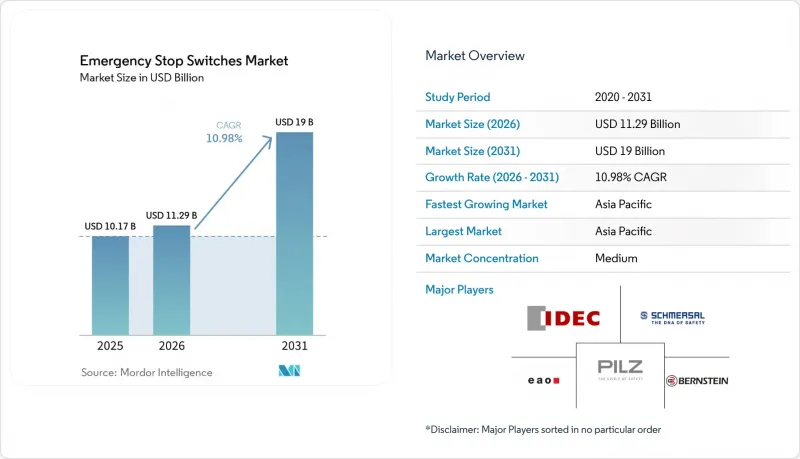
Mordor Intelligence에 의하면, 비상 정지 스위치 시장 규모는 2025년 101억 7,000만 달러로 평가되었고, 2026년 112억 9,000만 달러로 추정되고, 2031년까지 190억 달러에 이를 것으로 예측되며, 2026-2031년 CAGR 10.98%로 성장할 전망입니다.
본 보고서는 제품 유형별(푸시 버튼, 로프 풀, 풋 오퍼레이티드, 팜/머시룸, 인터록 일체형), 리셋 구조별(푸시 풀, 트위스트 릴리스, 키 릴리스, 레버, 자동/전자식), 최종 사용자 산업별(제조업, 엘리베이터 등), 접점 구성별(1 NC, 2 NC, 1 NO+1 NC 및 멀티 콘택트), 그리고 지역별로 분류되어 있습니다. 시장 전망은 금액(달러) 기준으로 제시되어 있습니다.
세계의 비상 정지 스위치 시장 동향 및 분석
기계 안전 규제의 강화와 기능 안전 규정 준수
비상 정지 스위치 시장은 기계 안전 규정의 변경으로 인해 단기적으로 가장 큰 호재를 맞이하고 있습니다. 이는 규정이 개정될 때마다 OEM이나 기계 제조업체가 이미 승인된 설계 및 기술 문서를 재검토해야 하기 때문입니다. 2026년 2월에 발간된 IEC 60947-5-5:2026에서는 새로운 래치 장치의 시험 프로토콜이 도입되었으며, 작동 상태와 비작동 상태를 표시하는 발광식 비상 정지 장치에 관한 부록 B가 추가되었습니다. 이에 따라 각 공급업체의 전체 제품 포트폴리오에 걸쳐 제품 재설계 및 재인증 작업이 진행되고 있습니다. ISO 13849:2023 및 IEC 62061:2021/A1:2024는 비상 정지 기능에 대한 더 엄격한 성능 요건을 지속적으로 지지하고 있으며, 고도로 자동화된 환경에서는 기본 준수 수준을 넘어 PLe 또는 SIL 3 수준의 설계 목표를 추구하는 경우가 많습니다. 개정된 EU 기계 규정 2023/1230은 적용 범위를 자율 주행 기계, 연결 기기 및 AI 기반 안전 기능까지 확대하고 있으며, 이에 따라 2027년 1월 규정 발효에 앞서 인증된 안전 부품의 가치가 높아지고 있습니다. 이러한 변화로 인해 비상 정지 장치는 더 이상 단순한 부속품이 아니라, 기계적 및 시스템 수준의 심사를 견뎌야 하는 고정된 부품 명세서(BOM) 항목으로 취급되게 되었습니다. 따라서 비상 정지 스위치 시장은 교체 수요뿐만 아니라, 감사 대응 능력을 강화하고 적합성 위험을 줄여주는 고사양 장치로의 광범위한 전환으로부터도 혜택을 보고 있습니다.
맞춤형 생산에서의 자동화 및 로봇 밀도 향상
비상 정지 스위치 시장은 로봇 밀도 증가에 힘입어 성장하고 있습니다. 산업용 로봇 셀, 코봇 스테이션 또는 자동화 모듈이 추가될 때마다 기계의 안전 레이아웃에 인증된 정지 지점이 추가되기 때문입니다. IFR의 보고서에 따르면, 2024년 서유럽에서는 제조업 종사자 1만 명당 267대의 로봇이 도입되었으며, 미국에서는 307대에 달했습니다. 이로 인해 북미와 유럽은 설치된 기계 1대당 안전 장치 장착 밀도 측면에서 여전히 가장 높은 지역 중 하나입니다. 중국은 2024년 제조업 종사자 1만 명당 166대의 로봇을 보유하며 세계 최대의 가동 대수를 유지하고 있습니다. 비록 기계 1대당 장착된 인증 장치의 수는 규제가 엄격한 공장에 아직 미치지 못하지만, 단위당 수요는 높은 수준을 유지하고 있습니다. IFR은 또한 2024년에 전 세계적으로 6만 4,542대의 협업 로봇과 19만 9,000대의 산업용 서비스 로봇이 도입된 것으로 집계했습니다. 이 두 가지 모두 중요한 의미를 지닙니다. 왜냐하면 협업 환경이나 이동형 자동화 시스템에서는 더욱 분산화된 안전 기능과 사람이 접근할 수 있는 명확한 비상 정지 수단이 필요하기 때문입니다. IDEC의 ‘비상 정지 지원 시스템’은 이러한 수요가 AGV 및 AMR 환경으로 확대되고 있음을 보여주고 있으며, 작업자가 고정된 버튼에 신속하게 접근할 수 없는 경우 무선 원격 조작이 유용합니다. 이러한 추세로 인해 비상 정지 스위치 시장은 혜택을 보고 있습니다. 왜냐하면 자동화 밀도의 향상은 단순히 설치 대수를 늘리는 것뿐만 아니라, 다접점식, 인터록 통합형 및 원격 조작이 가능한 설계에 대한 수요도 높이기 때문입니다.
기존 설비 개보수에 따른 가동 중단 시간 및 검증 비용
비상 정지 스위치 시장에서 가장 큰 상업적 장벽은 여전히 스위치 자체의 가격이 아니라, 개조에 수반되는 시스템 엔지니어링의 부담에 있습니다. Revere Control Systems사는 기계 가동 중단 시간, 기능 테스트 및 규정 준수 문서 작성이 개조 엔지니어링 시간의 30-40%를 차지할 수 있다고 지적하고 있습니다. 또한, 계획적인 가동 중단조차도 막대한 생산 손실을 초래할 수 있는 연속 공정 운영의 경우, 이러한 부담을 정당화하기가 특히 어렵습니다. 독일에 위치한 Pohlann사의 600톤 유압 프레스 개조 작업에서는 안전 제어 시스템의 전면 교체, 새로운 가드 도어 인터록, 정지 시간 측정, 그리고 재가동 전 감사에 대비한 문서화가 필요했습니다. 이는 소규모 사업자가 프로젝트를 미루는 이유를 여실히 보여줍니다. 따라서 많은 기존 플랜트 운영자들은 감사, 보험 심사 또는 대규모 정비를 통해 대응해야 할 상황이 닥칠 때까지 비상 정지 장치의 업그레이드를 미루게 되며, 그 결과 조달 기간이 단축되고 가격에 대한 민감도가 더욱 높아지게 됩니다. PowerSafe Automation사의 단계적 업그레이드 접근 방식은 90일, 3-12개월, 12-24개월의 각 단계에서 비용 문제를 관리할 수 있음을 보여주고 있지만, 한편으로는 발주 시기가 분산되어 유통업체의 계획 수립을 복잡하게 만들고 있습니다. 따라서 비상 정지 스위치 시장은 규정 준수상의 필요성만 고려했을 때 예상되는 것보다 완만한 속도로 성장하고 있습니다. 이는 개조 시기가 설비의 긴급성보다는 가동 중단에 따른 경제적 요인에 의해 결정되는 경우가 많기 때문입니다.
부문별 분석
2025년 기준으로, 푸시 버튼식 비상 정지 스위치는 60.51%의 점유율을 차지했으며, 비상 정지 스위치 시장에서 가장 큰 제품군을 이루고 있습니다. 이는 운영자 패널, 컨트롤러 케이스 및 일반적인 기계 작업대에서 여전히 기본 선택지로 남아 있기 때문입니다. 이러한 위상은 낮은 도입 비용, 운영자 간의 확실한 친숙도, 그리고 주요 비상 정지 규격에 기반한 명확한 준수 경로 덕분입니다. ISO 13850 및 IEC 60947-5-5는 빨간색 조작부, 노란색 배경, 상시 폐쇄 상태에서 직접 개방되는 접점 등의 요건을 통해 여전히 이러한 장치의 시각적 및 기능적 기준으로 자리 잡고 있습니다. 실제로 많은 기계 제조업체들은 여전히 푸시 버튼 방식을 기반으로 설계 검토를 시작하며, 위험 분석을 통해 추가 기능이 필요한 경우에만 더 복잡한 장치로 전환하고 있습니다. 이러한 기본 행동 양식은 더 고사양의 대체품이 급속히 성장하고 있는 상황에서도 대량 수요를 유지하고 있다는 점에서 중요합니다. 따라서 비상 정지 스위치 시장은 가장 광범위하고 안정적인 도입 기반으로서 여전히 푸시 버튼 카테고리에 의존하고 있습니다.
프리미엄 벤더 각사는 고장 시의 동작, 컴팩트한 외형, 그리고 기계 수준에서의 인증 용이성에 초점을 맞추어, 이 성숙한 시장 내에서도 차별화의 여지를 찾아내고 있습니다. IDEC의 XW 및 XA 시리즈는 숏 바디 형상과, 블록이 파손되거나 분리된 경우에도 상시 폐쇄 접점이 확실하게 개방되는 역에너지 구조를 통해 이를 명확히 입증했습니다. 한편, 안전 인터록이 통합된 비상 정지 스위치는 2031년까지 연평균 성장률(CAGR) 11.11%를 나타낼 것으로 예측되며, 이는 제품 유형 중 가장 빠른 성장세를 보이며 서로 다른 설계 논리를 지향하고 있습니다. 이 장치들은 비상 정지 작동, 가드 감지 및 잠금 기능을 단일 하우징에 통합하여 배선 복잡성을 줄이고, 소형 기계 셀의 정교한 진단 요구 사항을 충족합니다. Euchener사의 CTP는 이러한 변화를 여실히 보여주는 사례로, RFID 가드락, 푸시 버튼 제어 및 비상 정지 기능을 PL e 및 카테고리 4 규격에 부합하는 하우징에 통합하고 있습니다. 로프 풀 스위치는 컨베이어를 많이 사용하는 레이아웃에서 여전히 필수적이며, 한편 풋 스위치나 팜형, 버섯형 등 다양한 유형의 스위치는 공작기계, 프레스 및 개조 용도에서 그 역할을 계속하고 있습니다. 따라서 비상 정지 스위치 업계는 푸시 버튼 방식의 패러다임을 대체하기보다는 그 주위에 통합된 안전 계층을 구축하고 있다고 할 수 있습니다.
푸시-풀 방식 리셋 장치는 2025년에 시장의 47.54%를 차지했으며, 비상 정지 스위치 시장에서 주요 리셋 방식으로 자리매김하고 있습니다. 이는 재시작 요청 전에 위험이 제거되었음을 여전히 가장 명확하게 물리적으로 확인할 수 있기 때문입니다. 이러한 광범위한 사용은 그 간편성과 더불어, 많은 기계 분야에서 풀식 리셋이 여전히 친숙한 북미의 대규모 도입 실적을 모두 반영하고 있습니다. ISO 13850는 트위스트 리셋보다 풀 리셋을 권장하는 것은 아니지만, 실제 운용은 여전히 지역이나 운영자의 선호도에 따라 다릅니다. 트위스트 릴리스가 두 번째로 큰 시장 점유율을 차지하는 이유는 유럽의 기계 설계자들이 회전 동작을 보다 의도적인 인간 동작으로 간주하여, 실수로 풀릴 위험을 줄일 수 있다고 생각하기 때문입니다. 비상 정지 스위치 시장에서는 어느 한 형태도 모든 용도에서 다른 형태를 완전히 대체하지 못했기 때문에 두 형태가 계속해서 공존하고 있습니다.
자동 및 전자식 리셋 시장 규모는 2031년까지 연평균 성장률(CAGR) 11.02%로 확대될 것으로 예상되며, 유연한 제조 셀에서 재시작 로직이 인증된 컨트롤러로 전환됨에 따라 가장 빠르게 성장하는 리셋 유형이 될 전망입니다. 이러한 환경에서는 리셋 결정이 운영자가 패널까지 걸어 가서 버튼을 해제하는 행위에 국한되지 않습니다. 대신, 안전 컨트롤러가 비상 정지 회로가 해제되었는지, 기계의 축이 안전한 상태인지, 그리고 검증된 로직이 재시동 조건을 허용하는지 확인합니다. 이 아키텍처는 수동 리셋이 작업 지연이나 접근성 문제를 야기할 수 있는 협동 로봇 셀, AGV 인터페이스 및 소형 자동화 모듈에 적합합니다. 키 릴리스 방식이나 잠금 기능이 있는 버전도, 잠금 및 태그아웃 절차에서 그 중요성이 커지고 있습니다. 특히, 작업 중에 유지보수 담당자가 기계에 대한 접근을 통제해야 하는 경우입니다. IDEC의 자물쇠 호환 제품은 단일 장치에 최대 12개의 개인용 자물쇠를 장착할 수 있으며, 이는 비상 정지 스위치 업계가 단순한 정지 기능뿐만 아니라 운영 제어 요구 사항에 맞추어 리셋 하드웨어를 적용하고 있음을 보여줍니다.
지역별 분석
아시아태평양은 2025년 비상 정지 스위치 시장 점유율의 42.80%를 차지했으며, 2031년까지 연평균 성장률(CAGR) 11.64%로 성장할 것으로 전망됩니다. 이로 인해 해당 지역은 본 보고서에서 가장 규모가 크고 가장 빠르게 성장하고 있는 지역 시장이 되었습니다. 이 지역은 일본이나 한국과 같은 성숙한 고도 자동화 경제국과 중국이나 인도와 같은 대규모 성장 시장이 공존하고 있어, 기존 설비의 탄탄한 기반과 신규 건설의 활력을 모두 갖추고 있습니다. IFR 보고서에 따르면, 중국은 2024년 기준 제조업 종사자 1만 명당 166대의 로봇을 도입했으며, 공장이 수출용 규정 준수 기준에 가까워짐에 따라 안전 장치의 성장 여지가 여전히 남아 있습니다. 또한, 인도의 전자기기, 반도체, 의약품 분야의 그린필드 제조 프로젝트 역시 다국적 기업의 안전 기준을 충족하도록 설계된 시설에서 인증된 정지 장치에 대한 새로운 수요를 이끌고 있습니다. 한국과 일본에서는 반도체, 디스플레이, 자동차 제조 분야에서 인터록 기능이 내장된 장치나 통신 지원형 장치에 대한 프리미엄 수요가 지속적으로 증가하고 있으며, 슈멜살사가 2025년 3월 한국에 자회사를 설립한 것은 바로 이러한 기회를 반영한 것입니다.
북미는 2025년 기준 2위 시장 점유율을 차지했으며, 이 지역의 비상 정지 스위치 시장은 생산의 국내 복귀, 전기차 생산, 반도체 투자 및 물류 창고 자동화 확대에 힘입어 성장하고 있습니다. IFR의 보고서에 따르면, 2024년 북미의 로봇 도입률은 제조업 종사자 1만 명당 204대에 달했으며, 미국은 제조업 종사자 1만 명당 307대로 세계 최고 수준의 로봇 도입 밀도를 자랑하는 시장 중 하나가 되었습니다. 이러한 가동 기반은 대당 안전 장치 탑재율 향상을 뒷받침하고 있으며, 특히 고전압 배터리나 파워 일렉트로닉스 생산 라인에서는 정지 기능이 더욱 엄격한 안전 로직을 충족해야 하므로 이러한 경향이 두드러집니다. 또한, 해당 지역에는 상당수의 구형 설비가 존재하고 있어, 프레스기, 스탬핑 시스템, 사출 성형 라인 분야에서 개조 수요가 활발하게 유지되고 있습니다. 유럽은 여전히 규제 준수가 가장 엄격한 지역 시장이며, 2027년 1월 EU 기계 지침 시행에 앞서 각 OEM 업체들이 부품에 대한 사전 인증을 진행하고 있어, 독일, 영국, 프랑스, 이탈리아가 이 지역의 비상 정지 스위치 시장 규모를 지탱하고 있습니다.
남미, 중동 및 아프리카를 합치면 시장 점유율은 작지만, 광업, 석유 및 가스, 유틸리티 및 일부 산업의 현대화를 통해 비상 정지 스위치 시장은 여전히 성장하고 있습니다. 브라질은 광업 안전 대책 강화와 농산물 가공 확대를 통해 남미 시장을 주도하고 있으며, 로프 당김식 장치와 높은 IP 등급의 비상 정지 장치는 세척 환경이나 가혹한 작업 환경에 적합합니다. 중동은 사우디아라비아와 아랍에미리트(UAE)가 주도하고 있으며, 에너지 프로젝트 및 산업 자유무역지대에서 IEC 및 ISO 규격에 부합하는 국제 인증을 획득한 안전 시스템의 도입이 활발히 진행되고 있습니다. 아프리카은 여전히 개발도상국이지만, 남아프리카공화국과 이집트가 광업, 유틸리티, 식품 제조를 통해 지역 수요의 상당 부분을 차지하고 있습니다.
기타 혜택 :
- 엑셀 형식 시장 예측(ME) 시트
- 3개월간의 애널리스트 지원
자주 묻는 질문
목차
제1장 서론
제2장 조사 방법
제3장 주요 요약
제4장 시장 구도
제5장 시장 규모 및 성장 예측
제6장 경쟁 구도
제7장 시장 기회 및 향후 전망
AJY 26.06.22According to Mordor Intelligence, the emergency stop switches market size is expected to increase from USD 10.17 billion in 2025, USD 11.29 billion in 2026 and reach USD 19 billion by 2031, growing at a CAGR of 10.98% over 2026-2031.
This report is Segmented by Product Type (Push-Button, Rope Pull, Foot-Operated, Palm/Mushroom, and Interlock-Integrated), Reset Mechanism (Push-Pull, Twist-Release, Key-Release, Lever, and Auto/Electronic), End-User Industry (Manufacturing, Elevators, and More), Contact Configuration (1 NC, 2 NC, 1 NO+1 NC, and Multi-Contact), and Geography. The Market Forecasts are Provided in Terms of Value (USD).
Global Emergency Stop Switches Market Trends and Insights
Tighter Machinery Safety Enforcement And Functional Safety Compliance
The emergency stop switches market is receiving its strongest near-term lift from changing machinery safety rules, because each new revision forces OEMs and machine builders to revisit approved designs and technical files. The February 2026 release of IEC 60947-5-5:2026 introduced new latch-mechanism test protocols and added Annex B for illuminated emergency stop devices that indicate active and inactive states, pushing product redesign and recertification work across vendor portfolios. ISO 13849:2023 and IEC 62061:2021/A1:2024 continue to support higher performance expectations for emergency stop functions, and high-automation settings often move beyond baseline compliance toward PLe or SIL 3 design targets. The revised EU Machinery Regulation 2023/1230 widens the compliance lens to cover autonomous mobile machinery, connected equipment, and AI-based safety functions, which is raising the value of certified safety components before the rule becomes effective in January 2027. That shift means emergency stop devices are now treated less as simple accessories and more as fixed bill-of-materials items that must withstand both mechanical and system-level review. The emergency stop switches market, therefore, benefits not only from replacement demand but also from a broader shift toward higher-specification devices that enhance audit readiness and reduce conformity risk.
Higher Automation And Robotics Density In Discrete Manufacturing
The emergency stop switches market is also supported by rising robot density, as each industrial robot cell, cobot station, or automated module adds certified stop points to the machine safety layout. IFR reported that Western Europe reached 267 robots per 10,000 manufacturing employees in 2024, while the United States reached 307, which kept North America and Europe among the highest-density regions for safety-device content per installed machine. China reached 166 robots per 10,000 manufacturing employees in 2024 and held the largest operational stock worldwide, keeping unit demand high even as certified device content per machine still trails that of the most regulated factories. IFR also recorded 64,542 cobot installations worldwide in 2024 and 199,000 professional service robot installations, both of which matter because collaborative settings and mobile automation require more distributed safety functions and clearer human-access emergency stop access. IDEC's Emergency Stop Assist System showed how this need is spreading into AGV and AMR environments, where wireless remote actuation becomes useful when operators cannot reach a fixed button fast enough. The emergency stop switches market gains from this trend because higher automation density does not just increase unit counts; it also raises demand for multi-contact, interlock-integrated, and remotely accessible designs.
Legacy Retrofit Downtime And Validation Costs
The largest commercial friction point in the emergency stop switches market is still the system engineering effort around a retrofit, not the price of the switch itself. Revere Control Systems noted that machine downtime, functional testing, and compliance documentation can consume 30-40% of retrofit engineering hours, and that burden is especially hard to justify in continuous-process operations, where even planned outages can incur major production losses. Pohlann's 600-ton hydraulic press retrofit in Germany required a full safety control system replacement, new guard-door interlocks, stopping-time measurements, and audit-ready documentation before restart, which illustrates why smaller operators often delay projects. Many legacy-plant operators therefore postpone emergency-stop upgrades until an audit, insurance review, or major overhaul forces action, compressing procurement into shorter windows and increasing price sensitivity. PowerSafe Automation's phased upgrade approach shows that the cost problem can be managed across 90-day, 3-12-month, and 12-24-month stages, but it also fragments order timing and complicates distributor planning. The emergency stop switches market, therefore, grows more slowly than the compliance need alone would suggest, because retrofit timing is often determined by outage economics rather than device urgency.
Other drivers and restraints analyzed in the detailed report include:
- Conveyor And Warehouse Automation Expansion
- Safety Retrofits In Process Industries And Heavy Machinery
- Price Pressure From Low-Cost, Non-Certified Products
For complete list of drivers and restraints, kindly check the Table Of Contents.
Segment Analysis
Push-button e-stop switches held a 60.51% share in 2025, making them the largest product pool in the emergency stop switches market, as they remain the default choice for operator panels, controller enclosures, and general machine workstations. Their position is tied to low installed cost, clear familiarity among operators, and a straightforward conformity path under the main emergency stop standards. ISO 13850 and IEC 60947-5-5 still serve as the visual and functional baseline for these devices through requirements for red actuators, yellow backgrounds, and direct-opening normally closed contacts. In practice, many machine builders still begin a design review with a push-button architecture and shift to a more complex device only if the hazard analysis calls for additional functions. That default behavior matters because it protects volume demand even as higher-specification alternatives grow faster. The emergency stop switches market, therefore, continues to rely on the push-button category as its broadest and most stable installed base.
Premium vendors still find room to differentiate within this mature segment by focusing on failure behavior, compact packaging, and easier machine-level certification. IDEC's XW and XA series demonstrated this clearly through a short-body form and a reverse-energy structure that ensures normally closed contacts open even if the block is damaged or separated. At the same time, safety interlock-integrated e-stops are forecast to grow at a 11.11% CAGR through 2031, marking the fastest pace among product types and pointing to a different design logic. These devices combine emergency stop actuation, guard monitoring, and locking functions in a single housing, reducing wiring complexity and supporting higher diagnostic expectations in compact machine cells. Euchener's CTP is a live example of that shift, combining RFID guard locking, pushbutton controls, and emergency stop functionality in a PL e and Category 4 housing. Rope-pull switches remain essential in conveyor-heavy layouts, while foot-operated and palm- or mushroom-style variants retain their role in machine-tool, press, and retrofit applications, so the emergency stop switches industry is not replacing the push-button paradigm so much as building integrated safety layers around it.
Push-pull reset mechanisms accounted for 47.54% of the market in 2025, making them the leading reset type in the emergency stop switches market, as they still offer the clearest physical confirmation that the hazard has been cleared before a restart request. Their wide use reflects both simplicity and a large North American installed base, where pull-reset has remained familiar in many machine categories. ISO 13850 does not favor pull-reset over twist-reset, but actual practice still varies by region and operator preference. Twist-release holds the next-largest share because European machinery designers often view the rotational action as a more deliberate human gesture, reducing the risk of accidental release. The emergency stop switches market keeps both formats active because neither one has displaced the other across all applications.
Automatic and electronic reset variants are projected to expand at a 11.02% CAGR through 2031, making them the fastest-growing reset type as flexible manufacturing cells move more restart logic into certified controllers. In these settings, the reset decision is not limited to an operator walking to a panel and releasing a button. Instead, the safety controller checks whether the emergency stop circuit is clear, whether the machine axes are in a safe state, and whether the validated logic has authorized the restart condition. That architecture fits collaborative robot cells, AGV interfaces, and compact automated modules where manual reset would slow operations or create access issues. Key-release and lockable versions are also gaining relevance in lockout and tagout procedures, especially where maintenance staff must control access to a machine while work is underway. IDEC's padlock-capable offering, which accepts up to 12 personal locks on one device, shows how the emergency stop switches industry is adapting reset hardware to operational control needs rather than to stop function alone.
Geography Analysis
Asia-Pacific accounted for 42.80% of the emergency stop switches market share in 2025 and is also projected to expand at an 11.64% CAGR through 2031, which makes it both the largest and fastest-growing regional market in the report. The region combines mature high-automation economies such as Japan and South Korea with large expansion markets such as China and India, so it carries both installed-base depth and new-build momentum. IFR reported that China reached 166 robots per 10,000 manufacturing employees in 2024, leaving room for further growth in safety devices as factories move closer to export-grade compliance standards. India's greenfield manufacturing projects in electronics, semiconductors, and pharmaceuticals are also driving new demand for certified stop devices in facilities designed to meet multinational safety standards. South Korea and Japan continue to drive premium demand for interlock-integrated and communication-ready devices in semiconductor, display, and automotive manufacturing, and Schmersal's March 2025 subsidiary launch in South Korea directly reflects that opportunity.
North America held the second-largest share in 2025, and the emergency stop switches market there is being shaped by reshoring, EV production, semiconductor investment, and warehouse automation build-out. IFR reported that North America reached 204 robots per 10,000 manufacturing employees in 2024, while the United States ranked among the world's highest-density robot markets at 307 robots per 10,000 manufacturing employees. That operating base supports stronger safety-device content per machine, especially on high-voltage battery and power-electronics lines, where stop functions must meet more demanding safety logic. The region also has a sizeable legacy equipment base, which keeps retrofit demand active in presses, stamping systems, and injection molding lines. Europe remains the most compliance-intensive regional market, and the emergency stop switches market size there is being supported by Germany, the United Kingdom, France, and Italy as OEMs pre-qualify parts ahead of the EU Machinery Regulation implementation in January 2027.
South America, the Middle East, and Africa together make up a smaller share, but the emergency stop switches market is still expanding there through mining, oil and gas, utilities, and selective industrial modernization. Brazil leads South America through mining safety upgrades and agri-food processing expansion, where rope-pull devices and high-IP emergency stop units are well-suited for washdown and harsh-duty environments. The Middle East is supported by Saudi Arabia and the UAE, where energy projects and industrial free zones are increasing the adoption of internationally certified safety systems aligned with IEC and ISO standards. Africa remains nascent, with South Africa and Egypt accounting for much of the regional demand through mining, utilities, and food manufacturing.
- IDEC Corporation
- K.A. Schmersal GmbH & Co. KG
- EAO AG
- Pilz GmbH & Co. KG
- BERNSTEIN AG
- EUCHNER GmbH + Co. KG
- Georg Schlegel GmbH & Co. KG
- RAFI GmbH & Co. KG
- Pizzato Elettrica S.r.l.
- COMEPI S.r.l.
- IDEM Safety Switches Limited
- Rees, Inc.
- NKK SWITCHES CO., LTD.
- APEM SAS
- Giovenzana International B.V.
- TER Tecno Elettrica Ravasi S.r.l.
- Lovato Electric S.p.A.
- E. Dold & Sohne GmbH & Co. KG
- Baco Controls, Inc.
Additional Benefits:
- The market estimate (ME) sheet in Excel format
- 3 months of analyst support
TABLE OF CONTENTS
1 INTRODUCTION
- 1.1 Study Assumptions and Market Definition
- 1.2 Scope of the Study
2 RESEARCH METHODOLOGY
3 EXECUTIVE SUMMARY
4 MARKET LANDSCAPE
- 4.1 Market Overview
- 4.2 Market Drivers
- 4.2.1 Tighter Machinery Safety Enforcement and Functional Safety Compliance
- 4.2.2 Higher Automation and Robotics Density in Discrete Manufacturing
- 4.2.3 Conveyor and Warehouse Automation Expansion
- 4.2.4 Safety Retrofits in Process Industries and Heavy Machinery
- 4.2.5 Battery, Power Electronics, and High-Energy Assembly Line Build-Out
- 4.2.6 Hygiene-Grade and High-IP Emergency Stop Adoption in Food and Pharma Lines
- 4.3 Market Restraints
- 4.3.1 Legacy Retrofit Downtime and Validation Costs
- 4.3.2 Price Pressure From Low-Cost, Non-Certified Products
- 4.3.3 Cyber-Validation Burden for Diagnostic and Networked Emergency Stop Nodes
- 4.3.4 Human-Factors Failures From Poor Placement and Guarding
- 4.4 Industry Value-Chain Analysis
- 4.5 Regulatory Landscape
- 4.6 Technological Outlook
- 4.7 Impact of Macroeconomic Factors on the Market
- 4.8 Porter's Five Forces Analysis
- 4.8.1 Threat of New Entrants
- 4.8.2 Bargaining Power of Suppliers
- 4.8.3 Bargaining Power of Buyers
- 4.8.4 Threat of Substitutes
- 4.8.5 Competitive Rivalry
5 MARKET SIZE AND GROWTH FORECASTS (VALUE)
- 5.1 By Product Type
- 5.1.1 Push-Button E-Stop Switches
- 5.1.2 Rope Pull Switches
- 5.1.3 Foot-Operated E-Stop Switches
- 5.1.4 Palm / Mushroom Switches
- 5.1.5 Safety Interlock-Integrated E-Stops
- 5.2 By Reset Mechanism
- 5.2.1 Push-Pull
- 5.2.2 Twist-Release
- 5.2.3 Key-Release / Lockable
- 5.2.4 Lever / Mechanical Reset
- 5.2.5 Automatic / Electronic Reset
- 5.3 By End-user Industry
- 5.3.1 Manufacturing and General Machinery
- 5.3.2 Elevators and Escalators
- 5.3.3 Conveyors and Material Handling
- 5.3.4 Energy and Utilities
- 5.3.5 Other End-user Industries
- 5.4 By Contact Configuration
- 5.4.1 1 NC
- 5.4.2 2 NC
- 5.4.3 1 NO + 1 NC
- 5.4.4 Multi-contact (More than 2 NC)
- 5.5 By Geography
- 5.5.1 North America
- 5.5.1.1 United States
- 5.5.1.2 Canada
- 5.5.1.3 Mexico
- 5.5.2 South America
- 5.5.2.1 Brazil
- 5.5.2.2 Argentina
- 5.5.2.3 Rest of South America
- 5.5.3 Europe
- 5.5.3.1 United Kingdom
- 5.5.3.2 Germany
- 5.5.3.3 France
- 5.5.3.4 Italy
- 5.5.3.5 Rest of Europe
- 5.5.4 Asia-Pacific
- 5.5.4.1 China
- 5.5.4.2 Japan
- 5.5.4.3 India
- 5.5.4.4 South Korea
- 5.5.4.5 Rest of Asia-Pacific
- 5.5.5 Middle East
- 5.5.5.1 United Arab Emirates
- 5.5.5.2 Saudi Arabia
- 5.5.5.3 Turkey
- 5.5.5.4 Israel
- 5.5.5.5 Rest of Middle East
- 5.5.6 Africa
- 5.5.6.1 South Africa
- 5.5.6.2 Egypt
- 5.5.6.3 Rest of Africa
- 5.5.1 North America
6 COMPETITIVE LANDSCAPE
- 6.1 Market Concentration
- 6.2 Strategic Moves
- 6.3 Market Share Analysis
- 6.4 Company Profiles (includes Global Level Overview, Market Level Overview, Core Segments, Financials as available, Strategic Information, Market Rank/Share, Products and Services, Recent Developments)
- 6.4.1 IDEC Corporation
- 6.4.2 K.A. Schmersal GmbH & Co. KG
- 6.4.3 EAO AG
- 6.4.4 Pilz GmbH & Co. KG
- 6.4.5 BERNSTEIN AG
- 6.4.6 EUCHNER GmbH + Co. KG
- 6.4.7 Georg Schlegel GmbH & Co. KG
- 6.4.8 RAFI GmbH & Co. KG
- 6.4.9 Pizzato Elettrica S.r.l.
- 6.4.10 COMEPI S.r.l.
- 6.4.11 IDEM Safety Switches Limited
- 6.4.12 Rees, Inc.
- 6.4.13 NKK SWITCHES CO., LTD.
- 6.4.14 APEM SAS
- 6.4.15 Giovenzana International B.V.
- 6.4.16 TER Tecno Elettrica Ravasi S.r.l.
- 6.4.17 Lovato Electric S.p.A.
- 6.4.18 E. Dold & Sohne GmbH & Co. KG
- 6.4.19 Baco Controls, Inc.
7 MARKET OPPORTUNITIES AND FUTURE OUTLOOK
- 7.1 White-Space and Unmet-Need Assessment


