

|
시장보고서
상품코드
2063521
재조합 인자 C 어세이 : 시장 점유율 분석, 업계 동향 및 통계, 성장 예측(2026-2031년)Recombinant Factor C Assay - Market Share Analysis, Industry Trends & Statistics, Growth Forecasts (2026 - 2031) |
||||||
 Mordor Intelligence
Mordor Intelligence에 의하면, 재조합 인자 C 어세이 시장 규모는 2025년에 2,232만 달러로 평가되었습니다. 2026년에 2,457만 달러에서 2031년까지 4,092만 달러에 이를 것으로 예측됩니다.
2026년부터 2031년까지 연평균 성장률(CAGR) 10.74%를 나타낼 것으로 전망됩니다.
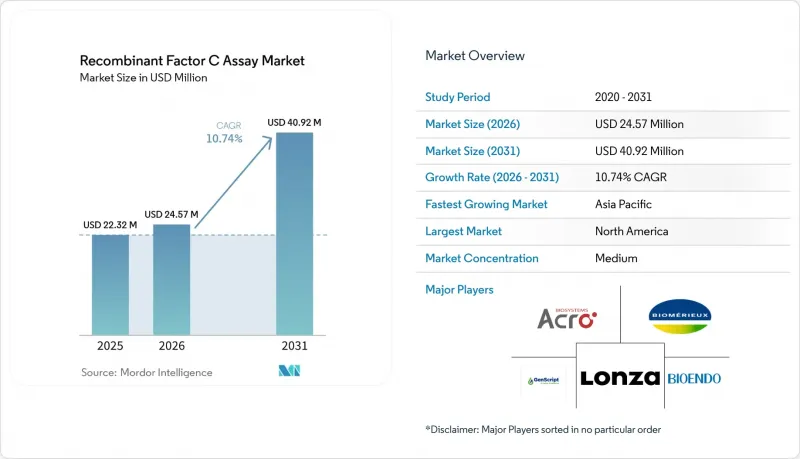
본 보고서는 제품 유형(키트 및 시약 등), 용도(제조 공정용수 및 원자재 등), 최종 사용자(제약·바이오기술 제조업체 등), 분석 구성(표준 마이크로플레이트 RFC 등), 처리량 수준 및 지역(북미, 유럽, 아시아태평양 등)별로 분류되어 있습니다. 시장 전망은 금액(달러) 기준으로 제시되어 있습니다.
세계의 재조합 인자 C 어세이 시장 동향 및 인사이트
약전 등재가 주류화를 가속화
2025년 5월 1일부터 발효되는 미국약전(USP) 제86장에 명시된 비동물 유래 엔도톡신 측정법의 공식 승인으로 인해, 미국 제조업체들에게 있어 검사 불확실성이라는 주요 장벽이 해소될 것입니다. 수질 검사 기준의 통일은 일상적인 GMP 환경 하에서 rFC를 도입하는 데 있어, 대규모이면서도 위험이 낮은 출발점이 되므로, 이를 추진하는 원동력이 되고 있습니다. 일본, 한국, 중국에서는 여전히 ‘검토 중’에서 ‘권고’에 이르는 표현이 사용되고 있으며, 그 결과 전 세계공급업체들은 이러한 시장에서 이중 기준에 따른 비교 시험을 실시할 수밖에 없는 상황에 처해 있습니다. 그 결과, 더 큰 조화가 실현될 때까지는 북미와 유럽에서는 도입이 가속화되는 반면, 아시아의 일부 지역에서는 보다 신중한 도입이 이루어지는 등 단계적인 도입 곡선이 형성될 것입니다.
ESG 및 환경 보전 압력에 따른 LAL에서 비동물성 rFC로의 대체
갑각류의 포획 데이터는 지속가능성을 둘러싼 논쟁을 더욱 격화시키고 있습니다. 2022년의 생물 의학적 목적을 위한 포획과 2024년의 사료용 포획은 생물 다양성에 대한 위험을 여실히 드러냈으며, 현재 투자자 및 업계 단체들이 그 동향을 예의주시하고 있습니다. 기업의 ESG 프로그램에서는 환자 안전을 위한 품질 기준을 유지하면서 생태계에 미치는 영향을 줄이기 위한 구체적인 조치로서 rFC의 도입이 점점 더 중요시되고 있습니다. 이는 유럽 규제 당국이 채택하고 있는 3R 원칙과도 부합하는 것입니다. 야생 생물 유래 시약에 대한 의존도를 낮추는 것은 어업 관리에서 계절적·규제적 변동의 영향을 받기 쉬운 공급망의 위험을 줄이는 데에도 기여합니다. 업계의 노력과 구매자의 기대에 따라, 약전상 허용되는 경로를 이용할 수 있는 경우, 동물 유래 성분을 사용하지 않는 방법을 명시하는 사내 방침의 업데이트가 가속화되고 있습니다. 사용자가 rFC를 시간적 제약이 엄격한 제품 출시에 확대 적용함에 따라, 베타글루칸과 관련된 위양성 결과를 줄일 수 있는 이점을 얻을 수 있으며, 이를 통해 폐기물과 재작업이 감소하고 실무상의 지속가능성 지표가 향상됩니다.
지역별 수용도의 차이에 따른 검증 및 비교 가능성 확보를 위한 업무 부담
여러 규제 관할 구역을 대상으로 하는 제조업체들은 미국이나 유럽 이외의 지역에서는 약전 규정이 여전히 통일되어 있지 않기 때문에 더욱 철저한 검증 계획을 수립해야 하는 상황에 직면해 있습니다. 중국은 지침에서 RFC를 구속력 있는 요건이 아닌 원칙으로 규정하고 있으며, 일본은 여전히 비교 증거를 평가 중인 관계로, 지역별 신청 서류에 대해 이중법 방식의 비교 시험이 계속되고 있습니다. 이러한 프로그램에서는 여러 로트에 걸친 회수율 평가 및 동향 분석이 필요하며, 이로 인해 일상적인 출하 및 여러 시장에 걸친 신청 일정이 장기화됩니다. 일부 제품군에서는 매트릭스 효과도 발생하여 rFC의 희석 범위가 좁아지므로, 복잡한 백신이나 벡터의 방법 적합성 평가에 드는 업무 부담이 증가합니다. 보다 광범위한 조화가 이루어질 때까지, 주요 스폰서들은 특정 시장에서 LAL과 rFC를 병행하여 계속 시행하게 될 것이며, 그 결과 전 세계 포트폴리오의 운영 비용이 높은 수준을 유지하게 될 것입니다.
부문별 분석
키트 및 시약은 2025년 매출의 68.12%를 차지하며 최대 점유율을 유지했습니다. 이는 대규모 바이오의약품 품질관리(QC) 업무에서 시험량에 비례하여 확대되는 지속적인 사용에 힘입은 것입니다. 재조합 인자 C 어세이 시장공급업체들은 플레이트 기반 분석에서 작업자 간 편차를 줄여주는 사전 최적화된 기질 및 고정화 대조군과 같은 형식 혁신을 중시하고 있습니다. 장비 및 판독기와 관련하여, 품질 관리 부서가 노후화된 탁도계를 폐기하고 북미 및 유럽의 주요 공급업체가 제공하는 멀티모드 형광 시스템으로의 표준화를 추진하는 과정에서 견조한 교체 수요가 나타났습니다. 21 CFR Part 11의 시행에 따라 규제 대상 시설 전반에서 전자 서명, 감사 추적, LIMS 통합이 추진됨에 따라, 자동화 및 규정 준수 소프트웨어 시장은 2031년까지 연평균 성장률(CAGR) 12.56%를 기록하며 가장 빠른 성장세를 보일 것으로 전망됩니다. 계약 시험 서비스는 사내에 전면적인 투자를 하지 않고도 측정법의 적합성 평가나 잉여 처리 능력을 필요로 하는 중소기업에게 여전히 현실적인 선택지이며, 이에 따라 재조합 인자 C 어세이 시장에서의 서비스 수요는 계속해서 중요한 위치를 차지하고 있습니다.
재조합 인자 C 어세이 업계는 복잡한 검사를 대규모로, 재현성 있게 수행하고 감사에 대응할 수 있도록 하는 소프트웨어 주도형 워크플로로 지속적으로 전환하고 있습니다. 사전 검증을 거친 소프트웨어 패키지를 통해 변경 관리 및 신청 절차의 검증 주기가 단축되어, 감사 시 발생할 수 있는 마찰이 줄어듭니다. 다이나믹 레인지 확장 등 선도적인 기술 혁신을 통해, 수동 게인 조정 없이도 단일 플레이트 상에서 고신호와 저신호를 혼합할 수 있게 되어, 다양한 매트릭스에서도 첫 측정 시부터 정확도를 보장합니다. 전체 구매자층을 놓고 볼 때, 서비스 모델과 교육 프로그램은 단번에 완전 자동화를 추진하기보다는 단계적인 전환을 선호하는 중규모 품질 관리(QC) 실험실에서의 도입을 촉진하고 있으며, 이에 따라 하이브리드 운영 모델이 결합된 형태의 재조합 인자 C 어세이 시장이 다양화되고 있습니다.
2025년에는 제조 공정 중의 물 및 원자재 시험이 전체 활동의 35.61%를 차지했으며, 규제 대상 제조 시설에서 매일 수행되는 BET(생물학적 동등성 시험)의 대부분을 정제수와 완충액이 차지하기 때문에 여전히 가장 빈도가 높은 이용 사례로 남아 있습니다. 많은 도입 업체들은 약전 시험 절차가 명확하고 매트릭스 효과가 제한적이기 때문에 물 시험부터 시작합니다. 이를 통해 일상적인 환경에서 rFC를 검증할 수 있는 안전한 진입점이 마련됩니다. 완성품의 출시 시험은 매트릭스 간섭이나 희석 한계가 방법의 적합성을 좌우할 수 있기 때문에 여전히 복잡한 편이며, 첫 번째 시험에서 성공하는 것이 매우 중요합니다. 기기 시험은 추출 시험 및 위험 관리에 관한 ISO 및 FDA의 요건에 따라 여전히 안정적인 분야로 자리 잡고 있습니다. 이 분야에서는 동물 유래 성분을 포함하지 않는 방법이, 재조합 인자 C 어세이 시장에서의 광범위한 규제 목표와 부합합니다.
첨단 치료 분야의 품질 관리 시장은 연평균 성장률(CAGR) 12.09%로 확대될 것으로 전망됩니다. 이는 스폰서가 자체 개발 및 동종 플랫폼의 규모를 확대하는 한편, 재시험의 여지가 없는 극히 짧은 출시 기간에 직면해 있기 때문입니다. EMA가 발표한 임상시험용 ATMP에 관한 최신 지침은 임상 생산 과정에서의 오염 관리에 대한 기대치를 높이고 있으며, 이는 신속하고 동물 유래 성분을 포함하지 않는 BET 파이프라인과 잘 부합합니다. 필터, 첨가제 또는 공정 라인으로 인해 베타글루칸에 노출될 우려가 있는 경우, rFC는 팩터 G에 영향을 받지 않으므로 위양성을 줄이고 유지 시간을 단축합니다. 이러한 상황에서 재조합 인자 C 어세이 시장은 지연을 허용할 수 없는 세포 및 유전자 치료 워크플로우의 출시 신뢰성을 높이기 위한 실용적인 수단을 제공합니다.
지역별 분석
북미는 USP 제86장에 대한 조기 대응과 주요 거점에서의 바이오의약품 제조 집중을 통해 2025년 재조합 인자 C 어세이 시장 점유율의 42.17%를 차지했습니다. 이 지역은 21 CFR Part 11 준수를 지원하는 품질 관리(QC) 자동화 솔루션 제공업체 및 소프트웨어 벤더로 구성된 견고한 생태계를 갖추고 있어, 검증된 워크플로우에 rFC를 도입할 준비가 되어 있습니다. 갑각류에 관한 공개된 보전 데이터는 이해관계자들 사이에서 널리 공유되고 있으며, 이는 지속가능성과 공급망의 회복탄력성을 위해 비동물 유래 시약을 우선적으로 사용하는 기업 방침을 뒷받침하고 있습니다. 북미의 CDMO는 서비스 포트폴리오에 재조합법을 도입하고 있으며, 이를 통해 소규모 의뢰사도 대규모 현장 투자를 하지 않고도 전환을 진행할 수 있습니다.
EMA가 임상 제조 분야에서 ATMP(첨단 치료 의약품)에 대한 기대치를 상향 조정함에 따라, 세포 및 유전자 치료 프로그램 전반에 걸쳐 신속하고 동물 유래 성분을 사용하지 않는 내독소 시험의 가치가 재조명되고 있습니다. 이 지역 전체적으로 볼 때, GMP 시설에서 구형 탁도 측정 장비가 멀티모드 형광 측정 장비로 교체됨에 따라, 자본 계획 주기와 교체 일정이 전환 속도를 좌우하고 있습니다.
인도와 중국이 바이오의약품 및 바이오시밀러의 생산 능력을 확대하고 있으며, 지역 공급업체들이 시약 생산을 현지화하고 있어 아시아태평양은 세계 평균을 상회하는 성장이 예상됩니다. 일부 국가에서는 규제 문구가 여전히 보수적이며, 현재 중국의 지침에 반영된 바와 같이 RFC가 약전이 아닌 권고적 성격을 띠고 있기 때문에 이중법에 따른 비교 가능성이 유지되고 있습니다. 일본에서는 유전자 재조합법에 관한 비교 데이터에 대한 검토가 계속되고 있으며, 한국에서는 새로운 규제 동향이 나타나고 있어, 가까운 시일 내에 미국의 기대와 일치하는 수준이 높아질 조짐이 보입니다. 조화가 진전됨에 따라, 재조합 인자 C 어세이 시장은 해당 지역 내의 모든 제조 거점에서 검증 과정의 신속화 및 야생동물 유래 시약에 대한 의존도 감소라는 혜택을 누리게 될 것입니다.
기타 혜택 :
- 엑셀 형식 시장 예측(ME) 시트
- 3개월간의 애널리스트 지원
자주 묻는 질문
목차
제1장 서론
제2장 조사 방법
제3장 주요 요약
제4장 시장 구도
제5장 시장 규모 및 성장 예측
제6장 경쟁 구도
제7장 시장 기회 및 향후 전망
KTH 26.06.24According to Mordor Intelligence, the recombinant factor c assay market size is projected to be USD 22.32 million in 2025, USD 24.57 million in 2026, and reach USD 40.92 million by 2031, growing at a CAGR of 10.74% from 2026 to 2031.
This report is Segmented by Product Type (Kits & Reagents, and More), Application (In-Process Water & Raw Materials, and More), End User (Pharma & Biotech Manufacturers, and More), Assay Configuration (Standard Microplate RFC, and More), Throughput Tier, and Geography (North America, Europe, Asia-Pacific, and More). The Market Forecasts are Provided in Terms of Value (USD).
Global Recombinant Factor C Assay Market Trends and Insights
Pharmacopeial Acceptance Accelerates Mainstream Adoption
Formal recognition of non-animal endotoxin methods in USP Chapter 86, effective May 1, 2025, removes the key barrier of inspection uncertainty for manufacturers in the United States. Alignment on water testing has become a catalyst because it represents a high-volume, lower-risk starting point for rFC deployment under routine GMP. Japan, South Korea, and China still operate with language that ranges from under consideration to advisory status, which leaves global suppliers running dual-method comparability in those markets. The net effect is a tiered adoption curve that moves faster in North America and Europe and more cautiously across parts of Asia until further harmonization takes effect.
ESG and Conservation Pressures to Replace LAL with Animal-Free rFC
Horseshoe crab harvest data has sharpened the sustainability debate, with the biomedical harvest in 2022 and bait harvest in 2024 highlighting biodiversity risks that are now tracked by investors and industry coalitions. Corporate ESG programs increasingly view rFC adoption as a measurable action to mitigate ecosystem impact while maintaining quality standards for patient safety, which aligns with the 3Rs principle used by European regulators. The reduction in dependence on wildlife-derived reagents also helps de-risk supply chains that are sensitive to seasonal and regulatory shocks in fishery management. Sector initiatives and purchaser expectations are adding momentum to in-house policy updates that specify animal-free methods where compendial paths are open. As users expand rFC to time-critical releases, they benefit from fewer beta-glucan related false positives, which reduces waste and rework and improves sustainability metrics in practice.
Validation and Comparability Workload with Heterogeneous Regional Acceptance
Manufacturers targeting multiple regulatory jurisdictions face a heavier validation plan because compendial language remains misaligned outside the United States and Europe. China frames rFC in guidance as a principle rather than a binding requirement, and Japan is still evaluating comparative evidence, which sustains dual-method comparability studies for regional dossiers. These programs require multi-lot recovery evaluations and trending analyses, which extend timelines for routine release and for submissions that cross multiple markets. Some product classes also present matrix effects that tighten dilution windows for rFC, which raises the method-suitability workload for complex vaccines and vectors. Until broader harmonization is achieved, large sponsors will continue to run LAL and rFC in parallel for certain markets, which sustains higher operating costs for global portfolios.
Other drivers and restraints analyzed in the detailed report include:
- QC Lab Automation and Digital Traceability Reduce OPEX and Speed Validation
- Beta-Glucan Independence Reduces Invalid and OOS Retesting Burden
- Gel-Clot Dominance and Cost Constraints in Parts of Asia, Africa, South America
For complete list of drivers and restraints, kindly check the Table Of Contents.
Segment Analysis
Kits and reagents held the largest share at 68.12% of 2025 revenue, anchored by recurring use that scales with test volume across large biopharma QC operations. Vendors in the recombinant Factor C assay market emphasize format innovations such as pre-optimized substrates and immobilized controls that reduce operator variability in plate-based assays. Instruments and readers showed healthy replacement demand as QC groups retired aging turbidimeters and standardized on multimode fluorescence systems from established suppliers in North America and Europe. Automation and compliance software is projected to deliver the fastest growth at a 12.56% CAGR through 2031 as 21 CFR Part 11 enforcement drives electronic signatures, audit trails, and LIMS integrations across regulated sites. Contract testing services remain a practical route for smaller firms that need method suitability or overflow capacity without full in-house investment, which keeps service demand relevant to the recombinant Factor C assay market.
The recombinant Factor C assay industry continues to migrate toward software-enabled workflows that make complex testing repeatable and audit-ready at scale. Pre-validated software packages translate into shorter validation cycles for change controls and submissions, which reduces friction during inspections. Reader innovations like enhanced dynamic range enable mixed high and low signals on a single plate without manual gain steps, which protects accuracy on first pass for diverse matrices. Across buyers, service models and training support adoption among mid-size QC labs that prefer staged transitions rather than full automation in one step, which diversifies the recombinant Factor C assay market with hybrid operating models.
In-process water and raw-materials testing captured 35.61% of activity in 2025 and remains the most frequent use case because purified water and buffers account for a large share of daily BET volume in regulated plants. Many adopters begin with water testing because compendial pathways are clear and matrix effects are limited, which creates a safe entry point to validate rFC under routine conditions. Finished product release stays more complex since matrix interferences and dilution limits can alter method suitability, which raises the stakes for first-pass success. Device testing remains a steady segment due to ISO and FDA expectations for extract testing and risk management, where animal-free methods align with broader regulatory goals for the recombinant Factor C assay market.
Advanced therapies quality control is projected to expand at a 12.09% CAGR as sponsors scale autologous and allogeneic platforms with very short release windows that cannot absorb retests. EMA's updated guidance for investigational ATMPs strengthens expectations around contamination controls in clinical production, which aligns well with fast, animal-free BET pipelines. Where beta-glucan exposure is likely due to filters, excipients, or process trains, rFC's independence from Factor G reduces false positives and shortens hold times. In this context, the recombinant Factor C assay market provides a practical route to improve release reliability for cell and gene therapy workflows that cannot tolerate delays.
Geography Analysis
North America held 42.17% of the recombinant Factor C assay market share in 2025 due to early alignment with USP Chapter 86 and concentrated biopharma manufacturing across key hubs. The region benefits from a robust ecosystem of QC automation providers and software vendors that support 21 CFR Part 11 compliance, which increases the readiness to adopt rFC in validated workflows. Public conservation data on horseshoe crabs resonates across stakeholders, which supports corporate policies that favor non-animal reagents for sustainability and supply chain resilience. North American CDMOs list recombinant methods in their service portfolios, which helps smaller sponsors transition without full on-site investments.
EMA's updated expectations for ATMPs in clinical production reinforce the value of rapid, animal-free endotoxin testing across cell and gene therapy programs. Across the region, capital planning cycles and replacement schedules shape the pace of transition as older turbidimetric readers give way to multimode fluorescence in GMP facilities.
Asia-Pacific is projected to grow faster than the global average as India and China scale biologics and biosimilar manufacturing capacity and as regional suppliers localize reagent production. Regulatory language remains more conservative in several countries, which sustains dual-method comparability where rFC is advisory rather than compendial, as reflected in current China guidance. Japan continues to examine comparative evidence for recombinant methods, and emerging regulatory updates in South Korea signal more alignment with U.S. expectations in the near term. As harmonization advances, the recombinant Factor C assay market will gain from faster validations and lower reliance on wildlife-derived reagents across regional manufacturing centers.
- ACROBiosystems Co., Ltd.
- Bioendo rFC Endotoxin Test Kit
- bioMerieux
- BMG LABTECH GmbH
- Cormica Ltd.
- Eurofins BioPharma Product Testing
- Genscript
- Hzymes Biotechnology
- Indoor Biotechnologies, Inc.
- INTEGRA Biosciences
- Lonza Group
- Microcoat Biotechnologie
- Xiamen Bioendo Technology Co., Ltd.
Additional Benefits:
- The market estimate (ME) sheet in Excel format
- 3 months of analyst support
TABLE OF CONTENTS
1 Introduction
- 1.1 Study Assumptions & Market Definition
- 1.2 Scope of the Study
2 Research Methodology
3 Executive Summary
4 Market Landscape
- 4.1 Market Overview
- 4.2 Market Drivers
- 4.2.1 Pharmacopeial acceptance accelerates mainstream adoption (EU Ph. Eur. rFC compendial; USP <86> official)
- 4.2.2 ESG and conservation pressures to replace LAL with animal-free rFC
- 4.2.3 First FDA drug release using rFC builds confidence in regulated use
- 4.2.4 QC lab automation (microplate fluorescence, digital traceability) reduces OPEX and speeds validation
- 4.2.5 Enterprise supply-chain risk diversification and multi-sourcing favor rFC
- 4.2.6 Beta-glucan independence (no Factor G) reduces invalid/OOS runs and retesting burden
- 4.3 Market Restraints
- 4.3.1 Validation and comparability workload; heterogeneous regional acceptance
- 4.3.2 Gel-clot dominance and cost constraints in parts of Asia, Africa, South America slow replacement
- 4.3.3 Higher rFC kit costs and fluorescence reader capex for small labs
- 4.3.4 Inter-supplier variability and product-matrix effects slow standardization
- 4.4 Supply-Chain Analysis
- 4.5 Regulatory Landscape
- 4.6 Technological Outlook
- 4.7 Porter's Five Forces
- 4.7.1 Threat of New Entrants
- 4.7.2 Bargaining Power of Suppliers
- 4.7.3 Bargaining Power of Buyers
- 4.7.4 Threat of Substitutes
- 4.7.5 Competitive Rivalry
5 Market Size & Growth Forecasts (Value, USD)
- 5.1 By Product Type
- 5.1.1 Kits & Reagents (rFC assay kits)
- 5.1.2 Pre-coated plates/strips
- 5.1.3 Instruments & Readers
- 5.1.4 Automation & Compliance Software
- 5.1.5 Contract Testing Services
- 5.2 By Application
- 5.2.1 In-process water & raw materials
- 5.2.2 Final drug product release
- 5.2.3 Advanced therapies (cell/gene therapy) QC
- 5.2.4 Medical device BET
- 5.2.5 Others
- 5.3 By End User
- 5.3.1 Pharma & Biotech manufacturers
- 5.3.2 CDMOs/CMOs
- 5.3.3 Medical device manufacturers
- 5.3.4 Others
- 5.4 By Assay Configuration
- 5.4.1 Standard microplate rFC
- 5.4.2 Pre-coated GO plates/strips
- 5.4.3 Automation-integrated rFC workflows
- 5.5 By Throughput Tier
- 5.5.1 High-volume QC labs
- 5.5.2 Mid-volume labs
- 5.5.3 Low-volume/point workflows
- 5.6 By Geography
- 5.6.1 North America
- 5.6.1.1 United States
- 5.6.1.2 Canada
- 5.6.1.3 Mexico
- 5.6.2 Europe
- 5.6.2.1 Germany
- 5.6.2.2 United Kingdom
- 5.6.2.3 France
- 5.6.2.4 Italy
- 5.6.2.5 Spain
- 5.6.2.6 Rest of Europe
- 5.6.3 Asia-Pacific
- 5.6.3.1 China
- 5.6.3.2 Japan
- 5.6.3.3 India
- 5.6.3.4 Australia
- 5.6.3.5 South Korea
- 5.6.3.6 Rest of Asia-Pacific
- 5.6.4 Middle East and Africa
- 5.6.4.1 GCC
- 5.6.4.2 South Africa
- 5.6.4.3 Rest of Middle East and Africa
- 5.6.5 South America
- 5.6.5.1 Brazil
- 5.6.5.2 Argentina
- 5.6.5.3 Rest of South America
- 5.6.1 North America
6 Competitive Landscape
- 6.1 Market Concentration
- 6.2 Market Share Analysis
- 6.3 Company Profiles {(includes Global level Overview, Market level overview, Core Segments, Financials as available, Strategic Information, Market Rank/Share for key companies, Products & Services, and Recent Developments)}
- 6.3.1 ACROBiosystems Co., Ltd.
- 6.3.2 Bioendo rFC Endotoxin Test Kit
- 6.3.3 bioMerieux SA
- 6.3.4 BMG LABTECH GmbH
- 6.3.5 Cormica Ltd.
- 6.3.6 Eurofins BioPharma Product Testing
- 6.3.7 GenScript Biotech Corporation
- 6.3.8 Hzymes Biotechnology
- 6.3.9 Indoor Biotechnologies, Inc.
- 6.3.10 INTEGRA Biosciences
- 6.3.11 Lonza Group AG
- 6.3.12 Microcoat Biotechnologie GmbH
- 6.3.13 Xiamen Bioendo Technology Co., Ltd.
7 Market Opportunities & Future Outlook
- 7.1 White-space & unmet-need assessment


