|
시장보고서
상품코드
2063683
단풍나무 시럽 소변 증후군 치료 : 시장 점유율 분석, 업계 동향 및 통계, 성장 예측(2026-2031년)Maple Syrup Urine Disease Treatment - Market Share Analysis, Industry Trends & Statistics, Growth Forecasts (2026 - 2031) |
||||||
 Mordor Intelligence
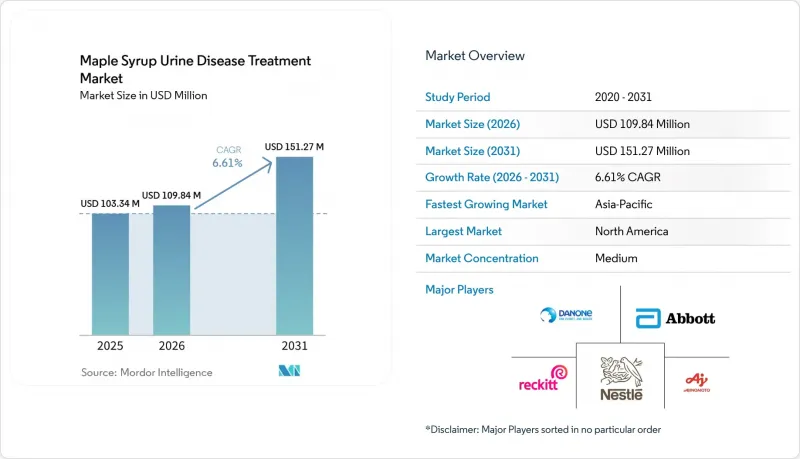
Mordor Intelligence에 의하면, 단풍나무 시럽 소변 증후군 치료 시장 규모는 2025년 1억 334만 달러로 평가되었습니다. 2026년에는 1억 984만 달러로 확대되어 2031년까지 1억 5,127만 달러에 이를 것으로 예측되며, 2026-2031년 CAGR은 6.61%를 나타낼 전망입니다.
본 보고서는 질환의 표현형(고전형, 중간형, 간헐형, 티아민 반응형), 연령대(신생아·영아, 소아, 성인), 유통 채널(전문 약국·의료기기 판매점, 병원 약국, 소비자 직접 판매(DTC) 전자상거래), 지역(북미, 유럽, 아시아태평양, 기타)별로 분류되어 있습니다. 시장 전망은 금액(달러) 기준으로 제시되어 있습니다.
세계의 단풍나무 시럽 소변 증후군 치료 시장 동향 및 인사이트
신생아 선별검사의 확대와 조기 진단
2024년부터 2026년에 걸쳐 선별 검사 항목을 확대한 지역에서는 정기 신생아 선별 검사 프로그램에 포함된 탠덤 질량 분석법을 통해 전형적인 MSUD의 진단까지 걸리는 시간이 생후 1주일 이내로 단축되었습니다. 이를 통해 BCAA를 포함하지 않는 영양 요법을 즉시 시작함으로써 중증 상태의 예방에 도움이 됩니다. 2026년 임상유전학 기관의 지침 개정으로 인해 위양성을 줄이기 위해 검사실의 기준치가 세분화되었으나, 이로 인해 일부 중간형 표현형이 초기 선별 검사 단계가 아닌 추적 조사 과정에서 확인되는 이중 구조의 상황이 발생할 가능성이 있습니다.
신장 위구르 자치구에서 실시된 선별검사 확대에 관한 지역 데이터에 따르면, 대규모 출생 코호트에서 검출률이 극히 낮은 것으로 나타났으며, 이로 인해 유병률이 낮은 지역에서 고품질의 선별검사를 지속적으로 실시하는 데 따르는 과제와, 비용 대비 효과를 유지하기 위해 여러 선천성 대사 이상을 통합하여 검사하는 것의 가치가 부각되었습니다. 공적 보험의 급여 체계는 지역에 따라 다르기 때문에 조기 진단을 받았다고 하더라도 주나 성의 정책에 따른 의료용 식품의 분류 방식에 따라 가족이 부담해야 하는 본인 부담금은 달라집니다. 실제로, 조기 발견과 급여 코드의 통합을 통해 영양 중재까지의 기간이 단축되고, 치료 순응도가 향상되며, 전형적인 증상이 나타나는 경우의 신경 장애 위험이 감소합니다.
BCAA를 함유하지 않은 의료용 식품 및 보충제에 대한 표준 치료로서의 의존
BCAA를 함유하지 않은 의료용 식품은 진단을 받은 대다수의 환자에게 여전히 치료의 기초가 되고 있으며, 그 높은 영양가, 기호성 및 미량영양소 구성은 매일의 복약 순응도와 임상적 안정성에 영향을 미치고 있습니다. 각 제조업체들은 오메가-3 및 특정 질환에 맞춘 배합을 지속적으로 개선하고 있으며, 이는 생애 단계에 따른 소아 및 성인의 영양 요구 사항에 부합하는 최신 제품 참고 자료 및 지침에 반영되어 있습니다. Vitaflo사는 조제가 용이하고 복약 순응도를 높이기 위해 독일에서 생산 능력을 확대하고 공압출 기술을 도입했습니다. 이 제품 라인업은 맛이나 섭취 방식에 따라 젤, 분말, 바로 마시는 유형 등 다양하게 구성되어 있습니다. 판매업체 간의 가격 투명성을 통해 브랜드, 형태, 영양 강화 내용에 따른 명확한 가격대가 제시되고 있으며, 이는 외래 진료 현장에서 가족의 선호도나 정기 구매 선택에 영향을 미치고 있습니다. 위기 이후의 규제적 기대에 부응하기 위해서는 중복성과 리스크 대비 계획이 요구되며, 이는 고정비를 증가시키는 한편, 시간적 제약이 엄격한 신생아 및 소아의 이용 사례에서 치료를 위협할 수 있는 장기적인 제품 부족 가능성을 줄여줍니다.
극히 드문 질환의 유병률은 상업적 실현 가능성과 임상시험 등록을 제한합니다.
MSUD의 낮은 발병률은 진단 및 치료가 가능한 환자 수를 제한하고 있어, 다기관 간 조정이 필요한 전향적 연구를 시도하려는 연구 후원자에게는 높은 장벽이 되고 있습니다. 유럽 규제 당국은 급성 보상 부전 치료와 관련하여 이 문제를 해결하기 위해, 예외적인 상황에서 BCAA가 함유되지 않은 비경구 용액의 사용을 승인했습니다. 이에 따라, 기존의 임상시험을 실시할 수 없는 경우, 후향적 데이터를 기반으로 한 대체적 증거 모델이 인정되게 되었습니다.
유전자 치료의 경우, 동물 모델에서 전임상 단계의 생존율 및 바이오마커 개선이 초기 소아 코호트 시험 실시의 근거를 뒷받침하고 있지만, 초기 인간 임상시험에서도 임상적 요구의 핵심이 되는 표현형 전반에 걸쳐 충분한 피험자 수를 확보해야 합니다. 또한, 중간형이나 간헐형에서는 효소 활성 수준에 편차가 있어 기존의 종말점을 반영하지 못할 가능성이 있으므로, 표현형의 이질성도 등록 전략에 반영해야 합니다. 이는 시험 설계 및 분석 계획에 영향을 미칩니다. 규제 당국이 실행 가능성과 엄격성 사이의 균형을 모색하는 가운데, 기업들은 적합한 후보자를 효율적으로 선별하기 위해 신생아 선별 검사와 연계 체계를 구축한 전 세계 대사 센터 네트워크에 의존할 가능성이 높습니다.
부문별 분석
2025년에는 전형적인 MSUD가 64.53%를 차지했습니다. 이는 신생아기에 발병하고, 평생 동안 BCAA가 함유되지 않은 조제분유에 의존해야 하는 상황을 반영하고 있습니다. 동일한 부문 내에서 더 많은 의료기관이 표준화된 B군 비타민 부하 검사 프로토콜을 도입함에 따라, 티아민 반응성 아형은 2031년까지 7.57% 성장할 것으로 전망됩니다. 단풍나무 시럽 소변 증후군 치료 시장 점유율은 전형적인 증상에 집중되어 있습니다. 이는 BCKDH의 잔존 활성이 거의 제로에 가깝기 때문에 출생 직후부터 대사 관리를 바탕으로 한 일관된 영양 요법이 필요하기 때문입니다. 효소 활성이 부분적으로 남아 있는 중간형 표현형의 경우, 유아기의 복약 순응도를 높이기 위해 맛과 조제의 편의성을 고려한 소아용 분말 제제에 의존하고 있습니다. 분자 검사의 임상 도입을 통해 아형의 조기 확정이 가능해지며, 이를 통해 표현형에 특화된 영양 계획 수립이 지원되어, 식단 조정의 지연이나 부적절함으로 인해 발생할 수 있는 위기 상황의 위험이 감소합니다. 전체 표현형 조합에 걸쳐, 급성 보상 부전 치료에는 현재 승인된 비경구 투여 옵션이 포함되어 있으며, 이를 통해 위기 상황에서 경구 또는 경장 제제를 사용할 수 없는 경우, 간헐형 및 중간형에 대한 병원의 치료 지침이 강화되고 있습니다.
티아민 반응성 표현형의 경우, 유전자형과 표현형의 상관관계 규명이 진전되고 부하 검사가 표준화됨에 따라, 경구용 보충제와 관련된 메이플 시럽뇨증 치료 시장 규모가 확대되고 있습니다. 이에 따라, 가능한 경우 중간형 증례의 일정 비율이 이식 경로에서 의학적 감독 하의 비타민 요법으로 전환되고 있습니다. 2025년에 시행된 유럽의 진단 규정에 따라 적합성 및 표시 기준이 추가되었고, 인증 검사실 간의 검사가 통합되어 각국 간에 보다 일관된 보고가 이루어지게 되었습니다. 2024년 이후의 유전자형 변이에 관한 조사 결과, 알려진 병태 스펙트럼이 확대되었으며, 이는 가족과 임상의가 영양 관리 및 모니터링의 강도를 계획할 때 임상적 위험 평가에 도움이 되고 있습니다. 이러한 노력이 확산됨에 따라, 보험사 및 의료기관은 반응성이 확인된 환자의 이식 의뢰 건수가 감소할 것으로 예상되나, 장기적인 신경인지적 예후에 대해서는 지속적인 추적 관찰이 필요합니다. 전반적으로, 단풍나무 시럽 소변 증후군 치료 시장에서 표현형에 기반한 치료 경로는 브랜드, 연령, 제형별로 제품이 어떻게 포지셔닝되는지를 지속적으로 뒷받침하고 있습니다.
지역별 분석
2025년, 북미는 메이플 시럽뇨증 치료 시장의 43.23%를 차지했습니다. 이는 대부분의 주에서 대사용 조제유를 약국 조제 의료용 식품으로 분류하는 WIC(여성·영유아 영양 보조 프로그램) 및 메디케이드(주 의료 보험)와 연계된 급여 체계에 의해 뒷받침되는 것입니다. 주 및 보험 플랜 차원의 문서에는 수급 자격 및 코딩에 대한 세부 사항이 명시되어 있으며, 이러한 사항들이 보험 청구 처리 경로를 결정하고 영유아 및 소아 진료의 연속성에 영향을 미치고 있습니다. 2022년 위기를 계기로 수립된 연방 정부의 장기 전략에 따라, 현재 중복성 계획이 의무화되어 있으며 수입의 유연성이 지원되고 있습니다. 이를 통해 충격이 발생하더라도 해외산 특수 조제분이 미국공급을 안정적으로 유지할 수 있게 됩니다. 텍사스주 등의 신생아 선별 검사 프로그램에서는 MSUD가 주요 검사 항목에 명확히 포함되었습니다. 이를 통해 진단까지 걸리는 시간이 단축되어, 신생아기에 분유 요법을 신속하게 이용할 수 있게 되었습니다. 일부 주에서 민간 보험이 개정됨에 따라 보장 범위는 확대되었으나, 보장 한도 및 투여 방법에 관한 조항으로 인해 가구별 본인 부담액에는 여전히 차이가 발생하고 있습니다. 제약사 및 전문 의료 제공업체들이 미국 내 생산 능력과 물류 체계를 강화하는 가운데, 북미의 메이플 시럽뇨증 치료 시장은 급성 악화 시 병원의 지원 체계를 바탕으로 영유아 및 소아 환자 수요에 힘입어 지속적으로 성장하고 있습니다.
유럽에서는 예외적인 상황에서 발생하는 MSUD의 위급한 상태에 대응하기 위해, EU에서 최초로 승인된 비경구용 BCAA 프리 아미노산 용액의 승인을 통해 급성기 의료 분야의 혁신을 주도하고 있습니다. 이 지역의 진단 체계는 2025년 시행될 새로운 체외진단용 의료기기(IVD) 규정에 완전히 부합하며, 이를 통해 MSUD 유전자 패널 전반에 걸친 적합성 및 표시 규정이 강화되고, 인증 검사 기관 간의 검사가 통합될 것입니다. 유럽의 의료 제도에서는 병원과 연계된 약국 채널을 통해 MSUD용 조제식이 제공되고 있으며, 이를 통해 임상적 감독이 이루어지고, 치료를 받고 있는 가족에게 확실한 공급이 보장되고 있습니다. 독일에서의 제조 투자를 통해 현지 생산 능력이 두 배로 늘어났으며, 조제 시간을 단축하고 소아 환자가 복약 순응도를 높일 수 있는 제형을 실현하는 생산 기술이 도입되었습니다. 이 지역 시장 구조는 중앙집권적인 조제와 전문 도매업체를 결합한 형태이며, 처방집의 규정에 따라 어떤 SKU가 보험 적용 대상이 되는지가 정의되어 있고, 이것이 국가별 브랜드별 시장 점유율을 형성하고 있습니다. 임상시험 경로와 시판 후 증거가 확대됨에 따라, 유럽의 메이플 시럽뇨증 치료 시장은 병원 측의 대응 체계 강화와 진단법의 조화 덕분에 혜택을 보고 있습니다.
아시아태평양은 연평균 성장률(CAGR) 7.17%로 성장을 지속하고, 있으며, 지방에서의 선별 검사 확대와 의뢰 네트워크 개선을 통해 환자를 조기에 발견하고 생후 1주일 이내에 영양 요법을 시작할 수 있게 됨에 따라, 2031년까지 가장 빠른 성장이 예상됩니다. 신장 위구르 자치구의 데이터에 따르면, 측정된 발생률이 낮더라도 공중보건 기준을 충족하기 위해 다른 선천성 대사 이상증과 함께 프로그램을 시행하는 경우, MS/MS 선별검사의 지속이 여전히 정당화될 수 있음을 보여줍니다. 아시아태평양의 병원 시스템은 3차 의료기관에서 급성 보상 부전에 대한 치료 경로를 강화하고 있으며, 경구 또는 경장 섭취가 불가능한 발작 시 비경구 요법 옵션이 환자의 가교 능력을 향상시키고 있습니다. 중동 및 북아프리카에서는 단일 의료기관의 소아 이식 프로그램에서 2025년 코호트의 1년 생존율이 100%로 보고되었으며, 기증자 공급을 최대한 활용하기 위해 도미노 이식의 활용이 확대되었습니다. 이를 통해 대기 시간이 단축되고, 이식 후 대사 안정성이 유지되고 있습니다. 이 지역 전반에 걸쳐 공적 선별 검사 정책이 확대되고 병원 역량이 강화됨에 따라, 메이플 시럽뇨증 치료 시장은 조기 영양 관리의 시작, 위기 관리 강화, 그리고 프로그램이 확립된 지역에서의 외과적 치료 경로의 점진적인 도입을 통해 혜택을 보고 있습니다.
기타 혜택 :
- 엑셀 형식 시장 예측(ME) 시트
- 3개월간의 애널리스트 지원
자주 묻는 질문
목차
제1장 서론
제2장 조사 방법
제3장 주요 요약
제4장 시장 구도
제5장 시장 규모 및 성장 예측
제6장 경쟁 구도
제7장 시장 기회 및 향후 전망
KTH 26.06.24According to Mordor Intelligence, the maple syrup urine disease treatment market size is expected to increase from USD 103.34 million in 2025 to USD 109.84 million in 2026 and reach USD 151.27 million by 2031, growing at a CAGR of 6.61% over 2026-2031.
This report is Segmented by Disease Phenotype (Classic, Intermediate, Intermittent, Thiamine-Responsive), Age Group (Neonates/Infants, Pediatrics, Adults), Distribution Channel (Specialty Pharmacies & DME, Hospital Pharmacies, Direct-To-Consumer E-Commerce), and Geography (North America, Europe, Asia-Pacific, and More). The Market Forecasts are Provided in Terms of Value (USD).
Global Maple Syrup Urine Disease Treatment Market Trends and Insights
Expansion of Newborn Screening and Earlier Diagnosis
Tandem mass spectrometry embedded in routine newborn screening programs has reduced time-to-diagnosis for classic MSUD to within the first week of life in jurisdictions that strengthened their panels between 2024 and 2026, which improves crisis prevention when BCAA-free nutrition is started immediately. Guidance updates from clinical genetics bodies in 2026 refined laboratory thresholds to reduce false positives, which may still produce a two-tier landscape where some intermediate phenotypes are identified during follow-up rather than at the initial screen.
Regional data from Xinjiang's expanded screening showed very low incidence detection in a large birth cohort, highlighting the challenge of sustaining high-quality coverage in low-prevalence regions and the value of bundling multiple inborn errors to maintain cost-effectiveness. Public payer coverage frameworks vary, so even with early diagnosis, families experience different out-of-pocket exposure depending on how medical foods are classified by state or provincial policy. In practice, earlier detection and aligned reimbursement codes shorten the window to nutritional intervention, improve adherence, and reduce neurological injury risk across classic presentations.
Standard-of-Care Reliance on BCAA-Free Medical Foods and Supplements
BCAA-free formulas remain the backbone of therapy for most diagnosed patients, and supply strength, palatability, and micronutrient profiles that influence daily adherence and clinical stability. Manufacturers continue to refine omega-3 and condition-specific formulations, reflected in updated product references and guides that align with pediatric and adult nutritional needs by life stage. Vitaflo expanded capacity and introduced co-extrusion technology in Germany to improve ease of preparation and support adherence, with the line-up spanning gels, powders, and ready-to-drink options to match taste and preparation preferences. Price transparency across distributors shows clear tiering by brand, format, and fortification, which nudges family preferences and subscription choices in the outpatient setting. Post-crisis regulatory expectations require redundancy and risk planning that add fixed costs but also reduce the likelihood of prolonged shortages that jeopardize care in highly time-sensitive neonatal and pediatric use cases.
Ultra-Rare Prevalence Limits Commercial Viability and Trial Enrollment
MSUD's low incidence limits the number of diagnosable and treatable patients, which raises the bar for sponsors attempting prospective studies that require multicenter coordination. European regulators addressed this for acute decompensation care by granting authorization for a parenteral BCAA-free solution under exceptional circumstances, allowing an alternative evidentiary model anchored in retrospective data when conventional trials are not feasible.
For gene therapy, preclinical survival and biomarker gains in animal models support the case for an initial pediatric cohort, yet early human trials still need sufficient numbers across phenotypes central to clinical need. Enrollment strategies must also consider phenotype heterogeneity, since intermediate and intermittent forms express variant enzyme activity levels that may not reflect classic endpoints, which influences study design and analysis plans. As regulators balance feasibility with rigor, companies are likely to rely on global networks of metabolic centers with established newborn screening linkages to identify eligible candidates efficiently.
Other drivers and restraints analyzed in the detailed report include:
- Adoption of Liver Transplantation as Curative Option in Severe Cases
- Broader Availability of MSUD-Specific Products Across Global Nutrition Majors
- High Lifetime Cost of Specialized Medical Foods and Transplant Care
For complete list of drivers and restraints, kindly check the Table Of Contents.
Segment Analysis
Classic MSUD accounted for 64.53% in 2025, reflecting neonatal presentation and lifelong reliance on BCAA-free formulas; within the same segmentation, the thiamine-responsive subtype is forecast to grow at 7.57% to 2031 as more centers implement standardized B-vitamin challenge protocols. The maple syrup urine disease treatment market share is concentrated in classic presentations because near-zero residual BCKDH activity requires consistent nutritional therapy under metabolic supervision beginning soon after birth. Intermediate phenotypes, with partial enzyme activity, rely on pediatric-friendly formulations tailored to taste and preparation convenience to support adherence during early childhood. Clinical adoption of molecular testing enables earlier subtype confirmation, which supports phenotype-specific nutrition planning and reduces the risk of crisis events arising from delayed or inappropriate dietary adjustments. Across the phenotype mix, acute decompensation care now includes an authorized parenteral option, which strengthens hospital protocols for intermittent and intermediate forms when oral or enteral formulation cannot be used during crisis.
In the thiamine-responsive phenotype, the maple syrup urine disease treatment market size tied to oral supplementation grows with better genotype-phenotype mapping and standardized challenge testing, which shifts a share of intermediate cases from transplant pathways to medically supervised vitamin therapy when feasible. European diagnostic regulations that took effect in 2025 add conformity and labeling standards, which consolidate testing among qualified labs and yield more consistent reporting across countries. Research on genotype variation since 2024 has broadened the documented spectrum and informs clinical risk assessment as families and clinicians plan nutrition and monitoring intensity. As adoption spreads, payers and clinics may see lower transplant referrals among those with confirmed responsiveness, though long-term neurocognitive outcomes require continued tracking. Overall, phenotype-driven care pathways continue to anchor how products are positioned by brand, age, and preparation format across the maple syrup urine disease treatment market.
Geography Analysis
North America held 43.23% of the maple syrup urine disease treatment market share in 2025, supported by WIC-linked and Medicaid-aligned coverage frameworks that classify metabolic formulas as pharmacy-dispensed medical foods across most states. State and plan-level documents detail eligibility and coding, which drive claim routing and influence continuity of care for infants and children. The 2022 crisis prompted a federal long-term strategy that now requires redundancy planning and supports import flexibilities so foreign-made specialized formulas can stabilize U.S. supply during shocks. Newborn screening programs in states like Texas brought MSUD squarely into core panels, which shortens diagnostic lag and raises prompt access to formula therapy in the neonatal stage. Commercial policy updates in some states have expanded coverage, although benefit caps and delivery-method clauses still generate variance in out-of-pocket costs for households. As manufacturers and specialty providers strengthen U.S. capacity and logistics, the maple syrup urine disease treatment market in North America remains anchored by infant and pediatric demand with hospital backup for acute decompensation.
Europe leads in acute-care innovation with the approval of the first EU-authorized parenteral BCAA-free amino acid solution for MSUD crises under exceptional circumstances. The region's diagnostic regime fully aligned with new IVD rules in 2025, which add conformity and labeling discipline across MSUD genetic panels and consolidate testing among accredited labs. European health systems dispense MSUD formulas through hospital-linked pharmacy channels, which ensures clinical oversight and reliable refills for families under care. Manufacturing investments in Germany doubled local capacity and introduced production technologies that improve preparation time and adherence-friendly formats for pediatric patients. The region's market structure blends centralized dispensing with specialty distributors, and formulary rules define which SKUs are reimbursable, which in turn shapes brand-level share by country. As clinical trial pathways and post-market evidence expand, the maple syrup urine disease treatment market in Europe benefits from stronger hospital readiness and harmonized diagnostics.
Asia-Pacific accounts 7.17% CAGR and is positioned for the fastest growth through 2031 as provincial screening expansions and improved referral networks identify cases earlier and start nutrition therapy in the first week of life. Data from Xinjiang illustrate how low measured incidence still warrants sustained MS/MS screening when programs are bundled with other inborn errors to meet public health thresholds. APAC's hospital systems strengthen care pathways for acute decompensation in tertiary centers, with parenteral options improving the ability to bridge patients during episodes where oral or enteral intake is not possible. In the Middle East and North Africa, single-center pediatric transplant programs reported 100% one-year survival in 2025 cohorts and expanded domino utilization to stretch donor supply, which reduces wait times and supports metabolic stability post-transplant. As public screening policies scale and hospital capabilities strengthen across these regions, the maple syrup urine disease treatment market gains from earlier initiation of nutritional care, tighter crisis management, and modest uptake of surgical pathways where programs are established.
- Abbott Laboratories
- Acer Therapeutics
- Ajinomoto Cambrooke, Inc.
- Danone
- Dr. Schar
- Galen Limited.
- HemoShear Therapeutics
- Jo Mar Labs
- Navamedic
- Nestle Health Science (Vitaflo)
- Orpharma
- POA Pharma
- Reckitt (Mead Johnson Nutrition)
- Recordati Industria Chimica e Farmaceutica S.p.A.
- Relief Therapeutics
- Taranis Nutrition
- Zevra Therapeutics, Inc.
Additional Benefits:
- The market estimate (ME) sheet in Excel format
- 3 months of analyst support
TABLE OF CONTENTS
1 Introduction
- 1.1 Study Assumptions & Market Definition
- 1.2 Scope of the Study
2 Research Methodology
3 Executive Summary
4 Market Landscape
- 4.1 Market Overview
- 4.2 Market Drivers
- 4.2.1 Expansion of Newborn Screening and Earlier Diagnosis
- 4.2.2 Standard-of-Care Reliance on BCAA-Free Medical Foods and Supplements
- 4.2.3 Adoption of Liver Transplantation as Curative Option in Severe Cases
- 4.2.4 Broader Availability of MSUD-Specific Products Across Global Nutrition Majors
- 4.2.5 Domino Liver Transplantation Expanding Donor Pool
- 4.2.6 Supply-Resilience Actions Post-2022 Formula Crisis and Import Flexibilities
- 4.3 Market Restraints
- 4.3.1 Ultra-Rare Prevalence Limits Commercial Viability and Trial Enrollment
- 4.3.2 High Lifetime Cost of Specialized Medical Foods and Transplant Care
- 4.3.3 Uneven Medical Food Reimbursement Due to Non-Drug Regulatory Status
- 4.3.4 Transplant Capacity/Ethics Constraints; Variable Program Acceptance
- 4.4 Supply-Chain Analysis
- 4.5 Regulatory Landscape
- 4.6 Technological Outlook
- 4.7 Porter's Five Forces
- 4.7.1 Threat of New Entrants
- 4.7.2 Bargaining Power of Suppliers
- 4.7.3 Bargaining Power of Buyers
- 4.7.4 Threat of Substitutes
- 4.7.5 Industry Rivalry
5 Market Size & Growth Forecasts (Value, USD)
- 5.1 By Disease Phenotype
- 5.1.1 Classic
- 5.1.2 Intermediate
- 5.1.3 Intermittent
- 5.1.4 Thiamine-responsive
- 5.2 By Age Group
- 5.2.1 Neonates/Infants
- 5.2.2 Pediatrics
- 5.2.3 Adults
- 5.3 By Distribution Channel
- 5.3.1 Specialty Pharmacies & DME
- 5.3.2 Hospital Pharmacies
- 5.3.3 Direct-to-Consumer E-Commerce
- 5.4 By Geography
- 5.4.1 North America
- 5.4.1.1 United States
- 5.4.1.2 Canada
- 5.4.1.3 Mexico
- 5.4.2 Europe
- 5.4.2.1 Germany
- 5.4.2.2 United Kingdom
- 5.4.2.3 France
- 5.4.2.4 Italy
- 5.4.2.5 Spain
- 5.4.2.6 Rest of Europe
- 5.4.3 Asia-Pacific
- 5.4.3.1 China
- 5.4.3.2 India
- 5.4.3.3 Japan
- 5.4.3.4 Australia
- 5.4.3.5 South Korea
- 5.4.3.6 Rest of Asia-Pacific
- 5.4.4 Middle East and Africa
- 5.4.4.1 GCC
- 5.4.4.2 South Africa
- 5.4.4.3 Rest of Middle East and Africa
- 5.4.5 South America
- 5.4.5.1 Brazil
- 5.4.5.2 Argentina
- 5.4.5.3 Rest of South America
- 5.4.1 North America
6 Competitive Landscape
- 6.1 Market Concentration
- 6.2 Market Share Analysis
- 6.3 Company Profiles {(includes Global level Overview, Market level overview, Core Segments, Financials as available, Strategic Information, Market Rank/Share for key companies, Products & Services, and Recent Developments)}
- 6.3.1 Abbott Laboratories
- 6.3.2 Acer Therapeutics
- 6.3.3 Ajinomoto Cambrooke, Inc.
- 6.3.4 Danone (Nutricia)
- 6.3.5 Dr. Schar
- 6.3.6 Galen Limited.
- 6.3.7 HemoShear Therapeutics
- 6.3.8 Jo Mar Labs
- 6.3.9 Navamedic
- 6.3.10 Nestle Health Science (Vitaflo)
- 6.3.11 Orpharma Pty Ltd.
- 6.3.12 POA Pharma
- 6.3.13 Reckitt (Mead Johnson Nutrition)
- 6.3.14 Recordati Industria Chimica e Farmaceutica S.p.A.
- 6.3.15 Relief Therapeutics
- 6.3.16 Taranis Nutrition
- 6.3.17 Zevra Therapeutics, Inc.
7 Market Opportunities & Future Outlook
- 7.1 White-space & unmet-need assessment