|
시장보고서
상품코드
2063687
혈액 및 혈액 성분 시장 : 점유율 분석, 업계 동향과 통계, 성장 예측(2026-2031년)Blood And Blood Components - Market Share Analysis, Industry Trends & Statistics, Growth Forecasts (2026 - 2031) |
||||||
 Mordor Intelligence
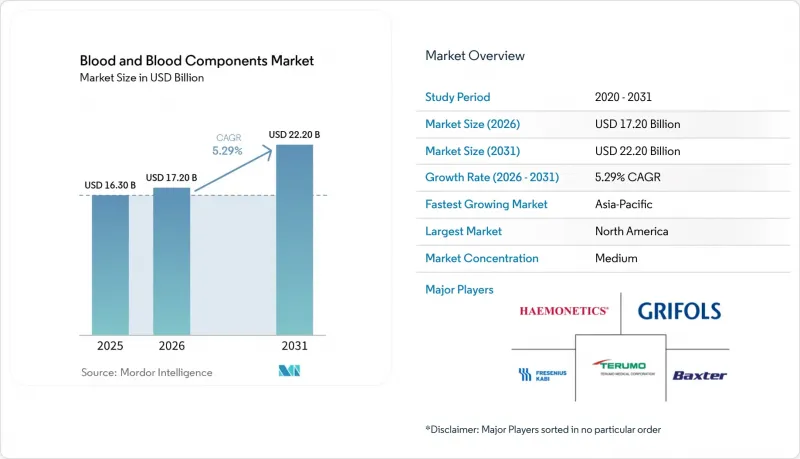
Mordor Intelligence에 의하면, 혈액 및 혈액 성분 시장 규모는 2025년 163억 달러에서 2026년에는 172억 달러로 확대되어 2026년부터 2031년까지 CAGR 5.29%로 성장을 지속하여, 2031년까지 222억 달러에 이를 것으로 예측됩니다.
본 보고서는 성분별(적혈구, 혈소판, 혈장, 크리오프레시피테이트), 채취 방법별(아페레시스, 전혈 유래), 용도별(외상·외과, 암 치료, 빈혈 관리, 산과), 최종 사용자별(병원, 혈액센터, ASC), 지역별(북미, 유럽, 아시아태평양, 중동 및 아프리카, 남미)로 분류되어 있습니다. 시장 전망은 금액(달러) 기준으로 제시되어 있습니다.
세계 혈액 및 혈액 성분 시장 동향과 인사이트
복잡한 전문 분야의 수술 건수 증가
미국의 외래 수술 건수는 2025년부터 2035년까지 21% 증가할 것으로 예상되며, 이는 외래 진료로의 전환을 나타냅니다. 복잡한 종양 절제술이나 로봇 보조 정형외과 수술의 경우, 여전히 교차적합 검사를 마친 적혈구 및 혈소판의 대기 공급이 필요하며, 이를 통해 병원의 재고가 유지되고 있습니다. 대규모 외래수술센터(ASC) 주변에는 위성 혈액은행이 늘어나고 있지만, 재고의 분산은 콜드체인 운영 비용을 증가시키며, 실시간 가시화가 필요합니다. FDA의 현행 조직 우수제조기준(cGTP) 및 AABB 기준에 따라, 이러한 센터들은 수혈 프로토콜을 문서화해야 할 의무가 있으며, 대규모 의료 시스템이 아닌 이상 쉽게 감당하기 어려운 규정 준수 비용이 추가로 발생하고 있습니다.
암 치료에 따른 빈혈 및 혈소판 감소증에 대한 대처
CAR-T 요법이나 고용량 화학요법의 경우, 치료 주기의 10-25%에서 중증 혈구 감소증이 발생하며, ASCO 및 ASH 지침에 따라 혈소판 수가 10,000/μL 미만으로 떨어질 경우 예방적 혈소판 수혈이 시행됩니다. 병원에서는 보존 기간을 연장하고 세균 오염을 억제하기 위해, 2025년에 FDA 승인을 받은 INTERCEPT 등의 병원체 저감 플랫폼을 도입하고 있습니다. 생존율이 향상됨에 따라 각 환자는 더 오랜 기간 동안 더 많은 수혈을 필요로 하게 되어, 혈액 및 혈액 성분 시장의 꾸준한 성장을 뒷받침하고 있습니다.
환자 혈액 관리를 통한 동종 수혈 감소
PBM(환자 혈액 관리)는 수술 전 빈혈 교정, 수술 중 세포 회수, 그리고 엄격한 기준치를 결합한 것으로, 독일의 다기관 공동 연구에서 적혈구 사용량을 최대 60% 줄이고 사망 위험을 0.33까지 낮췄습니다. 현재, 조인트 커미션의 기준에 따라 병원은 수혈의 적절성을 감사할 의무가 있으며, 수술의 난이도가 높아지는 상황에서도 수혈 수요를 억제하고 있습니다.
부문별 분석
2025년 매출의 65.18%를 적혈구가 차지하고 있지만, CAR-T 요법 및 강화된 화학요법으로 인해 혈소판 감소증 사례가 증가하고 있어, 혈소판 시장은 2031년까지 연평균 성장률(CAGR) 6.50%로 성장할 전망입니다. 혈장 및 크리오프레시피테이트는 대량 수혈 프로토콜에서 응고 인자 보충을 지속적으로 뒷받침하고 있지만, 병원체 제거 시스템의 보급으로 인해 그 비중은 수익성이 높고 보존 기간이 긴 혈소판 제제로 이동하고 있습니다. INTERCEPT의 2025년 FDA 승인은 이러한 변화 속에서 기술이 수행하는 역할을 상징합니다.
아페레시스 처리 능력이 제한적인 지역에서는 전혈 유래 혈소판이 여전히 필수적이지만, 세균 오염에 관한 엄격한 규제로 인해 1단위당 비용이 50-100달러 증가함에 따라, 병원들은 더 안전한 전처리 제품을 사용하도록 전환해야 하는 상황에 직면해 있습니다. 바르셀로나의 그리폴스사가 혈장 분리에 1억 6,000만 유로를 투자한 것은 수익성이 높은 파생 제품으로의 전환을 뒷받침하고 있습니다.
정착된 이동 채혈 활동 덕분에 2025년 매출의 72.18%를 전혈 채혈이 차지했으나, 아페레시스는 2031년까지 연평균 성장률(CAGR) 6.92%를 나타낼 것으로 전망됩니다. 2025년에 승인된 프레제니우스 카비(Fresenius Kabi)의 ‘오로라 Xi’ 소프트웨어는 1회 헌혈당 혈장 수율을 88mL 증가시켜, 아페레시스의 성장을 뒷받침하는 생산성 향상을 보여주고 있습니다.
이동 채혈은 지방으로의 확대에 있어 여전히 필수적이지만, 각 공급업체들은 수익성이 낮은 사업에서 철수하고 있습니다. 헤모네틱스사는 혈장 및 혈소판 자동화 사업에 집중하기 위해 2025년에 전혈 관련 자산을 GVS사에 6,710만 달러에 매각했습니다. 마찬가지로, 중국이 2024년에 개정된 지침에서도 자동화된 병원체 제거 채혈이 우선시되고 있어, 아시아태평양에서 아페레시스의 성장세를 확고히 하고 있습니다.
지역별 분석
2025년, 북미는 전 세계 매출의 36.19%를 차지하며 혈액 및 혈액 성분 시장에서 가장 큰 점유율을 유지했습니다. 2023년 미국 FDA 지침에 따라 혈소판의 14일간 냉장 보관이 허용됨에 따라, 외상 센터는 외딴 지역의 고속도로나 응급의료 서비스 시설 근처에 재고를 비치할 수 있게 되었습니다. 이러한 규제의 유연성 덕분에, 유효기간 만료로 인한 폐기가 줄어들었고, 도시 지역 병원에서는 환자 혈액 관리(PBM) 프로그램을 통해 적혈구 수요가 억제되고 있음에도 불구하고 꾸준한 성장이 뒷받침되고 있습니다. 지속적인 헌혈자 부족은 여전히 구조적인 과제이며, 2024년 1월 미국 적십자사가 전국적인 헌혈자 부족을 선언한 것이 그 대표적인 사례입니다.
아시아태평양은 2031년까지 연평균 성장률(CAGR) 6.81%를 나타낼 것으로 예측되며, 이는 혈액 및 혈액 성분 시장에서 모든 지역 중 가장 높은 성장률입니다. 중국의 병원 수용 능력 확대에 더해, 연간 28.9%의 성장률을 기록하며 24억 달러 규모로 성장하고 있는 CAR-T 부문이 혈소판 수요를 끌어올리고 있으며, 이에 따라 아페레시스 자동화 도입이 가속화되고 있습니다. 일본에서는 65세 이상 인구가 이미 29%를 넘어설 정도로 고령화가 진행되고 있으며, 일본적십자사는 헌혈을 안정적으로 유지하기 위해 젊은 층을 대상으로 한 캠페인을 전개하고, 헌혈 적격 기준 확대를 시범적으로 실시했습니다. 지역 규제 당국은 유럽과 미국에서 선구적으로 도입된 병원체 제거 및 유전자형 판정 프로토콜에 대해 여전히 평가를 진행 중이며, 공급업체가 아시아태평양의 비즈니스 기회를 최대한 활용하기 위해서는 이러한 제각각인 기준을 극복해야 합니다.
유럽에서는 각국의 혈액 기관들이 대규모 유전자형 검사를 도입하여, 겸상적혈구증 환자 집단에서 동종 면역을 최대 90%까지 줄임에 따라, 꾸준하지만 완만한 확대 추세가 나타나고 있습니다. 그럼에도 불구하고, 여름방학이나 연말연시 휴가로 인해 헌혈자 수는 여전히 15-20% 감소하고 있으며, 그 결과 예정된 수술이 취소되거나 유럽연합(EU) 역내에서 혈액 단위의 상호 이전이 이루어지고 있습니다. 중동 및 아프리카 및 남미에서는 외상 환자의 부담이 더 크고, 채혈 네트워크도 분산되어 있기 때문에 병원들은 O형 음성 혈액 재고를 우선적으로 확보하고, WHO가 권장하는 저온 보존 혈소판 프로토콜을 채택하고 있습니다.
기타 혜택:
- 엑셀 형식 시장 예측(ME) 시트
- 3개월간의 애널리스트 지원
자주 묻는 질문
목차
제1장 서론
제2장 조사 방법
제3장 주요 요약
제4장 시장 구도
제5장 시장 규모와 성장 예측
제6장 경쟁 구도
제7장 시장 기회와 향후 전망
JHS 26.06.23According to Mordor Intelligence, the blood and blood components market size is expected to grow from USD 16.30 billion in 2025 to USD 17.20 billion in 2026 and is forecast to reach USD 22.20 billion by 2031 at 5.29% CAGR over 2026-2031.
This report is Segmented by Component (Red Blood Cells, Platelets, Plasma, Cryoprecipitate), Collection Method (Apheresis, Whole-Blood-Derived), Application (Trauma & Surgery, Cancer Treatment, Anemia Management, Obstetrics), End User (Hospitals, Blood Centers, Ascs), and Geography (North America, Europe, Asia-Pacific, MEA, South America). Market Forecasts are Provided in Terms of Value (USD).
Global Blood And Blood Components Market Trends and Insights
Rising Surgical Volumes in Complex Specialties
Outpatient procedures in the United States are expected to climb 21% during 2025 to 2035, illustrating the shift toward ambulatory care. Complex oncologic resections and robotic-assisted orthopedic cases still mandate cross-matched red cells and platelets on standby, sustaining hospital inventories. Satellite blood depots are proliferating near large ambulatory surgical centers, yet decentralized stock elevates cold-chain overheads and demands real-time visibility. FDA Current Good Tissue Practice and AABB standards oblige these centers to document transfusion protocols, adding compliance costs that only large systems can easily absorb.
Oncology-Induced Anemia and Thrombocytopenia Support
CAR-T and high-dose chemotherapy produce severe cytopenias in 10-25% of treatment cycles, triggering prophylactic platelet transfusions below 10,000/μL as guided by ASCO and ASH. Hospitals are adopting pathogen-reduction platforms such as INTERCEPT, cleared by the FDA in 2025, to extend shelf life and curb bacterial contamination. As survival improves, each patient requires more transfusions over a longer horizon, reinforcing steady growth for the blood and blood components market.
Patient Blood Management Reducing Allogeneic Transfusions
PBM bundles preoperative anemia correction, intraoperative cell salvage, and restrictive thresholds have cut red-cell use by up to 60% and reduced mortality odds to 0.33 in German multicenter studies. Joint Commission standards now oblige hospitals to audit transfusion appropriateness, compressing demand even as surgical complexity climbs.
Other drivers and restraints analyzed in the detailed report include:
- Trauma and Road-Injury Burden Elevating Emergency Transfusions
- Aging Populations Increasing Perioperative Transfusion Intensity
- Shrinking Donor Pools and Seasonal Shortages
For complete list of drivers and restraints, kindly check the Table Of Contents.
Segment Analysis
Red blood cells generated 65.18% of 2025 revenue, yet platelets are on track for a 6.50% CAGR to 2031 as CAR-T and intensified chemotherapy expand thrombocytopenia cases. Plasma and cryoprecipitate continue to support coagulation-factor replacement in massive transfusion protocols, but pathogen-reduction systems are shifting the mix toward higher-margin, longer-shelf-life platelet products. INTERCEPT's 2025 FDA authorization is emblematic of technology's role in this shift.
Whole-blood-derived platelets remain critical across regions with limited apheresis capacity, yet stringent bacterial-contamination rules now add USD 50-100 to per-unit costs, nudging hospitals toward safer, pretreated supplies. Plasma fractionation investments, EUR 160 million by Grifols in Barcelona, underline a tilt toward derivatives with stronger margins.
Whole-blood collections captured 72.18% of 2025 revenue thanks to entrenched mobile drives, but apheresis is heading for a 6.92% CAGR through 2031. Fresenius Kabi's Aurora Xi software, cleared in 2025, raised plasma yield by 88 mL per donation, illustrating the incremental productivity that sustains apheresis growth.
Mobile collection remains indispensable for rural outreach, yet suppliers are exiting low-margin businesses. Haemonetics sold its whole-blood assets to GVS for USD 67.1 million in 2025 to focus on plasma and platelet automation. China's updated 2024 guidelines similarly prioritize automated, pathogen-reduced collections, securing momentum for apheresis in Asia-Pacific.
Geography Analysis
North America contributed 36.19% of global revenue in 2025, maintaining the largest blood and blood components market share. The U.S. FDA guidance in 2023 that permits 14-day cold storage of platelets lets trauma centers place inventory closer to remote highways and emergency medical services. This regulatory flexibility reduces wastage from expired units and supports steady growth even as Patient Blood Management programs restrain red-cell demand in urban hospitals. Persistent donor shortages remain a structural challenge, highlighted by the American Red Cross declaration of a national shortage in January 2024.
Asia-Pacific is forecast to log a 6.81% CAGR through 2031, the fastest among all regions within the blood and blood components market. China's hospital capacity boost, coupled with a USD 2.4 billion CAR-T segment that is expanding at 28.9% annually, lifts platelet demand and accelerates adoption of apheresis automation. Japan's aging population, where citizens over 65 already exceed 29%, forces the Japanese Red Cross to run targeted youth campaigns and pilot extended eligibility criteria to stabilize donations. Regional regulators are still evaluating pathogen-reduction and genotyping protocols pioneered in the West, creating a patchwork of standards that suppliers must navigate to unlock the full Asia-Pacific opportunity
Europe shows steady but slower expansion as national blood services roll out large-scale genotyping that cut alloimmunization in sickle-cell cohorts by up to 90%. Even so, summer vacations and year-end holidays still depress donor turnout by 15-20%, prompting elective-surgery cancellations and inter-country unit transfers within the European Union. Middle East and Africa as well as South America face higher trauma burdens and fragmented collection networks, driving hospitals to prioritize O-negative stocks and adopt cold-stored platelet protocols endorsed by the WHO.
- Asahi Kasei Medical
- B. Braun
- Baxter
- Bio Products Laboratory (BPL)
- CSL Behring
- Fresenius
- Grifols
- Haemonetics
- JMS Co., Ltd.
- Kaneka
- Kawasumi Laboratories
- Kedrion Biopharma
- MacoPharma
- Nikkiso Co., Ltd.
- Nipro
- Octapharma
- PuriBlood Medical
- Takeda Pharmaceuticals
- Terumo
Additional Benefits:
- The market estimate (ME) sheet in Excel format
- 3 months of analyst support
TABLE OF CONTENTS
1 Introduction
- 1.1 Study Assumptions & Market Definition
- 1.2 Scope of the Study
2 Research Methodology
3 Executive Summary
4 Market Landscape
- 4.1 Market Overview
- 4.2 Market Drivers
- 4.2.1 Rising Surgical Volumes in Complex Specialties
- 4.2.2 Oncology-Induced Anemia and Thrombocytopenia Support
- 4.2.3 Trauma and Road Injury Burden Elevating Emergency Transfusions
- 4.2.4 Aging Populations Increasing Perioperative Transfusion Intensity
- 4.2.5 Regulatory Acceptance of Cold-Stored Platelets up to 14 Days, Unlocking Trauma and Rural Adoption
- 4.2.6 National Rollouts of Blood Group Genotyping Reducing Alloimmunization and Wastage
- 4.3 Market Restraints
- 4.3.1 Patient Blood Management: Reducing Allogeneic Transfusions
- 4.3.2 Shrinking Donor Pools and Seasonal Shortages in High-Income Markets
- 4.3.3 Platelet Bacterial Contamination Controls Adding Cost and Limiting Usable Inventory
- 4.3.4 Ethnic Donor-Matching Gaps For SCD/Rare Phenotypes Constraining Supply
- 4.4 Supply-Chain Analysis
- 4.5 Regulatory Landscape
- 4.6 Technological Outlook
- 4.7 Porter's Five Forces Analysis
- 4.7.1 Threat of New Entrants
- 4.7.2 Bargaining Power of Suppliers
- 4.7.3 Bargaining Power of Buyers
- 4.7.4 Threat of Substitutes
- 4.7.5 Competitive Rivalry
5 Market Size & Growth Forecasts (Value, USD)
- 5.1 By Component
- 5.1.1 Red Blood Cells (RBCs)
- 5.1.2 Platelets (Apheresis-derived, Whole-blood-derived)
- 5.1.3 Plasma (FFP/FP24)
- 5.1.4 Cryoprecipitate/Cryo Reduced Plasma
- 5.2 By Collection Method
- 5.2.1 Apheresis Collections
- 5.2.2 Whole-blood-derived Components
- 5.3 By Application
- 5.3.1 Trauma & Surgery
- 5.3.2 Cancer Treatment / Hemato-oncology Support
- 5.3.3 Anemia and Chronic Disease Management
- 5.3.4 Obstetrics & Gynecology / Postpartum Hemorrhage
- 5.4 By End User
- 5.4.1 Hospitals
- 5.4.2 Standalone/Regional Blood Centers
- 5.4.3 Ambulatory Surgical Centers
- 5.5 By Geography
- 5.5.1 North America
- 5.5.1.1 United States
- 5.5.1.2 Canada
- 5.5.1.3 Mexico
- 5.5.2 Europe
- 5.5.2.1 Germany
- 5.5.2.2 United Kingdom
- 5.5.2.3 France
- 5.5.2.4 Italy
- 5.5.2.5 Spain
- 5.5.2.6 Rest of Europe
- 5.5.3 Asia-Pacific
- 5.5.3.1 China
- 5.5.3.2 India
- 5.5.3.3 Japan
- 5.5.3.4 South Korea
- 5.5.3.5 Australia
- 5.5.3.6 Rest of Asia-Pacific
- 5.5.4 Middle East and Africa
- 5.5.4.1 GCC
- 5.5.4.2 South Africa
- 5.5.4.3 Rest of Middle East and Africa
- 5.5.5 South America
- 5.5.5.1 Brazil
- 5.5.5.2 Argentina
- 5.5.5.3 Rest of South America
- 5.5.1 North America
6 Competitive Landscape
- 6.1 Market Concentration
- 6.2 Market Share Analysis
- 6.3 Company Profiles (includes Global level Overview, Market Level Overview, Core Segments, Financials as Available, Strategic Information, Market Rank/Share for Key Companies, Products & Services, and Recent Developments)
- 6.3.1 Asahi Kasei Medical
- 6.3.2 B. Braun Melsungen
- 6.3.3 Baxter International
- 6.3.4 Bio Products Laboratory (BPL)
- 6.3.5 CSL Behring
- 6.3.6 Fresenius Kabi
- 6.3.7 Grifols
- 6.3.8 Haemonetics Corporation
- 6.3.9 JMS Co., Ltd.
- 6.3.10 Kaneka Corporation
- 6.3.11 Kawasumi Laboratories
- 6.3.12 Kedrion Biopharma
- 6.3.13 Macopharma
- 6.3.14 Nikkiso Co., Ltd.
- 6.3.15 Nipro Corporation
- 6.3.16 Octapharma
- 6.3.17 PuriBlood Medical
- 6.3.18 Takeda Pharmaceutical Company
- 6.3.19 Terumo Corporation
7 Market Opportunities & Future Outlook
- 7.1 White-space & Unmet-need Assessment