

|
시장보고서
상품코드
2063719
군발 두통 치료제 : 시장 점유율 분석, 업계 동향 및 통계, 성장 예측(2026-2031년)Cluster Headache Drugs - Market Share Analysis, Industry Trends & Statistics, Growth Forecasts (2026 - 2031) |
||||||
 Mordor Intelligence
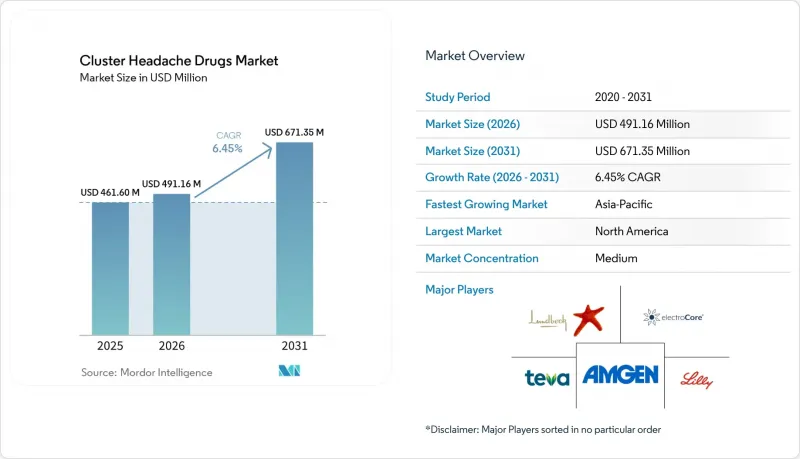
Mordor Intelligence에 의하면, 군발 두통 치료제 시장 규모는 2025년에 4억 6,160만 달러로 평가되었습니다. 2026년에 4억 9,116만 달러에서 2031년까지 6억 7,135만 달러에 이를 것으로 예측됩니다.
2026년부터 2031년까지 연평균 성장률(CAGR) 6.45%를 나타낼 것으로 전망됩니다.
본 보고서는 치료 유형(급성기 치료 등), 약물 분류(트립탄 계열, CGRP 단일클론 항체 등), 투여 경로(경구, 주사, 비강 내 등), 유통 채널(병원 약국, 소매 약국 등) 및 지역(북미, 유럽, 아시아태평양 등)별로 분류되어 있습니다. 시장 전망은 금액(달러) 기준으로 제시되어 있습니다.
세계의 군발 두통 치료제 시장 동향 및 인사이트
진단 환자 수 증가
3차신경 자율신경성 두통을 조기에 파악함으로써, 과거에는 정확한 진단을 받기까지 수년이 걸리던 기간이 단축되었습니다. 1차 진료 분야의 연수 강화와 알고리즘에 기반한 원격 진료를 통해, 발병 후 수개월 이내에 특징적인 일측성 통증 양상을 파악할 수 있게 되었습니다. 각국의 두통 등록 데이터에 따르면, 새로 진단된 군발 두통의 사례 수는 꾸준히 증가하고 있으며, 특히 미국 지방의 카운티 중 산발적인 순회 진료 대신 원격 신경학 플랫폼이 도입된 지역에서 그 증가세가 두드러집니다. 적극적인 사례 발굴의 경제적 근거는 설득력이 있습니다. 진단을 받지 못한 환자 1명당 연간 1만 1,000달러 이상의 직접적·간접적 비용이 발생하고 있으며, 이로 인해 보험사들이 인식 제고 캠페인과 신속한 진료 의뢰 경로에 대한 자금 지원을 확대되고 있습니다. 아시아태평양의 의료 시스템도 유사한 프로토콜을 채택하고 있으며, 중국과 인도 전역에서 특정 환자 수가 두 자릿수 증가세를 보이고 있습니다.
표적형 생물학적 제제 파이프라인 확대
갈카네주맙 등의 CGRP 단일클론 항체는 주당 발작 빈도를 중앙값 기준으로 52% 감소시키는 것으로 입증되어, 발작성 군발두통 예방에 있어 새로운 유효성 기준을 확립했습니다. 뇌하수체 아데닐산 시클라제 활성화 펩티드(PACAP-38) 및 ATP 감수성 칼륨 채널을 표적으로 하는 후기 개발 단계의 약물은 향후 질병 경과를 변화시키는 치료 옵션이 될 것으로 기대됩니다. 암젠의 2상 PAC1 길항제(AMG 301)는 다기관 공동 투여 임상시험 단계에 접어들었으며, 2026년에 중간 결과가 나올 것으로 기대됩니다. 한편, 전임상 단계에 있는 Kir6.1 조절제는 혈액-뇌 장벽 투과성이 양호한 것으로 나타났습니다. 2035년 이후에도 유효한 특허 포트폴리오가 벤처 캐피털의 유입과 교차 라이선스 계약을 촉진함으로써, 파이프라인 혁신이라는 선순환을 강화하고 있습니다.
고액의 치료비와 경제적 부담이라는 장벽
CGRP 억제제의 평균 연간 구입 비용은 6,900달러 전후로 유지되고 있으며, 보험에 가입하지 않았거나 보험 적용 범위가 불충분한 많은 환자들에게는 여전히 감당하기 어려운 금액입니다. 미국의 주요 보험사 중 절반 미만이 승인된 모든 CGRP 제품을 보장하고 있으며, 64%는 사전 승인 절차를 요구하고 있어 이로 인해 치료 시작이 몇 주 정도 지연될 수 있습니다. 저소득 국가 시장에서는 격차가 확대되고 있습니다. 소매 가격은 미국의 정가와 비슷한 수준인 반면, 가구의 의료비 예산은 OECD 평균의 불과 몇 분의 일에 불과합니다. 희귀질환 치료제의 가격 책정은 예산 영향 모델을 확대시키고 있으며, 희귀질환 치료에 드는 연간 지출의 중앙값은 20만 달러를 초과하여 각국의 보험 적용 의약품 목록에 부담을 주고 있습니다. 이러한 비용 측면의 역풍은 특히 동남아시아와 라틴아메리카 일부 지역의 본인 부담층에서 도입을 지연시키고 있으며, 결과적으로 시장의 매출 성장세를 억제하고 있습니다.
부문별 분석
예방 치료는 2025년 매출의 38.3%를 차지했으나, 2031년까지 연평균 성장률(CAGR) 19.3%로 가장 빠르게 성장할 전망입니다. 갈카네주맙이 발작 빈도를 절반 이상 줄일 수 있는 능력 덕분에, 예측 가능한 주기적 발작을 반복하는 환자에게 있어 예방 요법이 표준 치료법으로 재정의되었습니다. 2025년에 미국의 대형 약국 급여 관리 회사 2곳과 CGRP 제약사 간에 체결된 성과 연계형 계약에서는 응급실 내원 건수의 실제 감소와 환급액이 연계되었습니다. 급성기 치료는 여전히 필수적이며, 고유량 산소 요법이나 피하 투여형 트립탄 제제와 같은 신뢰성이 높은 약물에 힘입어 2024년 군발두통 치료제 시장 규모의 61.7%를 차지했습니다. Brekiya 자동 주사기와 같은 혁신적인 제품은 주사에 대한 불안을 줄이고 가정에서의 투약을 간소화함으로써, 급성기 치료 분야에서 그 중요성을 유지하고 있습니다. 현재 임상의들은 급성기 자가 관리 계획과 CGRP 유지 요법을 결합한 하이브리드 프로토콜을 채택하고 있으며, 이를 통해 건강 관련 생산성이 향상되고 전체 의료비 절감으로 이어지고 있습니다.
CGRP 단일클론 항체는 2025년에 군발 두통 치료제 시장 점유율의 30.4%를 차지하며, 약물 분류별 시장에서 1위를 기록했으며, 연평균 성장률(CAGR) 23.5%라는 가장 높은 성장률을 유지하고 있습니다. 갈카네주맙, 플레마네주맙, 엘렌맙 등 3가지 약물은 지속적인 효능과월1회 피하 투여라는 편의성 덕분에 처방 의사들로부터 신뢰를 얻고 있습니다. 제네릭 의약품으로 구입할 수 있는 트립탄 계열 약물은 급성 통증 발작을 신속하게 완화하는 용도에서 확고한 입지를 유지하고 있지만, 추가적인 성장은 최소한으로 그치고 있습니다. 오토인젝터 기술을 통해 재평가된 맥각 알칼로이드는 트립탄 계열 약물에 대한 반응이 미미한 특정 환자군에 효과적입니다. 장기적으로는 PACAP 및 KATP 조절제가 예방약 포트폴리오를 다각화할 가능성이 있습니다. 이러한 서로 다른 작용기전 덕분에, 항체계 약물에 반응하지 않는 환자들에게도 치료 효과가 확대될 가능성이 있습니다.
지역별 분석
북미는 생물학적 제제의 조기 도입, 광범위한 보험 적용, 그리고 학술적인 두통 센터의 긴밀한 네트워크에 힘입어 전 세계 매출의 약 48%를 차지하고 있습니다. 2025년 법 개정에 따라 42개 주에서 원격의료 진료에 대한 동등한 보험 급여가 의무화되면서 지방 지역의 의료 접근성 격차는 줄어들었지만, 미시시피강 서부 지역에서는 여전히 임상의 부족 현상이 지속되고 있습니다. 미국의 지급 기관은 CGRP 제제의 지급 수준을 환자의 반응에 연동시키는 적응증 기반 가격 책정 방식을 시범적으로 도입하고 있으며, 이는 다른 약물 분류별 성과 연동형 계약의 기반을 마련하고 있습니다. 캐나다는 중앙집권적인 가격 협상의 혜택을 받고 있으며, 동일한 CGRP 주사제의 가격이 미국 평균보다 32% 저렴하여, 공적 자금을 통한 주 정부 의료보험 제도 내 도입이 가속화되고 있습니다.
유럽은 성숙한 지역이지만, 상황은 다양합니다. 독일과 스칸디나비아 국가들에서는 승인된 3가지 CGRP 항체 모두에 대해 단계적 치료 요건을 최소화하여 보험 급여를 적용하고 있습니다. 한편, 중동부 유럽 시장에서는 도입을 가로막는 엄격한 예산 상한선이 부과되고 있습니다. 프랑스와 이탈리아의 의료기술평가기관은 지속적으로 이 약을 복용하는 환자에서 월평균 1.7회 응급실 방문이 감소한다는 실세계 데이터가 제시됨에 따라, 2024년 말에 플레마네즈마브를 승인했습니다. 스페인의 비용 대비 효과 위원회는 엘렌마브를 3만 유로(3만 5,243달러)라는 기준치를 크게 밑도는 수준으로 평가했으며, 이로 인해 처방 의사의 신뢰도가 높아지고 환자의 접근성이 확대되었습니다. 유럽연합 집행위원회가 추진하는 국경을 초월한 원격의료 서비스는 2027년까지 지방 지역의 전문의 부족 문제를 완화할 것으로 기대되고 있습니다.
아시아태평양은 연평균 성장률(CAGR) 10.9%를 기록하며 가장 빠르게 성장하고 있는 지역입니다. 중국 국가의약품감독관리국은 2025년 1월 리메게판트를 승인했으며, 이는 세계 최대 규모의 환자층을 보유한 중국에서 최초로 승인된 CGRP 수용체 길항제입니다. 상하이와 베이징의 대규모 도시 병원에서는 현재 신경질환 전문센터에 군발 두통 진료 프로토콜이 도입되어, 진단율 향상이 가속화되고 있습니다. 일본에서는 2025년 4월 진료 지침 개정에서 2년간의 안전성 모니터링을 통해 양호한 결과가 확인됨에 따라, CGRP 억제제를 이용한 장기 예방 요법이 권장되고 있으며, 생물학적 제제의 사용이 더욱 정착되고 있습니다. 태국과 인도네시아도 이에 발맞추어 희귀 두통 적응증에 대해 희귀질환용 의약품 예산을 배정하는 국가 처방집을 도입하고 있지만, 보상 상한액으로 인해 도입은 여전히 3차 의료기관으로 한정되어 있습니다.
기타 혜택 :
- 엑셀 형식 시장 예측(ME) 시트
- 3개월간의 애널리스트 지원
자주 묻는 질문
목차
제1장 서론
제2장 조사 방법
제3장 주요 요약
제4장 시장 구도
제5장 시장 규모 및 성장 예측
제6장 경쟁 구도
제7장 시장 기회 및 향후 전망
KTH 26.06.24According to Mordor Intelligence, the cluster headache drugs market size is projected to be USD 461.60 million in 2025, USD 491.16 million in 2026, and reach USD 671.35 million by 2031, growing at a CAGR of 6.45% from 2026 to 2031.
This report is Segmented by Treatment Type (Acute Treatment, and More), Drug Class (Triptans, CGRP Monoclonal Antibodies, and More), Route of Administration (Oral, Injectable, Intranasal, and More), Distribution Channel (Hospital Pharmacies, Retail Pharmacies, and More), and Geography (North America, Europe, Asia Pacific, and More). The Market Forecasts are Provided in Terms of Value (USD).
Global Cluster Headache Drugs Market Trends and Insights
Growing Diagnosed Patient Pool
Earlier recognition of trigeminal-autonomic cephalalgias is shortening what historically was a multi-year wait for an accurate diagnosis. Intensified primary-care training and algorithm-based teleconsultations allow practitioners to flag hallmark unilateral pain patterns within months of onset. National headache registries report a steady rise in newly coded cluster headache cases, particularly in rural U.S. counties where tele-neurology platforms have replaced sporadic outreach clinics. The financial case for aggressive case-finding is compelling. Every undiagnosed patient incurs more than USD 11,000 in direct and indirect annual costs, driving payers to fund awareness campaigns and expedited referral pathways. Asia-Pacific health systems are adopting similar protocols, contributing to double-digit growth in patient identification across China and India.
Expansion of Targeted Biologics Pipelines
CGRP monoclonal antibodies such as galcanezumab have demonstrated a median 52% reduction in weekly attack frequency, setting a new efficacy benchmark for episodic cluster headache prevention. Late-stage assets targeting pituitary adenylate cyclase-activating peptide (PACAP-38) and ATP-sensitive potassium channels promise additional disease-modifying options. Amgen's Phase II PAC1 antagonist (AMG 301) has entered multi-center dosing studies with interim results anticipated in 2026, while pre-clinical Kir6.1 modulators are showing favorable blood-brain-barrier penetration profiles. Patent estates that extend beyond 2035 are fueling venture capital inflows and cross-licensing deals, reinforcing a virtuous cycle of pipeline innovation.
High Treatment Costs & Affordability Hurdles
Average annual acquisition costs for a CGRP inhibitor hover at USD 6,900 and remain beyond reach for many uninsured or under-insured patients. Less than half of large U.S. payers cover all approved CGRP products, and 64% impose prior-authorization steps that can delay therapy initiation by several weeks. Disparities widen in low-income markets, where retail prices mirror U.S. list prices but household health budgets are a fraction of OECD averages. Orphan drug pricing inflates budget-impact models; median annual spend for rare-disease therapies exceeds USD 200,000, straining national formularies. These cost headwinds slow uptake, particularly in cash-pay segments of Southeast Asia and parts of Latin America, thereby tempering topline market growth.
Other drivers and restraints analyzed in the detailed report include:
- Technological Advances in Delivery & Neuromodulation
- Growth of Specialized Clinics & Telehealth
- Specialist Shortages & Diagnostic Delays
For complete list of drivers and restraints, kindly check the Table Of Contents.
Segment Analysis
Preventive regimens generated 38.3% of 2025 revenue but are set to rise fastest at 19.3% CAGR through 2031. Galcanezumab's ability to cut episodic attack frequency by more than half has repositioned prophylaxis as the standard of care for patients with predictable cyclical bouts. Pay-for-performance contracts signed in 2025 between two large U.S. pharmacy-benefit managers and CGRP manufacturers link reimbursement to real-world reductions in emergency-department visits. Acute interventions remain vital, capturing 61.7% share of the cluster headache drugs market size in 2024, supported by reliable agents such as high-flow oxygen and subcutaneous triptans. Innovations like the Brekiya autoinjector are sustaining acute segment relevance by reducing injection anxiety and streamlining at-home administration. Clinicians now employ hybrid protocols that combine an acute self-rescue plan with maintenance CGRP dosing, improving health-related productivity and diminishing overall cost of care.
CGRP monoclonal antibodies led the drug-class hierarchy with 30.4% of the cluster headache drug market share in 2025 and maintain the highest expansion rate at 23.5% CAGR. Three agents galcanezumab, fremanezumab, and erenumab have captured prescriber confidence due to sustained efficacy and monthly subcutaneous dosing convenience. Triptans, available in generic form, keep a firm footing for rapid pain abortive use but add minimal incremental growth. Ergot alkaloids, revitalized by autoinjector technology, serve niche patient cohorts who respond poorly to triptans. Looking forward, PACAP and KATP modulators could diversify the preventive portfolio; their differentiated mechanisms may extend therapeutic benefit to antibody non-responders.
Geography Analysis
North America anchors nearly 48% of global revenue, driven by early biologic adoption, broad insurance coverage, and dense networks of academic headache centers. Legislative changes in 2025 that mandate equal reimbursement for telehealth visits in 42 states have lowered rural access disparities, yet clinician shortages persist west of the Mississippi River. U.S. payers are experimenting with indication-based pricing that ties CGRP payment levels to patient response, laying the groundwork for outcome-based agreements across other drug classes. Canada benefits from centralized price negotiations; identical CGRP injectors cost 32% less than the U.S. average, encouraging faster uptake among publicly funded provincial plans.
Europe represents a mature but heterogeneous landscape. Germany and Scandinavia reimburse all three licensed CGRP antibodies with minimal step-therapy requirements, whereas Central- and Eastern-European markets impose stricter budget caps that hamper adoption. Health-technology-assessment agencies in France and Italy approved Fremanezumab in late 2024 after real-world evidence showed 1.7 fewer emergency-room visits per month among continuous users. Spain's cost-effectiveness committee placed erenumab well below its EUR 30,000 (USD 35,243) threshold, propelling prescriber confidence and widening patient access. The European Commission's push for cross-border telemedicine services is expected to alleviate specialist shortages in peripheral regions by 2027.
Asia-Pacific is the fastest-growing territory, rising at a 10.9% CAGR. China's National Medical Products Administration cleared rimegepant in January 2025, marking the first CGRP receptor antagonist venue in the world's largest patient pool. Large urban hospitals in Shanghai and Beijing now include cluster headache pathways in their neurologic centers of excellence, accelerating diagnosis rates. Japan's April 2025 guideline update endorsed long-term anti-CGRP prophylaxis after a favorable two-year safety surveillance, further normalizing biologic use. Thailand and Indonesia are following suit through national formularies that earmark orphan-drug budgets for rare-headache indications, though reimbursement ceilings still limit uptake to tertiary-care hospitals.
- Eli Lilly and Company
- Amgen
- Novartis
- Teva Pharmaceutical Industries
- Lundbeck A/S
- Abbvie
- Pfizer
- Otsuka Pharma
- electroCore Inc.
- Zogenix Inc. (UCB)
- Impel NeuroPharma
- AstraZeneca
- Satsuma Pharma
- Johnson & Johnson
- Dr. Reddy's Laboratories
- Cipla
- Endo International
- WraSer Pharmaceuticals
- Hikma Pharmaceuticals
- Upsher-Smith Labs
Additional Benefits:
- The market estimate (ME) sheet in Excel format
- 3 months of analyst support
TABLE OF CONTENTS
1 Introduction
- 1.1 Study Assumptions & Market Definition
- 1.2 Scope of the Study
2 Research Methodology
3 Executive Summary
4 Market Landscape
- 4.1 Market Overview
- 4.2 Market Drivers
- 4.2.1 Growing Diagnosed Patient Population Worldwide
- 4.2.2 Expansion Of Targeted Biologics and Novel Therapeutic Pipelines
- 4.2.3 Increasing Healthcare Expenditure and Orphan Drug Reimbursements
- 4.2.4 Technological Advancements in Drug Delivery and Neuromodulation
- 4.2.5 Proliferation of Specialized Headache Clinics and Telemedicine Services
- 4.2.6 Regulatory Incentives Accelerating Rare Disease Drug Approvals
- 4.3 Market Restraints
- 4.3.1 High Treatment Costs and Affordability Challenges
- 4.3.2 Limited Specialist Availability and Diagnostic Delays
- 4.3.3 Long Term Safety and Efficacy Uncertainties for Emerging Therapies
- 4.3.4 Supply Chain Constraints in Essential Acute Care Modalities
- 4.4 Supply-Chain Analysis
- 4.5 Regulatory Landscape
- 4.6 Technological Outlook
- 4.7 Porter's Five Forces Analysis
- 4.7.1 Bargaining Power of Suppliers
- 4.7.2 Bargaining Power of Buyers
- 4.7.3 Threat of New Entrants
- 4.7.4 Threat of Substitutes
- 4.7.5 Competitive Rivalry
5 Market Size & Growth Forecasts (Value, uSD)
- 5.1 By Treatment Type
- 5.1.1 Acute Treatment
- 5.1.2 Preventive Treatment
- 5.2 By Drug Class
- 5.2.1 Triptans
- 5.2.2 CGRP Monoclonal Antibodies
- 5.2.3 Ergot Alkaloids
- 5.2.4 Calcium-Channel Blockers (Verapamil)
- 5.2.5 Others
- 5.3 By Route of Administration
- 5.3.1 Oral
- 5.3.2 Injectable
- 5.3.3 Intranasal
- 5.3.4 Inhalation (Medical Oxygen)
- 5.3.5 Neuromodulation Device
- 5.4 By Distribution Channel
- 5.4.1 Hospital Pharmacies
- 5.4.2 Retail Pharmacies
- 5.4.3 Online Pharmacies
- 5.4.4 Specialty Clinics
- 5.4.5 Home Healthcare Providers
- 5.5 By Geography
- 5.5.1 North America
- 5.5.1.1 United States
- 5.5.1.2 Canada
- 5.5.1.3 Mexico
- 5.5.2 Europe
- 5.5.2.1 Germany
- 5.5.2.2 United Kingdom
- 5.5.2.3 France
- 5.5.2.4 Italy
- 5.5.2.5 Spain
- 5.5.2.6 Rest of Europe
- 5.5.3 Asia-Pacific
- 5.5.3.1 China
- 5.5.3.2 Japan
- 5.5.3.3 India
- 5.5.3.4 South Korea
- 5.5.3.5 Australia
- 5.5.3.6 Rest of Asia-Pacific
- 5.5.4 Middle East & Africa
- 5.5.4.1 GCC
- 5.5.4.2 South Africa
- 5.5.4.3 Rest of Middle East & Africa
- 5.5.5 South America
- 5.5.5.1 Brazil
- 5.5.5.2 Argentina
- 5.5.5.3 Rest of South America
- 5.5.1 North America
6 Competitive Landscape
- 6.1 Market Concentration
- 6.2 Market Share Analysis
- 6.3 Company Profiles {(includes Global level Overview, Market level overview, Core Segments, Financials as available, Strategic Information, Market Rank/Share for key companies, Products & Services, and Recent Developments)}
- 6.3.1 Eli Lilly & Co.
- 6.3.2 Amgen Inc.
- 6.3.3 Novartis AG
- 6.3.4 Teva Pharmaceutical
- 6.3.5 Lundbeck A/S
- 6.3.6 AbbVie Inc.
- 6.3.7 Pfizer Inc.
- 6.3.8 Otsuka Pharma
- 6.3.9 electroCore Inc.
- 6.3.10 Zogenix Inc. (UCB)
- 6.3.11 Impel NeuroPharma
- 6.3.12 AstraZeneca plc
- 6.3.13 Satsuma Pharma
- 6.3.14 Johnson & Johnson (Janssen)
- 6.3.15 Dr. Reddy's Laboratories
- 6.3.16 Cipla Ltd.
- 6.3.17 Endo International
- 6.3.18 WraSer Pharmaceuticals
- 6.3.19 Hikma Pharmaceuticals
- 6.3.20 Upsher-Smith Labs
7 Market Opportunities & Future Outlook
- 7.1 White-space & Unmet-Need Assessment


