

|
시장보고서
상품코드
2063735
제약 환경 모니터링 시스템 : 시장 점유율 분석, 업계 동향 및 통계, 성장 예측(2026-2031년)Pharmaceutical Environmental Monitoring System - Market Share Analysis, Industry Trends & Statistics, Growth Forecasts (2026 - 2031) |
||||||
 Mordor Intelligence
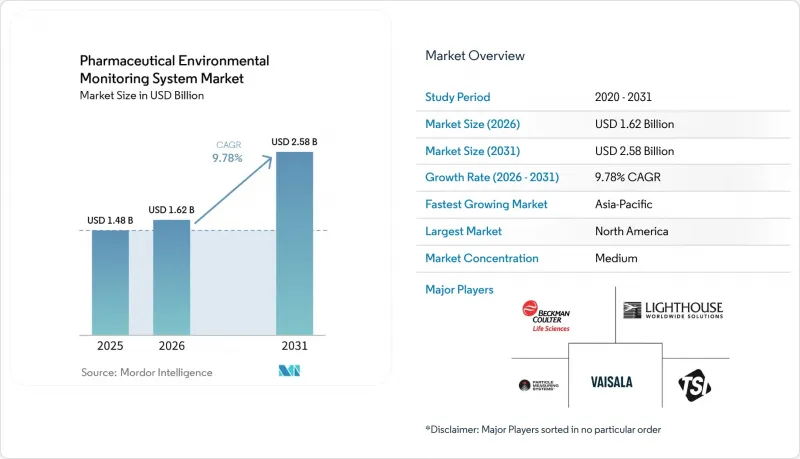
Mordor Intelligence에 의하면, 제약 환경 모니터링 시스템 시장 규모는 2025년에 14억 8,000만 달러로 평가되었습니다. 2026년 16억 2,000만 달러에서 2031년까지 25억 8,000만 달러에 이를 것으로 예상되며, 예측 기간(2026-2031년) CAGR은 9.78%를 나타낼 전망입니다.
본 보고서는 제공 형태(하드웨어, 소프트웨어, 서비스), 모니터링 유형(비생물성 공기 입자 모니터링 등), 용도(무균 충전·포장 및 무균 주사제 등), 최종 사용자(제약·바이오기술 제조업체 등), 지역(북미, 유럽 등)별로 분류되어 있습니다. 시장 전망은 금액(달러) 기준으로 제시되어 있습니다.
세계의 제약 환경 모니터링 시스템 시장 동향 및 인사이트
부록 1 : 등급 A/B에서의 연속 모니터링으로의 전환
PIC/S를 통한 조화를 통해 이러한 기대는 수많은 검사 당국으로 확산되고 있으며, 지역을 초월해 공통 플랫폼을 운영하는 전 세계 제조업체들이 겪는 불확실성이 완화되고 있습니다. 현재 검사관은 클린룸이 정지 상태에서 분류 기준을 충족하고 있으며, 기류의 시각화와 견고한 동향 분석을 바탕으로 가동 중 실시간 공정 제어를 유지하고 있다는 증거를 요구하고 있습니다. 기존 공장에서는 위험 평가, 입자 수송 손실 평가, 그리고 SCADA 및 BMS와의 경보 연동을 우선시하고 있으며, 이를 통해 편차가 문서화된 시정 조치 및 예방 조치로 직접 이어지도록 하고 있습니다.
데이터의 무결성 및 21 CFR Part 11의 검증 요건
21 CFR Part 11의 지속적인 시행에 따라 환경 모니터링 시스템에 대한 규정 준수 기준이 강화되었으며, 사용자 및 장치 전반에 걸쳐 안전하고 변조가 불가능한 감사 추적 기록과 역할 기반 접근 제어가 요구되고 있습니다. 환경 데이터, 경보 확인 응답, 임계값 변경 및 사용자 조작은 완전한 메타데이터와 함께 기록되며, 정기적인 검토를 지원하는 검증된 시스템에서 관리될 것으로 기대됩니다. 이러한 규제 방침은 환경 모니터링 프로그램과 데이터 무결성 절차가 검사 대응에 필수적인 미국의 조제 환경에도 적용됩니다. 각 벤더사는 감사 추적, 암호화, 인증에 관한 요건을 충족하는 동시에, 품질 관리 팀과 IT 팀의 패치 적용 및 백업에 따른 부담을 줄여주는 클라우드 지원 플랫폼을 제공함으로써 이에 대응하고 있습니다. 제약 업계의 환경 모니터링 시스템 시장의 근본적인 목적은 감사에 견딜 수 있을 만큼 신뢰성이 높고 검증 가능한 기록을 유지하며, 수동 데이터 통합 작업 없이 신속한 이상 조사 지원을 하는 데 있습니다.
높은 초기 비용과 검증에 따른 부담
자본 비용과 검증 작업의 부담은 생산을 중단하지 않고 하드웨어, 소프트웨어 및 경보 로직의 적합성을 확인해야 하는 중소규모 조직이나 수탁 제조업체에게 가장 큰 부담이 되고 있습니다. IQ, OQ, PQ에 걸친 적합성 확인 절차에 더해, 교정 및 문서화 작업으로 인해 일정이 장기화되어 캠페인 도중에 감당하기 어려운 서비스 비용이 발생합니다. 고성능 생체 모니터링 기술은 신속한 의사결정을 보장하지만, 배양법에 기반한 일상적인 절차를 대체하기 전에 신중한 방법 검증과 변경 관리가 필요합니다. 또한, 프로젝트 팀은 고정 샘플링 지점을 설치하거나 센서 네트워크를 SCADA 및 BMS와 통합하기 위해 방을 폐쇄해야 할 수 있으며, 이로 인해 적합성 확인 기간이 단축되어 일정상의 압박이 발생할 가능성이 있습니다. 제약 환경 모니터링 시스템 시장은 서버 비용을 절감하고, 관리된 절차 내에서 업데이트를 용이하게 하는 사전 검증된 패키지 및 클라우드 기반 관리형 플랫폼을 제공함으로써 이러한 과제를 해결하고 있습니다.
부문별 분석
2025년, 제약 환경 모니터링 시스템 시장 점유율의 62.70%를 하드웨어가 차지했습니다. 이는 부유 입자 계수기, 생균 채취기, 환경 센서가 규정을 준수하는 클린룸에서 여전히 핵심적인 감지 계층으로 자리 잡고 있기 때문입니다. 시설에서 검증된 경보 및 조치 임계값을 활용한 지속적인 모니터링을 추구하는 가운데, 무균 공정에서는 고정식 및 원격식 입자 계수기가 휴대용 기기만으로 이루어지던 일상적인 모니터링을 계속해서 대체하고 있습니다. 미생물 공기 시료 채취 장치와 실시간 생균 계수기는 신속한 검출을 통해 교대 근무 중 발생하는 근본 원인 분석 및 이상 현상에 대한 대응 및 개선을 지원하는 분야에서 주목받고 있습니다. 온도, 습도, 기류, 차압을 측정하는 환경 센서는 모든 클린룸에서 필수적이며, 이를 중앙 관리 플랫폼에 통합하려는 움직임이 가속화되고 있습니다. 이와 동시에, 팀이 전 세계 사업 포트폴리오 전반에 걸쳐 표준화를 추진하는 가운데, 공장 전체의 경보, 감사 추적 기록, 보고서를 관리하는 소프트웨어 플랫폼 도입이 진행되고 있습니다.
소프트웨어 및 서비스는 가장 빠르게 성장하는 분야이며, 클라우드 네이티브 아키텍처가 서버 유지보수 부담을 줄이면서 Part 11 요건을 충족함에 따라, 이 부문의 제약 환경 모니터링 시스템 시장 규모는 2031년까지 연평균 성장률(CAGR) 7.18%로 확대될 것으로 전망됩니다. 각 벤더사는 완전한 재인증이 필요 없이 갱신을 용이하게 하는 구독 모델에서 검증된 감사 추적, 암호화 및 역할 기반 접근 제어를 제공합니다. SCADA 및 BMS와의 통합을 통해 팀은 환경 동향을 공정 및 설비 신호와 연계할 수 있으며, 이를 통해 이상 현상 조사 및 에너지 관리가 개선됩니다. 제약 환경 모니터링 시스템 시장에서 이러한 변화는 현지의 업무 흐름을 유지하면서도 무균 구역 전체에 걸쳐 통일된 구성을 추구하는 다중 사업장 기업들 사이에서 가장 두드러지게 나타나고 있습니다.
2025년 기준으로, 비생물성 공기 입자 모니터링은 등급 A부터 D에 이르는 ISO 및 GMP 준수 기준에 따른 분류 및 관리 도구로서 41.13%의 점유율을 차지했습니다. 부록 1에서는 중요한 등급 A 작업 중 지속적인 모니터링이 요구되고 있으며, 이 기준에 따라 검증된 히스토리안과 연동된 고정식 및 원격식 카운터의 도입이 증가하고 있습니다. 원격 입자 카운터는 현장에서 휴대용 장비만으로 수행되는 일상적인 작업에 따르는 노력과 시간적 제약을 피하는 데 도움이 되며, 충전 중 발생하는 이상 상황에 대해 실시간으로 대응할 수 있게 해줍니다. 제약 환경 모니터링 시스템 시장은 바이오버든의 변동에 앞서 나타나는 공정 불안정성을 나타내는 지표로서, 비생물성 입자 모니터링의 동향에 계속해서 의존하고 있으며, 이로 인해 중요한 공정에서 연속 시료 채취가 필수적입니다.
생균 환경 모니터링은 2031년까지 연평균 성장률(CAGR) 11.62%를 기록하며 가장 빠르게 성장하는 분야로, 실시간에 가까운 상태에서 실용적인 신호를 제공하는 신속한 미생물학적 기법에 의해 주도되고 있습니다. 레이저 유도 형광법을 이용한 생균 계수기, ATP 바이오루미네센스법 및 기타 신속한 분석 기법은 결과 도출 시간을 단축하고, 확인 배양과 결합함으로써 조기 개입과 보다 적절한 출하 결정을 지원합니다. 무균 시설에 대한 사례 연구에 따르면, 통합적인 ID 전략과 신속한 검출을 통해 약전 요건을 저해하지 않으면서 조사 기간을 단축할 수 있는 것으로 나타났습니다. 주요 품질 관리(QC) 기업들의 전략적 투자는 기존 미생물학 방법을 보완하는 차원에서 생균 모니터링에 대한 신뢰를 뒷받침하고 있습니다. 따라서 제약 환경 모니터링 시스템 시장에서는 기존의 배지 기반 도구와 무균 제조 과정에서 발생하는 정보의 공백을 메워주는 신속한 기기 간의 균형이 이루어지고 있습니다.
지역별 분석
북미는 바이오의약품 분야의 집중적인 혁신, 대규모 무균 제조 능력, 그리고 검증된 모니터링 시스템의 도입을 정착시킨 강력한 Part 11 규제의 시행에 힘입어, 2025년 제약 환경 모니터링 시스템 시장 점유율 42.80%를 유지했습니다. 첨단 치료 분야의 미국 내 신규 프로젝트는 지속적인 비생체 및 생체 모니터링에 대한 수요를 유지하는 동시에, 이상 징후를 배치 기록과 연계하는 통합 경보 관리에 대한 수요도 뒷받침하고 있습니다. 캐나다와 멕시코에서는 특정 거점의 현대화를 통해 생산 능력이 단계적으로 확대되고 있는 반면, 미국의 조제 환경에서는 개정된 기준에 따라 환경 모니터링 체계화가 진행되고 있습니다.
유럽은 여전히 핵심 축이며, 부속서 1의 시행이 지속적인 모니터링 및 조화로운 오염 관리 전략으로의 전환을 촉진하고 있습니다. 다국적 제조업체들은 독일, 영국, 프랑스, 이탈리아, 스페인에서 아키텍처 통합을 추진하고 있으며, 이를 통해 일관된 검증 패키지와 현장 서비스를 제공할 수 있는 공급업체들이 지원을 받고 있습니다. 유럽의 제약 환경 모니터링 시스템 시장은 바이오의약품에 대한 지속적인 투자와, 기존 분석법을 대체하지는 않으면서도 검사 지연을 줄여주는 신속한 생균 검출 기술의 도입으로 인해 혜택을 보고 있습니다. 공장이 최신 데이터 무결성 및 연속 모니터링 요건을 충족하기 위해 기존 제어 시스템과 경보 로직을 업데이트하는 브라운필드 통합 프로젝트는 여전히 중요한 위치를 차지하고 있습니다.
아시아태평양은 2031년까지 연평균 성장률(CAGR)이 13.13%로 가장 빠르게 성장하고 있는 지역입니다. 이는 중국, 인도, 한국의 신규 무균 제조 설비가 프로젝트 설계 초기 단계부터 지속적인 모니터링을 포함하고 있기 때문입니다. 인도의 바이오시밀러 및 규제 시장에 대한 승인 신청 추진과 중국의 바이오의약품 자급자족 노력에 힘입어, 검증 완료되고 Annex 1을 준수하는 모니터링에 의존하는 도입 기반이 확대되고 있습니다. 해당 지역의 제약 환경 모니터링 시스템 시장 규모는 네트워크 확장에 따라 교육 및 검증을 용이하게 해주는 표준화되고 여러 사업장 간 호환성이 있는 플랫폼을 선호하는 신규 시설의 추세를 반영하고 있습니다. 호주와 일본은 검증된 Part 11 대응 역량을 갖춘 공급업체의 지원을 받아, 높은 수준의 규정 준수 체계를 도입하고 분산형 네트워크 전반에 걸쳐 클라우드 기반 모니터링을 실시함으로써 시장에 기여하고 있습니다.
기타 혜택 :
- 엑셀 형식 시장 예측(ME) 시트
- 3개월간의 애널리스트 지원
자주 묻는 질문
목차
제1장 서론
제2장 조사 방법
제3장 주요 요약
제4장 시장 구도
제5장 시장 규모 및 성장 예측
제6장 경쟁 구도
제7장 시장 기회 및 향후 전망
KTH 26.06.24According to Mordor Intelligence, the pharmaceutical environmental monitoring system market size was valued at USD 1.48 billion in 2025 and is estimated to grow from USD 1.62 billion in 2026 to reach USD 2.58 billion by 2031, at a CAGR of 9.78% during the forecast period (2026-2031).
This report is Segmented by Offering (Hardware, Software & Services), Monitoring Type (Non-Viable Air Particle Monitoring, and More), Application (Aseptic Fill-Finish and Sterile Injectables, and More), End User (Pharmaceutical and Biotechnology Manufacturers, and More), and Geography (North America, Europe, and More). The Market Forecasts are Provided in Terms of Value (USD).
Global Pharmaceutical Environmental Monitoring System Market Trends and Insights
Annex 1-Driven Shift to Continuous Monitoring in Grade A/B
Harmonization through PIC/S has extended these expectations across a large set of inspection authorities, which reduces ambiguity for global manufacturers that operate common platforms across regions. Inspectors now look for evidence that cleanrooms meet classification at rest and maintain real-time process control in operation supported by airflow visualization and robust trending. Legacy plants are prioritizing risk assessments, particle transport loss evaluations, and alarm integration into SCADA or BMS so that excursions tie directly to documented corrective and preventive actions.
Data-Integrity and 21 CFR Part 11 Validation Requirements
Persistent enforcement of 21 CFR Part 11 has raised the compliance bar for environmental monitoring systems with secure, immutable audit trails and role-based access across users and devices. Environmental data, alarm acknowledgments, threshold changes, and user actions are expected to be captured with full metadata and maintained in validated systems that support periodic review. The regulatory posture also covers compounding environments in the United States where environmental monitoring programs and data integrity procedures are integral to inspection readiness. Vendors are responding with cloud-capable platforms that meet audit trail, encryption, and authentication expectations while easing patching and backup overhead for quality and IT teams. The underlying aim in the pharmaceutical environmental monitoring system market is to maintain trustworthy, reviewable records that stand during audits and support rapid deviation investigation without manual data stitching.
High Upfront Cost and Validation Burden
Capital and validation workloads weigh most on smaller organizations and contract manufacturers that must qualify hardware, software, and alarm logic without disrupting production. Qualification steps across IQ, OQ, and PQ, along with calibration and documentation, extend timelines and add service costs that are difficult to absorb mid-campaign. Higher performance viable monitoring technologies promise faster decisions, yet they require careful method validation and change control before replacing culture-based routines. Project teams also face room closures to install fixed sampling points and integrate sensor networks with SCADA or BMS, which can compress qualification windows and create scheduling pressure. The pharmaceutical environmental monitoring system market contends with these hurdles by offering pre-validated packages and cloud-managed platforms that reduce server costs and facilitate updates within controlled procedures.
Other drivers and restraints analyzed in the detailed report include:
- Expanding Aseptic Capacity in Biologics and CGT
- Digitalization of EMS (Cloud/SCADA, Remote Alarming)
- Brownfield Integration with Legacy BMS/IT
For complete list of drivers and restraints, kindly check the Table Of Contents.
Segment Analysis
Hardware captured 62.70% of the pharmaceutical environmental monitoring system market share in 2025 as airborne particle counters, viable samplers, and environmental sensors remain the core sensing layer in compliant cleanrooms. Fixed and remote particle counters continue to replace portable-only routines in aseptic operations, as sites pursue continuous monitoring with validated alert and action thresholds. Microbial air samplers and real-time viable counters are drawing interest where faster detection supports on-shift root cause analysis and better excursion response. Environmental sensors for temperature, humidity, airflow, and differential pressure remain essential in every suite, and they are increasingly tied into centralized platforms. At the same time, software platforms that manage alarms, audit trails, and reporting across plants are gaining adoption as teams standardize across global portfolios.
Software & Services is the fastest-growing component, and the pharmaceutical environmental monitoring system market size for this segment is projected to expand at 7.18% CAGR through 2031 as cloud-native architectures reduce server maintenance while meeting Part 11 expectations. Vendors are delivering validated audit trails, encryption, and role-based access in subscription models that ease updates without full requalification. Integration with SCADA and BMS lets teams connect environmental trends to process and equipment signals, which improves deviation investigations and energy control. In the pharmaceutical environmental monitoring system market, this shift is strongest among multi-site enterprises that want unified configurations across aseptic sites while preserving local workflows.
Non-viable Air Particle Monitoring held 41.13% in 2025 as the baseline classification and control tool for ISO and GMP compliance across Grades A through D. Annex 1 requires continuous monitoring during critical Grade A operations, and this standard is increasing deployments of fixed and remote counters linked to validated historians. Remote particle counters help sites avoid the labor and timing limits of portable-only routines and enable real-time responses to excursions during filling. The pharmaceutical environmental monitoring system market continues to rely on non-viable trends to indicate process instability that can precede bioburden movement, which makes continuous sampling essential for critical steps.
Viable Environmental Monitoring is the fastest-growing type with an 11.62% CAGR to 2031, driven by rapid microbiological methods that deliver actionable signals closer to real time. Laser-induced fluorescence viable counters, ATP bioluminescence, and other rapid approaches reduce time-to-result and support earlier intervention and better release decisions when paired with confirmatory culture. Case studies in sterile facilities show that integrated ID strategies and rapid detection shorten investigations without displacing compendial requirements Strategic investment by leading QC players underscores confidence in continuous viable monitoring as a complement to established microbiology. The pharmaceutical environmental monitoring system market therefore balances classical plate-based tools with rapid instruments that close information gaps during aseptic production.
Geography Analysis
North America retained 42.80% of the pharmaceutical environmental monitoring system market share in 2025 supported by concentrated biologics innovation, significant aseptic capacity, and strong Part 11 enforcement that anchors validated monitoring adoption. New U.S. projects in advanced therapies sustain demand for continuous non-viable and viable monitoring along with integrated alarm management that ties excursions to batch records. Canada and Mexico add incremental capacity with modernization in selected hubs, while U.S. compounding environments continue to formalize environmental monitoring under updated standards.
Europe remains a core pillar as Annex 1 enforcement catalyzes upgrades to continuous monitoring and harmonized contamination control strategies. Multinational manufacturers are aligning architectures across Germany, the United Kingdom, France, Italy, and Spain, which supports vendors able to provide consistent validation packages and field service. The pharmaceutical environmental monitoring system market in Europe also benefits from ongoing biologics investments and adoption of rapid viable technologies that reduce investigation delays without displacing compendial methods. Brownfield integration projects remain significant as plants update legacy controls and alarm logic to meet modern data integrity and continuous monitoring expectations.
Asia-Pacific is the fastest-growing region with a 13.13% CAGR through 2031 as greenfield aseptic capacity in China, India, and South Korea embeds continuous monitoring into project designs from day one. India's push into biosimilars and regulated-market submissions and China's drive for self-sufficiency in biologics are expanding the installed base that depends on validated, Annex 1-aligned monitoring. The pharmaceutical environmental monitoring system market size in the region reflects new facilities that prefer standardized, multi-site compatible platforms which ease training and validation as networks scale. Australia and Japan contribute with high-compliance deployments and cloud-forward monitoring across distributed networks, supported by vendors with proven Part 11 capabilities.
- Beckman Coulter Life Sciences (MET ONE)
- bioMerieux (Air IDEAL microbial air sampling)
- Charles River
- Climet Instruments Company
- Dickson (incl. Oceasoft)
- Ellab (incl. Hanwell Monitoring)
- Kanomax
- Lighthouse Worldwide Solutions
- Merck KGaA (MAS-100 air sampling)
- Met One Instruments (Acoem)
- PAMAS Partikelmess
- Particle Measuring Systems (Spectris)
- Pharmagraph
- Rees Scientific
- RION
- Rotronic / Process Sensing Technologies (PST)
- SensoScientific
- Setra Systems
- TSI Incorporated
- Vaisala
- XiltriX International
Additional Benefits:
- The market estimate (ME) sheet in Excel format
- 3 months of analyst support
TABLE OF CONTENTS
1 Introduction
- 1.1 Study Assumptions & Market Definition
- 1.2 Scope of the Study
2 Research Methodology
3 Executive Summary
4 Market Landscape
- 4.1 Market Overview
- 4.2 Market Drivers
- 4.2.1 Annex 1-Driven Shift to Continuous Monitoring in Grade A/B
- 4.2.2 Data-Integrity and 21 CFR Part 11 Validation Requirements
- 4.2.3 Expanding Aseptic Capacity in Biologics and CGT
- 4.2.4 Digitalization of EMS (Cloud/SCADA, Remote Alarming)
- 4.2.5 USP <797> 2023 Enforcement in U.S. Compounding
- 4.2.6 Energy Optimization Needs Driving Sensor-Led Control
- 4.3 Market Restraints
- 4.3.1 High Upfront Cost and Validation Burden
- 4.3.2 Brownfield Integration with Legacy BMS/IT
- 4.3.3 Slow Acceptance of Rapid Viable Monitoring
- 4.3.4 Cybersecurity and Cloud Policies Limiting Adoption
- 4.4 Value Chain Analysis
- 4.5 Regulatory Landscape
- 4.6 Technological Outlook
- 4.7 Porter's Five Forces Analysis
- 4.7.1 Threat of New Entrants
- 4.7.2 Bargaining Power of Suppliers
- 4.7.3 Bargaining Power of Buyers
- 4.7.4 Threat of Substitutes
- 4.7.5 Industry Rivalry
5 Market Size & Growth Forecasts (Value, USD)
- 5.1 By Offering
- 5.1.1 Hardware
- 5.1.1.1 Airborne Particle Counters (portable, remote, handheld)
- 5.1.1.2 Microbial Air Samplers (active, passive, rapid methods)
- 5.1.1.3 Environmental Sensors (temperature, RH, DP, airflow, CO2)
- 5.1.1.4 Data Loggers & Transmitters
- 5.1.1.5 Controllers/IO/PLC & SCADA nodes
- 5.1.1.6 Others
- 5.1.2 Software & Services
- 5.1.1 Hardware
- 5.2 By Monitoring Type
- 5.2.1 Non-viable Air Particle Monitoring
- 5.2.2 Viable Environmental Monitoring
- 5.2.3 Environmental Parameters Monitoring (T/RH/DP/airflow/CO2)
- 5.2.4 Utilities & Water Systems Monitoring (WFI/PW, compressed gases)
- 5.3 By Application
- 5.3.1 Aseptic Fill-Finish and Sterile Injectables
- 5.3.2 Biologics & Cell/Gene Therapy Suites
- 5.3.3 Oral Solid Dose & Non-Sterile Manufacturing
- 5.3.4 QC Microbiology Labs & Cleanroom Support
- 5.3.5 Warehousing, Cold Rooms, and Distribution
- 5.3.6 Others
- 5.4 By End User
- 5.4.1 Pharmaceutical and Biotechnology Manufacturers
- 5.4.2 CDMOs/CMOs
- 5.4.3 Hospital Compounding Pharmacies
- 5.4.4 Others
- 5.5 By Geography
- 5.5.1 North America
- 5.5.1.1 United States
- 5.5.1.2 Canada
- 5.5.1.3 Mexico
- 5.5.2 Europe
- 5.5.2.1 Germany
- 5.5.2.2 United Kingdom
- 5.5.2.3 France
- 5.5.2.4 Italy
- 5.5.2.5 Spain
- 5.5.2.6 Rest of Europe
- 5.5.3 Asia-Pacific
- 5.5.3.1 China
- 5.5.3.2 Japan
- 5.5.3.3 India
- 5.5.3.4 Australia
- 5.5.3.5 South Korea
- 5.5.3.6 Rest of Asia-Pacific
- 5.5.4 Middle East and Africa
- 5.5.4.1 GCC
- 5.5.4.2 South Africa
- 5.5.4.3 Rest of Middle East and Africa
- 5.5.5 South America
- 5.5.5.1 Brazil
- 5.5.5.2 Argentina
- 5.5.5.3 Rest of South America
- 5.5.1 North America
6 Competitive Landscape
- 6.1 Market Concentration
- 6.2 Market Share Analysis
- 6.3 Company Profiles {(includes Global level Overview, Market level overview, Core Segments, Financials as available, Strategic Information, Market Rank/Share for key companies, Products & Services, and Recent Developments)}
- 6.3.1 Beckman Coulter Life Sciences (MET ONE)
- 6.3.2 bioMerieux (Air IDEAL microbial air sampling)
- 6.3.3 Charles River Laboratories
- 6.3.4 Climet Instruments Company
- 6.3.5 Dickson (incl. Oceasoft)
- 6.3.6 Ellab (incl. Hanwell Monitoring)
- 6.3.7 Kanomax
- 6.3.8 Lighthouse Worldwide Solutions
- 6.3.9 Merck KGaA (MAS-100 air sampling)
- 6.3.10 Met One Instruments (Acoem)
- 6.3.11 PAMAS Partikelmess
- 6.3.12 Particle Measuring Systems (Spectris)
- 6.3.13 Pharmagraph
- 6.3.14 Rees Scientific
- 6.3.15 RION Co., Ltd.
- 6.3.16 Rotronic / Process Sensing Technologies (PST)
- 6.3.17 SensoScientific
- 6.3.18 Setra Systems
- 6.3.19 TSI Incorporated
- 6.3.20 Vaisala
- 6.3.21 XiltriX International
7 Market Opportunities & Future Outlook
- 7.1 White-space & unmet-need assessment


