

|
시장보고서
상품코드
2063838
급여 및 인사 컴플라이언스 소프트웨어 시장 : 점유율 분석, 업계 동향과 통계, 성장 예측(2026-2031년)Payroll And HR Compliance Software - Market Share Analysis, Industry Trends & Statistics, Growth Forecasts (2026 - 2031) |
||||||
 Mordor Intelligence
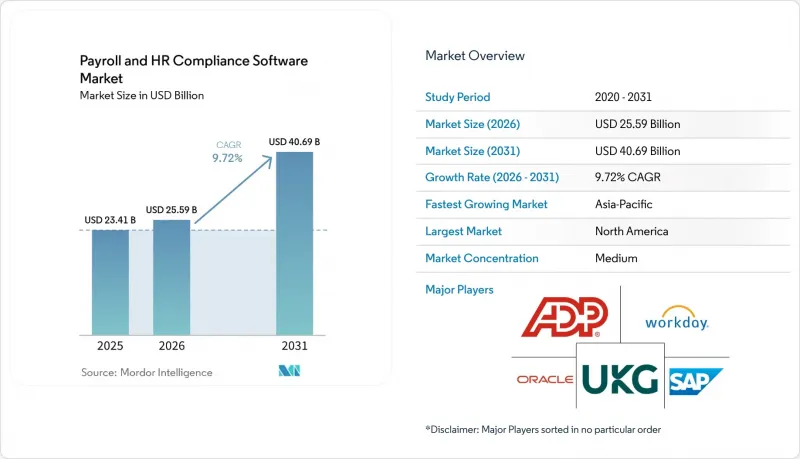
Mordor Intelligence에 의하면, 급여 및 인사 컴플라이언스 소프트웨어 시장 규모는 2025년 234억 달러, 2026년 256억 달러에서 2031년까지 407억 달러로 확대되어 2026년부터 2031년까지 연평균 복합 성장률(CAGR)은 9.72%를 나타낼 것으로 예측됩니다.
본 보고서는 도입 모델(클라우드, On-Premise, 하이브리드), 최종 사용자 규모(대기업, 중소기업), 용도(급여 계산, 인사 컴플라이언스, 근태 관리, 핵심 HR), 업종(은행, 금융서비스 및 보험(BFSI), 헬스케어, IT 및 통신, 제조, 소매, 정부 기관 등) 및 지역별로 분류되어 있습니다. 시장 전망은 금액(달러) 기준으로 제시되어 있습니다.
전 세계 급여 및 인사 컴플라이언스 소프트웨어 시장 동향과 인사이트
중소기업의 클라우드 도입이 SaaS 급여 계산의 보급을 가속화
급여 및 인사 컴플라이언스 소프트웨어 시장에서 가장 뚜렷한 수요 변화가 나타나는 부문은 중소기업 부문입니다. 여기에서는 구매자들이 수작업 프로세스나 제한적인 급여 계산 도구에서 벗어나, 급여 계산, 기록 관리, 컴플라이언스 업무를 단일 환경에서 통합하는 클라우드 시스템으로 전환하고 있습니다. 이러한 변화가 중요한 이유는 중소기업은 일반적으로 대기업 구매자에 비해 도입 절차가 간편하고, 제품 업데이트가 신속하며, 공급업체 간 인수인계가 최소화되기를 원하기 때문입니다. 프랑스에서는 2025년에 기업의 86%가 급여 계산 소프트웨어를 이용하고, 직원의 62%가 디지털 급여 명세서를 수령하고 있어, 성숙한 중소기업 환경에서 디지털 급여 관리가 얼마나 보편화되었는지를 보여주고 있습니다. 점점 더 많은 중소기업이 광범위한 HR 플랫폼을 도입함에 따라, 회계 시스템과 연동된 독립형 급여 계산 모듈의 중요성은 점차 줄어들고 있습니다. 이는 구매자가 급여, 직원 기록, 컴플라이언스 업무를 통합한 워크플로를 선호하기 때문입니다. 따라서 급여 및 인사 컴플라이언스 소프트웨어 시장은 단순한 단기적인 소프트웨어 업데이트 주기뿐만 아니라, 구매 행태의 구조적 변화로 인한 혜택을 누리고 있습니다.
엄격한 다자간 세무 및 노동 컴플라이언스 요건
급여 및 인사 컴플라이언스 소프트웨어 시장은 급여의 투명성, 급여 관련 서류, 사이버 보안 대책, 그리고 각국 고유의 노동 관리 규정에 이르는 컴플라이언스 요건에 힘입어 계속해서 성장하고 있습니다. 고용주가 여러 관할 구역에 걸쳐 급여 관리를 수행하는 경우, 규정 변경, 보고 요건 및 현지 신고 관행이 더 이상 단일 급여 팀이나 단일 현지 시스템 내에서만 처리될 수 없게 되므로, 도입에 따른 비즈니스상의 이점은 더욱 커집니다. CloudPay는 2025년 말 보고서를 통해 현재 36% 이상의 조직이 6개국 이상에서 급여 계산을 관리하고 있다고 지적하며, 단일 플랫폼 내에서 통합된 규칙과 현지 컴플라이언스의 철저한 이행이 필요함을 강조하고 있습니다. 이러한 다국적 대응에 따른 부담은 초기 도입 후에도 각국의 새로운 규정이나 컴플라이언스 요건이 지속적으로 업데이트되기 때문에 일회성 요인에 그치지 않습니다. 따라서 급여 및 인사 컴플라이언스 소프트웨어 시장은 고용주들이 급여 계산 프로세스 자체에서 소프트웨어를 통한 관리를 점점 더 요구하게 된 점과 지속적인 컴플라이언스 업무에 힘입어 성장하고 있습니다.
전 세계 데이터 개인정보 보호 규제의 복잡성
급여 및 인사 컴플라이언스 소프트웨어 시장은 여전히 국가별로 제각각인 데이터 개인정보 보호 규제로 인해 큰 제약을 받고 있습니다. 급여 시스템은 직원의 기밀 기록, 급여 명세서, 납세자 번호, 은행 계좌 정보 등을 다루기 때문에 국경을 넘는 업무 흐름이 발생할 때마다 추가적인 통제 조치, 현지 심사 또는 제품 재설계가 필요할 수 있습니다. 한 고용주가 여러 국가에서 급여 계산을 수행하면서, 단일 시스템을 통해 통합적인 관리와 현지 법적 요건을 모두 충족하기를 기대하는 경우, 이 과제는 더욱 심각해집니다. 다국적 급여 계산에 관한 조사 결과는 이러한 국경을 초월한 운영 모델이 얼마나 보편화되었는지를 보여주고 있으며, 개인정보 보호와 관련된 마찰이 이전 도입 주기에 비해 더 많은 구매자에게 영향을 미치고 있음을 시사합니다. 따라서 급여 및 인사 컴플라이언스 소프트웨어 시장에서는 벤더들이 다국적 기업을 확보하기 위해 현지 호스팅 옵션, 지역별 프로세스 로직, 보다 신중한 데이터 접근 설계가 필요한 경우가 많아 표준화 진전이 더딘 실정입니다.
부문별 분석
2025년에는 클라우드가 매출의 68.4%를 차지해, 2031년까지 연평균 성장률(CAGR) 10.8%로 확대될 것으로 전망되어, On-Premise 및 하이브리드형을 확실히 앞지르고 있습니다. 따라서 2025년 급여 및 인사 컴플라이언스 소프트웨어 시장 점유율에서 클라우드가 68.4%를 차지하고 있으며, 이러한 우위는 단순한 호스팅 선호도를 넘어서는 의미를 반영하고 있습니다. 구매자가 클라우드를 선택하는 이유는 급여 계산 규정이 빈번하게 변경되고, 지역별 요건이 다르며, 소프트웨어 업데이트가 기존의 릴리스 주기보다 신속하게 이루어져야 하기 때문입니다. 급여 및 인사 컴플라이언스 소프트웨어 시장에서 이 모델은 신규 사업 부문이나 신규 국가의 급여 계산 시스템으로의 확대도 용이하게 합니다. 반면, ERP 맞춤화가 고도로 진행된 기업, 엄격한 관리 요건을 가진 기업, 또는 단계적인 전환 계획을 수립한 기업의 경우, On-Premise 및 하이브리드 배포 방식이 여전히 중요합니다.
나머지 도입 방식은 특히 규제가 엄격한 업계나 국가별 준비 상황에 차이가 있는 다국적 기업 그룹 등, 모든 급여 계산 워크로드를 한 번에 이전할 수 없는 구매자를 지속적으로 지원하고 있습니다. 하이브리드 도입은 기업이 신규 국가에서의 급여 계산에는 클라우드의 신속성을 원하면서도, 특정 데이터 세트나 레거시 시스템과의 통합에 대해서는 보다 엄격한 현지 관리를 유지하고자 할 때 유용합니다. 타사 인증, 보안이 보장된 호스팅, 문서화된 관리 프레임워크는 유럽 및 기타 규제가 엄격한 지역에서 클라우드 공급업체에게 필수적인 진입 요건으로 자리 잡고 있습니다. 이러한 추세로 인해 급여 및 인사 컴플라이언스 소프트웨어 업계에서 신뢰할 수 있는 공급업체의 선택 폭은 점점 좁아지고 있습니다. 왜냐하면 소규모 공급업체는 후보 목록에 이름을 올리기 위해서라도 더욱 강력한 컴플라이언스 체계를 구축해야 하기 때문입니다. 따라서 급여 및 인사 컴플라이언스 소프트웨어 시장은 점점 더 클라우드 중심으로 전환되고 있지만, 전환 경로는 여전히 위험 수용 수준, 현지화 요구 사항, 그리고 기존 시스템의 복잡성에 따라 달라집니다.
2025년에는 대기업이 매출의 61.7%를 차지하는 반면, 중소기업(SME)은 2031년까지 연평균 성장률(CAGR) 10.4%라는 더 높은 성장률을 나타낼 것으로 예측됩니다. 다중 법인 구조, 세계 세무 신고, 감사 요건 및 ERP와의 연동으로 인해 고객사당 소프트웨어 이용도가 높아짐에 따라, 대기업 기반이 여전히 급여 및 인사 컴플라이언스 소프트웨어 시장의 주축을 이루고 있습니다. 이러한 기업들은 보다 상세한 워크플로우 관리, 더욱 강력한 보고 기능, 그리고 급여 계산 시스템과 재무 시스템 간의 긴밀한 연동이 필요한 경우가 많습니다. 한편, 중소기업들은 급여 계산 소프트웨어를 단순한 선택적 백오피스 도구가 아닌 사업 운영에 필수적인 요소로 인식하게 되면서, 시장의 주변부에서 미래 수요의 중심부로 자리매김하고 있습니다. 이러한 수요는 급여 계산, 직원 기록, 복리후생, 컴플라이언스를 하나의 플랫폼에서 관리하고자 하는 소규모 기업에서 특히 두드러집니다.
중소기업 부문의 성장은 제품 설계의 변화도 반영하고 있습니다. 새로운 공급업체는 복잡한 설정보다는 도입 속도와 운영 부담 경감을 더 중요하게 여기기 때문입니다. 프랑스에서는 2025년 기준으로 기업의 86%가 이미 급여 계산 소프트웨어를 이용하고 있으며, 중소기업들 사이에서 그 가치가 명확해지면 도입이 급속도로 진행될 것으로 예측됩니다. 신생 업체들 역시 급여 계산을 플랫폼으로의 진입점으로 삼아, 이를 통해 인접 서비스로 사업을 확장함으로써 장기적으로 고객 유지율과 지갑 점유율을 높이고 있습니다. 이러한 교차 판매 패턴은 급여 및 인사 컴플라이언스 소프트웨어 업계에 있어 중요합니다. 왜냐하면 경쟁의 초점을 단순한 급여 계산 처리에서 보다 광범위한 인력 관리로 전환하기 때문입니다. 따라서 예측 기간 동안 급여 및 인사 컴플라이언스 소프트웨어 시장에서 중소기업 부문이 가장 활발한 구매자 그룹으로 남아 있을 것으로 예측됩니다.
지역별 분석
2025년, 북미는 전 세계 매출의 38.6%를 차지하며 급여 및 인사 컴플라이언스 소프트웨어 분야에서 가장 규모가 큰 지역 시장이 되었습니다. 따라서 2025년 급여 및 인사 컴플라이언스 소프트웨어 시장 점유율의 38.6%를 북미가 차지하고 있으며, 이를 주도하고 있는 것은 미국입니다. 미국에서는 급여 계산 플랫폼과 통합 솔루션이 잘 갖춰져 있으며, 컴플라이언스를 중시하는 제품에 대한 수요도 높은 수준을 유지하고 있습니다. 또한, 이 지역은 급여 연동과 관련된 주요 인접 활용 사례인 ‘급여 선지급(Earned Wage Access)’이 활발하게 확산되고 있는 점에서도 혜택을 보고 있습니다. 2025년 12월, 해당 급여 선지급 상품이 규정 Z(Regulation Z)에 따라 신용으로 간주되지 않는다는 점이 명확해졌으며, 이를 통해 고용주 통합형 모델과 관련된 주요 규제상 우려 사항 중 하나가 해소되었습니다. 또한, 기업 고객들이 급여 계산, 노무 관리, 직원 대상 금융 서비스를 연동하는 시스템에 대한 투자를 지속하고 있기 때문에 북미의 급여 및 인사 컴플라이언스 소프트웨어 시장은 여전히 매력적인 시장으로 남아 있습니다.
유럽은 여전히 2위 지역 시장이며, 영국, 독일, 프랑스, 스페인이 주요 수요 거점입니다. 유럽의 급여 및 인사 컴플라이언스 소프트웨어 시장은 각국 고유의 급여 형식, 보고 요건, 데이터 처리에 대한 기대에 따라 형성되어 있으며, 이를 위해서는 현지화와 규모 모두 필요합니다. 프랑스에서는 2025년에 기업의 86%가 급여 계산 소프트웨어를 이용하고, 직원의 62%가 디지털 급여 명세서를 수령하고 있는 것으로 나타나, 검증 및 업그레이드에 대한 수요가 예상되는 성숙한 디지털 급여 환경이 형성되어 있습니다. 이러한 현지 요건으로 인해 유럽은 다자간 대응과 각국 내 업무 흐름에 대한 심도 있는 지원을 모두 갖춘 공급업체에게 유력한 시장이 되고 있습니다.
아시아태평양은 2031년까지 연평균 성장률(CAGR) 12.7%를 나타낼 것으로 예측되며, 급여 및 인사 컴플라이언스 소프트웨어 시장에서 가장 빠르게 성장하는 지역으로 꼽히고 있습니다. 노동 시장의 정규화, 중소기업의 디지털화 진전, 그리고 다국적 기업들의 인도, 동남아시아, 호주로의 진출이 더욱 확대됨에 따라 수요가 증가하고 있습니다. 2025년 10월, 한 벤더는 2029년까지 100개국 이상에서 현지화된 급여 계산 서비스를 제공할 계획을 발표했습니다. 이는 급변하는 지역 환경에서 공급업체들이 현재 각국에서의 대응 능력을 얼마나 중요한 성장 동력으로 인식하고 있는지를 보여줍니다. 남미, 중동 및 아프리카는 여전히 초기 단계 시장이지만, 노동법의 현대화, 고용주 대행 서비스, 세계 HR 플랫폼의 확대에 힘입어 급여 계산 업무가 수작업에서 벗어나고 있는 만큼, 도입이 증가하는 추세입니다.
기타 혜택:
- 엑셀 형식 시장 예측(ME) 시트
- 3개월간의 애널리스트 지원
자주 묻는 질문
목차
제1장 서론
제2장 조사 방법
제3장 주요 요약
제4장 시장 구도
제5장 시장 규모와 성장 예측
제6장 경쟁 구도
제7장 시장 기회와 향후 전망
JHS 26.06.23According to Mordor Intelligence, the payroll and HR compliance software market size is projected to expand from USD 23.4 billion in 2025 and USD 25.6 billion in 2026 to USD 40.7 billion by 2031, registering a CAGR of 9.72% between 2026 and 2031.
This report is Segmented by Deployment Model (Cloud, On-Premise, and Hybrid), End User Size (Large Enterprises, and Small and Medium Enterprises), Application (Payroll Processing, HR Compliance, Time and Attendance, and Core HR), Vertical (BFSI, Healthcare, IT and Telecom, Manufacturing, Retail, Government, and More), and Geography. The Market Forecast are Provided in Terms of Value (USD).
Global Payroll And HR Compliance Software Market Trends and Insights
Cloud Adoption by SMEs Accelerating SaaS Payroll Uptake
The payroll and HR compliance software market is seeing one of its clearest demand shifts in the SME segment, where buyers are moving from manual processes and narrow payroll tools to cloud systems that combine payroll, records, and compliance tasks in a single environment. This change matters because smaller firms usually need lower setup effort, faster product updates, and fewer vendor handoffs than large enterprise buyers. In France, 86% of companies used payroll software in 2025, and 62% of employees received digital payslips, indicating how commonplace digital payroll administration has become in a mature SME setting. As more SMEs adopt broader HR platforms, standalone accounting-linked payroll modules become less relevant, as buyers prefer a single workflow for pay, employee records, and compliance actions. The payroll and HR compliance software market, therefore, benefits from a structural shift in buying behavior, not just from short-term software replacement cycles.
Stringent Multi-Country Tax and Labor Compliance Mandates
The payroll and HR compliance software market continues to gain support from compliance mandates that now span pay transparency, payroll documentation, cyber controls, and country-specific labor administration rules. The commercial case becomes stronger when employers manage payroll across several jurisdictions, because rule changes, reporting demands, and local filing practices no longer sit neatly inside one payroll team or one local system. CloudPay reported in late 2025 that more than 36% of organizations now manage payroll across 6 or more countries, underscoring the need for centralized rules and local compliance enforcement within a single platform. This multi-country burden does not act as a one-time trigger, because new country rules and compliance updates continue to arrive after the initial implementation. The payroll and HR compliance software market is therefore being pulled forward by recurring compliance work that employers increasingly want software to manage inside the payroll process itself.
Complexities in Global Data Privacy Regulations
The payroll and HR compliance software market still faces a major restraint from data privacy rules that do not align neatly across countries. Payroll systems handle sensitive employee records, pay details, tax identifiers, and banking data so that each cross-border workflow can trigger extra controls, local review, or product redesign. This becomes harder when one employer runs payroll across multiple countries and expects one system to support both centralized oversight and local legal requirements. Multi-country payroll findings show how common these cross-border operating models have become, indicating that privacy friction now affects a wider share of buyers than in earlier deployment cycles. The payroll and HR compliance software market, therefore, faces slower standardization because vendors often need local hosting choices, regional process logic, and more careful data access design to win multinational clients.
Other drivers and restraints analyzed in the detailed report include:
- AI-Driven Payroll Error Detection and Fraud Prevention
- Integration of Payroll APIs Into Fintech Ecosystems
- High Switching Costs From Legacy ERP Modules
For complete list of drivers and restraints, kindly check the Table Of Contents.
Segment Analysis
Cloud accounted for 68.4% of revenue in 2025 and is projected to expand at a 10.8% CAGR through 2031, keeping it clearly ahead of on-premises and hybrid options. Cloud, therefore, represented 68.4% of the payroll and HR compliance software market share in 2025, and that lead reflects more than hosting preference alone. Buyers are choosing the cloud because payroll rules change frequently, local requirements vary, and software updates need to move faster than traditional release cycles. In the payroll and HR compliance software market, this model also supports easier rollout across new business units and new country payrolls. On-premises and hybrid deployments still matter for enterprises with heavy ERP customization, strict control requirements, or gradual migration plans.
The remaining deployment mix continues to serve buyers that cannot move all payroll workloads at once, particularly in regulated verticals and multinational groups with uneven country readiness. Hybrid deployments remain useful where firms want cloud speed for new-country payrolls but still want tighter local control for selected data sets or legacy integrations. Third-party certifications, secure hosting, and documented control frameworks have become a basic entry requirement for cloud vendors in Europe and other sensitive regions. That dynamic is narrowing the field of credible providers in the payroll and HR compliance software industry, because smaller vendors need a stronger compliance posture just to stay on the shortlist. The payroll and HR compliance software market is thus becoming more cloud-led, but the migration path still depends on risk tolerance, localization needs, and installed-base complexity.
Large enterprises accounted for 61.7% of revenue in 2025, while SMEs are expected to record the faster 10.4% CAGR through 2031. The large enterprise base still anchors the payroll and HR compliance software market because multi-entity structures, global tax filings, audit demands, and ERP links create higher software intensity per customer. These employers often need deeper workflow control, stronger reporting layers, and closer coordination between payroll and finance systems. SMEs, however, are shifting from the margin of the category to the center of future demand because they now see payroll software as an operating necessity rather than an optional back-office tool. That demand is especially evident among small firms that want a single platform for payroll, employee records, benefits, and compliance.
Growth in the SME segment also reflects a shift in product design, as newer vendors emphasize speed of deployment and lower operational burden rather than heavy configuration. In France, 86% of companies were already using payroll software in 2025, suggesting that adoption can move quickly once the value case becomes clear among SMEs. Challenger vendors are also turning payroll into a platform entry point, then expanding into adjacent services that raise retention and wallet share over time. That cross-sell pattern matters for the payroll and HR compliance software industry because it shifts competition away from simple payroll processing and toward broader workforce administration. The payroll and HR compliance software market should therefore see the SME segment remain the most commercially active buyer group during the forecast period.
Geography Analysis
North America accounted for 38.6% of global revenue in 2025, making it the largest regional market for payroll and HR compliance software. North America, therefore, accounted for 38.6% of the payroll and HR compliance software market share in 2025, led by the United States, which has a dense base of payroll platforms, integrations, and compliance-oriented product demand. The region also benefits from active development in earned wage access, which has become a major adjacent use case for payroll connectivity. In December 2025, it was clarified that covered earned wage access products are not considered credit under Regulation Z, which reduced one important regulatory concern for employer-integrated models. The payroll and HR compliance software market in North America also remains attractive because enterprise clients continue to invest in systems that connect payroll, workforce administration, and employee financial services.
Europe remained the second-largest regional market, with the United Kingdom, Germany, France, and Spain forming the main demand centers. The payroll and HR compliance software market in Europe is shaped by country-specific payroll formats, reporting requirements, and data-handling expectations that require both localization and scale. In France, 86% of companies used payroll software in 2025, and 62% of employees received digital payslips, indicating a mature digital payroll environment with room for validation and upgrade demand. These local requirements make Europe a strong region for vendors that combine multi-country coverage with deep in-country workflow support.
Asia-Pacific is projected to grow at a 12.7% CAGR through 2031, making it the fastest-growing region in the payroll and HR compliance software market. Demand is rising as labor markets formalize, SME digitization spreads, and multinational employers expand deeper into India, Southeast Asia, and Australia. In October 2025, one vendor announced plans to target native payroll coverage in 100+ countries by 2029, which shows how seriously vendors now view in-country capability as a growth lever across fast-moving regions. South America, the Middle East, and Africa are still earlier-stage markets, but adoption is rising as labor law modernization, employer-of-record services, and global HR platform expansion push payroll administration away from manual processes.
- Automatic Data Processing, Inc.
- Paychex, Inc.
- Workday, Inc.
- UKG Inc.
- Ceridian HCM Holding Inc.
- Paylocity Holding Corporation
- Oracle Corporation
- SAP SE
- Intuit Inc.
- Paycom Software, Inc.
- Rippling People Center Inc.
- Gusto, Inc.
- HiBob Inc.
- Deel Inc.
- Papaya Global Ltd.
- BambooHR LLC
- Sage Group plc
- Paycor HCM, Inc.
- Personio
- Ramco Systems Limited
Additional Benefits:
- The market estimate (ME) sheet in Excel format
- 3 months of analyst support
TABLE OF CONTENTS
1 INTRODUCTION
- 1.1 Study Assumptions and Market Definition
- 1.2 Scope of the Study
2 RESEARCH METHODOLOGY
3 EXECUTIVE SUMMARY
4 MARKET LANDSCAPE
- 4.1 Market Overview
- 4.2 Market Drivers
- 4.2.1 Cloud Adoption by SMEs Accelerating SaaS Payroll Uptake
- 4.2.2 Stringent Multi-country Tax and Labor Compliance Mandates
- 4.2.3 Integration of Payroll APIs into Fintech Ecosystems
- 4.2.4 Shift Toward On-demand Pay and Earned Wage Access
- 4.2.5 AI-driven Payroll Error Detection and Fraud Prevention
- 4.2.6 Growing Freelancer and Gig Workforce Requiring Agile Payroll
- 4.3 Market Restraints
- 4.3.1 Complexities in Global Data Privacy Regulations
- 4.3.2 High Switching Costs from Legacy ERP Modules
- 4.3.3 Skill Shortage in Payroll Compliance Specialists
- 4.3.4 Resistance to Payroll Process Outsourcing in Regulated Verticals
- 4.4 Industry Value-Chain Analysis
- 4.5 Regulatory Landscape
- 4.6 Technological Outlook
- 4.7 Impact of Macroeconomic Factors on the Market
- 4.8 Porter's Five Forces Analysis
- 4.8.1 Bargaining Power of Suppliers
- 4.8.2 Bargaining Power of Buyers
- 4.8.3 Threat of New Entrants
- 4.8.4 Threat of Substitutes
- 4.8.5 Competitive Rivalry
5 MARKET SIZE AND GROWTH FORECASTS (VALUE)
- 5.1 By Deployment Model
- 5.1.1 Cloud
- 5.1.2 On-premise
- 5.1.3 Hybrid
- 5.2 By End User Enterprise Size
- 5.2.1 Large Enterprises
- 5.2.2 Small and Medium Enterprises
- 5.3 By Application
- 5.3.1 Payroll Processing
- 5.3.2 Time and Attendance Management
- 5.3.3 HR Compliance and Regulatory Management
- 5.3.4 Benefits and Compensation Administration
- 5.3.5 Core HR and Employee Records Management
- 5.4 By End User Industry Vertical
- 5.4.1 Information Technology (IT) and Telecom
- 5.4.2 Banking, Financial Services and Insurance (BFSI)
- 5.4.3 Healthcare and Life Sciences
- 5.4.4 Industrial Manufacturing
- 5.4.5 Retail and eCommerce
- 5.4.6 Government and Public Sector
- 5.4.7 Other End User Industry Verticals
- 5.5 By Geography
- 5.5.1 North America
- 5.5.1.1 United States
- 5.5.1.2 Canada
- 5.5.1.3 Mexico
- 5.5.2 South America
- 5.5.2.1 Brazil
- 5.5.2.2 Argentina
- 5.5.2.3 Rest of South America
- 5.5.3 Europe
- 5.5.3.1 United Kingdom
- 5.5.3.2 Germany
- 5.5.3.3 France
- 5.5.3.4 Italy
- 5.5.3.5 Spain
- 5.5.3.6 Rest of Europe
- 5.5.4 Asia-Pacific
- 5.5.4.1 China
- 5.5.4.2 India
- 5.5.4.3 Japan
- 5.5.4.4 South Korea
- 5.5.4.5 Australia
- 5.5.4.6 Rest of Asia-Pacific
- 5.5.5 Middle East
- 5.5.5.1 United Arab Emirates
- 5.5.5.2 Saudi Arabia
- 5.5.5.3 Turkey
- 5.5.5.4 Rest of Middle East
- 5.5.6 Africa
- 5.5.6.1 South Africa
- 5.5.6.2 Nigeria
- 5.5.6.3 Kenya
- 5.5.6.4 Rest of Africa
- 5.5.1 North America
6 COMPETITIVE LANDSCAPE
- 6.1 Market Concentration
- 6.2 Strategic Moves
- 6.3 Market Share Analysis
- 6.4 Company Profiles (includes Global Level Overview, Market Level Overview, Core Segments, Financials as available, Strategic Information, Market Rank/Share, Products and Services, Recent Developments)
- 6.4.1 Automatic Data Processing, Inc.
- 6.4.2 Paychex, Inc.
- 6.4.3 Workday, Inc.
- 6.4.4 UKG Inc.
- 6.4.5 Ceridian HCM Holding Inc.
- 6.4.6 Paylocity Holding Corporation
- 6.4.7 Oracle Corporation
- 6.4.8 SAP SE
- 6.4.9 Intuit Inc.
- 6.4.10 Paycom Software, Inc.
- 6.4.11 Rippling People Center Inc.
- 6.4.12 Gusto, Inc.
- 6.4.13 HiBob Inc.
- 6.4.14 Deel Inc.
- 6.4.15 Papaya Global Ltd.
- 6.4.16 BambooHR LLC
- 6.4.17 Sage Group plc
- 6.4.18 Paycor HCM, Inc.
- 6.4.19 Personio
- 6.4.20 Ramco Systems Limited
7 MARKET OPPORTUNITIES AND FUTURE OUTLOOK
- 7.1 White-space and Unmet-need Assessment


