

|
시장보고서
상품코드
2063864
현장 진료용 미들웨어 시장 : 시장 점유율 분석, 업계 동향 및 통계, 성장 예측(2026-2031년)Point-of-Care Middleware - Market Share Analysis, Industry Trends & Statistics, Growth Forecasts (2026 - 2031) |
||||||
 Mordor Intelligence
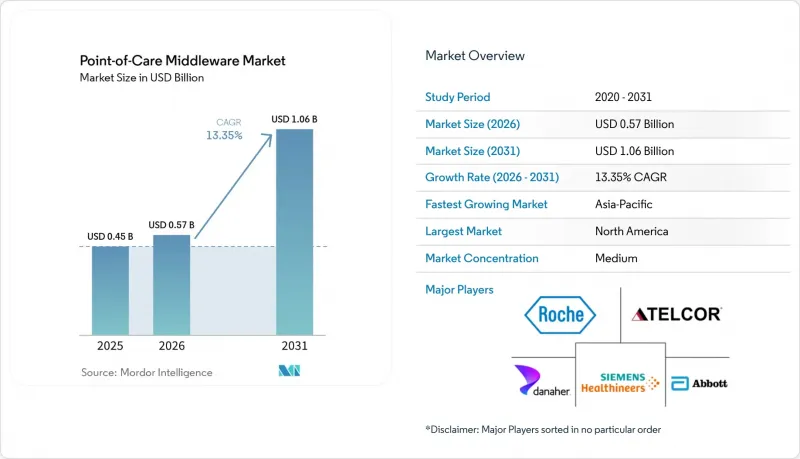
Mordor Intelligence에 의하면, 현장 진료용 미들웨어 시장 규모는 2025년에 4억 5,000만 달러로 평가되었고, 2026년 5억 7,000만 달러로 추정되고, 2031년까지 10억 6,000만 달러에 이를 것으로 예측되며, 예측 기간(2026-2031년) CAGR은 13.35%를 나타낼 전망입니다.
본 보고서는 배포 방식별(클라우드 기반, 온프레미스형, 하이브리드형), 용도별(혈당 모니터링, 감염증, 응고, 소변 검사, 심장 대사, 암 마커, 혈액학 등), 최종 사용자별(병원 및 중환자실, 진단센터, 클리닉 등), 지역별(북미, 유럽, 아시아태평양, 중동 및 아프리카, 남미)로 분류되어 있습니다. 예상치는 금액(달러)으로 표시되어 있습니다.
세계의 현장 진료용 미들웨어 시장 동향 및 인사이트
실시간 POCT를 EHR/LIS에 통합함으로써 임상 데이터의 지연이 해소됩니다.
현장 진료용 미들웨어 시장은 수동으로 이루어지던 POCT 결과 전사를 기기, EHR 시스템, 검사 플랫폼 간에 자동화된 양방향 결과 교환으로 대체해야 할 필요성 때문에 계속해서 가장 큰 지지를 받고 있습니다. 이러한 변화가 중요한 이유는 기록 전입의 지연이나 환자 기록의 불일치가 환자 수와 검사 빈도가 높은 의료 현장에서 환자와 가까운 곳에서 실시되는 검사의 임상적 가치를 저해할 가능성이 있기 때문입니다. 애보트사는 자사의 현장 진단 데이터 관리 환경이 연간 2억 2,500만 건의 검사 결과를 수집하고 있으며, 연결된 전체 인프라에서 매일 환자 검사를 수행하는 8만 대 이상의 측정기 및 기기를 지원하고 있다고 밝혔습니다.
의료 시스템이 POCT 워크플로를 특정 HL7 v2.x 또는 FHIR R4 메시지 구조에 매핑하는 경우, 다른 공급업체로 전환하려면 일반적으로 부서 및 사업장 전체에 걸친 광범위한 인터페이스 재검증이 필요합니다. 이 프로세스는 지속적인 전환 비용을 발생시키기 때문에 병원이 기술 스택을 재검토하더라도 현장 진료용 미들웨어 시장에서는 기존 벤더에 대한 충성도 비율이 높은 경향이 있습니다. 이와 같은 통합 압력은 미국의 상호운용성 정책에 의해 더욱 강화되고 있으며, 이로 인해 연결된 진단 소프트웨어의 구매 결정에 있어 규격에 부합하는 데이터 교환이 핵심 요소로 자리 잡고 있습니다.
클라우드 기반 차량 관리가 대규모 POC의 경제성을 재구축합니다.
또한, 의료 시스템이 병원, 클리닉 및 외부 거점에 걸쳐 있는 다수의 기기를 관리할 때, 기존의 온프레미스형 아키텍처의 한계로 인해 현장 진료용 미들웨어 시장도 재편되고 있습니다. TELCOR사는 자사의 QML 미들웨어가 2,700개 이상의 병원 및 외래 진료 시설을 연결하고 있다고 보고했으며, 이는 다중 거점에서의 POCT 운영에 있어 중앙 집중식 관리가 얼마나 실용적인 요건인지 보여줍니다. 지멘스 헬스인어즈(Siemens Healthineers)는 자사의 POCcelerator 플랫폼이 70개 이상의 제조업체가 생산한 250대 이상의 POCT 기기를 연결하고 있는 한편, Ci 모듈이 기기의 성능, 품질 관리(QC) 상태 및 운영자의 활동에 대해 KPI 수준의 가시성을 제공한다고 밝혔습니다.
이러한 기능들은 클라우드 배포를 통해 공급업체가 연결된 모든 거점에 대해, 거점별로 개별적으로가 아니라 한 번에 장치 드라이버, 품질 관리 규칙, 규정 준수 설정을 업데이트할 수 있다는 점에서 중요합니다. 따라서 현장 진료용 미들웨어 시장은 연결성에 대한 수요뿐만 아니라, 중앙 집중식 관리를 통한 운영 비용 절감, 운영자 관리 효율성 향상, 폐기물 감소, 그리고 로컬 서버의 부하 경감 등의 이점도 누리고 있습니다. 집중형 플랫폼을 사용하면 각 거점에서의 수동 프로세스 없이도 공통된 접근 규칙, 퀴즈 배포, 감사 문서화를 적용할 수 있으므로, 운영자의 역량 향상 및 품질 관리 자동화도 이러한 변화에 직접적으로 부합합니다.
높은 도입 비용과 인터페이스 개발 비용이 시장 내 광범위한 확산을 저해하고 있습니다.
현장 진료 미들웨어 시장은 여전히 큰 도입 장벽에 직면해 있습니다. 이는 미들웨어, POCT 기기, LIS 시스템 및 EHR 환경 간의 인터페이스 개발이 기술적으로 어렵고 비용도 많이 들기 때문입니다. 대규모의 다중 공급업체 병원 환경에서는 특히 각 장치 유형별로 개별적인 테스트, 문서화 및 워크플로우 승인이 필요한 경우, 초기 인터페이스 및 검증 비용이 수십만 달러에 달할 가능성이 있습니다. 2026년 2월에 발표된 FDA의 사이버 보안에 관한 최종 지침에서는 연결된 의료기기에 대해 SBOM(소프트웨어 구성 관리) 문서, 패치 검증 계획 및 침투 테스트 증거와 관련된 새로운 요건이 추가되었습니다.
이러한 의무는 공급업체의 엔지니어링 및 도입 비용을 증가시키며, 그 부담의 일부는 도입 및 지원 과정에서 고객에게 전가됩니다. 포인트 오브 케어(PoC) 미들웨어 시장은 대형 IVD 제조업체들의 번들링 전략의 영향도 받고 있습니다. 이로 인해 독립 진단 사업자가 경쟁사의 장비와 오픈 플랫폼을 통해 연결할 때 비용이 높아지는 경향이 있습니다. 중동 및 아프리카(MEA) 및 남미의 공공 의료 시스템에서는 미들웨어 도입의 거버넌스적 필요성이 분명함에도 불구하고, 조달 예산에서 디지털 인프라보다 분석 장비나 소모품이 우선시되는 경우가 많기 때문에 이 문제의 영향을 더욱 크게 받고 있습니다.
부문별 분석
2025년 기준으로, 온프레미스 배포는 현장 진료용 미들웨어 시장 규모의 51.26%를 차지했습니다. 이는 로컬 서버, 확립된 IT 관리 체계, 그리고 데이터 소재지 선호도에 기반하여 이미 구축되어 있던 병원 도입 인프라의 규모가 크다는 점을 반영하고 있습니다. 많은 병원이 이러한 환경을 유지한 이유는 보안 정책, 조달 이력 및 내부 지원 모델이 이미 로컬에서 호스팅되는 소프트웨어와 일치했기 때문입니다. 클라우드 기반 도입은 2031년까지 연평균 성장률(CAGR) 15.67%를 나타낼 것으로 예측되며, 이는 분산형 테스트 네트워크에서 중앙 관리형 환경으로의 전환이 현재 가장 큰 탄력을 받고 있음을 보여줍니다. 이러한 성장은 각 의료 현장에서 별도의 미들웨어 인프라를 유지하지 않고도 여러 시설을 지원해야 할 필요성이 커지고 있는 것과 관련이 있습니다. 하이브리드 도입은 시장 점유율 면에서는 여전히 가장 작은 부문이지만, 모든 환자 식별 정보를 로컬 시스템에서 이전하지 않고도 클라우드 분석과 중앙 집중식 관리를 원하는 기관들로부터 주목을 받고 있습니다.
실무 측면에서는 클라우드 서비스를 통해 벤더가 단일 관리 거점에서 장치 드라이버 업데이트, 규정 준수 변경 사항 배포, 그리고 대규모 네트워크 전반에 걸친 장비 가시성 확대를 보다 수월하게 수행할 수 있게 됩니다. 조직이 외래 진료소, 응급 치료 시설, 지역 거점을 추가할 때, 이들 시설이 별도의 서버 유지보수나 로컬 업데이트 주기를 필요로 하지 않기 때문에 이 운영 모델은 더욱 매력적입니다. 애보트는 AegisPOC를 보안이 강화된 데이터센터 호스팅을 갖춘 웹 기반 오픈 플랫폼으로 포지셔닝하고 있는 반면, 클리니시스는 보다 가벼운 인프라 사양을 원하는 고객을 지원하기 위해 Orchard Point-of-Care SaaS 옵션을 제공합니다. 애보트의 호주용 자료에서는 ISO 27001 인증도 강조되고 있으며, 이러한 인증은 단순한 기능 목록에 그치지 않고, 검증된 거버넌스를 요구하는 구매자가 진행하는 입찰에서 실질적인 선정 기준으로 자리 잡고 있습니다. 현장 진료용 미들웨어 업계에서 이로 인해 온프레미스형 시스템은 확고한 도입 기반을 유지하고 있는 반면, 클라우드 모델은 확장성, 신속한 업데이트, 그리고 운영 비용 절감을 중시하는 고객들로부터 새로운 수요를 모으고 있습니다.
따라서 현장 진료용 미들웨어 시장은 단순한 교체 주기를 거치고 있는 것이 아니라, 공간, 인력, 규정 준수 업무 등 각 분야에서 고객이 미들웨어에 기대하는 관리 범위가 서서히 변화하고 있는 단계에 있습니다. 하이브리드 모델도 여전히 그 중요성을 유지하고 있습니다. 이는 현지 거버넌스 요건을 준수하면서도 점유율 분석 기능과 원격지의 장비 그룹에 대한 가시성을 필요로 하는 기관에게 타협점을 제시하는 선택지를 제공하기 때문입니다. 따라서 도입 여부는 단일한 보편적인 아키텍처를 선호하는 것이 아니라, 고객의 운영 모델과 밀접하게 연계되어 결정됩니다. 현장 진료용 미들웨어 시장에서는 기존 도입 기반의 변화가 완만한 반면, 신규 구매 파이프라인은 클라우드 지향성이 강하기 때문에 예측 기간 동안 두 모델이 계속 공존할 가능성이 높습니다.
지역별 분석
2025년 기준으로 북미는 현장 진료용 미들웨어 시장 점유율의 38.47%를 차지했으며, 매출액 측면에서 가장 규모가 큰 지역 클러스터로 자리매김하고 있습니다. 이 지역의 경쟁력은 POCT 기기의 높은 보급률, 성숙한 EHR의 확산, 그리고 상호운용성, 인증, 사이버 보안 등 모든 요소가 소프트웨어 구매 결정에 영향을 미치는 정책 환경에서 비롯됩니다. 애보트사는 자사의 현장 진단 데이터 관리 플랫폼이 미국 병원의 50% 이상과 연결되어 있다고 밝혔으며, 이는 이 지역에서 해당 플랫폼의 도입 기반이 얼마나 깊이 뿌리내리고 있는지를 보여줍니다. 캐나다도 수요 증가에 기여하고 있으며, 서스캐처원주 보건국은 2025년 말까지 해당 기관의 POCT 프로그램이 14곳으로 확대되어 214건의 응급실 서비스 중단을 사전에 방지했다고 발표했습니다. 멕시코는 여전히 초기 단계에 있지만, 병원의 디지털화와 시스템 간 상호 연결성에 대한 수요는 도시 지역의 의료 네트워크 전반에 걸쳐 현장 진료용 미들웨어 시장의 점진적인 확장을 뒷받침하고 있습니다. FDA의 2026년 사이버 보안 지침 및 CLIA와 관련된 감독 체계로 인해, 의료 서비스 제공업체의 예산이 빠듯한 상황에서도 미들웨어에 대한 투자는 자본 지출 계획에서 계속해서 중시되고 있습니다.
아시아태평양은 2031년까지 연평균 성장률(CAGR) 15.13%를 나타낼 것으로 예측되며, 이에 따라 현장 진료용 미들웨어 시장에서 가장 빠르게 성장하는 지역 부문이 될 것입니다. 호주는 분산형 수요의 뚜렷한 사례를 보여주고 있습니다. 정부 자금을 지원받은 ‘원주민 및 트레스 해협 섬 주민 대상 코로나19 POC 검사 프로그램’은 105개 진료소에서 시행되었으며, 7만 2,624건의 검사가 실시되었고, 결과 통보까지 걸린 시간은 중앙값 기준 1.4시간이었습니다. 검사 규정이 변경되었을 때, 미들웨어 업그레이드가 중요하게 여겨졌습니다. 중국과 인도 역시 1차 의료 및 지역 사회 차원의 검사 역량을 확대하고 있으며, 이에 따라 데이터 흐름 관리, 운영자 관리 및 기기 추적 가능성이 필요한 거점이 증가하고 있습니다. 일본과 한국에서는 병원 시스템에서 문서화된 품질 관리와 구조화된 데이터 교환이 더욱 중시되고 있어, 이에 따른 프리미엄 수요가 발생하고 있습니다. 이로 인해 아시아·태평양 지역은 규모 확대와 거버넌스 수요가 별개로 진행되는 것이 아니라, 함께 발전하고 있는 지역이 되었습니다.
유럽은 여전히 주요 지역 블록으로 남아 있습니다. 독일, 영국, 프랑스에서는 미들웨어 구매를 미루기 어렵게 만드는 인증 요건이나 규제 소프트웨어 요건이 계속해서 적용되고 있기 때문입니다. ISO 15189:2022는 POCT(현장 검사) 감독에 있어 추적성 및 문서화 요건을 확대한 반면, IVDR 2017/746은 적격 소프트웨어를 보다 공식적인 규제 체계 내에 포함시키고 있습니다. 중동 및 아프리카은 아직 도입 초기 단계이지만, 사우디아라비아나 UAE 등 GCC 국가들은 향후 미들웨어 도입을 지원하는 국가 변혁 프로그램의 일환으로 병원의 디지털화를 추진하고 있습니다. 남아프리카는 민간 병원 그룹들이 인증 기준에 부합하는 품질 관리 시스템을 보다 적극적으로 활용하고 있기 때문에 MEA 지역에서 가장 발전된 시장으로 자리매김하고 있습니다. 케냐에서는 PEPFAR의 자금 지원을 받은 ‘진단 네트워크 최적화 이니셔티브’를 통해 분산형 의뢰 네트워크 전반에서 HIV 검사 소요 시간이 7일에서 2일로 단축되었습니다. 이는 자원이 제한된 환경에서 연계된 진단 및 모니터링의 실용적 가치를 입증하는 한 가지 사례입니다. 남미에서는 브라질과 아르헨티나가 주도하여 민간 병원 및 진단 체인을 통한 도입을 통해 여전히 발전 단계에 있는 반면, 공공 조달의 경우 예산 편성 시기와 인프라 간의 상충 관계에 더 큰 영향을 받는 상황이 지속되고 있습니다.
기타 혜택 :
- 엑셀 형식 시장 예측(ME) 시트
- 3개월간의 애널리스트 지원
자주 묻는 질문
목차
제1장 서론
제2장 조사 방법
제3장 주요 요약
제4장 시장 구도
제5장 시장 규모 및 성장 예측
제6장 경쟁 구도
제7장 시장 기회 및 향후 전망
AJY 26.06.26According to Mordor Intelligence, the point-of-Care middleware market size was valued at USD 0.45 billion in 2025 and is estimated to grow from USD 0.57 billion in 2026 to reach USD 1.06 billion by 2031, at a CAGR of 13.35% during the forecast period (2026-2031).
This report is Segmented by Deployment Mode (Cloud-Based, On-Premise, Hybrid), Application (Glucose Monitoring, Infectious Disease, Coagulation, Urinalysis, Cardiometabolic, Cancer Markers, Hematology, and More), End User (Hospitals and Critical Care Units, Diagnostic Centers, Clinics and More), and Geography (North America, Europe, Asia-Pacific, MEA, South America). Forecasts in Value (USD).
Global Point-of-Care Middleware Market Trends and Insights
Real-time POCT to EHR/LIS Integration Eliminates Clinical Data Latency
The point-of-care middleware market continues to draw its strongest support from the need to replace manual POCT transcription with automated and bidirectional result exchange across instruments, EHR systems, and laboratory platforms. That shift matters because transcription delays and mismatched patient records can weaken the clinical value of near-patient testing in high-volume care settings. Abbott stated that its point-of-care data management environment captures 225 million test results each year and supports more than 80,000 meters and devices that run patient tests every day across its connected base.
Once a health system has mapped POCT flows to specific HL7 v2.x or FHIR R4 message structures, a move to another middleware vendor usually requires broad interface revalidation across departments and sites. That process creates durable switching costs, which is why the point-of-care middleware market tends to show strong incumbent retention even when hospitals review technology stacks. The same integration pressure is reinforced by U.S. interoperability policy, which keeps compliant data exchange close to the center of purchasing decisions for connected diagnostic software.
Cloud-based Fleet Management Reshapes POC Economics at Scale
The point-of-care middleware market is also being reshaped by the limits of older on-premise architectures when health systems manage large fleets of devices across hospitals, clinics, and off-site locations. TELCOR reported that its QML middleware connects more than 2,700 hospitals and ambulatory locations, showing how centralized management has become a practical requirement in multi-site POCT operations. Siemens Healthineers stated that its POCcelerator platform connects more than 250 POCT devices from over 70 manufacturers, while its Ci module provides KPI-level visibility into device performance, QC status, and operator activity.
These capabilities matter because cloud delivery lets vendors update device drivers, quality rules, and compliance settings across all connected sites at once rather than site by site. The point-of-care middleware market therefore gains not only from connectivity demand, but also from the operational savings that come from centralized oversight, better operator control, lower waste, and fewer local server burdens. Operator competency and QC automation fit directly into this shift because centralized platforms can apply common access rules, quiz delivery, and audit documentation without requiring local manual processes at each site.
High Deployment and Interface Costs Constrain Broad Market Penetration
The point-of-care middleware market still faces a meaningful adoption barrier because interface development between middleware, POCT devices, LIS systems, and EHR environments remains technically demanding and expensive. In large multi-vendor hospital environments, upfront interface and validation costs can move into six figures, especially when each device type needs separate testing, documentation, and workflow approval. The FDA's final cybersecurity guidance from February 2026 adds new requirements around SBOM documentation, patch validation planning, and evidence of penetration testing for connected medical devices.
Those obligations raise engineering and implementation costs for vendors, and part of that burden is passed on to customers during deployment and support. The point-of-care middleware market is also affected by bundling behavior from major IVD manufacturers, which often makes open-platform connectivity to competing instruments more expensive for independent diagnostic operators. Public health systems in MEA and South America are more exposed to this issue because procurement budgets often prioritize analyzers and consumables ahead of digital infrastructure, even when the governance case for middleware is clear.
Other drivers and restraints analyzed in the detailed report include:
- Decentralized Testing Network Expansion Opens New Connectivity Surface
- ISO 15189:2022 Traceability Requirements Raise the Accreditation Floor
- Cybersecurity and Data-Privacy Exposure Introduces Deployment Risk
For complete list of drivers and restraints, kindly check the Table Of Contents.
Segment Analysis
On-premise deployment held 51.26% share of the point-of-care middleware market size in 2025, reflecting the large base of hospital installations that were already built around local servers, established IT controls, and data residency preferences. Many hospitals kept these environments because security policy, procurement history, and internal support models were already aligned with locally hosted software. Cloud-based deployment is projected to grow at 15.67% CAGR through 2031, showing that the fastest momentum is now moving toward centrally managed environments for distributed testing networks. That growth is tied to the rising need to support multiple facilities without maintaining local middleware infrastructure at every care site. Hybrid deployment remains the smallest category by share, yet it is drawing attention from organizations that want cloud analytics and centralized management without moving all patient identifiers off local systems.
In practical terms, cloud delivery gives vendors a simpler path to update device drivers, roll out compliance changes, and extend fleet visibility across large networks from one control point. That operating model becomes more attractive as organizations add outpatient clinics, urgent care settings, and community locations that would otherwise need separate server maintenance and local update cycles. Abbott positions AegisPOC as a web-based open platform with secure data center hosting, while Clinisys offers an Orchard point-of-Care SaaS option that supports customers seeking lighter infrastructure demands. Abbott's Australia material also highlights ISO 27001 certification, and that kind of credential is becoming a practical filter in tenders where buyers look for tested governance rather than feature lists alone. Within the point-of-care middleware industry, this leaves on-premise systems in a strong installed position while cloud models gather new demand from customers that value scale, speed of updates, and lower operational overhead.
The point-of-care middleware market is therefore not moving through a simple replacement cycle, but through a gradual shift in what customers expect middleware to manage across space, staff, and compliance tasks. Hybrid models also remain relevant because they offer a middle path for institutions that must respect local governance requirements while still wanting shared analytics and remote fleet visibility. That keeps deployment choice tied closely to customer operating model rather than to a single universal architecture preference. The point-of-care middleware market will likely keep both models active through the forecast period because the installed base changes slowly and the new buying pipeline is more cloud oriented.
Geography Analysis
North America held 38.47% of the point-of-care middleware market share in 2025, making it the largest regional cluster by revenue. The region's lead came from high POCT device density, mature EHR penetration, and a policy environment where interoperability, accreditation, and cybersecurity all influence software buying decisions. Abbott states that its point-of-care data management platform connects more than 50% of U.S. hospitals, which shows how deep the installed base has become in the region. Canada is also contributing to demand, with Saskatchewan Health Authority stating in late 2025 that its POCT program had expanded to 14 locations and had prevented 214 potential emergency department service disruptions. Mexico remains at an earlier stage, but hospital digitization and cross-system connectivity needs still support a gradual expansion path for the point-of-care middleware market across urban care networks. The FDA's 2026 cybersecurity guidance and CLIA-linked oversight help keep middleware spending visible on capital agendas even when provider budgets tighten.
Asia-Pacific is projected to grow at 15.13% CAGR through 2031, which makes it the fastest-growing regional segment in the point-of-care middleware market. Australia offers a clear example of distributed demand, as the government-funded Aboriginal and Torres Strait Islander COVID-19 POC Testing Program operated across 105 clinics, performed 72,624 tests, and recorded a median transmission time of 1.4 hours, with middleware upgrades cited as important when testing rules changed. China and India are also expanding primary care and community testing capacity, which creates more sites that need controlled data flow, operator management, and device traceability. Japan and South Korea add premium demand because hospitals in those systems place higher value on documented quality management and structured data exchange. This leaves Asia-Pacific as the region where volume expansion and governance needs are advancing together rather than separately.
Europe remains a major regional block because Germany, the United Kingdom, and France continue to enforce accreditation and regulated software requirements that make middleware purchases harder to defer. ISO 15189:2022 has widened the traceability and documentation case for POCT oversight, while IVDR 2017/746 keeps qualifying software within a more formal regulatory frame. The Middle East and Africa region is earlier in adoption, yet GCC countries such as Saudi Arabia and the UAE are pushing hospital digitization under national transformation programs that support future middleware uptake. South Africa remains the most developed MEA market because private hospital groups are more active users of accreditation-aligned quality systems. Kenya's PEPFAR-funded Diagnostic Network Optimisation initiative reduced HIV testing turnaround time from 7 days to 2 days across a decentralized referral network, which helps demonstrate the practical value of connected diagnostic oversight in resource-limited settings. South America, led by Brazil and Argentina, is still developing through private hospital and diagnostic chain adoption, while public procurement remains more exposed to budget timing and infrastructure trade-offs.
- Abbott Laboratories
- Clinisys, Inc.
- Danaher Corporation (Radiometer Medical ApS)
- EKF Diagnostics Holdings plc.
- Roche
- Nova Biomedical
- Relaymed
- Siemens Healthineers
- TELCOR Inc.
- Werfen, S.A.
Additional Benefits:
- The market estimate (ME) sheet in Excel format
- 3 months of analyst support
TABLE OF CONTENTS
1 Introduction
- 1.1 Study Assumptions & Market Definition
- 1.2 Scope of the Study
2 Research Methodology
3 Executive Summary
4 Market Landscape
- 4.1 Market Overview
- 4.2 Market Drivers
- 4.2.1 Real-Time POCT to EHR/LIS Integration
- 4.2.2 Cloud-Based Fleet Management
- 4.2.3 Operator Competency and QC Automation
- 4.2.4 Decentralized Testing Network Expansion
- 4.2.5 Hospital-At-Home Connectivity Needs
- 4.2.6 ISO 15189:2022 Traceability Pressure
- 4.3 Market Restraints
- 4.3.1 High Deployment and Interface Costs
- 4.3.2 Cybersecurity and Data-Privacy Exposure
- 4.3.3 Legacy Device Firmware Fragmentation
- 4.3.4 SBOM and Patch-Validation Burden
- 4.4 Value Chain Analysis
- 4.5 Regulatory Landscape
- 4.6 Technological Outlook
- 4.7 Porter's Five Forces Analysis
- 4.7.1 Threat of New Entrants
- 4.7.2 Bargaining Power of Suppliers
- 4.7.3 Bargaining Power of Buyers
- 4.7.4 Threat of Substitutes
- 4.7.5 Industry Rivalry
5 Market Size & Growth Forecasts (Value)
- 5.1 By Deployment Mode
- 5.1.1 Cloud-Based
- 5.1.2 On-Premise
- 5.1.3 Hybrid
- 5.2 By Application
- 5.2.1 Glucose Monitoring
- 5.2.2 Infectious Disease Devices
- 5.2.3 Coagulation Monitoring
- 5.2.4 Urinalysis
- 5.2.5 Cardiometabolic Monitoring
- 5.2.6 Cancer Markers
- 5.2.7 Hematology
- 5.2.8 Other Applications
- 5.3 By End User
- 5.3.1 Hospitals and Critical Care Units
- 5.3.2 Diagnostic Centers
- 5.3.3 Clinics and Outpatient
- 5.3.4 Other End Users
- 5.4 By Geography
- 5.4.1 North America
- 5.4.1.1 United States
- 5.4.1.2 Canada
- 5.4.1.3 Mexico
- 5.4.2 Europe
- 5.4.2.1 Germany
- 5.4.2.2 United Kingdom
- 5.4.2.3 France
- 5.4.2.4 Italy
- 5.4.2.5 Spain
- 5.4.2.6 Rest of Europe
- 5.4.3 Asia-Pacific
- 5.4.3.1 China
- 5.4.3.2 Japan
- 5.4.3.3 India
- 5.4.3.4 Australia
- 5.4.3.5 South Korea
- 5.4.3.6 Rest of Asia-Pacific
- 5.4.4 Middle East and Africa
- 5.4.4.1 GCC
- 5.4.4.2 South Africa
- 5.4.4.3 Rest of Middle East and Africa
- 5.4.5 South America
- 5.4.5.1 Brazil
- 5.4.5.2 Argentina
- 5.4.5.3 Rest of South America
- 5.4.1 North America
6 Competitive Landscape
- 6.1 Market Concentration
- 6.2 Market Share Analysis
- 6.3 Company Profiles (includes Global level Overview, Market level overview, Core Segments, Financials as available, Strategic Information, Market Rank/Share for key companies, Products & Services, and Recent Developments)
- 6.3.1 Abbott
- 6.3.2 Clinisys, Inc.
- 6.3.3 Danaher Corporation (Radiometer Medical ApS)
- 6.3.4 EKF Diagnostics Holdings plc.
- 6.3.5 F. Hoffmann-La Roche Ltd
- 6.3.6 Nova Biomedical Corporation
- 6.3.7 Relaymed
- 6.3.8 Siemens Healthineers AG
- 6.3.9 TELCOR Inc.
- 6.3.10 Werfen, S.A.
7 Market Opportunities & Future Outlook
- 7.1 White-space & unmet-need assessment


