
|
시장보고서
상품코드
2063872
제약 연구개발 분야 AI 시장 : 시장 점유율 분석, 업계 동향 및 통계, 성장 예측(2026-2031년)AI In Pharmaceutical R & D - Market Share Analysis, Industry Trends & Statistics, Growth Forecasts (2026 - 2031) |
||||||
 Mordor Intelligence
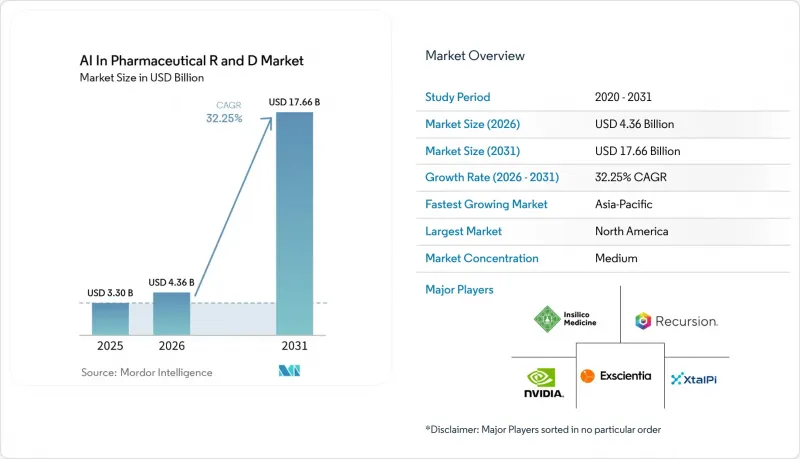
Mordor Intelligence에 의하면, 제약 연구개발(R&D) 분야 AI 시장 규모는 2025년에 33억 달러로 평가되었고, 2026년 43억 6,000만 달러로 추정되고, 2031년까지 176억 6,000만 달러에 이를 것으로 예측되며, 예측 기간(2026-2031년) CAGR은 32.25%를 나타낼 전망입니다.
본 보고서는 구성 요소별(소프트웨어, 서비스, 하드웨어), 기술별(머신러닝, 자연어 처리, 딥러닝/생성 학습), 용도별(타겟 ID, 히트-투-리드, 전임상/임상, 약물 최적화), 최종 사용자별(제약·바이오기술, CRO, 학술 기관, 기타), 지역별(북미, 유럽, 아시아태평양, 중동 및 아프리카, 남미)로 분류되어 있습니다. 예상치는 금액(달러)으로 표시되어 있습니다.
세계의 제약 연구개발 분야 AI 시장 동향 및 인사이트
바이오의약품 연구 개발 비용의 급등
JAMA의 추산에 따르면, 자본 비용과 프로그램 중도 탈락률을 고려할 때 신약을 시장에 출시하는 데 드는 평균 비용은 13억 1,000만 달러에 달할 전망입니다. 중소 바이오의약품 기업들은 상위 20개사와 비교해 37.6%의 비용 증가에 직면해 있으며, 이로 인해 의약품 개발 기간 단축이 매우 중요하다는 점이 부각되고 있습니다. AI 플랫폼은 단계 전환의 성공률을 높이고, 환자를 대상으로 한 임상시험 기간을 단축함으로써 이 과제를 해결하고 있습니다. 예를 들어, 인실리코 메디신(Insilico Medicine)은 불과 8개월 만에 전임상 후보 물질을 선정했습니다. 이는 기존의 2.5년에서 4년에 이르는 기간에 비해 대폭 단축된 것입니다. 이러한 발전으로 인해 제약 연구개발 분야의 비용 절감에 대한 AI에 대한 신뢰가 높아지고 있으며, 계약 구조에서도 개발 기간 단축과 연계된 마일스톤이 빈번하게 포함되고 있습니다.
생물의학 데이터의 급증
파운데이션 모델은 유전체학, 단백질체학, 영상 데이터, 전자건강기록(EHR) 등 다양한 데이터 세트에 의존하고 있습니다. 예를 들어, Recursion사는 20페타바이트 규모의 종양학 데이터에 대한 독점적 접근권을 확보함으로써, 자사의 총 데이터 보유량을 약 50페타바이트로 확대했습니다. 마찬가지로, IBM의 연구는 10억 건이 넘는 저분자 화합물 및 단백질 서열을 활용해 모델을 학습시켰으며, Xaira의 X-Cell은 2,560만 건의 단일 세포 전사체 데이터에서 도출된 49억 개의 매개변수를 활용하고 있습니다. 이러한 데이터 세트의 확대와 다양화는 모델의 일반화 능력을 높여, 지금까지 테스트되지 않은 표적이나 경로에 대한 예측을 가능하게 합니다. 이러한 추세는 클라우드 컴퓨팅에 대한 지속적인 투자를 촉진하고 있으며, 제약 연구개발 분야 AI 시장에서 전문 인프라 제공업체의 사업 기회를 더욱 확대되고 있습니다.
데이터 품질 및 표준화의 과제
일관성 없는 어노테이션, 누락된 메타데이터, 그리고 비표준 식별자는 모델의 일반화 능력을 약화시킵니다. 규제 당국은 현재 모든 데이터 처리 단계에 대해 추적 가능한 문서화와 한계에 대한 명확한 인식을 요구하고 있습니다. 페데레이티드 프로젝트(Federated Project)와 같은 공동 이니셔티브는 파트너 간에 온톨로지를 표준화함으로써 이러한 과제를 해결하고 있습니다. 또한, 중국의 ‘2025 디지털·지능형 변혁 계획’과 같은 국가 전략은 데이터 품질을 향상시키기 위해 통일된 데이터 표준과 지역 데이터 허브의 구축을 목표로 하고 있습니다. 그러나 시대에 뒤떨어진 시험 방법이나 데이터에 충분히 반영되지 않은 집단과 같은 과제는 여전히 큰 장애물로 남아 있으며, 이에 적절히 대처할 때까지 제약 연구 개발 분야에서 AI의 성장을 제한할 가능성이 있습니다.
부문별 분석
2025년, 소프트웨어는 제약 연구개발 분야 AI 시장에서 57.34%라는 압도적인 점유율을 차지했습니다. RecursionOS와 같은 통합 플랫폼은 표적 발굴부터 임상시험 시뮬레이션에 이르는 전 과정을 관리하며, 매주 수백만 장의 페노믹스 이미지를 처리하고 36페타바이트 규모의 독자적인 데이터를 저장하고 있습니다. Exscientia의 플랫폼은 1차 인간 조직 분석을 설계 과정에 통합하고 있으며, 이 회사 경영진은 기존 동물 모델에 비해 임상적 관련성을 높인다고 주장하고 있습니다. 이 강력한 플랫폼에 대한 충성도는 지속적인 라이선스 수익을 창출하며, 제약 연구개발 분야 AI 시장 성장세를 뒷받침하고 있습니다.
서비스 부문은 현재 시장 점유율이 낮지만, 2031년까지 연평균 성장률(CAGR) 32.55%라는 견실한 성장이 예상됩니다. 의약품 개발 수탁 기관(CRO)은 AI를 활용한 피험자 모집 모듈과 적응형 임상시험 설계를 도입함으로써 자사 서비스의 차별화를 꾀하고 있습니다. 스폰서들이 고정비보다 변동비를 선호하는 경향이 강해짐에 따라, AI 기능의 외부 위탁 도입이 확대되고, 제약 연구개발 분야에서 AI 시장의 침투가 더욱 깊어질 것으로 예측됩니다.
2025년에는 머신러닝이 기술 매출의 45.45%를 차지했으며, ADME-Tox 예측, 바이오마커 발견, 환자 세분화 등 주요 프로세스를 주도했습니다. 지도 학습 알고리즘은 특히 라벨이 지정된 데이터가 풍부한 경우, 여전히 신뢰할 수 있는 기법으로 자리 잡고 있습니다.
생성 학습은 가장 빠르게 성장하는 분야로 부상하고 있으며, 2031년까지의 연평균 성장률(CAGR)은 32.79%로 예측됩니다. AlphaFold 3의 혁신적인 확산법은 단백질-리간드 예측 능력을 대폭 강화하여 정확도를 50% 향상시켰습니다. Exscientia사가 AI로 생성한 여섯 번째 분자가 2023년에 임상시험에 진입하면서, 이 기술에 있어 획기적인 순간이 되었습니다. 트랜스포머나 확산 네트워크와 같은 기술의 발전으로 인해 항체, RNA 치료제, PROTAC 등이 생성되게 되었으며, 생성형 프레임워크는 제약 R&D 분야의 AI 시장 상황을 재정의하게 될 것입니다.
지역별 분석
2025년, 북미는 매출의 48.45%를 차지했습니다. 이는 보스턴에서 샌디에이고에 이르는 생명공학 집적지와, AI의 신뢰성에 관한 FDA의 초기 지침에 힘입은 결과입니다. 2024년에는 벤처 투자자들이 AI 신약 개발 관련 거래에 약 100억 달러를 투자했으며, 그중 5건의 거래 규모가 10억 달러를 넘어섰습니다. 이 지역의 연산 능력을 보여주는 예로, Recursion사의 슈퍼컴퓨터 ‘BioHive-2’에는 504개의 NVIDIA H100 GPU가 탑재되어 있습니다. 이러한 요인들이 복합적으로 작용하여, 북미는 제약 연구개발 분야에서 AI 주도 혁신의 벤치마크 시장으로서의 입지를 확고히 하고 있습니다.
유럽은 북미에 이어 규제 당국의 개입이 두드러집니다. MELLODDY 등 연방 학습(Federated Learning) 관련 프로젝트에서는 GDPR(EU 개인정보보호규정) 요건 준수가 중요하게 여겨지고 있습니다. EMA(유럽의약품청)의 검토 문서는 제품의 전체 수명 주기에 걸친 상세한 지침을 제공합니다. 또한, 민관 협력 및 ‘호라이즌 유럽’의 자금 지원을 통해 초기 단계의 벤처 기업이 육성되고 있으며, 제약 연구개발 분야 AI 시장에서 유럽의 중요성이 유지되고 있습니다.
아시아태평양은 가장 빠르게 성장하고 있는 지역으로, 2031년까지의 연평균 성장률(CAGR)은 34.00%로 전망됩니다. 중국의 디지털·지능형 변혁 계획은 2030년까지 전면적인 이행을 목표로 하고 있으며, 여기에는 100곳의 디지털 의약품 시범 공장과 10곳의 대규모 모델 혁신 허브가 포함됩니다. 인도는 의약품 개발 수탁 기관(CRO)을 대상으로 비용 효율적인 데이터 사이언스 인재를 제공하고 있는 반면, 일본은 정밀의료 보조금을 활용하여 임상 인프라의 현대화를 추진하고 있습니다. 라틴아메리카 및 중동 및 아프리카(MEA) 지역은 컴퓨팅 자원과 규제 체계 면에서 뒤처져 있지만, 브라질과 아랍에미리트(UAE)에서 진행 중인 시범 프로젝트는 꾸준한 진전을 보이고 있으며, 제약 연구개발 분야에서 AI의 세계 확산을 확대되고 있습니다.
기타 혜택 :
- 엑셀 형식 시장 예측(ME) 시트
- 3개월간의 애널리스트 지원
자주 묻는 질문
목차
제1장 서론
제2장 조사 방법
제3장 주요 요약
제4장 시장 구도
제5장 시장 규모 및 성장 예측
제6장 경쟁 구도
제7장 시장 기회 및 향후 전망
AJY 26.06.26According to Mordor Intelligence, the aI in pharmaceutical r & d market size was valued at USD 3.30 billion in 2025 and is estimated to grow from USD 4.36 billion in 2026 to reach USD 17.66 billion by 2031, at a CAGR of 32.25% during the forecast period (2026-2031).
This report is Segmented by Component (Software, Services, Hardware), Technology (Machine Learning, NLP, Deep / Generative Learning), Application (Target ID, Hit-To-Lead, Preclinical / Clinical, Drug Optimisation), End User (Pharma & Biotech, Cros, Academic Institutes, Others) and Geography (North America, Europe, APAC, MEA, South America). Forecasts in Value (USD).
Global AI In Pharmaceutical R & D Market Trends and Insights
Soaring Costs in Biopharma R&D
JAMA estimates that the average cost of bringing a drug to market is USD 1.31 billion, accounting for capital costs and program attrition. Smaller biopharma firms face a 37.6% cost premium compared to the top 20 companies, highlighting the critical need to reduce drug development timelines. AI platforms are addressing this challenge by improving phase-transition success rates and shortening patient trial durations. For instance, Insilico Medicine identified a preclinical candidate in just eight months, significantly faster than the traditional 2.5 to 4-year timeframe. These advancements are increasing confidence in AI's ability to reduce costs in pharmaceutical R&D, with deal structures now frequently incorporating milestones tied to accelerated timelines.
Surge in Biomedical Data Volumes
Foundation models depend on diverse data sets, including genomics, proteomics, imaging, and electronic health records (EHRs). Recursion, for example, has gained exclusive access to 20 petabytes of oncology data, increasing its total data holdings to approximately 50 petabytes. Similarly, IBM Research trains its models on over a billion small molecules and protein sequences, while Xaira's X-Cell leverages 4.9 billion parameters derived from 25.6 million single-cell transcriptomes. The expansion and diversity of these data sets enhance model generalization, enabling predictions for previously untested targets or pathways. This trend is driving continuous investments in cloud computing, further expanding opportunities for specialized infrastructure providers in the AI-driven pharmaceutical R&D market.
Data Quality & Standardization Gaps
Inconsistent annotations, missing metadata, and non-standard identifiers weaken the generalizability of models. Regulatory bodies now require traceable documentation for every data-processing step and explicit acknowledgment of limitations. Collaborative initiatives, such as federated projects, are addressing these gaps by standardizing ontologies across partners. Additionally, national strategies, like China's digital-intelligent transformation plan for 2025, aim to establish unified data standards and regional data hubs to improve data quality. However, challenges such as outdated assays and underrepresented populations remain significant obstacles that could limit the growth of the AI in pharmaceutical R&D market until adequately addressed.
Other drivers and restraints analyzed in the detailed report include:
- Surge in Pharma-AI Collaborations & Funding
- Regulatory Embrace of AI in R&D
- Shortage of AI-Skilled Life-Science Talent
For complete list of drivers and restraints, kindly check the Table Of Contents.
Segment Analysis
In 2025, software captured a dominant 57.34% share of the AI in pharmaceutical R&D market. Integrated platforms like RecursionOS manage processes ranging from target discovery to clinical-trial simulations, processing millions of phenomics images weekly and storing 36 petabytes of proprietary data. Exscientia's platform integrates primary human-tissue assays into design loops, which management asserts enhances clinical relevance compared to traditional animal models. This strong platform loyalty drives recurring license revenue and supports the growth trajectory of the AI in pharmaceutical R&D market.
While services currently hold a smaller market share, they are projected to grow at a robust 32.55% CAGR through 2031. Contract Research Organizations (CROs) are differentiating their offerings by incorporating AI-driven patient-recruitment modules and adaptive-trial designs. As sponsors increasingly prefer variable costs over fixed ones, the adoption of outsourced AI capabilities is expected to expand, deepening their penetration in the AI in pharmaceutical R&D market.
In 2025, machine learning accounted for 45.45% of technology revenue, driving key processes such as ADME-Tox prediction, biomarker discovery, and patient stratification. Supervised algorithms continue to be dependable, particularly when labeled data is abundant.
Generative learning is emerging as the fastest-growing segment, with a remarkable 32.79% CAGR projected through 2031. AlphaFold 3's innovative diffusion method has significantly enhanced protein-ligand predictions, improving accuracy by 50%. Exscientia's sixth AI-generated molecule entered clinical trials in 2023, marking a pivotal moment for the technology. With advancements like transformer and diffusion networks now crafting antibodies, RNA therapeutics, and PROTACs, generative frameworks are set to redefine the AI in pharmaceutical R&D market landscape.
Geography Analysis
In 2025, North America accounted for 48.45% of the revenue, driven by biotech clusters spanning Boston to San Diego and early FDA guidance on AI credibility. In 2024, venture investors directed nearly USD 10 billion into AI drug-discovery deals, with five transactions exceeding USD 1 billion. Demonstrating the region's computational capabilities, Recursion's BioHive-2 supercomputer features 504 NVIDIA H100 GPUs. These factors collectively establish North America as the benchmark market for AI-driven innovation in pharmaceutical R&D.
Europe, while following North America, demonstrates strong regulatory involvement. Federated learning initiatives, such as MELLODDY, emphasize compliance with GDPR requirements. The EMA's reflection paper provides detailed guidance across the product life cycle. Additionally, public-private partnerships and Horizon Europe funding foster early-stage ventures, maintaining Europe's relevance in the AI pharmaceutical R&D market.
Asia-Pacific is the fastest-growing region, with a projected CAGR of 34.00% through 2031. China's digital-intelligent transformation plan aims for full implementation by 2030, including 100 pilot digital drug factories and 10 large-model innovation hubs. India offers cost-efficient data-science talent for Contract Research Organizations (CROs), while Japan utilizes precision-medicine grants to modernize its clinical infrastructure. Although Latin America and the Middle East & Africa (MEA) lag in computational resources and regulatory frameworks, pilot projects in Brazil and the UAE indicate gradual progress, expanding the global footprint of AI in pharmaceutical R&D.
- Absci Corporation
- Alphabet Inc. (DeepMind / Isomorphic Labs)
- Atomwise
- BenevolentAI S.A.
- Berg Health (BPGbio)
- BioSymetrics
- Cloud Pharmaceuticals
- Deep Genomics Inc.
- Exscientia plc
- GNS Healthcare (Aitia)
- Healx
- Iktos
- Insilico Medicine IP Limited
- insitro
- IBM
- NVIDIA
- Owkin
- Recursion Pharmaceuticals
- Relay Therapeutics
- Schrodinger
- Standigm
- Valo Health
- Verge Genomics
- XtalPi
Additional Benefits:
- The market estimate (ME) sheet in Excel format
- 3 months of analyst support
TABLE OF CONTENTS
1 Introduction
- 1.1 Study Assumptions & Market Definition
- 1.2 Scope of the Study
2 Research Methodology
3 Executive Summary
4 Market Landscape
- 4.1 Market Overview
- 4.2 Market Drivers
- 4.2.1 Escalating Biopharma R&D Costs
- 4.2.2 Expanding Biomedical Data Volumes
- 4.2.3 Pharma-AI Partnerships & Funding Surge
- 4.2.4 Regulatory Openness to AI in R&D
- 4.2.5 Emergence of Foundation Bio-Models
- 4.2.6 Growth of Federated?Learning Data Corridors
- 4.3 Market Restraints
- 4.3.1 Data Quality & Standardization Gaps
- 4.3.2 Shortage of AI-Skilled Life-Science Talent
- 4.3.3 IP Ambiguity for AI-Generated Molecules
- 4.3.4 Rising GPU / Cloud Compute Costs
- 4.4 Value / Supply-Chain Analysis
- 4.5 Regulatory Landscape
- 4.6 Technological Outlook
- 4.7 Porter's Five Forces Analysis
- 4.7.1 Threat of New Entrants
- 4.7.2 Bargaining Power of Suppliers
- 4.7.3 Bargaining Power of Buyers
- 4.7.4 Threat of Substitute Products
- 4.7.5 Competitive Rivalry
5 Market Size & Growth Forecasts (Value, USD)
- 5.1 By Component
- 5.1.1 Software
- 5.1.2 Services
- 5.1.3 Hardware
- 5.2 By Technology
- 5.2.1 Machine Learning
- 5.2.2 Natural Language Processing
- 5.2.3 Deep / Generative Learning
- 5.3 By Application
- 5.3.1 Target Identification & Validation
- 5.3.2 Hit Generation & Lead Optimisation
- 5.3.3 Preclinical / Clinical Testing
- 5.3.4 Drug Optimisation & Repurposing
- 5.4 By End User
- 5.4.1 Pharmaceutical & Biotechnology Companies
- 5.4.2 Contract Research Organisations
- 5.4.3 Academic & Research Institutes
- 5.4.4 Others
- 5.5 By Geography
- 5.5.1 North America
- 5.5.1.1 United States
- 5.5.1.2 Canada
- 5.5.1.3 Mexico
- 5.5.2 Europe
- 5.5.2.1 Germany
- 5.5.2.2 United Kingdom
- 5.5.2.3 France
- 5.5.2.4 Italy
- 5.5.2.5 Spain
- 5.5.2.6 Rest of Europe
- 5.5.3 Asia-Pacific
- 5.5.3.1 China
- 5.5.3.2 Japan
- 5.5.3.3 India
- 5.5.3.4 Australia
- 5.5.3.5 South Korea
- 5.5.3.6 Rest of Asia-Pacific
- 5.5.4 Middle East & Africa
- 5.5.4.1 GCC
- 5.5.4.2 South Africa
- 5.5.4.3 Rest of Middle East & Africa
- 5.5.5 South America
- 5.5.5.1 Brazil
- 5.5.5.2 Argentina
- 5.5.5.3 Rest of South America
- 5.5.1 North America
6 Competitive Landscape
- 6.1 Market Concentration
- 6.2 Market Share Analysis
- 6.3 Company Profiles (includes Global level Overview, Market level overview, Core Segments, Financials as available, Strategic Information, Market Rank/Share for key companies, Products & Services, and Recent Developments)
- 6.3.1 Absci Corporation
- 6.3.2 Alphabet Inc. (DeepMind / Isomorphic Labs)
- 6.3.3 Atomwise
- 6.3.4 BenevolentAI S.A.
- 6.3.5 Berg Health (BPGbio)
- 6.3.6 BioSymetrics
- 6.3.7 Cloud Pharmaceuticals, Inc.
- 6.3.8 Deep Genomics Inc.
- 6.3.9 Exscientia plc
- 6.3.10 GNS Healthcare (Aitia)
- 6.3.11 Healx
- 6.3.12 Iktos
- 6.3.13 Insilico Medicine IP Limited
- 6.3.14 insitro
- 6.3.15 International Business Machines Corporation
- 6.3.16 NVIDIA
- 6.3.17 Owkin
- 6.3.18 Recursion Pharmaceuticals
- 6.3.19 Relay Therapeutics
- 6.3.20 Schrodinger
- 6.3.21 Standigm
- 6.3.22 Valo Health
- 6.3.23 Verge Genomics
- 6.3.24 XtalPi
7 Market Opportunities & Future Outlook
- 7.1 White-space & Unmet-Need Assessment