
|
시장보고서
상품코드
2063887
파이프라인 서비스 시장 : 점유율 분석, 업계 동향과 통계, 성장 예측(2026-2031년)Pipeline Services - Market Share Analysis, Industry Trends & Statistics, Growth Forecasts (2026 - 2031) |
||||||
 Mordor Intelligence
Mordor Intelligence에 의하면, 파이프라인 서비스 시장 규모는 2025년 452억 8,000만 달러, 2026년 477억 3,000만 달러에서 2031년까지 648억 7,000만 달러로 확대되어 2026년부터 2031년까지 연평균 복합 성장률(CAGR)은 6.33%를 나타낼 것으로 예측됩니다.
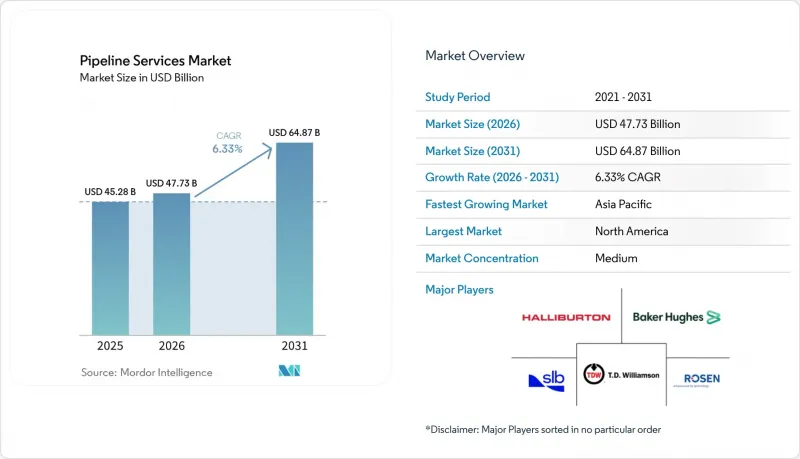
본 보고서는 서비스 유형(시운전 전, 건전성 관리·감시, 유지보수, 폐로 조치 등), 파이프라인 유형(석유, 천연가스, 정제 제품, 물 및 산업용), 용도(석유 및 가스 등), 그리고 지역(북미, 유럽, 아시아·태평양, 남미, 중동 및 아프리카)별로 분류되어 있습니다. 시장 전망은 금액(달러) 기준으로 제시되어 있습니다.
세계 파이프라인 서비스 시장 동향 및 인사이트
세계 석유 및 가스 수요의 확대가 파이프라인 네트워크 확장을 주도하고 있습니다.
사우디 아람코의 88억 달러 규모의 ‘마스터 가스 시스템 3단계’와, 에너지 트랜스퍼의 21억 달러 규모 ‘퍼미안 애디션’과 같은 메가 프로젝트를 통해 수천 킬로미터에 달하는 집배관 및 수송 파이프라인이 추가됨에 따라, 정수압 시험 및 지능형 피그ging에 관한 수십 년에 걸친 서비스 계약이 확정되었습니다. 동남아시아에서는 트랜스-아세안(Trans-ASEAN) 프레임워크가 2030년까지 4,500킬로미터의 상호 연결 파이프라인 구축을 목표로 하고 있으며, 이를 위해서는 누출 검사에서 오감지율 1% 미만을 달성할 수 있는 시운전 전 전문가가 필요합니다. 서아프리카에서 계획 중인 나이지리아-모로코 간 가스 파이프라인은 13개국을 가로지르며 총 5,660킬로미터에 달하는 것으로, 전 세계적으로 신규 건설 활동이 확대되고 있음을 여실히 보여주고 있습니다. 이러한 각 노선에서는 사막, 열대 기후, 해안 횡단 구간을 극복하기 위해 개별적인 자재 선정, 응력 기반 설계 및 지속적인 건전성 모니터링이 필요합니다. 엔지니어링, 센서 설치, 규제 대응을 통합적으로 제공할 수 있는 공급업체야말로 이 새로운 수요의 물결을 최대한 활용할 수 있는 입장에 있습니다.
수명 연장 서비스가 필요한 노후화된 파이프라인 자산
미국 천연가스 수송 파이프라인의 약 65%는 1970년 이전에 부설된 것이며, 평균 자산 연수가 40년을 넘는 유럽의 북해 파이프라인망도 비슷한 상황입니다. 파이프라인 내부 검사 데이터에 따르면, 응력 부식 균열 및 용접 비드 결함이 확인되었으며, 이를 해결하지 않으면 파열이 발생할 우려가 있습니다. 엠브리지사의 53억 달러 규모의 간선 파이프라인 교체 사업과 인도의 12억 달러 규모의 해상 파이프라인 건전성 프로그램은 이에 투입되는 막대한 자본을 여실히 보여주고 있습니다. 복합재를 이용한 보강, 광섬유 음향 센싱, 예측 분석을 통해 자산 수명을 15-20년 연장함으로써, 수십억 달러에 달하는 갱신 비용 지출을 미루고 있습니다. 규제 압력도 커지고 있습니다. PHMSA는 현재 중대 사고 발생 위험이 높은 구역에 대해 5년마다 점검을 의무화하고 있으며, 데이터 기반 유지보수 도입을 가속화하고 있습니다. 손해 이력 지표에 연동된 보험료 역시 예방적 검사 주기의 정착을 더욱 뒷받침하고 있습니다.
높은 서비스 비용과 가동 중단 시간의 영향
대구경 파이프라인의 인라인 검사는 1마일당 평균 1만 8,000-2만 5,000달러가 소요되며, 여기에 동원비와 데이터 분석비가 30-40% 추가되기 때문에 규모의 경제를 누릴 수 없는 중견 기업들에게는 큰 부담이 되고 있습니다. 일일 50만 배럴 규모의 원유 파이프라인에서 72시간 동안 가동이 중단될 경우, 배럴당 72달러로 계산하면 3,600만 달러의 수송량 손실에 해당합니다. 따라서 운영 담당자는 이익률이 높은 기간에는 중요도가 낮은 운행을 연기하도록 권고받고 있습니다. API 1169 인증 검사원의 급여는 12만-16만 달러에 달하며, 결원율이 18%를 넘어서면서 도급업체의 요금이 상승하고 있습니다. 원유 가격 변동으로 인해 2024년 북미 미드스트림 부문의 설비 투자가 120억 달러 규모로 연기되었으며, 최적화 프로젝트 예산이 축소되고 있습니다. 공급업체가 일정 수준의 성과 위험을 부담하는 성과 기반 계약이 점차 보급되고 있지만, 소규모 운영업체들 사이에서는 아직 널리 퍼지지 않았습니다.
부문별 분석
2025년, 운영사들이 신규 건설보다 수명 연장을 우선시함에 따라, 유지보수 부문은 파이프라인 처리 및 파이프라인 서비스 시장의 56.9%를 차지했습니다. 복합 랩, 핫탭 격리, 클라우드 분석을 통해 막대한 가동 중단을 방지하면서 수리 주기를 단축하고 있습니다. 피그 검사 데이터와 토양 부식 지도를 결합한 예측 알고리즘을 통해, 사업자는 위험 임계치에 도달할 때까지 비긴급 굴착 작업을 연기할 수 있게 됩니다. 수소 및 CO2 파이프라인의 보급에 따라, 질소 퍼지 및 진공 건조를 중심으로 한 시운전 전 서비스 시장 점유율이 확대되고 있지만, 그 기반은 여전히 미미한 수준입니다. 무결성 관리 서비스는 중대한 영향을 미치는 지역에서 5년마다 검사를 의무화하는 PHMSA 규정의 혜택을 받고 있습니다.
검사 서비스는 지속적으로 발전하고 있으며, 서브mm 단위의 검출 정밀도 덕분에 오감지율이 낮아져, 보수 조치를 연기할 수 있다는 확신을 가지고 판단할 수 있게 되었습니다. 북해에서는 로봇을 이용한 절단 및 해저 잔해 제거를 통해 40년이 지난 파이프라인이 폐쇄되는 등, 폐쇄 조치가 주목을 받고 있습니다. 로봇 기술, AI 강화형 센서, 클라우드 시각화를 통합할 수 있는 공급업체는 평균 복구 시간을 35% 단축했으며, 그 결과 수년에 걸친 종합적 서비스 계약을 체결하고 있습니다. 그 결과, 유지보수와 관련된 파이프라인 처리 및 파이프라인 서비스 시장 규모는 전 세계 보수 예산의 확대에 발맞추어 증가할 것으로 전망됩니다.
지역별 분석
북미는 2025년에 전 세계 매출의 36.3%를 차지해, 309억 달러 규모의 트랜스 마운틴 확장 사업과 엠브리지사의 메인라인 교체 사업이 이를 뒷받침하고 있습니다. 이 지역에는 270만 마일의 파이프라인이 가동 중이며, 그중 65%는 1970년 이전에 부설된 것으로, 부식 방지 대책이 지출 계획의 핵심을 이루고 있습니다. PHMSA의 새로운 규정에 따라, 중대한 영향을 미치는 지역에서는 6개월마다 메탄 조사를 실시해야 하며, 광학식 가스 이미징 드론 및 광섬유 센싱 기술의 도입이 가속화되고 있습니다. 통합형 공급업체는 디지털 트윈을 활용하여 수년에 걸친 건전성 관리 계약을 수주하고 있는 반면, 틈새 시장 전문 기업들은 더 이상 필요하지 않게 된 해상 파이프라인의 해체 작업을 수주하고 있습니다.
중국이 1만 5,000킬로미터의 간선 파이프라인을 신설하고, 인도가 450킬로미터에 달하는 메사나-바틴다 구간의 건설을 완료함에 따라, 아시아태평양은 2031년까지 7.8%라는 가장 높은 성장률을 기록할 전망입니다. 트랜스-아세안 가스 회랑과 인도네시아의 도시 상수도망 개보수 사업으로 인해 누수 감지 및 무굴착 개보수에 대한 수요가 증가하고 있습니다. 호주의 해양 사업자는 심해 타이백을 대상으로 자율형 검사 차량의 실증 실험을 실시하여 사이클 타임을 40% 단축했습니다. 지역 규제 당국은 누출 배출 기준을 강화하며, 사업자들에게 지속적인 모니터링 플랫폼 도입을 권장하고 있습니다.
유럽에서는 노후화된 탄화수소 자산과 에너지 전환 프로젝트 간의 균형을 맞추고 있습니다. 복합재 피복 및 전기화학적 보호를 통해 북해 파이프라인의 수명을 최대 20년까지 연장할 수 있는 반면, HyNet North West나 MosaHYc와 같은 수소 회랑에서는 새로운 세척 기술과 재료 적합성 확인이 요구되고 있습니다. 독일의 OGE가 진행한 개조 사례는 목표가 명확한 투자를 통해 기존 파이프라인을 2년 이내에 수소 대응이 가능하도록 만들 수 있음을 보여주고 있습니다. 한편, 나이지리아에서 모로코까지 총 길이 5,660킬로미터에 달하는 가스 수송 파이프라인은 견고한 무결성 관리 프로그램이 필요한 메가 프로젝트에 대한 중동 및 아프리카 수요가 높다는 점을 여실히 보여주고 있습니다. 남미에서는 규모는 작지만, 브라질의 프레솔트층 개발과 아르헨티나의 바카 무에르타 셰일층 개발로 인해 해저 파이프라인의 무결성 관리 및 가스 집하 시스템 설치가 촉진되고 있습니다.
기타 혜택:
- 엑셀 형식 시장 예측(ME) 시트
- 3개월간의 애널리스트 지원
자주 묻는 질문
목차
제1장 서론
제2장 조사 방법
제3장 주요 요약
제4장 시장 구도
제5장 시장 규모와 성장 예측
제6장 경쟁 구도
제7장 시장 기회와 향후 전망
JHS 26.06.23According to Mordor Intelligence, the pipeline services market size is projected to expand from USD 45.28 billion in 2025 and USD 47.73 billion in 2026 to USD 64.87 billion by 2031, registering a CAGR of 6.33% between 2026 to 2031.
This report is Segmented by Service Type (Pre-Commissioning, Integrity Management and Monitoring, Maintenance, Decommissioning, and More), Pipeline Type (Oil, Natural-Gas, Refined-Product, and Water and Industrial), Application (Oil and Gas, and More), and Geography (North America, Europe, Asia-Pacific, South America and Middle Easrt and Africa). The Market Forecasts are Provided in Terms of Value (USD).
Global Pipeline Services Market Trends and Insights
Growing Global Oil and Gas Demand Driving Pipeline Network Expansion
Mega-projects such as Saudi Aramco's USD 8.8 billion Master Gas System Phase 3 and Energy Transfer's USD 2.1 billion Permian addition are adding thousands of kilometers of gathering and transmission lines, locking in multi-decade service contracts for hydrostatic testing and intelligent pigging . In Southeast Asia, the Trans-ASEAN framework targets 4,500 kilometers of interconnected pipelines by 2030, which will require pre-commissioning specialists able to achieve sub-1% false-call rates during leak checks . West Africa's planned Nigeria-Morocco Gas Pipeline stretches 5,660 kilometers across 13 countries, underscoring the global reach of new-build activity. Each of these corridors demands bespoke material selection, strain-based design, and continuous integrity monitoring to navigate deserts, tropical climates, and coastal crossings. Vendors capable of bundling engineering, sensor deployment, and regulatory support are best positioned to capitalize on the emerging capacity wave.
Aging Pipeline Assets Requiring Life-Extension Services
Roughly 65% of U.S. natural-gas transmission lines were installed before 1970, a profile mirrored by Europe's North Sea grid, where average asset age exceeds 40 years. Inline inspection data reveal stress-corrosion cracking and seam-weld flaws that, left unaddressed, can trigger ruptures. Enbridge's USD 5.3 billion Mainline replacement and India's USD 1.2 billion offshore integrity program illustrate the capital at stake. Composite wraps, fiber-optic acoustic sensing, and predictive analytics are extending asset life by 15-20 years, deferring billions in replacement outlays. Regulatory pressure is rising: PHMSA now mandates high-consequence area inspections every 5 years, accelerating adoption of data-driven maintenance. Insurance premiums tied to loss-history metrics further reinforce proactive inspection cycles.
High Service Cost and Downtime Impact
Large-diameter inline inspections average USD 18,000-25,000 per mile, with mobilization and data analysis adding 30-40%, a burden for midstream firms lacking scale economies. A 72-hour outage on a 500,000 bpd crude line equates to USD 36 million in lost throughput at USD 72 per barrel, incentivizing operators to defer non-critical runs during high-margin periods. Certified API 1169 inspectors command USD 120,000-160,000 salaries, and vacancy rates top 18%, inflating contractor rates. Volatile oil prices deferred USD 12 billion in North American midstream capital outlays in 2024, narrowing budgets for optimization projects. Outcome-based agreements, where vendors absorb some performance risk, are gaining ground but have yet to scale across smaller operators.
Other drivers and restraints analyzed in the detailed report include:
- Operational-Efficiency Push Through Inline Inspection and Pigging Analytics
- Emergence of Hydrogen and CO2 Pipelines Requiring Novel Cleaning and Commissioning
- Stringent HSE and Environmental Compliance Burden
For complete list of drivers and restraints, kindly check the Table Of Contents.
Segment Analysis
The maintenance segment accounted for 56.9% of the pipeline processing and pipeline services market in 2025 as operators prioritized life-extension over greenfield builds. Composite wraps, hot-tap isolation, and cloud analytics compress repair cycles while avoiding costly shutdowns. Predictive algorithms that blend pigging data with soil-corrosion maps enable operators to delay non-critical digs until risk thresholds are met. Pre-commissioning, centered on nitrogen purging and vacuum drying, is gaining share as hydrogen and CO2 lines proliferate, though from a smaller base. Integrity management services benefit from PHMSA rules mandating five-year inspection intervals in high-consequence areas.
Inspection services continue to evolve, with sub-millimeter detection lowering false-positive rates and enabling confident deferment of remediation. Decommissioning is emerging in the North Sea, where 40-year-old lines are retired via robotic cutting and subsea debris removal. Vendors able to integrate robotics, AI-enhanced sensors, and cloud visualization cut mean-time-to-repair by 35% and are rewarded with multi-year master service agreements. As a result, the pipeline processing and pipeline services market size tied to maintenance is forecast to rise in lockstep with global refurbishment budgets.
Geography Analysis
North America contributed 36.3% of global revenue in 2025, underpinned by the USD 30.9 billion Trans Mountain expansion and Enbridge's Mainline replacement. The region operates 2.7 million miles of pipelines, 65% of which were laid before 1970, placing corrosion mitigation at the center of spending plans. New PHMSA rules mandate methane surveys every six months in high-consequence areas, accelerating the adoption of optical-gas-imaging drones and fiber-optic sensing. Integrated providers leverage digital twins to win multi-year integrity deals, while niche firms capture decommissioning scopes for redundant offshore lines.
Asia-Pacific posts the quickest growth at 7.8% through 2031 as China adds 15,000 kilometers of trunk lines and India completes the 450-kilometer Mehsana-Bhatinda section. The Trans-ASEAN gas corridor and Indonesia's city-water overhaul drive demand for leak-detection and trenchless rehabilitation. Offshore operators in Australia experiment with autonomous inspection vehicles for deepwater tie-backs, cutting cycle time by 40%. Regional regulators tighten fugitive-emission standards, nudging operators toward continuous-monitoring platforms.
Europe balances aging hydrocarbon assets with energy-transition projects. Composite wraps and electrochemical protection extend North Sea pipelines by up to 20 years, while the HyNet North West and MosaHYc hydrogen corridors require novel cleaning and material-compatibility checks. Germany's OGE retrofit demonstrates how targeted investment can make legacy lines hydrogen-ready within two years. Meanwhile, Nigeria's 5,660-kilometer gas link to Morocco underscores the Middle East and Africa's appetite for mega-projects that demand robust integrity programs. South America remains smaller, yet Brazil's pre-salt developments and Argentina's Vaca Muerta shale spur subsea integrity and gathering-system installations.
- Baker Hughes Company
- Halliburton Company
- Schlumberger Limited (SLB)
- ROSEN Group
- T.D. Williamson Inc.
- EnerMech Group
- IKM Gruppen AS
- Altus Intervention
- Penspen Limited
- LIN SCAN
- A.Hak Industrial Services
- NDT Global
- Quest Integrity
- Enduro Pipeline Services
- Dacon Inspection Services
- Onstream Pipeline Inspection
- Applus+
- SGS SA
- Intertek Group
- Gulf Interstate Engineering
Additional Benefits:
- The market estimate (ME) sheet in Excel format
- 3 months of analyst support
TABLE OF CONTENTS
1 Introduction
- 1.1 Study Assumptions & Market Definition
- 1.2 Scope of the Study
2 Research Methodology
3 Executive Summary
4 Market Landscape
- 4.1 Market Overview
- 4.2 Market Drivers
- 4.2.1 Growing global oil & gas demand; pipeline network expansion
- 4.2.2 Rising cross-border pipeline CAPEX & EPC contracts
- 4.2.3 Aging pipeline assets needing life-extension services
- 4.2.4 Operational-efficiency push: inline inspection, pigging analytics
- 4.2.5 Emergence of hydrogen & CO2 pipelines needing novel cleaning/commissioning
- 4.3 Market Restraints
- 4.3.1 High service cost & downtime impact
- 4.3.2 Stringent HSE & environmental compliance burden
- 4.3.3 Volatile crude & gas prices deferring O&M budgets
- 4.3.4 Skilled-labour shortage for advanced pigging/robotics
- 4.4 Supply-Chain Analysis
- 4.5 Regulatory Landscape
- 4.6 Technological Outlook
- 4.7 Porter's Five Forces
- 4.7.1 Threat of New Entrants
- 4.7.2 Bargaining Power of Buyers
- 4.7.3 Bargaining Power of Suppliers
- 4.7.4 Threat of Substitutes
- 4.7.5 Competitive Rivalry
5 Market Size & Growth Forecasts
- 5.1 By Service Type
- 5.1.1 Pre-commissioning
- 5.1.2 Integrity Management and Monitoring
- 5.1.3 Inspection (Pigging, Flushing and Chemical Cleaning, Hydrostatic Testing, Drying, and Others)
- 5.1.4 Maintenance (Including Repair, Replace, etc.)
- 5.1.5 Decommissioning
- 5.2 By Pipeline Type
- 5.2.1 Oil Pipelines
- 5.2.2 Natural-Gas Pipelines
- 5.2.3 Refined-Product Pipelines
- 5.2.4 Water and Industrial Pipelines
- 5.3 By Application
- 5.3.1 Oil and Gas
- 5.3.2 Chemicals and Petrochemicals
- 5.3.3 Water and Waste-water Utilities
- 5.3.4 Other Applications
- 5.4 By Geography
- 5.4.1 North America
- 5.4.1.1 United States
- 5.4.1.2 Canada
- 5.4.1.3 Mexico
- 5.4.2 Europe
- 5.4.2.1 Germany
- 5.4.2.2 United Kingdom
- 5.4.2.3 France
- 5.4.2.4 Italy
- 5.4.2.5 NORDIC Countries
- 5.4.2.6 Russia
- 5.4.2.7 Rest of Europe
- 5.4.3 Asia-Pacific
- 5.4.3.1 China
- 5.4.3.2 India
- 5.4.3.3 Japan
- 5.4.3.4 South Korea
- 5.4.3.5 ASEAN Countries
- 5.4.3.6 Australia and New Zealand
- 5.4.3.7 Rest of Asia-Pacific
- 5.4.4 South America
- 5.4.4.1 Brazil
- 5.4.4.2 Argentina
- 5.4.4.3 Colombia
- 5.4.4.4 Rest of South America
- 5.4.5 Middle East and Africa
- 5.4.5.1 Saudi Arabia
- 5.4.5.2 United Arab Emirates
- 5.4.5.3 South Africa
- 5.4.5.4 Nigeria
- 5.4.5.5 Algeria
- 5.4.5.6 Rest of Middle East and Africa
- 5.4.1 North America
6 Competitive Landscape
- 6.1 Market Concentration
- 6.2 Strategic Moves (M&A, Partnerships, PPAs)
- 6.3 Market Share Analysis (Market Rank/Share for key companies)
- 6.4 Company Profiles (includes Global level Overview, Market level overview, Core Segments, Financials as available, Strategic Information, Products & Services, and Recent Developments)
- 6.4.1 Baker Hughes Company
- 6.4.2 Halliburton Company
- 6.4.3 Schlumberger Limited (SLB)
- 6.4.4 ROSEN Group
- 6.4.5 T.D. Williamson Inc.
- 6.4.6 EnerMech Group
- 6.4.7 IKM Gruppen AS
- 6.4.8 Altus Intervention
- 6.4.9 Penspen Limited
- 6.4.10 LIN SCAN
- 6.4.11 A.Hak Industrial Services
- 6.4.12 NDT Global
- 6.4.13 Quest Integrity
- 6.4.14 Enduro Pipeline Services
- 6.4.15 Dacon Inspection Services
- 6.4.16 Onstream Pipeline Inspection
- 6.4.17 Applus+
- 6.4.18 SGS SA
- 6.4.19 Intertek Group
- 6.4.20 Gulf Interstate Engineering
7 Market Opportunities & Future Outlook
- 7.1 White-space & unmet-need assessment