

|
시장보고서
상품코드
2063988
의료 분야 원자간력 현미경 시장 : 시장 점유율 분석, 업계 동향 및 통계, 성장 예측(2026-2031년)Atomic Force Microscopy In Healthcare - Market Share Analysis, Industry Trends & Statistics, Growth Forecasts (2026 - 2031) |
||||||
 Mordor Intelligence
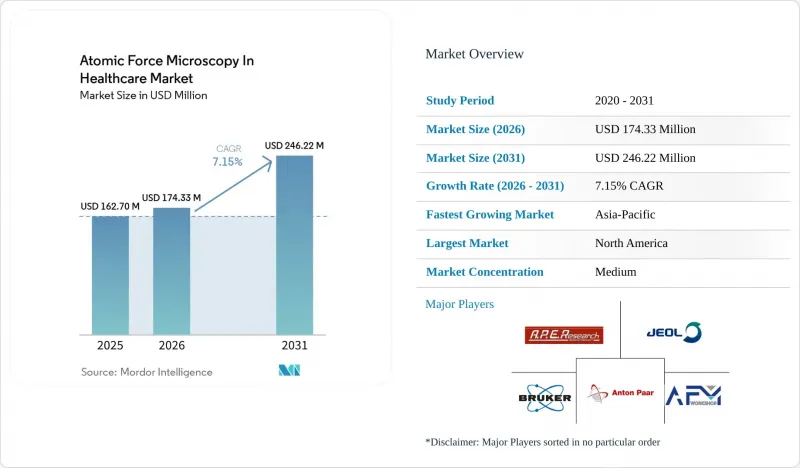
Mordor Intelligence에 의하면, 의료 분야 원자간력 현미경(AFM) 시장 규모는 2025년 1억 6,270만 달러로 평가되었고, 2026년에는 1억 7,433만 달러로 추정되며, 2031년까지 2억 4,622만 달러에 이를 것으로 예측됩니다.
2026-2031년 연평균 성장률(CAGR) 7.15%로 성장할 것으로 전망됩니다.
본 보고서는 제공 유형별(AFM 장비 등), 용도별(세포 및 조직 역학 등), 최종 사용자별(학술 및 연구 기관 등), 지역별(북미, 유럽, 아시아태평양, 중동 및 아프리카, 남미)로 분류되어 있습니다. 시장 전망은 금액(달러) 기준으로 제시되어 있습니다.
세계의 의료 분야 원자간력 현미경 시장 동향 및 인사이트
바이오의약품, 나노입자 및 바이오로직스의 특성 평가에 대한 수요
의료 분야 원자간력 현미경(AFM) 시장은 지질 나노입자를 활용한 약물 전달 기술의 통합과 개발 단계에서 단일 나노입자의 해상도에 대한 수요가 증가함에 따라 확대되고 있습니다. AFM 데이터는 지질 나노입자 내 mRNA의 코일 구조 등 상세한 구조적 정보를 제공하며, 다른 기법의 성능을 능가합니다. 브루커(Bruker)사의 Dimension 플랫폼에 탑재된 AFM-IR 기능은 약물의 질량 분율 정량 능력을 향상시켜, 단일 장비로서 경쟁 우위를 제공합니다. 제제 개발 초기 단계에서 AFM-IR을 도입하면 배치 간 불균일성을 파악하는 데 도움이 되며, 후기 단계에서 재제제화의 위험을 줄일 수 있습니다.
나노의료 분야의 공공 및 민간 연구개발 자금 증가
공공 및 기관의 투자가 의료 분야 원자간력 현미경 시장 성장을 주도하고 있습니다. 중국은 2025년에 ‘국가 멀티모드 트랜스스케일 생의학 영상 센터’를 설립하여, 종양 및 뇌 연구를 위한 첨단 분자 영상에 주력하고 있습니다. 인도는 ‘Vigyan Dhara’ 계획 및 ‘MAHA MedTech Mission’을 통해 나노 소재 및 생명공학 분야에 대한 자금 지원을 확대하고, 고정밀 영상 기술을 지원하고 있습니다. 이러한 노력은 연구 기관의 조달 주기를 강화하고, 학술 기관 및 수탁 서비스 제공업체 수요를 촉진하고 있습니다.
높은 초기 비용과 프로브 교체에 따른 부담
원자간력 현미경(AFM)의 높은 비용은 특히 주요 바이오의약품 거점이나 연구센터를 제외한 의료 시장에서 여전히 도입을 제한하고 있습니다. 고성능 AFM 플랫폼을 구축하려면 막대한 초기 투자가 필요하며, 특수 프로브에 드는 지속적인 비용은 소규모 연구소나 병원 부서에게 부담이 되고 있습니다. 2026년 1월, Tanzhen Nano Technology사는 드라이 에칭 방식을 이용한 AFM 프로브의 생산 확대를 위해 1,000만 위안 이상을 조달했습니다. 이 회사는 품질을 유지하면서 비용을 30-40% 절감하는 것을 목표로 하고 있습니다. 그러나 이러한 노력은 중국 내 프로브 비용 문제를 해결하는 것이지, 장비 구입, 서비스 계약 및 교육과 관련된 광범위한 재정적 부담을 경감시키는 것은 아닙니다. 신흥 시장의 소규모 CRO나 연구소 역시 장비 가격의 10-15%에 해당하는 연간 유지보수 비용에 직면해 있으며, 이것이 도입을 더욱 가로막고 있습니다.
부문별 분석
2025년, AFM 장비는 의료 분야 원자간력 현미경(AFM) 시장에서 45.35%의 점유율을 차지했으며, 이는 제약, 생명공학, 학술 분야에서의 수익 확대에 있어 자본 설비가 얼마나 중요한지를 여실히 보여주고 있습니다. 하드웨어가 시장을 독점하고 있는 배경에는 이러한 시스템의 복잡성이 있습니다. 차세대 장비는 고성능 이미징 모드, 저잡음화, 시료 호환성 향상을 실현하여 연구실의 업그레이드를 촉진하고 있습니다. 예를 들어, 옥스포드 기기는 2025년 5월에 ‘Jupiter Discovery AFM’을 출시했습니다. 이 제품은 25피코미터 미만의 노이즈 플로어와 대폭 향상된 스캔 속도를 특징으로 합니다. 프로브와 캔틸레버는 힘 분광법이나 나노 인덴테이션 작업 과정에서 빈번하게 사용되기 때문에 여전히 신뢰할 수 있는 수익원입니다.
소프트웨어 및 분석 분야는 2031년까지 연평균 성장률(CAGR) 8.12%를 나타낼 것으로 예측되며, 의료 분야 원자간력 현미경 시장에서 가장 빠르게 성장하는 부문이 될 것입니다. 이러한 성장은 자동화된 힘-변위 곡선 분석과 AI를 활용한 이미지 해석에 힘입어 이루어지고 있으며, 전문 운영자에 대한 의존도를 낮추고 있습니다. 오픈 프레임워크와 벤더 고유의 도구가 편의성을 높여주면서, 데이터 사이언스자와 제제 개발 팀의 관심을 끌고 있습니다. 이러한 변화로 인해 고객이 데이터 관리 및 분석을 위해 특정 소프트웨어 환경에 의존하게 되면서, 전환 비용이 증가하고 있습니다.
지역별 분석
2025년, 북미는 의료 분야 원자간력 현미경(AFM) 시장의 41.20%를 차지했습니다. 이는 바이오의약품 분야의 혁신 기업들이 밀집해 있고, 성숙한 연구 생태계가 구축되어 있으며, 기계생물학 및 약물 전달 분야에서 풍부한 연구 지원금이 제공되고 있기 때문입니다. 개발자들이 LNP(리포좀 나노입자) 기반 치료제의 개발 과정에 AFM-IR을 통합함에 따라, 미국이 지역 수요를 주도하고 있습니다. 한편, 캐나다는 학술 분야에서의 기여를 강화하고 있으며, 멕시코는 수탁 연구 및 제조 관련 활동을 지원하고 있습니다. 브루커사는 자사의 매출액 34억 4,000만 달러 중 미국 내 매출이 26%를 차지했다고 보고했으며, 이는 과학 기기 분야에서 북미의 구매력을 여실히 보여주고 있습니다.
유럽은 의료 분야 원자간력 현미경(AFM)의 지역 시장 규모에서 2위를 차지하고 있으며, 공공 자금을 통한 관련 AFM 연구에서 주도적인 위치를 유지하고 있습니다. 독일과 영국이 장비 개발의 중심이 되고 있는 반면, 프랑스, 이탈리아, 스페인에서는 AFM-IR 및 멀티모달 시스템의 도입이 확대되고 있습니다. 보르도 대학은 기계생물학 및 암 연구를 위해, 브루커(Bruker)사의 BioScope 장비를 포함한 4대의 AFM 시스템을 결합한 VibrAFM 플랫폼을 운영하고 있습니다. 미슈콜츠 대학교는 2025년 9월, AFM 라만 FLIM 시스템을 도입했습니다. 이는 전 세계에 단 3대밖에 없는 플랫폼 중 하나이며, 유럽 내 첨단 시스템에 대한 수요를 반영하고 있습니다.
아시아태평양은 중국, 일본, 인도, 한국의 정부 주도의 인프라 구축, 확대되는 나노의료 연구, 그리고 대규모 기관들의 조달에 힘입어 2031년까지 연평균 성장률(CAGR) 8.55%를 나타낼 것으로 예측되며, 이는 모든 지역 중 가장 높은 성장률입니다. 2억 3,700만 달러가 투자된 중국의 ‘국가 멀티모드 트랜스스케일 생의학 영상 센터’는 2025년 3월, 해당 지역에서 중요한 이정표가 되었습니다. 일본은 교토대학 및 나고야대학을 통해 고속 AFM 연구를 추진하고 있는 반면, 인도의 9,000만 달러 규모의 ‘MAHA MedTech Mission’은 첨단 영상 시스템에 대한 접근성을 높이고 있습니다. 중동 및 아프리카와 남미는 여전히 신흥 시장이며, 공공 기관과 수입 금융에 힘입어 GCC 국가, 남아프리카공화국, 브라질에 수요가 집중되고 있습니다.
기타 혜택 :
- 엑셀 형식 시장 예측(ME) 시트
- 3개월간의 애널리스트 지원
자주 묻는 질문
목차
제1장 서론
제2장 조사 방법
제3장 주요 요약
제4장 시장 구도
제5장 시장 규모 및 성장 예측
제6장 경쟁 구도
제7장 시장 기회 및 향후 전망
AJY 26.06.24According to Mordor Intelligence, the atomic force microscopy in healthcare market size is expected to increase from USD 162.70 million in 2025 to USD 174.33 million in 2026 and reach USD 246.22 million by 2031, growing at a CAGR of 7.15% over 2026-2031.
This report is Segmented by Offering (AFM Instruments, and More), by Application (Cellular and Tissue Mechanics, and More), by End User (Academic and Research Institutions, and More), and Geography (North America, Europe, Asia-Pacific, Middle East and Africa, South America). The Market Forecasts are Provided in Terms of Value (USD).
Global Atomic Force Microscopy In Healthcare Market Trends and Insights
Biopharma Nanoparticle and Biologics Characterization Demand
The atomic force microscopy market in healthcare is advancing due to the integration of lipid nanoparticle drug delivery and the need for single nanoparticle resolution in development. AFM data provides detailed structural insights, such as mRNA coiling within lipid nanoparticles, surpassing the capabilities of other methods. Bruker's AFM-IR feature on the Dimension platform enhances drug mass fraction quantification, offering a competitive edge over standalone tools. Early adoption of AFM-IR in formulation helps identify batch inconsistencies, reducing late-stage reformulation risks.
Rising Public and Private Nanomedicine R&D Funding
Public and institutional investments are driving growth in the atomic force microscopy market in healthcare. China launched its National Multimode Trans-Scale Biomedical Imaging Center in 2025, focusing on advanced molecular imaging for tumor and brain research. India increased funding for nanomaterials and biotechnology through its Vigyan Dhara scheme and MAHA MedTech Mission, supporting high-precision imaging technologies. These initiatives strengthen procurement cycles at research institutions, fueling demand from academic and contract service providers.
High Capital Cost and Probe Replacement Burden
The high costs of atomic force microscopy (AFM) continue to restrict its adoption in the healthcare market, particularly outside major biopharma sites and research centers. Premium AFM platforms require significant upfront investment, and recurring expenses for specialized probes pose challenges for smaller labs and hospital units. In January 2026, Tanzhen Nano Technology raised over CNY 10 million to scale dry etching-based AFM probe production, aiming to reduce costs by 30-40% while maintaining quality. However, this effort addresses probe costs in China but does not mitigate the broader financial burden of instrument purchases, service contracts, and training. Smaller CROs and labs in emerging markets also face annual service costs of 10-15% of the instrument's value, further hindering adoption.
Other drivers and restraints analyzed in the detailed report include:
- AI-Enabled Automation and Analysis for Easier AFM Adoption
- Label-Free Live-Cell and Biomolecular Interaction Imaging Demand
- Slow Throughput for Scaled Screening Workflows
For complete list of drivers and restraints, kindly check the Table Of Contents.
Segment Analysis
In 2025, AFM Instruments held a 45.35% share of the atomic force microscopy market in healthcare, highlighting the importance of capital equipment in driving revenue across pharmaceutical, biotech, and academic sectors. The dominance of hardware reflects the complexity of these systems, with each new generation offering advanced imaging modes, reduced noise levels, and enhanced sample compatibility, encouraging lab upgrades. For instance, Oxford Instruments launched the Jupiter Discovery AFM in May 2025, featuring a noise floor under 25 picometers and significantly faster scan rates. Probes and cantilevers remain a reliable revenue stream due to their frequent use in force spectroscopy and nanoindentation workflows.
Software and analytics are projected to grow at an 8.12% CAGR through 2031, making it the fastest-growing segment in the atomic force microscopy market for healthcare. This growth is driven by automated force curve analysis and AI-guided image interpretation, reducing reliance on expert operators. Open frameworks and vendor-specific tools are broadening usability, attracting data scientists and formulation teams. This shift increases switching costs, as customers become reliant on specific software environments for data management and analysis.
Geography Analysis
In 2025, North America accounted for 41.20% of the atomic force microscopy (AFM) market in healthcare, driven by a high concentration of biopharma innovators, a mature research ecosystem, and robust grant funding in mechanobiology and drug delivery. The U.S. leads regional demand as developers integrate AFM-IR into workflows for LNP-based therapeutics, while Canada strengthens academic contributions, and Mexico supports contract research and manufacturing-linked activities. Bruker reported that U.S. revenues represented 26% of its USD 3.44 billion turnover, highlighting North America's purchasing power in scientific instruments.
Europe ranked as the second-largest regional market for atomic force microscopy in healthcare, maintaining leadership in publicly funded correlative AFM research. Germany and the U.K. anchor instrument development, while France, Italy, and Spain expand AFM-IR and multimodal system installations. The University of Bordeaux operates a VibrAFM platform with four coupled AFM systems, including Bruker BioScope instruments, for mechanobiology and cancer research. The University of Miskolc installed an AFM Raman FLIM system in September 2025, one of only three such platforms globally, reflecting Europe's demand for advanced systems.
Asia-Pacific is projected to grow at an 8.55% CAGR through 2031, the fastest among all regions, supported by government-backed infrastructure, expanding nanomedicine research, and large-scale institutional procurements in China, Japan, India, and South Korea. China's National Multimode Trans-Scale Biomedical Imaging Center, with a USD 237 million investment, became a major regional milestone in March 2025. Japan advances high-speed AFM research through Kyoto and Nagoya Universities, while India's MAHA MedTech Mission, valued at USD 90 million, facilitates access to advanced imaging systems. The Middle East, Africa, and South America remain emerging markets, with demand concentrated in GCC countries, South Africa, and Brazil, driven by public institutions and import financing.
- A.P.E. Research S.r.l.
- AFMWorkshop, LLC
- Anton Paar
- attocube systems AG
- Bruker
- CSInstruments
- DME Scanning Probe Microscopes
- Hitachi
- HORIBA Ltd.
- JEOL Ltd.
- Molecular Vista, Inc.
- NanoMagnetics Instruments Ltd.
- Nanonics Imaging Ltd.
- Nanoscience Instruments
- Nanosurf AG
- NT-MDT Spectrum Instruments
- Oxford Instruments
- Park Systems Corporation
- RHK Technology, Inc.
- Semilab Inc.
Additional Benefits:
- The market estimate (ME) sheet in Excel format
- 3 months of analyst support
TABLE OF CONTENTS
1 Introduction
- 1.1 Study Assumptions & Market Definition
- 1.2 Scope of the Study
2 Research Methodology
3 Executive Summary
4 Market Landscape
- 4.1 Market Overview
- 4.2 Market Drivers
- 4.2.1 Biopharma Nanoparticle and Biologics Characterization Demand
- 4.2.2 Rising Public and Private Nanomedicine R&D Funding
- 4.2.3 AI-Enabled Automation and Analysis for Easier AFM Adoption
- 4.2.4 Label-Free Live-Cell and Biomolecular Interaction Imaging Demand
- 4.2.5 Correlative AFM With Raman and Fluorescence Workflows
- 4.2.6 Biomaterials and Medical-Device Surface Nanomechanics Demand
- 4.3 Market Restraints
- 4.3.1 High Capital Cost and Probe Replacement Burden
- 4.3.2 Slow Throughput for Scaled Screening Workflows
- 4.3.3 Inter-Lab Reproducibility Gaps in Live-Cell Nanomechanics
- 4.3.4 Limited Clinical Validation of AFM-Derived Biomarkers
- 4.4 Value / Supply-Chain Analysis
- 4.5 Regulatory Landscape
- 4.6 Technological Outlook
- 4.7 Porter's Five Forces Analysis
- 4.7.1 Threat of new entrants
- 4.7.2 Bargaining power of suppliers
- 4.7.3 Bargaining power of buyers
- 4.7.4 Threat of substitutes
- 4.7.5 Competitive rivalry
5 Market Size & Growth Forecasts (Value, USD)
- 5.1 By Offering
- 5.1.1 AFM Instruments
- 5.1.2 Probes and Cantilevers
- 5.1.3 Software and Analytics
- 5.1.4 Services
- 5.2 By Application
- 5.2.1 Cellular and Tissue Mechanics
- 5.2.2 Biomolecular Imaging and Force Spectroscopy
- 5.2.3 Drug Discovery and Formulation Characterization
- 5.2.4 Biomaterials and Medical Device Surface Analysis
- 5.2.5 Microbiology, Virology, and Biofilms
- 5.2.6 Clinical Diagnostics and Biosensing Research
- 5.3 By End User
- 5.3.1 Academic and Research Institutions
- 5.3.2 Pharmaceutical and Biotechnology Companies
- 5.3.3 Hospitals and Clinical Research Centers
- 5.3.4 Contract Research Organizations
- 5.3.5 Medical Device and Biomaterials Companies
- 5.4 By Geography
- 5.4.1 North America
- 5.4.1.1 United States
- 5.4.1.2 Canada
- 5.4.1.3 Mexico
- 5.4.2 Europe
- 5.4.2.1 Germany
- 5.4.2.2 United Kingdom
- 5.4.2.3 France
- 5.4.2.4 Italy
- 5.4.2.5 Spain
- 5.4.2.6 Rest of Europe
- 5.4.3 Asia-Pacific
- 5.4.3.1 China
- 5.4.3.2 India
- 5.4.3.3 Japan
- 5.4.3.4 South Korea
- 5.4.3.5 Australia
- 5.4.3.6 Rest of Asia-Pacific
- 5.4.4 Middle East and Africa
- 5.4.4.1 GCC
- 5.4.4.2 South Africa
- 5.4.4.3 Rest of Middle East and Africa
- 5.4.5 South America
- 5.4.5.1 Brazil
- 5.4.5.2 Argentina
- 5.4.5.3 Rest of South America
- 5.4.1 North America
6 Competitive Landscape
- 6.1 Market Concentration
- 6.2 Market Share Analysis
- 6.3 Company Profiles (includes Global level Overview, Market level overview, Core Segments, Financials as available, Strategic Information, Market Rank/Share for key companies, Products & Services, and Recent Developments)
- 6.3.1 A.P.E. Research S.r.l.
- 6.3.2 AFMWorkshop, LLC
- 6.3.3 Anton Paar GmbH
- 6.3.4 attocube systems AG
- 6.3.5 Bruker Corporation
- 6.3.6 CSInstruments
- 6.3.7 DME Scanning Probe Microscopes
- 6.3.8 Hitachi High-Tech Corporation
- 6.3.9 HORIBA Ltd.
- 6.3.10 JEOL Ltd.
- 6.3.11 Molecular Vista, Inc.
- 6.3.12 NanoMagnetics Instruments Ltd.
- 6.3.13 Nanonics Imaging Ltd.
- 6.3.14 Nanoscience Instruments
- 6.3.15 Nanosurf AG
- 6.3.16 NT-MDT Spectrum Instruments
- 6.3.17 Oxford Instruments plc
- 6.3.18 Park Systems Corporation
- 6.3.19 RHK Technology, Inc.
- 6.3.20 Semilab Inc.
7 Market Opportunities & Future Outlook
- 7.1 White-space & Unmet-Need Assessment


