

|
시장보고서
상품코드
2064353
당단백질 시장 : 점유율 분석, 업계 동향과 통계, 성장 예측(2026-2031년)Glycoprotein - Market Share Analysis, Industry Trends & Statistics, Growth Forecasts (2026 - 2031) |
||||||
 Mordor Intelligence
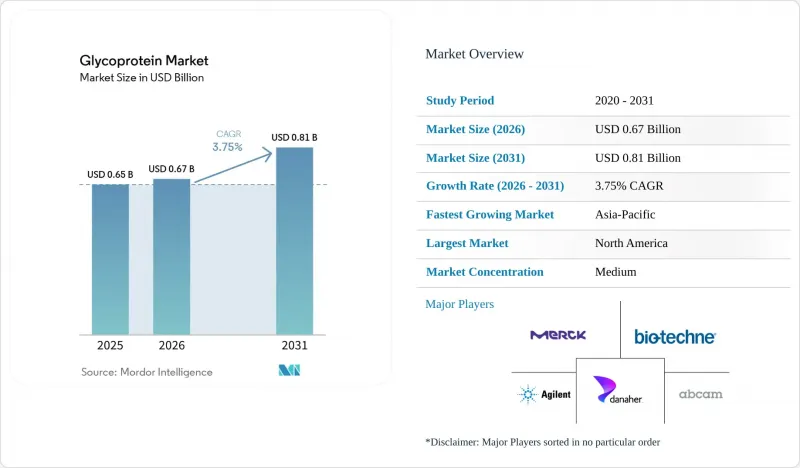
Mordor Intelligence에 의하면, 당단백질 시장 규모는 2025년 6억 5,000만 달러에서 2026년에는 6억 7,000만 달러로 확대되어 2026년부터 2031년까지 CAGR 3.75%로 성장을 지속하여, 2031년까지 8억 1,000만 달러에 이를 것으로 예측됩니다.
본 보고서는 제품 유형(재조합, 천연, 합성, 반합성), 당사슬 변형 유형(N-결합형, O-결합형, 혼합형, 희귀형), 용도(치료제, 진단제, 신약 개발·연구), 최종 사용자(제약·바이오기술 기업, 학술 기관, CRO/CDMO, 병원), 지역(북미, 유럽, 아시아태평양, 중동 및 아프리카, 남미)별로 분류되어 있습니다. 시장 전망은 금액(달러) 기준으로 제시되어 있습니다.
세계 당단백질 시장 동향 및 분석
mAb, Fc 융합 단백질 및 백신용 당단백질에 대한 수요 증가가 단기적인 성장을 견인
단일클론 항체, Fc 융합 단백질, 백신 및 당사슬 특이적 항체-약물 복합체(ADC)가 당단백질 시장 수요를 견인하고 있습니다. 이러한 제제는 개발 및 출하 시험 과정에서 당사슬 구조에 대한 엄격한 관리가 필요합니다. Fc-당사슬 특이적 항체-약물 복합체는 임상시험에서 진전을 보이고 있으며, JSKN003이나 IBI343과 같은 후보 물질은 신약 개발 단계를 넘어선 당사슬 결합형 표적 치료의 진전을 보여주고 있습니다. 이 치료 분야의 성장세는 설계된 업스트림 공정의 원료, 정제 워크플로우 및 다운스트림 공정의 특성 평가 서비스에 대한 수요를 끌어올려 시장의 수익 기반을 확대되고 있습니다.
만성 질환의 부담 증가로 인해 당단백질 치료제 및 바이오마커의 도입이 가속화되고 있습니다.
만성 질환 및 비감염성 질환의 유병률이 증가함에 따라, 효소 보충제, 당단백질 호르몬 유사체, 면역 표적 바이오의약품 등 당단백질을 기반으로 한 치료법에 대한 수요가 높아지고 있습니다. 이 모든 것들은 최적의 기능을 발휘하기 위해 특정 당사슬 프로파일에 의존하고 있습니다. 또한, 당단백질의 변이가 중요한 질환 지표로 인식됨에 따라 진단법의 중요성도 높아지고 있습니다. DGlyTAC을 활용한 전임상 연구 결과, PD-L1에서 N-글리칸을 제거함으로써 항종양 효과가 나타나는 것으로 밝혀졌으며, 이는 기존의 체크포인트 억제 요법과는 다른 새로운 치료 접근법을 시사했습니다. 이러한 연구 결과는 시장의 상업적 잠재력을 높여, 기준 생물학적 제제의 대체에 그치지 않고 더 많은 환자층을 대상으로 하는 새로운 종양학 프로그램으로 확대되고 있습니다.
높은 제조·정제 비용이 시장 확대의 걸림돌이 되고 있습니다.
제조 비용은 당단백질 시장에서 중대한 과제로 대두되고 있습니다. 특히, 가격 변동의 영향을 받기 쉬운 환경에 있는 기업, 충분한 자금 지원 없이 신규 프로그램을 확대하려는 기업의 경우 그 영향이 두드러집니다. Sartorius사와 Sanofi사의 연구에 따르면, 막 기반 다운스트림 공정의 비용이 1그램당 35유로(40.60달러)인 반면, 수지 기반 크로마토그래피는 1그램당 65유로(75.39달러)이며, 처리 능력이 29배 향상된 것으로 밝혀졌습니다. 그러나 그 도입은 여전히 자금력이 있는 대규모 시설에 집중되어 있습니다. ICH 준수 실무 및 FDA 지침에서는 스케일업 시 당사슬 구조, 비교 가능성, 공정의 일관성을 포괄하는 광범위한 특성 평가 패키지가 요구되고 있으며, 이러한 규제 요건으로 인해 비용이 더욱 증가하고 있습니다. 이러한 비용은 소규모 바이오시밀러 개발 기업이나 신흥 시장의 CDMO에 불균형적인 영향을 미치고 있으며, 수요 환경이 양호함에도 불구하고 생산 능력 확대를 지연시키고 있습니다.
부문별 분석
2025년, 재조합 당단백질은 당단백질 시장 점유율의 45.60%를 차지했습니다. 이는 확립된 CHO 세포 인프라와, 승인된 생물학적 제제의 대부분이 재조합 생산 방식에 의존하고 있기 때문입니다. 천연형 당단백질은 분석용 표준물질이나 초기 조사에서 여전히 중요하지만, 재조합형과 비교하면 수요 기반이 작고 분산되어 있습니다. 유전자 재조합 제품은 특히 반복 구매나 적합성 평가 작업이 필요한 규제 대상 치료제 제조 분야에서 단기적인 수익을 견인하고 있습니다.
합성 및 반합성 당단백질 시장은 2026년부터 2031년까지 연평균 성장률(CAGR) 4.10%를 기록하며 성장할 것으로 예상되며, 가장 빠르게 성장하는 제품 유형이 될 전망입니다. 대장균에서 DmPglB의 활용이나 식물 유래 N-글리칸 리모델링과 같은 당공학의 발전으로 인해, 자본 집약적인 포유류 시스템에 대한 의존도가 낮아지고 생산 기반이 다양화되고 있습니다.
N-결합형 당단백질은 기능, 방출 시험 및 비교 평가에서 IgG 단일클론 항체가 수행하는 중요한 역할에 힘입어 2025년에는 시장 점유율의 48.75%를 차지했습니다. 이러한 우위는 다수의 시판 중인 바이오의약품의 품질 문서 및 규제 당국에 제출된 신청 자료에 반영되어 있음으로써 더욱 공고해지고 있습니다.
O-결합형 당단백질은 2026년부터 2031년까지 연평균 성장률(CAGR) 4.45%를 나타낼 것으로 예측되며, 가장 빠르게 성장하는 당사슬 변형 유형이 될 전망입니다. 연구소에서는 N-글리칸 프로파일을 넘어서는 번역 후 변형을 매핑하는 워크플로우의 도입이 증가하고 있으며, 이는 규제 대상 워크플로우에서 여러 당사슬 클래스를 특성 분석할 수 있는 장비 및 소프트웨어에 대한 수요를 이끌고 있습니다.
지역별 분석
2025년, 북미는 당단백질 시장의 41.61%를 차지했습니다. 이는 활발한 바이오의약품 제조, CRO(의약품 개발 수탁 기관)의 강력한 입지, 그리고 분석 장비 공급업체의 대규모 기반에 힘입은 결과입니다. FDA의 바이오시밀러 비교 가능성에 관한 지침에 따르면, 최소 10개 로트의 참조 제품을 사용한 당사슬 평가가 의무화되어 있어, 당사슬 분석 인프라는 필수적인 투자로 자리 잡고 있습니다. 2026년, 서모피셔는 단일클론 항체 바이오리액터에서 연속 라만 공정 분석 기술을 검증하여, 역가를 10% 향상시키고 당화 현상을 60% 감소시키는 데 성공했습니다. 이러한 발전은 제품 수요와 첨단 제조 역량을 바탕으로 한 북미의 선도적 위상을 여실히 보여주고 있습니다.
아시아태평양은 2026년부터 2031년까지 연평균 성장률(CAGR) 4.20%를 나타낼 것으로 예측되며, 당단백질 시장에서 가장 빠르게 성장하는 지역이 될 전망입니다. 잘트리아스사는 2025년 아시아태평양의 바이오프로세스 관련 매출이 9.0% 증가했다고 보고했으며, 이는 설비 및 공정 인프라에 대한 투자 확대를 반영한 것입니다. 이러한 성장은 해당 지역이 저비용 생산에 그치지 않고, 보다 광범위한 제조 및 분석 기반으로 전환되고 있음을 보여줍니다.
2025년에는 유럽, 중동 및 아프리카, 남미가 합쳐서 나머지 당단백질 시장 점유율을 차지하고 있으며, 확립된 바이오시밀러 및 분석 규정 준수 생태계를 배경으로 유럽이 주도적인 입지를 차지하고 있습니다. 유럽의 비교 가능성 및 글리칸 핑거프린팅에 관한 전문 지식은 개발 및 수명 주기 관리 전반에 걸쳐 안정적인 수요를 보장합니다. 중동 및 아프리카는 개발 초기 단계에 있으며, 선별적인 의료 투자가 진단 및 특수 생물학적 제제 분야의 역량을 강화하고 있습니다. 남미 역시 초기 단계에 있으며, 학술 및 공공 연구 이니셔티브가 향후 글리코단백질체학 및 바이오시밀러 활동의 기반을 마련하고 있습니다.
기타 혜택:
- 엑셀 형식 시장 예측(ME) 시트
- 3개월간의 애널리스트 지원
자주 묻는 질문
목차
제1장 서론
제2장 조사 방법
제3장 주요 요약
제4장 시장 구도
제5장 시장 규모와 성장 예측
제6장 경쟁 구도
제7장 시장 기회와 향후 전망
JHS 26.06.23According to Mordor Intelligence, the glycoprotein market size is expected to grow from USD 0.65 billion in 2025 to USD 0.67 billion in 2026 and is forecast to reach USD 0.81 billion by 2031 at 3.75% CAGR over 2026-2031.
This report is Segmented by Product Type (Recombinant, Native, Synthetic and Semi-Synthetic), Glycosylation Type (N-Linked, O-Linked, Mixed and Rare), Application (Therapeutics, Diagnostics, Drug Discovery and Research), End User (Pharma/Biotech, Academic Institutes, CROs/CDMOs, Hospitals), and Geography (North America, Europe, Asia-Pacific, MEA, South America). The Market Forecasts are Provided in Terms of Value (USD).
Global Glycoprotein Market Trends and Insights
Expanding mAb, Fc-fusion, and Vaccine Glycoprotein Demand Fuels Near-term Growth
Monoclonal antibodies, Fc-fusion proteins, vaccines, and glycan-directed antibody-drug conjugates are driving demand in the glycoprotein market. These formats rely on stringent glycan structure control during development and release testing. Fc-glycan-specific antibody-drug conjugates are advancing in clinical trials, with candidates like JSKN003 and IBI343 showcasing the progress of glycan-linked targeting beyond discovery stages. This therapeutic momentum boosts demand for engineered upstream inputs, purification workflows, and downstream characterization services, broadening the market's revenue base.
Rising Chronic-disease Burden Accelerates Glycoprotein Therapeutic and Biomarker Adoption
The increasing prevalence of chronic and non-communicable diseases is amplifying demand for glycoprotein-based therapies, including enzyme replacement products, glycoprotein hormone analogs, and immune-targeting biologics, all dependent on specific glycan profiles for optimal function. Diagnostics are also gaining importance as glycoprotein alterations are recognized as significant disease indicators. A preclinical DGlyTAC study highlighted anti-tumor effects from removing N-glycans from PD-L1, suggesting a novel treatment approach distinct from traditional checkpoint inhibition. Such findings enhance the market's commercial potential, expanding beyond reference biologics replacement to new oncology programs targeting larger patient demographics.
High Production and Purification Costs Constrain Market Expansion
Production costs pose a significant challenge in the glycoprotein market, particularly for companies in price-sensitive environments or those scaling new programs without substantial financial backing. A study by Sartorius and Sanofi highlighted that membrane-based downstream processing costs EUR 35 per gram (USD 40.60) compared to EUR 65 per gram (USD 75.39) for resin-based chromatography, with a 29-fold throughput improvement. However, adoption remains concentrated in larger, well-funded facilities. Regulatory requirements further escalate costs, as ICH-aligned practices and FDA guidelines demand extensive characterization packages covering glycan structure, comparability, and process consistency during scale-up. These costs disproportionately impact smaller biosimilar developers and emerging-market CDMOs, slowing capacity expansion despite favorable demand conditions.
Other drivers and restraints analyzed in the detailed report include:
- Advances in Glycoengineering and High-resolution Glycan Analytics Reshape the Production Frontier
- Precision-medicine Biomarker Discovery in Glycoproteomics Unlocks Long-term Diagnostic Revenue
- Glycosylation Heterogeneity Complicates Biosimilar Development and Approval
For complete list of drivers and restraints, kindly check the Table Of Contents.
Segment Analysis
In 2025, recombinant glycoproteins held 45.60% of the glycoprotein market share, driven by established CHO-cell infrastructure and the reliance of most approved biologics on recombinant production routes. Native glycoproteins remain relevant in analytical standards and early research but have a smaller and fragmented demand base compared to recombinant formats. Recombinant products dominate near-term revenue, particularly in regulated therapeutic manufacturing, which requires repeat purchasing and qualification work.
Synthetic and semi-synthetic glycoproteins are projected to grow at a 4.10% CAGR from 2026 to 2031, making them the fastest-growing product type. Advancements in glycoengineering, such as the use of DmPglB in E. coli and plant N-glycan remodeling, are reducing reliance on capital-intensive mammalian systems and diversifying the production base.
N-linked glycoproteins accounted for 48.75% of the market share in 2025, driven by their critical role in IgG monoclonal antibodies for function, release testing, and comparability assessments. Their dominance is reinforced by their inclusion in quality documentation for numerous marketed biologics and regulatory submissions.
O-linked glycoproteins are expected to grow at a 4.45% CAGR from 2026 to 2031, making them the fastest-growing glycosylation class. Laboratories are increasingly adopting workflows that map post-translational modifications beyond N-glycan profiles, driving demand for instruments and software capable of characterizing multiple glycan classes in regulated workflows.
Geography Analysis
In 2025, North America accounted for 41.61% of the glycoprotein market, driven by strong biologics manufacturing, a significant CRO presence, and a large base of analytical instrument suppliers. The FDA's biosimilar comparability guidance mandates glycan assessments using at least 10 reference product lots, making glycan analytics infrastructure a critical investment. In 2026, Thermo Fisher validated continuous Raman process analytical technology in monoclonal antibody bioreactors, achieving a 10% titer increase and a 60% reduction in glycation. These advancements highlight North America's leadership, supported by product demand and advanced manufacturing capabilities.
Asia-Pacific is projected to grow at a 4.20% CAGR from 2026 to 2031, making it the fastest-growing region in the glycoprotein market. Sartorius reported a 9.0% growth in bioprocess revenue in Asia/Pacific in 2025, reflecting increased investment in equipment and process infrastructure. This growth indicates the region's shift toward a broader manufacturing and analytics base, beyond low-cost production.
In 2025, Europe, the Middle East and Africa, and South America collectively held the remaining glycoprotein market share, with Europe leading due to its established biosimilar and analytical compliance ecosystem. Europe's expertise in comparability and glycan fingerprinting ensures steady demand across development and lifecycle management. The Middle East and Africa are in early development stages, with selective healthcare investments supporting diagnostic and specialty biologics capabilities. South America is also in its early stages, with academic and public research initiatives building a foundation for future glycoproteomics and biosimilar activities.
- Abcam
- Acro Biosystems
- Agilent Technologies
- Bio-Rad Laboratories
- Bio-Techne
- Bruker
- CD BioGlyco
- Creative Biolabs
- Creative Diagnostics
- Danaher
- Genscript
- Merck
- Polysciences, Inc.
- Promega
- Revvity
- Sartorius
- Shimadzu
- Takara Bio
- Thermo Fisher Scientific
- Waters Corporation
Additional Benefits:
- The market estimate (ME) sheet in Excel format
- 3 months of analyst support
TABLE OF CONTENTS
1 Introduction
- 1.1 Study Assumptions & Market Definition
- 1.2 Scope of the Study
2 Research Methodology
3 Executive Summary
4 Market Landscape
- 4.1 Market Overview
- 4.2 Market Drivers
- 4.2.1 Expanding mAb, Fc-Fusion, and Vaccine Glycoprotein Demand
- 4.2.2 Rising Chronic-Disease Demand for Glycoprotein Therapeutics and Biomarkers
- 4.2.3 Advances in Glycoengineering and High-Resolution Glycan Analytics
- 4.2.4 Precision-Medicine Biomarker Discovery in Glycoproteomics
- 4.2.5 Adoption of Real-Time Glycosylation PAT and MAM Workflows
- 4.2.6 Commercialization of Glycoproteomic Liquid-Biopsy Assays
- 4.3 Market Restraints
- 4.3.1 High Production and Purification Cost
- 4.3.2 Glycosylation Heterogeneity and Reproducibility Complexity
- 4.3.3 Stricter Biosimilar Comparability and Glycan Characterization Burden
- 4.3.4 Limited Glycan Reference Standards and Cross-Lab Harmonization
- 4.4 Value / Supply-Chain Analysis
- 4.5 Regulatory Landscape
- 4.6 Technological Outlook
- 4.7 Porter's Five Forces Analysis
- 4.7.1 Threat of New Entrants
- 4.7.2 Bargaining Power of Suppliers
- 4.7.3 Bargaining Power of Buyers
- 4.7.4 Threat of Substitutes
- 4.7.5 Intensity of Rivalry
5 Market Size & Growth Forecasts (Value, USD)
- 5.1 By Product Type
- 5.1.1 Recombinant Glycoproteins
- 5.1.2 Native Glycoproteins
- 5.1.3 Synthetic and Semi-synthetic Glycoproteins
- 5.2 By Glycosylation Type
- 5.2.1 N-linked Glycoproteins
- 5.2.2 O-linked Glycoproteins
- 5.2.3 Mixed and Rare Glycosylation Types
- 5.3 By Application
- 5.3.1 Therapeutics
- 5.3.2 Diagnostics
- 5.3.3 Drug Discovery and Research
- 5.4 By End User
- 5.4.1 Pharmaceutical and Biotechnology Companies
- 5.4.2 Academic and Research Institutes
- 5.4.3 CROs and CDMOs
- 5.4.4 Hospitals and Diagnostic Laboratories
- 5.5 By Geography
- 5.5.1 North America
- 5.5.1.1 United States
- 5.5.1.2 Canada
- 5.5.1.3 Mexico
- 5.5.2 Europe
- 5.5.2.1 Germany
- 5.5.2.2 United Kingdom
- 5.5.2.3 France
- 5.5.2.4 Italy
- 5.5.2.5 Spain
- 5.5.2.6 Rest of Europe
- 5.5.3 Asia-Pacific
- 5.5.3.1 China
- 5.5.3.2 India
- 5.5.3.3 Japan
- 5.5.3.4 South Korea
- 5.5.3.5 Australia
- 5.5.3.6 Rest of Asia-Pacific
- 5.5.4 Middle East and Africa
- 5.5.4.1 GCC
- 5.5.4.2 South Africa
- 5.5.4.3 Rest of Middle East and Africa
- 5.5.5 South America
- 5.5.5.1 Brazil
- 5.5.5.2 Argentina
- 5.5.5.3 Rest of South America
- 5.5.1 North America
6 Competitive Landscape
- 6.1 Market Concentration
- 6.2 Market Share Analysis
- 6.3 Company Profiles (includes Global level Overview, Market level overview, Core Segments, Financials as available, Strategic Information, Market Rank/Share for key companies, Products & Services, and Recent Developments)
- 6.3.1 Abcam plc
- 6.3.2 ACROBiosystems
- 6.3.3 Agilent Technologies
- 6.3.4 Bio-Rad Laboratories
- 6.3.5 Bio-Techne Corporation
- 6.3.6 Bruker Corporation
- 6.3.7 CD BioGlyco
- 6.3.8 Creative Biolabs
- 6.3.9 Creative Diagnostics
- 6.3.10 Danaher Corporation (Cytiva)
- 6.3.11 GenScript Biotech Corporation
- 6.3.12 Merck KGaA
- 6.3.13 Polysciences, Inc.
- 6.3.14 Promega Corporation
- 6.3.15 Revvity
- 6.3.16 Sartorius AG
- 6.3.17 Shimadzu Corporation
- 6.3.18 Takara Bio Inc.
- 6.3.19 Thermo Fisher Scientific Inc.
- 6.3.20 Waters Corporation
7 Market Opportunities & Future Outlook
- 7.1 White-space & unmet-need assessment


