|
시장보고서
상품코드
2064428
항이뇨제 : 시장 점유율 분석, 업계 동향 및 통계, 성장 예측(2026-2031년)Antidiuretic Drugs - Market Share Analysis, Industry Trends & Statistics, Growth Forecasts (2026 - 2031) |
||||||
 Mordor Intelligence
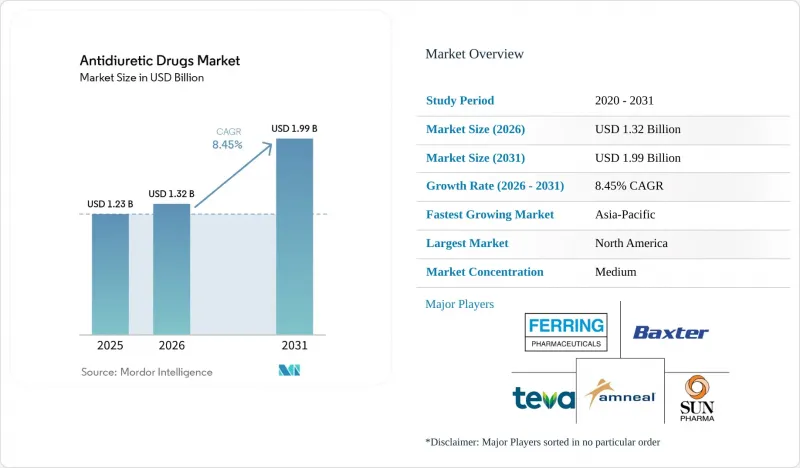
Mordor Intelligence에 의하면, 항이뇨제 시장 규모는 2025년에 12억 3,000만 달러로 평가되었습니다. 2026년에 13억 2,000만 달러에서 2031년까지 19억 9,000만 달러에 이를 것으로 예측되며, 2026-2031년 CAGR은 8.45%를 나타낼 전망입니다.
본 보고서는 약제의 유형(데스모프레신, 바소프레신, 텔리프레신, 리프레신, 기타), 투여 경로(경구, 비강 내, 주사제, 정맥 내, 피하/근육 내), 적응증(중추성 요붕증, 뇌척수성 요붕증, 야간 빈뇨, A형 혈우병, 혈관확장성 쇼크, 기타), 최종 사용자(병원, 전문 클리닉, 재택치료), 지역(북미, 유럽, 아시아태평양, 중동 및 아프리카, 남미)별로 분류되어 있습니다. 예측은 금액 기준(달러)으로 이루어집니다.
세계의 항이뇨제 시장 동향 및 인사이트
AVP 결핍증 진단 증가
진단 건수 증가로 인해, 항이뇨제 시장의 치료 대상 환자층이 확대되고 있습니다. ‘중추성 요붕증’에서 ‘아르기닌 바소프레신 결핍증’으로 임상 용어가 변경됨에 따라, 진단의 초점이 명확해지고 내분비 진료에서의 혼란이 줄어들면서, 일반적인 진료 과정에서 사례 인식이 향상되고 있습니다. 『The Lancet Diabetes &Endocrinology』지에 게재된 2025년 연구에서는 혈장 나트륨, 삼투압, 코펩틴 및 증상 특징을 종합한 기초 임상 확률 점수가 개발 및 검증되었으며, 이를 통해 동적 자극 검사를 실시하지 않고도 환자의 75%에서 AVP-D를 진단했습니다. AVP-D는 여전히 유병률이 낮은 질환이지만, 실제 임상 현장에서의 사례 포착률은 여전히 역학적 예측치를 밑돌고 있으므로, 진단 프로토콜을 개선하면 항이뇨제 시장에서 데스모프레신의 사용 대상 환자군을 직접 확대하는 결과로 이어질 것입니다. 진단 속도가 빨라지면 환자가 더 조기에 치료를 시작할 수 있게 되어, 치료 경로도 변화하고 연간 치료 환자 일수가 증가합니다. 이에 따라, 이뇨억제제 시장은 질환 유병률 증가뿐만 아니라 더 정확한 진단에 힘입어 성장을 가속할 수 있습니다.
노화에 따른 야간 빈뇨로 인한 부담
노화에 따른 야간 빈뇨는 항이뇨제 시장 확대의 주요 요인입니다. 『Tzu Chi Medical Journal』의 2024년 리뷰에 따르면, 80세 이상 성인의 야간 빈뇨 유병률은 50%를 초과하며, 이는 이러한 수요가 인구 고령화와 얼마나 밀접하게 연관되어 있는지를 보여줍니다. 해당 리뷰에서는 미국에서 야간 빈뇨와 관련된 낙상 및 부상으로 인한 직접적인 의료비가 연간 15억 달러에 달한다는 점도 지적되고 있으며, 이는 의료 시스템과 처방 의사들이 이 질환을 항상 염두에 두게 하는 요인이 되고 있습니다. 고령자는 야간 다뇨증에 대한 모니터링, 경과 관찰, 장기 치료 방침의 결정이 반복적으로 필요하기 때문에 이러한 수요 요인은 단순히 환자 수 증가로 인한 효과보다 더 강력합니다. 일본과 한국에서 고령화가 진행됨에 따라, 1차 진료 및 비뇨기과 현장에서는 이 증상을 체계화되지 않은 삶의 질(QOL)에 관한 호소로 다루기보다는 보다 공식적인 야간 빈뇨 진단을 내리게 될 가능성이 높습니다. 이러한 변화로 인해, 항이뇨제 시장은 전문 내분비 센터 이외의 곳에서도 더 광범위한 의뢰 기반과 안정적인 처방 수요를 확보하게 될 것입니다.
저나트륨혈증 모니터링의 부담과 박스 경고
저나트륨혈증의 모니터링은 여전히 항이뇨제 시장에 있어 가장 뚜렷한 걸림돌로 작용하고 있습니다. 데스모프레신 아세테이트에 대한 FDA의 박스 경고에 따르면, 치료 시작 전에 혈청 나트륨 수치가 정상인지 확인한 후, 7일 이내, 약 1개월 후, 그리고 그 이후에는 정기적으로 검사를 실시해야 합니다. 또한, 첨부 문서에서는 65세 이상의 환자나 임상적 특징상 나트륨 관련 위험이 높은 환자에 대해서는 보다 면밀한 관찰이 필요하다고 명시되어 있어, 이에 따라 고령층에 대한 일상적인 처방 시에는 더욱 신중을 기해야 합니다. 이는 중요한 상업적 과제입니다. 왜냐하면 안전에 대한 우려가 큰 고령 환자들일수록 야간 빈뇨를 가장 자주 호소하는 계층이기도 하기 때문입니다. 따라서 처방 의사는 증상 완화와 안전한 치료에 필요한 추적 관찰의 부담 사이에서 명확한 상충 관계에 직면해 있습니다. 모니터링이 용이해지거나, 저위험 환자 선별에 대한 확신이 높아질 때까지는 이 안전성 체계가 항이뇨제 시장의 일부에서 인지도가 처방으로 이어지는 것을 계속 방해할 것입니다.
부문별 분석
2025년 시점에서 데스모프레신은 시장의 48.91%를 차지하며, 약물 분류별로는 여전히 압도적인 1위를 유지했습니다. 이러한 우위는 항이뇨호르몬 결핍증(AVP-D), 원발성 야뇨증, 야간 빈뇨, 야간 다뇨 및 특정 출혈 관련 증례에서의 사용에 반영되어 있으며, 경쟁 약물군보다 폭넓은 임상적 근거를 갖추고 있습니다. 또한, 내분비학 및 비뇨기과 진료 경로가 이미 본 제제를 중심으로 구축되어 있기 때문에 항이뇨제 시장에서 가장 확고히 자리 잡은 만성기 치료 옵션으로서의 지위를 유지하고 있습니다. 이러한 V2 수용체 선택성 덕분에 천연 바소프레신에서 나타나는 혈압 상승 작용 없이 항이뇨 작용에 치료의 초점을 계속 맞출 수 있으며, 이것이 일상 진료에서 오랫동안 수행해 온 역할을 뒷받침하고 있습니다. 이 약물군은 전문의, 일반 개업의 및 병원 팀 사이에서 여전히 널리 알려져 있다는 장점을 가지고 있으며, 이러한 높은 인지도 덕분에 신제품이 출시되었을 때의 전환 압력을 완화시켜 주고 있습니다.
리프레신은 2031년까지 연평균 성장률(CAGR) 8.84%를 나타낼 것으로 예측되며, 이에 따라 항이뇨제 시장에서 가장 빠르게 성장하는 약물 유형이 될 것입니다. 이러한 성장은 소규모 기반에서 시작되었지만, 비강 투여 및 내약성 고려 사항이 치료 선택에 큰 영향을 미치는 보다 제한적인 환자 집단에서 주목을 받고 있습니다. 바소프레신은 패혈증성 쇼크 치료 프로토콜에 따라 여전히 중환자실에서 사용이 권장되고 있으며, 의료기관에서의 구매가 활발하게 유지되고 있기 때문에 병원 수익에서 중요한 위치를 차지하고 있습니다. 한편, 테를리프레신의 경우, 2026년 국제 패혈증 지침에서 패혈증성 쇼크에 대한 사용이 권장되지 않게 되었기 때문에 이 특정 치료 상황에서 그 역할은 더욱 제한적으로 바뀌었습니다. 이 부문의 나머지 부분은 여전히 규모가 작지만, 사용자들이 제공한 증거에 따르면 항이뇨제 업계는 정체되어 있지 않으며, 틈새 시장에서의 제형 개선 전략에 여전히 개방적인 태도를 보이고 있는 것으로 나타났습니다. 2025년 FDA에 신청이 접수된 Eton사의 데스모프레신 경구용 액제 프로그램은 핵심인 정제 사업이 제네릭 의약품의 압박에 직면해 있음에도 불구하고, 기업이 여전히 특정 하위 부문을 지키려 하고 있음을 보여줍니다.
2025년 기준으로 경구 제제는 항이뇨제 시장 규모의 39.57%를 차지하며, 이 투여 경로는 1위 자리를 유지했습니다. 이러한 장점은 만성 AVP-D 및 야간 빈뇨 관리에 있어 정제나 설하제가 실용적으로 적합하기 때문인 것으로 보입니다. 이러한 분야에서는 급성기 투여 속도보다 장기적인 복약 순응도가 더 중요하게 여겨지기 때문입니다. 경구 투여는 상태가 안정된 환자의 경우 정기적인 임상적 모니터링의 필요성을 없애주기 때문에 항이뇨제 시장이 재택 치료 및 외래 진료로 전환되는 추세와도 부합합니다. 특히 고령층의 경우, 야간 복용 패턴이나 수분 섭취 시기가 중요하기 때문에 물 없이 복용할 수 있는 구강 분해정의 편의성이 특히 유용합니다. 따라서 이 투여 경로는 편의성, 환자의 일상생활, 그리고 지속적인 처방전 재발급이라는 상업적 중점을 유지하고 있습니다.
주사제는 2031년까지 연평균 성장률(CAGR) 8.52%로 확대될 것으로 예측되며, 항이뇨제 시장에서 가장 빠르게 성장하는 투여 경로가 될 전망입니다. 그 주된 이유는 ICU 프로토콜 및 조달 주기에 부합하고, 조제 부담이 적은 바소프레신 제품에 대한 병원 측 수요가 증가하고 있기 때문입니다. 특히, 조제 절차를 간소화하고 투약 오류 위험을 줄이는 데 기여하며, 대량 투여가 필요한 중환자 치료 환경에도 원활하게 적용할 수 있는 ‘즉시 사용형 제제’가 매력적입니다. 비강 내 투여용 데스모프레신은 특정 환자에게 여전히 임상적으로 중요하지만, 포장의 기밀성 문제로 인해 전 세계적으로 리콜이 실시된 이후 공급이 정상화되기까지는 시간이 걸리고 있습니다. 펠링사는 공급 회복 과정의 일환으로 2024년 11월 유럽 규제 당국에 변경 신청서를 제출했으며, 2025년 2분기에 미국에 신청할 예정이라고 밝혔습니다. 피하 및 근육 내 투여 제제는 상업적으로는 여전히 규모가 작지만, 투여 경로의 유연성이 임상적으로 요구되는 수술 전후 관리나 중환자실(ICU)로의 이송 시에는 여전히 중요한 역할을 하고 있습니다.
지역별 분석
2025년 기준으로 북미는 시장의 38.43%를 차지하며 최대 지역 시장이 되었습니다. 미국은 첨단 ICU 인프라, 강력한 AVP-D 진단 능력, 그리고 경구용 및 주사제 모두에서 제네릭 의약품 승인이 활발히 이루어지고 있는 점으로 인해 여전히 핵심 수익원으로 자리 잡고 있습니다. FDA의 2024년 의약품 부족 보고서에는 15건의 새로운 의약품 부족 사례가 기록되었으며, 이는 지난 10년 동안 가장 낮은 수준이었지만, 바소프레신 주사제는 여전히 유효한 부족 목록에 남아 있었습니다. 이러한 강력한 수요와 불안정한 공급이 맞물리면서, 병원 고객들에게는 가격과 마찬가지로 공급 상황도 중요한 요소가 되는 시장이 형성되고 있습니다. 캐나다도 비슷한 추세를 보였으며, 2026년 3월, 중환자 치료용 약품의 국내 공급 부족에 대처하기 위해 미국에서 승인된 바소프레신 주사제의 일시적인 수입을 허가했습니다. 이러한 현상은 북미가 항이뇨제 시장에서 여전히 상업적으로 가장 중요한 지역인 동시에, 운영 측면에서도 가장 민감한 지역 중 하나임을 보여줍니다.
유럽은 항이뇨제 시장에서 2위를 차지하는 지역 클러스터로, 제네릭 데스모프레신과의 경쟁과 엄격한 시판 후 조사의 영향을 지속적으로 받고 있습니다. 펠링사에 따르면, 2024년 미니린의 매출액은 환율 변동 영향을 제외하면 6% 감소했으나, 그 원인 중 하나로 서유럽 및 캐나다에서의 제네릭 의약품 시장 진입을 꼽을 수 있습니다. 독일과 영국은 성숙한 내분비 의료 체계와 중환자실(ICU)에서의 바소프레신 사용률이 높은 점이 결합되어 있어, 고부가가치 시장으로 두각을 나타내고 있습니다. 내분비학회의 임상 지침은 입원 환자의 항이뇨호르몬(AVP) 결핍증(AVP-D) 관리를 표준화하는 데 기여해 왔으며, NHS(국민보건서비스)의 전체 진료 현장에서 보다 일관된 처방과 모니터링을 지원해 왔습니다.
아시아태평양은 2031년까지 연평균 성장률(CAGR) 9.85%를 기록하며 성장할 것으로 예상되며, 항이뇨제 시장에서 가장 빠르게 성장하는 지역이 될 전망입니다. 이 지역은 인구 고령화, 지역 내 일부에서 보험 적용 범위가 확대된 점, 그리고 제네릭 의약품의 지역적 생산 기반이 강화된 점 등의 혜택을 누리고 있습니다. 일본은 아시아·태평양 지역에서 고령화가 가장 빠르게 진행되고 있는 만큼, 여전히 이 지역에서 가장 선진적인 시장이며, 임상 지침에서는 중추성 요붕증의 표준 치료법으로 데스모프레신이 공식적으로 권장되고 있습니다. 2025년 1월, 키세이는 일본 내 ‘미닐린 멜트’ 및 데스모프레신 제제에 관한 펠링사와의 국내 판매 제휴가 2025년 3월 31일에 종료되며, 이후에는 펠링사가 단독으로 판촉 책임을 맡게 될 것이라고 발표했습니다. 중국과 인도는 시장 침투 측면에서 아직 초기 단계에 있지만, 병원 확충과 의료비 증가로 인해 치료 대상이 되는 환자층은 서서히 확대되고 있습니다. 중동 및 아프리카와 남미는 여전히 시장 규모가 작은 지역이지만, 중환자 치료에 대한 투자와 희귀 내분비 질환에 대한 보험 적용 범위 확대에 힘입어, 항이뇨제 시장 전체 수요 증가 추세는 지속될 전망입니다.
기타 혜택 :
- 엑셀 형식 시장 예측(ME) 시트
- 3개월간의 애널리스트 지원
자주 묻는 질문
목차
제1장 서론
제2장 조사 방법
제3장 주요 요약
제4장 시장 구도
제5장 시장 규모 및 성장 예측
제6장 경쟁 구도
제7장 시장 기회 및 향후 전망
KTH 26.06.24According to Mordor Intelligence, the antidiuretic drugs market size is projected to be USD 1.23 billion in 2025, USD 1.32 billion in 2026, and reach USD 1.99 billion by 2031, growing at a CAGR of 8.45% from 2026 to 2031.
This report is Segmented by Drug Type (Desmopressin, Vasopressin, Terlipressin, Lypressin, Others), Route of Administration (Oral, Intranasal, Injectable, IV, SC/IM), Indication (Central DI, PNE, Nocturia, Hemophilia A, Vasodilatory Shock, Others), End User (Hospitals, Specialty Clinics, Homecare), and Geography (North America, Europe, Asia-Pacific, MEA, South America). Forecasts in Terms of Value (USD).
Global Antidiuretic Drugs Market Trends and Insights
Higher Diagnosis Of AVP-Deficiency Disorders
Higher diagnosis is expanding the treatable pool in the antidiuretic drugs market. The change in clinical language from central diabetes insipidus to arginine vasopressin deficiency has sharpened diagnostic focus and reduced confusion in endocrine practice, which is improving case recognition in regular care pathways. A 2025 study in The Lancet Diabetes & Endocrinology developed and validated a basal clinical probability score that combined plasma sodium, osmolality, copeptin, and symptom features, and it diagnosed AVP-D in 75% of patients without dynamic stimulation testing. AVP-D remains a low-prevalence condition, yet real-world case capture is still below epidemiological expectations, so each upgrade in diagnostic protocol can directly widen the treated base for desmopressin use in the antidiuretic drugs market. Faster diagnosis also changes the care path because patients can move to treatment earlier, which increases treated patient-days over a full year. This helps the antidiuretic drugs market build growth from better identification, not only from a rise in disease prevalence.
Aging-Linked Nocturia Burden
Aging-linked nocturia is a major source of expansion for the antidiuretic drugs market. A 2024 review in Tzu Chi Medical Journal reported that nocturia prevalence exceeds 50% in adults older than 80, which shows how strongly demand is tied to population aging. The same review noted that direct healthcare costs tied to nocturia-related falls and injuries in the United States reached USD 1.5 billion annually, which keeps the condition visible to health systems and prescribers. This demand driver is stronger than a simple volume effect because older populations generate a repeat need for monitoring, follow-up, and long-term therapy decisions around nocturnal polyuria. As Japan and South Korea continue to age, primary care and urology settings are likely to record more formal nocturia diagnoses instead of treating the condition as an unstructured quality-of-life complaint. That shift gives the antidiuretic drugs market a broader referral base and a steadier prescription flow outside specialist endocrine centers.
Hyponatremia Monitoring Burden And Boxed Warnings
Hyponatremia monitoring remains the clearest brake on the antidiuretic drugs market. The FDA boxed warning for desmopressin acetate requires serum sodium to be normal before treatment starts, then checked within 7 days, at around 1 month, and periodically after that. The label also calls for closer observation in people aged 65 or older and in patients whose clinical profile raises sodium-related risk, which makes routine prescribing more cautious in older populations. This is a meaningful commercial issue because the same elderly patients who carry higher safety concerns also represent the most active nocturia population. Prescribers therefore face a clear tradeoff between symptom relief and the follow-up burden that safe treatment requires. Until monitoring becomes easier or confidence improves in lower-risk patient selection, this safety framework will keep part of the antidiuretic drugs market from converting awareness into prescriptions.
Other drivers and restraints analyzed in the detailed report include:
- Generic Launches Expanding Access
- Septic Shock Guideline Support For Vasopressin
- Vasopressin Injection Shortages And Back-Order Risk
For complete list of drivers and restraints, kindly check the Table Of Contents.
Segment Analysis
Desmopressin accounted for 48.91% of the market in 2025 and remained the clear leader by drug type. That lead reflects its use across AVP-D, primary nocturnal enuresis, nocturia, nocturnal polyuria, and selected bleeding-related settings, which gives it a wider clinical base than competing classes. It also remains the best-established chronic therapy option in the antidiuretic drugs market because endocrinology and urology pathways are already built around it. Its V2 receptor selectivity keeps the therapeutic focus on antidiuretic action without the pressor effect seen with native vasopressin, which supports its long-standing role in routine care. The class still benefits from broad familiarity among specialists, general practitioners, and hospital teams, and that familiarity reduces switching pressure when new products arrive.
Lypressin is projected to grow at 8.84% CAGR through 2031, which makes it the fastest-growing drug type in this antidiuretic drugs market. Its growth is coming from a small base, yet it is gaining attention in narrower patient cohorts where nasal delivery and tolerability considerations shape treatment choice more heavily. Vasopressin continues to command meaningful hospital revenue because septic shock protocols still support its use in critical care and keep institutional purchasing active. Terlipressin now faces a more limited role in this specific therapeutic setting after the 2026 international sepsis guidance recommended against it for septic shock. The rest of the category remains small, but the user-supplied evidence shows that the antidiuretic drugs industry is not standing still and is still open to niche reformulation strategies. Eton's desmopressin oral solution program, which reached FDA filing acceptance in 2025, shows how companies are still trying to defend focused subsegments even as the core tablet business faces generic pressure.
Oral formulations held 39.57% of the antidiuretic drugs market size in 2025, which kept this route in the leading position. That leadership came from the practical fit of tablets and sublingual products in chronic AVP-D and nocturia management, where long-term adherence matters more than acute administration speed. Oral use also matches the shift of the antidiuretic drugs market toward home-based and outpatient care because it removes the need for regular clinical supervision in stable patients. The waterless convenience of oral disintegrating formats has been especially useful in older populations, where nighttime dosing patterns and fluid timing matter. This route, therefore, keeps the commercial center of gravity tied to convenience, patient routine, and refill continuity.
Injectables are projected to expand at 8.52% CAGR through 2031, making them the fastest-growing route in the antidiuretic drugs market. The main reason is stronger hospital demand for vasopressin products that can fit ICU protocols and procurement cycles with lower preparation burden. Ready-to-use presentations are particularly attractive because they reduce compounding steps, help lower medication error risk, and fit high-volume critical care settings more smoothly. Intranasal desmopressin remains clinically important for selected patients, but supply restoration has taken time after the earlier global recall tied to packaging tightness issues. Ferring said it submitted a variation to European regulators in November 2024 and planned a U.S. submission in Q2 2025 as part of that restoration process. Subcutaneous and intramuscular presentations remain smaller in commercial terms, yet they still matter in perioperative care and ICU transitions where route flexibility is clinically necessary.
Geography Analysis
North America held 38.43% of the market in 2025, which made it the largest regional base. The United States remains the core revenue center because it combines advanced ICU infrastructure, strong AVP-D diagnostic capacity, and active generic approvals across both oral and injectable products. The FDA's calendar year 2024 shortage report recorded 15 new drug shortages, the lowest level in a decade, yet vasopressin injection still remained on the active shortage list. That combination of strong demand and uneven supply creates a market where availability can matter as much as price for hospital customers. Canada followed a similar pattern and authorized the temporary importation of U.S.-authorized vasopressin injection in March 2026 to address a domestic supply shortfall for critical care patients. These events show that North America remains the most commercially important part of the antidiuretic drugs market, but also one of the most operationally sensitive.
Europe is the second-largest regional cluster in the antidiuretic drugs market and remains shaped by generic desmopressin competition and strict post-marketing surveillance. Ferring reported that Minirin sales declined 6% at constant exchange rates in 2024, partly because of generic entry in Western Europe and Canada. Germany and the UK stand out as high-value markets because they combine mature endocrine care with strong ICU vasopressin utilization. The Society for Endocrinology's clinical guidance has helped standardize inpatient AVP-D management and has supported more consistent prescribing and monitoring across NHS practice.
Asia-Pacific is projected to grow at 9.85% CAGR through 2031, making it the fastest-growing region in the antidiuretic drugs market. The region is benefiting from population aging, wider insurance access in parts of the region, and a stronger regional manufacturing base for generic medicines. Japan remains the most advanced country market in Asia-Pacific because aging is deepest there, and clinical guidance formally supports desmopressin as standard treatment for central DI. In January 2025, Kissei announced that its domestic sales partnership with Ferring for Minirin Melt and desmopressin preparations in Japan would end on March 31, 2025, after which Ferring would assume sole promotion responsibility. China and India are still earlier in penetration terms, but hospital expansion and rising healthcare spending are widening the treated pool over time. The Middle East, Africa, and South America remain smaller regional positions, yet critical care investment and broader reimbursement for rare endocrine disorders should keep incremental demand moving upward across the antidiuretic drugs market.
- American Regent
- Amneal Pharmaceuticals
- Amphastar Pharmaceuticals
- Apotex
- Aurobindo Pharma Ltd.
- Baxter
- Caplin Steriles Limited
- Civica, Inc.
- Dr. Reddy's Laboratories Ltd.
- Eugia US LLC
- Ferring Pharmaceuticals
- Fresenius
- GLAND PHARMA
- Glenmark Pharmaceuticals
- Par Health, Inc.
- Pharmascience
- Sandoz Canada Incorporated
- Sun Pharmaceuticals Industries
- Teva Pharmaceutical Industries
- Zydus Pharmaceuticals (USA) Inc.
Additional Benefits:
- The market estimate (ME) sheet in Excel format
- 3 months of analyst support
TABLE OF CONTENTS
1 Introduction
- 1.1 Study Assumptions & Market Definition
- 1.2 Scope of the Study
2 Research Methodology
3 Executive Summary
4 Market Landscape
- 4.1 Market Overview
- 4.2 Market Drivers
- 4.2.1 Higher Diagnosis of AVP-Deficiency Disorders
- 4.2.2 Aging-Linked Nocturia Burden
- 4.2.3 Generic Launches Expanding Access
- 4.2.4 Septic Shock Guideline Support for Vasopressin
- 4.2.5 Post-Pituitary Surgery AVP-Deficiency Case Capture
- 4.2.6 Copeptin-Led Diagnostic Upgrade
- 4.3 Market Restraints
- 4.3.1 Hyponatremia Monitoring Burden and Boxed Warnings
- 4.3.2 Limited Affordability in Chronic-Use Markets
- 4.3.3 Vasopressin Injection Shortages and Back-Order Risk
- 4.3.4 Route-Specific Adherence and Administration Frictions
- 4.4 Value / Supply-Chain Analysis
- 4.5 Regulatory Landscape
- 4.6 Technological Outlook
- 4.7 Porter's Five Forces Analysis
- 4.7.1 Threat of New Entrants
- 4.7.2 Bargaining Power of Suppliers
- 4.7.3 Bargaining Power of Buyers
- 4.7.4 Threat of Substitutes
- 4.7.5 Industry Rivalry
5 Market Size & Growth Forecasts
- 5.1 By Drug Type
- 5.1.1 Desmopressin
- 5.1.2 Vasopressin
- 5.1.3 Terlipressin
- 5.1.4 Lypressin
- 5.1.5 Other Drug Type
- 5.2 By Route of Administration
- 5.2.1 Oral
- 5.2.1.1 Tablets
- 5.2.1.2 Oral lyophilisates / sublingual tablets
- 5.2.2 Intranasal
- 5.2.2.1 Metered nasal sprays
- 5.2.2.2 Nasal solutions / drops
- 5.2.3 Injectable
- 5.2.4 Intravenous
- 5.2.5 Subcutaneous / intramuscular
- 5.2.1 Oral
- 5.3 By Indication
- 5.3.1 Central Diabetes Insipidus
- 5.3.2 Primary Nocturnal Enuresis
- 5.3.3 Nocturia / Nocturnal Polyuria
- 5.3.4 Hemophilia A and von Willebrand Disease Type 1
- 5.3.5 Vasodilatory Shock
- 5.3.6 Temporary Postoperative Polyuria / Polydipsia
- 5.4 By End User
- 5.4.1 Hospitals
- 5.4.2 Specialty Clinics
- 5.4.3 Endocrinology Clinics
- 5.4.4 Urology Clinics
- 5.4.5 Hematology Clinics
- 5.4.6 Homecare Settings
- 5.5 By Geography
- 5.5.1 North America
- 5.5.1.1 United States
- 5.5.1.2 Canada
- 5.5.1.3 Mexico
- 5.5.2 Europe
- 5.5.2.1 Germany
- 5.5.2.2 United Kingdom
- 5.5.2.3 France
- 5.5.2.4 Italy
- 5.5.2.5 Spain
- 5.5.2.6 Rest of Europe
- 5.5.3 Asia-Pacific
- 5.5.3.1 China
- 5.5.3.2 Japan
- 5.5.3.3 India
- 5.5.3.4 Australia
- 5.5.3.5 South Korea
- 5.5.3.6 Rest of Asia-Pacific
- 5.5.4 Middle East & Africa
- 5.5.4.1 GCC
- 5.5.4.2 South Africa
- 5.5.4.3 Rest of Middle East & Africa
- 5.5.5 South America
- 5.5.5.1 Brazil
- 5.5.5.2 Argentina
- 5.5.5.3 Rest of South America
- 5.5.1 North America
6 Competitive Landscape
- 6.1 Market Concentration
- 6.2 Market Share Analysis
- 6.3 Company Profiles (includes Global level Overview, Market-level Overview, Core Segments, Financials, Strategic Information, Market Rank/Share, Products & Services, Recent Developments)
- 6.3.1 American Regent, Inc.
- 6.3.2 Amneal Pharmaceuticals, Inc.
- 6.3.3 Amphastar Pharmaceuticals, Inc.
- 6.3.4 Apotex Inc.
- 6.3.5 Aurobindo Pharma Ltd.
- 6.3.6 Baxter International Inc.
- 6.3.7 Caplin Steriles Limited
- 6.3.8 Civica, Inc.
- 6.3.9 Dr. Reddy's Laboratories Ltd.
- 6.3.10 Eugia US LLC
- 6.3.11 Ferring Pharmaceuticals
- 6.3.12 Fresenius Kabi
- 6.3.13 Gland Pharma Limited
- 6.3.14 Glenmark Pharmaceuticals Inc.
- 6.3.15 Par Health, Inc.
- 6.3.16 Pharmascience Inc.
- 6.3.17 Sandoz Canada Incorporated
- 6.3.18 Sun Pharmaceutical Industries Ltd.
- 6.3.19 Teva Pharmaceutical Industries Ltd.
- 6.3.20 Zydus Pharmaceuticals (USA) Inc.
7 Market Opportunities & Future Outlook
- 7.1 White-space & Unmet-need Assessment