

|
시장보고서
상품코드
2064482
색전 입자 시장 : 시장 점유율 분석, 업계 동향 및 통계, 성장 예측(2026-2031년)Embolization Particle - Market Share Analysis, Industry Trends & Statistics, Growth Forecasts (2026 - 2031) |
||||||
 Mordor Intelligence
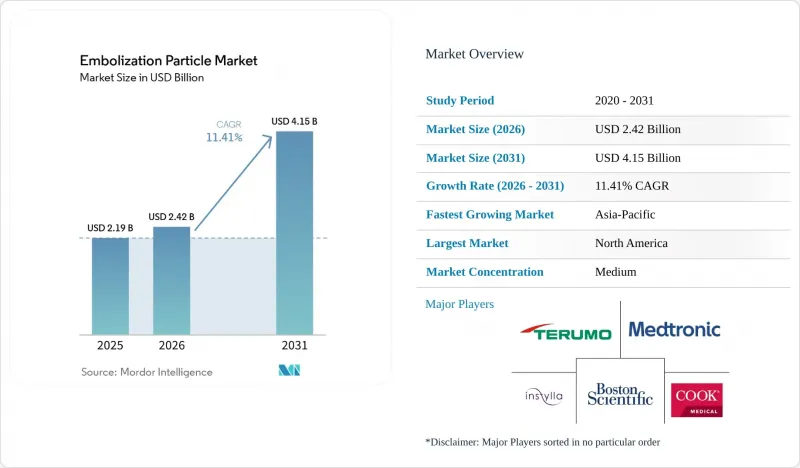
Mordor Intelligence에 의하면, 색전 입자 시장 규모는 2025년 21억 9,000만 달러로 평가되었고, 2026년 24억 2,000만 달러로 추정되고, 2031년까지 41억 5,000만 달러로 확대될 전망이며, 2026-2031년까지 연평균 복합 성장률(CAGR)은 11.41%를 나타낼 것으로 예측됩니다.
본 보고서는 제품 유형별(방사선 색전 요법용 스피어, 기타), 색전 재료별(합성, 천연), 작용기전별(영구형, 일시적/흡수성), 용도별(종양학, 비뇨기과, 기타), 최종 사용자별(병원, 외래수술센터(ASC), 전문 클리닉), 지역별(북미, 유럽, 아시아태평양, 중동 및 아프리카, 남미)로 분류되어 있습니다. 시장 전망은 금액(달러) 기준으로 제시되어 있습니다.
세계의 색전 입자 시장 동향 및 인사이트
증가하는 간암 및 색전술 사례 수
색전 입자 시장은 간암 발병률과 밀접한 관련이 있습니다. 이는 수술 적정 시기를 지난 환자에게 있어 경동맥적 치료가 여전히 주된 치료법이기 때문입니다. 2010-2021년 전 세계 간암 환자 수는 26% 증가하여 52만 9,202건에 달했으며, 이 중 간세포암이 80%에서 85%를 차지하고 있는데, 이는 절제 불가능한 질환에 대한 색전술의 사용 증가를 직접적으로 뒷받침하는 것입니다. 또한, 간암은 여전히 전 세계적으로 암 사망의 주요 원인 중 하나이며, 연령 조정 발병률이 안정적이거나 감소하고 있는 지역이라 하더라도 고령화에 따라 그 절대적인 부담은 계속해서 증가하고 있습니다. 중국은 여전히 특히 중요한 시장입니다. 해당 국가의 임상 문헌에 따르면, 간세포암(HCC) 환자의 64%가 중진행기부터 진행기 단계에서 진단되고 있으며, CNLC IIb 및 IIIa 병변의 경우 TACE가 1차 치료법으로 권장되고 있기 때문입니다. 두 번째 수요원은 간 전이입니다. 대장암은 여전히 많은 환자를 발생시키고 있으며, 이러한 환자들은 추후 간 병변을 제어하기 위해 색전 요법이 필요할 수 있기 때문입니다.
조영성, 교정 완료, 약물 방출성 입자의 발전
색전 입자 시장은 입자의 가시화, 분포, 약물 적재 방식에 있어 제품 설계가 더욱 정밀해지고 있음에 따라 지속적으로 발전하고 있습니다. HCC 환자 4,367명을 대상으로 한 32건의 연구에 대한 메타분석 결과, DEB-TACE가 기존 TACE에 비해 전체 생존 기간을 3.54개월, 무재발 생존 기간을 3.07개월 개선하는 것으로 나타났으며, 이는 약물 방출형 플랫폼으로의 임상적 전환이 지속되고 있음을 뒷받침합니다. 보스턴 사이언티피크(Boston Scientific)사의 DC Bead LUMI와 LC Bead LUMI는 공유 결합된 요오드를 통해 고유한 조영성을 갖추고 있어, 이를 통해 의사는 시술 중 CT, 투시, 콘빔 CT를 통해 입자의 전달 상황을 시각화할 수 있습니다. 이와 병행하여, 히알루론산과 마이크로플루이딕스 제조 기술을 활용해 제작된 흡수성 마이크로스피어도 개발되었습니다. 이는 전임상 모델에서 혈관에 적합한 부착성을 보였으며, 2개월 이내에 90% 이상이 분해되는 것으로 확인되어, 영구적인 폐색이 바람직하지 않은 경우 향후 폭넓게 활용될 가능성을 시사하고 있습니다. 또한, 입자의 균일성이 향상됨에 따라 시술의 예측 가능성도 높아졌습니다. 이는 병원에 있어 중요한 점입니다. 이는 보다 정밀한 엔드포인트 관리를 통해 폐기물 감축, 재시술 위험 감소, 고품질 색전제의 임상적 유용성 강화로 이어지기 때문입니다.
높은 시술 비용과 불균등한 보험 급여
색전 입자 시장은 여전히 비용 측면에서 큰 장벽에 직면해 있습니다. 왜냐하면 고도의 색전술에는 고가의 소모품, 훈련을 받은 팀, 영상 진단 지원, 그리고 Y-90의 경우 복잡한 계획 단계가 필요하기 때문입니다. 자궁동맥 색전술 123건을 대상으로 한 시간 기반 활동 원가 계산 조사에 따르면, 색전제는 소모품 비용의 51%를 차지했으며, 이는 사례 번들에서 가장 큰 단일 비용 요소였습니다. 이러한 비용 구조로 인해, 병원이나 비용 분석 위원회는 고가화를 정당화할 수 있을 만큼 정밀하게 조정된 입자나 조영 입자가 시술 시간 단축, 재사용 감소, 혹은 수술 후 합병증 감소에 충분히 기여할 수 있는지 여부를 검토할 수밖에 없게 되었습니다. 진료 환경이나 적응증에 따라 보험 급여 상황이 제각각이며, 의사가 색전술의 임상적 유효성을 지지하는 경우에도 도입이 지연될 가능성이 있습니다. 따라서 실세계에서의 근거가 더 탄탄하고, 등록 데이터가 오랫동안 축적되어 있으며, 코딩 지원이 명확한 기존 제품이, 이와 같은 경제적 근거가 부족한 신규 진입 제품을 대체하는 사례가 종종 나타납니다.
부문별 분석
2025년, 방사선 색전 요법용 스피어는 36.93%라는 최대 점유율을 기록하며, 이 부문은 색전 입자 시장에서 매출 1위를 차지했습니다. 이러한 우위는 특히 선량 측정 분야의 전문 지식, 핵의학 약국에 대한 접근성, 다학제적 협력을 통한 종양학 워크플로우를 이미 갖추고 있는 기관에서 간암 치료에 있어 Y-90 요법의 확고한 위상을 반영하고 있습니다. 2025년 7월 FDA가 절제 불가능한 간세포암(HCC)에 대한 SIR-Spheres를 승인함에 따라, 수지 미세구 시장의 기회가 확대되었습니다. 한편, TheraSphere는 긴급성이 높은 프로그램에서 유리 마이크로스피어의 기반을 지속적으로 뒷받침하고 있습니다. 이 두 플랫폼을 결합함으로써 병원은 치료의 유연성을 높이고, 이미 확립된 방사선 색전술 프로그램과 확대 중인 프로그램 모두에서 의료진의 지속적인 교육을 지원할 수 있습니다.
약제 용출 비드(DEB)는 2031년까지 연평균 성장률(CAGR) 12.84%를 기록하며 성장할 것으로 예상되며, 색전 입자 시장에서 가장 빠르게 성장하고 있는 제품 유형입니다. 이러한 추세는 더욱 강력한 비교 근거와 관련이 있습니다. 4,367명의 HCC 환자를 대상으로 한 메타분석 결과, DEB-TACE가 기존 TACE에 비해 전체 생존 기간(OS)과 무재발 생존 기간(PFS)을 모두 개선하는 것으로 나타났기 때문입니다. 문맥 종양 혈전을 동반한 간세포암(HCC)을 대상으로 한 무작위 임상시험에서도, CalliSphere 100-300 마이크로미터 비드를 사용했을 때의 전체 생존 기간 중앙값이 12개월이었던 반면, 기존 방식의 TACE에서는 7개월이었던 것으로 보고되었습니다. 색전용 마이크로스피어, PVA 입자, 젤라틴 스폰지는 자궁근종 색전술, 출혈 제어, 수술 전 혈관 차단 분야에서 여전히 확고한 역할을 수행하고 있으며, 이에 따라 색전 입자 산업의 혁신은 단일 형태에 집중되기보다는 여러 틈새 시술 분야로 확대되고 있습니다.
2025년에는 합성 소재가 56.16%의 점유율을 차지했으며, 종양학 및 혈관 중재술 부문에서 색전 입자 시장의 중심에 자리매김했습니다. 이러한 우위는 PVA, 아크릴, PMMA, PEG 하이드로겔, 수지, 유리 등 플랫폼의 오랜 임상 실적에서 비롯된 것으로, 이들 모두는 마이크로카테터를 이용한 시술에서 예측 가능한 크기, 제어된 전달, 익숙한 취급성을 보여줍니다. 또한, 합성 입자는 시판 후 데이터 세트가 풍부하다는 장점도 있어, 이를 통해 규제 당국이나 병원 위원회는 이러한 제품을 보다 광범위한 프로토콜에 도입하는 것을 검토할 때 더 큰 확신을 가질 수 있습니다. 실제로 이는 표준화된 합성 플랫폼을 보유한 공급업체가 재구매, 의사의 선호도, 다양한 적응증에서의 사용을 지원하는 데 있어 유리한 입장에 있다는 것을 의미합니다.
천연 소재 시장은 2031년까지 연평균 성장률(CAGR) 12.39%를 나타낼 것으로 예측되며, 이는 색전 입자 시장에서 일시적 폐색 및 재시술의 유연성에 대한 관심이 높아지고 있음을 반영합니다. Instylla의 ‘Tembo Embolic System’은 2025년 1월, 고혈관성 종양 및 말초 혈관 색전술용 생체 흡수성 드라이 젤라틴 입자로 FDA 510(k) 승인을 획득했습니다. 이로써 이 카테고리의 한 부문이 미국에서 보다 명확한 상업적 기반을 마련하게 되었습니다. 젤라틴이나 전분을 주성분으로 하는 재료의 장점은 특정 부인과 분야, 근골격계, 또는 단계적 색전술과 같이 재개통이 임상적으로 유용할 수 있는 상황에서 가장 두드러집니다. 영구적이고 정밀하게 관리되는 플랫폼이 여전히 방대한 양의 종양학 진료 수요에 더 부합하기 때문에 색전 입자 산업은 중기적으로 합성 소재 중심의 추세가 지속될 것으로 보입니다.
지역별 분석
2025년, 북미는 전 세계 매출의 36.05%를 차지했으며, 이 지역의 색전 입자 시장은 여전히 세계 최대 규모를 유지했습니다. 미국이 이러한 우위를 유지하고 있는 이유는 확립된 방사선 색전술 인프라와 고도의 종양학적 시술을 뒷받침할 수 있는 대규모 중재적 방사선학 진료 체계를 모두 갖추고 있기 때문입니다. 2025년 7월 FDA가 절제 불가능한 간세포암(HCC)에 대한 SIR-Spheres를 승인함에 따라, 의료진의 치료 선택지가 확대되었으며, 간 치료 분야에서 Y-90 요법 시장 입지가 강화되었습니다. 또한, 이 지역에서는 외래 치료로의 전환이 더욱 진전되어, 북미에서는 방사선 색전술의 85%가 외래 환자를 대상으로 시행되는 반면, 유럽에서는 13%에 그치고 있습니다. 이로 인해 병상 수의 확대와 비례하지 않는 수준으로 환자 수가 증가하고 있습니다. 캐나다와 멕시코는 여전히 규모는 작지만, 양국 모두 3차 의료 체계 강화와 색전술에 대한 접근성을 점진적으로 확대하기 위한 발표 채널 구축의 혜택을 누리고 있습니다.
유럽은 성숙한 지역이며, 이 지역의 색전 입자 시장은 환자 수의 급격한 증가보다는 증거에 기반한 도입을 통해 형성되고 있습니다. 독일, 영국, 프랑스, 이탈리아, 스페인은 긴밀한 전문의 네트워크와 활발한 중재적 종양학 진료를 통해 계속해서 지역 내 수요를 뒷받침하고 있습니다. 전 세계 조사 결과에 따르면, 유럽 의료기관의 84%가 라디오엠볼리제이션에 맞춤형 선량 측정을 도입하고 있는 반면, 북미에서는 71%에 그치고 있으며, 이는 소프트웨어 통합, 영상 정렬, 상세한 교육을 지원할 수 있는 공급업체에 유리하게 작용합니다. 또한, EU의 MDR 요건은 공급업체에 시판 후 증거와 관련하여 더 엄격한 요구 사항을 부과하고 있으며, 이는 확립된 임상 등록 시스템과 강력한 규제 대응 팀을 갖춘 대형 제조업체에 유리한 방향으로 작용하는 경향이 있습니다.
아시아태평양은 가장 빠르게 성장하고 있는 지역이며, 색전 입자 시장은 2031년까지 연평균 성장률(CAGR) 15.36%로 확대될 것으로 전망됩니다. 중국은 여전히 핵심적인 위치를 차지하고 있는데, 그 이유는 간암 발병률이 높을 뿐만 아니라, 국내 임상 문헌에서 수술이 불가능한 CNLC IIb 및 IIIa 병변에 대한 1차 치료법으로 TACE가 권장되고 있기 때문입니다. 일본은 2025년판 HCC 가이드라인 개정과 동맥 화학색전술에 대한 DC Bead의 보험 적용 승인을 통해 안정적인 시술 수요를 뒷받침하고 있습니다. 중동 및 아프리카와 남미는 현재로서는 규모가 작지만, 3차 의료에 대한 투자 확대, 의료 관광, 현지 상업화 노력 등이 이러한 신흥 지역의 장기적인 성장을 지속적으로 뒷받침하고 있습니다.
기타 혜택
- 엑셀 형식 시장 예측(ME) 시트
- 3개월간의 애널리스트 지원
자주 묻는 질문
목차
제1장 서론
제2장 조사 방법
제3장 주요 요약
제4장 시장 구도
제5장 시장 규모 및 성장 예측
제6장 경쟁 구도
제7장 시장 기회 및 향후 전망
AJY 26.06.26According to Mordor Intelligence, the embolization particle market size is projected to expand from USD 2.19 billion in 2025 and USD 2.42 billion in 2026 to USD 4.15 billion by 2031, registering a CAGR of 11.41% between 2026 to 2031.
This report is Segmented by Product Type (Radioembolization Spheres, and More), Embolic Material (Synthetic, Natural), Mode of Action (Permanent, Temporary/Resorbable), Application (Oncology, Urology, and More), End User (Hospitals, Ascs, Specialty Clinics), and Geography (North America, Europe, Asia-Pacific, MEA, South America). The Market Forecasts are Provided in Terms of Value (USD).
Global Embolization Particle Market Trends and Insights
Rising Liver Cancer and Embolization Case Volumes
The embolization particle market is closely tied to liver cancer incidence because transarterial therapies remain central for patients who present beyond the surgical window. Global liver cancer cases rose 26% between 2010 and 2021 to 529,202, and hepatocellular carcinoma accounted for 80% to 85% of that burden, which directly supports higher use of embolization in unresectable disease. Liver cancer also remains one of the leading causes of cancer death worldwide, and its absolute burden continues to rise with aging populations even where age-standardized rates have stabilized or declined. China remains especially important because national clinical literature states that 64% of HCC patients are diagnosed at intermediate to advanced stages, where TACE is recommended as first-line treatment for CNLC IIb and IIIa disease. A second demand stream comes from liver metastases, since colorectal cancer continues to generate a large pool of patients who may later require embolization-based control of hepatic lesions.
Advances in Radiopaque, Calibrated, and Drug-Eluting Particles
The embolization particle market is also moving forward because product design is becoming more precise in how particles are visualized, distributed, and loaded with therapy. A 32-study meta-analysis covering 4,367 HCC patients found that DEB-TACE improved overall survival by 3.54 months and progression-free survival by 3.07 months versus conventional TACE, which supports continued clinical conversion toward drug-eluting platforms. Boston Scientific's DC Bead LUMI and LC Bead LUMI introduced inherent radiopacity through covalently bound iodine, which allows physicians to visualize particle delivery through CT, fluoroscopy, and cone-beam CT during the procedure itself. A parallel development came from absorbable microspheres made with hyaluronic acid and microfluidic manufacturing, which showed vessel-adaptive adhesion and more than 90% degradation within 2 months in preclinical models, pointing to broader future use where permanent occlusion is not preferred. Better particle uniformity is also improving procedural predictability, which matters to hospitals because more precise endpoint control can limit waste, reduce repeat intervention risk, and strengthen the clinical case for premium embolics.
High Procedure Costs and Uneven Reimbursement
The embolization particle market still faces meaningful friction from cost because advanced embolization procedures require expensive consumables, trained teams, imaging support, and, in the case of Y-90, complex planning steps. A time-driven activity-based costing study of 123 uterine artery embolization procedures found that embolic agents represented 51% of consumable costs, which made them the single largest cost component in the case bundle. That kind of cost profile pushes hospitals and value-analysis committees to ask whether premium-calibrated or radiopaque particles can reduce procedure time, repeat use, or downstream complications enough to justify higher prices. Reimbursement remains uneven across settings and indications, which can delay adoption even when physicians support the clinical case for embolization. This is why established products with stronger real-world evidence, longer registries, and clearer coding support often displace newer entrants that lack the same economic proof package.
Other drivers and restraints analyzed in the detailed report include:
- FDA Expansion of SIR-Spheres for Unresectable HCC
- Guideline Mainstreaming of Prostate Artery Embolization for BPH/LUTS
- Interventional Radiology Workforce Shortages
For complete list of drivers and restraints, kindly check the Table Of Contents.
Segment Analysis
Radioembolization spheres held the largest share at 36.93% in 2025, which gave this category the leading revenue position in the embolization particle market. This lead reflects the established place of Y-90 therapies in liver cancer care, especially in centers that already have dosimetry expertise, nuclear pharmacy access, and multidisciplinary oncology workflows. The July 2025 FDA approval of SIR-Spheres for unresectable HCC widened the resin microsphere opportunity, while TheraSphere continued to support the glass microsphere base in high-acuity programs. The combination of these two platforms gives hospitals more treatment flexibility and supports continued physician training across both established and expanding radioembolization programs.
Drug-eluting beads are forecast to grow at a 12.84% CAGR through 2031, making them the fastest-expanding product type in the embolization particle market. Their momentum is linked to stronger comparative evidence, since a meta-analysis of 4,367 HCC patients found that DEB-TACE improved both overall survival and progression-free survival versus conventional TACE. A randomized clinical trial in HCC with portal vein tumor thrombus also reported median overall survival of 12 months with CalliSphere 100 to 300 µm beads versus 7 months with conventional TACE. Embolic microspheres, PVA particles, and gelatin sponge still hold durable roles in fibroid embolization, hemorrhage control, and pre-operative devascularization, which keeps innovation in the embolization particle industry spread across several procedural niches rather than concentrated in one format.
Synthetic materials commanded 56.16% share in 2025, which placed them at the center of the embolization particle market across oncology and vascular intervention. Their lead comes from the long clinical history of PVA, acrylic, PMMA, PEG hydrogel, resin, and glass platforms, all of which offer predictable sizing, controlled delivery, and familiar handling in microcatheter-based procedures. Synthetic particles also benefit from stronger post-market datasets, which give regulators and hospital committees more confidence when these products are considered for wider protocol adoption. In practice, this means suppliers with standardized synthetic platforms are better placed to support repeat purchasing, physician preference, and multi-indication use.
Natural materials are projected to grow at a 12.39% CAGR through 2031, reflecting rising interest in temporary occlusion and repeat-procedure flexibility within the embolization particle market. Instylla's Tembo Embolic System received FDA 510(k) clearance in January 2025 as a bioresorbable dry gelatin particle for hypervascular tumor and peripheral vascular embolization, which gave this part of the category a clearer commercial foothold in the United States. The appeal of gelatin and starch-based materials is strongest where recanalization can be clinically useful, such as selected gynecologic, musculoskeletal, or staged embolization settings. Even so, the embolization particle industry is likely to remain synthetic-heavy over the medium term because permanent and calibrated platforms still align more closely with the needs of high-volume oncology practice.
Geography Analysis
North America held 36.05% of global revenue in 2025, and the embolization particle market in the region remained the largest worldwide. The United States anchors this lead because it has both established radioembolization infrastructure and high-volume interventional radiology practices that can support advanced oncologic procedures. The July 2025 FDA approval of SIR-Spheres for unresectable HCC widened physician choice and strengthened the commercial position of Y-90 therapy in liver-directed care. Outpatient migration is also more advanced here, with 85% of North American radioembolization procedures performed as outpatient cases versus 13% in Europe, which helps volume growth without matching hospital bed expansion. Canada and Mexico remain smaller, but both benefit from growing tertiary care capability and referral pathways that gradually widen access to embolization procedures.
Europe is a mature region, and the embolization particle market there is shaped more by evidence-led adoption than by abrupt volume surges. Germany, the United Kingdom, France, Italy, and Spain continue to anchor regional demand through dense specialist networks and active interventional oncology practice. A global survey found that 84% of European sites used personalized dosimetry for radioembolization versus 71% in North America, which favors suppliers that can support software integration, imaging alignment, and training depth. EU MDR requirements also place heavier post-market evidence demands on suppliers, which tends to support larger manufacturers with established clinical registries and stronger regulatory teams.
Asia-Pacific is the fastest-growing region, with the embolization particle market forecast to expand at a 15.36% CAGR through 2031. China remains central because liver cancer burden is high and national clinical literature recommends TACE as first-line treatment for CNLC IIb and IIIa disease, where surgery is not feasible. Japan supports stable procedural demand through its updated 2025 HCC guidance and reimbursement recognition for DC Bead in arterial chemoembolization. Middle East and Africa and South America are smaller today, but rising tertiary care investment, medical tourism, and local commercialization efforts still support long-term expansion across these emerging regions.
- ABK Biomedical Inc.
- Boston Scientific
- Cardiolink Science (Shenzhen) Medical Technology Development Co., Ltd.
- Cook Group
- CrannMed Ltd.
- Endovastec (Shanghai MicroPort Endovascular MedTech (Group) Co., Ltd.)
- IMBiotechnologies Ltd.
- Instylla, Inc.
- Magle Pharmacept GmbH
- Medtronic
- Merit Medical Systems
- NEXTBIOMEDICAL Co., Ltd.
- PLMICROMED Co., Ltd.
- QXMedical
- SCITECH Medical
- Serumwerk Bernburg AG
- Siemens Healthineers
- Sirtex Medical Limited
- Suzhou Hengrui Medical Equipment Co., Ltd.
- Terumo
Additional Benefits:
- The market estimate (ME) sheet in Excel format
- 3 months of analyst support
TABLE OF CONTENTS
1 Introduction
- 1.1 Study Assumptions & Market Definition
- 1.2 Scope of the Study
2 Research Methodology
3 Executive Summary
4 Market Landscape
- 4.1 Market Overview
- 4.2 Market Drivers
- 4.2.1 Rising Liver Cancer and Embolization Case Volumes
- 4.2.2 Shift Toward Minimally Invasive Embolization Over Surgery
- 4.2.3 Advances in Radiopaque, Calibrated, and Drug-Eluting Particles
- 4.2.4 Expansion of Hospital-To-Outpatient Embolization Workflows
- 4.2.5 FDA Expansion of SIR-Spheres for Unresectable HCC
- 4.2.6 Guideline Mainstreaming of Prostate Artery Embolization For BPH/LUTS
- 4.3 Market Restraints
- 4.3.1 High Procedure Costs and Uneven Reimbursement
- 4.3.2 Stringent Regulatory and Evidence Requirements
- 4.3.3 Interventional Radiology Workforce Shortages
- 4.3.4 Tariff-Driven Supply-Chain and Input-Cost Volatility
- 4.4 Value / Supply-Chain Analysis
- 4.5 Regulatory Landscape
- 4.6 Technological Outlook
- 4.7 Porter's Five Forces Analysis
- 4.7.1 Threat of New Entrants
- 4.7.2 Bargaining Power of Suppliers
- 4.7.3 Bargaining Power of Buyers
- 4.7.4 Threat of Substitutes
- 4.7.5 Industry Rivalry
5 Market Size & Growth Forecasts
- 5.1 By Product Type
- 5.1.1 Radioembolization Spheres
- 5.1.1.1 Resin Microspheres
- 5.1.1.2 Glass Microspheres
- 5.1.2 Drug-Eluting Beads
- 5.1.2.1 Doxorubicin-Loadable Beads
- 5.1.2.2 Irinotecan-Loadable Beads
- 5.1.2.3 Other Drug-Loadable Beads
- 5.1.3 Embolic Microspheres
- 5.1.3.1 Trisacryl Gelatin Microspheres
- 5.1.3.2 PEG / Hydrogel Microspheres
- 5.1.3.3 Acrylic / PMMA-Based Microspheres
- 5.1.4 PVA Particles
- 5.1.5 Gelfoam / Gelatin Sponge Particles
- 5.1.1 Radioembolization Spheres
- 5.2 By Embolic Material
- 5.2.1 Synthetic Materials
- 5.2.1.1 Polyvinyl Alcohol
- 5.2.1.2 Acrylic / PMMA
- 5.2.1.3 PEG / Hydrogel
- 5.2.1.4 Resin / Glass / Ceramic
- 5.2.2 Natural Materials
- 5.2.2.1 Gelatin
- 5.2.2.2 Starch-Based
- 5.2.1 Synthetic Materials
- 5.3 By Mode of Action
- 5.3.1 Permanent
- 5.3.2 Temporary / Resorbable
- 5.4 By Application
- 5.4.1 Oncology
- 5.4.2 Urology
- 5.4.3 Gynecology
- 5.4.4 Neurology
- 5.4.5 Peripheral Vascular Disease and Hemorrhage Control
- 5.5 By End User
- 5.5.1 Hospitals
- 5.5.2 Ambulatory Surgical Centers
- 5.5.3 Specialty Clinics
- 5.6 By Geography
- 5.6.1 North America
- 5.6.1.1 United States
- 5.6.1.2 Canada
- 5.6.1.3 Mexico
- 5.6.2 Europe
- 5.6.2.1 Germany
- 5.6.2.2 United Kingdom
- 5.6.2.3 France
- 5.6.2.4 Italy
- 5.6.2.5 Spain
- 5.6.2.6 Rest of Europe
- 5.6.3 Asia-Pacific
- 5.6.3.1 China
- 5.6.3.2 Japan
- 5.6.3.3 India
- 5.6.3.4 Australia
- 5.6.3.5 South Korea
- 5.6.3.6 Rest of Asia-Pacific
- 5.6.4 Middle East & Africa
- 5.6.4.1 GCC
- 5.6.4.2 South Africa
- 5.6.4.3 Rest of Middle East & Africa
- 5.6.5 South America
- 5.6.5.1 Brazil
- 5.6.5.2 Argentina
- 5.6.5.3 Rest of South America
- 5.6.1 North America
6 Competitive Landscape
- 6.1 Market Concentration
- 6.2 Market Share Analysis
- 6.3 Company Profiles (includes Global level Overview, Market-level Overview, Core Segments, Financials, Strategic Information, Market Rank/Share, Products & Services, Recent Developments)
- 6.3.1 ABK Biomedical Inc.
- 6.3.2 Boston Scientific Corporation
- 6.3.3 Cardiolink Science (Shenzhen) Medical Technology Development Co., Ltd.
- 6.3.4 Cook Medical LLC
- 6.3.5 CrannMed Ltd.
- 6.3.6 Endovastec (Shanghai MicroPort Endovascular MedTech (Group) Co., Ltd.)
- 6.3.7 IMBiotechnologies Ltd.
- 6.3.8 Instylla, Inc.
- 6.3.9 Magle Pharmacept GmbH
- 6.3.10 Medtronic plc
- 6.3.11 Merit Medical Systems, Inc.
- 6.3.12 NEXTBIOMEDICAL Co., Ltd.
- 6.3.13 PLMICROMED Co., Ltd.
- 6.3.14 QXMedical
- 6.3.15 SCITECH Medical
- 6.3.16 Serumwerk Bernburg AG
- 6.3.17 Siemens Healthineers AG
- 6.3.18 Sirtex Medical Limited
- 6.3.19 Suzhou Hengrui Medical Equipment Co., Ltd.
- 6.3.20 Terumo Corporation
7 Market Opportunities & Future Outlook
- 7.1 White-space & Unmet-need Assessment


