|
시장보고서
상품코드
2065546
자산 관리 전사적 자원 계획(ERP) : 시장 점유율 분석, 산업 동향 및 통계 데이터, 성장 예측(2026-2031년)Asset Management Enterprise Resource Planning - Market Share Analysis, Industry Trends & Statistics, Growth Forecasts (2026 - 2031) |
||||||
 Mordor Intelligence
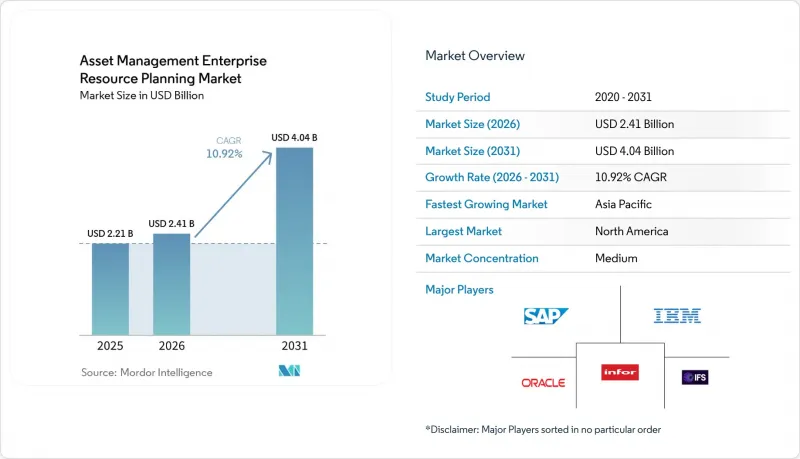
Mordor Intelligence에 의하면, 자산 관리 전사적 자원 계획(ERP) 시장 규모는 2025년 22억 1,000만 달러로 평가되었습니다. 2026년에는 24억 1,000만 달러로 확대되어 2026년부터 2031년에 걸쳐 CAGR 10.92%로 성장을 지속하여, 2031년에는 40억 4,000만 달러에 이를 것으로 예측됩니다.
본 보고서는 배포 방식(클라우드, On-Premise, 하이브리드), 조직 규모(대기업, 중소기업), 업종(제조, 에너지 및 유틸리티, 의료 등), 모듈(자산 수명 주기 관리, 작업 지시 관리, 재고·예비 부품 관리 등), 지역별로 분류되어 있습니다. 시장 전망은 금액(달러) 기준으로 제시되어 있습니다.
세계의 자산 관리 전사적 자원 계획(ERP) 시장 동향 및 인사이트
클라우드 기반 도입 모델로의 급속한 전환
클라우드 네이티브 제품군을 통해 기업은 인프라 부담을 줄이고, 기능 제공을 가속화하며, 비용을 실제 사용량에 맞추어 조정할 수 있게 됩니다. 2027년까지 클라우드 ERP에 대한 지출은 AI 지원 솔루션으로 전환될 것이며, 평가 및 감가상각 워크플로우에 머신러닝을 접목한 플랫폼으로의 전환이 두드러질 것입니다. NetSuite에 따르면, 하이브리드 아키텍처는 여전히 주류를 이루고 있으며, 88%의 조직이 기밀성이 높은 원장을 프라이빗 클라우드에 보관하면서 퍼블릭 클라우드에서 분석 기능을 확장하고 있습니다. 컨테이너화는 주요 운영 환경에서 채택되어 자산 모듈의 클라우드 간 이식성을 높이고, 재해 복구를 간소화하고 있습니다. 그러나 예상치 못한 비용 발생으로 인해 일부 기업이 워크로드를 On-Premise로 되돌리고 있어, FinOps 거버넌스와 자동화된 비용 관리의 필요성이 부각되고 있습니다. 전반적으로, 클라우드 전환의 가속화는 IoT의 신속한 통합과 예측 분석을 가능하게 하고 있으며, 이것이 자산 관리 전사적 자원 계획(ERP) 시장의 가장 큰 성장 요인이 되고 있습니다.
예측 유지보수를 가능하게 하는 IoT 센서의 도입 확대
IEEE의 사례 연구에 따르면, 센서와 ERP의 통합을 통해 유지보수 요청 처리 및 고장 임계값 알림이 자동화되어 수동 입력이 줄어들 뿐만 아니라, 예측 기반의 워크플로우가 가능해짐이 확인되었습니다. 유틸리티 업체들은 초기 도입자입니다. DNV의 ‘Cascade’는 SCADA 히스토리안을 자산 점수와 연동하고, SAS의 분석 기능은 터빈의 이상을 감지하여 선제적인 스케줄링을 가능하게 합니다. 보안은 여전히 과제로 남아 있습니다. 대부분의 IoT 기기에는 에이전트가 탑재되어 있지 않고, 기본 인증 정보가 설정된 상태로 출하되기 때문에 기업들은 ERP 인터페이스를 보호하기 위해 마이크로 세분화이나 네트워크 감지 기술에 의존할 수밖에 없는 상황입니다. 커버리지의 공백이 메워짐에 따라, 예측 유지보수는 자산 관리를 위한 전사적 자원 계획(ERP) 시장의 다른 모듈들을 계속해서 앞지르는 성장세를 이어갈 것입니다.
기존 ERP 시스템과의 통합에 따른 막대한 초기 비용
수십 년에 걸쳐 축적된 사용자 정의 코드와 문서화되지 않은 인터페이스의 존재로 인해 현대화에는 막대한 비용이 소요됩니다. 프로세스 마이닝 도구는 숨겨진 비효율성을 밝혀냅니다. 예를 들어, 생산 상황이 기록보다 2일 뒤처져 있거나, BOM(부품표)에 전환 규칙이 잘못 기재되어 있는 사실 등이 밝혀지면서, 본 가동 전에 마스터 데이터를 수정해야 할 필요성이 부각되고 있습니다. 이 단계를 소홀히 한 조직은 부적절한 워크플로를 자동화하게 될 위험이 있으며, 자산 관리 전사적 자원 계획(ERP) 시스템 도입을 통해 기대했던 투자 수익률(ROI)을 저해할 우려가 있습니다.
부문별 분석
2025년 기준으로 클라우드 도입은 자산 관리 전사적 자원 계획(ERP) 시장 점유율의 48.50%를 차지했으며, 이 부문은 2031년까지 연평균 성장률(CAGR) 12.30%로 성장할 것으로 전망됩니다. 조직은 벤더 관리형 인프라와 신속한 기능 출시를 선호하는 반면, 컨테이너화된 마이크로서비스는 하이브리드 전략에서 이식성을 향상시키고 있습니다. AI를 활용한 서비스를 통해 유지보수 분석 및 탄소 회계가 컴퓨팅 능력에 점점 더 가까워짐에 따라, 클라우드 도입과 관련된 자산 관리 전사적 자원 계획(ERP) 시장 규모는 확대될 전망입니다.
지연 시간이나 데이터 주권 요건이 우선시되는 분야, 특히 국방 분야나 규제가 엄격한 공공 서비스 분야에서는 On-Premise형 솔루션이 여전히 주류를 이루고 있습니다. 현재 기업의 88%가 채택하고 있는 하이브리드 모델은 기밀성이 높은 원장을 프라이빗 클라우드에 보관하고, 분석의 확장에는 퍼블릭 클라우드를 활용함으로써 이러한 제약 사항 간의 균형을 맞추고 있습니다. 기업의 54%가 클라우드 지출을 정확하게 추적하지 못하고 있어, 하드웨어 축소를 통한 비용 절감 효과가 상쇄될 우려가 있기 때문에 FinOps를 통한 안전장치가 표준화되고 있습니다. 전반적으로 볼 때, 도입 여부는 기술적 역량의 차이보다는 규제나 지연 시간 등의 고려 사항에 따라 결정되는 경향이 점점 더 강해지고 있습니다.
2025년 매출액 중 대기업이 60.30%를 차지했으나, 벤더들이 종량제, 로우코드 템플릿, 매니지드 서비스를 확대함에 따라 중소기업 부문은 연평균 성장률(CAGR) 11.60%로 성장하고 있습니다. 중소기업용 자산 관리 전사적 자원 계획(ERP) 시장 규모는 도입이 용이해지고 설비 투자가 감소함에 따라 성장할 것으로 보입니다.
자원 제약은 여전히 중소기업에게 과제로 남아 있지만, 재무, 공급망, 자산 관리 각 모듈을 통합하고 마스터 데이터 자동 정제 기능을 갖춘 SaaS 제품군을 통해 기능 면에서의 격차는 줄어들고 있습니다. 아시아태평양(APAC) 및 남미 지역에서는 클라우드 우선 정책을 추진하는 정부의 인센티브와 환율 헤지가 포함된 구독 요금제 덕분에 도입 장벽이 더욱 낮아지고 있습니다. 사용량 기반 과금제가 성숙해짐에 따라, 예측 기간 동안 중소기업이 수요 증가분의 더 큰 비중을 주도할 것으로 예측됩니다.
지역별 분석
북미는 성숙한 클라우드 인프라와 AI 기반 분석 기술의 조기 도입에 힘입어 2025년 매출의 33.40%를 차지했습니다. 2027년 마감 시한을 앞두고 SAP ECC에서 S/4HANA로의 전환이 거래를 가속화하고 있지만, 데이터 정제의 복잡성으로 인해 일정이 촉박해지고 있습니다. EU 사이버 복원력법의 역외 적용에 따라, 미국 공급업체들은 유럽 시장 접근성을 유지하기 위해 취약점 보고 기능 및 SBOM 기능을 탑재하여 제품을 선제적으로 강화하고 있습니다.
연평균 성장률(CAGR) 11.40%로 가장 빠르게 성장하고 있는 아시아태평양은 중국과 인도의 대규모 인프라 투자, 그리고 5,000억 달러가 넘는 민간 자금을 통한 반도체 생산 능력 확대의 혜택을 받고 있습니다. 동남아시아 전역의 중소기업들은 구독형 라이선싱을 활용하여 자본 부담 없이 엔터프라이즈급 기능을 이용하고 있으며, 이로 인해 해당 지역 수요가 더욱 증가하고 있습니다.
유럽에서는 엄격한 사이버 보안 및 지속가능성 요건이 부과되고 있어, 통합된 규정 준수 기능이 필수적입니다. 중동 및 아프리카 및 남미는 아직 개발도상국이지만, 미래가 밝을 것으로 기대되고 있습니다. UAE의 대기업 그룹이 Infor M3를 도입하고, 브라질의 중견 제조업체가 NetSuite의 SaaS 플랫폼을 채택한 것은 클라우드 지역이나 환율 헤지가 적용된 가격 책정을 통해 거시경제적 리스크가 완화되는 지역에서 이에 대한 관심이 높아지고 있음을 반영하고 있습니다. 케냐의 ‘트러스트드 데이터 존(Trusted Data Zone)’ 프로젝트와 같이, 정부가 ‘클라우드 퍼스트’ 정책을 의무화한 사례는 주권 클라우드 규정이 국영 공공 서비스 기관 및 교통 기관에서의 도입을 어떻게 촉진하고 있는지를 보여줍니다. 큰 경제적 충격이 없다면, 2031년까지 이 지역에서의 도입은 꾸준히 확대될 것으로 예측됩니다.
기타 혜택 :
- 엑셀 형식 시장 예측(ME) 시트
- 3개월간의 애널리스트 지원
자주 묻는 질문
목차
제1장 서론
제2장 분석 방법
제3장 주요 요약
제4장 시장 구도
제5장 시장 규모 및 성장 예측
제6장 경쟁 구도
제7장 시장 기회 및 향후 전망
KTH 26.06.29According to Mordor Intelligence, the asset management enterprise resource planning (ERP) market size is expected to grow from USD 2.21 billion in 2025 to USD 2.41 billion in 2026 and is forecast to reach USD 4.04 billion by 2031 at 10.92% CAGR over 2026-2031.
This report is Segmented by Deployment Model (Cloud, On-Premise, and Hybrid), Organization Size (Large Enterprises, and SMEs), Application Vertical (Manufacturing, Energy and Utilities, Healthcare, and More), Module and Functionality (Asset Lifecycle Management, Work Order Management, Inventory and Spare Parts Management, and More), and Geography. The Market Forecasts are Provided in Terms of Value (USD).
Global Asset Management Enterprise Resource Planning Market Trends and Insights
Rapid Migration to Cloud-Based Deployment Models
Cloud-native suites let enterprises offload infrastructure, accelerate feature delivery, and align expenses with consumption. Cloud ERP spending will shift toward AI-enabled solutions by 2027, highlighting a pivot toward platforms that embed machine learning into valuation and depreciation workflows. According to NetSuite, Hybrid architectures remain prevalent, with 88% of organizations retaining sensitive ledgers on private clouds while scaling analytics in the public cloud. Containerization has been adopted in significant production environments, making asset modules portable across clouds and simplifying disaster recovery. However, several percent of enterprises have repatriated workloads amid unforeseen costs, underscoring the need for FinOps governance and automated cost controls. Overall, cloud acceleration is unlocking rapid IoT integration and predictive analytics, making it the largest single growth lever for the Asset Management Enterprise Resource Planning (ERP) market.
Growing Adoption of IoT Sensors Enabling Predictive Maintenance
IEEE case studies confirm that sensor-to-ERP integration automates maintenance request processing and failure threshold alerts, reducing manual entry and enabling predictive workflows. Utilities are early adopters: DNV's Cascade links SCADA historians to asset scores, while SAS analytics detect turbine anomalies to enable proactive scheduling. Security remains a hurdle because most IoT devices lack agents and ship with default credentials, forcing enterprises to rely on micro-segmentation and network detection to safeguard ERP interfaces. As coverage gaps close, predictive maintenance will continue to outpace other modules within the Asset Management Enterprise Resource Planning (ERP) market.
High Upfront Integration Cost with Legacy ERP Systems
Decades of custom code and undocumented interfaces make modernization expensive. Process-mining tools reveal hidden inefficiencies: production often lags records by two days, and BOMs misstate changeover rules, underscoring the need for master-data remediation before go-live. Organizations that neglect this step risk automating poor workflows and eroding the ROI of the Asset Management Enterprise Resource Planning (ERP) market rollout.
Other drivers and restraints analyzed in the detailed report include:
- Rising Demand to Reduce Unplanned Downtime in Asset-Intensive Industries
- Convergence of EAM and Sustainability Reporting for Scope 3 Compliance
- Cybersecurity and Data-Privacy Concerns in Connected Asset Ecosystems
For complete list of drivers and restraints, kindly check the Table Of Contents.
Segment Analysis
Cloud deployments accounted for 48.50% of the Asset Management Enterprise Resource Planning (ERP) market share in 2025, and the segment is forecast to grow at a 12.30% CAGR through 2031. Organizations prefer vendor-managed infrastructure and rapid feature releases, while containerized microservices improve portability for hybrid strategies. The Asset Management Enterprise Resource Planning (ERP) market size attached to cloud deployments will expand as AI-enabled services move maintenance analytics and carbon accounting closer to compute power.
On-premise solutions persist where latency and data-sovereignty mandates prevail, especially in defense and heavily regulated utilities. Hybrid models, now embraced by 88% of enterprises, balance these constraints by keeping sensitive ledgers on private clouds and using public regions for scaling analytics. FinOps guardrails are becoming standard because 54% of enterprises cannot accurately track cloud spend, threatening to offset savings from hardware avoidance. Overall, the deployment choice now hinges more on regulatory and latency considerations than on technical capability differentials.
Large enterprises accounted for 60.30% of 2025 revenue, but small and medium enterprises are expanding at a 11.60% CAGR as vendors roll out consumption-based pricing, low-code templates, and managed services. The Asset Management Enterprise Resource Planning (ERP) market size accruing to SMEs will benefit from easier onboarding and reduced capital expenditure.
Resource constraints still challenge SMEs, yet SaaS suites that bundle finance, supply chain, and asset modules with automated master-data cleansing narrow the capability gap. In APAC and South America, cloud-first government incentives and currency-hedged subscription offers further lower adoption barriers. As usage-based pricing matures, SMEs are expected to drive a larger share of incremental demand over the forecast period.
Geography Analysis
North America accounted for 33.40% of 2025 revenue, supported by mature cloud infrastructure and early adoption of AI-driven analytics. Migration from SAP ECC to S/4HANA before the 2027 deadline is accelerating deals, though data-cleansing complexity is stretching timelines. The extraterritorial reach of the EU Cyber Resilience Act is prompting U.S. vendors to harden their products preemptively, embedding vulnerability-reporting and SBOM features to maintain European market access.
Asia-Pacific, the fastest-growing region at 11.40% CAGR, benefits from large-scale infrastructure investment in China and India and semiconductor capacity expansion backed by private commitments exceeding USD 500 billion. SMEs across Southeast Asia are leveraging subscription licensing to access enterprise-grade functionality without capital strain, further lifting regional demand.
Europe faces stringent cybersecurity and sustainability requirements, making integrated compliance features a must-have. The Middle East and Africa and South America remain nascent but promising. UAE conglomerates rolling out Infor M3 and Brazilian mid-market manufacturers adopting NetSuite SaaS platforms reflect rising interest where cloud regions and foreign-exchange-hedged pricing mitigate macro risks. Government cloud-first mandates, such as Kenya's trusted data zone projects, illustrate how sovereign-cloud provisions unlock adoption among state-owned utilities and transportation agencies. Absent major economic shocks, regional uptake is expected to broaden steadily through 2031.
- IBM Corporation
- SAP SE
- Oracle Corporation
- Infor, Inc.
- IFS AB
- Hexagon AB
- ABB Ltd.
- Aptean, Inc.
- CGI Inc.
- CMMS Data Group, Inc.
- Ramco Systems Limited
- IPS Intelligent Process Solutions GmbH
- AVEVA Group plc
- Bentley Systems, Incorporated
- ServiceNow, Inc.
- UpKeep Technologies, Inc.
- Asset Panda, Inc.
- AssetWorks LLC
- Fluke Corporation
- Trimble Inc.
Additional Benefits:
- The market estimate (ME) sheet in Excel format
- 3 months of analyst support
TABLE OF CONTENTS
1 INTRODUCTION
- 1.1 Study Assumptions & Market Definition
- 1.2 Scope of the Study
2 RESEARCH METHODOLOGY
3 EXECUTIVE SUMMARY
4 MARKET LANDSCAPE
- 4.1 Market Overview
- 4.2 Market Drivers
- 4.2.1 Rapid Migration to Cloud-Based Deployment Models
- 4.2.2 Growing Adoption of IoT Sensors Enabling Predictive Maintenance
- 4.2.3 Rising Demand to Reduce Unplanned Downtime in Asset-Intensive Industries
- 4.2.4 Convergence of EAM and Sustainability Reporting Modules for Scope 3 Emissions Compliance
- 4.2.5 Uptake of AI-Driven Master-Data Cleansing Tools Improving ROI Acceleration
- 4.2.6 Availability of Usage-Based Subscription Pricing for Mid-Tier Manufacturers
- 4.3 Market Restraints
- 4.3.1 High Upfront Integration Cost with Legacy ERP Systems
- 4.3.2 Cybersecurity and Data-Privacy Concerns in Connected Asset Ecosystems
- 4.3.3 Shortage of Certified Asset Management ERP Implementation Specialists
- 4.3.4 Vendor Lock-In Risk Due to Proprietary Data Models and Limited Interoperability Standards
- 4.4 Impact of Macroeconomic Factors on the Market
- 4.5 Industry Value Chain Analysis
- 4.6 Regulatory Landscape
- 4.7 Technological Outlook
- 4.8 Porter's Five Forces Analysis
- 4.8.1 Threat of New Entrants
- 4.8.2 Bargaining Power of Suppliers
- 4.8.3 Bargaining Power of Buyers
- 4.8.4 Threat of Substitute Products
- 4.8.5 Intensity of Competitive Rivalry
5 MARKET SIZE AND GROWTH FORECASTS (VALUE)
- 5.1 By Deployment Model
- 5.1.1 Cloud
- 5.1.2 On-Premise
- 5.1.3 Hybrid
- 5.2 By Organization Size
- 5.2.1 Large Enterprises
- 5.2.2 Small and Medium Enterprises
- 5.3 By Application Vertical
- 5.3.1 Manufacturing
- 5.3.2 Energy and Utilities
- 5.3.3 Transportation and Logistics
- 5.3.4 Government and Public Sector
- 5.3.5 Healthcare
- 5.3.6 Other Application Verticals
- 5.4 By Module
- 5.4.1 Asset Lifecycle Management
- 5.4.2 Work Order Management
- 5.4.3 Inventory and Spare Parts Management
- 5.4.4 Predictive Maintenance
- 5.4.5 Financial Asset Accounting
- 5.4.6 Other Modules
- 5.5 BY GEOGRAPHY
- 5.5.1 North America
- 5.5.1.1 United States
- 5.5.1.2 Canada
- 5.5.1.3 Mexico
- 5.5.2 South America
- 5.5.2.1 Brazil
- 5.5.2.2 Argentina
- 5.5.2.3 Chile
- 5.5.2.4 Rest of South America
- 5.5.3 Europe
- 5.5.3.1 Germany
- 5.5.3.2 United Kingdom
- 5.5.3.3 France
- 5.5.3.4 Italy
- 5.5.3.5 Spain
- 5.5.3.6 Russia
- 5.5.3.7 Rest of Europe
- 5.5.4 Asia-Pacific
- 5.5.4.1 China
- 5.5.4.2 India
- 5.5.4.3 Japan
- 5.5.4.4 South Korea
- 5.5.4.5 Australia and New Zealand
- 5.5.4.6 Rest of Asia-Pacific
- 5.5.5 Middle East
- 5.5.5.1 Saudi Arabia
- 5.5.5.2 United Arab Emirates
- 5.5.5.3 Turkey
- 5.5.5.4 Rest of Middle East
- 5.5.6 Africa
- 5.5.6.1 South Africa
- 5.5.6.2 Egypt
- 5.5.6.3 Nigeria
- 5.5.6.4 Rest of Africa
- 5.5.1 North America
6 COMPETITIVE LANDSCAPE
- 6.1 Market Concentration
- 6.2 Strategic Moves
- 6.3 Market Share Analysis
- 6.4 Company Profiles (includes Global Level Overview, Market Level Overview, Core Segments, Financials as available, Strategic Information, Market Rank/Share, Products and Services, Recent Developments)
- 6.4.1 IBM Corporation
- 6.4.2 SAP SE
- 6.4.3 Oracle Corporation
- 6.4.4 Infor, Inc.
- 6.4.5 IFS AB
- 6.4.6 Hexagon AB
- 6.4.7 ABB Ltd.
- 6.4.8 Aptean, Inc.
- 6.4.9 CGI Inc.
- 6.4.10 CMMS Data Group, Inc.
- 6.4.11 Ramco Systems Limited
- 6.4.12 IPS Intelligent Process Solutions GmbH
- 6.4.13 AVEVA Group plc
- 6.4.14 Bentley Systems, Incorporated
- 6.4.15 ServiceNow, Inc.
- 6.4.16 UpKeep Technologies, Inc.
- 6.4.17 Asset Panda, Inc.
- 6.4.18 AssetWorks LLC
- 6.4.19 Fluke Corporation
- 6.4.20 Trimble Inc.
7 MARKET OPPORTUNITIES AND FUTURE OUTLOOK
- 7.1 White-Space and Unmet-Need Assessment